Three in the morning. You surface out of sleep because your hand has gone wrong.
Not painful, exactly. Dead. Wooden. You do the thing everyone does, which is dangle it over the side of the bed and shake it like you are trying to get water out of a thermos, and after a minute or two the pins and needles roar in, and then it fades, and you go back to sleep annoyed.
Most people have had a version of that night. Almost none of it means anything.
What separates the version that means nothing from the version worth investigating is not how bad the numbness feels. It is the pattern. And the useful thing is that you can read most of that pattern yourself, from your own bed, before you ever book an appointment. Five questions do the bulk of the sorting.
Why Sleep Is When Nerves Get Squashed
Nighttime hand numbness usually comes down to nerve compression or reduced blood flow, and sleep is unusually good at producing both.
Awake, you shift constantly. You are never in one position long enough to matter, and if a nerve does start protesting your body fidgets before you consciously notice. Asleep, that feedback loop is switched off. You can hold a wrist folded at forty-five degrees or an elbow bent tight to your shoulder for two hours straight, and nothing in you objects.
The wrist is the classic offender. A great many people sleep with wrists curled or bent, and that position sharply raises the pressure inside the carpal tunnel, the narrow passage where the median nerve crosses into the hand. Hold that pressure for hours and the nerve stops conducting properly. Sleep position matters here in a way that is genuinely actionable: stomach sleeping is associated with nerve compression, while side sleeping with straight wrists is the least likely arrangement to leave you numb.
The elbow is the second offender and gets far less attention. The ulnar nerve runs through a groove on the inside of your elbow, and it stretches and compresses when the elbow is bent. If you sleep with an arm folded up under a pillow or tucked against your chest, you are holding that nerve under tension all night.
All of that is mechanical. Nothing is damaged, nothing is diseased. A nerve was leaned on, it stopped working for a while, and it started again once the pressure came off.
Question One: Which Fingers?
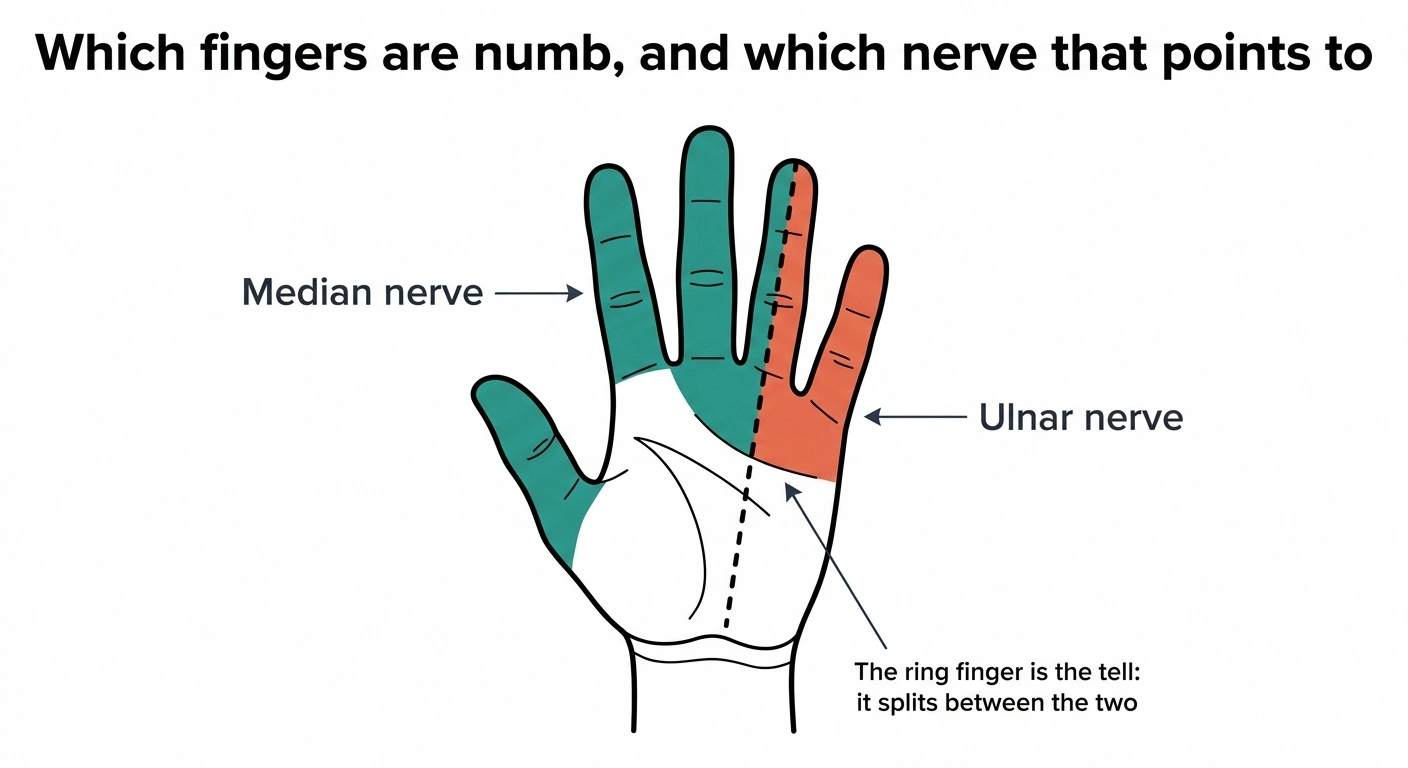
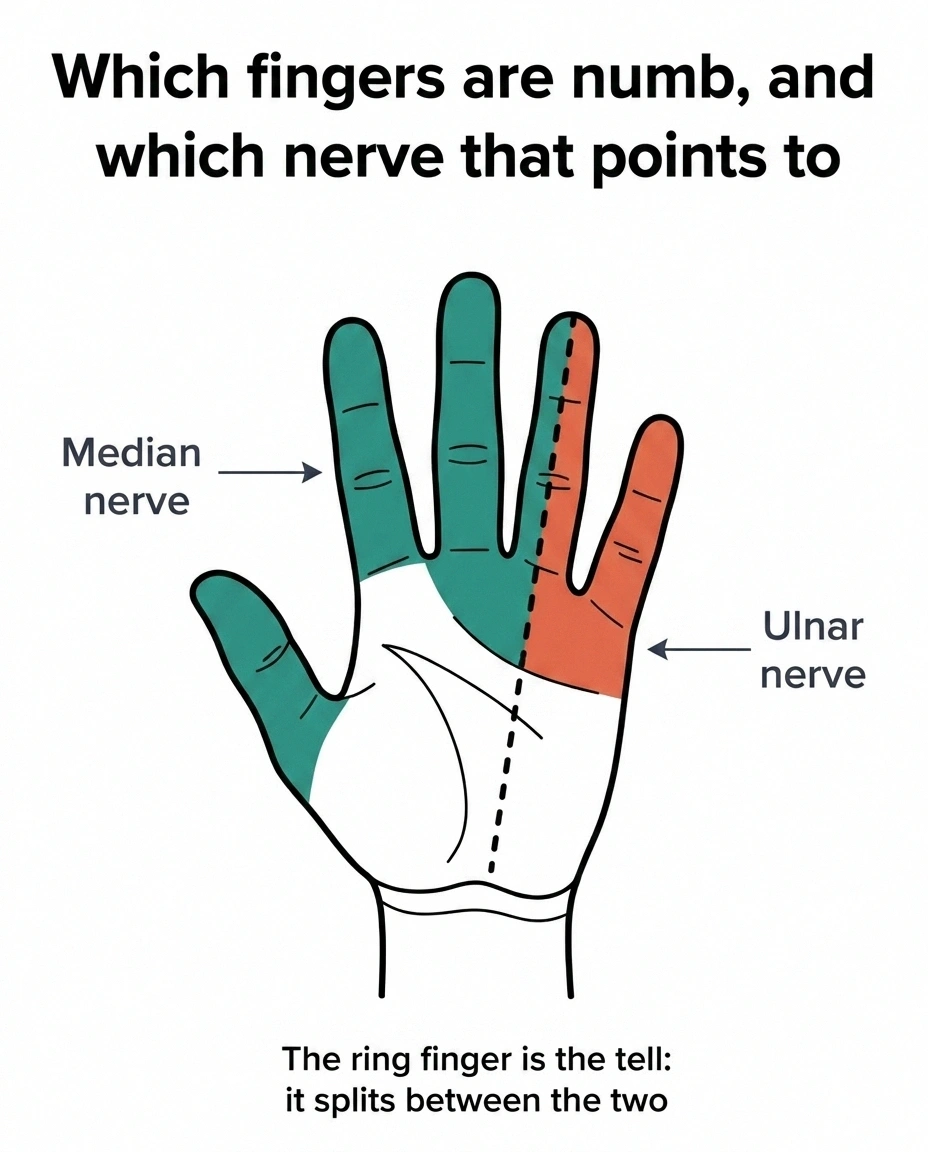
This is the single most informative thing you can notice, and it takes about four seconds.
Which fingers, and what it points to
- Thumb, index, middle, thumb-side half of the ring finger
- Median nerve territory. The carpal tunnel pattern, compressed at the wrist.
- Little finger and the outer half of the ring finger
- Ulnar nerve territory. Usually compressed at the elbow rather than the wrist, and often caused by sleeping with the arm folded.
- All five fingers equally, no split in the ring finger
- Fits neither single-nerve map. This is the pattern that raises the question of something affecting nerves broadly rather than one pinch point.
The ring finger is the tell. It is the only finger split lengthwise between two nerves, so noticing whether half of it is numb narrows things faster than anything else you can observe.
The median nerve serves the thumb, index finger, middle finger, and half the ring finger, split down the middle lengthwise. The ulnar nerve serves the little finger and the other half of the ring finger. Those territories are separate and reasonably consistent from person to person.
So the next time you wake up numb, before you shake it out, take note of what is actually numb.
Thumb side numb, little finger fine, points toward median nerve compression at the wrist. That is the carpal tunnel pattern.
Little finger numb, thumb fine, points toward ulnar nerve trouble, usually at the elbow. Our article on ulnar neuropathy covers that pattern in more depth.
The whole hand numb, all five fingers equally, including the little finger and the thumb, does not fit either single-nerve map. That pattern is more suggestive of something affecting the nerves broadly rather than one nerve at one pinch point, and it deserves more attention than the tidier patterns do.
The ring finger deserves its own note, because it is genuinely the tell. It is the only finger split between two nerves. If half of it goes numb and half of it does not, you are looking at compression of one specific nerve, which is reassuring in a way. Whole-hand numbness that ignores that boundary is the less tidy finding.
Question Two: One Hand or Both?

Positional compression is an accident of how you were lying. Accidents are usually one-sided, and they move around. The hand you slept on. Whichever arm ended up under the pillow. Different night, different hand.
Peripheral neuropathy is a different animal because it is generally systemic. Whatever is affecting the nerves, whether that is blood sugar, a vitamin shortfall, a medication, or an autoimmune process, is reaching both sides of your body equally. So it produces symmetrical symptoms. Both hands, in roughly the same distribution, to roughly the same degree.
Carpal tunnel can absolutely occur in both hands, so this test is not perfect on its own. But it is strong when combined with the others, and it is particularly strong when the two sides are truly equal. Bilateral carpal tunnel usually has a dominant worse side. Neuropathy tends to be more even-handed, in every sense.
Question Three: How Long Does It Take to Clear?
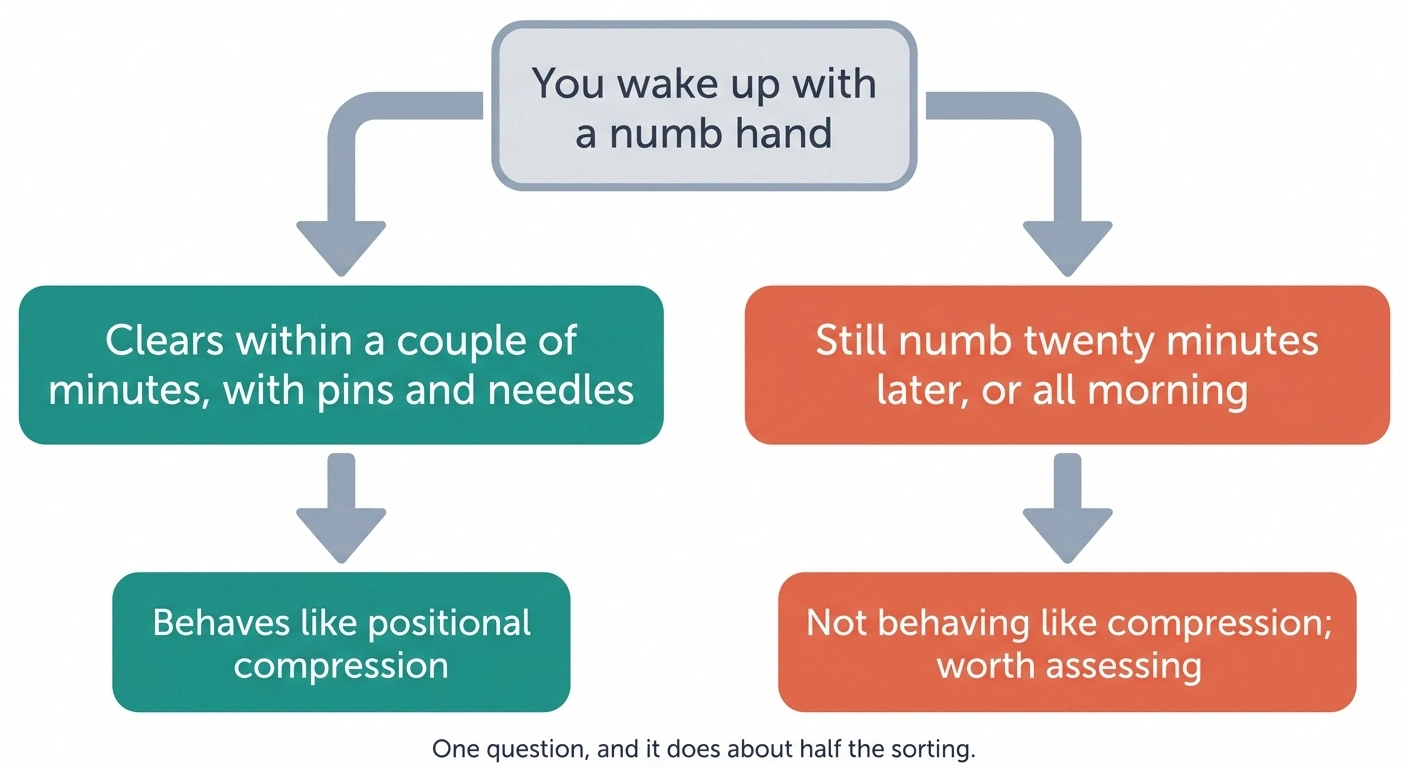
This one is my favourite because the answer is nearly binary.
Positional compression clears fast. You move the joint, blood and nerve conduction come back, you get the electric pins-and-needles rush that everyone recognises, and within a couple of minutes the hand is a normal hand again. The whole episode is over before you have properly woken up.
Neuropathy does not do that, because the numbness was never caused by a position. There is nothing to relieve. It fades slowly, or it does not fade at all, or it fades but leaves a baseline of altered sensation behind that is still there while you make the coffee.
So: gone in two minutes is one thing entirely. Still there twenty minutes later is a different thing entirely.
Half the useful information in this whole article is in that one comparison. If you take nothing else, take the clock.
Question Four: Does It Wake You, or Greet You?
There is a real difference between numbness that pulls you out of sleep and numbness that is simply present when the alarm goes off.
Compression usually wakes you. It builds while you lie still, reaches a threshold, and interrupts sleep, often at the same sort of hour each time. People describe it as waking to a hand that feels like it belongs to someone else, and it often comes with the urge to shake or hang the arm.
Neuropathy more often greets you. It was there when you fell asleep, in some form, and it is there when you wake, and it did not particularly disturb the night. It also has an unpleasant habit of being worse in the evening and at night for reasons that have nothing to do with position, which we went through in why neuropathy gets worse at night.
An important exception: carpal tunnel that has progressed far enough eventually stops being only a night problem and starts persisting into the day, at which point this question loses some of its power. That progression is itself a signal, and it is one of the clearer reasons to get it looked at rather than to keep adjusting pillows.
Question Five: What About Your Feet?
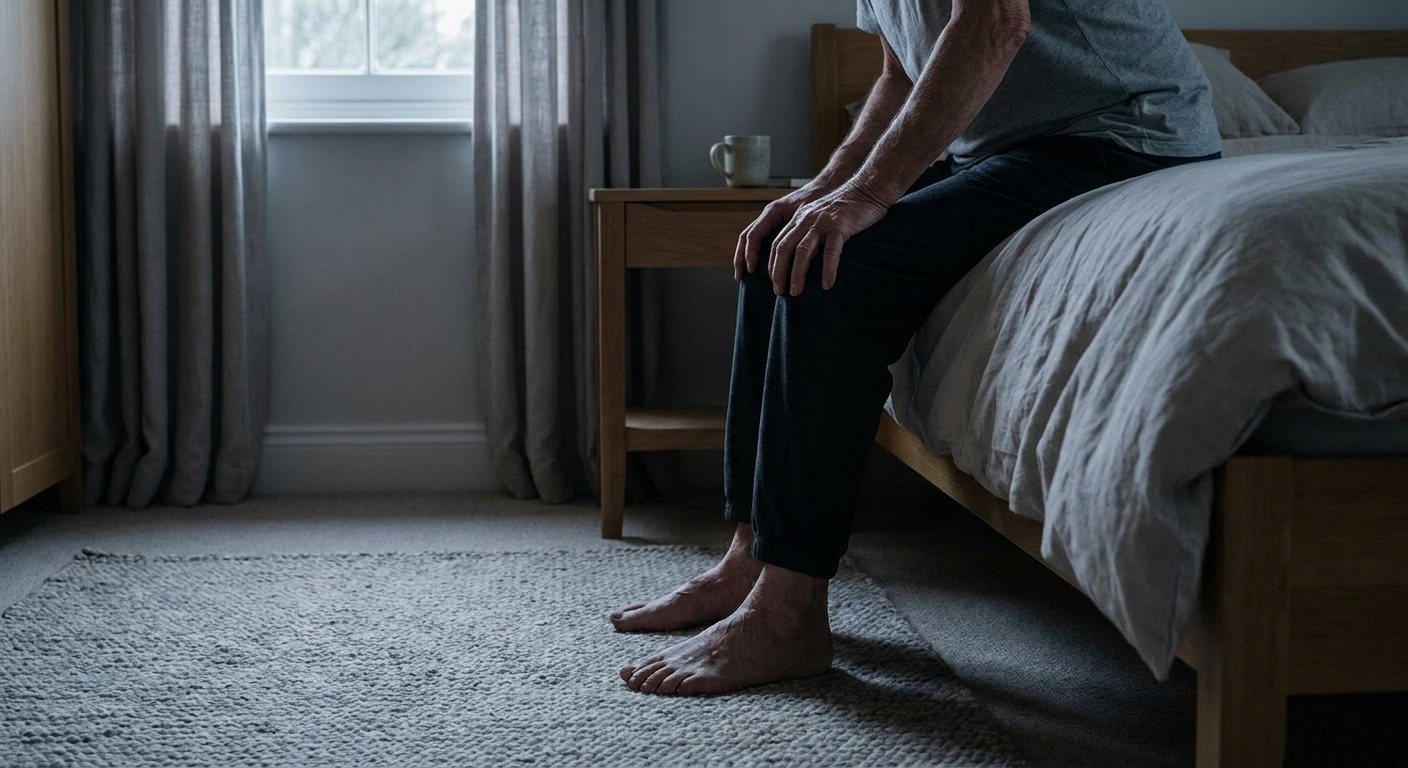
This is the question almost nobody thinks to ask themselves, and it may be the most decisive one on the list.
The five questions, side by side
No single row settles it. Four or five rows pointing the same direction usually does.
| Positional compression | Peripheral neuropathy | |
|---|---|---|
| Which fingers | Follows one nerve map; the ring finger splits | Whole hand, no respect for nerve boundaries |
| One hand or both | Usually one side, and it changes sides between nights | Both hands, roughly equally |
| Time to clear | A couple of minutes, with pins and needles on the way back | Slow, incomplete, or still there at breakfast |
| Timing | Wakes you, often around the same hour | Already there when you wake; did not disturb the night |
| The feet | Fine | Usually affected first, often for months or years |
Most peripheral neuropathy is length-dependent. It affects the longest nerves first, and the longest nerves in your body run to your feet. Which means that in the great majority of cases, the feet go before the hands. Burning, tingling, numbness, or a sense of walking on something that is not there, usually starting in the toes and creeping up.
By the time a length-dependent neuropathy is producing hand symptoms, it has usually been in the feet for a while, and often up to about the ankles or higher. That is the classic stocking-then-glove progression.
So if your hands go numb at night and your feet are entirely fine, generalised peripheral neuropathy becomes a good deal less likely as the explanation. Something local to the arm is a better fit. If both feet have been quietly odd for a year and now the hands are joining in, that changes the picture substantially, and our guide to neuropathy in the hands covers what that combination usually means.
There are exceptions, because there always are. Small fiber neuropathy does not always follow the tidy length-dependent rule. Some autoimmune neuropathies start in the arms. But as a first-pass sorting question in your own bed at 3 a.m., feet-or-no-feet is excellent.
The Things That Are Neither
Two other explanations sit outside the compression-versus-neuropathy frame and are worth knowing about, because they get missed.
Your neck. Nerve roots leave the spinal cord in the neck and travel down the arm. A compressed root there produces symptoms in the hand, and it can genuinely mimic carpal tunnel. The distinguishing features are usually neck involvement, pain or symptoms running down the arm in a stripe rather than starting at the hand, and a relationship to neck position. If turning or tilting your head changes what your hand feels, that is worth mentioning specifically.
Circulation. Reduced blood flow produces numbness too, and it comes with different companions: colour change in the hand, coldness, sluggish refill when you press a fingertip. Circulatory causes belong in the differential when symptoms are persistent or do not fit the usual patterns.
Neither is common as a cause of ordinary morning numbness. Both are worth naming out loud at an appointment, because they change what gets examined.
What to Try First, and How to Know If It Worked

If your five answers point toward positional compression, and for most people they will, there is a genuinely useful experiment available before you spend anything.
A two-week test that costs almost nothing
Three nights proves nothing. Night-to-night variation is larger than most people assume, which is why short trials keep producing false conclusions in both directions.
- Keep both wrists straight overnight, using an off-the-shelf splint if you cannot manage it otherwise.
- Stop sleeping with an arm folded under your head or pillow, especially if the little finger is involved.
- Each morning, write one word: numb, or not.
- Read the fourteen entries together at the end. Either result is useful, including no change, which is evidence to bring rather than a failure.
Keep your wrists straight at night. That is the entire intervention. A neutral wrist keeps carpal tunnel pressure low, and a wrist splint is simply a mechanical way of enforcing it while you are unconscious and cannot enforce it yourself. Inexpensive off-the-shelf ones are widely available.
Keep your elbows relatively straight too, particularly if your little finger is the affected one. Not being able to fold your arm up under your head is the point, not a side effect. Some people wrap a towel loosely around the elbow to make deep bending uncomfortable enough to avoid without actually restricting anything.
Then give it two weeks, and this is the part people skip. Two weeks is roughly what it takes to know, because night-to-night variation is large enough that three nights tells you nothing. Write down each morning whether you woke numb, in one word. Fourteen entries is data. A vague sense of whether things are better is not.
If splinting the wrists and straightening the elbows resolves it, you have both your answer and your treatment in one move. If two disciplined weeks change nothing at all, that result is also informative, and it is worth taking to your appointment as evidence rather than as a complaint. Our guide to sleeping with neuropathy covers the wider sleep-position question for people whose symptoms are not primarily positional.
When to Stop Experimenting
An occasional numb hand after an odd position is not a medical event. The pattern is what matters, and there are specific patterns that should end the home-experiment phase.
Weakness changes the timeline
Numbness is a sensory nerve complaining. Weakness means the motor supply is affected, and thinning of the fleshy muscle at the base of the thumb means it has been affected for a while. That is the point at which continued waiting carries a real cost rather than just an inconvenience.
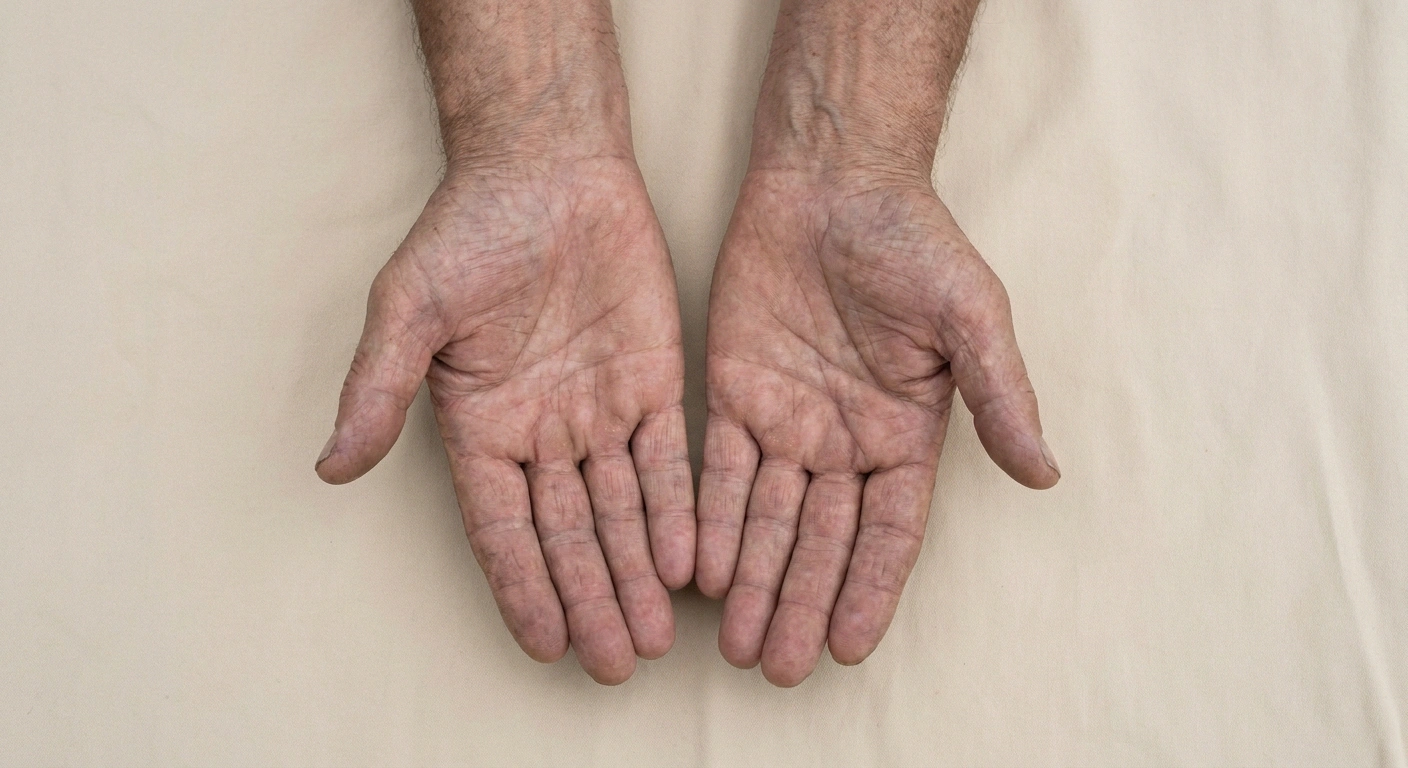
Practical check: hold your two hands palm-up side by side in good light and compare the pad at the base of each thumb. A visible difference between them is worth mentioning specifically at your next appointment.
Numbness waking you repeatedly, most nights. Numbness that persists into the daytime rather than clearing. Frequency that is clearly increasing over months. Any weakness, meaning dropping things, trouble with buttons or jar lids, or a grip that has changed. Visible thinning of the muscle at the base of the thumb. Symptoms in both hands and both feet. And no improvement after two honest weeks of positioning changes.
Weakness and muscle wasting are the ones to take most seriously, because they mean a nerve has been compressed long enough to affect the muscle it supplies, and that is the situation where waiting has a real cost.
What happens next is usually straightforward: an examination, a set of questions much like the five above, and often a nerve conduction study, which measures how fast and how strongly signals travel and can localise a compression to a specific spot. It is the test that separates a pinched median nerve at the wrist from a generalised neuropathy with reasonable confidence, and our overview of how neuropathy is diagnosed explains where it fits in the wider workup. If your case turns out to sit on the boundary between the two, our comparison of carpal tunnel and peripheral neuropathy goes deeper into telling them apart, and they can coexist in the same person, which is a genuine and underappreciated complication.
The Short Version

Most morning hand numbness is a wrist or an elbow that got leaned on for two hours. It respects one nerve territory, it is usually one-sided, it clears in minutes, it wakes you, and your feet are fine.
Take the other pattern seriously: both hands equally, all the fingers rather than a nerve map, slow to clear or never fully clearing, present on waking rather than waking you, and feet that have been telling you something for a while.
Spend two weeks on straight wrists and straight elbows before you spend anything else. If that fixes it, wonderful. If it does not, you will walk into your appointment with fourteen mornings of evidence and five specific observations, which is considerably more than most people arrive with.
Frequently Asked Questions
Why do my hands go numb when I sleep?
Most often because a nerve is being compressed by the position you are lying in, or because blood flow to the hand is reduced. Many people sleep with their wrists bent, which raises pressure inside the carpal tunnel and compresses the median nerve for hours, and sleeping with the elbow folded stretches the ulnar nerve in a similar way. Asleep, you do not shift position the way you would while awake, so the pressure stays on long enough to interrupt nerve conduction.
How can I tell if it is carpal tunnel or neuropathy?
Look at which fingers are affected and how quickly the numbness clears. Carpal tunnel follows the median nerve territory, meaning the thumb, index, middle and half the ring finger, and it usually clears within a few minutes of moving the hand. Generalised peripheral neuropathy tends to affect both hands equally, does not respect a single nerve map, clears slowly or incompletely, and in most cases has already been affecting the feet for some time.
Which sleeping position causes numb hands?
Positions that bend the wrist or the elbow for long periods are the main culprits. Stomach sleeping is associated with nerve compression, partly because of how the arms tend to be placed. Side sleeping with the wrists kept straight is generally the least likely to produce numbness, though tucking an arm under the pillow can still compress the ulnar nerve at the elbow.
How long should numbness take to go away?
Numbness from positional compression typically resolves within a couple of minutes once you move and shake the hand, usually passing through a burst of pins and needles on the way. Numbness that is still present twenty minutes later, or that persists into the day, is not behaving like simple compression and is worth having assessed.
Do wrist splints actually help?
For numbness caused by wrist position at night, keeping the wrist in a neutral straight position is the whole objective, and a splint is simply a way of maintaining that while you are asleep and cannot control it. Give it about two weeks and record each morning whether you woke numb, because night-to-night variation is too large to judge from a few nights.
Can numb hands at night mean something serious?
Occasional numbness after an awkward position is usually harmless. The findings that warrant prompt attention are weakness such as dropping things or struggling with buttons and jar lids, visible thinning of the muscle at the base of the thumb, numbness that persists into the daytime, symptoms in both hands and both feet together, and a pattern that is clearly worsening over months.
Can neck problems cause numb hands at night?
Yes. The nerves supplying the hand originate as roots leaving the spinal cord in the neck, and compression there can produce hand symptoms that resemble carpal tunnel. Clues that point toward the neck include neck pain or stiffness, symptoms running down the arm in a stripe rather than being confined to the hand, and symptoms that change when you turn or tilt your head.
Can I have both carpal tunnel and peripheral neuropathy?
Yes, and this combination is more common than people expect, particularly in those with diabetes. Nerves already affected by a generalised neuropathy appear to tolerate compression less well, so the two can occur together and the symptoms overlap. Nerve conduction testing is generally what sorts out how much of the picture is coming from each.
About the Author