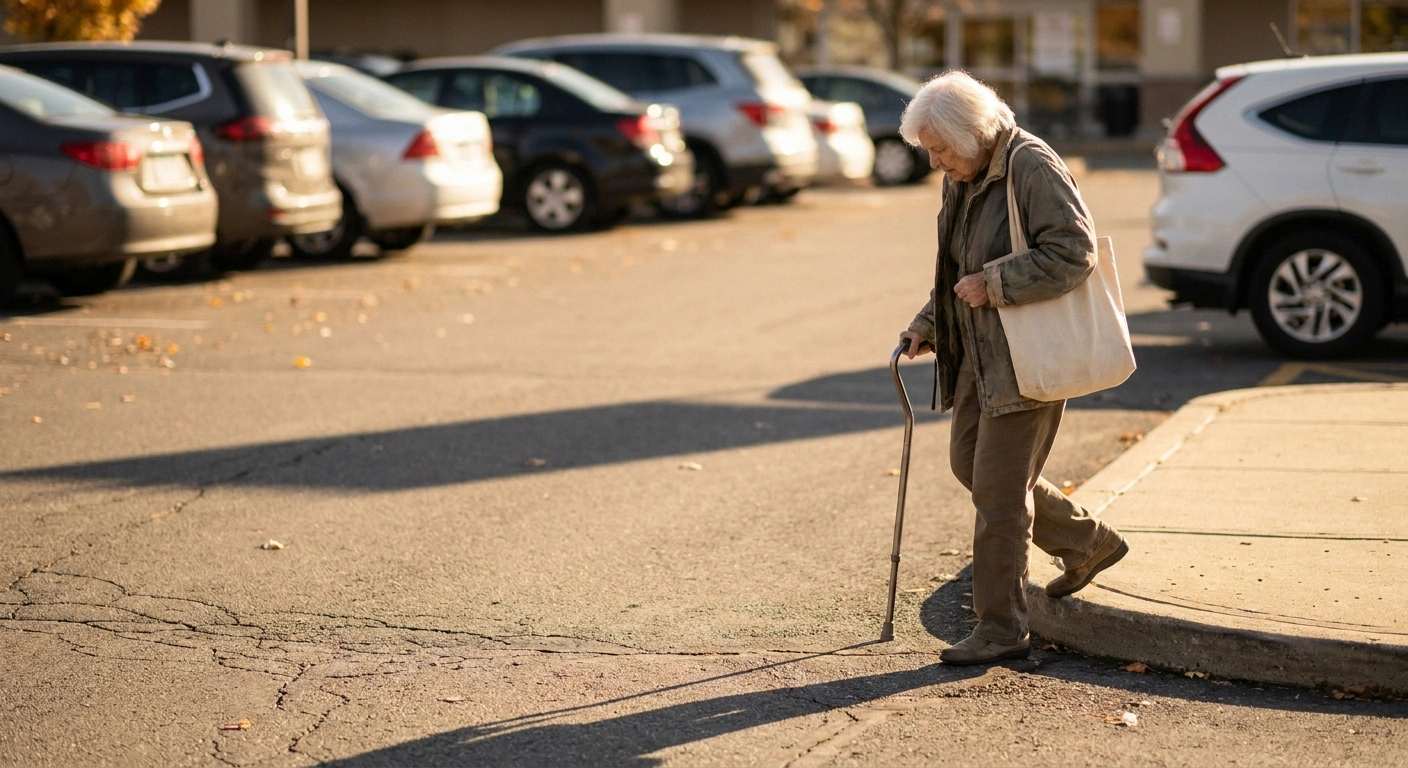
Count them sometime. Between your car door and the store's sliding doors there's usually a painted stripe, a concrete parking block, a seam or two in the asphalt, a drive lane full of people backing out, a curb, and a stray cart drifting in the wind. Most shoppers never notice any of it. With numb feet, I notice every one of them — usually half a second too late.
Parking lots are odd little places. They aren't sidewalks, so many of the rules that keep sidewalks smooth don't reach them. They aren't roads either, so most of the crashes that happen in them never show up in the national traffic counts. And they're where nearly every errand starts and ends — often with a purse on one shoulder, a cane in one hand and drivers around us who are hunting for a space instead of watching for people on foot.
So let's walk it together, from the parking space to the door and back. The facts come from the NIDDK (part of the National Institutes of Health), CDC researchers, the National Highway Traffic Safety Administration (NHTSA), the Justice Department's ADA design standards, and a University of Michigan team that tested people with neuropathy on rough, dimly lit walkways. Where something is just my own habit, I'll say so. Rules and figures are as current as I could make them in October 2026, and this is practical background, not legal or medical advice.
Why Asphalt Asks More of Numb Feet
First, some perspective. In a Boston study that followed 765 older adults, mostly 70 and up, parking lots were the setting for 6% of the 524 outdoor falls people reported — well behind sidewalks (23%), yards or gardens and streets or curbs (14% each), and outside stairs (13%). A Northern California study of adults 45 and older found the same theme: 73% of outdoor falls were set off by the surroundings, such as uneven surfaces or tripping or slipping on something. And the people most likely to fall outdoors weren't the frailest. They tended to be the more active, healthier ones. They called for fixing the ground: repairing uneven surfaces, clearing debris, adding ramps and painting curbs. Until the property manager at your grocery store gets that memo, the job is ours, and neuropathy makes it a harder job.
The NIDDK puts the core problem plainly: “Peripheral neuropathy can make you more likely to lose your balance and fall, which can increase your chance of fractures and other injuries.” Its list of symptoms also includes “problems sensing movement or position,” and it warns that when your feet lose feeling, you may not notice the pressure or small injuries that turn into blisters and sores.
Rough Ground, Dim Light
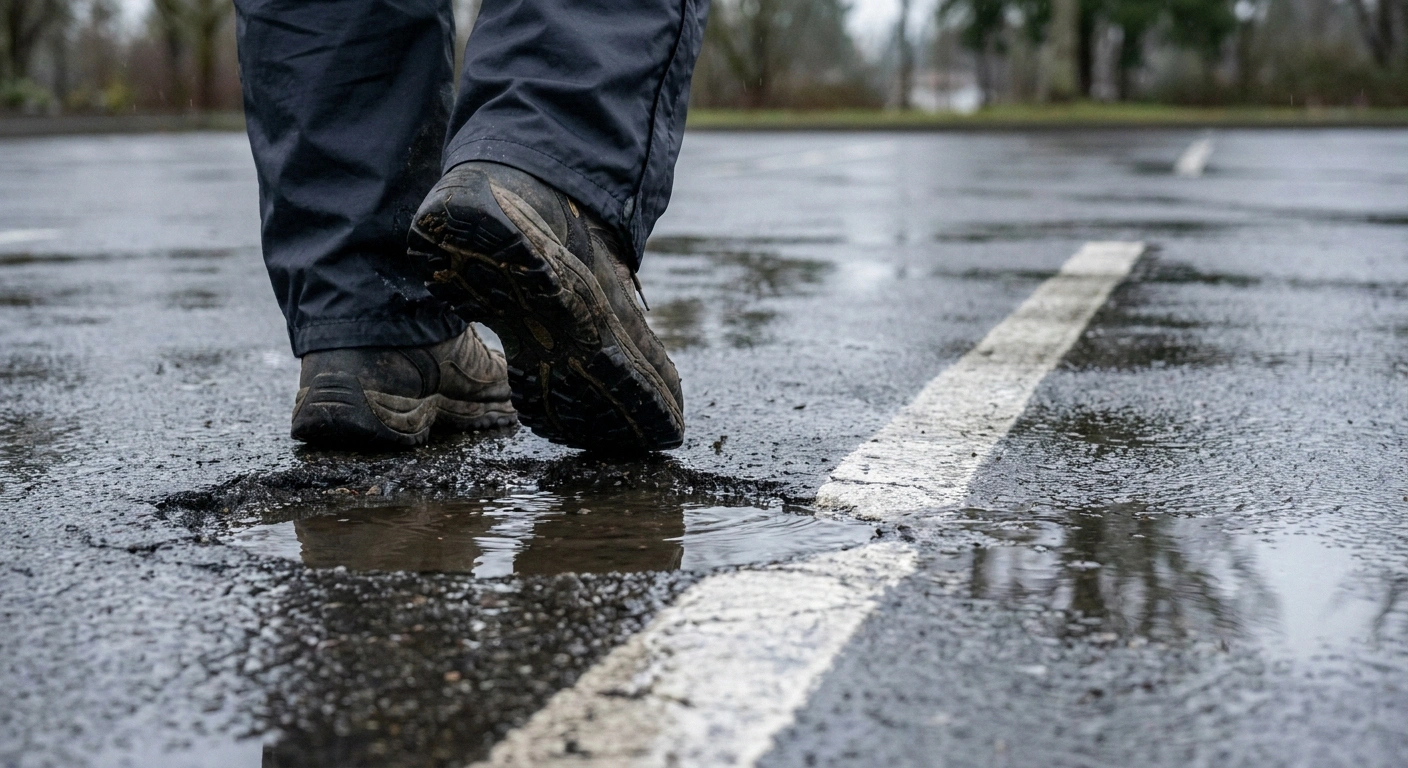
The Michigan research is what made me take the lot seriously. In a 2005 study of 42 adults with neuropathy (average age around 65), walking on an irregular surface in low light made their steps noticeably less consistent from one stride to the next. A companion study compared people who'd fallen in the past year with people who hadn't. On a smooth, well-lit walkway, the two groups walked the same way. Only on the rough, dim walkway did the fallers stand out. Then the same team followed 20 older adults with neuropathy for a full year. Thirteen of them fell. Of the 76 falls the group logged, 69 involved a surface that was irregular or slick.
Those are small studies, and none of those falls was traced to a parking lot in particular. But think about what a lot actually is: patched asphalt, raised seams, painted stripes, gentle slopes built in for drainage, and long stretches lit by a few tall poles. It's that rough, dim walkway — with cars added.
Where You Park Decides Half the Walk
The most useful patch of pavement in the whole lot may be the striped strip beside the accessible spaces. The 2010 ADA Standards for Accessible Design, which apply to newly built or altered lots at businesses and at state and local government buildings, say accessible spaces “shall be located on the shortest accessible route from parking to an entrance.” The striped access aisle beside each one has to be at least 60 inches wide, run the full length of the space and sit nearly level with it, with no curb ramp poking into it. The rules also say “Access aisles shall be marked so as to discourage parking in them.” ADA.gov explains why: “Access aisles provide a designated area for people who use wheelchairs or other mobility devices to get in and out of their car or van.” Its list of those devices includes walkers, canes, crutches and braces.
- Car space
- At least 96 inches wide, with an access aisle of at least 60 inches that runs its full length. Two spaces may share one aisle.
- Van space
- 132 inches wide beside a 60-inch aisle, or 96 inches wide when the aisle is also 96 inches. The space, its aisle and the driving route to it need at least 98 inches of headroom, and the sign must say the space is van accessible.
- Slope
- No steeper than 1:48 in the space or the aisle, roughly a 2 percent grade, so a wheelchair can transfer on level ground.
- Medical buildings
- At least 10% of patient and visitor parking must be accessible at hospital outpatient facilities, and 20% at outpatient physical therapy facilities. Ordinary doctors' offices follow the same table as any other business.
- Paint and penalties
- The federal rules require aisles to be marked but leave the color, the signs and the enforcement to state and local law.
Flat, wide, no curb edge, nobody allowed to park in it — that's exactly the ground I want under me when I push up out of a car seat. The standards add: “Where possible, it is preferable that the accessible route not pass behind parked vehicles.”
Picking Your Spot
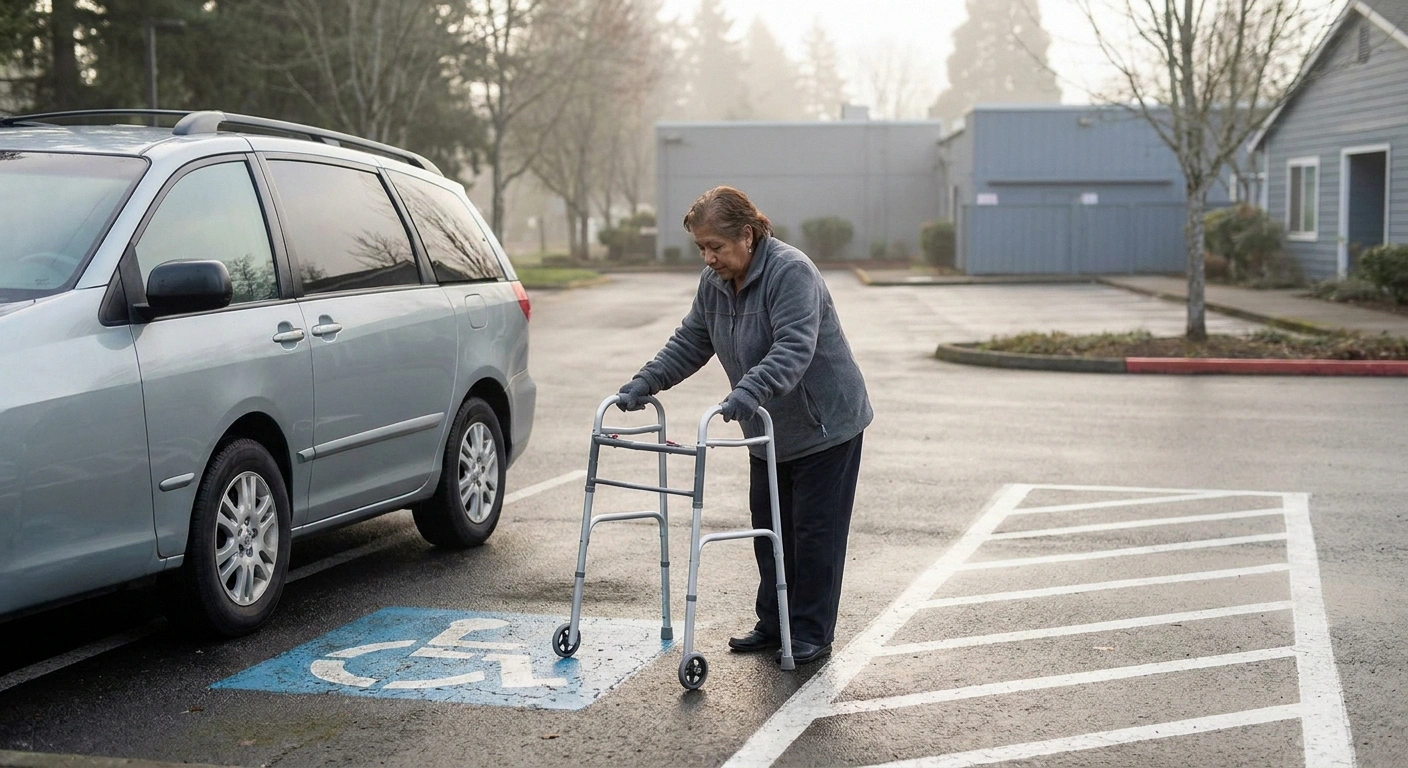
Wherever you end up parking, you can tilt the odds. These are my own habits, not rules:
- Pick a pull-through space, so you can leave driving forward instead of backing into a busy lane.
- Park near a cart corral, so the cart's trip home is short.
- Choose a space under or near a light pole whenever there's any chance you'll come out after dark.
- Look for a space along the edge of the lot, where the path to the door doesn't cut behind rows of parked cars.
- Skip the space beside a tall pickup or van. You can't see around it, and a driver backing out of it can't see you.
If you do have a disability placard, use it, and use it without apology. Our page on getting a disability parking placard covers who qualifies and how to bring it up with your doctor.
Getting Out Is the Harder Half
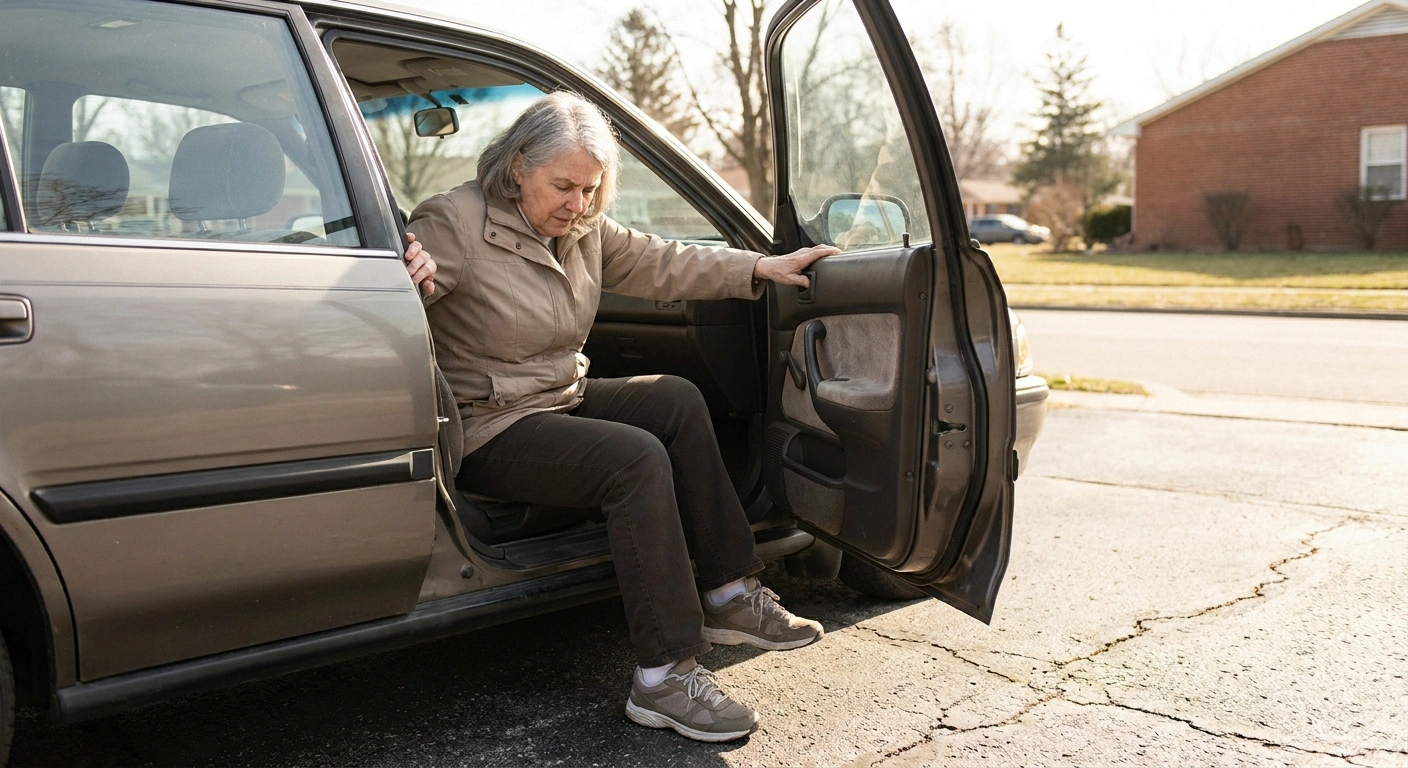
CDC researchers who studied emergency room records from 2001 to 2003 estimated that about 37,000 older adults a year were treated for injuries getting into or out of a vehicle, and 41.3% of those injuries came from falls. Falls while getting out outnumbered falls while getting in by about two and a half to one. A newer look at 2017 to 2021 records, published in 2025, found the injury rate for adults 65 and older was roughly double the rate for younger adults, and older people were about five times as likely to end up admitted to the hospital. Fractures were the most common injury in the older group. Those counts include parking lots and driveways along with streets.
| Emergency room data | What the researchers found |
|---|---|
| 2001 to 2003 | Fall injuries while getting out: about 11,030 a year. While getting in: about 4,346. |
| 2017 to 2021 | 107.6 injuries per 100,000 people aged 65 and older, against 54.51 for younger adults. |
| 2017 to 2021 | Admitted to the hospital: 21.3% of older patients and 3.9% of younger ones. Fractures made up 26.9% of the older group's injuries. |
Sources: Dellinger and colleagues (CDC), Journal of the American Geriatrics Society, 2008; Zhang and colleagues, Innovation in Aging, 2025. Both count injuries anywhere a person boards a vehicle, including driveways and parking lots.
Picture it and it makes sense. Getting in, you lower yourself onto a seat. Getting out, you push up from a low, soft seat onto ground you can't feel and haven't looked at yet, often while twisting, sometimes while holding something. Car doors aren't kind to numb fingers either — a federal tally from 2007 estimated 148,000 injuries a year from closing doors, across all ages.
Here's the sequence I've settled on. Before I stand, I look down. That's honestly the whole trick. I open the door all the way, swing both feet out onto the pavement and actually look at where they landed: a crack, a curb edge, a puddle, the painted end of a parking block. Then I put a hand on the door frame or the seat back rather than the door itself, because a door can swing. I stand, and I wait through a slow count of three before my first step. If I feel dizzy or weak, I sit right back down. Last of all, I check that my fingers are clear before the door closes.
A small study published in 2016 interviewed 18 older drivers and found that people work out their own footwork routines for getting in and out of the car. If yours feels shaky, a physical or occupational therapist can build one with you and let you practice it in a parked car.
Summer adds one more catch. The National Weather Service says “a dark dashboard or seat can easily reach temperatures in the range of 180 to over 200°F.” Pavement bakes too, and the NIDDK's foot-care advice is to “Wear shoes at the beach and on hot pavement,” because with nerve damage “you may burn your feet and not know you did.” I never kick my shoes off for a drive. And I don't trust my fingers on a sunbaked seat-belt buckle; I drape a cloth over it or let the car cool first, a habit of mine, since nobody publishes buckle temperatures.
Curbs, Parking Blocks and the Cracks Between
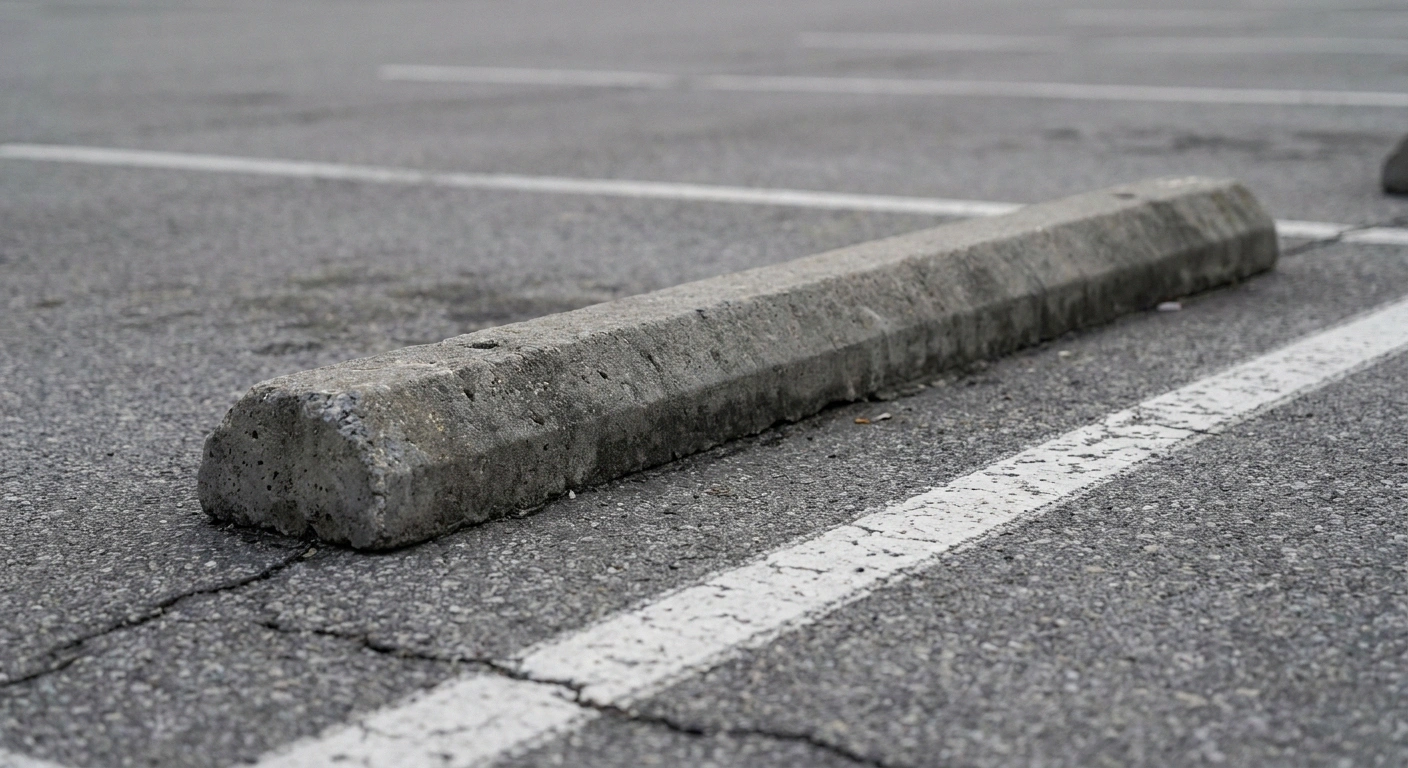
Those low concrete bars at the head of a parking space have a real purpose. The ADA standards explain that “Wheel stops are an effective way to prevent vehicle overhangs from reducing the clear width of accessible routes.” In plain English, they keep bumpers from jutting out over the walkway. The trouble is that they sit low, they're often gray on gray asphalt, and they're right about the height a numb toe drags into. I couldn't find any federal count of falls over them, so here's simply what I do. I walk around the end of a wheel stop when there's room, and when there isn't, I stop, look, and step over it on purpose. I never step up onto one — the tops are narrow and often crumbling.
Curbs get the same respect. I'll use the curb ramp whenever there is one, even if it's a few steps out of the way. When there isn't one, I square up to the edge, pause, and step down one foot at a time, the same way I'd take a single stair.
The federal design rules for the accessible parts of a lot are stricter than most people realize. Ground there must be “stable, firm, and slip resistant,” and even a half-inch lip is supposed to be beveled or ramped. The Justice Department's guidance says “An accessible route never has curbs or stairs,” and the U.S. Access Board adds that “Transitions to these areas from other portions of lots should be smooth to prevent tripping hazards.” Those rules cover accessible spaces, aisles and routes, though, not every corner of the lot. Out in the rows, the patched seams and heaved slabs are on us.
A few more things I watch for, from experience rather than any study: puddles that hide how deep a pothole goes, painted stripes and oil spots that can turn slick in the rain, wet leaves this time of year, and the slope toward the storm drain that tilts the middle of so many lots. Shoes matter more out here than almost anywhere else, so our page on shoes with good grip and support is worth a look. If you walk for exercise, the same eye for surfaces runs through our guide to picking smooth, well-lit walking routes.
One more Michigan finding belongs here. In a 2004 study of 42 people with neuropathy walking a rough, dim walkway, a straight cane, semirigid ankle braces or simply touching a wall all made their steps more regular. (Braces need proper fitting, and numb skin under one needs regular checks for rubbing.) Plenty of us steady ourselves with a hand on a parked car. I do it too, lightly. But a car isn't a wall. It can move, so I never trust one with my full weight.
Cars That Back Up Without Seeing You
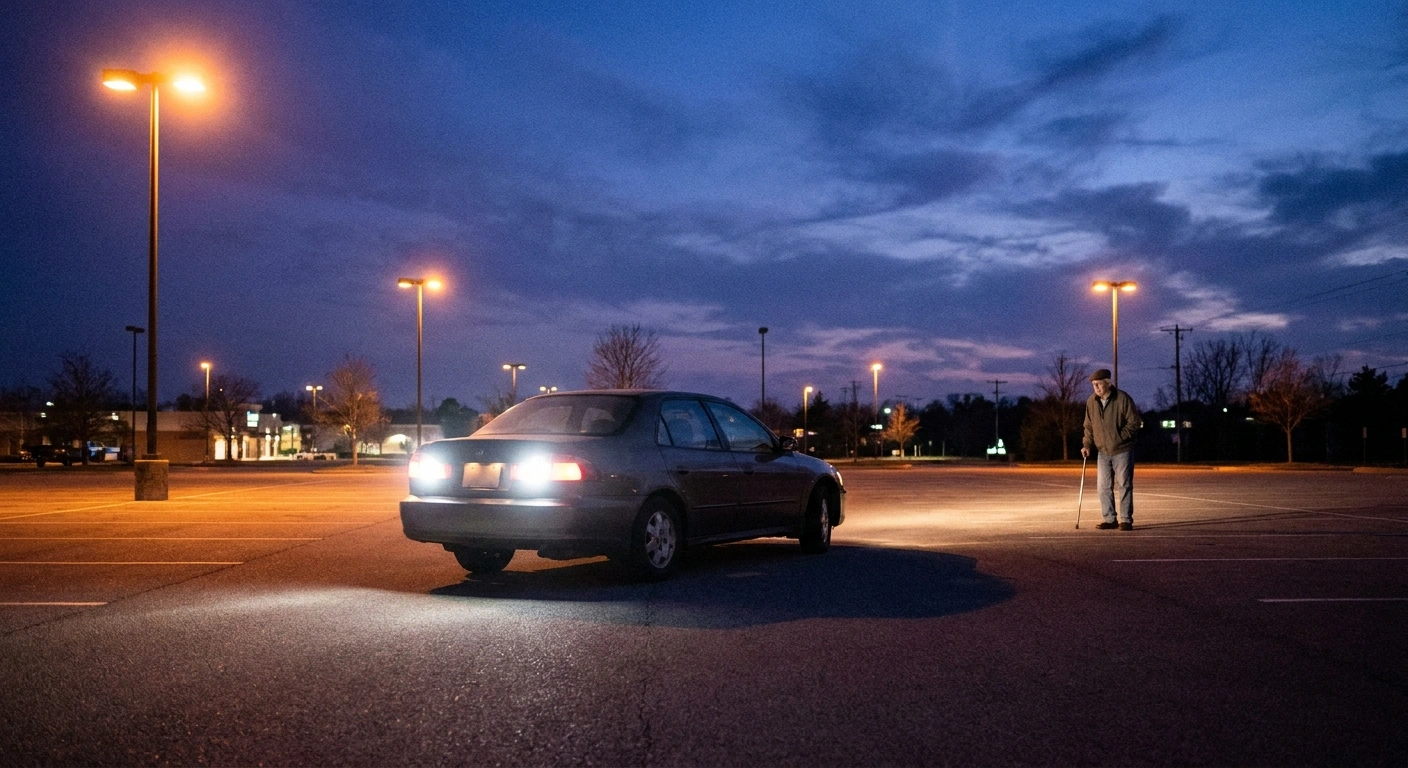
A 2008 NHTSA report to Congress, built from mid-2000s data, estimated 292 deaths and 18,000 injuries a year from backovers, meaning a driver reversing into someone on foot. Adults 70 and older were badly overrepresented among the people hurt and killed. NHTSA offered one likely reason: for an older person, a bump from a slow-moving car “may result in a fall and a broken bone.” And a little over half of all backover injuries happened in nonresidential parking lots, the big lots at shopping centers, grocery stores and discount stores.
| Adults 70 and older | 26% of backover deaths and about 18% of injuries, while making up 9% of the population |
| Store and business parking lots | About 52% of backover injuries and 17% of deaths |
| Driveways | 24% of backover deaths, the largest single setting |
| Off-road crashes in 2015 | Backing vehicles killed an estimated 284 people on foot or bike (34% of such deaths) and injured about 12,000 (40%) |
Sources: NHTSA, Fatalities and Injuries in Motor Vehicle Backing Crashes, Report to Congress, 2008 (built on mid-2000s data, before the rearview-image rule); NHTSA, Non-Traffic Surveillance: 2015 data, published 2018.
Most of these crashes never reach the national pedestrian statistics, which are built around public roads. NHTSA counts them in a separate system. For 2015, it estimated 2,125 deaths in crashes off public roads, in places like driveways and parking facilities.
Backup cameras help, but they're no guarantee. Under federal safety standard FMVSS No. 111, cars and other light vehicles of 10,000 pounds or less built on or after May 1, 2018 must show a rearview image within 2.0 seconds of the driver starting to back up. Plenty of cars on the road were built before that. And when the Insurance Institute for Highway Safety analyzed backing crashes in 2018, mostly cars backing into other cars, cameras alone made only a small dent that wasn't statistically significant. The big drop, more than 75 percent, came from vehicles that combined a camera and sensors with automatic braking in reverse.
So I take NHTSA's reminders literally: “Never assume a driver sees you,” and “Make eye contact with drivers as they approach.” My own add-ons: watch for white reverse lights, listen for an engine starting, give a wide berth to any parked car with someone in the driver's seat, and walk where drivers can see me coming rather than squeezing out from between two parked cars.
A Cart Can Steady You, Until It Rolls
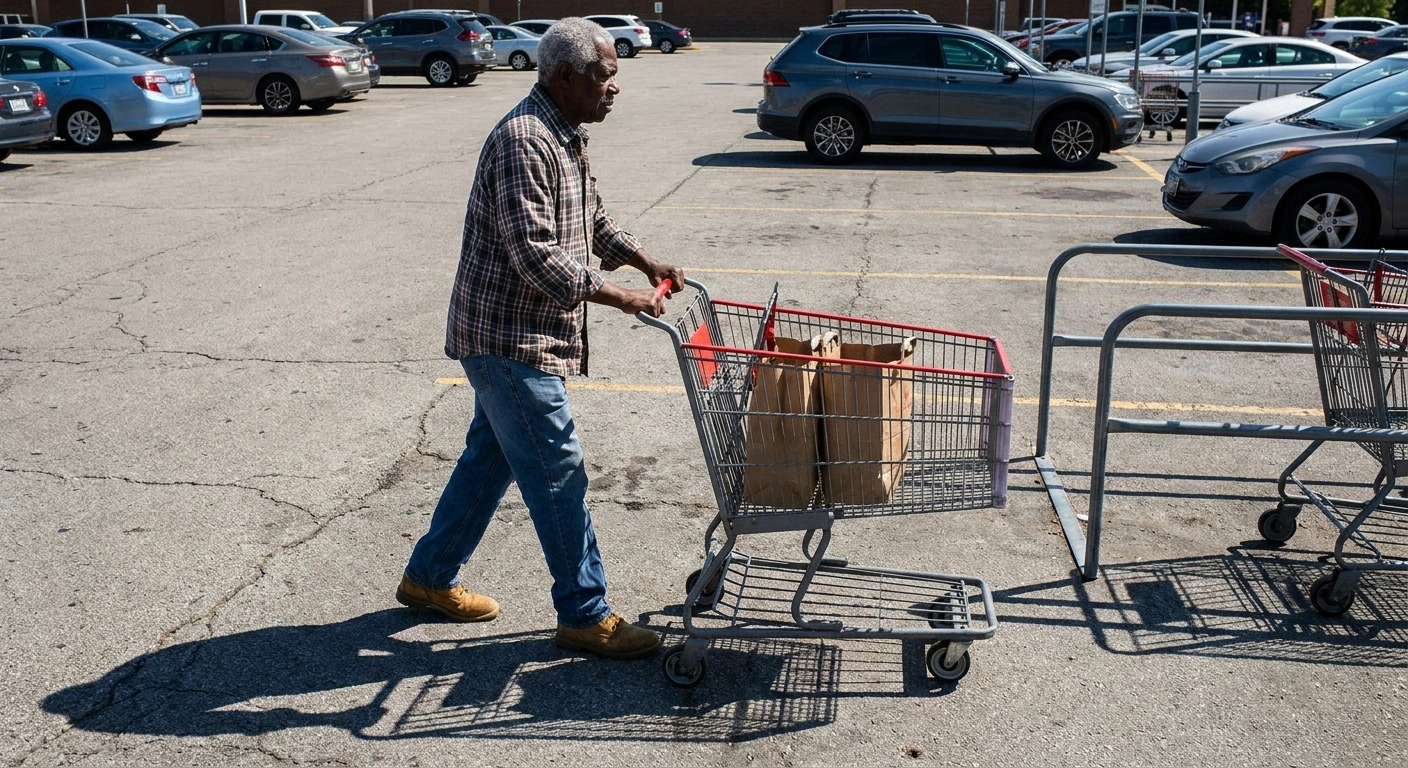
Plenty of us use a shopping cart as a sort of walker on wheels. But in fairness, I couldn't find a single study that tested carts as walking aids, and ADA.gov's list of mobility devices doesn't include them. A cart has no brakes, and on the gentle slope of a parking lot it will happily roll off with your groceries — or pull you along with it. If you truly need support to walk, a cart is no stand-in for a fitted cane or rollator.
Cart injuries aren't only a children's problem, either. CPSC staff counted an average of 20,332 emergency room visits a year from cart injuries to children under five between 2003 and 2008, mostly falls out of the cart, which is worth knowing if you shop with a grandchild. But an analysis of national emergency room data from 2000 to 2023, published in Lower Extremity Review, found that 38.0% of 828,254 cart-related injuries involved adults 20 and older. Among the leg and foot injuries, about one in five came from a fall, trip or slip involving a cart, and roughly one in nine from being run over by one.
My cart routine goes like this. Both hands on the handle, and the cart close to my body, never out at arm's length. I take it all the way to the car, then nose it against a curb, a light-pole base or the side of my car so it can't roll while I load. If the corral is close, I push the empty cart there. If it's far, or the wind is up, I ask for help. Many stores will carry groceries out if you ask, though I couldn't confirm that any store is required to, so ask at the register before you check out. Our grocery shopping guide covers the inside-the-store half of the trip.
Canes, Rollators and the Car Trunk
If you already use a cane or a rollator, bring it, even for a quick stop. The Michigan lab work found a cane did the most good in exactly the conditions where lots are at their worst: uneven footing and low light.
Between 2001 and 2006, an estimated 47,312 adults 65 and older a year were treated in U.S. emergency rooms for falls involving a walking aid. Walkers were involved in 87.3% of those falls and canes in 12.3%, and about one patient in three was admitted to the hospital.
Walker users tend to be frailer to start with, so this doesn't show that walkers cause falls. The CDC authors said more research is needed to improve walking-aid design, and the practical lesson is to have the height set and to practice curbs and car doors with a therapist before you rely on the aid in a busy lot.
Walking aids aren't magic, though. CDC researchers have counted tens of thousands of older adults treated in emergency rooms each year for falls involving walkers or canes. That doesn't mean walkers are dangerous, since the people using them were often frailer to begin with. It means fit and practice matter. A physical therapist can set the height and walk you through curbs before you meet one in a busy lot.
Two trunk tips from my own trial and error. Lock the rollator's brakes before you lift anything into or out of the trunk. And park your cane where you can reach it from the driver's seat before you stand up, not leaning against the bumper. Our page on using a rollator safely goes deeper on brakes, curbs and seat height.
When the Clocks Fall Back
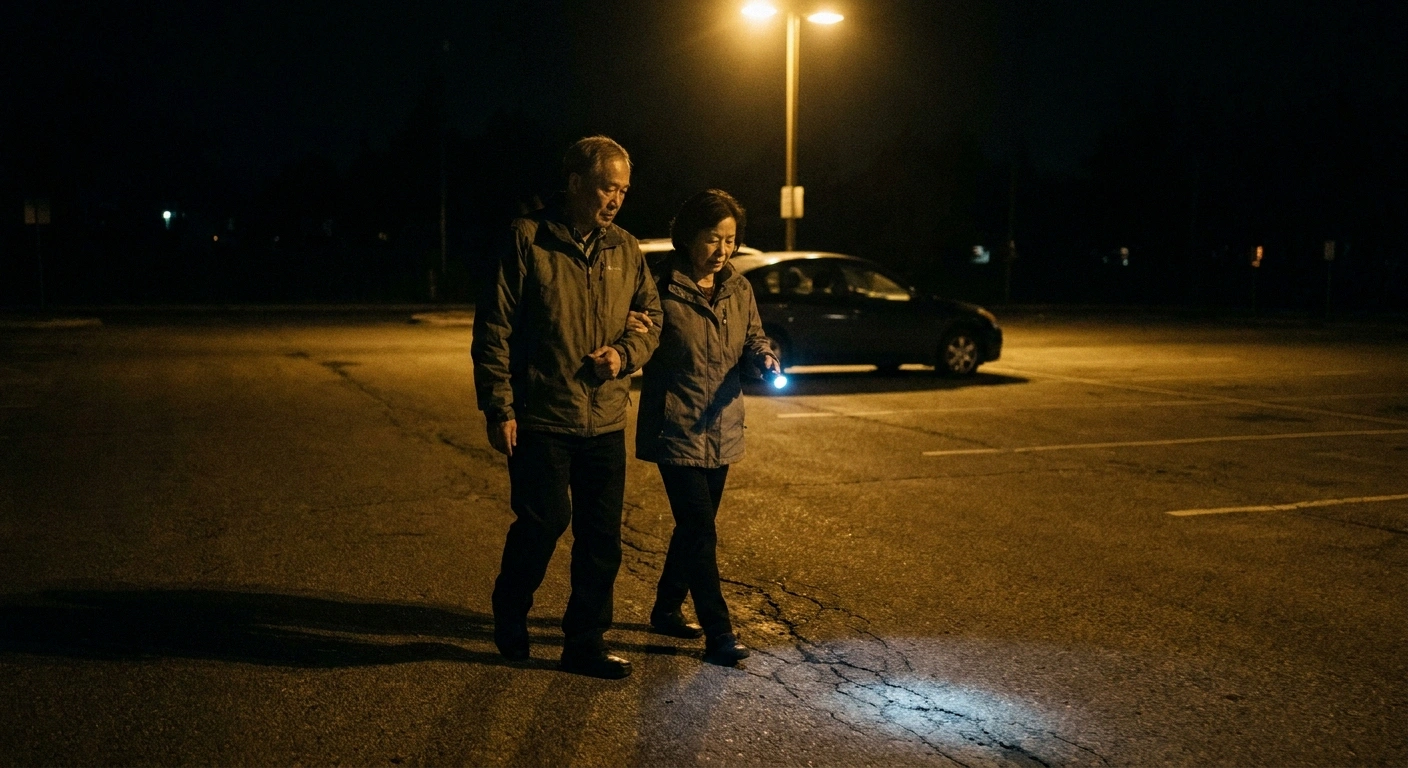
Mark your calendar: according to NIST, daylight saving time ends at 2 a.m. on Sunday, November 1, 2026, in the places that observe it. Overnight, the after-supper grocery run happens in the dark.
NHTSA's 2024 figures, published in June 2026, show why that matters. Of the pedestrians killed in traffic crashes that year, 76% died in the dark, and during the fall months, 29% of those deaths happened between 6 and 8:59 p.m. Those figures cover public roads rather than most parking lots, but darkness doesn't get friendlier when you step off the street.
There's a reason darkness hits us so hard. When your feet go quiet, your eyes quietly take over their job. In an older lab study from the Michigan team, eight people with neuropathy and eight matched volunteers stood on a platform that tipped beneath them. Taking away vision — which the researchers likened to the dark of night — made balance failures about four times as common, and a cane significantly cut the risk of losing balance, especially in low light. That was a lab balance test, not a count of real-world falls. Still, it matches what so many of us feel crossing a lot at dusk. Our page on losing your sense of where your feet are explains the body side of all this.
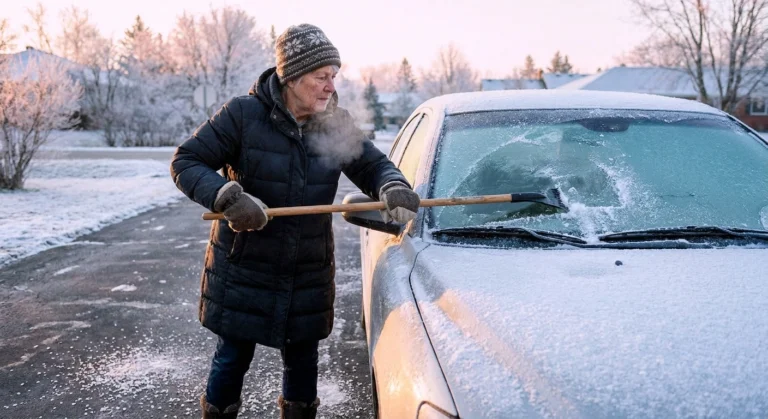
My fall and winter habits are simple. I shop before dusk when I can, park under a light, and keep a small flashlight in my coat pocket; NHTSA's own reminder is to wear reflective materials or “use a flashlight at night.” Light-colored clothes help too. When the first frosts arrive, the walk around the car brings its own problems, and our guide to frosty mornings at the car covers footing, frostbite and the windshield itself. For the boots, the NIDDK's foot-care page recommends lined, waterproof ones in winter.
If You Go Down Between the Cars
Nobody plans this part, so let's plan it now. There's no official step-by-step I could quote for you here, so treat these as one advocate's tips. Don't rush to stand up. Take a breath, check whether anything hurts or looks wrong, and call out or phone for help if you need it. Get up only if you feel able, and if a physical therapist has taught you a way to get up from the ground, use that method. General safety advice, not from the studies above: a knock to the head, a leg that won't hold you, heavy bleeding, feeling faint, or being on a blood thinner means getting help now.
- Look even if nothing hurts. The NIDDK warns that numb feet can have real problems you simply don't feel.
- Can't bend that far? The NIDDK's suggestion: “try using a mirror to see them, or ask someone else to look at your feet.”
- Turn your hands over too. Palms and fingertips take the brunt when you catch yourself, and numb fingers can miss a scrape.
- Jot down the date, the spot and what tripped you, so the details are fresh when you bring it up at your next visit.
Then, even if nothing seems hurt, look at your feet and hands as soon as you're home, and again that evening. Numb skin can hide a scrape or a bruise for days, and I don't sit on a cut, blister or swelling that looks angry; I get it seen. The NIDDK's reminder is simple: “A good way to remember is to check your feet each evening when you take off your shoes.” Our daily foot check page shows how to make it a habit.
And tell someone. A tumble in a parking lot is worth bringing up at your next checkup, even a small one. CDC researchers write that “Falls and fall prevention should be discussed during annual wellness visits,” and CDC's fall-prevention initiative asks clinicians to screen older adults for fall risk.
My Car-to-Door Routine
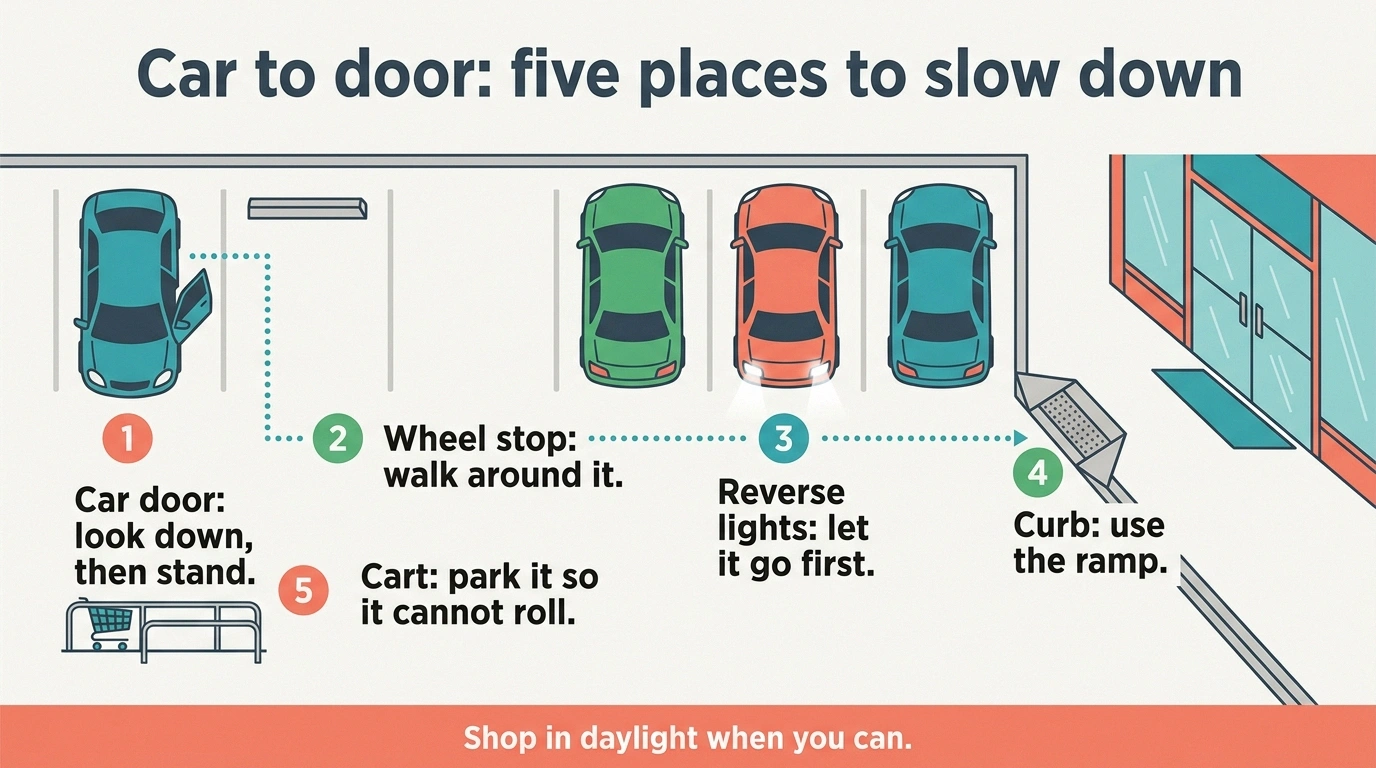
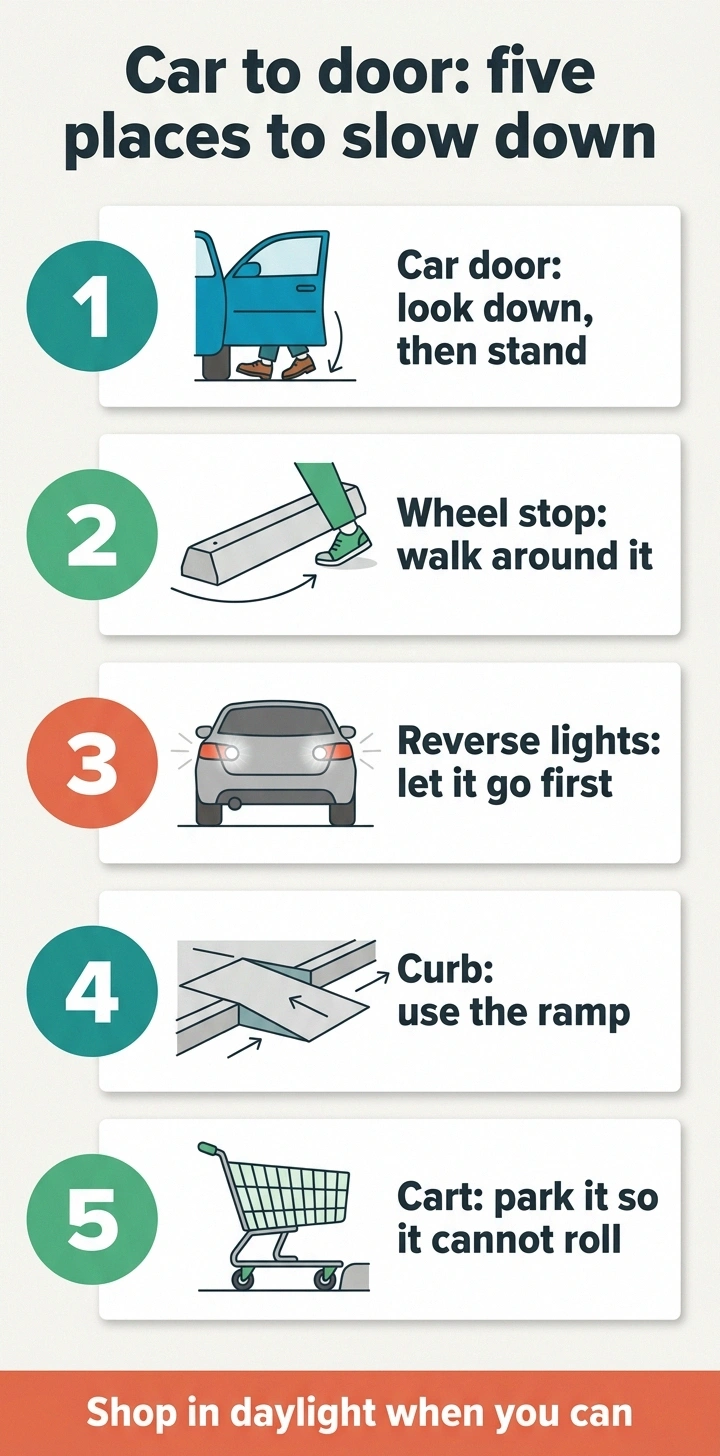
Put together, the whole walk boils down to a short routine:
- Park close to the door, in an accessible space if you have a placard or a pull-through space where the lot allows it, near a light and a cart corral.
- Swing both feet out, look at the ground, then stand and count to three.
- Close the door with your fingers well clear of the frame.
- Use the marked walkway or accessible route rather than squeezing behind parked cars.
- Go around wheel stops, use curb ramps, and treat puddles and wet paint as suspects.
- Watch for white reverse lights and catch drivers' eyes.
- Take the cart all the way to the car, park it so it can't roll, and ask for carry-out help when the corral is far.
- Check your feet that evening, and mention any stumble at your next visit.
It takes a little longer than dashing in for milk used to. I've made my peace with that.
Frequently Asked Questions
Is it safe to lean on a shopping cart for balance?
A cart can steady you, but no study has tested shopping carts as walking aids, and a cart has no brakes. Keep both hands on the handle and the cart close to you, and park it against a curb or your car so it can't roll while you load. If you need real support, bring your cane or rollator.
Can I park in the striped area next to a handicap space?
You shouldn't. Under the 2010 ADA Standards, access aisles must be marked to discourage parking in them, because people who use wheelchairs, walkers and canes need that space to get in and out of their vehicles. The markings, signs and penalties are set by state and local law.
How wide is a van-accessible parking aisle?
Under the 2010 ADA Standards, every access aisle must be at least 60 inches wide. A van space can be 132 inches wide with a 60-inch aisle, or 96 inches wide when its aisle is also 96 inches wide, and van spaces need at least 98 inches of vertical clearance.
Do backup cameras mean drivers can see me?
Not always. Federal standard FMVSS No. 111 requires a rearview image only on vehicles of 10,000 pounds or less built on or after May 1, 2018, and a 2018 insurance-industry analysis found cameras alone made only a small difference in backing crashes. NHTSA's advice still applies: never assume a driver sees you.
When do the clocks change this fall?
Daylight saving time ends at 2 a.m. on Sunday, November 1, 2026, according to NIST. Evening errands get darker after that, so shop earlier when you can and park near a light.
Why is getting out of the car riskier than getting in?
You are pushing up from a low seat onto ground you may not feel, often while turning. CDC researchers estimated that older adults had about 11,030 fall injuries a year getting out of vehicles, compared with 4,346 getting in. Look at the ground before you stand and pause before your first step.
What should I do if I fall in a parking lot?
Don't rush to get up. Check yourself, call for help if you need it, and stand only if you feel able. As general safety advice, get help right away if you hit your head, can't put weight on a leg, are bleeding heavily, feel faint or confused, or take a blood thinner. Otherwise, look over your feet and hands once you're home, since numb skin can hide an injury, and mention the fall at your next checkup.
About the Author