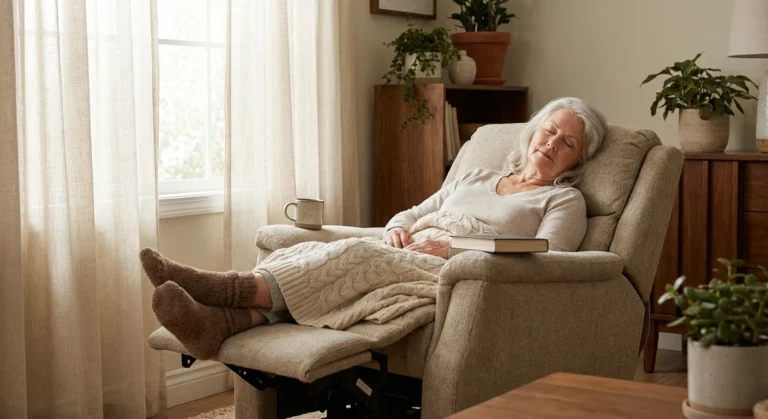
My Aunt Rosa is the reason I know as much as I do about rollators. She’d been living with peripheral neuropathy for eight years before she agreed to try one, and she picked hers out the same way she picked her groceries: fast, from a big-box store, without asking anyone. Three weeks later she had a bruise the length of her thigh from where the seat had rolled out from under her, and she was ready to throw the whole thing off a bridge.
What she’d needed wasn’t a different rollator. She’d needed someone to sit down with her before she bought one and walk her through the four or five things that actually matter when you have neuropathy — the height, the brakes, the seat, the wheels, and the wall of small habits around all of them. So that’s what I want to do here, with a cup of coffee and no rush.
If you’re on the fence about whether it’s time, or you’re not sure which type to get, or you’ve had one shoved at you by a well-meaning family member and you’re not using it because it feels wrong somehow — this piece is for you.
Walker vs. Rollator: Which One Do You Actually Need
The words get used interchangeably at the pharmacy, but they are two different tools.
Key takeaway
A walker is for load-bearing support when your legs need to push through your arms. A rollator is a rolling handrail with a seat for balance, confidence, and rest when your feet are numb and your standing endurance is short. Ask yourself which problem you actually have — weak legs, or numb feet plus short endurance — and the choice usually decides itself.
A standard walker is a frame with four legs. It might have no wheels at all (you pick it up and set it down with each step), it might have two front wheels and two rear glides, or it might have four small wheels — though four wheels on a rigid walker is much less common than on a rollator. You lean weight through your arms into it. It is the choice when you need real, load-bearing support for stability — post-surgery, significant weakness, or serious balance loss.
A rollator is a four-wheel mobility aid with hand brakes, a seat, and usually a small basket or storage bag. You push it, you don’t lift it. You don’t lean full body weight on it the way you would a walker — you rest your hands and use it for balance and confidence, and when you get tired, you flip around, lock the brakes, and sit.
The neuropathy question that decides between them is usually this: are your legs weak, or are your feet just numb and your endurance short?
Numb feet with reasonable leg strength and a real problem with fatigue and balance in longer outings — that’s rollator territory. You’re not looking for a crutch. You’re looking for a rolling handrail that also offers you a place to sit when your legs start to burn or your feet start to feel like they’re walking on marbles.
Real leg weakness, unsteady weight-bearing, needing to actively push through your arms with every step — that’s when a walker earns its keep. Some people need both, in different contexts. Rosa uses a walker at 4 a.m. on her way to the bathroom and a rollator for grocery shopping and church.
When It’s Time to Consider One (The Honest Signs)
Nobody wants to be the person with the walker. I get that. My aunt held out for a good two years past when she should have started, and the trigger was a fall in the driveway that could have been much worse than it was.
The natural progression
Mobility aids are engineering solutions, not personal failings. Most people move through them in this order as their needs change:
- Cane — one-hand balance support, minor stability boost, widened base.
- Walker — bilateral support when one hand is no longer enough, real weight-bearing through arms.
- Rollator — mobility plus a seat when standing endurance becomes the limiting factor.
- Mobility scooter or wheelchair — when endurance loss dominates and even a rollator’s rest stops aren’t enough.
Here are the honest, non-hedged signs. If two or three of these are true, it’s time:
- You’ve had a fall, a stumble, or a “close call” in the last three months, and you can’t confidently say you know why it happened.
- You’re skipping errands, outings, or family events because you’re worried about the walking involved.
- You’re grabbing walls, furniture, or shopping carts as your unofficial balance aid — and you know that’s a compromise, not a solution.
- Your endurance has dropped to the point where you’re planning routes by where you can sit down and rest.
- Your family has raised it, gently or not gently, more than once.
- Your podiatrist, neurologist, or PT has mentioned a mobility aid — even in passing — as something worth considering.
A cane is often the first stop. It offers a bit of extra balance and a widened base of support. When one hand is no longer enough — when you need two hands on something stable to feel safe — that’s the graduation to a walker or rollator. And when standing endurance becomes the limiting factor, when you can walk fine for ten minutes but not for thirty, that’s when the rollator’s seat becomes the whole point.
None of these transitions are a failure. They are engineering solutions to a real physical situation, and the sooner you make the switch, the more of your life you keep.
What to Look For in a Rollator (the Neuropathy Version)
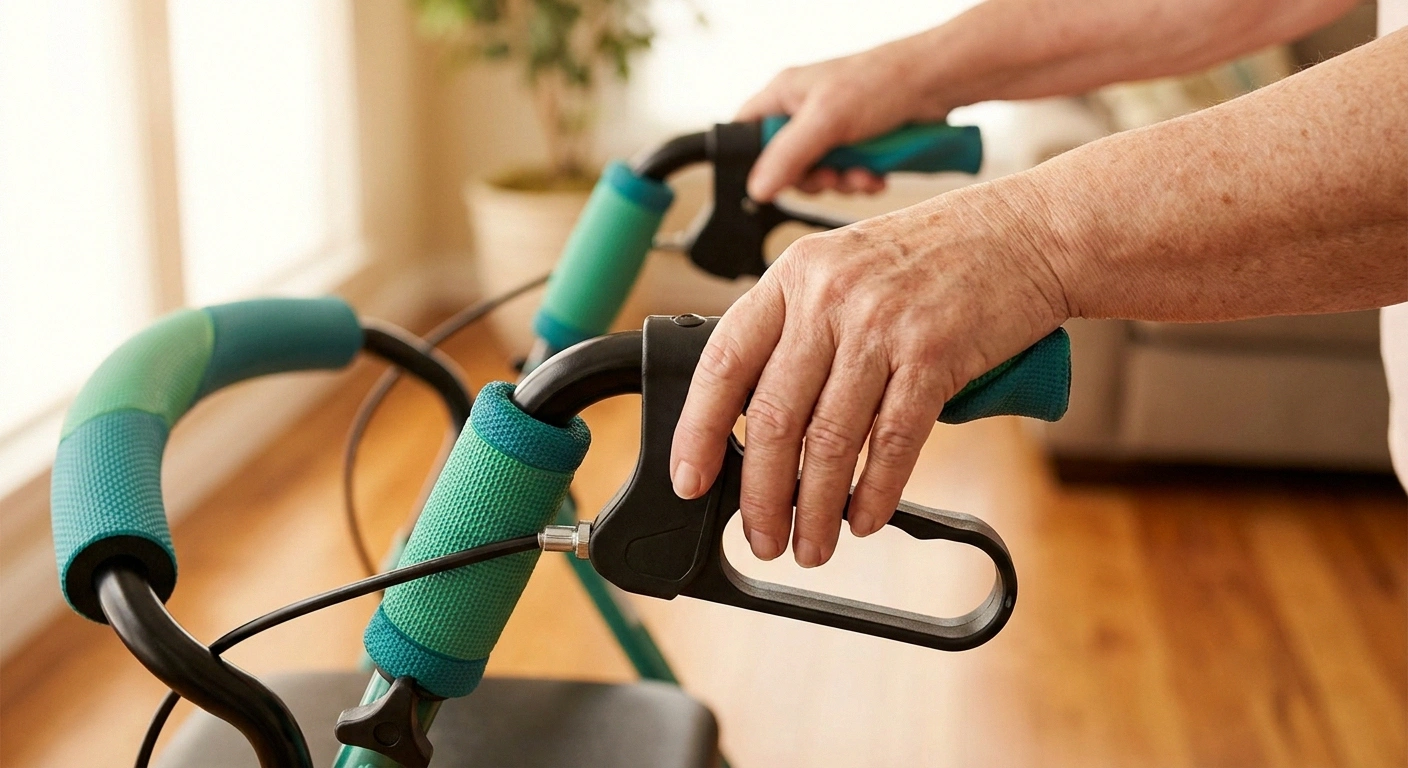
A good rollator for someone with neuropathy is not the cheapest four-wheeler at the drugstore. It’s specced for the specific problems neuropathy creates: numb hands, reduced grip strength, slower reactions, and standing-endurance fatigue.
Here’s what I’d walk into the DME store looking for:
- Brakes that engage with light pressure. This is the single most important feature. If squeezing the brake hard enough to stop the rollator requires strong hand strength, and your hands are numb — that is a real safety problem. Ask to test the brakes. If they feel stiff, ask if the tension can be adjusted (usually yes, at the cable barrel adjuster near the handle).
- Loop-style hand brakes (like bicycle brakes) that also lock into a parking position when you push the lever down. This is the standard for a reason — it’s the same motion for slowing and parking, just a different direction.
- Padded, ergonomic handles. If your hands go numb during long grips, cushion matters. Softer, contoured grips distribute pressure better than hard plastic.
- A seat with a backrest. A seat without a backrest is only useful for a very brief rest. A backrest turns it into a genuine sitting solution when your standing endurance gives out.
- Folding frame. If it can’t collapse to fit into a car trunk or a coat closet, it’s going to sit in the garage and not get used.
- Wheel size to match your terrain. Six-inch wheels are nimble indoors but catch on outdoor cracks. Eight-inch wheels are a good all-around compromise. Ten- to twelve-inch wheels handle grass, gravel, and uneven sidewalks but are bigger and heavier.
- Weight capacity you’re comfortable with. Standard rollators are rated to 250-300 lb. Bariatric models go to 400-500 lb. Always give yourself margin.
- A basket or bag. Practical, but check that it doesn’t unbalance the rollator when loaded. Some hang so far forward that a full grocery run tips the front end.
Skip the fancy features you won’t use. LED headlights on a rollator sound charming; nobody I know actually uses them. Cup holders are nice; make sure they don’t fall off in the first week.
What to Look For in a Standard Walker
Standard walkers are simpler beasts, and the choices are narrower — but they still matter.
Rollator vs. walker at a glance
| Feature | Rollator (4-wheel) | Standard walker |
|---|---|---|
| Weight bearing | Light — balance + rest | Heavy — full arm support |
| Brakes | Loop hand brakes + parking lock | None (rubber tips or glides) |
| Seat | Yes, with backrest | No |
| Best for | Numb feet, short endurance, community outings | Weak legs, post-surgery, indoor short distance |
| Weight | Typically 12-18 lb | Typically 5-8 lb |
| Medicare covered | Yes (standard model) | Yes |
- No-wheel walker (four rubber-tipped legs) — most stable, cheapest, but requires you to lift it with every step. Good for indoor use, short distances, and when maximum stability is the priority. Rough on painful hands and shoulders.
- Two-wheel walker (front wheels, rear glides or tips) — you push instead of lift, and the rear glides drag lightly. This is the most common choice for people who need real support but don’t want to pick up a walker with every step.
- Four-wheel walker — quicker but less braking control than a rollator, since traditional four-wheel walkers don’t always have hand brakes. If you want four wheels, you probably want a rollator.
- Glides vs. tennis balls. Rear glides (small plastic skids) let the walker slide smoothly on hard floors and short carpet without lifting. Tennis balls are the folk-remedy version and work fine on many surfaces, but they collect debris and eventually shred. Purpose-made glides last longer and look better if that matters to you.
- Height adjustability. Every walker should adjust. Confirm the range fits your height before you buy.
- Folding. Same as rollators. If it can’t fold, it lives where you leave it.
- Weight. Under 7 pounds is easy for most people. Above 10 pounds gets tiring, especially in a no-wheel walker where you’re lifting with each step.
Setting the Height Right — This Matters More Than You Think
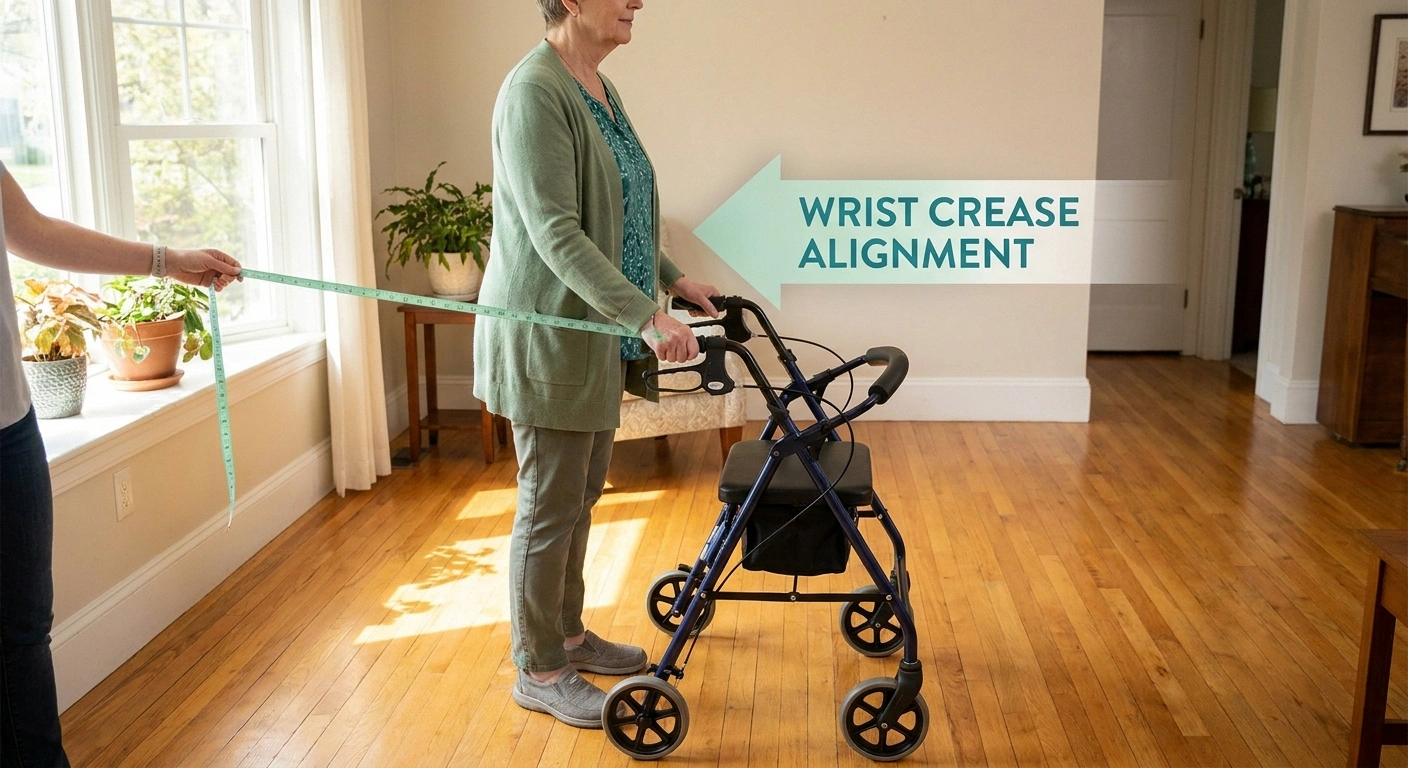
An incorrectly sized walker or rollator will hurt your back, hunch your shoulders, kill your wrists, and quietly convince you the thing doesn’t work — when really, it’s just the wrong height.
How to size a rollator or walker (5 steps)
The rule is simple. Stand up straight in your normal shoes. Let your arms hang naturally at your sides. Look at where your wrist crease is — that little bend at the base of your palm where a watch would sit. The top of the walker or rollator handle should be at that wrist crease.
When you put your hands on the grips, your elbows should have a slight bend of about 15 to 20 degrees. Not locked straight. Not scrunched up like you’re doing bicep curls. Just a soft, comfortable bend.
If you’re leaning forward, the handles are too low. If your shoulders are riding up around your ears, they’re too high.
Every walker and rollator I know adjusts. The height posts are usually a push-button system — press the button, slide the post, click it into the next hole. Adjust both sides to the same setting. If you can’t do this comfortably yourself, a spouse, adult child, or the DME technician can do it in about two minutes.
Braking When Your Hands Are Numb (Safety Critical)
This is the part I most want to underline. Please read this section twice.
Brake safety with numb hands — do not skip
- Test brake tension before you buy. If it takes hard hand force to stop a slow-rolling rollator, the brake is too tight for numb hands. Ask the DME tech to loosen the barrel adjuster.
- Practice the parking-brake motion 10 times before your first real use. Push the lever down until it clicks locked. Try to push the rollator forward — it must not move. Release. Repeat until automatic.
- Lock BOTH parking brakes before sitting. Every time. One locked and one released will still roll out from under you. Lock both, tug the frame once to confirm, then sit.
- Never rest weight on an unlocked rollator. This is the single most common way people get hurt with these tools. Numb hands + assumed brakes = falls.
- If any of this feels shaky, ask a PT. A no-brake walker may be a safer choice than a rollator you can’t reliably brake.
When your hands are numb, your brain does not get accurate feedback about how hard you are squeezing the brake. You think you’re braking firmly. In reality, you might barely be pressing at all. Or the reverse — you might be gripping much harder than you need to, exhausting your hand strength inside of ten minutes.
Three rules for numb-hand braking:
- Test the brake tension before you commit to the rollator. Push it forward at a slow walking pace, then squeeze the brakes gently. Can you feel the resistance change? Can you stop it without a hard, focused effort? If not, ask the DME technician to loosen the tension at the barrel adjuster (turn the barrel counterclockwise a half turn at a time and re-test). Softer brakes are safer for numb hands.
- Practice engaging the parking brakes ten times before your first real use. Push the lever down until it clicks into the locked position. Try to push the rollator forward — it should be locked in place, not creeping. Release. Repeat. Build the motion into muscle memory so you don’t have to think about it in the moment you need it.
- Lock BOTH parking brakes before you sit down. Always. A rollator with one brake locked and one released will still roll out from under you when you sit. This is how my aunt got her thigh bruise. Lock both, tug the frame once to be sure it doesn’t budge, then sit. Never rest weight on an unlocked rollator.
If any of that feels too complicated for your current hand function — that is important information, not a personal failing. It might mean a walker with no brakes at all is safer for you than a rollator. Talk to a physical therapist. This is exactly what they’re there for.
Using the Seat for Pacing and Rest

The seat is the whole reason a rollator exists. Use it.
The neuropathy honest truth is that standing endurance often runs out before walking endurance does — because standing still puts sustained pressure on the same numb spots on your feet, while walking rotates the pressure. If you can walk from the car to the store but can’t stand in the checkout line for six minutes without your feet screaming, you are not weak. Your nerves are doing exactly what they’re doing.
Plan rest stops the same way you’d plan bathroom stops on a road trip. Halfway through the grocery aisle. At the end of a long church hallway. On the far side of the parking lot before you make the walk to the car. Lock both brakes, sit, take one or two minutes, and go.
Two or three short sits will get you through outings that feel impossible if you try to power through standing. This is not giving up. This is pacing — the same thing marathon runners do.
Getting Around Your Home vs. Out in the World
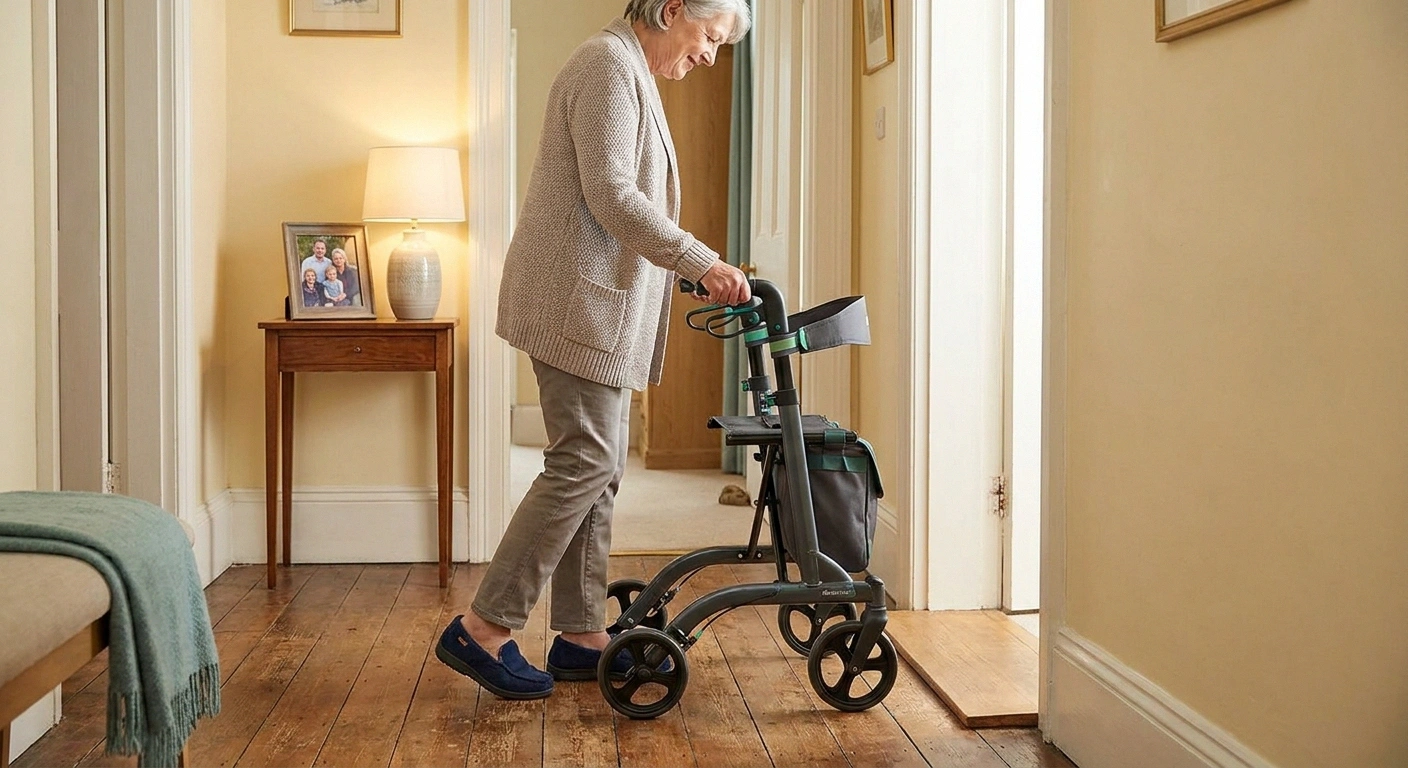
The rollator or walker you love at home is not always the one you’d want out in the world.
Indoors, in your home:
- Measure your doorways before you buy. Most rollators are 24 to 27 inches wide. Most standard walkers are 22 to 26 inches. Interior doorways are usually 28 to 32 inches — but bathroom doorways can be as narrow as 24 inches, and that’s the pinch point. If a doorway is too narrow, some models have a narrower “walker mode” you can fold to.
- Threshold plates and door saddles will catch small wheels. Consider ramping them or replacing raised thresholds with flat ones.
- Loose rugs are the biggest indoor hazard for anyone with neuropathy, walker or not. Please tape them down or remove them. My community has more falls attributed to rug edges than to anything else.
- Keep hallway lighting bright and reachable. Fumbling for a switch in a hallway at 3 a.m. is where midnight-bathroom-trip falls happen.
Outdoors, in the community:
- Larger wheels earn their keep on cracked sidewalks, grass, and store parking lots.
- The basket becomes a real asset — hands free to focus on the terrain.
- The seat is not optional out in the world. Long stretches without a chair are exactly the situation the rollator was designed for.
- Curbs and steps require attention. Approach curbs slowly, at a right angle, and either use the tip-lever with your foot or ask for a hand.
Some people run a two-rollator household — a lightweight indoor one, a rugged outdoor one. That’s a fine solution if the budget allows.
Insurance, Medicare, and Getting One Covered

The short version: Medicare Part B covers standard walkers and rollators as durable medical equipment (DME). You need a physician’s prescription documenting medical necessity — the neurologist, primary care doctor, or podiatrist can write it — and you need a supplier who is enrolled in Medicare. After your Part B deductible, Medicare covers 80 percent of the allowable amount and you’re responsible for the remaining 20 percent (or your Medigap or supplemental picks up the coinsurance).
Two things to know that catch people off guard:
- Medicare covers a “standard” rollator, not necessarily the premium one you may want. If you want a fancier model with bigger wheels, a nicer seat, or lighter carbon-fiber frame, you can usually upgrade — but you’ll pay the difference out of pocket. The DME supplier can quote you the upgrade cost before you commit.
- You may need to use a supplier in Medicare’s competitive-bidding network. Ask the supplier whether they’re contracted with Medicare in your area. If not, Medicare may not pay them, which means the whole bill lands on you.
Commercial insurance and Medicare Advantage plans vary. Call the number on the back of your card and ask specifically: “Do you cover a rollator as durable medical equipment, and which supplier network do I use?” Write down the name of the person you spoke to and the date.
If you’re paying out of pocket, a solid basic rollator runs $120 to $200. Mid-range with better wheels and a real seat is $200 to $350. Premium — carbon-fiber frame, larger wheels, upgraded brakes — is $400 to $700.
Frequently Asked Questions
How do I know if I need a rollator or a walker?
If your main issue is balance and standing endurance and your legs are still doing their job, a rollator with a seat is usually the right choice. If your legs are genuinely weak and you need to bear real weight through your arms with each step, a walker is what you want. When in doubt, a physical therapist can watch you walk and tell you in about ten minutes.
Can I use a rollator if I have numb hands from neuropathy?
Yes, but the brake tension needs to be set correctly for your grip strength, and you need to practice the parking-brake motion until it’s automatic. Ask the supplier to adjust the brakes and to show you how to test them. If your hands are severely affected, a walker with no brakes may actually be a safer choice — this is a conversation worth having with a PT.
What height should my walker or rollator handles be?
Stand up straight in your normal shoes with your arms hanging naturally at your sides. The top of the handle should reach the crease at the base of your palm, right where a watch sits. When your hands are on the grips, your elbows should have a soft 15 to 20-degree bend.
Does Medicare pay for a rollator?
Yes, Medicare Part B covers standard rollators and walkers as durable medical equipment. You’ll need a prescription from your doctor and a Medicare-enrolled supplier. After your Part B deductible, Medicare pays 80 percent of the allowable amount and you pay the other 20 percent unless you have supplemental coverage.
Is it safe to sit on a rollator seat?
Only when both parking brakes are locked. Push the brake levers down until they click into the locked position, then push the rollator forward once with your hip to make sure it doesn’t move. If it holds, sit. If it moves at all, re-lock and re-test. Never rest weight on a rollator with unlocked brakes.
What’s the difference between glides and tennis balls on a walker?
Rear glides are small plastic skids that let the walker slide smoothly on hard floors and short carpet without you having to lift it. Tennis balls are the old-school workaround and do a similar job, but they collect dirt, wear out, and can shred. Purpose-made glides last longer, look neater, and are the better long-term choice.
How do I get a rollator or walker in the car?
Most current models fold either side to side or front to back. Practice the folding motion with the salesperson at the DME store, then practice loading it into your own car before you drive it home. Some models weigh 10 pounds; others weigh 18. If lifting into a trunk is going to be an issue, look for a lighter frame or a model with a lift-assist feature.
When should I transition from a rollator to a mobility scooter or wheelchair?
When your standing and walking endurance drops to the point that you can’t get across a parking lot or through a grocery store even with the rollator’s rest stops, it’s time to have the conversation. This isn’t a failure — it’s a next step. A mobility scooter opens up outings a rollator can’t support, and many people use a rollator at home and a scooter out in the community.
If you’re wrestling with the emotional side of any of these transitions — and most people do — please know that grieving a piece of your mobility is a normal, human thing. Support groups, family conversations, and honest talks with your care team all help. You are not the first person to sit with this, and you won’t be the last. See managing the mental-health side of neuropathy if that piece is weighing heavily.
And whichever aid you land on, please pair it with the right shoes for neuropathy, keep up your gentle strength and mobility work, and stay steady on your daily foot-care routine. The rollator or walker is the visible tool. The rest of it is the quiet daily work that keeps the tool doing its job.
Rosa uses her rollator every day now. She grumbles about it about once a week. She also hasn’t fallen in over a year, she goes to the farmer’s market on Saturdays again, and she can sit in the middle of the produce aisle when she needs a minute — no drama, no apology. That’s what a good mobility aid does. It hands you back the parts of your life the neuropathy was quietly taking.
About the Author