
I want to start this article with something I rarely admit out loud. There was a stretch about eighteen months into my neuropathy when I was, on most days, deeply, viscerally angry. Not sad. Not anxious. Angry. At my feet. At the doctor who told me I just needed to lose weight. At the insurance company that denied my second nerve conduction study. At my husband for forgetting and asking me to walk to the mailbox. At the woman in line at the pharmacy who muttered that I should hurry up.
I was ashamed of it. I thought I was supposed to be the brave, philosophical patient. The one who handled it gracefully. Instead I was a person walking around a wound, snapping at people I loved, and silently raging at my own body twenty hours a day.
It took me a long time to figure out that the anger wasn't a personal failing. It was a normal — almost predictable — part of chronic neuropathic pain that almost no one talks about, and that hardly any doctor screens for. This article is the conversation I wish someone had had with me three years ago.
The Emotion Nobody Names
Most articles about neuropathy and mental health talk about depression and anxiety. We've covered both — depression and anxiety are real and common, and our piece on neuropathy and mental health goes deep on them. But when researchers actually ask chronic pain patients which emotion dominates their experience, a surprising answer keeps surfacing.
Key Takeaway
If you have neuropathy and you're angrier than you used to be, you are not a bad person — you're a person whose nervous system is sending high-volume distress signals all day long. Anger is one of the most predictable downstream effects of chronic neuropathic pain, and it's also one of the least talked about.
It's not depression. It's not anxiety. It's anger.
Multiple studies of chronic pain populations have found that anger — not sadness, not worry — is the single most prominent emotion in many people living with chronic pain. And neuropathic pain, with its particular qualities (burning, electric, unpredictable, treatment-resistant), tends to produce more anger than other types of chronic pain. There are good reasons for this, which we'll get to. But the first thing worth saying is: if you have neuropathy and you've found yourself angrier than you used to be, you are not alone, and you are not a bad person. You're a person whose nervous system is sending high-volume distress signals all day long, and anger is one of the most predictable downstream effects.
Why Neuropathy Specifically Triggers Anger
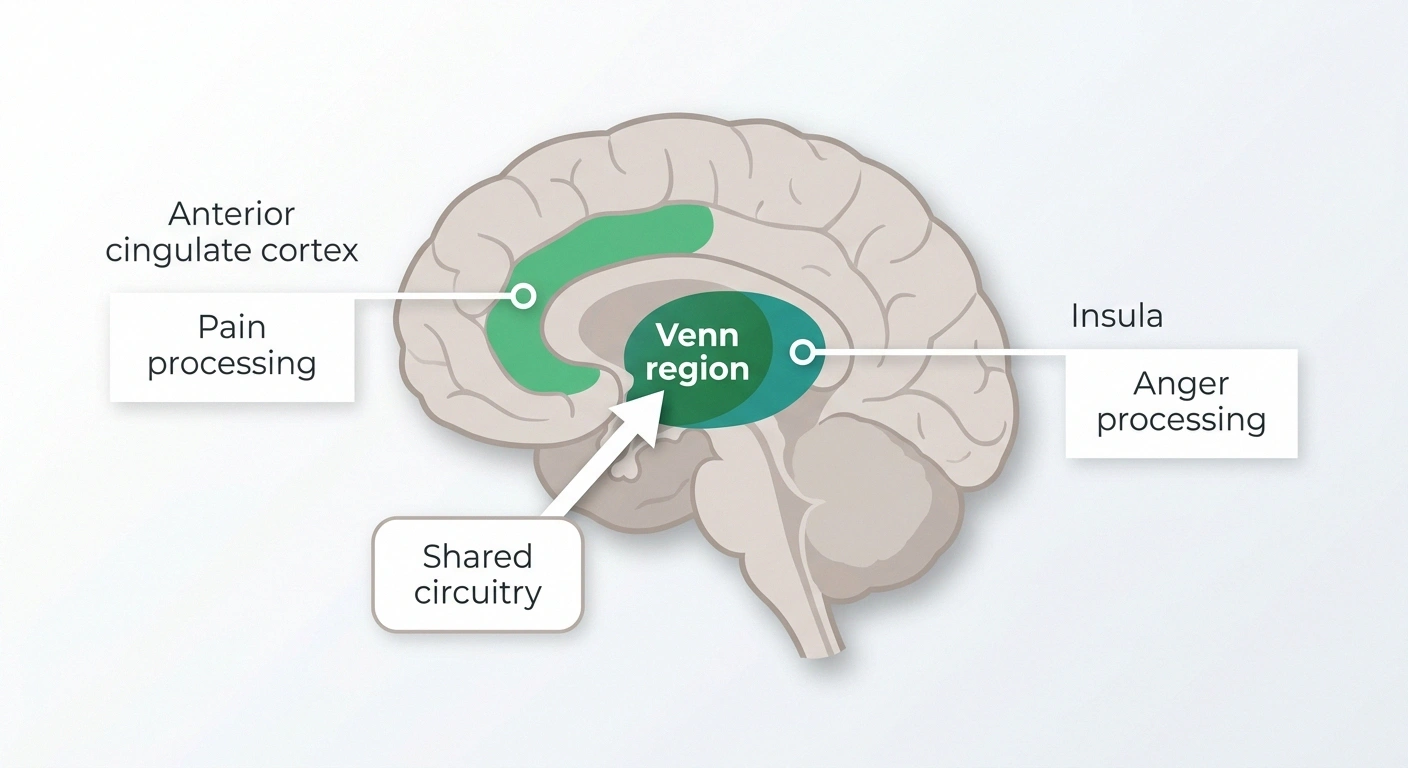
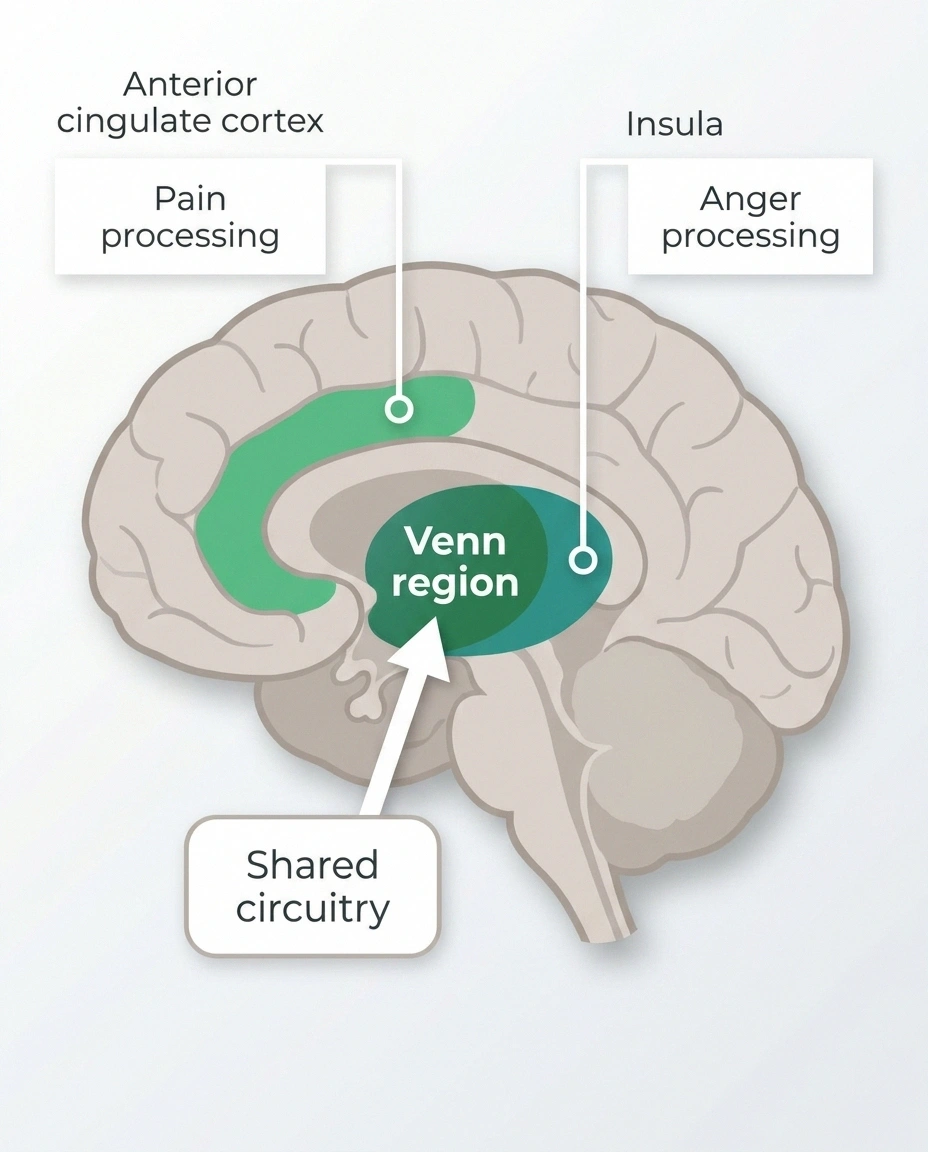
The link between chronic pain and anger isn't just psychological — it's neurological. Three patterns drive it.
What the Research Shows
Multiple studies of chronic pain populations have found that anger is the single most prominent emotion in many people living with chronic pain — more than depression, anxiety, or shame. Recent research also identifies that the combination of anger and “perceived injustice” (feeling what's happening to you is unfair) correlates with greater pain intensity, more body areas affected, and worse treatment outcomes.
Pain and anger share brain real estate
The same brain regions that process the unpleasantness of physical pain — the anterior cingulate cortex and the insula — are deeply involved in processing anger. When pain signals are firing constantly, those regions stay activated, and they lower the threshold for anger to bubble up. Small everyday irritations that you'd previously brush off (the slow driver, the loud neighbor, the spouse asking the wrong question at the wrong moment) start landing as full-strength provocations.
Sleep loss compounds everything
Neuropathy is famous for being worse at night. Burning feet that won't let you sleep, restless legs, the inability to find a comfortable position — the pain often peaks exactly when you most need rest. Chronic sleep loss reduces emotional regulation by a substantial margin. People who haven't slept well for weeks are physiologically less able to dampen anger responses. We've covered why neuropathy gets worse at night separately, but the emotional spillover deserves its own mention here. You're not weak for snapping at someone after the third night of three hours of sleep. You're sleep-deprived.
Unpredictability is enraging
Predictable pain — the pain of a sprained ankle, the pain after surgery — is unpleasant but psychologically containable. You know what it is, when it'll improve, what makes it better. Chronic neuropathic pain is the opposite. It surges and recedes for reasons you can't always identify. Days when you feel tolerable end without warning in a flare. Plans get cancelled. Treatments work for two weeks then stop working. Your body becomes an unreliable narrator. The accumulated frustration of trying to live a normal life around something this unreliable produces anger as reliably as it produces fatigue.
The Specific Things Neuropathy Patients Get Angry About

In the support group I help facilitate, when people finally feel safe enough to talk about anger, the same themes come up over and over. If any of these resonate, write them down — naming them is the first step to working with them rather than being run by them.
Where the Anger Comes From
Anger at the body itself
“My feet betrayed me.” No external offender — the source of suffering lives inside you.
Anger at being dismissed
Doctors who called early symptoms “anxiety” or “normal aging.” Years lost to disbelief.
Anger at the people you love
They forget. They suggest things that feel like they've never listened. Misunderstanding hurts more from them.
Anger at lost identity
The gardener who can't kneel. The grandparent who can't walk to the playground. Grief that arrives as anger.
Anger at the bureaucracy
Insurance denials. Pre-auths. Forty-five minutes on hold to be transferred to the wrong department.
Anger at minimizers
“You don't look sick.” “At least it's not cancer.” Each one a tiny erasure of what you actually feel.
Anger at the body
“My feet betrayed me.” “My hands won't do what I tell them to.” There's a specific kind of anger that comes from your own body becoming the source of your suffering. It's different from anger at an external problem because there's no one to be angry at — the offender lives inside you.
Anger at being dismissed
Almost every neuropathy patient I've met has at least one story of a doctor who dismissed early symptoms. Tingling that was “anxiety.” Burning that was “in your head.” Symptoms that were “normal aging.” Sometimes it took years to get a diagnosis. The damage done by being disbelieved by the people you went to for help is real and lasting. Anger at the medical system — the appointments, the dismissals, the insurance battles — is one of the most common threads.
Anger at the people closest to you
The people who love you can't see your pain. They forget. They make plans you can't keep. They suggest things (“have you tried walking more?”) that feel like they've never actually listened. The anger at being misunderstood by the people who are supposed to understand is uniquely painful, because there's nowhere to put it that doesn't damage relationships.
Anger at lost identity
The runner who can't run. The gardener who can't kneel. The grandparent who can't walk to the playground. Neuropathy takes away specific things, and grief over those things often shows up as anger first. I should still be able to do this. Why can't I do this anymore?
Anger at the bureaucracy
Insurance denials. Disability paperwork. Pre-authorization requirements. The hours on hold with billing departments. The hoops to jump through to get something covered that shouldn't be in question in the first place. Few things produce purer anger than spending forty-five minutes navigating an automated phone tree to be told the wrong department handles your issue.
Anger at “minimizers”
The acquaintance who says “well, at least it's not cancer.” The relative who recommends a supplement they read about. The person who tells you “you don't look sick.” Each one feels like a tiny erasure of what you're actually experiencing.
The Bidirectional Trap: Anger Makes Pain Worse
Here's the cruelest part of all this. Anger doesn't just follow from pain — it actively amplifies pain. Studies have repeatedly shown that high anger states correlate with greater pain intensity, more body areas affected, more disability, and worse treatment outcomes. The same nervous system pathways that respond to anger (sympathetic activation, increased muscle tension, elevated stress hormones, increased inflammation) are the pathways that make neuropathic pain worse.
The Bidirectional Trap
Anger doesn't just follow from pain — it actively amplifies pain. The same nervous system pathways activated by anger (sympathetic activation, increased muscle tension, elevated stress hormones, increased inflammation) are the pathways that worsen neuropathic pain. Managing anger is part of pain management itself, not a soft “feelings” project.
Recent research has identified that the combination of anger and a sense of “perceived injustice” — feeling that what's happening to you is unfair, undeserved, or someone else's fault — is particularly damaging. People with high levels of both anger and perceived injustice report more intense pain, pain that spreads to more body areas, higher disability, and greater emotional distress.
This means the work of managing anger is not a soft, optional, “feelings” project. It's part of pain management itself.
What Doesn't Work

Before we get to what helps, let me name what doesn't — because I tried most of it.
What Doesn't Help vs. What Does
Doesn't Work
- Suppression
- Explosive venting
- Self-blame
- “Just stay positive”
Does Help
- Naming the emotion
- The pause
- Physical discharge
- CBT, ACT, MBSR
Suppression. Pretending you're fine, swallowing the anger, “rising above it.” This raises blood pressure, increases inflammation, and the anger comes out anyway, often at the wrong target.
Explosion. Letting the anger out in raw form on whoever's nearest. Damages relationships, deepens isolation, and — here's the kicker — doesn't actually relieve the underlying anger. Studies show that “venting” makes anger worse, not better.
Self-blame. Telling yourself you shouldn't be angry, you're weak for being angry, that other people have it worse. Compounds the original distress with shame. The body still feels what it feels regardless of what you tell yourself you should feel.
Generic positivity. “Just stay positive.” “Mind over matter.” Toxic positivity makes you feel broken for having normal human responses to a hard situation. Toss this advice — it's not for you.
What Actually Helps

1. Naming the emotion in real time
The single highest-leverage skill I've learned is naming what I'm feeling, out loud, while it's happening. “I'm angry right now.” “I'm frustrated that this appointment took two hours.” “I'm furious that the pharmacy lost my prescription again.” This sounds simple to the point of trivial. It is not trivial. The act of naming an emotion engages the prefrontal cortex — the part of the brain that regulates emotion — and reduces the intensity of the response. Researchers call this “affect labeling,” and it's one of the most reliable findings in the emotion regulation literature.
~60%
of neuropathic pain patients experience comorbid depression, anxiety, or stress
Anger, often unmeasured in clinical settings, sits alongside these. Treating the emotional layer alongside the physical pain is increasingly recognized as essential — not optional.
2. The pause
The few seconds between feeling angry and acting on it are the most consequential seconds in your entire emotional life. Almost any pause helps. A breath. A walk to the kitchen for water. Counting backward from ten. Setting the phone down before responding to a text. The skill is not “don't be angry” — it's “give yourself the smallest possible delay between the feeling and the response.” The delay is where wisdom lives.
3. Physical discharge
Anger is a body-state, not just a mental state. Adrenaline is in your system. Heart rate is up. Muscles are tight. Doing something physical — walking, gentle stretching, deep breathing, a few sit-to-stand exercises if you can — discharges some of the physiological component. Aerobic exercise (whatever your body can tolerate; for many that's walking, swimming, or chair-based movement) is one of the strongest evidence-based mood regulators in the medical literature.
4. Cognitive behavioral therapy adapted for chronic pain
CBT is the most extensively studied psychological treatment for chronic pain, and one of its modules specifically addresses anger. A CBT-trained therapist can help you identify the automatic thoughts that drive anger (often “this is unfair,” “they should have known better,” “I shouldn't have to deal with this”) and develop more flexible responses. CBT for chronic pain isn't talk therapy in the traditional sense — it's structured, skill-based, and time-limited. Most courses run 8–12 weekly sessions.
5. Acceptance and Commitment Therapy (ACT)
ACT differs from CBT in that it doesn't try to change your thoughts. Instead, it helps you stop fighting them, identify what you actually value in life, and act in alignment with those values even when the painful thoughts and feelings are present. For neuropathy patients, ACT often resonates because it doesn't require you to think positively or pretend the pain isn't real — it asks you to commit to living the life you want anyway.
6. Mindfulness-Based Stress Reduction (MBSR)
The 8-week MBSR program, originally developed for chronic pain patients, has substantial evidence for reducing pain intensity, improving mood, and lowering reactivity. The core skill — observing what you're feeling without immediately acting on it — is exactly the skill anger management requires. Many hospitals and community wellness centers offer MBSR programs; some are now available online.
7. Anger-specific journaling
Five to ten minutes of writing, by hand, about what you're angry about. Not editing, not tidying, not making it sound reasonable. Just letting it out on paper. The ritual helps for several reasons: the writing slows the thoughts to handwriting speed (which forces a pause), the page becomes a non-human recipient that can absorb the worst of it, and reading what you wrote later often reveals patterns you couldn't see in the moment. A few patients in my support group keep a private journal specifically for this; most find it lowers the intensity of the anger noticeably.
8. Targeted couples conversations
If your closest relationships are absorbing the brunt of misplaced anger — and they often are — a single targeted conversation can change a lot. The structure that works: “There's something I want to talk about. It's not your fault, and I'm not asking you to fix it. I just want you to know what's actually going on with me.” Then say what you've been holding back. Most partners I know want to be on the team but don't know what their role is. Telling them what's happening removes the guesswork.
9. A therapist who specializes in chronic illness
General therapists are sometimes wonderful and sometimes uncomprehending of chronic pain. A therapist with explicit experience in chronic pain or chronic illness will recognize patterns immediately and won't waste sessions trying to “solve” your pain. The “Find a Therapist” tool at Psychology Today lets you filter by specialty; the American Chronic Pain Association also maintains a directory.
10. Address the underlying pain when possible
Sometimes the most direct way to reduce anger is to reduce pain. If your current pain management isn't adequate, that's a medical conversation worth having. Our articles on gabapentin, duloxetine, and natural remedies for neuropathic pain cover what's available. Better pain control reduces the upstream pressure on your emotional regulation system.
What to Do When You've Already Snapped at Someone You Love

Almost everyone with chronic pain has done it. You said something sharp. You raised your voice. You sent the text you wish you could unsend. The damage has been done.
The Repair Script
“That came out harsher than I meant it. I'm sorry. I was in a lot of pain and I took it out on you. That isn't fair to you.”
Owns the behavior. Names the context without using it as an excuse. Centers the impact on the other person. Repeat as often as needed.
The repair, in my experience, has three parts: own it, name what was happening, and don't make it about yourself.
“That came out harsher than I meant it. I'm sorry. I was in a lot of pain and I took it out on you. That isn't fair to you.”
That sentence is more useful than ten paragraphs of explanation. It owns the behavior, gives context without making the context an excuse, and centers the impact on the other person rather than your own struggle. Most people, given that, will meet you halfway. Repeat as often as needed. The goal isn't never snapping — it's repairing well when you do.
When to Seek Help Beyond Self-Management

Self-management is enough for many people. For others, the anger reaches levels that need professional support. Signs it's time to talk to a therapist or your doctor:
If You Need Immediate Help
If the anger has tipped into thoughts of harming yourself or others, or if you're feeling “too tired to do this anymore,” please reach out now. Call or text 988 (the Suicide and Crisis Lifeline in the U.S., free and confidential), or contact your doctor's office. None of this means you're broken — it means you've reached the point where the right next step is professional support.
- Anger that's affecting your closest relationships in serious ways — a partner thinking about leaving, an estranged child, friends pulling back
- Episodes of anger that frighten you in retrospect
- Physical aggression toward objects or people
- Anger that's accompanied by increased drinking, substance use, or risky behavior
- Suicidal thoughts (“I'm too tired to do this anymore” — please call 988 or your doctor immediately)
- Anger at yourself that's curdled into self-loathing
- Anger that's been stuck at the same intensity for over a year despite trying everything you can think of
None of these mean you're broken. They mean the situation has exceeded what self-management can handle, and that's exactly what professional support is for.
The Long View
I want to be honest with you about something. Three years into my own neuropathy, the anger has changed shape but it has not gone away entirely. Some days it's barely there. Some days it surfaces again — usually after a bad sleep, an insurance denial, or a careless comment from someone who should know better. The difference between now and the worst stretch isn't that I no longer feel angry. It's that I've gotten better at recognizing it, naming it, pausing, and choosing what to do with it. The emotion still happens; the wreckage that used to follow doesn't.
If you're in the middle of the angry phase, please hear this: you are not failing. You are responding to a difficult, often unfair, often unrecognized situation in a way that millions of other patients respond. The work of finding skills to handle it is real work, and worth doing. You can do it. And the people who love you, given a chance to understand, will almost always choose to stay on your team.
Frequently Asked Questions
Why am I so angry since my neuropathy started?
Anger is one of the most common emotional responses to chronic neuropathic pain, more common than many people realize. Pain and anger share neural pathways, chronic sleep loss reduces emotional regulation, and the unpredictability of neuropathy compounds frustration. Combined with insurance denials, dismissive doctors, and the loss of activities you used to enjoy, anger is a normal response, not a personal failing.
Does anger make neuropathy pain worse?
Yes. Anger activates the sympathetic nervous system, increases muscle tension, raises stress hormones, and amplifies inflammation, all of which can worsen neuropathic pain. Studies have repeatedly shown that high anger states correlate with greater pain intensity, more body areas affected, more disability, and worse treatment outcomes. Managing anger is part of pain management.
Is it normal to take my pain out on family members?
It's common, but it's not something you have to accept as inevitable. Almost everyone with chronic pain has snapped at the people closest to them. The skill to develop is recognizing the pattern and learning to repair the moments after they happen — owning the behavior, acknowledging what was happening, and not making it about yourself.
What's the difference between anger and depression in chronic pain?
Depression typically presents as low energy, persistent sadness, loss of interest in activities, hopelessness, and changes in sleep and appetite. Anger presents as irritability, short fuse, intolerance of small frustrations, hostility, and outbursts. The two often coexist, and either one can amplify pain. Both are treatable, but they respond to somewhat different approaches.
Should I see a therapist for anger about my neuropathy?
If anger is significantly affecting your relationships, your sleep, your physical health, or your treatment outcomes, yes. Look for a therapist with explicit experience in chronic pain or chronic illness. Cognitive behavioral therapy and acceptance and commitment therapy both have strong evidence for chronic pain. Self-management skills work for many people; professional support is essential when the anger has exceeded what self-management can handle.
Is there medication for chronic pain anger?
There is no medication specifically for “chronic pain anger.” However, treating the underlying neuropathic pain better often reduces anger as a downstream effect, and treating coexisting depression or anxiety with medication can also lower anger reactivity. Some patients find low-dose SNRIs (like duloxetine) help with both pain and emotional regulation. Discuss with your doctor.
How do I explain my anger to family without making it worse?
The structure that works for many patients: open with a frame that takes pressure off the listener (“This isn't your fault, and I'm not asking you to fix anything”), then describe what's actually happening with you (“My pain has been worse at night and I haven't slept well in three weeks. Some days I'm running on fumes and I can't regulate my reactions the way I want to”). Most family members want to be on your team but don't know how. Give them a way in.
Will the anger ever go away?
For most people, the anger doesn't disappear entirely, but it changes shape over time. Acute, frequent anger usually mellows as you develop better skills for naming it, pausing before reacting, and choosing how to respond. Some sources of anger (insurance battles, bureaucracy, ignorance from acquaintances) tend to keep producing flare-ups. The goal isn't to stop feeling angry; it's to stop being run by the anger when it shows up.
About the Author