The last time I tried to power through a movie without thinking about my feet, it was a Tuesday matinee, the theater was nearly empty, and I picked the middle of a row because that's what you do when there are good seats available. Forty minutes in, my left foot was buzzing like a phone on a wood table, my right calf was locking up, and I had to do that excruciating shuffle past five other people just to escape to the lobby. I missed the entire second act. I sat in my car in the parking garage and cried a little, because it was such a small thing to lose, and somehow that made it worse.
I tell you that not because it's a sad story but because I want you to know that I have been there, and I'm not there anymore. I go to the movies again. Not as often as I used to, sure, and not the same way. But I go. And on a good night, with the right seat and the right prep, I can disappear into a film for two hours and forget my feet entirely. That, friend, is the goal. So let me share what I figured out the hard way, so you can skip a few of the rough Tuesdays I had to live through.
Why the Movies Are Uniquely Hard With Neuropathy
If you've been wondering why your living room couch is fine for a long stretch but a theater seat at minute 45 feels like a punishment, you're not imagining it. Movie theaters stack a half-dozen small challenges on top of each other in a way that almost nothing else does.
Movie theaters stack five neuropathy challenges at once: long sitting, cold air, dark navigation, narrow rows, and inflexible seats. The fix isn't powering through — it's engineering the night around your nerves with the right seat, the right kit, and small in-seat movements every 20-30 minutes.
You're sitting still for two to three hours, often longer with previews. The auditorium is cold — most theaters keep them in the 65-to-68-degree range, and that chill settles right into your feet and toes the way nothing else can. Once the lights go down, getting up means navigating a dark, sloped floor with people's knees and bags in your way. Standard rows are narrow. Bathroom trips become an expedition. And the seats themselves, even the new ones, weren't designed with sustained nerve comfort in mind — they were designed for the average butt for the average two hours.
None of this is your fault. The environment is genuinely hard. Once you accept that, you stop trying to white-knuckle through it and you start engineering around it.
Before You Even Buy the Ticket
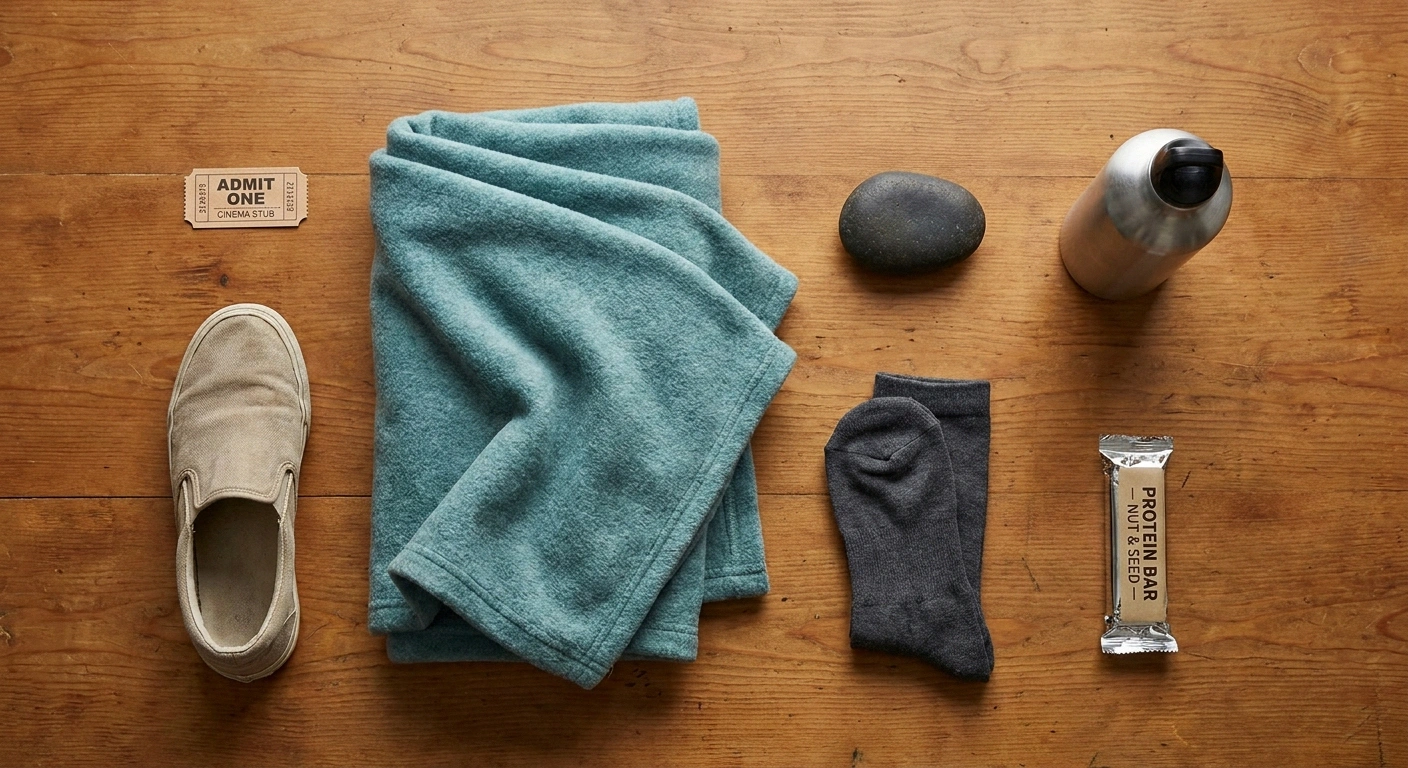
The biggest gains I made weren't in the theater at all. They happened in the hours leading up to it. A movie outing with neuropathy is more like a small expedition than a spontaneous evening — and once I started treating it that way, the whole thing got easier.
Pre-Movie Prep Checklist
- Pick the showtime: matinee or off-peak weekday over a 9 PM screening.
- Time your meds: peak effect should hit when the lights go down, not after.
- Eat light, eat early: small dinner about 2 hours before showtime.
- Mind the drinks: sip enough to stay comfortable; skip the 32-oz soda and the wine.
- Reserve your seat in daylight: aisle, end of row, accessible seating if available.
- Permission to reschedule: if a flare is brewing, the theater isn't going anywhere.
First, the showtime. I almost never book the late screening anymore. By 9 PM my feet are louder, my legs are heavier, and a film I'd love at 2 PM becomes a slog. Matinees are my friend. Off-peak weekday screenings also tend to have emptier auditoriums, which means I can spread out, prop a foot up on the seat next to me, and get up without disturbing anyone. If you can swing a Tuesday or a Sunday morning, do.
Second, the meds. If you take a daytime medication that helps with nerve symptoms, time it so it's working at peak when the lights go down — not wearing off during the climax. I take mine about an hour before I leave the house. If you take something that makes you drowsy, the dark theater will magnify it; sometimes I save those for the drive home, not the show.
Third, the food and drink. Heavy meals before a movie are a trap — they pull blood toward digestion and away from where you need it. I eat a small, light dinner two hours before, and I'm careful about caffeine and alcohol. Caffeine can amp up nerve sensations for some of us, and alcohol disrupts sleep that night, which usually means a worse-feeling next day. As for hydration: I sip enough to stay comfortable, but I don't show up to a 140-minute film with a 32-ounce soda. The math just doesn't work, and a forced bathroom trip in the dark is exactly what we're trying to avoid.
If a flare is already brewing — you know the feeling — give yourself permission to reschedule. Managing a flare is a real thing, and you don't owe a movie theater your worst night.
Picking the Right Seat
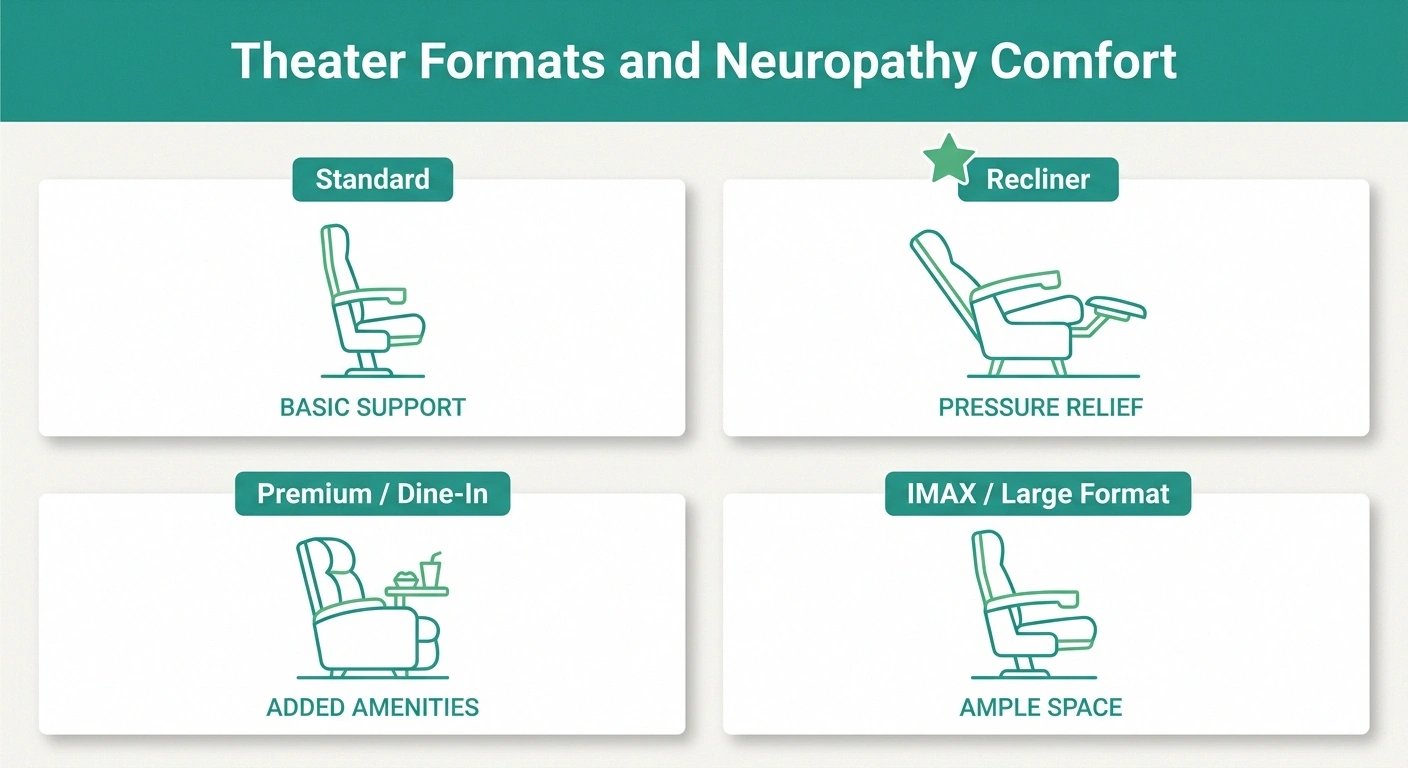
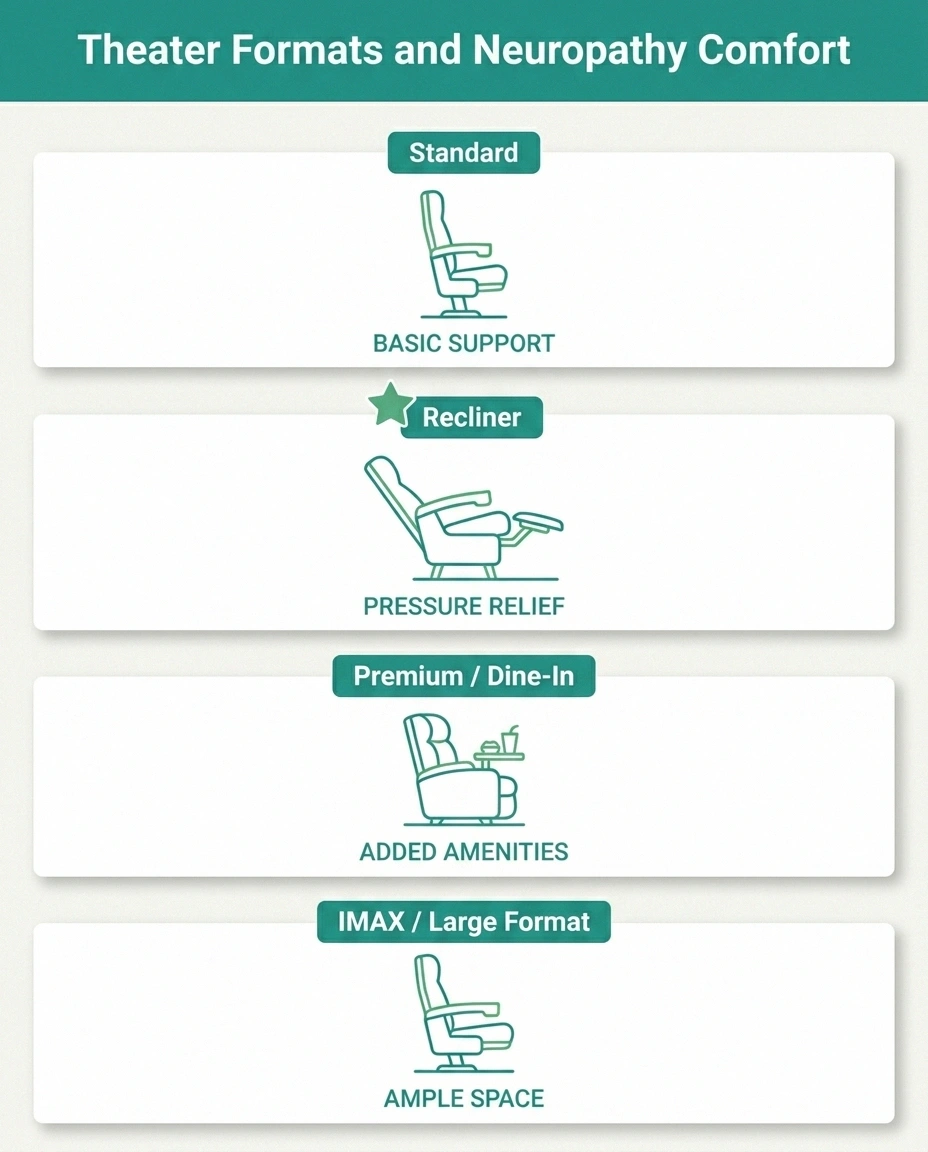
Of all the changes I made, this one moved the needle most. The seat is everything.
Theater Format Comparison for Neuropathy
| Format | Strengths | Watch-Outs |
|---|---|---|
| Standard | Cheapest; widely available. | Narrow rows, fixed seat, hardest for long sitting. |
| Recliner | Powered footrest, position changes, more legroom. Best overall. | Few extra dollars per ticket; not at every theater. |
| Premium / Dine-In | Comfortable seats; in-seat service means fewer trips. | Higher cost; some setups still have fixed seats. |
| IMAX / Large Format | Big-screen experience; sometimes wider seats. | Often longer films; cold air; standard seat designs. |
My rule is simple: aisle seat, end of a row, in a section where I can stretch my legs forward. I haven't sat in the middle of a row in three years, and I don't miss it. The aisle gives you four gifts at once — you can extend your “outside” leg into the walkway when no one's coming, you can stand and shake out your feet without disturbing anyone, you can leave for the bathroom in twelve seconds instead of three minutes, and you can reposition without a domino effect on the row.
Even better: book accessible or companion seating if you qualify. The Americans with Disabilities Act requires theaters to designate wheelchair and companion seats throughout the auditorium, and you don't have to be in a wheelchair to need accessible seating — anyone with a mobility-affecting condition like peripheral neuropathy can ask for it. These seats are usually placed at row breaks with extra legroom, and according to ADA guidance on ticket sales, you don't have to provide proof of disability to book one. You can also buy companion seats for up to three people sitting with you.
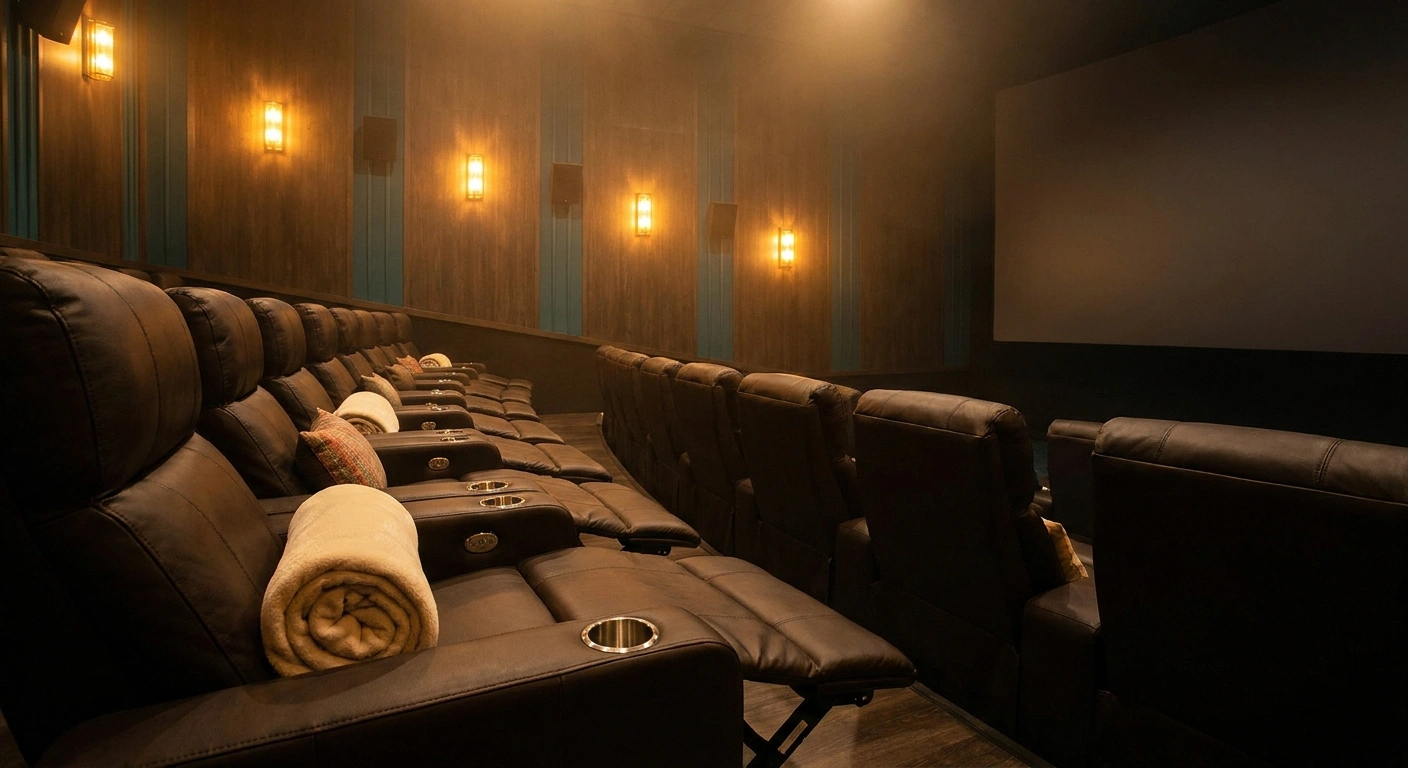
And then there's the recliner theater. If you have one within reasonable driving distance, this is a small miracle. AMC's recliner houses, Cinépolis Luxury Cinemas, Alamo Drafthouse, Regal RPX, and a growing number of independent theaters now offer fully reclining electric seats with built-in footrests. You can shift positions, elevate your legs, and stretch in ways a standard seat doesn't allow. The first time I saw a film in a recliner theater, I came out feeling better than I'd felt going in. They cost a few dollars more. They are worth every penny. If you're choosing between three theaters for the same film, drive the extra ten minutes to the recliner option.
One last seat tip: most theaters now let you reserve seats in advance through their app or website. Use it. Pick your seat in daylight, from your couch, with the map in front of you. Don't show up and gamble on what's left.
What to Bring
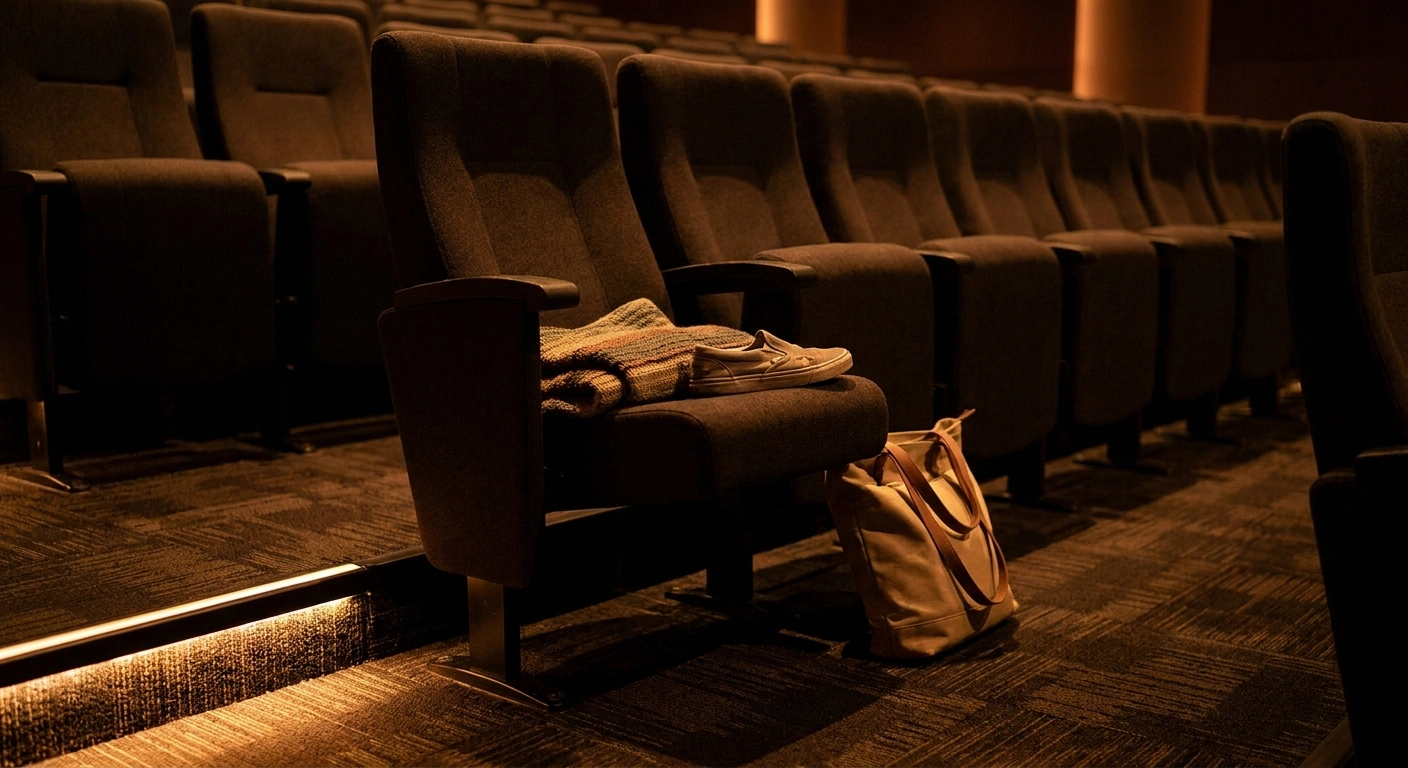
I always have a small tote bag for movie outings now. Nothing fancy — just a few items that turn a hard seat into a manageable one. Here's my standard kit.
The Movie-Outing Tote
A small cushion or rolled lap blanket. A simple memory-foam seat cushion fits under most theater seats; if it's too bulky, a folded fleece throw works almost as well. The blanket also handles the cold-air problem.
Slip-on shoes. Lace-up shoes feel restrictive after twenty minutes of stillness. A good pair of slip-ons with a roomy toe box lets you wiggle, ease pressure off the ball of the foot, and reposition without a fight. I've also worn a fresh pair of cushioned house shoes to evening shows. Nobody noticed. Nobody cared. The slip-on lifestyle wins again.
Compression socks — cautiously. Light to moderate graduated compression socks can really help with the long-sitting circulation problem. They reduce that pooled-blood, swollen-feet feeling at hour two. But — and this is important — if you have diabetic neuropathy, peripheral arterial disease, or any reduced sensation in your feet, please clear compression with your doctor first. The wrong compression can make some conditions worse. Here's a fuller breakdown of when they help and when to skip them.
A water bottle and a small snack. Sips of water keep you comfortable; a small protein bar or a few nuts can take the edge off if symptoms feel partly blood-sugar related.
A fidget tool. This one surprised me. A small textured stone or a quiet hand fidget gives my brain somewhere else to send the noise when my feet are loud. It's not magic, but it shifts the volume just enough that I stop bracing.
Your phone, on silent, dimmest setting. Not for scrolling — for the timer. I'll explain in a second.
Strategies for the Two Hours You're in the Seat
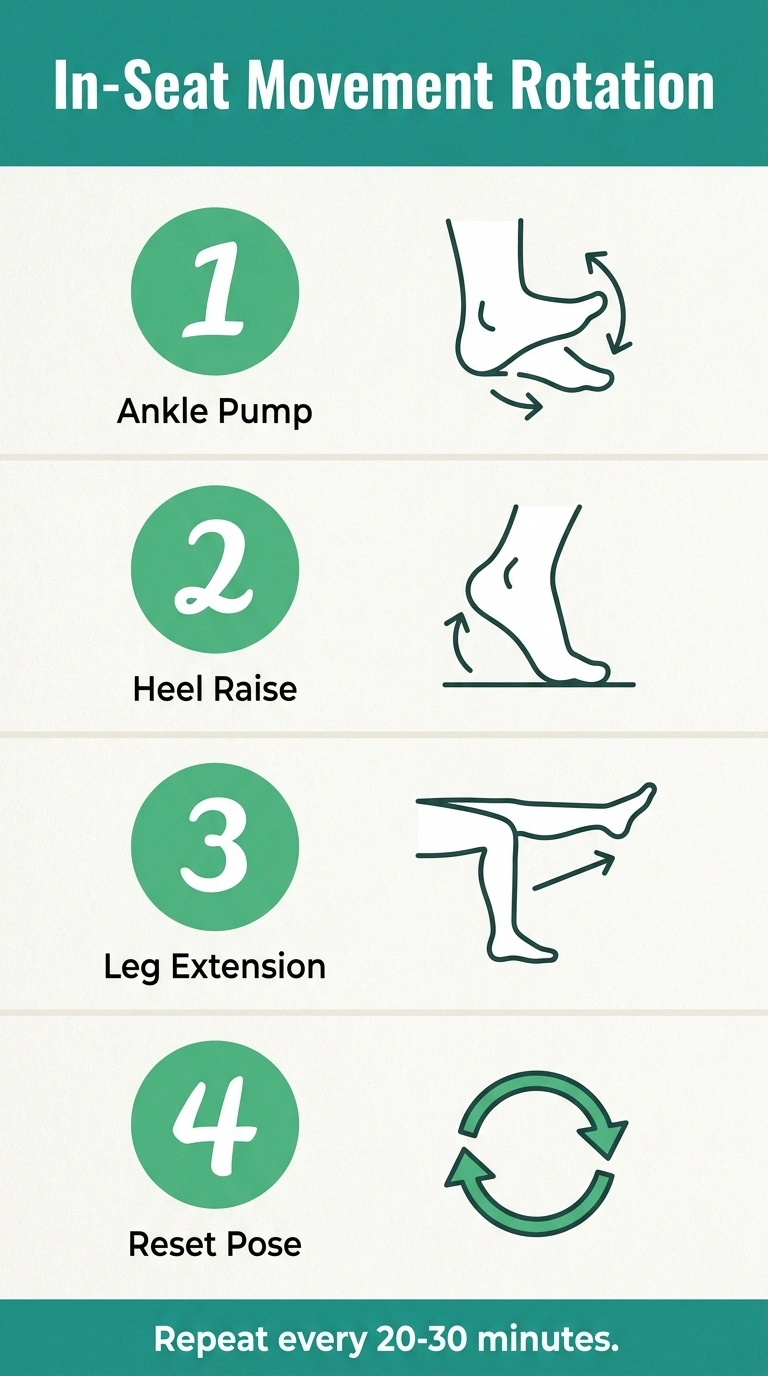
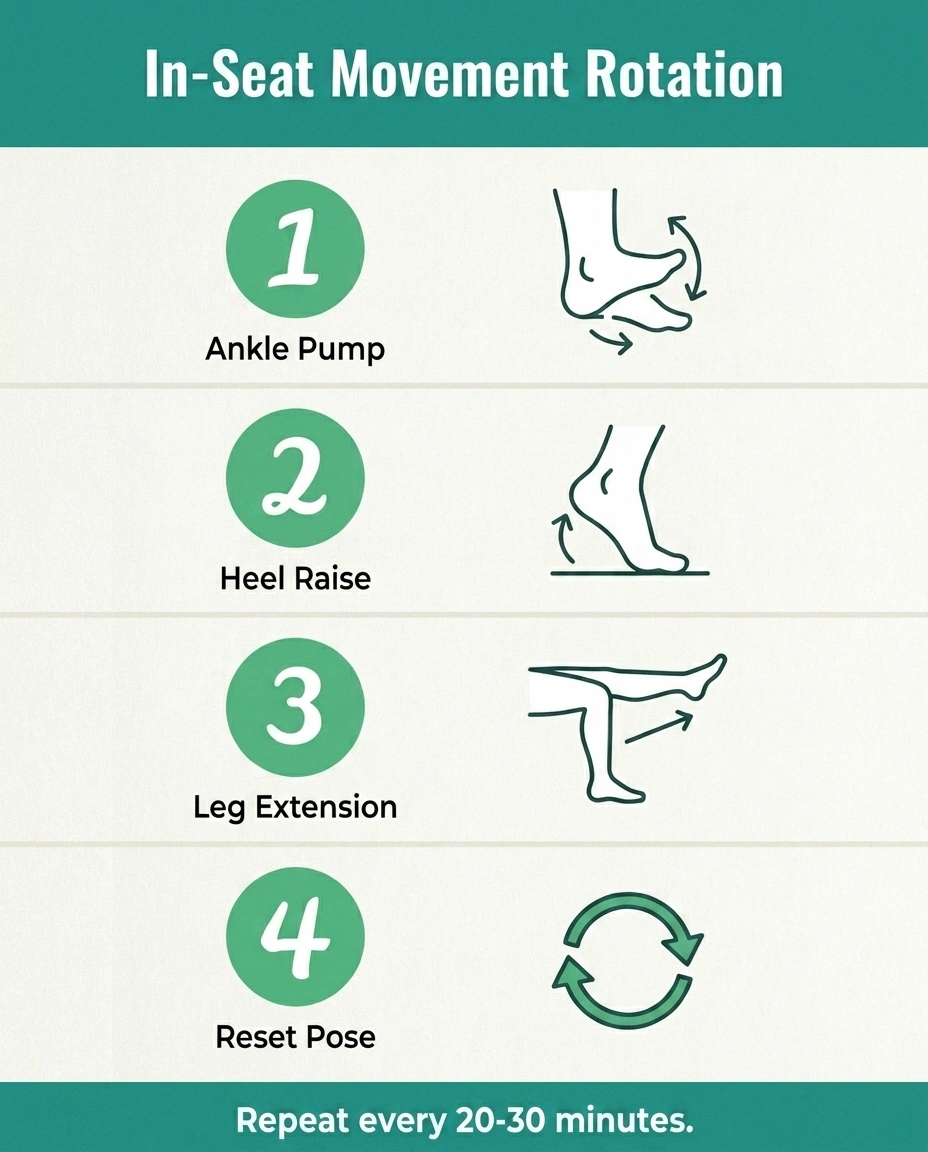
Once you're settled in, the goal isn't to sit perfectly still. The goal is to keep blood and nerves moving without pulling focus from the film. Small, quiet movements every 20 to 30 minutes do wonders. Most of these are invisible to anyone watching the screen.
Invisible In-Seat Movements (Every 20-30 Minutes)
Ankle pumps. Slowly point your toes forward, then pull them back toward your shin. Ten times each foot. Nobody can see you doing this in a dark theater.
In-seat calf raises. Press the balls of both feet down, lift your heels off the floor, hold for three seconds, lower. Ten reps. Two sets if you're feeling ambitious.
Knee extensions. Slide your foot forward and straighten one leg out for ten seconds, then switch. Aisle seat is great for this because the leg has somewhere to go.
The position shift. Every twenty minutes, change something — uncross your legs, rotate your hips slightly, shift your weight, stand for five seconds during a loud action scene if you can. Set a silent vibration timer on your phone for every 25 minutes. After a couple of movies, you'll do it without the timer.
If you're a passenger on the way home, the same logic applies. A few mid-ride adjustments can save your evening, especially if the drive is long.
The Cold Air Problem
I cannot tell you how much harder a chilly theater is on neuropathy until you've felt it. The cold seems to amplify every sensation, and once your feet get cold, getting them warm again mid-movie is nearly impossible. Plan for the temperature the way you'd plan for outdoor weather — because indoors, it might as well be.
I always bring a layer I can pull over my lap, even in summer. A cardigan, a light scarf doubled into a lap throw, the rolled blanket I mentioned earlier. Toe-covered shoes always; never sandals or open-back slip-ons in a theater. Compression or warm cotton socks under your shoes. If you're someone whose feet run especially cold, the same strategies that help with cold-weather flares apply here. Treat the theater like January.
Bathroom Trips and Aisle Navigation in the Dark
This one used to terrify me. Standing up after sitting for an hour, my feet are at their most numb, my balance is off, and now I'm walking down a sloped, dimly lit aisle with cup-holders sticking out and other people's feet in the path. It's a setup for a fall.
What helped: I always do a “wake-up” routine before standing. Thirty seconds of ankle pumps and calf raises in my seat to get the blood moving. Then I stand slowly with one hand on the seat back for balance. I let my legs catch up before I take a step. The aisle seat means I'm two feet from the wall the whole way down, and I keep one hand brushing the wall or the railing. The same balance principles that apply to any uneven surface apply here.
If your theater has stadium seating with stairs, take them slowly, one foot to a step until you're at the bottom. Don't be embarrassed about it. Nobody is watching you. They're watching the movie.
The Drive Home
One thing people forget: the movie isn't over when the credits roll. If you're driving home, you've got another twenty to forty minutes of sitting, sometimes more, often at night. Numb feet on pedals can be a real safety concern. I always do a few minutes of standing and walking in the lobby before I leave — a short loop around to the bathroom and back wakes everything up. A few simple checks before you turn the key are worth the extra two minutes. If your feet aren't communicating clearly with the pedals, don't drive — sit in the lobby for ten minutes or call someone.
When to Skip the Theater Entirely
I love the movies. I love a big screen and a dark room and the way you forget about everything else for two hours. But some nights, the theater isn't the right call, and I've made peace with that.
“Aisle seat at a recliner theater on a Tuesday afternoon is one valid answer. Streaming on the couch with the pause button is another. Both count.”
If you're already in a flare, if you didn't sleep well, if your feet have been talking all day, streaming wins. Build a small at-home setup that competes — a recliner or a couch corner with proper foot elevation, a soft blanket, a good lamp, a pause button when you need to walk for a minute. The pause button alone is enough reason. I've watched some of my favorite films of the last few years on my couch with my feet up, hitting pause every thirty minutes for a stretch. The film didn't suffer. I didn't either.
The point of all of this isn't to force yourself back into a perfect movie-going experience. The point is to keep going to the movies in the way that works for the body you have right now. Sometimes that's an aisle seat at a recliner theater on a Tuesday afternoon. Sometimes it's the couch. Both count.
One More Thing
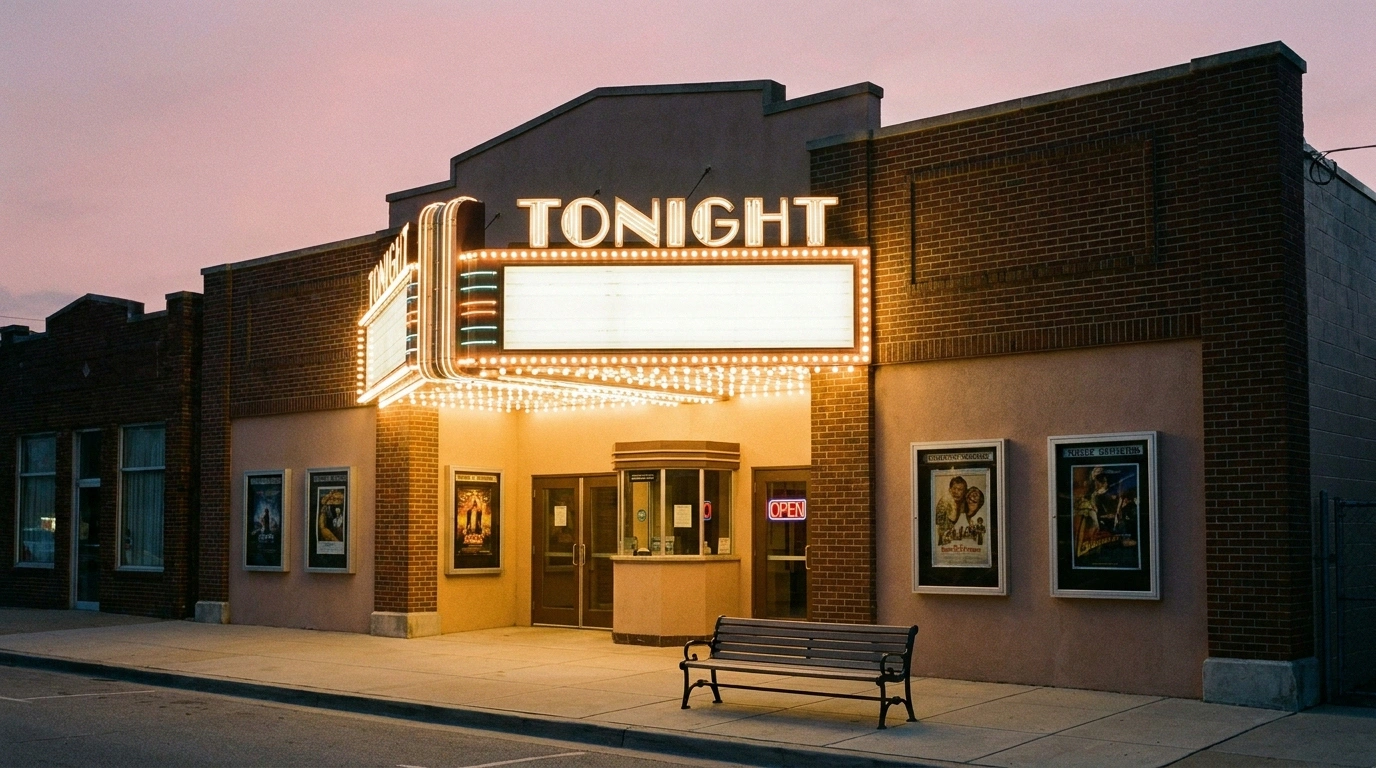
The first time I went back to a theater after my “left at 40 minutes” night, I was nervous. I picked a film I really wanted to see, booked an aisle seat at the recliner theater across town, packed my little kit, and gave myself permission to leave at any point with no judgment. I made it through the whole film. And about ninety minutes in, I realized I hadn't been thinking about my feet for a while. That moment — that little stretch of forgetting — was the whole point.
You don't need a perfect plan. You just need a few small adjustments and a willingness to engineer the night around your nerves instead of against them. The rest is the movie.
Frequently Asked Questions
Is sitting through a movie bad for neuropathy?
Long, unbroken sitting can worsen neuropathy symptoms because it reduces circulation and lets blood pool in the legs. A two-hour movie is a long time, but it's not damaging if you take small in-seat movement breaks every 20 to 30 minutes. Ankle pumps, calf raises, and position shifts go a long way. The bigger problem is total stillness, not the activity itself.
What's the best seat at a movie theater for neuropathy?
An aisle seat at the end of a row is almost always the best choice. It lets you extend your outside leg, stand briefly, leave for the bathroom without disturbing anyone, and reposition freely. If your theater has accessible or companion seating, those seats often have extra legroom and don't require proof of disability to book. Recliner theaters are the gold standard if one is available to you.
Can I bring a cushion or blanket to the movies?
Yes. Most theaters allow personal items including small cushions, lap blankets, and water bottles. A folded fleece throw works double-duty as a cushion under you and a layer over your lap when the air conditioning gets aggressive. If you're worried, call the theater ahead of time, but in practice no one has ever stopped me.
Should I wear compression socks to the movies?
Light to moderate graduated compression socks can help reduce the swelling and heaviness that come with long sitting. However, if you have diabetic neuropathy, peripheral arterial disease, or significantly reduced sensation in your feet, ask your doctor before using compression. The wrong compression level can worsen some conditions. When cleared by a doctor, compression worn during a 2-3 hour movie is similar to wearing them on a long flight.
How do I book accessible seating at a movie theater?
Most major chains let you select accessible or companion seats directly through their app or website — they're marked on the seating map. Under the ADA, theaters cannot require proof of disability to book one, and you can purchase up to three additional companion seats in the same row. If the website is confusing, call the theater directly. They can usually book accessible seating over the phone.
What if I have to leave in the middle of the movie?
Stand slowly, keep one hand on the seat back, do a few ankle pumps before taking a step, and use the wall or railing for support on the way out. There is no shame in leaving. Pop into the lobby, walk for five minutes, use the bathroom, and decide whether to go back in. Many theaters will let you finish the film at a later showing if you ask the manager. And if streaming is the better call that night, that's a perfectly good answer too.
Are recliner theaters really worth the extra cost?
For most people with neuropathy, yes. The ability to elevate your legs, shift positions, and stretch in your seat makes a meaningful difference in how you feel after the credits. AMC's recliner houses, Cinépolis, Alamo Drafthouse, and Regal RPX all offer powered recliners. The price difference is usually a few dollars per ticket. If you can drive a little farther for a recliner showing, it's almost always worth it.
About the Author