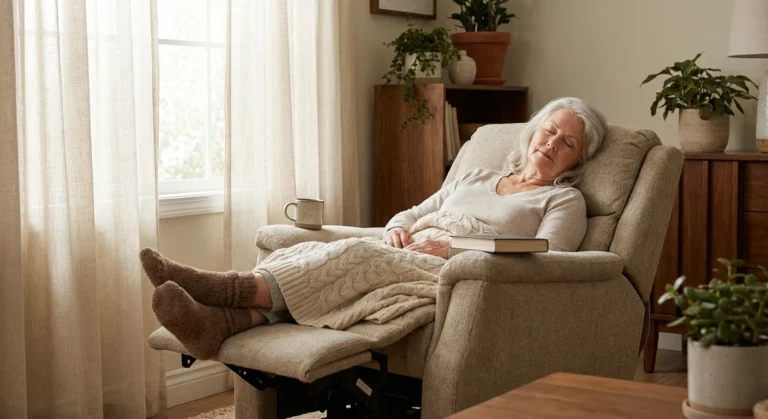
I spent thirty years building toward the retirement I thought I wanted: travel, golf, long days in the garden, volunteering at the community center. Then neuropathy rewrote the script. The burning in my feet made golf rounds agonizing. Long flights became exercises in pain management. Even gardening — something I'd done my whole life — required more physical capacity than my body could reliably deliver. I wasn't losing my retirement. I was learning that the one I'd imagined needed to be rebuilt from the ground up.
If you're approaching retirement with neuropathy — or if a neuropathy diagnosis has upended retirement plans you'd already set in motion — you're navigating something that very few financial planners, career counselors, or retirement guides address. This article bridges that gap. We'll cover the financial, physical, lifestyle, and emotional adjustments that can help you build a retirement that works with your condition, not against it.
How Neuropathy Changes the Retirement Equation
Retirement planning assumes a certain baseline of physical capability. Most advice presumes you'll be able to travel freely, stay active, and live independently for the foreseeable future. Neuropathy disrupts each of those assumptions in specific, practical ways.
Neuropathy is a progressive condition for many people. What starts as occasional tingling may eventually become persistent pain, significant numbness, balance impairment, and increased fall risk. Planning for retirement with neuropathy means planning not just for today's symptoms, but for the possibility that they may worsen over the next 10 to 30 years.
This isn't about pessimism — it's about building flexibility into every aspect of your plan. The retirees who adapt most successfully to chronic conditions are those who plan for multiple scenarios rather than a single vision of “the good retirement.”
Financial Planning Adjustments
Neuropathy introduces medical costs and lifestyle modifications that standard retirement calculators don't account for. Understanding these costs now allows you to plan realistically.
Healthcare Costs You May Not Have Budgeted For
The ongoing cost of managing neuropathy goes well beyond a neurologist visit and a prescription. Consider budgeting for:
☐ Neurologists and pain specialists in-network
☐ Physical therapy visit limits sufficient for ongoing care
☐ DME coverage for TENS units, braces, mobility aids
☐ Medigap or supplemental plan for frequent visit copays
☐ Therapeutic shoe program coverage (diabetic patients)
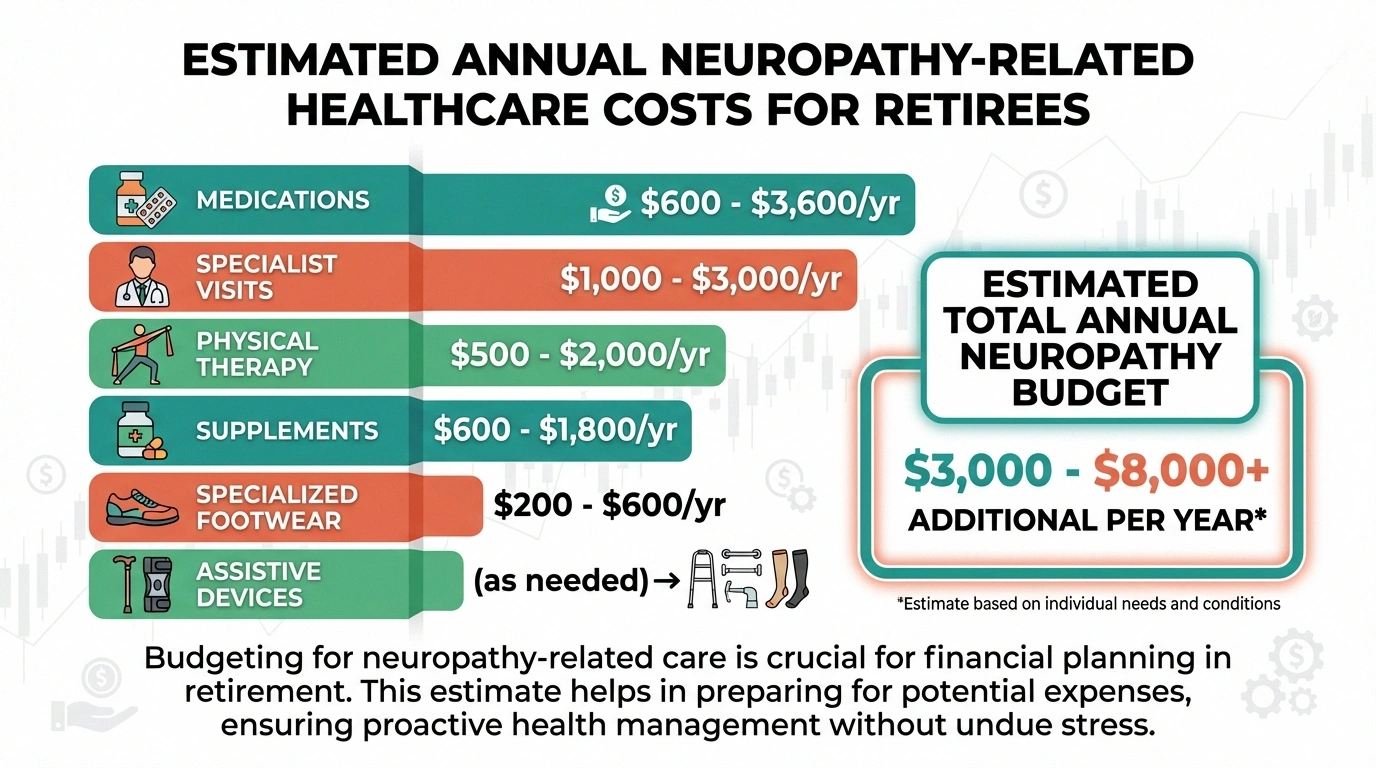
- Medications — Gabapentin, pregabalin, duloxetine, and other neuropathy medications can cost $50-$300+ per month even with insurance. If your medication regimen changes over time, costs may increase
- Specialist visits — Regular neurology appointments, EMG/nerve conduction studies, and lab work add up. Budget $1,000-$3,000 annually for specialist care after insurance
- Physical therapy — Physical therapy for neuropathy may be ongoing rather than a one-time course. Medicare covers a portion, but copays and out-of-pocket limits apply
- Supplements — Quality supplements like alpha-lipoic acid, B vitamins, and magnesium aren't always covered by insurance. Budget $50-$150 per month
- Specialized footwear — Therapeutic shoes range from $100-$300 per pair and typically need replacing every 6-12 months. Medicare's therapeutic shoe program covers one pair annually for qualifying diabetic patients
- Assistive devices — Canes, walkers, grab bars, compression gloves, and home modifications may be needed as symptoms progress
Medicare and Insurance Navigation
Navigating insurance with neuropathy requires attention to details that healthy retirees can ignore. When choosing Medicare plans, look specifically at:
- Drug formulary coverage — Ensure your neuropathy medications are on the formulary at a reasonable tier
- Specialist network — Confirm that neurologists and pain management specialists are in-network
- Physical therapy limits — Some Medicare Advantage plans cap therapy visits more aggressively than Original Medicare
- Durable medical equipment (DME) coverage — For TENS units, braces, and mobility aids
- Supplemental insurance — A Medigap plan can significantly reduce your out-of-pocket exposure for the frequent medical visits neuropathy often requires
When to Consider Early Retirement
Some careers become unsustainable with progressive neuropathy. Jobs requiring prolonged standing, precise hand work, heavy lifting, or extensive driving may become dangerous or impossible. If you're considering early retirement due to neuropathy, weigh these factors:
✅ Employer health insurance continues
✅ Social connection maintained
✅ Higher Social Security benefit
⚠️ Requires workplace willing to accommodate
✅ More time for symptom management
✅ SSDI may be available if disabled
⚠️ Permanent SS benefit reduction
⚠️ Insurance gap before age 65
- Social Security timing — Taking benefits before full retirement age means a permanent reduction. If possible, bridge the gap with savings rather than claiming early
- SSDI option — Social Security Disability Insurance may be available if neuropathy prevents you from working. SSDI converts to regular retirement benefits at full retirement age
- Health insurance bridge — If you retire before Medicare eligibility (age 65), you'll need to cover the insurance gap. ACA marketplace plans, COBRA, or a spouse's employer plan are typical options
- Employer accommodations — Before assuming early retirement is necessary, explore workplace accommodations under the ADA that might extend your working years
Reimagining Retirement Activities
This is where the emotional work of retirement adjustment happens. If the activities you planned around become painful or impossible, you need to grieve that loss while simultaneously building something new. Both parts of that process are legitimate and necessary.
Travel Adjustments
Neuropathy doesn't end travel — but it changes how you plan it. Strategies that experienced neuropathy travelers use:

• Wear compression socks during all flights
• Carry medications in carry-on only (never checked bags)
• Choose accessible ground-floor hotel rooms
• Get travel insurance with medical coverage for flare-ups
• Consider cruise travel — minimal walking, on-board medical
- Shorter trips, more frequent — Three 5-day trips are often better than one 15-day trip when fatigue management is a factor
- Cruise travel — Eliminates the constant packing/unpacking, reduces walking demands, and provides on-board medical facilities
- Accessible accommodations — Book ground-floor rooms, roll-in showers, and locations near elevators. Research these before booking, not after arrival
- Flight preparation — Compression socks, aisle seats, frequent movement breaks, and medication timing can make air travel manageable
- Travel insurance with medical coverage — Essential for covering emergency medical care abroad and potential trip cancellations due to neuropathy flare-ups
Exercise and Active Pursuits
Physical activity remains crucial in retirement — arguably more so with neuropathy, since regular movement may help slow disease progression and maintain nerve function. The key is matching activity to capability:
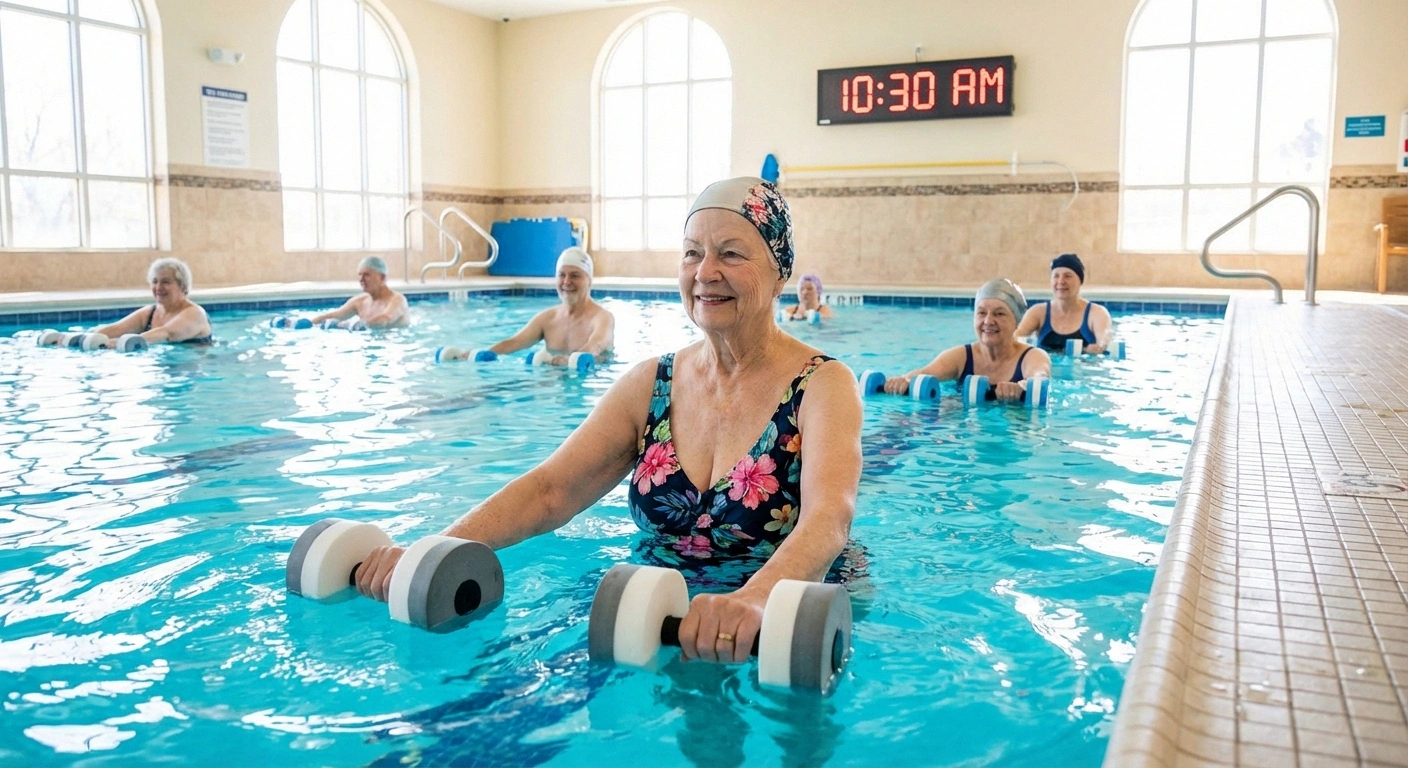
- Swimming and water aerobics — Water supports body weight, reduces fall risk, and provides gentle resistance. Many retirees with neuropathy find pool-based exercise to be the single most sustainable activity
- Chair yoga and adaptive yoga — Maintains flexibility and balance without standing-intensive poses
- Recumbent cycling — Provides cardiovascular exercise without the balance demands of a traditional bicycle
- Seated strength training — Maintains muscle mass and functional strength, both critical for independence
- Golf adaptations — Use a cart for all holes, wear proper footwear, play 9 instead of 18, and consider evening rounds when neuropathy pain is often less severe
Hobbies and Creative Pursuits
Many fulfilling hobbies can be adapted for neuropathy or chosen specifically because they work well with the condition:

- Photography — Can be done seated or with minimal walking. Adaptive camera grips help with hand numbness
- Writing and journaling — Voice-to-text software eliminates typing difficulties. A symptom journal can double as a creative and medical practice
- Bird watching — Minimal physical demands, deeply absorbing, and can be done from your backyard or a parked car
- Adaptive gardening — Raised beds, ergonomic tools, and seated gardening methods keep this popular retirement activity accessible
- Music — Instruments can be adapted for reduced hand sensation. Singing, listening groups, and music appreciation require no fine motor skills
- Digital skills — Online courses, genealogy research, video calling with grandchildren — screen-based activities are often neuropathy-friendly
Housing and Living Arrangement Decisions
Where and how you live in retirement becomes a medical decision as much as a lifestyle one when neuropathy is in the picture.
Aging in Place vs. Downsizing
If you plan to stay in your current home, assess it through the lens of progressive neuropathy:
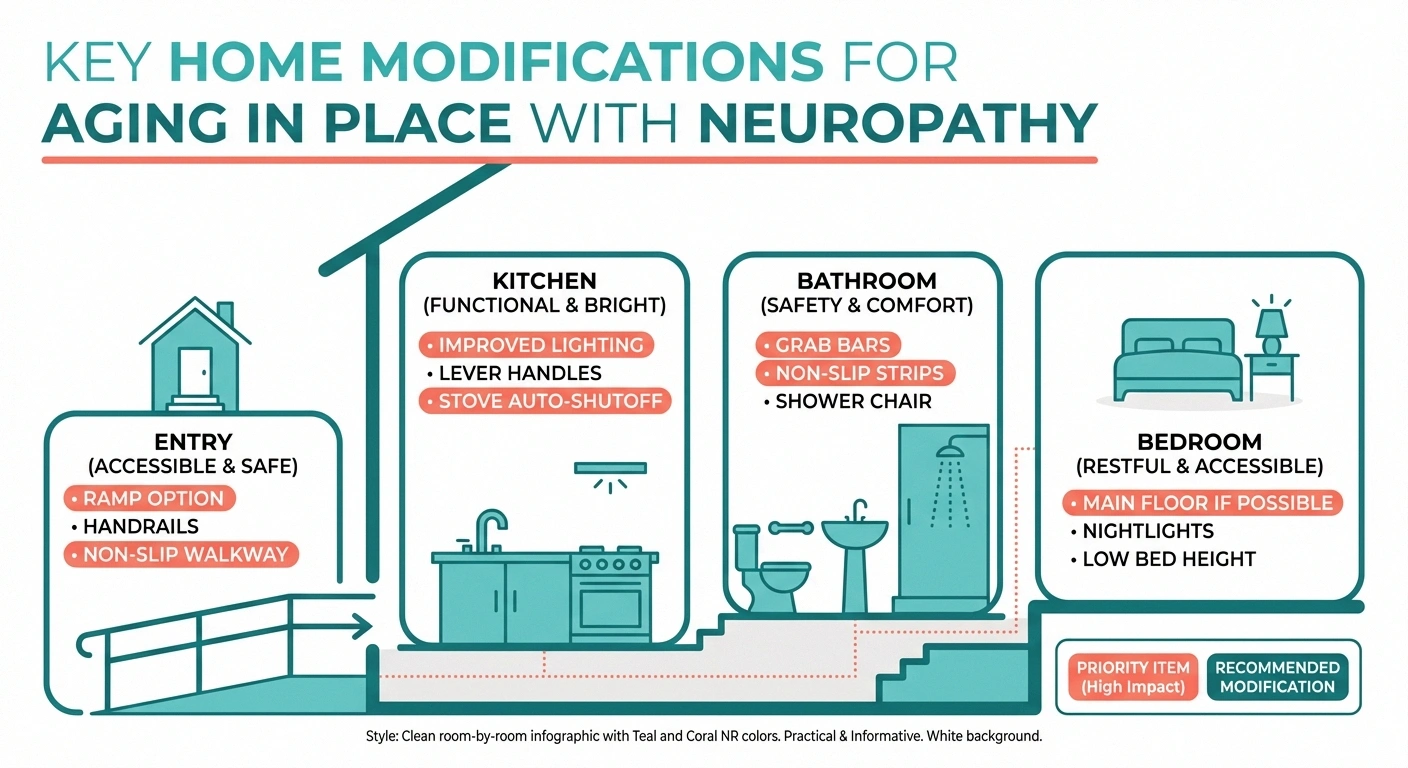
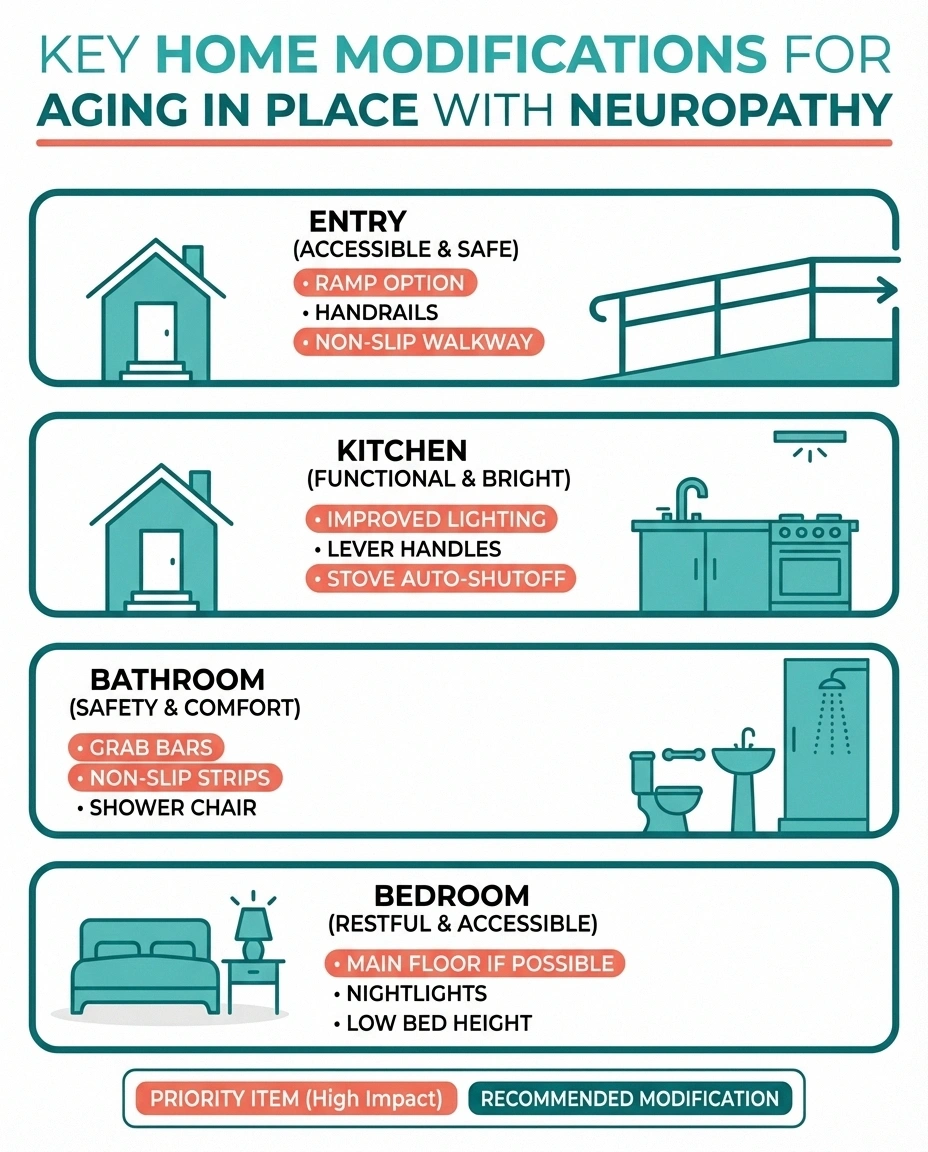
- Are bedrooms and bathrooms on the main floor, or will stairs become a problem?
- Can hallways accommodate a walker if you eventually need one?
- Is the neighborhood walkable with flat, even sidewalks?
- Are medical facilities reasonably close?
Home modifications — grab bars, non-slip flooring, improved lighting, fall prevention adaptations — are an investment that may allow you to stay in place longer. Consider making these modifications early, while you're physically able to manage the disruption of construction.
Climate and Location Considerations
Climate matters more than most people realize when neuropathy is a factor. Cold weather worsens neuropathy symptoms for many patients, while extreme heat can also trigger flare-ups. Moderate climates with mild winters and warm (but not scorching) summers tend to be most comfortable. If you're considering a retirement relocation, factor your specific neuropathy triggers into the decision alongside the usual considerations of cost, proximity to family, and lifestyle amenities.
Relationships and Social Life in Retirement
Retirement can be isolating even without a chronic condition. Add neuropathy — with its fatigue, unpredictable flare-ups, and activity limitations — and the risk of social withdrawal multiplies.

Proactive planning matters. Before you retire, start building the social infrastructure you'll rely on:
- Neuropathy support groups — Connect with people who understand your experience. Both in-person and online groups exist
- Volunteer work that fits your capabilities — Phone-based volunteering, mentoring, serving on nonprofit boards, or library assistance often require minimal physical exertion
- Faith or community organizations — Churches, synagogues, community centers, and service clubs provide social structure
- Communicate with your partner — If you're retiring as a couple, neuropathy changes the dynamic. Discuss expectations openly
Mental Health and Identity Shifts
Here's what nobody tells you about retiring with a chronic condition: the identity adjustment is harder than the physical adjustment. If your self-image was built around being active, capable, and independent, neuropathy may force a reckoning that goes deeper than “what will I do with my time?”

Grieving the retirement you expected is a legitimate, necessary process. Allow yourself to feel the loss of the golf game, the European walking tour, the ability to chase grandchildren around the yard without pain. That grief doesn't mean you can't build something meaningful — but skipping past it usually means it resurfaces as anger, withdrawal, or depression.
Consider working with a therapist or counselor, particularly one experienced in chronic illness adjustment. Cognitive behavioral therapy (CBT) has strong evidence for helping people with chronic pain develop more adaptive thought patterns and build meaning in changed circumstances.
Creating a Neuropathy-Adapted Retirement Plan
Here's a practical framework for building a retirement plan that accounts for neuropathy at every level:

- Audit your current symptoms honestly — What can you do comfortably today? What requires workarounds? What's becoming harder?
- Project potential progression — Talk to your neurologist about realistic scenarios for the next 5, 10, and 20 years. Use neuropathy prognosis information to inform your planning
- Build financial flexibility — Increase your healthcare and contingency reserves. Plan for higher-than-average medical costs and potential home modifications
- Design adaptable activities — Choose hobbies, exercise routines, and social activities that can be scaled up or down based on your symptom levels
- Prepare your home — Make accessibility modifications proactively, not reactively
- Build your support network — Identify medical providers, support groups, helpers for bad days, and emergency contacts specific to neuropathy needs
- Address the emotional dimension — Work with a mental health professional to process grief and build new sources of identity and purpose
- Review and adjust annually — Your symptoms, finances, and priorities will shift. Build an annual retirement plan review into your calendar

Frequently Asked Questions
Should I retire early because of neuropathy?
Early retirement should be considered if neuropathy makes your job unsafe, causes unmanageable pain during work hours, or if continuing to work is accelerating your symptoms. However, explore workplace accommodations and modified roles before leaving. Working longer — even part-time — improves both financial security and social connection. Consult with a financial planner who can model different retirement timing scenarios.
How much extra should I save for healthcare costs with neuropathy?
Plan for an additional $3,000 to $8,000 annually above standard healthcare budgets for neuropathy-related expenses including medications, specialist visits, physical therapy, supplements, and specialized footwear. If symptoms are progressing, also budget for home modifications ($5,000 to $20,000 one-time) and potential assistive devices ($500 to $3,000 as needed).
Can I still travel in retirement with neuropathy?
Absolutely. Most neuropathy patients can continue traveling with proper planning. Key strategies include choosing accessible accommodations, taking shorter trips more frequently, using compression socks during flights, booking aisle seats for movement breaks, carrying extra medication, and purchasing travel insurance with medical coverage. Cruise travel is particularly well-suited to neuropathy because it minimizes walking demands while offering on-board medical facilities.
What retirement activities work well with neuropathy?
Water-based exercise (swimming, water aerobics), photography, bird watching, writing, adaptive gardening with raised beds, genealogy research, online learning, volunteer mentoring, music appreciation, and social groups are all well-suited to life with neuropathy. The key is choosing activities that provide meaning and engagement while accommodating your specific symptom profile.
Does neuropathy qualify me for disability benefits in retirement?
Neuropathy may qualify you for Social Security Disability Insurance (SSDI) if it prevents substantial gainful activity before retirement age. After full retirement age, SSDI converts to standard retirement benefits. Veterans may also qualify for VA disability benefits if neuropathy is service-connected. Additionally, some long-term disability insurance policies and state programs may provide benefits. Consult with a disability attorney or advocate familiar with neuropathy cases.
Where should I retire if I have neuropathy?
Moderate climates with mild winters tend to be most comfortable for neuropathy patients, since cold weather worsens symptoms for many people. Prioritize locations near quality neurological care, with flat terrain for walking, and accessible community amenities. Proximity to family and your existing support network often matters more than climate, since isolation is one of the biggest quality-of-life risks in retirement with chronic illness.

Building a Retirement That Fits Your Reality
The retirement you planned may not be the retirement you get. That's a hard truth, and you're allowed to find it unfair. But the retirees I've spoken with who are living well despite neuropathy all share one quality: they grieved what they lost, then redirected their energy toward what was still possible.
Neuropathy narrows some doors and opens others you might never have considered. The person who gave up golf discovered watercolor painting. The former hiker became a birding expert. The world traveler found that her grandchildren lived 20 minutes away and she'd been too busy to notice.
Plan for the condition. Prepare your finances. Adapt your living situation. But don't stop there. The most important retirement adjustment isn't financial or practical — it's the willingness to let go of one vision of a good life and build another. Your nerves may be damaged, but your capacity for a rich, meaningful retirement isn't.
About the Author