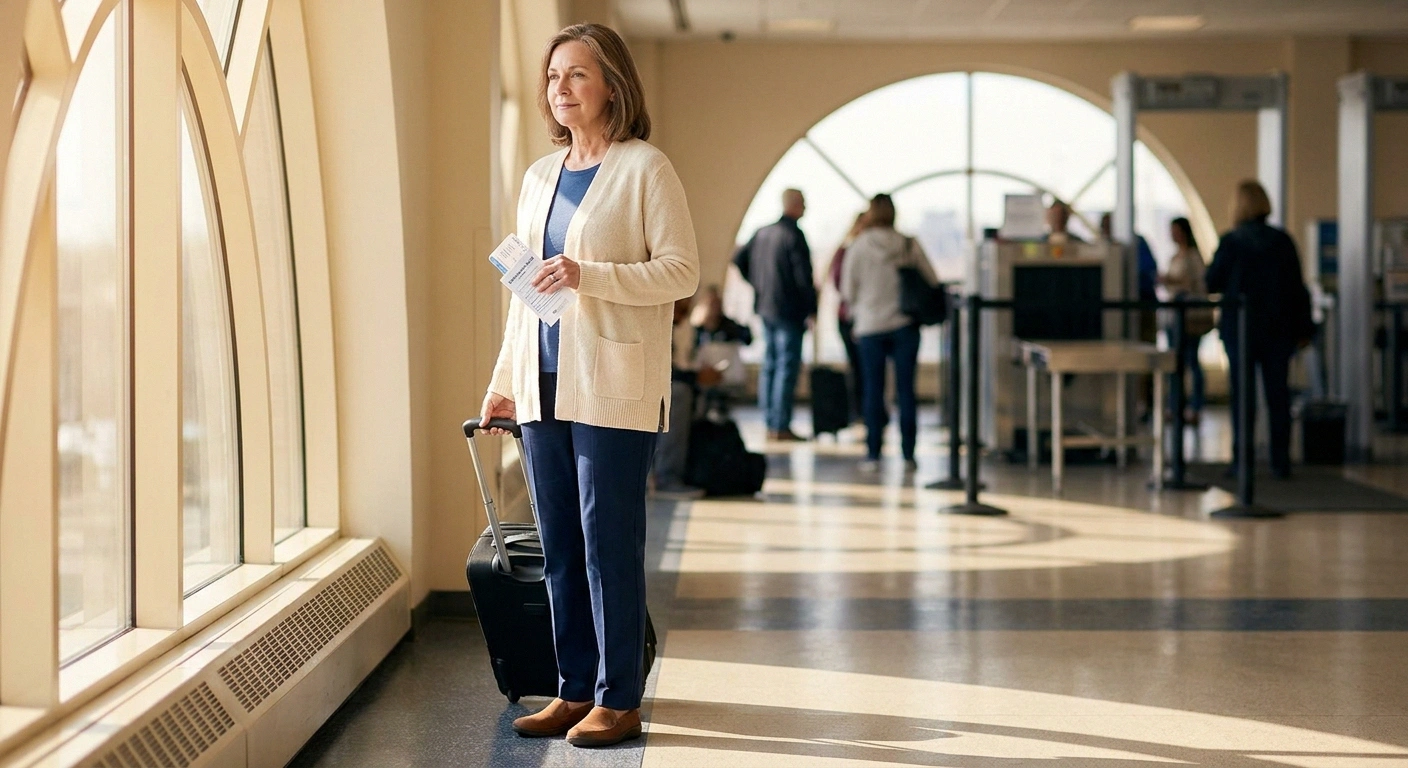
The first time I flew after my neuropathy got significantly worse, I cried in the security line. Not from pain, exactly, although standing in that long zigzag line in unsupportive shoes had brought my feet to a roar. I cried because I felt invisible. Because I didn't know how to ask for what I needed without sounding rude or making the people behind me sigh. Because I'd never flown as someone whose body needed accommodations, and the rules of the encounter felt new and confusing.
I am here to tell you, six years and many flights later, that airport security with neuropathy can be much smoother than that first awful experience. There are programs designed exactly for travelers like us. There are concrete things you can ask for, words you can use, and tools you can carry. The TSA isn't perfect, but it has resources we are entitled to use, and once you know about them, the experience changes considerably.
This guide is everything I wish I had known before that first flight. We'll cover the programs that exist for travelers with neuropathy, what to do before you arrive, what to expect at the checkpoint, what your rights are around screening, and how to handle medications, mobility aids, and medical devices. None of this requires arguing with anyone. Most of it just requires knowing what's available.
Programs Designed for Travelers Like Us

The most important thing to know is that the TSA has formal programs specifically for travelers with disabilities, chronic medical conditions, and accessibility needs. These aren't favors anyone is doing for you. They are services you are entitled to use.
TSA Cares is the call to make 72 hours before you fly
Free service for travelers with disabilities and medical conditions. They arrange a Passenger Support Specialist to walk you through screening at your own pace.
📞 (855) 787-2227 · weekdays 8am–11pm ET, weekends 9am–8pm ET
TSA Cares
TSA Cares is the TSA's free help line for travelers who need assistance navigating airport security. You call them 72 hours before your flight, tell them about your neuropathy and any related concerns, and they coordinate accommodations at your departure airport.
The phone number is (855) 787-2227. They're open weekdays from 8 a.m. to 11 p.m. Eastern time, and weekends and holidays from 9 a.m. to 8 p.m. Eastern time.
What the call does is set up a Passenger Support Specialist (a TSA officer with extra training in working with travelers who have disabilities or medical conditions) to meet you at the checkpoint and walk you through screening at your own pace. You'll usually be asked to arrive at security a bit earlier — typically an hour and a half to two hours before your flight — to give the specialist time to find you.
Passenger Support Specialists
Even if you didn't call ahead, you can ask for a Passenger Support Specialist when you arrive at the checkpoint. Walk up to any TSA officer at the lane entrance and say, “I have a medical condition that affects my screening. May I please have a Passenger Support Specialist or a Supervisory TSA Officer assist me?” They'll find one. This works at most major airports, though smaller airports may not have a specialist on duty for every shift.
TSA PreCheck
If you fly even a few times a year, TSA PreCheck is genuinely worth considering. The application costs around $77.95 and lasts five years (about $15 per year). Once approved, you go through a separate, faster lane and you don't have to remove shoes, belts, light jackets, laptops, or 3-1-1 liquids. For someone with neuropathy, the shoe-removal alone is reason enough.
The application requires an in-person appointment at an enrollment center for a quick interview and fingerprint. You can find centers and apply at the official TSA PreCheck website (search for it directly — don't trust look-alike sites that charge extra fees).
The TSA Notification Card
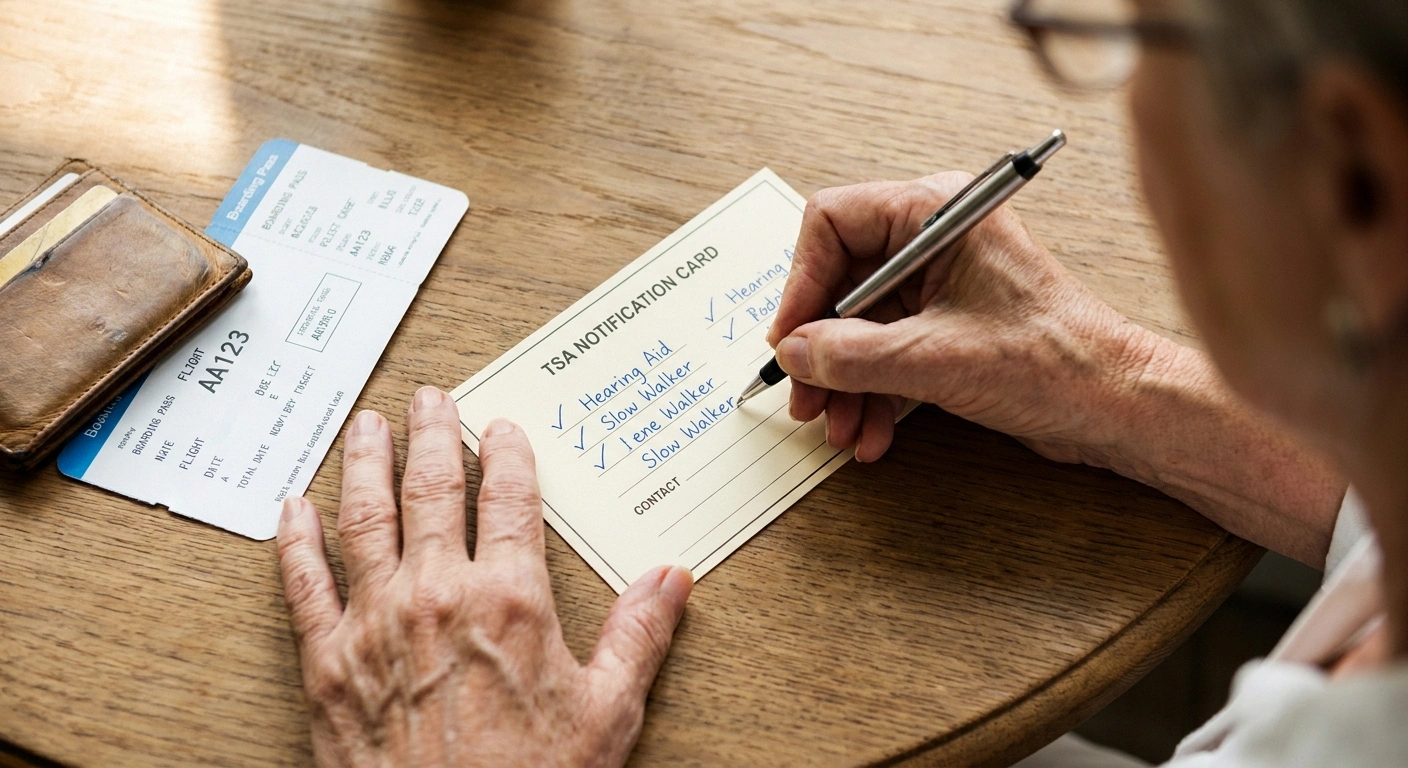
This is one of the most useful tools available, and it's free. The TSA Notification Card is a small, printable PDF that you fill out with your medical condition and present discreetly to a screening officer. It lets you communicate that you have a condition affecting screening without saying it out loud in front of other travelers.
Three TSA Tools to Have Ready
You can find and download it from the TSA website (search “TSA notification card”). Print one out, fill in the relevant fields about your neuropathy and any devices you carry, and tuck it in your boarding pass holder or wallet. When you reach the officer, you can simply hand it over.
The card doesn't change what TSA can or must do — they can still screen anything they need to screen — but it makes communication smoother and quicker.
Before You Even Pack
A little planning at home saves a lot of stress at the airport. Here are the things worth thinking about days before your flight, not at the checkpoint.
Medications and Prescriptions
Pack your neuropathy medications in your carry-on, not your checked bag. Checked bags can be delayed or lost; you don't want to land in a different city without your gabapentin or Lyrica. Keep medications in original prescription bottles when possible — it's not strictly required by TSA, but it makes any questions easier.
Liquid medications larger than 3.4 ounces are allowed in carry-on luggage if you declare them at the start of screening. This includes liquid pain medications, lidocaine sprays, eye drops, and similar. Just say at the front of the checkpoint: “I have liquid medications larger than 3.4 ounces.”
Medications themselves don't generally trigger restrictions even if they're scheduled prescriptions. Gabapentin, pregabalin, duloxetine, amitriptyline, tramadol — all standard travel-friendly. If you're carrying opioid medications, the same applies, but the original prescription bottle with your name matters more.
Mobility Aids and Devices
Canes, walkers, rollators, wheelchairs, and scooters are all welcome at the checkpoint. They'll go through x-ray screening (if foldable) or be hand-inspected (if not). You can keep using your aid right up until screening and have it back as soon as it's cleared. If you can't safely transfer for screening, the officer will work around your aid.
If you use a TENS unit, insulin pump, continuous glucose monitor, or any other small medical device, you can either wear it through screening or remove it. If you wear it through, you may need a brief hand swab or wand inspection. Tell the officer up front: “I'm wearing a TENS unit.”
Compression Socks
You don't need to remove compression socks for screening. They're considered ordinary clothing. If you have them on, they stay on.
Choose Your Shoes Carefully
If you don't have PreCheck and have to remove your shoes, choose ones that are easy to slip off and back on. Slip-on loafers, soft sneakers without elaborate lacing, or simple flats work well. Avoid boots, intricate sandals, or anything that requires balance to remove. Whatever you wear, make sure they're cushioned and supportive — you'll be on your feet a long time before, during, and after the flight.
What to Expect at the Checkpoint
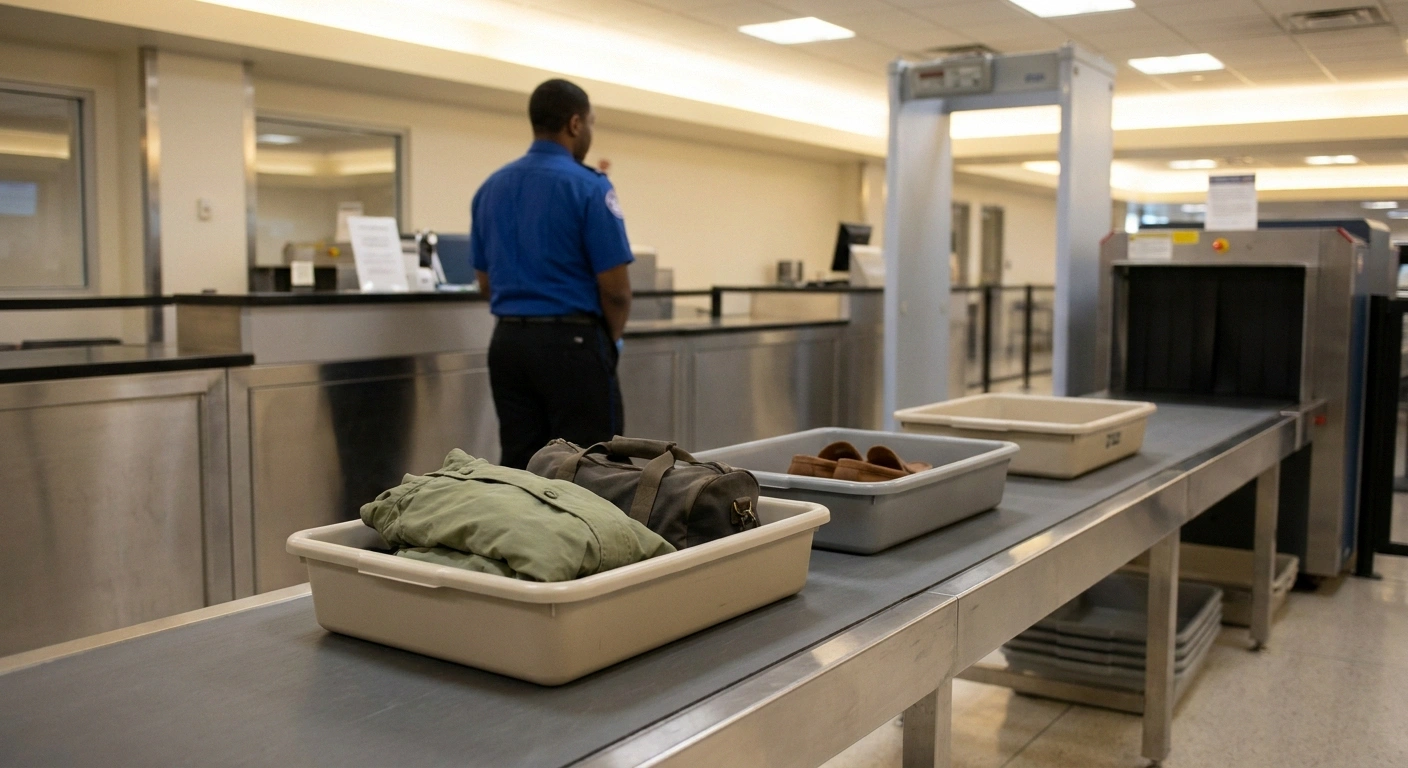
Knowing the standard flow takes a lot of the anxiety out of it.
Standard Screening Checklist
- Carry-on bags
- Personal items
- 3-1-1 liquids (separate)
- Laptops, e-readers
- Shoes (if no PreCheck)
- Heavy outerwear
- Compression socks
- Worn medical devices (declare)
- Mobility aids (handled separately)
- Light layers
- With PreCheck: shoes, belt, light jacket
You'll arrive at the start of the screening line and have your boarding pass and ID checked. Then you'll move into the screening area itself, where you'll place items on the conveyor belt to go through x-ray.
What goes on the belt:
- Carry-on bags
- Personal items (purse, small backpack)
- 3-1-1 liquids in a clear bag (if you don't have PreCheck)
- Laptops or e-readers (if you don't have PreCheck)
- Your shoes (if you don't have PreCheck and you're under 75)
- Outerwear like coats and heavy jackets
What stays on you:
- Compression socks
- Medical devices you're wearing (with declaration)
- Mobility aids (handled separately)
- Anything if you have PreCheck — shoes, belt, light jacket all stay
You'll then walk through one of two screening machines: either a metal detector (a doorway you walk through) or an Advanced Imaging Technology body scanner (a chamber where you stand briefly with arms raised). Most major airports use body scanners as the primary screening method.
Your Rights Around Screening
This is the section I most wish I had known about during my first stressful airport experience. You have specific rights that many travelers don't realize they can use.
What you're entitled to ask for
- A pat-down instead of the body scanner
- A chair to sit in during screening
- Keep weight on your mobility aid during a pat-down
- Private screening for any reason
- Same-gender officer for a pat-down
- A supervisor if a request isn't being honored
You Can Request a Pat-Down Instead of the Body Scanner
If you can't comfortably stand still in the body scanner, can't raise your arms, or simply prefer not to use it, you can request a pat-down instead. Just say, “I'd like a pat-down, please.” The officer will arrange one. Pat-downs are conducted by an officer of the same gender as you, and you can request that it be done in a private screening area if you prefer.
You Can Sit Down During Screening
If standing is painful or risky for you, you can ask for a chair. Most checkpoints have a few. You can sit while removing shoes, sit during a pat-down (the pat-down for a seated traveler covers all areas a standing one does), and sit while waiting for your belongings.
You Can Keep Weight on Your Mobility Aid
If you use a cane, walker, or rollator and need it for balance, you don't have to give it up entirely. You can keep weight on it during a pat-down. The officer will work around it. If they ask you to set it aside in a way that makes you feel unsafe, you can say, “I need this for balance — I cannot stand without it.”
You Can Request a Private Screening
If you have any device, scar, or skin condition that you'd rather not have visible to other travelers, you can request that the screening be conducted in a private area. The TSA officer will arrange this.
You Can Ask for a Supervisor
If you feel an officer is being dismissive, abrupt, or refusing accommodations you're entitled to, calmly ask, “May I speak with a supervisor, please?” Most issues resolve at this level. The vast majority of TSA officers are professional and helpful, but if something feels off, escalation is your right.
Specific Situations Worth Planning For
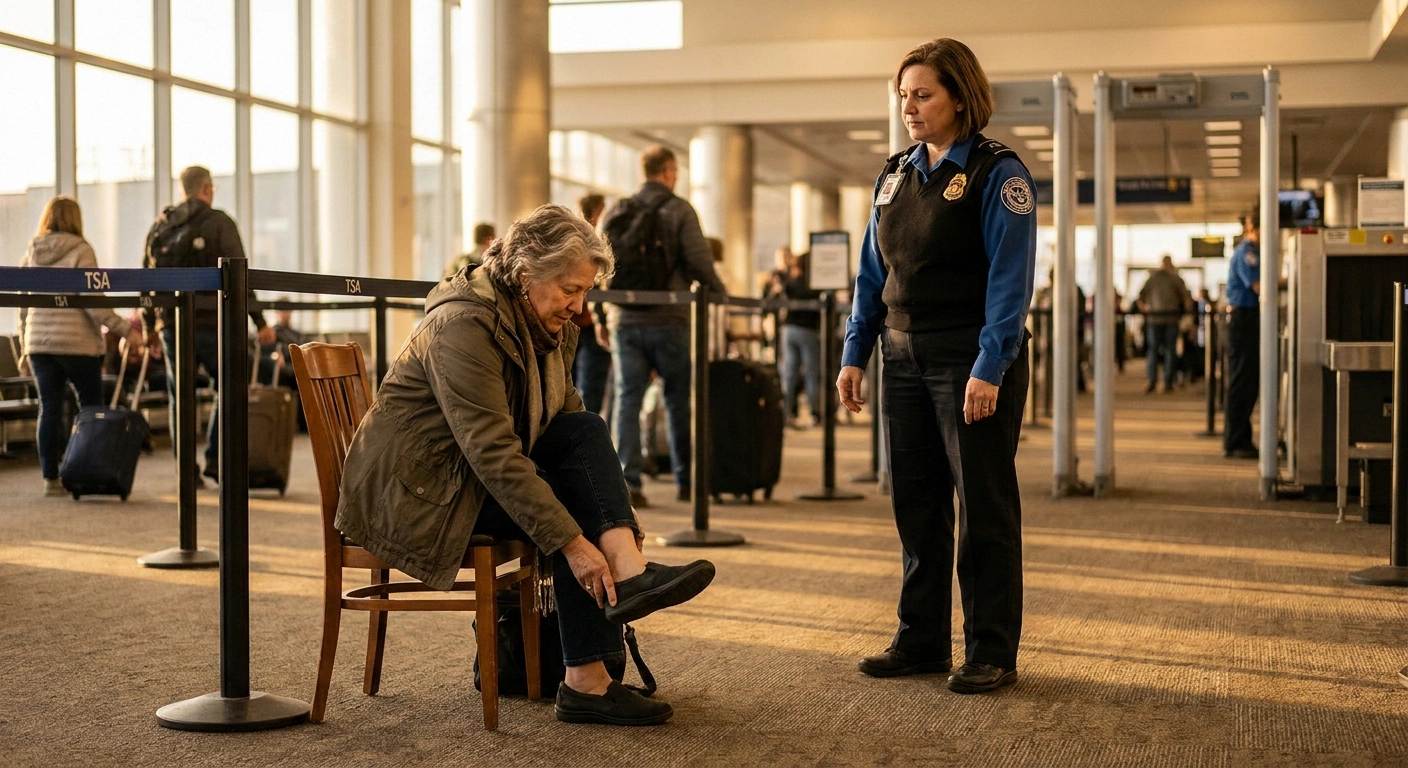
You Need to Remove Shoes and Have Trouble Balancing
Ask for a chair before you start. Sit, remove your shoes, place them on the belt, walk through screening, retrieve your shoes, sit again, and put them back on. Don't try to do this standing on one leg in the middle of the line. The officers are accustomed to this and will help.
A Smooth Checkpoint Routine
You Have a TENS Unit On
Tell the officer at the start of screening: “I have a TENS unit on for nerve pain. Would you prefer I remove it or wear it through?” They'll tell you their preference. If you wear it through, expect a brief hand swab to check for explosives residue, which is routine and not concerning.
You Have an Implanted Medical Device
If you have a pacemaker, defibrillator, deep brain stimulator, or spinal cord stimulator, you may not be able to use the metal detector or, in some cases, the body scanner. Use your TSA Notification Card or simply tell the officer at the start: “I have an implanted [device name]. I need an alternative screening.” They'll arrange a pat-down.
You're Carrying Many Medications
Place your medication bag in a separate bin and tell the officer it's medical. They may inspect more thoroughly, which is normal. Bring a printed list of your medications to share if asked, though it's not required.
You Get Pulled Aside for Additional Screening
Don't panic. Additional screening happens for many reasons unrelated to suspicion — including readings on a body scanner that pick up clothing seams, sweat, or even thick fabric. Stay calm, comply, and the process is usually brief.
Making the Whole Trip Easier
Airport security is one piece of a larger trip. A few broader tips help the whole journey.
Janet's Carry-On Comfort Kit
Arrive earlier than you think you need. Two hours before a domestic flight, two and a half before an international one. The minimum recommendations assume an able-bodied traveler with no extra steps. Give yourself buffer.
Use the wheelchair service if standing in lines or walking long distances is painful. You can request one when you check in, or in advance through your airline. There's no shame in this — even people who can walk reasonable distances on a normal day sometimes use the service for a hard day. The airport is huge.
Move during the flight. On flights longer than two hours, get up at least every hour to walk to the bathroom, even if you don't need it. Sitting still for hours can worsen neuropathy symptoms and increases the (small) risk of blood clots. Wear those compression socks.
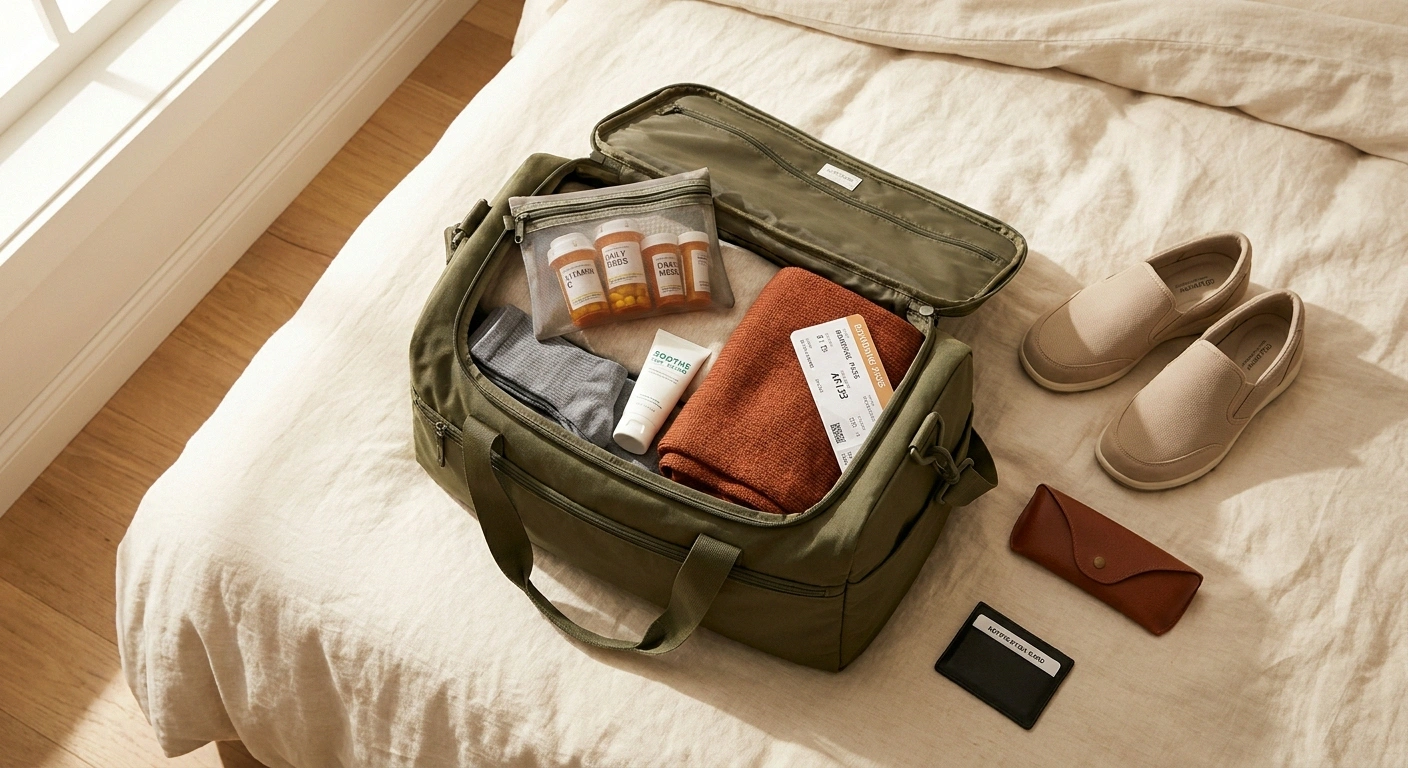
Pack a small comfort kit in your carry-on. Mine includes my regular medications, a fresh pair of socks, a small bottle of foot cream, a soft scarf I can wrap around my feet on the plane if they get cold, and a few crackers in case my blood sugar dips. Tiny things that take up almost no space and make a real difference.
Plan for arrival. After a long flight, your feet will feel terrible. Don't schedule anything strenuous for the first few hours after you land. Plan to elevate your feet, hydrate, and ease back into activity.
A Word About Patience — Yours and Theirs
Most TSA officers I've encountered are decent humans doing a hard, thankless job. They're working with travelers who are stressed, tired, sometimes belligerent, often confused. When I show up calm, prepared, and clear about what I need, they almost always respond in kind.
The Notification Card helps. Saying “I have a medical condition” with a small smile rather than a defensive tone helps. Knowing exactly what to ask for helps. The first time you fly with neuropathy is the hardest. Each subsequent trip gets easier as you build your own personal toolkit of what works for you.
And on the rare day where you do get an officer who's having a bad shift, remember that escalation is allowed, supervisors exist, and one bad encounter doesn't define the system. Take a breath, ask for help, and keep moving.
If You Haven't Flown Since Your Neuropathy Got Bad

This part is for anyone who's been holding off on a trip because they're afraid of the airport. I want you to know that the trip is probably more doable than you think.
The trip is more doable than you think
TSA Cares · Notification Card · slip-on shoes · compression socks · medications in carry-on · arrive early · ask for what you need. The grandkids, the wedding, the place you've been wanting to see — they're still possible.
Start small. A short flight to visit family is a fine first trip back. Use TSA Cares. Wear your easiest slip-on shoes. Ask for a wheelchair if you're not sure about the walking. Carry your medications, your Notification Card, and your patience. Build the experience back up.
The grandkids you've been missing, the friend whose wedding you don't want to skip, the place you've been wanting to see — those things are still possible. The airport doesn't have to be the wall that stops you. With a little planning and the right knowledge, it's just one stage of the journey, and it's a stage you can navigate.
Frequently Asked Questions
Can I keep my shoes on through TSA with neuropathy?
Standard travelers under 75 are required to remove shoes for screening. However, TSA PreCheck members keep their shoes on, as do travelers 75 and older and children 12 and under. If you don't have PreCheck and shoe removal is painful or risky, you can request a chair to sit in while you remove and replace them.
Do I need medical documentation to bring my medications through TSA?
You don't strictly need a doctor's note for standard prescription medications. Keeping them in their original prescription bottles makes any questions easier to answer. For unusual liquid medications over 3.4 ounces or for unfamiliar medical devices, a brief letter from your doctor can speed things up but isn't required.
Can I get a TSA pat-down instead of going through the body scanner?
Yes. You have the right to request a pat-down instead of the body scanner for any reason. Pat-downs are conducted by an officer of the same gender, and you can request a private screening area if you prefer. Just tell the officer at the start of screening: “I'd like a pat-down, please.”
How do I request TSA assistance for my neuropathy?
Call TSA Cares at (855) 787-2227 at least 72 hours before your flight to arrange a Passenger Support Specialist to meet you at security. You can also request a specialist on the spot when you arrive at the checkpoint by asking any TSA officer.
Can I bring my TENS unit through TSA?
Yes. TENS units are allowed in carry-on luggage and can also be worn through screening. If you wear it through, tell the officer at the start of screening, and expect a brief hand-swab inspection. If you remove it, place it in a separate bin so it can be hand-inspected if needed.
Are gabapentin or Lyrica restricted at airport security?
No. Gabapentin and pregabalin (Lyrica) are not flagged or restricted at TSA. They are routine prescription medications and travel without issue. Keep them in your carry-on bag, ideally in their original prescription bottles.
What is a TSA Notification Card?
The TSA Notification Card is a free downloadable PDF you can fill out with your medical condition and present discreetly to a TSA officer. It lets you communicate about your condition without speaking it aloud in front of other travelers. You can find it on the TSA website by searching “TSA notification card.”
Can I sit during TSA screening?
Yes. Most checkpoints have chairs available. You can request to sit while removing shoes, during a pat-down, or while waiting for your belongings. If you don't see a chair, ask any officer: “May I sit while I remove my shoes?”
About the Author