I get asked about vibrating insoles for neuropathy more than almost any other gadget. Partly because the idea sounds magical — your feet can't feel the ground, so a buzz from below somehow helps? — and partly because there's a real prescription device on the market that's been studied for actual fall reduction. So I went digging.
Here's what I learned, and it changed how I answer the question: the response depends entirely on which vibrating insole you're talking about, because three completely different products get lumped under the same name. A $30 buzzing insole from Amazon is not the same thing as a $7,000 prescription device. They aren't cousins. They aren't even in the same room.
If you have peripheral neuropathy and you're worried about balance, falls, or that strange “walking on cotton” feeling, this is for you. I'll walk you through what these devices actually do, what the science honestly shows, and what to ask your doctor before you spend a dollar on any of them.
First, What Vibrating Insoles Cannot Do
Before we get into what the research shows, I want to clear up the expectations that hurt the most when they don't pan out.
Vibrating insoles do not treat nerve pain. They are not analgesics. If your neuropathy hurts — burning, electric, tingling, that all-night ache — these devices are not the answer. They target a different problem entirely: the loss of sensation that makes your feet feel disconnected from the floor, the unsteady balance, the trip-prone walking.
They do not regenerate damaged nerves. There is no published evidence that the vibration parameters used in these devices repair nerve fibers. The mechanism is about using the nerve signal you still have, not rebuilding the nerve signal you've lost.
They do not cure neuropathy. None of the research, even the most encouraging studies, claims this. If a website tells you otherwise, close the tab.
What they may do — and this is where the evidence actually lives — is help your brain detect ground contact and pressure changes more reliably, which translates to steadier walking, slightly faster gait, better balance on uneven surfaces, and possibly fewer falls. For someone with neuropathy who lives in fear of stairs and curbs, that's not a small thing. It's just not the same thing as pain relief or nerve regeneration.
How Vibrating Insoles Work: Stochastic Resonance in Plain English
The science behind vibrating insoles for neuropathy has a name that sounds like a physics class: stochastic resonance. The idea is actually beautiful once you get past the term.
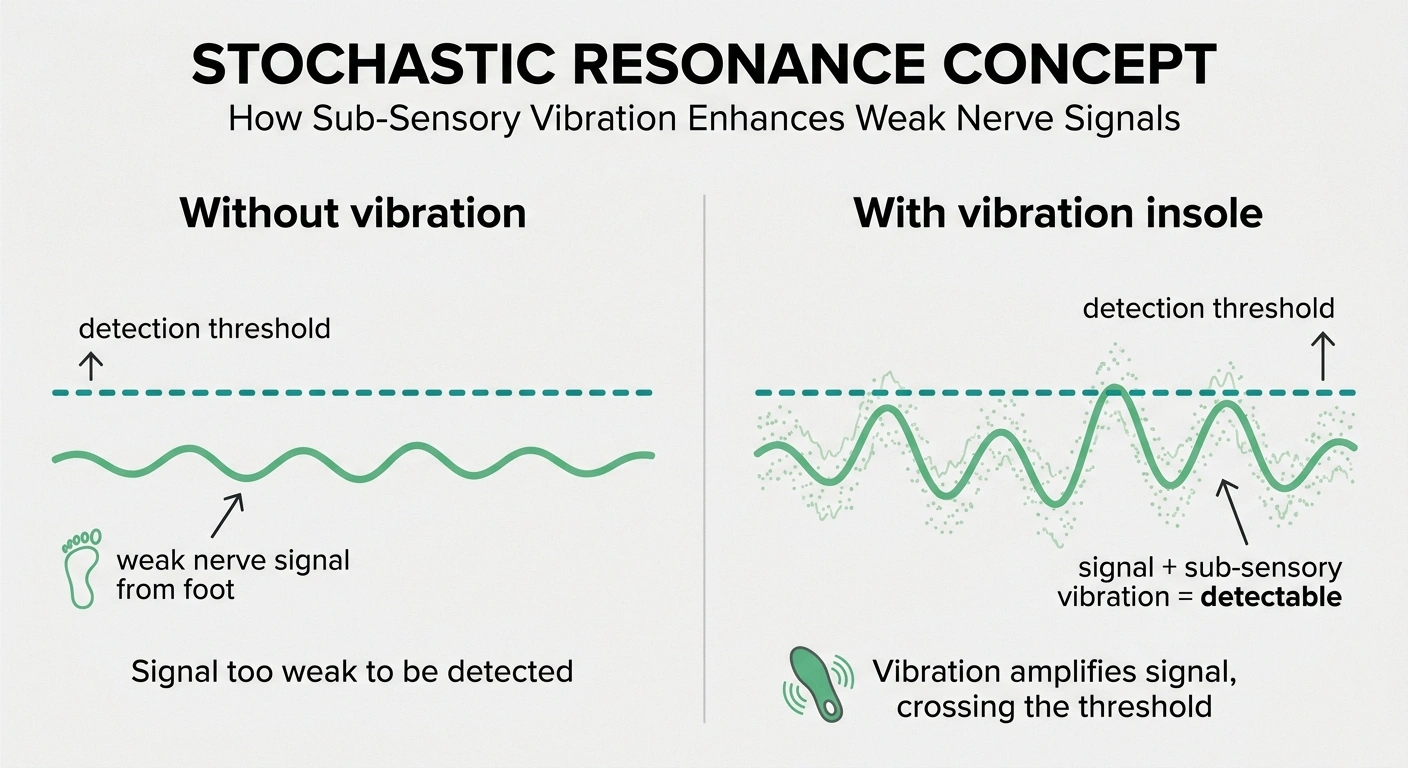
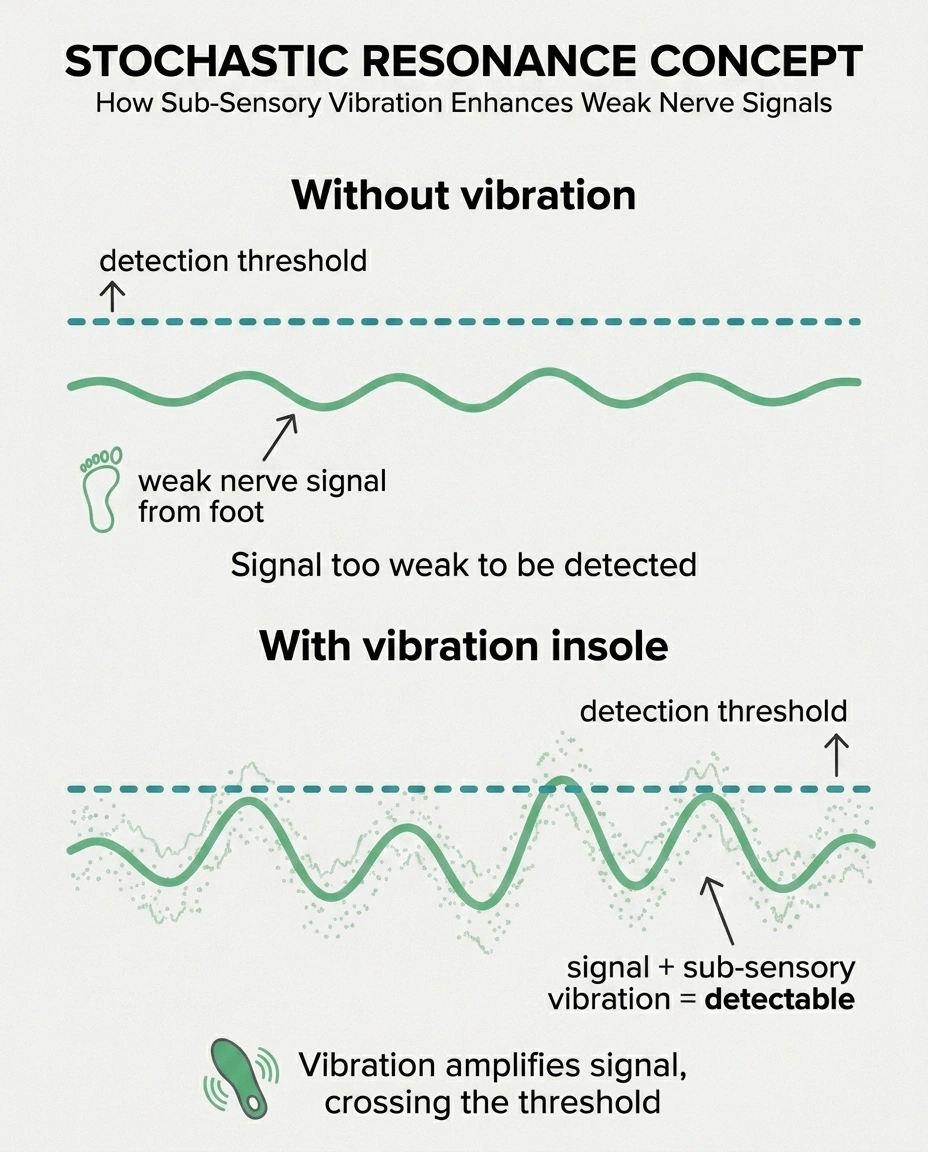
Think about an old AM radio trying to pick up a faint station. The signal is there but too weak for the receiver to lock onto. Now imagine someone tunes in a little background static at just the right volume — and suddenly the music comes through. The static didn't add information. It pushed the weak signal over a threshold where the receiver could finally catch it.
That's what happens with stochastic resonance and your feet. Peripheral neuropathy weakens the signal your foot's sensory nerves send to your brain. The pressure information from each step gets too quiet for your nervous system to use reliably for balance and gait. A vibrating insole adds a low-level “noise” — vibration that's either just below or right at your perception threshold — and that noise nudges the weak nerve signals over the line where your brain can detect them.
The principle has been studied since the early 2000s, with the foundational work coming from Lewis Lipsitz and colleagues at the Wyss Institute and Hebrew SeniorLife. In a 2015 study of healthy older adults, subsensory vibrating insoles improved Timed Up and Go performance, reduced postural sway, and reduced gait variability. Galica's earlier 2009 work showed the same kind of stride-time stability improvements in elderly fallers.
The mechanism is real. What's much more complicated is which specific devices reliably deliver it.
The Three Categories of Vibrating Insoles (Don't Confuse Them)
This is the single most important thing in this article. Almost every other piece I've read lumps these together and patients end up buying the wrong thing expecting the wrong outcome.
Tier 1 — Prescription medical device. Right now, this is essentially one product: Walkasins by RxFunction. It's regulated by the FDA as a Class II medical device, requires a prescription, costs roughly $6,000 to $7,000, and has multiple peer-reviewed studies behind it. It's not actually an “insole” in the way most people picture — more on that in a moment.
Tier 2 — Research-grade insoles in trials. These are devices used in published clinical studies but not yet broadly available to U.S. consumers. PathFeel by Walk With Path (UK), SureStep insoles by Phoenix Medical Technologies, and various university prototypes. Real science, limited commercial access.
Tier 3 — Consumer products sold on Amazon. Vibrathotics and various generic “vibrating massage insoles.” These are battery-powered, deliver high-amplitude perceptible vibration (basically a foot massage), and are marketed for plantar fasciitis, neuropathy, and circulation. They are not regulated as medical devices. There is no peer-reviewed RCT evidence for these specific products. Some are HSA-eligible — which is a tax category, not an efficacy endorsement.
If you remember nothing else from this article, remember this: when product pages cite “Harvard studies” or “research showing vibrating insoles reduce falls,” they are usually citing Tier 2 research that was done with a different prototype device — not the product you're about to buy. The marketing borrows the credibility of research it didn't participate in.
Tier 1: Walkasins — The Prescription Device with the Strongest Evidence
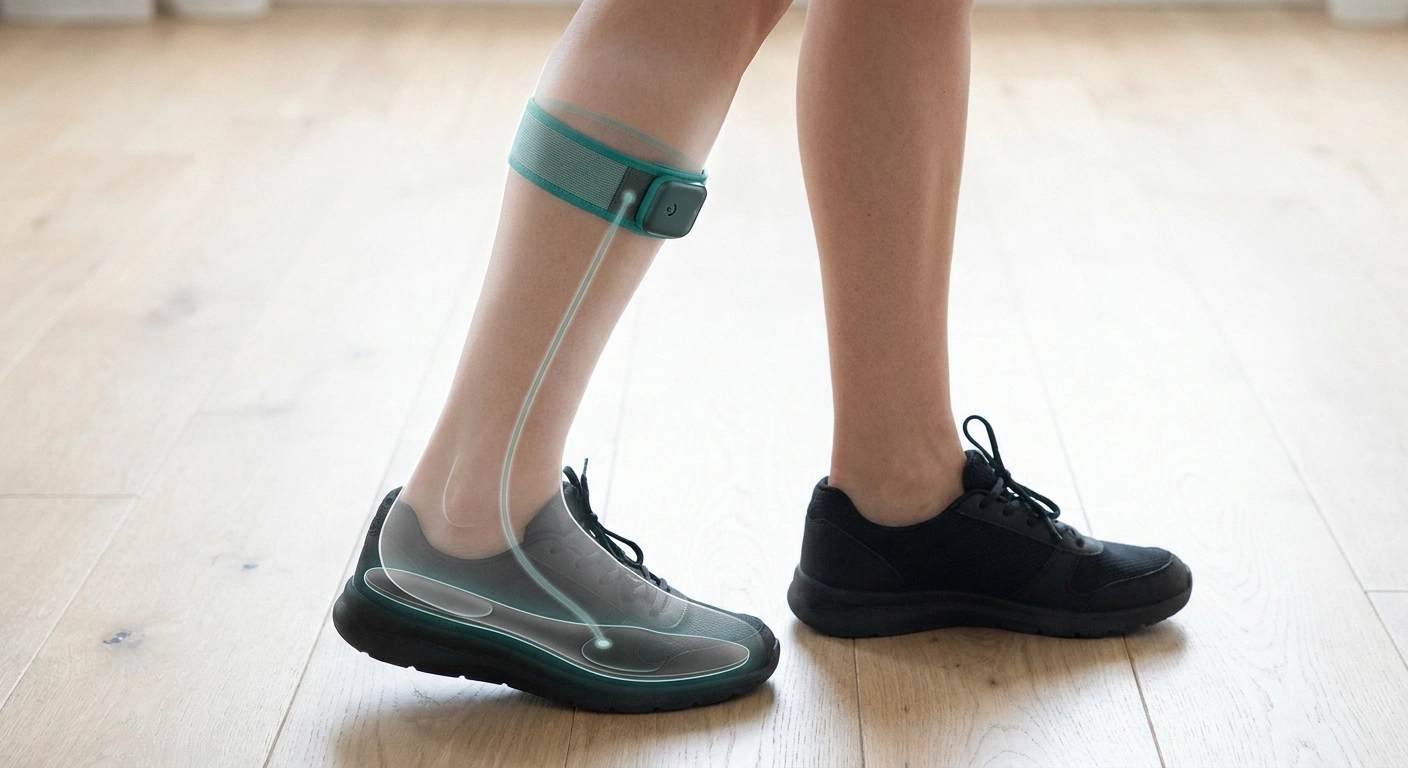
Walkasins, made by RxFunction in Eden Prairie, Minnesota, is the most studied vibrating-feedback device for peripheral neuropathy. And here's the first surprise: it's not really an insole.
- Functional Gait Assessment scores improved from 15.0 to 19.1 (Cohen's d = 0.92, large effect)
- Gait speed improved from 0.86 to 0.95 m/s
- Fall rate in pre-fallers dropped 46% (13.8 → 7.4 falls per 1,000 patient-days)
- Improvements sustained at the 26-week follow-up
It's a two-part system. A thin foot pad with pressure sensors goes inside your shoe. Wires run up to a small module that wraps around your lower leg, just above the ankle. When you put weight on the ball of your foot, the leg module vibrates on the front of your shin. When weight shifts to your heel, the back of the module buzzes. Side-to-side, the same. The device essentially borrows the working sensory nerves in your lower leg to deliver the foot-pressure information your damaged foot nerves can no longer transmit clearly.
The technical name is a “sensory prosthetic.” It doesn't replace your foot nerves — it routes around them.
The evidence base is the strongest of any device in this category. The walk2Wellness study, published in Frontiers in Aging Neuroscience in 2020 and led by Lars Oddsson, enrolled 52 people with peripheral neuropathy and high fall risk. After 10 weeks of daily Walkasins use, their Functional Gait Assessment scores went from 15.0 to 19.1 — a Cohen's d of 0.92, which in research terms is a large effect. Gait speed improved. The Timed Up and Go test improved. And in the subgroup that had been falling regularly before the study, falls dropped by 46 percent. Sixteen of 25 pre-fallers had zero falls during the 10 weeks.
A follow-up paper showed those improvements were sustained at 26 weeks.
Honest caveats: walk2Wellness was a single-arm study. There was no placebo or control group, the participants knew they were getting the device, and 79 percent were male veterans. The improvements are encouraging but not the same as a randomized controlled trial would deliver. RxFunction has a newer trial underway called Balance4Mobility that aims to address some of these design questions.
On the regulatory side, Walkasins is a Class II device that is 510(k)-exempt, which means it's legally marketed under FDA medical-device regulation but did not go through the formal 510(k) premarket review process. Some patient materials call it “FDA-cleared” — that's not quite accurate; “FDA-regulated” is the precise term. The device requires a prescription.
Cost is the part that stops most people: roughly $6,000 to $7,000. Some Medicare coverage is possible under the Part B prosthetic benefit, with the typical 20 percent patient cost-share after the deductible, but only through Medicare-enrolled suppliers and the coverage is not guaranteed. Many private insurance plans treat it as durable medical equipment and require prior authorization. The honest answer is that out-of-pocket exposure can be significant.
Tier 2: Research-Grade Insoles That Could Be the Future
The research-grade tier is where the most interesting recent science lives. These devices are real insoles — thin pads that slip inside your shoe and deliver vibration directly to the sole of the foot — and they're being tested specifically in people with diabetic peripheral neuropathy.
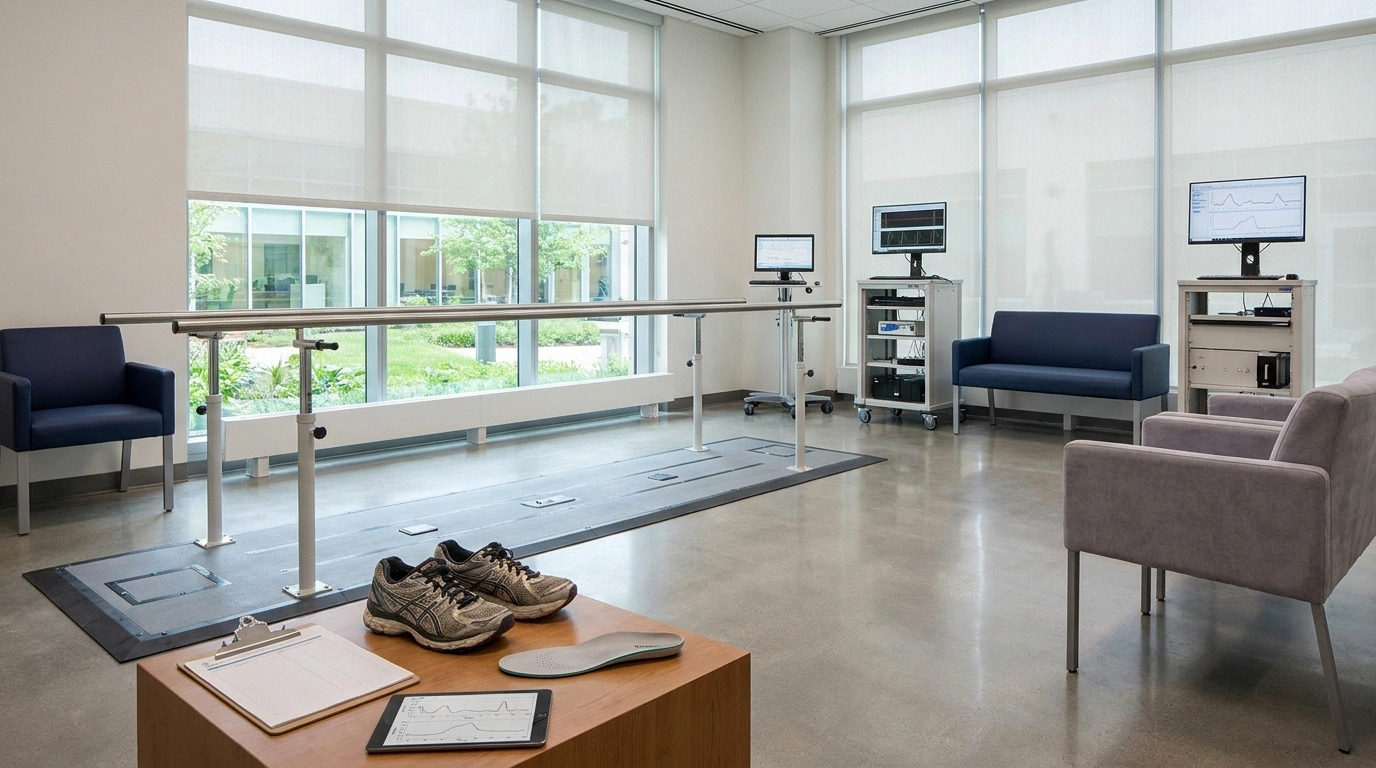
PathFeel by Walk With Path is the device used in a 2024 study published in Diabetes Care by Orlando and colleagues. They tested 22 men with diabetic peripheral neuropathy in a crossover design with seven different vibration settings. The headline result: gait speed improved 7 to 10 percent during level walking and stair climbing under the right vibration conditions. Standing balance (with eyes closed) also improved. The catch was that dynamic balance during walking didn't improve significantly once you adjusted for the gait-speed change — so the picture isn't as clean as the marketing might suggest, but the gait improvement is real.
SureStep insoles by Phoenix Medical Technologies were tested in a 2024 pilot study by Ennion and Hijmans. Twenty-two participants with diabetic neuropathy wore the insoles 30 minutes a day for a month. Their vibration perception threshold — basically how much vibration they need to feel — improved from 34 volts to 25.5 volts, and the improvement held after a one-month washout period. That's the first evidence I've seen that benefits might be retained beyond the moment of use, which would be a big deal if confirmed in larger trials.
One nuance worth knowing about: a 2008 study by Hijmans found that vibrating insoles only improved standing balance in diabetic neuropathy patients when their attention was distracted. In other words, when they were focused on standing still, the device didn't help. When they were thinking about something else (which is what real life looks like), it did. This suggests that real-world benefits might be larger than lab tests show — but also that the science is still working out the exact conditions under which these devices help.
Both PathFeel and SureStep have limited U.S. commercial availability. If you're interested in a research-tier device, ask your physical therapist or podiatrist whether any clinical trials are recruiting near you, and check ClinicalTrials.gov.
Tier 3: Amazon Vibrating Insoles — What You're Actually Getting
Search “vibrating insoles for neuropathy” on Amazon and you'll find products like Vibrathotics V2 — battery-powered insoles with multiple vibration intensities, USB charging, and marketing copy about Harvard research and clinical studies. I want to be careful here because some readers will have tried these and felt better, and I'm not going to tell them they're imagining it.
But here's the honest picture. There is no peer-reviewed clinical trial specific to Vibrathotics or any of the other consumer “vibrating massage insoles” on Amazon. The “Harvard study” their marketing references almost certainly points to the Lipsitz/Galica subsensory-vibration research from the Wyss Institute — work done with a completely different prototype device, with different vibration parameters, in a different population. Borrowing that research to back-fill product claims is a stretch.
What these devices actually deliver is a perceptible foot massage — high-amplitude vibration you can feel as a buzz or tingle. That's different from the subsensory or just-at-threshold vibration the stochastic resonance research uses. A foot massage isn't worthless; it can feel good, relieve some superficial muscle tension, and provide a brief distraction from baseline discomfort. For some people that's enough to justify $30 to $60. Just don't confuse it with the kind of benefit you'd get from the prescription device.
Amazon reviews of these products specifically from neuropathy patients are genuinely mixed. Some users report that buzzing helps them feel their feet a little better and walk with more confidence. Others report no benefit, durability problems (batteries dying within months), or that the vibration becomes irritating after a few weeks.
If you want to experiment with a consumer product, I won't talk you out of it — they're cheap, returnable, and unlikely to do harm. Just go in knowing what they are: a foot-massage device with a wellness positioning, not a clinically validated treatment for neuropathy.
What the 2024 Diabetes Care Study Actually Found
The 2024 study in Diabetes Care by Orlando and colleagues is the most-cited recent paper on vibrating insoles for diabetic peripheral neuropathy, so it's worth understanding what it did and didn't show.
The team tested 22 men, average age 68, with confirmed diabetic peripheral neuropathy. Each participant tried seven different vibration settings — including the device turned off — in random order during a single lab session. They measured gait speed, postural balance with eyes closed, and dynamic balance during walking.
Two clear positives emerged. First, gait speed improved 7 to 10 percent across multiple vibration conditions, both on level ground and stairs. For people who walk slowly because of neuropathy (and slow gait speed is itself a strong predictor of falls), that's meaningful. Second, postural balance with eyes closed improved — center-of-pressure velocity dropped in four of seven vibration conditions.
The honest qualifier: when they adjusted dynamic-balance results for the gait-speed change, the balance improvement during walking lost statistical significance. So the device helps people walk faster, and walking faster looks like better balance, but whether the device independently improves dynamic balance is less clear.
It was also an acute (single-session) study. We don't yet know what happens with weeks or months of use, whether benefits persist after taking the device off, or what the fall-prevention effect would be in everyday life. Those are exactly the questions that need to be answered in larger, longer, controlled trials.
Questions to Ask Your Doctor or Physical Therapist
If you're considering any vibrating insole or sensory prosthetic, here's the conversation I'd want to have with my healthcare team. Bring this list to the appointment.
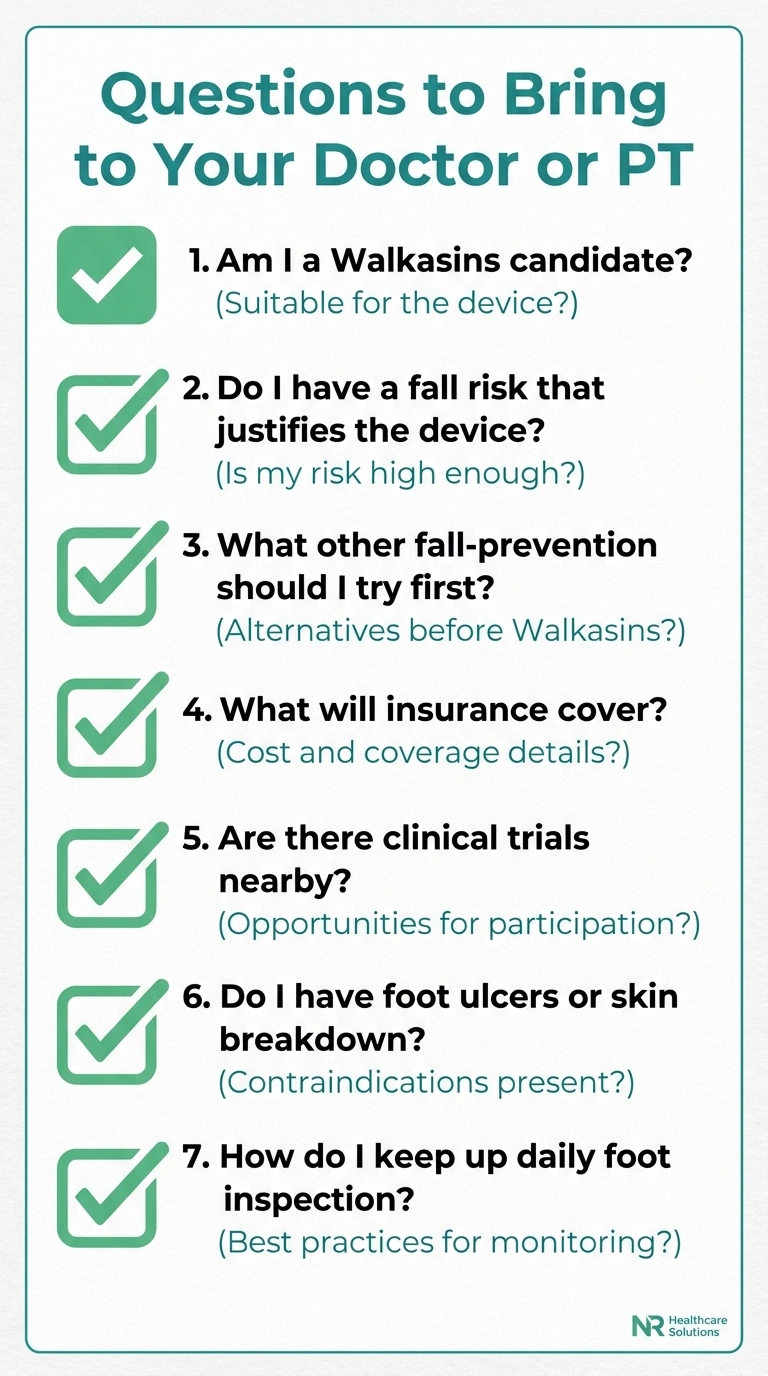
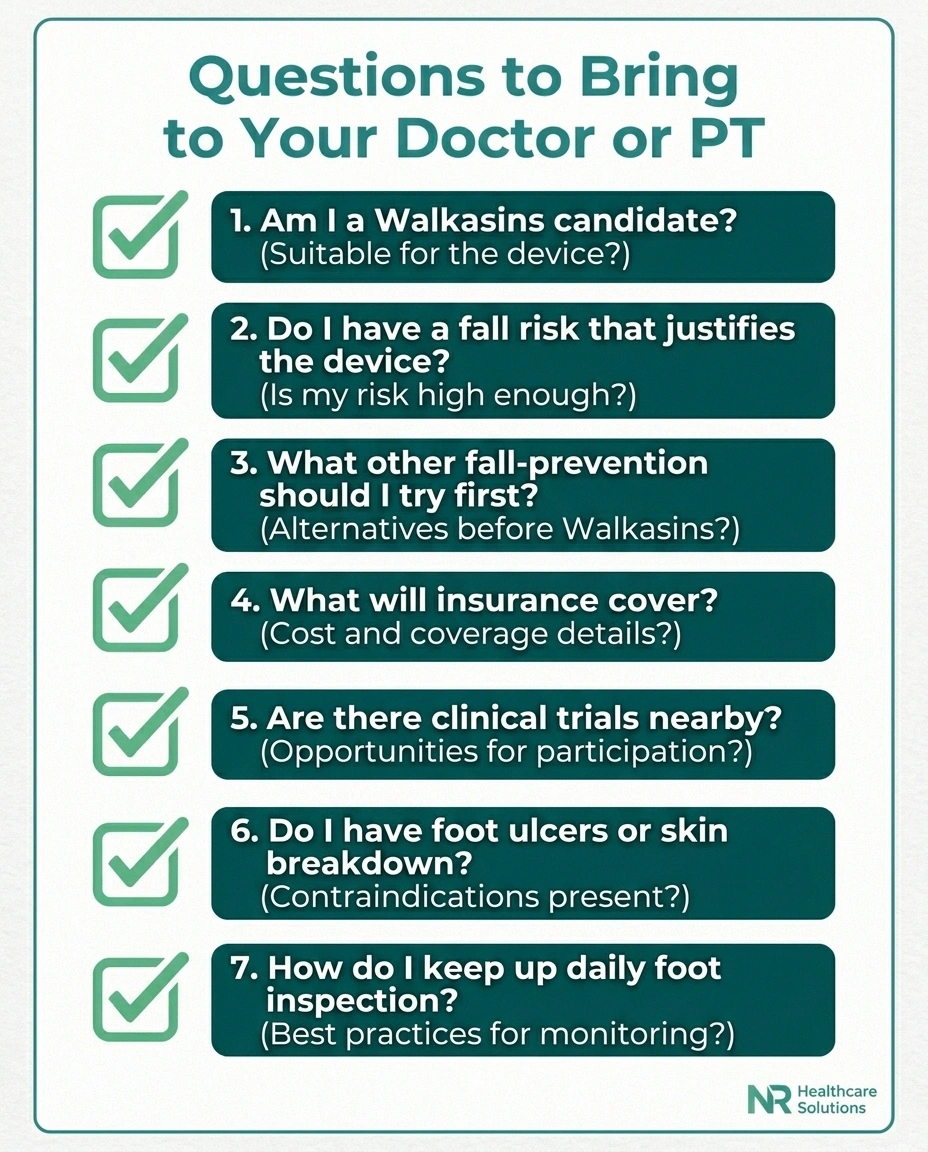
Am I a candidate for Walkasins? The device requires intact sensation on the lower leg above the ankle — that's where the vibrotactile module sits. If your neuropathy has progressed up the leg, you may not be able to feel the cues. A physical therapist can do a quick sensation check.
Do I have a fall risk that justifies the device? Walkasins was studied in people with measurable gait and balance impairment. If your neuropathy hasn't yet affected your walking or steadiness, the case is weaker.
What other fall-prevention strategies should I try first or alongside? Tai chi, vestibular physical therapy, home modifications (grab bars, lighting, removing rugs), reviewing fall-risk medications with your pharmacist, and improving footwear all have well-established evidence for fall reduction. Vibrating insoles should be an addition to these, not a replacement.
Will my insurance or Medicare cover any of this? Get a specific answer in writing before you commit. Coverage varies dramatically by plan, and “may be covered” is not the same as “will be covered.”
Are there clinical trials I could enroll in? Trial participation can give you access to research-grade devices at no cost, and you contribute to the science that helps everyone with neuropathy.
Do I have any active foot wounds, ulcers, or skin breakdown? If yes, no insole device of any kind should be added without medical clearance. Pressure points from a poorly fitting insole over a numb foot is exactly how a small problem becomes a big one. For more on this, our guide to neuropathy foot care goes deeper on daily inspection and what to watch for.
How do I keep up daily foot inspection? No device replaces this. If you have neuropathy and reduced sensation, looking at the bottoms of your feet every single day is the single most important thing you do for your feet. A handheld mirror or a phone camera works.
Where Vibrating Insoles Fit in a Bigger Picture
Vibrating insoles, even the well-studied prescription kind, are one tool. They are most useful as part of a broader strategy that addresses the underlying condition driving your neuropathy and the consequences it creates.
For most people that means: tight control of whatever is causing the neuropathy (if it's diabetes, the metabolic side comes first — see our overview of diabetic neuropathy treatment); appropriate footwear that protects insensate feet without creating new pressure points (our best shoes for neuropathy guide is a good starting point); a fall-prevention plan that includes balance training and home modifications (more in neuropathy and balance: fall prevention strategies); and supportive treatments for pain if pain is part of your picture.
Vibrating insoles slot into the fall-prevention column. If your main complaint is pain rather than balance, look at neuropathy-specific medications, topicals, and the lifestyle pieces in our natural remedies guide first.
And if you find yourself drawn to gadgets in general (I am — I admit it), the question I try to ask myself is: am I considering this because the evidence says it'll help me, or because doing something feels better than waiting on a slow chronic condition? Both are valid feelings. They're not the same thing as efficacy.
What I'd Tell a Friend
If a friend with neuropathy asked me whether they should try vibrating insoles, here's what I'd say.

If your main issue is balance, fall risk, and feeling disconnected from the floor, and you have intact sensation on your lower legs above the ankle, talk to your neurologist or physical therapist about whether Walkasins makes sense. The evidence is the strongest in this category, the device is real, and the company has been doing this for years. The price tag is hard, and insurance coverage isn't guaranteed, so go in with eyes open.
If your main issue is pain, vibrating insoles aren't your tool. Look elsewhere.
If you want to experiment with a $30 Amazon vibrating insole because you're curious, your feet are intact, and you understand it's a wellness gadget rather than a medical treatment, go ahead. Just don't postpone the conversations with your doctor about the bigger picture, and stop using it if it irritates your skin or creates pressure points.
And whatever tier you're considering, keep doing the unglamorous work — inspect your feet daily, wear protective shoes, address the metabolic causes, and don't go barefoot at home (more on that in our recent piece on going barefoot at home with neuropathy). The fancy device only works if you're still doing the basics.
Frequently Asked Questions
Do vibrating insoles actually work for neuropathy?
It depends on which device. The prescription Walkasins device has multiple peer-reviewed studies showing improved gait speed, balance, and reduced fall rates in people with peripheral neuropathy. Research-grade insoles like PathFeel show improved gait speed in 2024 trials. Consumer Amazon vibrating insoles have no peer-reviewed evidence specific to those products. The category is not one thing.
Can vibrating insoles reverse my nerve damage?
No. There is no published evidence that vibrating insoles regenerate damaged nerves. They help your brain make better use of the nerve signals you still have. If a product claims to reverse nerve damage, treat that as a warning sign.
How much do Walkasins cost and does Medicare cover them?
Walkasins typically cost about $6,000 to $7,000. Medicare Part B may cover them under the prosthetic benefit, with the standard 20 percent patient cost-share after the deductible, but only through Medicare-enrolled suppliers. Coverage is not automatic and varies by region. Private insurance often requires prior authorization. Get coverage confirmed in writing before committing.
Do vibrating insoles help with neuropathy pain?
No, they are not analgesic devices. Vibrating insoles target balance, gait, and sensation — not pain. If pain is your main issue, talk to your doctor about neuropathy-specific medications, topicals like capsaicin or lidocaine, and other pain-management approaches.
Are vibrating insoles safe if I have a diabetic foot ulcer?
No. Any active foot wound, ulcer, or skin breakdown is a contraindication for adding any insole device without medical clearance. The combination of reduced sensation and a new pressure source over broken skin can turn a small problem into a serious one quickly. Get the wound healed and have your podiatrist clear you before adding any device.
How long does it take to notice benefit from a vibrating insole?
For Walkasins, the walk2Wellness study showed measurable improvement in gait and balance after 10 weeks of daily use, with continued improvement through 26 weeks. For research-grade insoles like PathFeel, some benefit is acute (felt during the session) and some appears to develop over weeks. Consumer products vary widely and individual response is unpredictable. Give any device a fair trial of at least several weeks before deciding.
Do I need a prescription to get vibrating insoles?
You need a prescription for Walkasins. Research-grade devices are typically accessed only through clinical trials. Consumer products on Amazon do not require a prescription. The presence or absence of a prescription requirement is a useful marker of which tier of device you're actually buying.
What's better — vibrating insoles or my nerve pain medication?
This is an apples-to-oranges comparison. Medications like gabapentin, pregabalin, or duloxetine target neuropathic pain. Vibrating insoles target balance and gait. They address different problems. Many people with neuropathy benefit from both: medication for pain, supportive devices for the balance side. Talk to your doctor about your specific goals.
About the Author