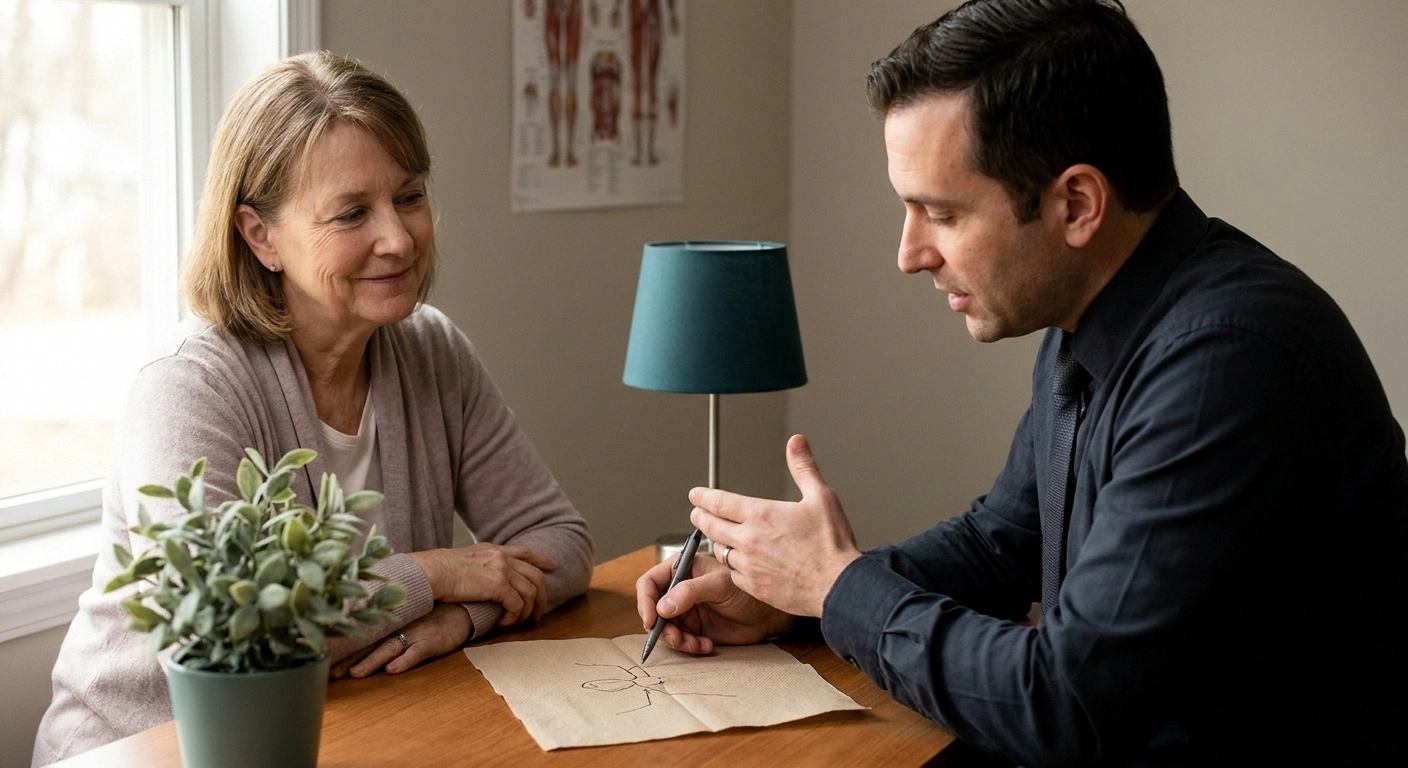
The first time I asked my neurologist about damaged nerves, I sat in his office with my hands folded and asked the question I had been afraid to ask for months. “If my nerves are damaged, can they actually heal at all?” I expected a soft, sad answer. Instead, he leaned forward, drew a line on a paper towel, made an X in the middle, and said, “Janet, this is one of the most fascinating processes in the human body. It even has a name. Wallerian degeneration.”
I had never heard those words. In the months that followed, I realized that wallerian degeneration is not the bad news it sounds like. It is the body’s way of clearing a path so that, in some cases, regrowth can happen. So, like sharing coffee with a friend, let me walk you through what I have learned.
What Wallerian Degeneration Actually Means
The name comes from a British physiologist named Augustus Waller, who described the process back in 1850. He noticed that when a nerve was cut or crushed, the part past the injury did not just die quietly. It actively broke itself down, in a very organized way, almost like a controlled demolition.
That is what wallerian degeneration is. The active, programmed breakdown of the axon (the long fiber part of a nerve cell) on the far side of an injury. If you imagine the nerve as a long electrical cable running from your spine to your toe, and the injury happens somewhere along the way, the part closer to the spine is usually still alive. It is the part past the damage that goes through demolition.
What surprised me most is that wallerian degeneration is not the body giving up. It is the body cleaning house. The damaged section has to come down so that something new can grow in its place. Think of it like clearing storm debris off a road before the repair crew can rebuild.
That distinction changed how I think about my own neuropathy. If you want a broader view, I wrote about the stages of neuropathy. The short version is, “damaged” does not always mean “dead.”
The Three Levels of Nerve Injury
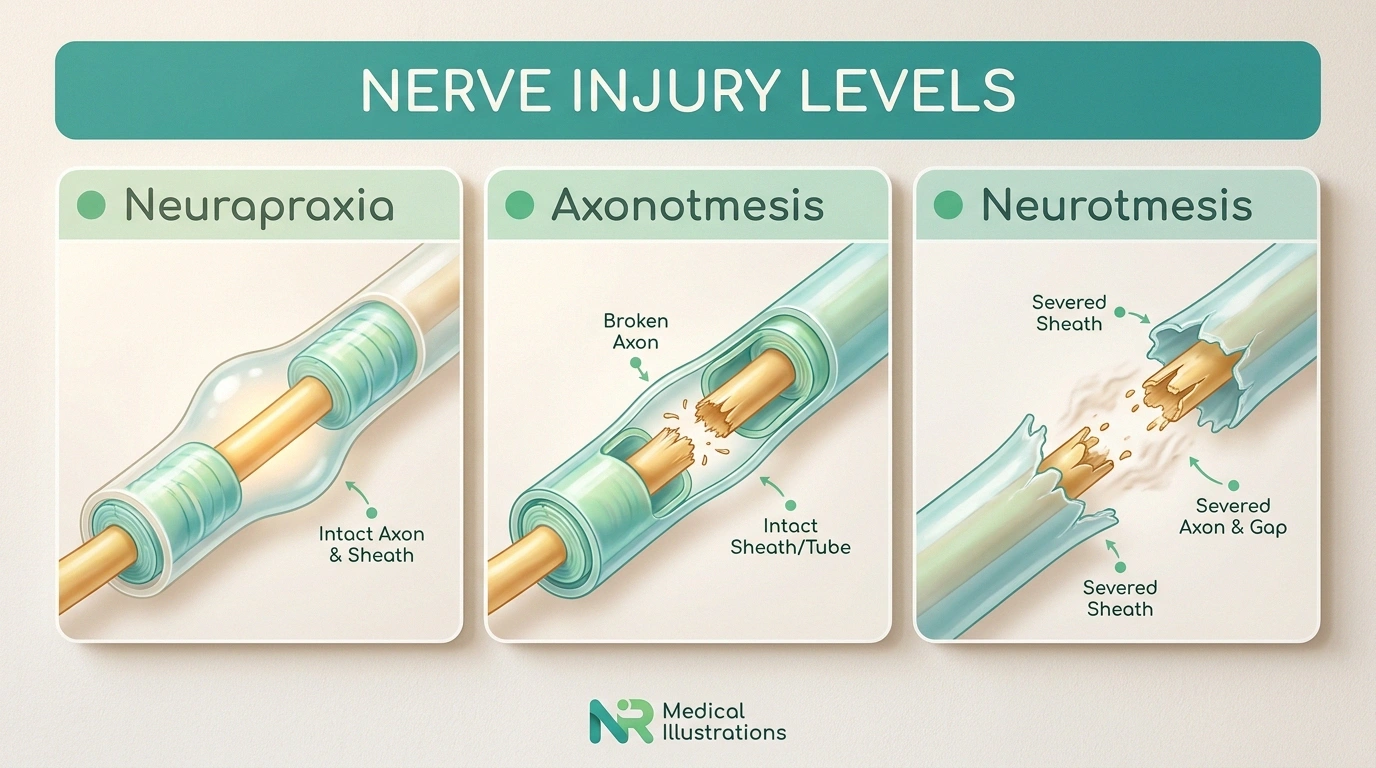
Doctors use a classification system, created by Herbert Seddon, that breaks nerve injuries into three levels of severity.
Level one is neurapraxia. The nerve is bruised or compressed, but the axon is intact. The signal stops getting through for a while, but no demolition is needed. Wallerian degeneration does not happen here. Recovery is usually a matter of weeks.
Level two is axonotmesis. The axon itself is damaged or severed, but the outer sheath is intact. This is where wallerian degeneration kicks in. The distal axon breaks down, the sheath stays as a guide tube, and a new axon can grow back through that tube. Recovery is possible, but slow, months to years.
Level three is neurotmesis. The entire nerve, including the sheath, is fully severed. Wallerian degeneration still happens, but without the sheath, regrowing axons have nothing to guide them. Surgical repair is often needed, and even then, regeneration may be incomplete.
For most people with peripheral neuropathy from causes like diabetes, chemotherapy, or vitamin deficiency, the damage is usually closer to level two. The supporting structures are mostly still there. If you want to dig deeper, my piece on demyelinating vs axonal neuropathy goes through it side by side.
Inside the First 48 Hours: What Happens Right After Damage
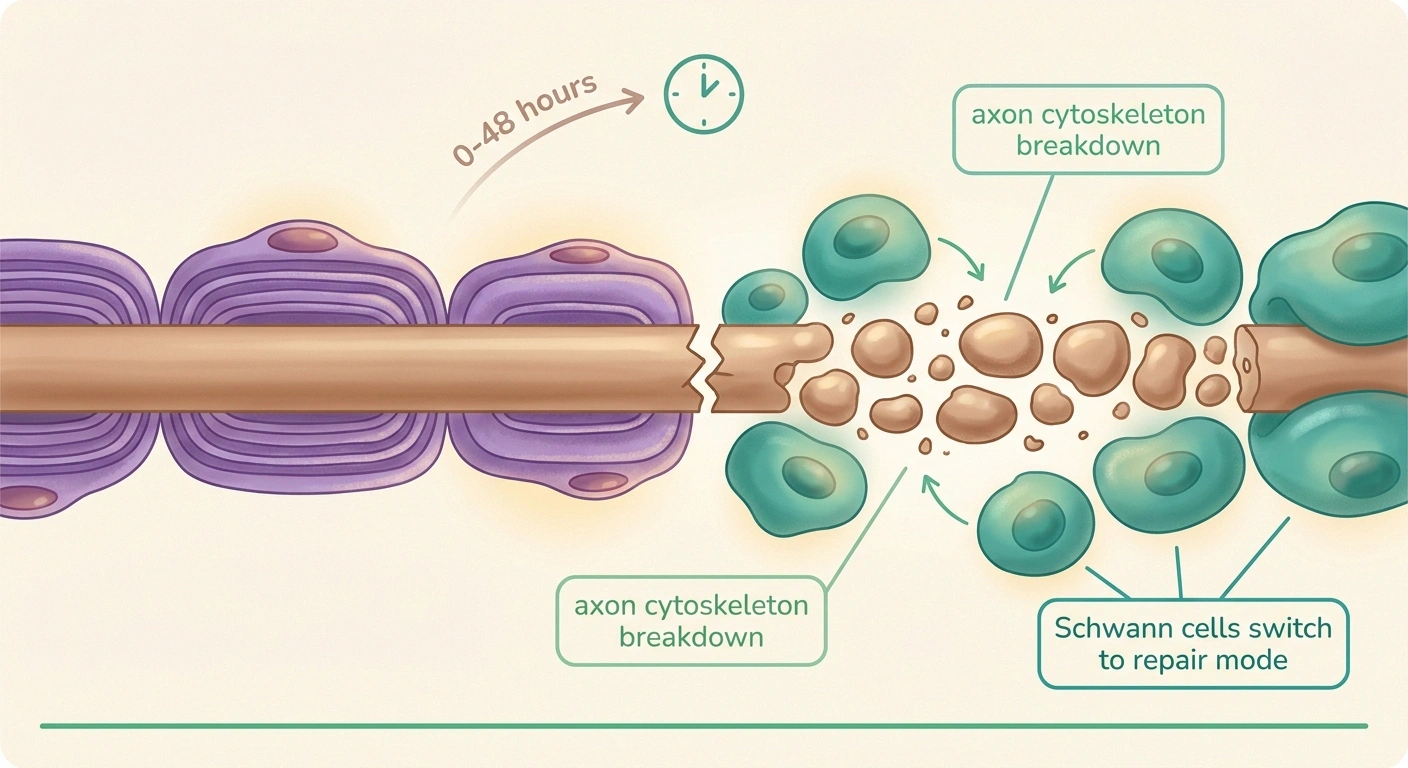
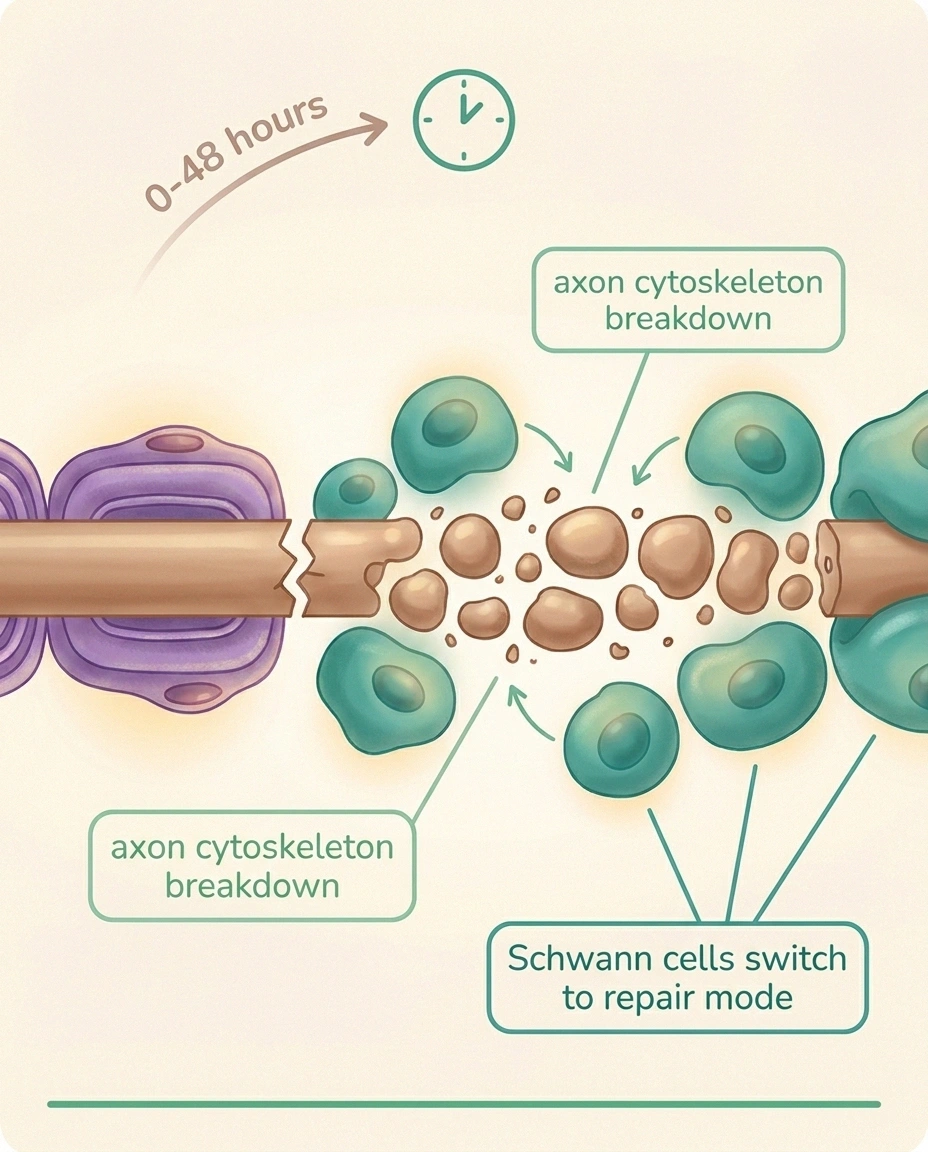
Once a nerve is damaged enough to trigger wallerian degeneration, the first 24 to 48 hours are when the demolition kicks off. So much is happening at the microscopic level while everything looks calm on the outside.
Inside the axon, the structural scaffolding (called the cytoskeleton) starts to break down on the distal side. This is triggered by specific molecular signals. The axon gets the message that its connection to the cell body has been compromised, and it begins to disassemble itself.
At the same time, the Schwann cells (the helper cells that wrap around peripheral nerves and form the myelin sheath) change behavior. They stop acting like insulators and start acting like clean-up crews. Scientists call this “dedifferentiation.” The cells switch modes, send chemical signals to recruit immune cells, and help digest damaged material.
If you have ever had nerve damage and felt like things got worse before they got better, this is part of what is happening underneath. Sometimes it just means the body is starting to clear the area. For a deeper look at how myelin specifically is affected, see my page on the myelin sheath and neuropathy.
Weeks 1-4: How the Body Clears the Path
After those first couple of days, the real cleanup begins. From about day 2 through day 7, specialized immune cells called macrophages flood the area. Their job is to eat the myelin debris and the broken-down axon fragments, the way a tidy crew sweeps up after a controlled demolition.
Axon breakdown begins
Macrophages clear debris
Bands of Bungner form
The peripheral nervous system is welcoming to these macrophages. The blood vessels around the nerve become more permeable around the two-week mark, as if the nerve is opening its doors to let the cleanup crew in.
By the end of week one, the Schwann cells line up along the now-empty sheath like stepping stones inside the tube. This sets the stage for the next phase.
Most people do not feel the cleanup itself. What we feel are symptoms of nerves not working, like numbness, tingling, weakness, or strange sensations. If you have ever wondered whether neuropathy can be reversed, the answer is tied directly to this window.
Axon Regrowth: Why “One Millimeter a Day” Matters
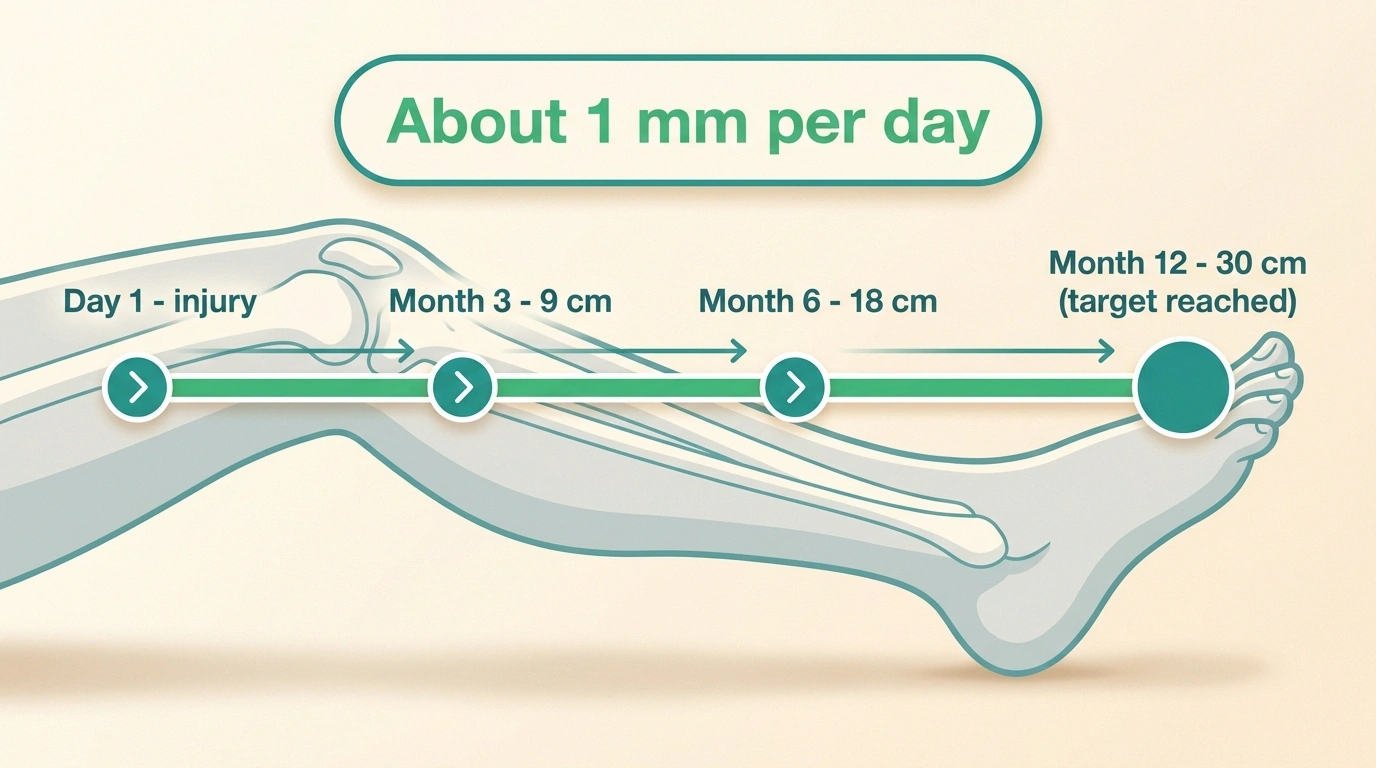
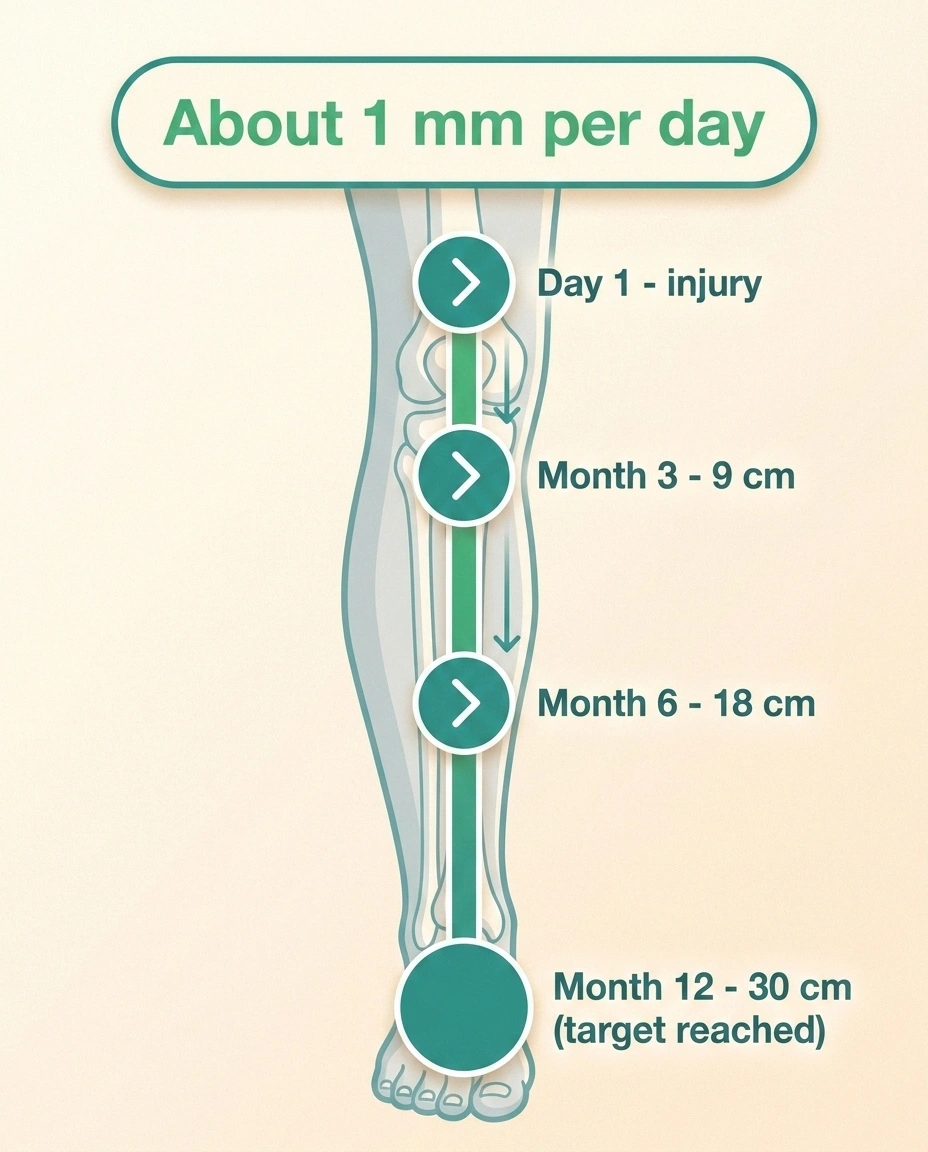
Here is the number that changed how I think about recovery. Peripheral axons regrow at roughly one millimeter per day. The range is about one to three millimeters, but one is the safe estimate.
Let me make that concrete. If a nerve is damaged at your knee and the target is in your foot, that might be 30 centimeters. At one millimeter per day, that is roughly 300 days. Nearly a year. If the damage is near the lumbar spine and the target is the bottom of the foot, recovery is measured in years.
This is why my neurologist was emphatic about patience. We are used to cuts healing in a week. Nerves are different. The cells are some of the longest in the body, and they regrow at a pace that has nothing to do with how motivated we are.
This also explains a common misunderstanding. Patients sometimes assume that because they do not feel better in three months, recovery is not happening. But three months at one millimeter per day is only nine centimeters. If the target is further away, the regrowing nerve has not yet reached it. I dig into this in nerve regeneration and healing.
The “one millimeter a day” rule applies when conditions are good. When the underlying cause is still active, regrowth may slow or stop. This is why correcting the root cause matters, whether it is blood sugar in diabetic neuropathy, replacing B12 in vitamin deficiency neuropathy, or stopping drinking in alcoholic neuropathy.
Bands of Bungner: Nature’s Guide Rails
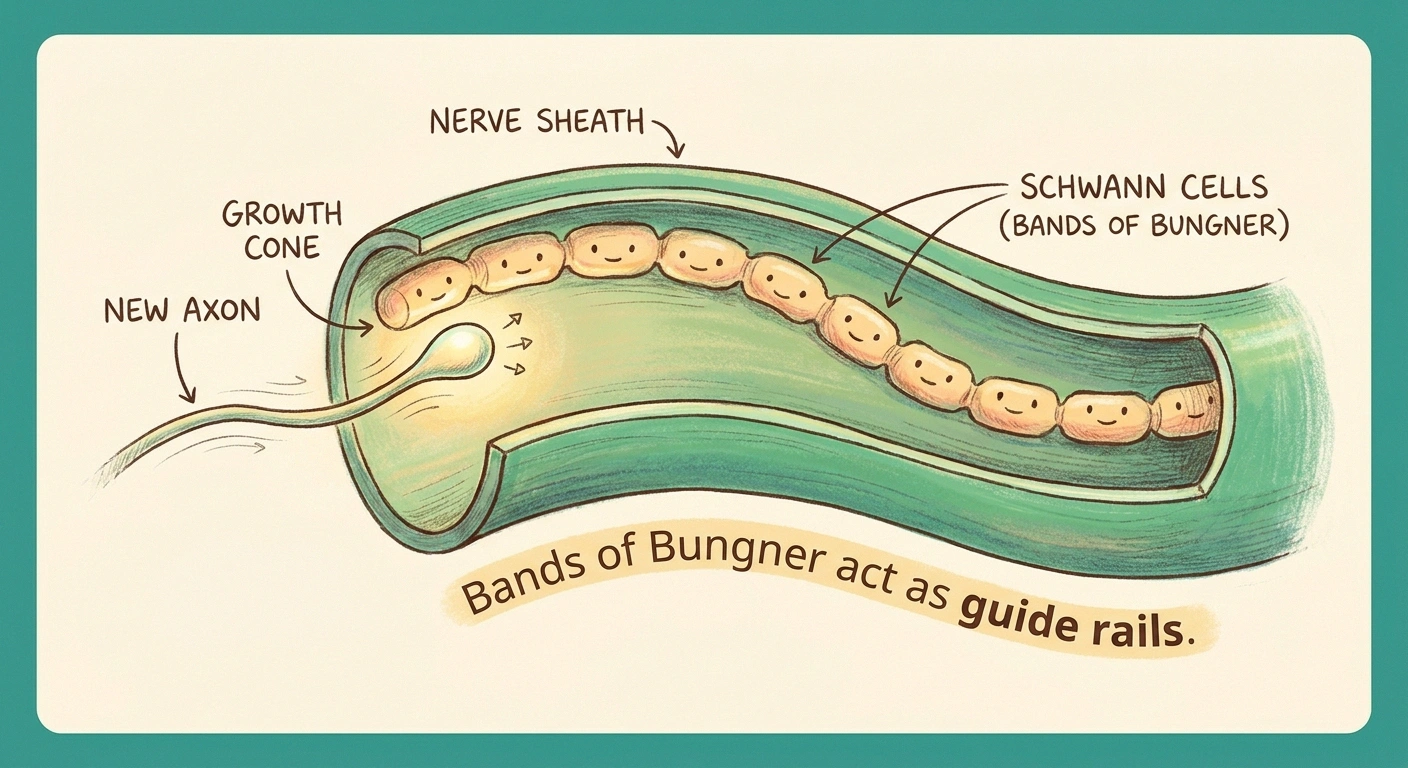
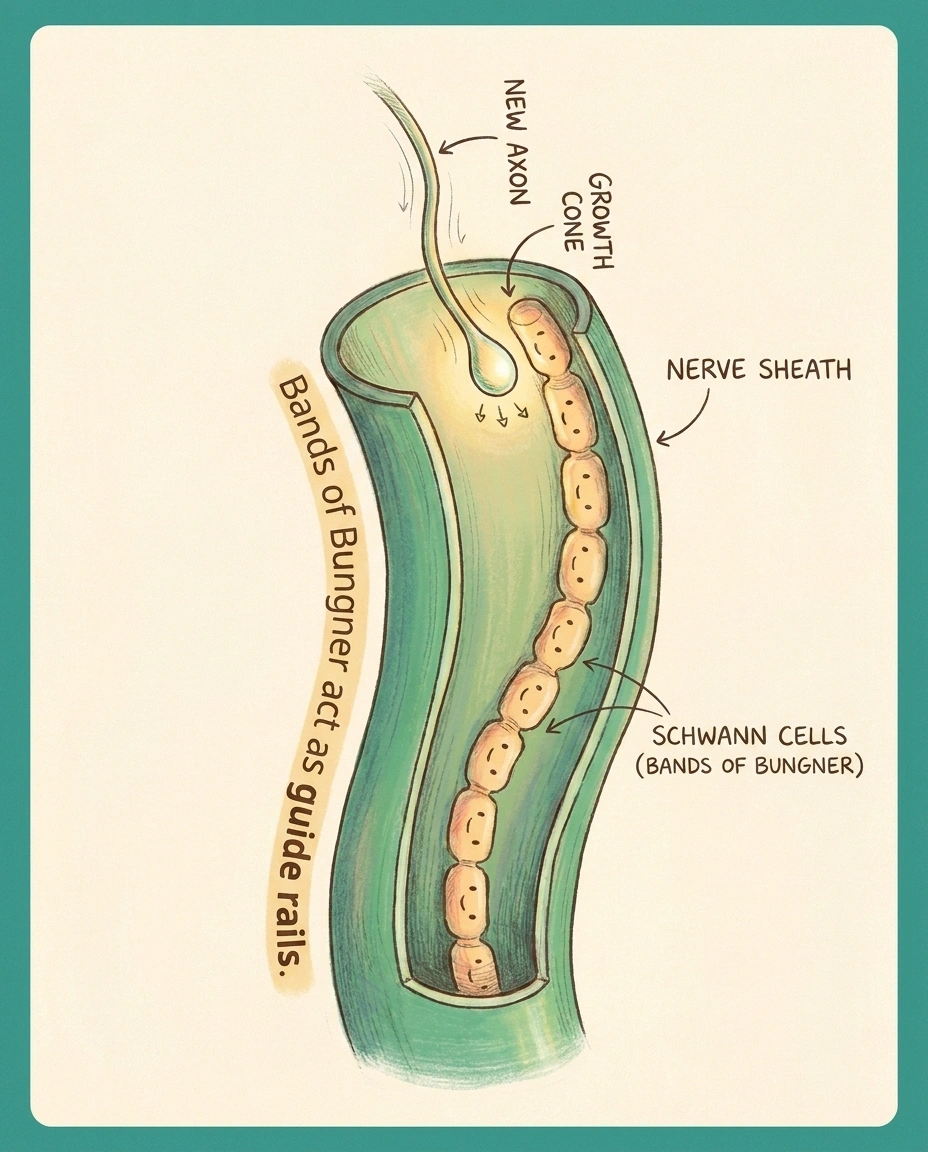
By weeks one through four, those Schwann cells do something remarkable. They line up end-to-end inside the empty sheath and form long, tube-like structures called Bands of Bungner. They are named after a German researcher who described them in the late 1800s.
These bands act like guide rails. When a regenerating axon starts growing from the surviving end of the nerve, it does not know which direction to go. It sends out exploratory tips called “growth cones” that feel around in the tissue. If those growth cones find a Band of Bungner, they latch onto it and follow it like a train on a track.
This is why an intact sheath is so important. Without the bands, the regrowing axons wander. They might end in scar tissue or never reach their target. This is why level two injuries have a much better prognosis than level three.
When surgical repair is done, surgeons work to align the cut ends properly, giving regrowing axons a fighting chance at finding the right tube. Researchers are also building synthetic versions of these bands. My piece on nerve regeneration research covers some of it.
Why Peripheral Nerves Can Regenerate (and Central Nerves Can’t)
One question I asked my neurologist early on was, “If peripheral nerves can heal, why can’t spinal cord injuries heal too?”
The peripheral nervous system and the central nervous system handle damage very differently. In the peripheral system, wallerian degeneration is welcomed by the environment. Macrophages clear the debris, Schwann cells form guide rails, and molecular signals encourage regrowth.
In the central nervous system, the same demolition happens, but the environment fights back. The CNS forms a “glial scar,” made of cells that wall off the injury, and the molecular environment fills with proteins that actively block axons from growing. Even if a central axon tries to regrow, it hits a wall.
For neuropathy patients, this is good news. Peripheral neuropathy affects peripheral nerves, which are the ones with the better regenerative environment. That does not guarantee recovery. It just means biology is on your side in a way it would not be if the damage were in the spinal cord.
What This Means for People Living With Neuropathy

So what does this mean day to day? My neurologist gave me a few takeaways I have come back to again and again.
First, damaged is not the same as dead. As long as the cell body (which usually sits near the spinal cord) is intact, and the underlying cause is removed or controlled, regeneration is biologically possible. Not guaranteed. Not fast. But possible.
Second, the timeline is brutal. Months to years, not weeks. Many patients give up on recovery after a few months, thinking nothing is happening. In many cases, something is happening. It just has not shown up at the surface.
Third, the underlying cause matters more than almost anything else. If the nerve is still being damaged faster than it can regrow, you will not see net progress.
Fourth, some patients work with their doctors on supplements like alpha-lipoic acid or acetyl-L-carnitine. This is a conversation to have with your doctor, not something to add on your own.
Fifth, certain types of neuropathy regenerate better than others. Small fiber neuropathy has its own recovery dynamics. Length-dependent neuropathies can take the longest to show improvement because the distances are greatest.
The Role of SARM1 and NMNAT2: What Researchers Are Targeting
Scientists have identified two key molecules that act like the trigger and the brake. SARM1 is the trigger. When a nerve is stressed or damaged, SARM1 gets activated, and that activation starts the demolition. NMNAT2 is the brake. It is a protein that protects the axon and keeps SARM1 quiet. When NMNAT2 levels drop, the brake comes off, and demolition begins.
Here is why this matters. In some forms of neuropathy, like chemotherapy-induced neuropathy and possibly diabetic neuropathy, researchers think SARM1 may be getting activated too easily. Axons are being demolished when they could have been saved. If you could block SARM1 with a drug, you might be able to slow that demolition.
Several drug companies and academic labs are working on SARM1 inhibitors right now, mostly in animal studies and early human trials. We are not at the point of “ask your doctor for a prescription” yet, but the science is real. My neurologist mentioned that he expects the next decade to bring real options here, though he was careful not to overpromise.
Tracking Recovery: Tinel’s Sign and What It Tells You
One of the most surprising tools my neurologist used to track my recovery was so simple I almost laughed. He tapped along the path of a nerve with his finger and asked, “Do you feel a tingle?” That is Tinel’s sign, one of the oldest clinical tricks in the book.
When an axon is regenerating, the new, growing tip is hypersensitive. Tapping over that tip sends a little electric tingle into the area the nerve is trying to reach. By tapping from where the damage was toward where the nerve is heading, the doctor can find the spot where the tingle is strongest. That is the leading edge of regrowth.
If you come back in a month and the spot has moved further down the limb, regeneration is happening. A few centimeters in a few months is consistent with the one-millimeter-per-day rule.
The first time he did this on me, I did not feel anything dramatic. It was a small flicker. He marked the spot with a felt-tip pen and asked me to come back. A few months later, the spot had moved. Slightly, but it had moved. That was the first concrete evidence I had seen that my body was doing something hopeful.
If you are working with a neurologist, ask about Tinel’s sign. Combined with an EMG and nerve conduction study, it gives a fuller picture. The diagnostic side is worth understanding too, which is why I wrote about how neuropathy is diagnosed.
Why Some Regenerating Nerves “Get Miswired”

I want to close with a topic that does not get talked about enough. Sometimes, regenerating nerves do not grow back the way they used to. They take wrong paths. They cross wires. They miss their original targets and end up connecting to nearby tissue instead.
When this happens, the result can be strange and persistent symptoms. You might feel cold when something warm touches you. You might feel a sensation in one spot when a different spot is touched. Some patients experience phantom sensations where the nerve fires signals for stimuli that are not really there.
This miswiring is one of the underrecognized sources of chronic neuropathic pain. The nerve is technically “healed” in the sense that an axon got from point A to roughly point B, but the wiring is off. The brain receives signals it cannot make sense of.
There is also a related issue with proprioception, your body’s sense of where your limbs are in space. If proprioceptive nerves regenerate incorrectly, balance and coordination can linger as issues even after sensation returns. I dig into this in proprioception loss in neuropathy.
The takeaway is that “recovery” is not always the same as “back to normal.” Sometimes recovery means a different normal. If you are noticing new strange sensations during what you think is a recovery phase, bring it up with your neurologist. Keep a symptom journal. That information is gold for the doctor trying to map what is happening underneath.
Frequently Asked Questions
Q: How long does wallerian degeneration take to complete?
The active demolition and cleanup phase typically takes about three to four weeks in peripheral nerves. The axon cytoskeleton starts breaking down within 24 to 48 hours after injury. Macrophages do most of the debris cleanup in the first one to two weeks. Schwann cells form their guide rails during weeks one through four. After that, the stage is set for regeneration to begin, but the regrowth itself takes much longer.
Q: Is wallerian degeneration reversible?
Wallerian degeneration itself is not reversible because it is a one-way demolition process. Once an axon distal to the injury starts breaking down, that section is gone. However, the process clears the path for new regeneration. In peripheral nerves where the cell body is intact and the underlying cause has been addressed, regeneration is biologically possible but slow. Talk through your specific situation with your neurologist.
Q: Does wallerian degeneration happen in the central nervous system?
Yes, a similar breakdown happens in the brain and spinal cord after injury, but the environment is very different. Central nervous system tissue forms glial scars and produces molecules that actively block axon regrowth. So while the demolition phase happens, the regeneration phase mostly does not. This is why peripheral nerves can heal in ways that central nerves usually cannot.
Q: What is the difference between wallerian degeneration and axonal degeneration?
Wallerian degeneration is a specific form of axonal degeneration that happens distal to an injury site after the axon is cut or crushed. Axonal degeneration is a broader term that also includes the “dying back” pattern seen in many slow neuropathies, where the longest axons gradually deteriorate from the tip backward toward the cell body.
Q: How fast do peripheral nerves regenerate after wallerian degeneration?
The general rule is about one millimeter per day, with a range of roughly one to three millimeters per day depending on the person, the cause, and how well the underlying condition is controlled. A damaged nerve that needs to regrow 30 centimeters might take close to a year. Longer distances take longer.
Q: Does wallerian degeneration happen in diabetic or chemo-induced neuropathy?
Yes, in many cases. Both diabetic neuropathy and chemotherapy-induced neuropathy involve ongoing damage to peripheral axons. Researchers are studying whether blocking the SARM1 trigger could slow this process. This is an active area of research, and any treatment decisions should be made with your medical team.
Q: Can I do anything to help my nerves regenerate faster?
I am a patient, not a doctor, so please take this as what my neurologist explained rather than medical advice. The biggest factor is removing or controlling the underlying cause. Good general nutrition, adequate sleep, gentle movement, and avoiding new sources of nerve stress all create conditions where the body can do its work. Some doctors discuss supplements like alpha-lipoic acid or acetyl-L-carnitine, but those should be talked through individually. There is no shortcut around the one-millimeter-per-day pace, but you can avoid slowing it down further.
About the Author