“You can’t feel your feet and you want to play a racket sport?”
That was my sister-in-law, at the kitchen table, entirely well-meaning and entirely wrong. She’d watched me trip on a curb the previous spring and had filed me permanently under fragile.
Here’s what she was missing. The choice in front of me wasn’t pickleball versus safe walking. It was pickleball versus another season of sitting, and sitting has its own casualty list: weaker legs, worse balance, a smaller world every year. Movement is protective. The question was never whether to move. It was how to move without getting hurt.
Pickleball turns out to be a surprisingly good fit for neuropathy, once you change three things. Not fitness, not competitiveness. Shoes, footwork, and what you do in the ten minutes after you leave the court.
Why This Particular Sport Fits
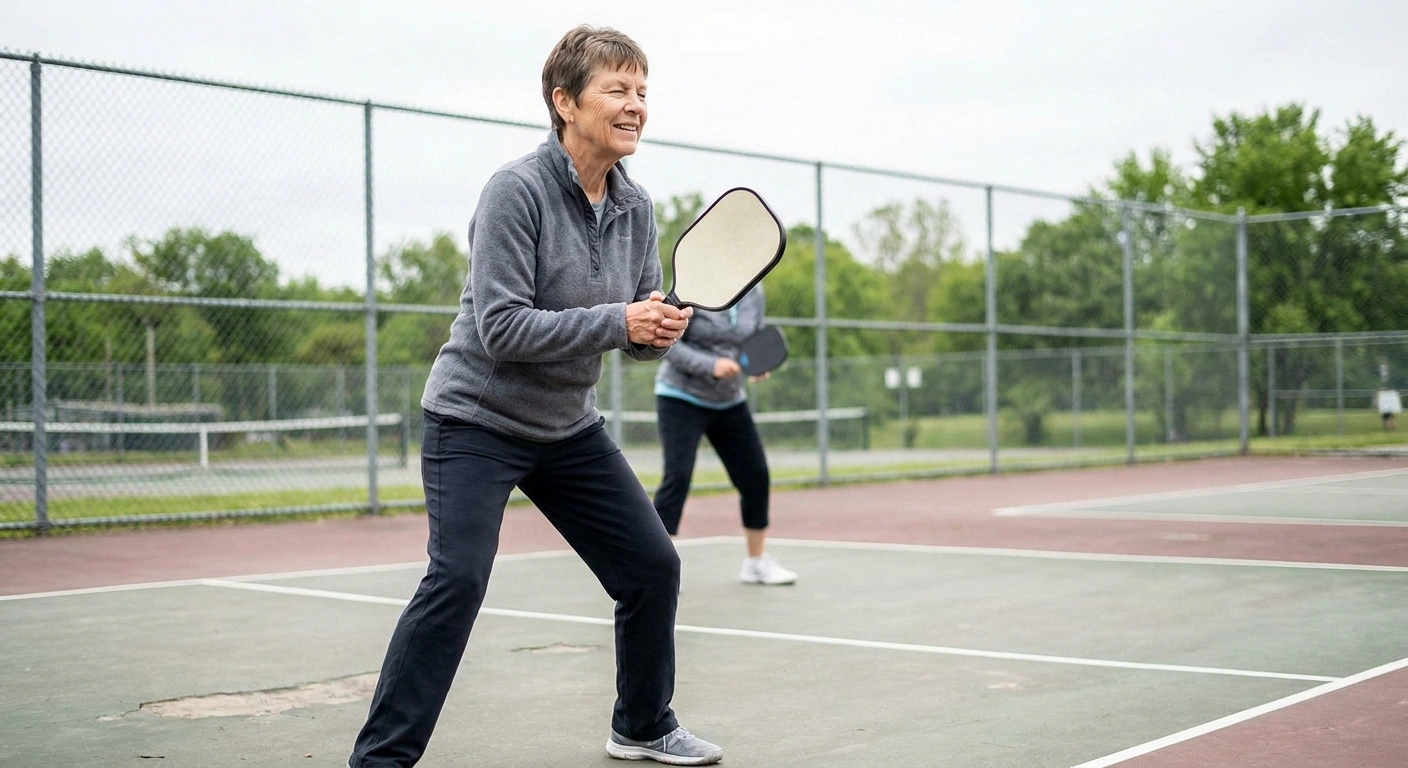
The court is 20 by 44 feet, less than a third the size of a tennis court. The ball is plastic and slow. Doubles is the default, so you’re covering roughly half of an already small space.
Most points are won near the kitchen line with soft, controlled shots. You’re not sprinting baseline to baseline. You’re taking small adjusting steps in a fairly compact zone, reading the ball, and placing it.
That describes a nearly ideal balance workout. You’re weight-shifting constantly, tracking a moving object, and reacting — which trains standing balance far more effectively than any static exercise, because real balance is dynamic. And the social structure is genuinely built in. Open play means rotating partners, which is a very different afternoon from walking laps alone.
There’s a real hazard too, and glossing it over would be doing you no favors. Pickleball produces meaningful numbers of foot and ankle injuries, mostly from sudden lateral movement and abrupt stops. Add reduced position sense and you’re at higher risk than the average player at the same skill level.
That risk is manageable. Most of it lives in the three things below.
Change One: The Shoes
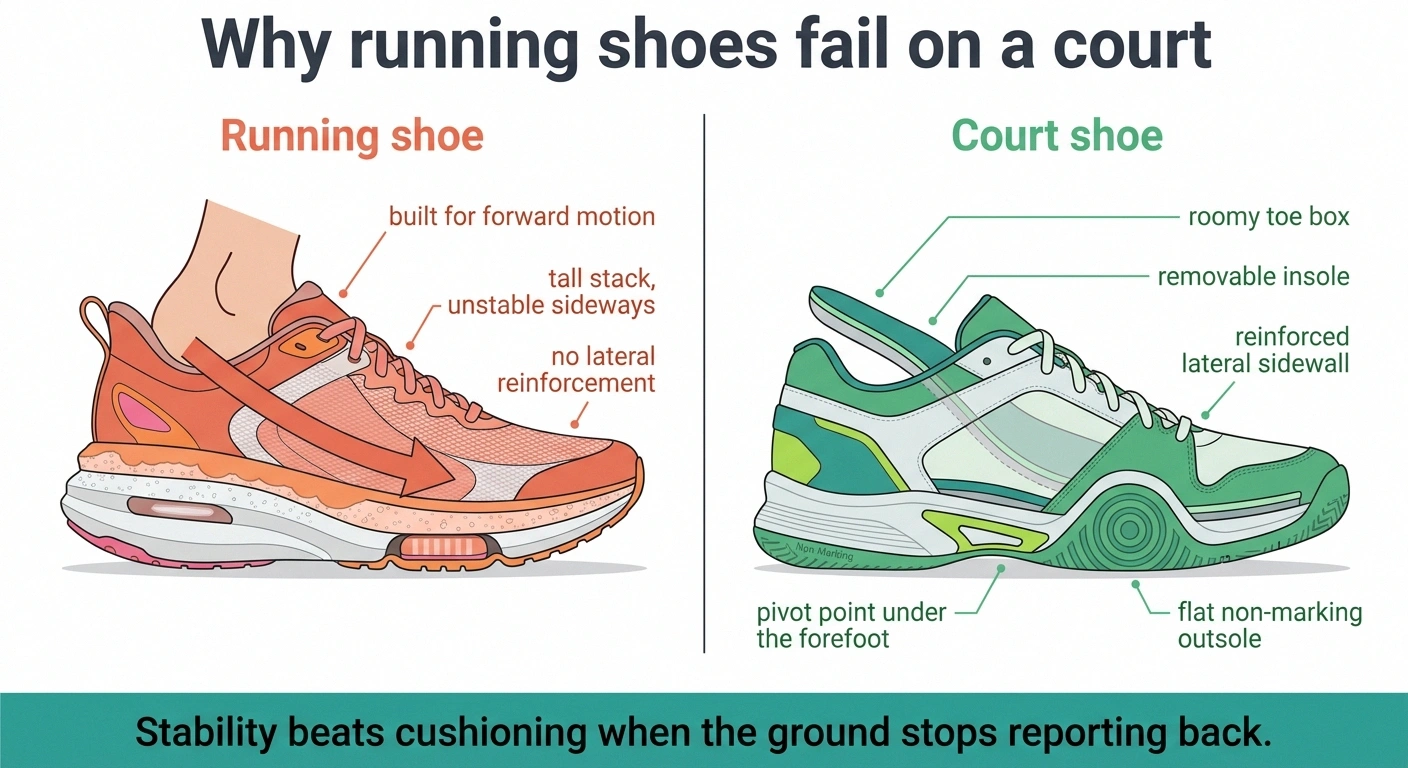
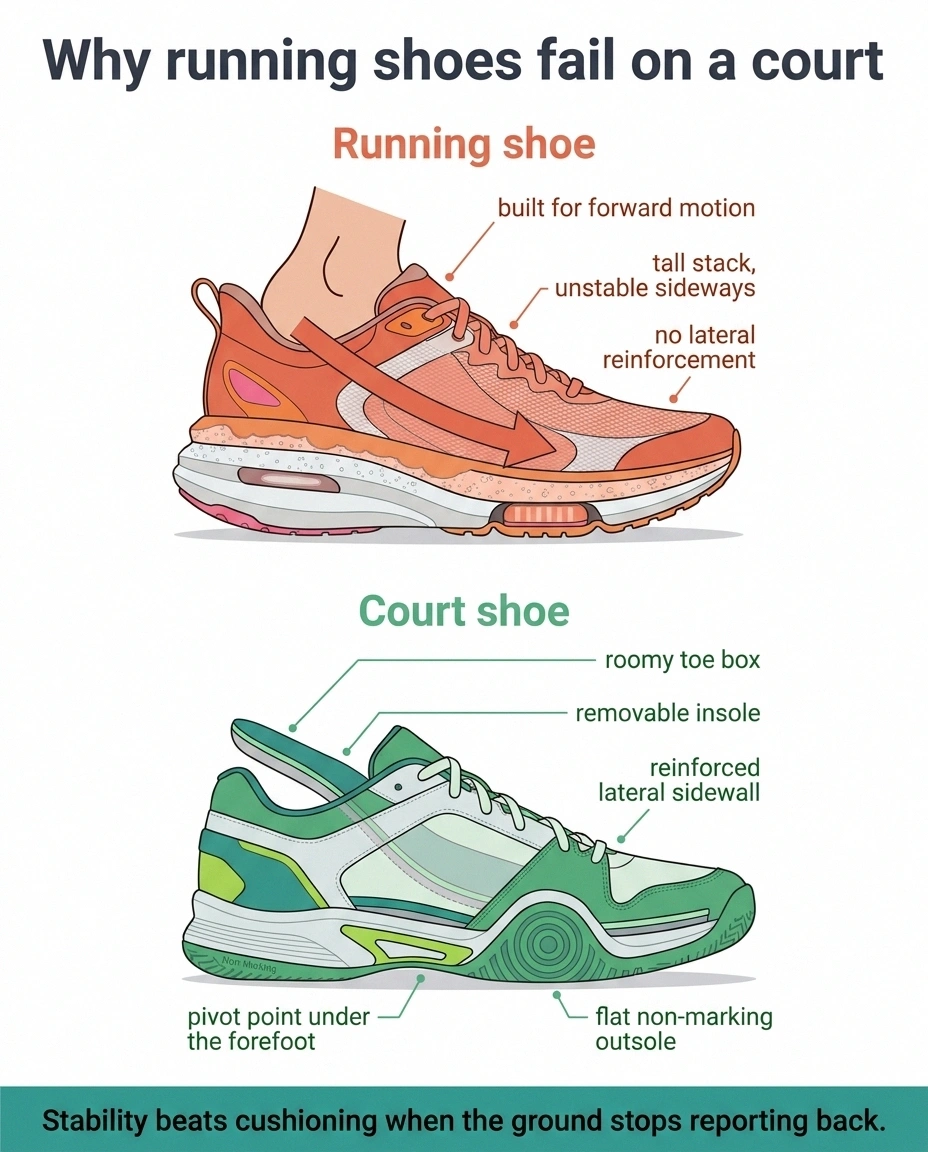
If you take one thing from this page, take this. Running shoes are the wrong shoes for a court.
| Feature | How to check it | What it prevents |
|---|---|---|
| Lateral sidewall | Press the outer edge inward with your thumb. It should resist, not fold. | Your foot sliding off the platform sideways |
| Low, flat sole | Set it beside a running shoe. The heel should sit visibly closer to the ground. | Rolling over a tall cushioned stack |
| Forefoot pivot point | Look for a smoother circle in the tread under the ball of the foot. | The shoe gripping while your knee turns |
| Toe box width | A thumb’s width past your longest toe, standing, late in the day. | Blisters you will not feel forming |
| Removable insole | Pull it out in the store. If it does not lift cleanly, the shoe is not orthotic-friendly. | Losing depth when you add your own footbed |
Two brand-agnostic notes: court shoes wear out through the outsole rather than the cushioning, so check the tread under the pivot point every couple of months. And a shoe that felt fine in the store and rubs in game three is telling you about width, not about break-in.
Running shoes are engineered for forward motion, and modern ones have tall, soft, cushioned heel stacks. That stack is comfortable in a straight line and unstable the moment you move sideways. Your foot rolls on top of the cushioning, the outsole isn’t built to grip laterally, and there’s no reinforcement at the side to stop it. That’s a rolled ankle waiting for the right dink.
Court shoes are a different tool. What you want:
A reinforced lateral sidewall. The material wrapping up the outer edge of the shoe. It’s what stops your foot sliding off the platform during a sideways push.
A flat, non-marking outsole. Herringbone or a similar court pattern, low to the ground. Lower is more stable, and stability beats cushioning when you can’t feel the ground reporting back to you.
A pivot point under the forefoot. A smoother circle in the tread that lets your foot rotate rather than catching. Catching is how knees get twisted.
A roomy toe box. Non-negotiable with neuropathy. Cramped toes plus repeated forward stops equals blisters, and blisters are the injury that actually ends seasons for people like us.
A removable insole. If you wear orthotics or prefer a specific footbed, you need the room. Several court lines — New Balance, ASICS, and K-Swiss among them — build models with wide fits and removable footbeds specifically for this.
Shop late in the day when your feet are at their largest, and bring the socks you’ll actually play in. Since you may not feel a shoe that’s slightly too tight, fit by measurement and thumb-width rather than by comfort alone. Our general guide to shoes for neuropathy covers the fitting principles in more depth, and they all transfer to court shoes.
On socks: seamless, moisture-wicking, cushioned, and never cotton. Cotton holds sweat against your skin and that’s where friction damage starts. There’s more in our rundown on socks that actually help, and a fresh pair for a second session the same day is a genuinely good habit.
Change Two: The Footwork
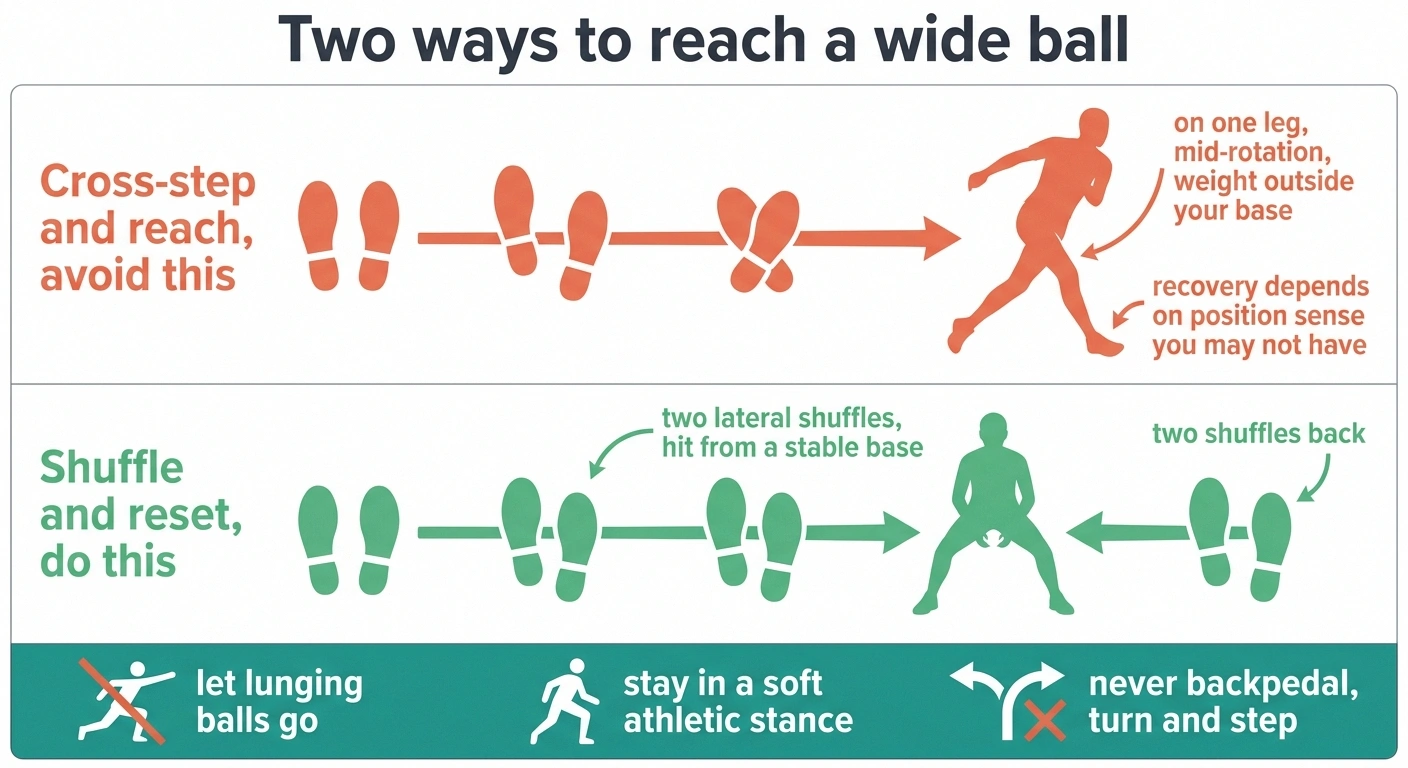
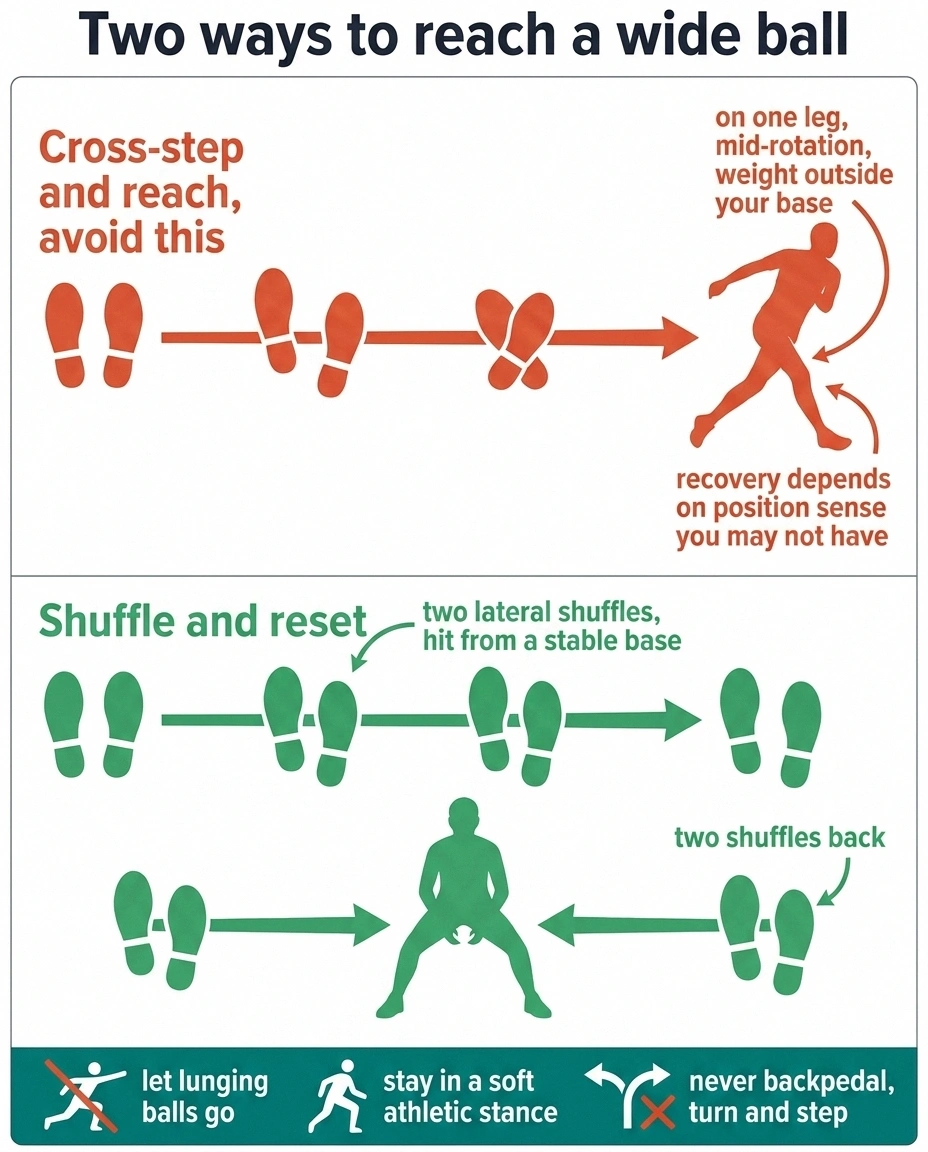
The instinctive move, when a ball pulls you wide, is to cross one foot over the other and reach. Every pickleball coach who works with older players tries to break this habit, and for neuropathy it’s worth breaking twice over.
“I’ve got nerve damage in my feet, so I’m not going to chase the wide ones. Take those if you can.”
It does two jobs. Your partner knows what to cover, and you stop feeling obliged to attempt shots you had already decided to let go. The second job is the one that actually protects you, because the pull to reach for a ball is strongest in the half-second when there is no time to think.
Say it before the first serve rather than after the first ball you let past. Afterwards it sounds like an apology; before, it sounds like a plan.
The cross-step puts you on one leg, mid-rotation, with your weight outside your base. Your body recovers from that position using position sense from your feet and ankles, reporting where you are in space. When that reporting is degraded, the recovery is slower and less accurate — and that’s the moment falls happen.
The substitution: shuffle and reset. Two quick lateral shuffle steps toward the ball, feet never crossing. Hit from a stable base with both feet under you. Two shuffle steps back to center.
It costs you a little reach. It buys you an enormous amount of stability, and it’s the single highest-value change on this list after footwear.
Three more that stack with it:
Give up on balls you’d have to lunge for. Let them go. In doubles, call it and let your partner take it. One point is not worth a wrist fracture, and good partners understand this immediately if you tell them at the start.
Stay in a soft athletic stance. Knees slightly bent, weight toward the middle of your foot, ready to move. Standing upright with locked knees puts you in the worst possible position to react.
Don’t backpedal. Walking backward for a lob is how experienced players fall. Turn, take a couple of steps, and turn back to hit. Slower and dramatically safer.
If your balance already feels unreliable, working on it off the court pays direct dividends on it, and our balance and fall prevention guide is the place to start.
Change Three: The Post-Game Foot Check
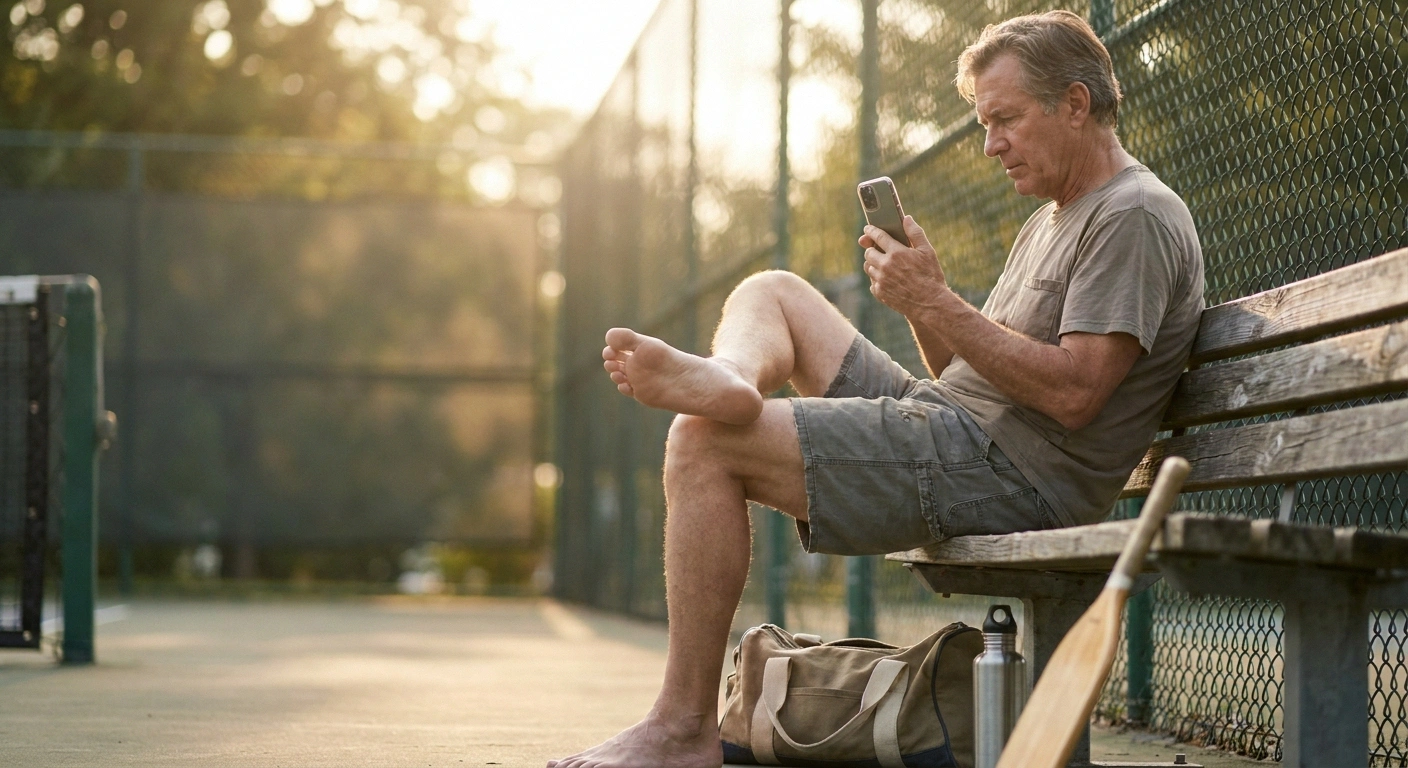
This is the one nobody tells you and the one that protects you most.
- Shoes and socks off. Both feet, not just the one that feels like something.
- Top of the foot, then the sole. Phone camera or a mirror on the ground if bending is hard.
- Between every toe. Spread them. This is where moisture damage hides and where nobody looks.
- Heel and the ball of the foot. The two highest-pressure zones in a sport built on stopping.
- Compare the two feet. One warmer, one more swollen, one redder is more informative than either foot on its own.
Keep a small flashlight and a couple of adhesive dressings in your paddle bag. The check only becomes a habit when doing something about what you find does not require a trip home first.
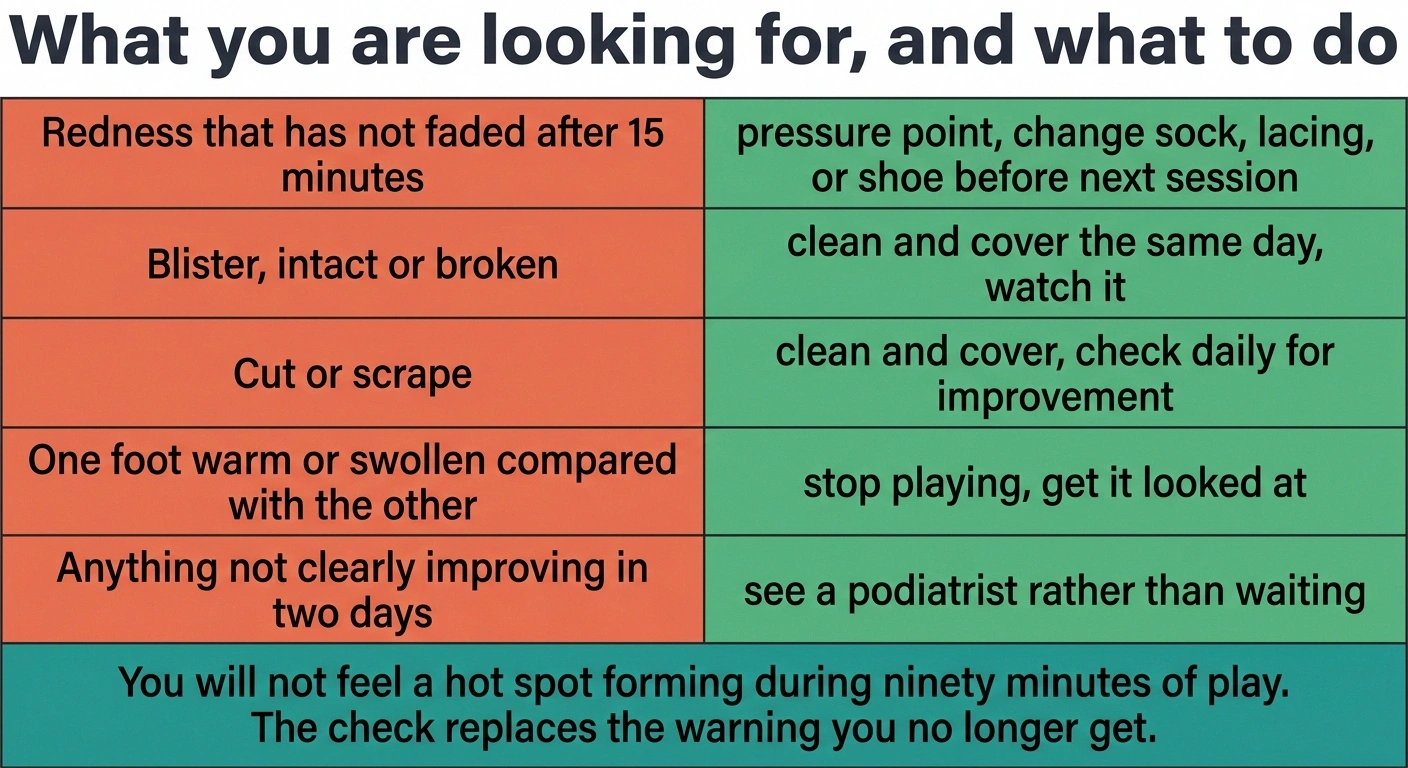
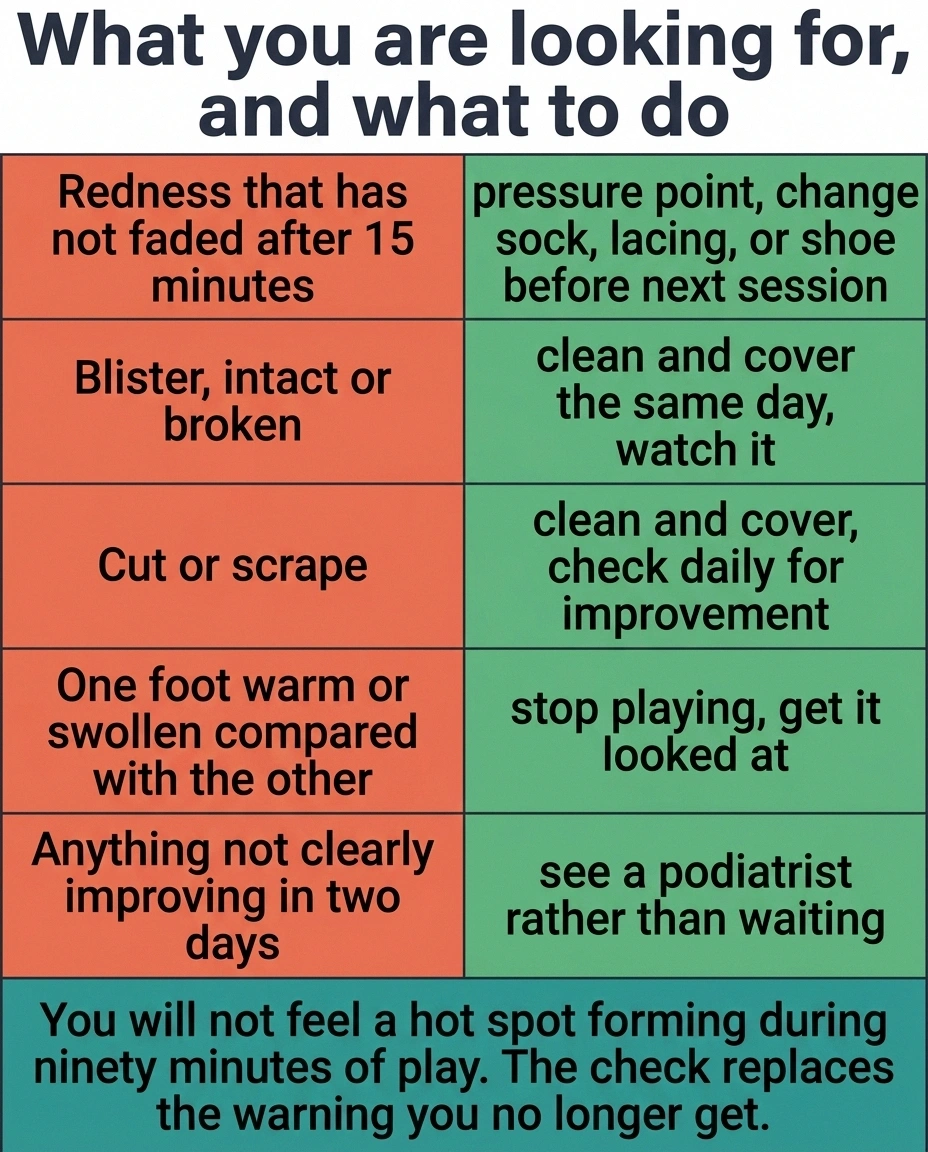
During ninety minutes of play you will not feel a hot spot forming. That’s the entire problem with reduced protective sensation — the early-warning system that would normally make you stop and adjust your sock has been switched off. A blister you’d have caught at minute twenty becomes a broken blister by the time you’re in the car.
So the check is a substitute for the missing warning. Every time, before you drive home:
Shoes and socks off. Look at the whole foot in decent light, including between every toe and across the entire sole. Use a mirror on the floor or your phone’s camera if bending is difficult. You’re looking for redness that doesn’t fade within about fifteen minutes, any blister intact or broken, cuts or scrapes, and anything warm or swollen compared with the other foot.
Redness that persists is the important one. It’s the pressure point that will be a blister next session if you don’t change something — a different sock, a lacing adjustment, a different shoe.
Anything that breaks the skin gets cleaned and covered the same day, and gets watched. If it isn’t clearly improving within a couple of days, that’s the point to bring in a podiatrist rather than waiting to see. Small foot wounds in numb feet have a way of becoming large ones quietly.
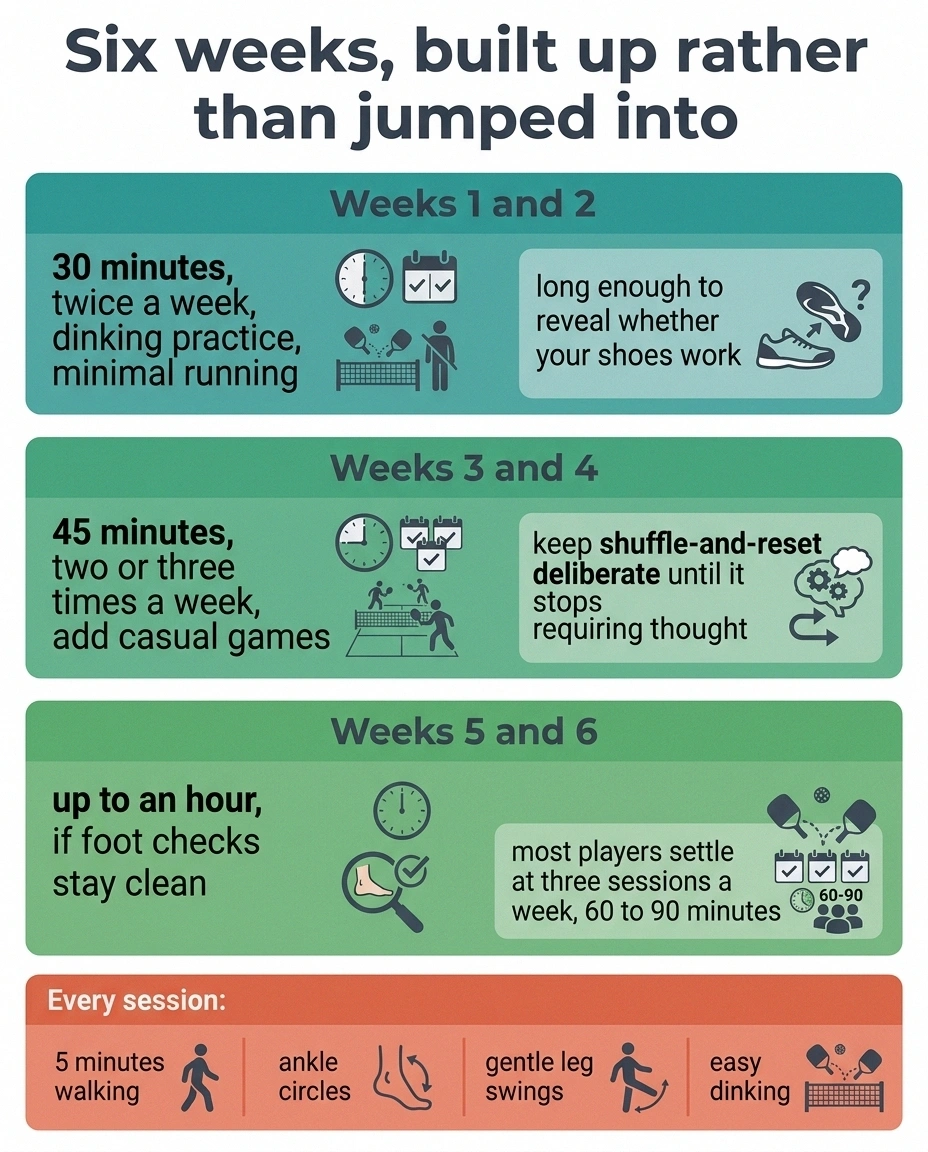
Your First Six Weeks
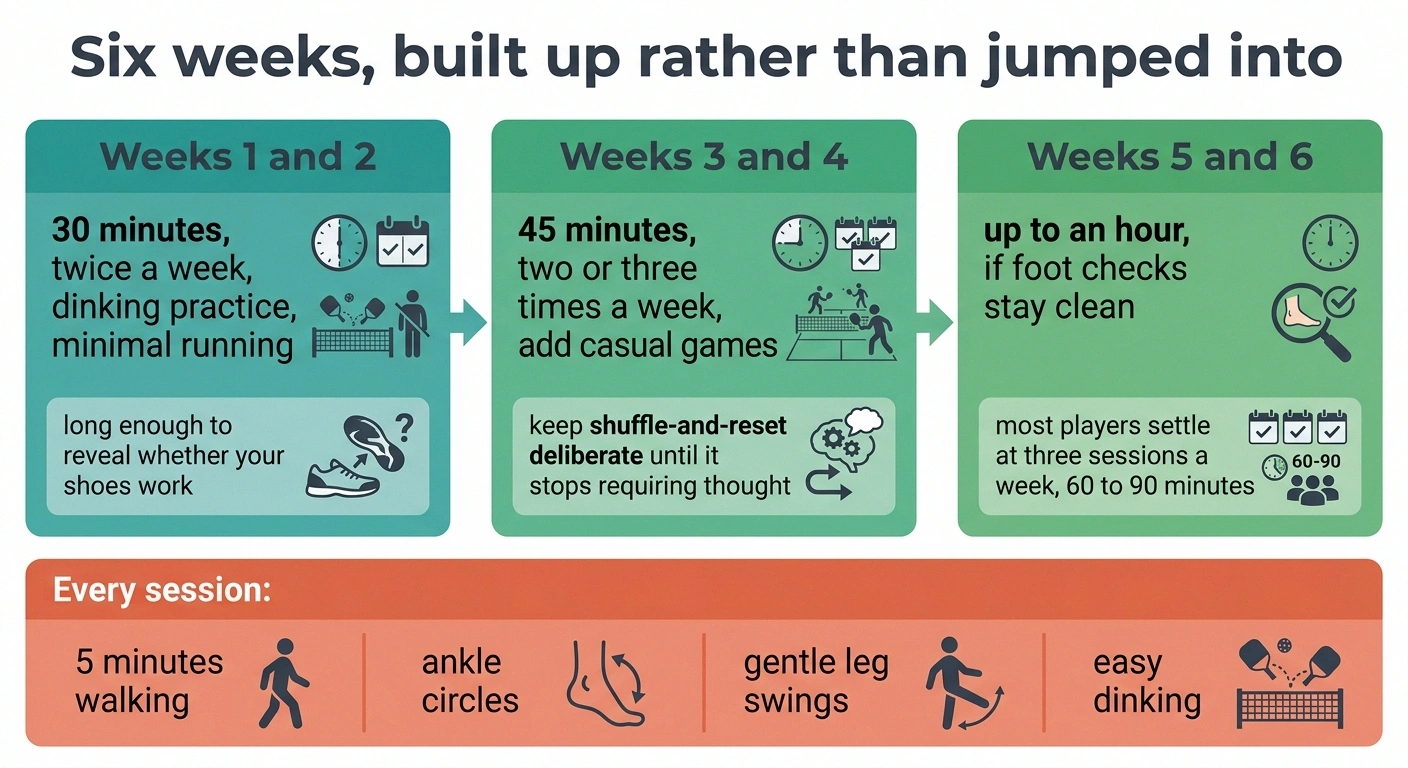
Almost everyone who gets hurt early does it by playing too long on day one. Enthusiasm is the risk factor.
Weeks one and two. Thirty minutes, twice a week. Dinking practice, minimal running. This is enough to build the movement patterns and reveal whether your shoes work.
Weeks three and four. Forty-five minutes, two or three times a week. Add casual games. Keep the shuffle-and-reset deliberate until it stops requiring thought.
Weeks five and six. An hour, if the foot checks have stayed clean and nothing is flaring. Most people settle around three sessions a week at sixty to ninety minutes.
Warm up first, every time: five minutes of walking, then ankle circles, gentle leg swings, and some easy dinking before anything competitive. Cold tissue and unfamiliar lateral loads don’t mix well.
Play in the morning if your symptoms follow the common evening-worsening pattern, and take water seriously, since courts get hot and dehydration makes nerve symptoms noticeably worse for a lot of people. Our notes on staying hydrated cover why that connection is real.
The Social Part, Honestly
Open play means strangers, and strangers means the question of whether to say anything.
- The kitchen
- The seven-foot zone on each side of the net, properly called the non-volley zone. You cannot hit the ball out of the air while standing in it. For our purposes it is also the calmest real estate on the court.
- Dink
- A soft shot that drops into the opponent’s kitchen. Low effort, low impact, and the shot that wins most points in recreational play. Learning to dink well is the fastest route to playing competitively without running.
- Stacking
- A doubles arrangement where partners line up on the same side and switch after the serve, so each stays on their stronger side. Worth asking about if one of your feet or knees is markedly better than the other.
- Open play
- Drop-in sessions where you rotate through partners rather than arriving with a team. Paddles usually go in a rack or on a fence hook to mark the queue. Sessions labeled recreational, beginner, or 55-plus run at a friendlier pace.
I’d say something. Not a medical history — one sentence at the start. “I’ve got nerve damage in my feet, so I’m not going to chase the wide ones. Take those if you can.” Nobody has ever reacted badly to that in my experience, and it does two useful things at once: it stops you feeling obliged to attempt shots you shouldn’t, and it tells your partner what to cover.
Look for sessions labeled beginner, recreational, or 55+. The pace is more forgiving and the culture is friendlier. Many places run a specific slow-play or social session, and those are ideal for a first month.
The community aspect is not a small bonus. A lot of what makes chronic conditions hard is how much they shrink your week, and a standing Tuesday-and-Thursday commitment with people who expect you is worth something real beyond the exercise.
When to Stop and Get It Looked At
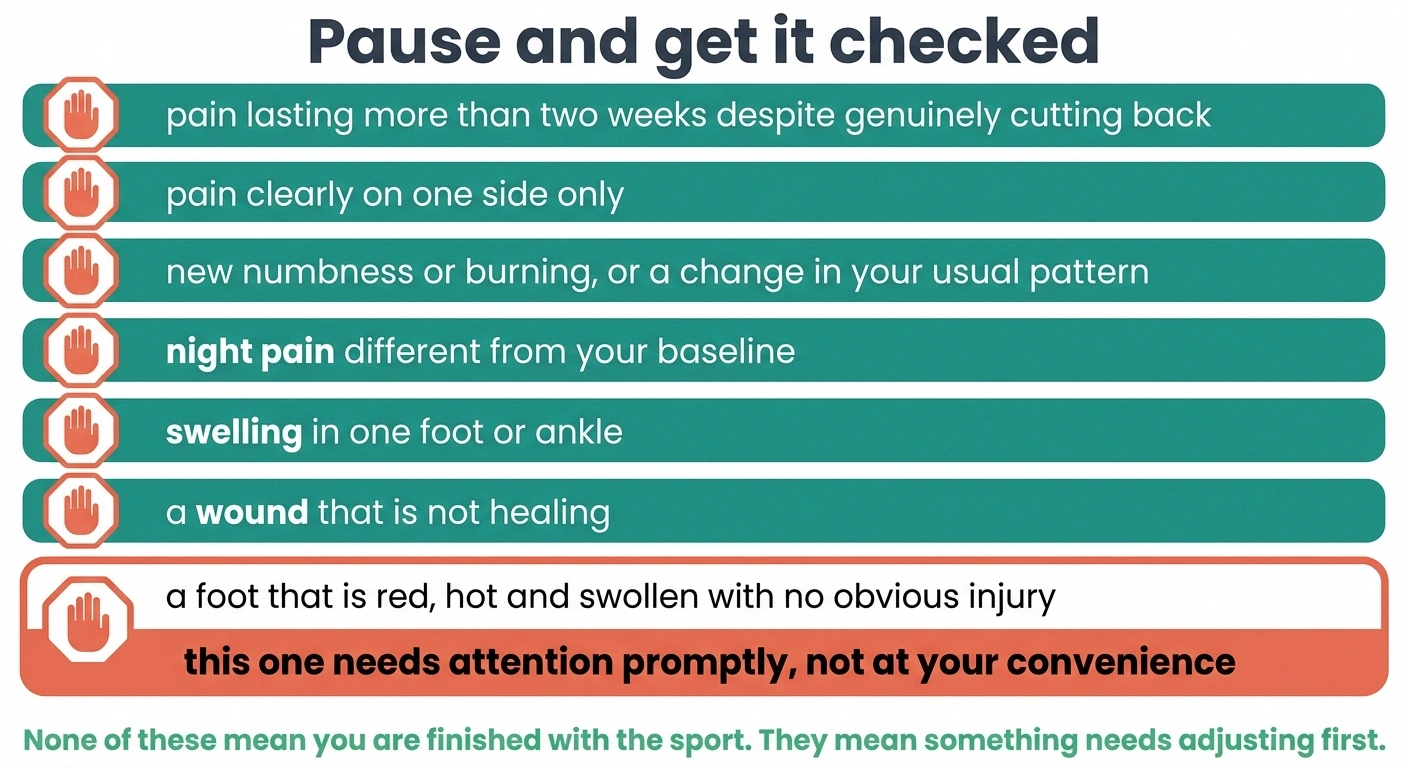
Some signals mean pause rather than push through:
Pain that persists more than two weeks despite genuinely cutting back your playing. Pain clearly on one side only, which suggests a structural problem rather than general overuse. New numbness, new burning, or a change in your usual pattern. Night pain that’s different from your baseline. Swelling in one foot or ankle. Any wound that isn’t healing. And a foot that becomes red, hot, and swollen without an obvious injury, which needs to be looked at promptly rather than at your convenience.
None of these mean you’re finished with the sport. They mean something needs adjusting before you continue.
What Changed for Me
Two years in, my sister-in-law plays too. She’s better than me, which she mentions.
My feet are not better. Neuropathy doesn’t work like that. But my legs are stronger, I recover from a stumble faster than I did, and I have two mornings a week that belong to something other than managing symptoms. My last balance assessment was the best in three years, and I’m confident the pickleball is why.
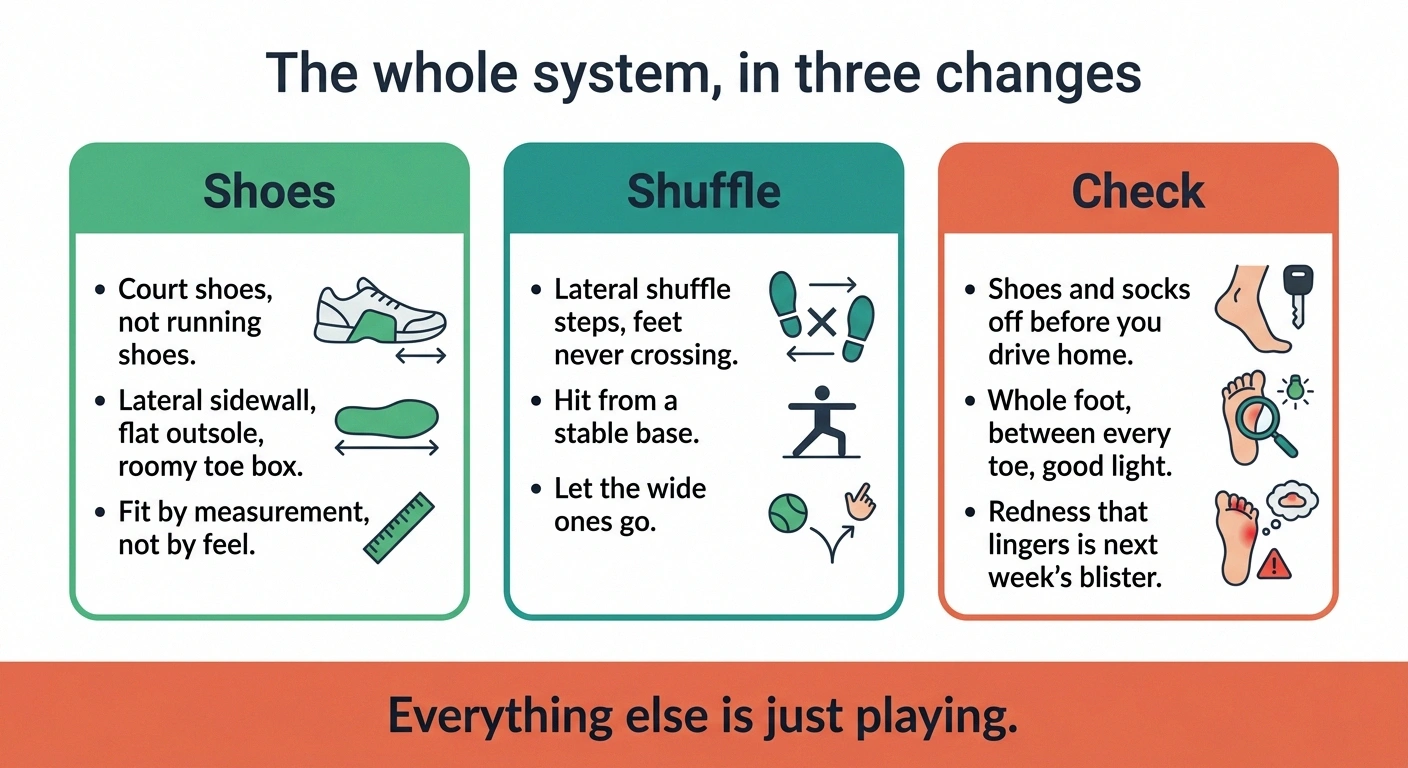
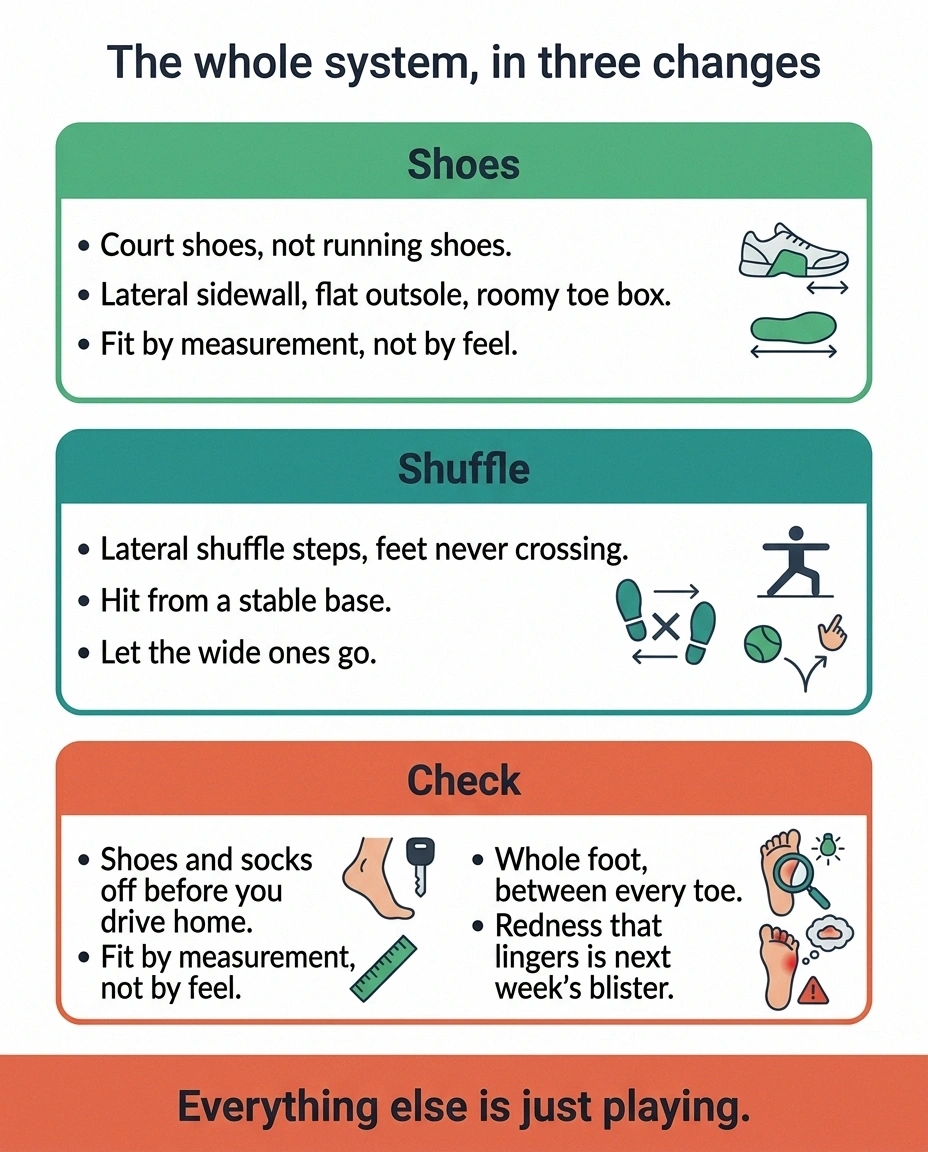
The shoes, the shuffle, the foot check. That’s the whole system. Everything else is just playing.
Frequently Asked Questions
Is pickleball safe if I cannot feel my feet?
For many people with neuropathy it can be, with specific modifications. The main risks are falls from reduced position sense during lateral movement, and unnoticed blisters or wounds from absent protective sensation. Both are substantially reduced by wearing proper court shoes with lateral support and a roomy toe box, replacing cross-step reaching with lateral shuffle steps, and inspecting the feet after every session. Anyone with active foot ulcers, an unhealed wound, significant balance impairment, or a recent fall should have an individual assessment before starting, since those situations change the calculation.
What shoes should I wear for pickleball with neuropathy?
Court shoes rather than running shoes. Running shoes are built for forward motion and their tall cushioned heels become unstable during sideways movement, which is most of pickleball. Look for a reinforced lateral sidewall, a flat non-marking outsole with a court tread pattern, a pivot point under the forefoot, a wide toe box, and a removable insole if you use orthotics. Fit them late in the day wearing the socks you will play in, and rely on measurement and thumb-width at the end of the toe rather than on how they feel, since reduced sensation makes a too-tight shoe hard to detect.
How do I keep my balance on the pickleball court?
Use lateral shuffle steps rather than crossing one foot over the other, since crossing puts you on one leg with your weight outside your base at the moment recovery is hardest. Stay in a soft athletic stance with knees slightly bent and weight toward the middle of the foot. Never walk backward for a lob; turn, move, and turn back to hit. Let wide balls go rather than lunging. Off-court balance training between sessions makes all of these easier and is worth doing two or three times a week.
Should I play singles or doubles?
Doubles, in nearly every case. Singles requires covering the entire court, which means far more running, more lunging, and more of the sudden direction changes that create fall and injury risk. Doubles halves your coverage area, keeps play focused near the kitchen line where movement is small and controlled, and gives you a partner who can take the wide balls you choose to let go. It is also the standard format at most open play sessions, so it is rarely a limitation socially.
How long should I play?
Start with thirty minutes twice a week for the first two weeks, extend to forty-five minutes two or three times weekly in weeks three and four, and move toward an hour by weeks five and six if foot checks stay clean and symptoms are not flaring. Most regular players settle at around three sessions a week of sixty to ninety minutes. Building up gradually matters more with neuropathy than with most conditions, because reduced sensation means the usual feedback that would tell you to stop arrives late or not at all.
What should I check on my feet after playing?
Remove shoes and socks and examine the entire foot in good light, including between all the toes and across the whole sole, using a floor mirror or a phone camera if bending is difficult. Look for redness that has not faded after about fifteen minutes, blisters whether intact or broken, cuts, scrapes, and any area that feels warm or looks swollen compared with the other foot. Persistent redness marks a pressure point that will become a blister without a change of sock, lacing, or shoe. Clean and cover anything that breaks the skin the same day.
Will playing pickleball make my neuropathy worse?
Exercise itself is not known to worsen nerve damage, and regular physical activity is associated with better outcomes in peripheral neuropathy including improved balance and preserved strength. What can worsen is the foot, through blisters, pressure injuries, or unnoticed wounds, which is why footwear and post-session inspection carry so much weight here. Some people notice temporary symptom increases after activity, particularly with heat, and playing in cooler parts of the day and maintaining hydration usually reduces that.
Do I need to tell the other players about my neuropathy?
It is not required, but one brief sentence at the start of play tends to make the session go better. Something as simple as mentioning nerve damage in your feet and that you will not be chasing wide balls tells your partner what to cover and removes any pressure you might feel to attempt shots that are unsafe for you. Sessions labeled beginner, recreational, or 55-plus generally have a slower pace and a more accommodating culture, and are a good place to begin.
About the Author