The pharmacy called me on a Tuesday afternoon, in the parking lot after book club. “Janet, your prior authorization is still pending on the pregabalin. You want to pick up the two you already have, or wait?” I told her I would wait, and I sat in the car with the engine off for a moment, because the last time this word “pending” showed up on a prescription of mine, it took eleven days and three phone calls to unstick. I am not a special case in this. In 2026, a prior authorization is between you and a large percentage of the medications that actually treat peripheral neuropathy well.
My name is Janet Ellis, and I have been living with neuropathy long enough now to have developed a system for these things. This is that system, written down, so that the next time your neurologist writes a script and the pharmacy says the letters “PA,” you know exactly what is happening, what to do, and what to hand your doctor’s office so the request moves the first time instead of the third.
What “Prior Authorization” Actually Means
A prior authorization is a coverage-approval step your insurance plan requires before it will pay for certain drugs, tests, or procedures. Your doctor writes the prescription. The pharmacy runs it through your insurance. The insurance computer flags the drug as “PA required.” The pharmacy bounces the script back to the prescriber. Your doctor’s office then submits paperwork to justify the choice, and a plan reviewer (sometimes an algorithm, sometimes a pharmacist, sometimes a physician) decides yes or no.
None of that happens on your kitchen table. Almost all of it happens in the two or three days after you drop the script off, and most of the time you do not know it is happening. When it goes smoothly, you get a text saying your prescription is ready. When it does not, you get a phone call about “pending” or a letter that says the request was denied and here are the alternative drugs the plan prefers.
Prior authorization exists because insurance plans use it as a budgetary lever. Some drugs are expensive. Some have cheaper alternatives that the plan wants tried first. Some are FDA-approved for conditions other than yours, and the plan wants documentation that the off-label use is medically appropriate. The lever is legitimate in principle, and it is often frustrating in practice, and it is almost always beatable when the medical reasoning is on your side.
The Neuropathy Drugs That Almost Always Trigger PA
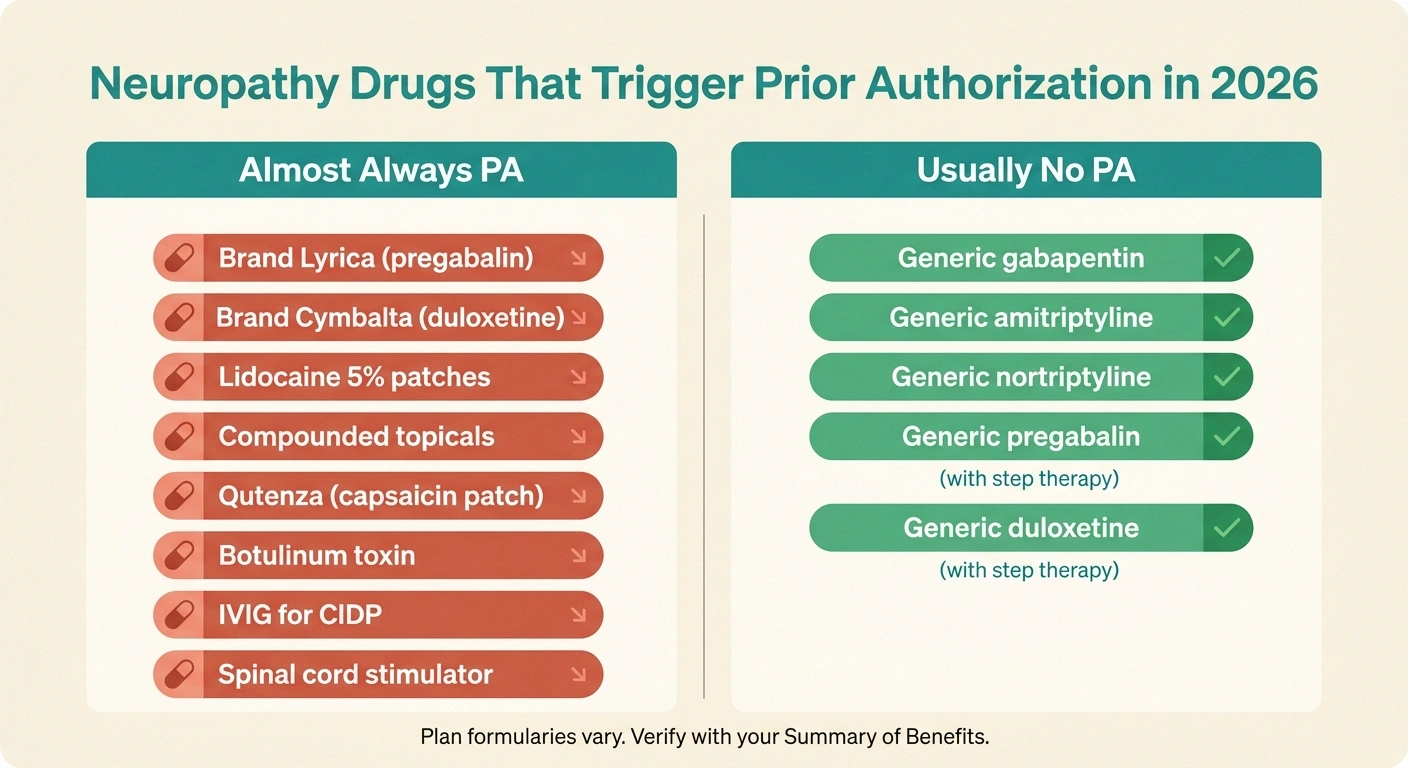
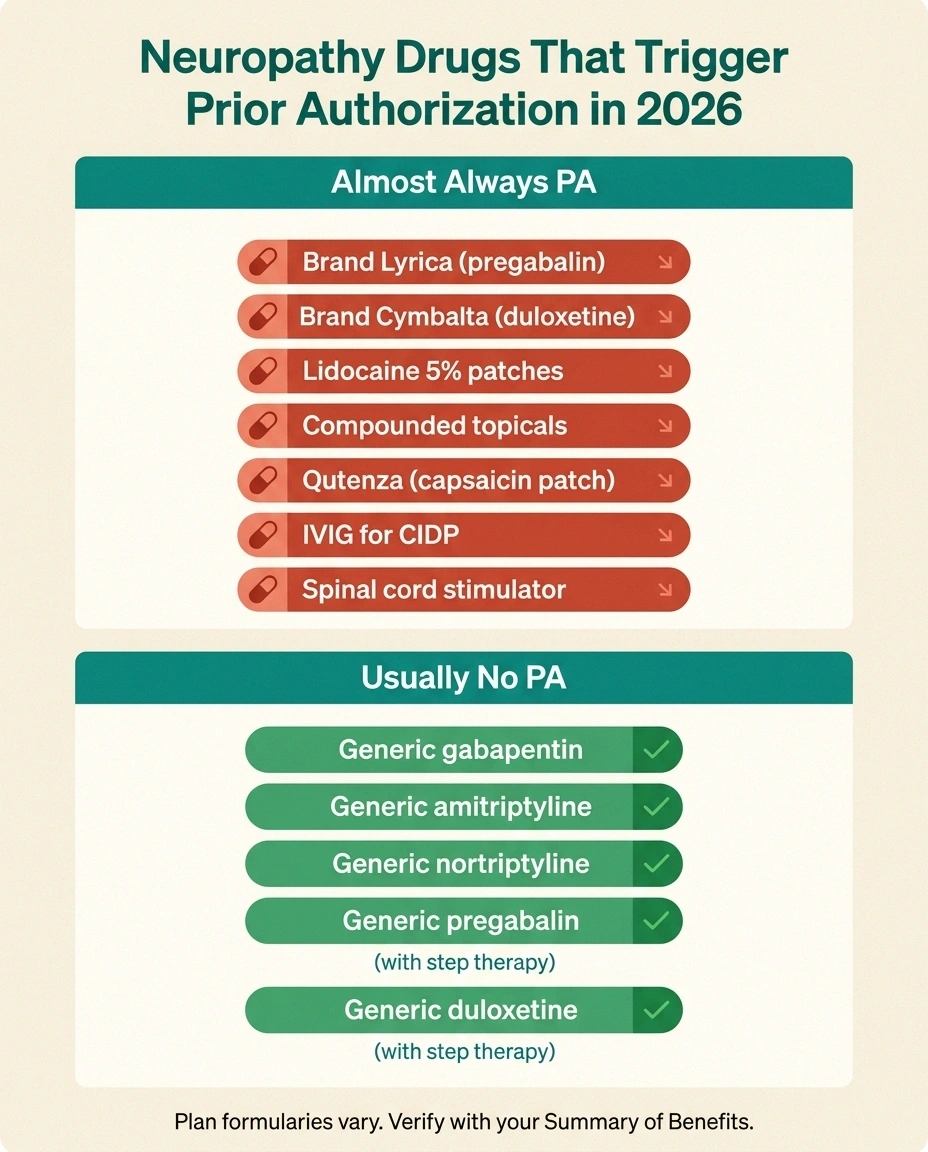
Not every neuropathy medication requires prior authorization. A short list of drugs will not: generic gabapentin, generic amitriptyline, and generic nortriptyline usually run through without a hitch on nearly every plan. They are cheap, they are old, and formularies love them.
A 2024 American Medical Association survey found that 94 percent of physicians report PA delays patient care, and 78 percent say PA sometimes or often leads to treatment abandonment. Meanwhile, in a 2019 American Journal of Managed Care analysis of Medicaid pregabalin PA policy, prior-authorization requirements reduced pregabalin utilization but did not reduce total drug spending — patients shifted to other neuropathic agents rather than going without.
Translation: the barrier is real, and treatment abandonment is common, but persistence works. Most PAs approve when properly resubmitted, and when they do not, the appeal ladder reliably moves them.
The drugs that almost always trigger a PA request in 2026:
- Brand-name Lyrica (pregabalin). Universal PA on nearly every plan. Generic pregabalin is therapeutically equivalent, and step therapy usually requires a documented trial of generic gabapentin at a therapeutic dose (typically 900 mg/day or higher, split three times daily) before the plan will approve pregabalin.
- Brand-name Cymbalta (duloxetine). Same story. Generic duloxetine is usually formulary-covered, but if your doctor writes for the brand, expect a PA.
- Lidocaine 5 percent patches. Medicare Part D commonly caps the quantity to a specific number of patches per month; going above requires a quantity-limit exception.
- Compounded topicals (ketamine, amitriptyline, baclofen, gabapentin, lidocaine in creams). These are not FDA-approved drug products in the compounded form, and most commercial plans and Traditional Medicare do not cover them. If your dermatologist or pain clinic compounds one, expect denial and plan to appeal.
- Capsaicin 8 percent patch (Qutenza). Always PA, always administered in-office by trained staff, and almost always requires documented failure or intolerance of oral neuropathy medications first.
- Botulinum toxin injections for chronic neuropathic pain.
- IVIG (intravenous immunoglobulin) for CIDP, multifocal motor neuropathy, or the still-controversial small-fiber applications.
- Spinal cord stimulator trial and permanent implant.
- Suzetrigine (Journavx) is approved for moderate-to-severe acute pain only as of 2026. Any off-label neuropathic use will hit a wall of PA and step-therapy requirements.
Every one of these has a well-worn path. Once you know the pattern, you can hand your prescribing doctor’s office the components list and the packet usually moves in one submission instead of three.
Step Therapy: The Rule Behind Most PA Denials
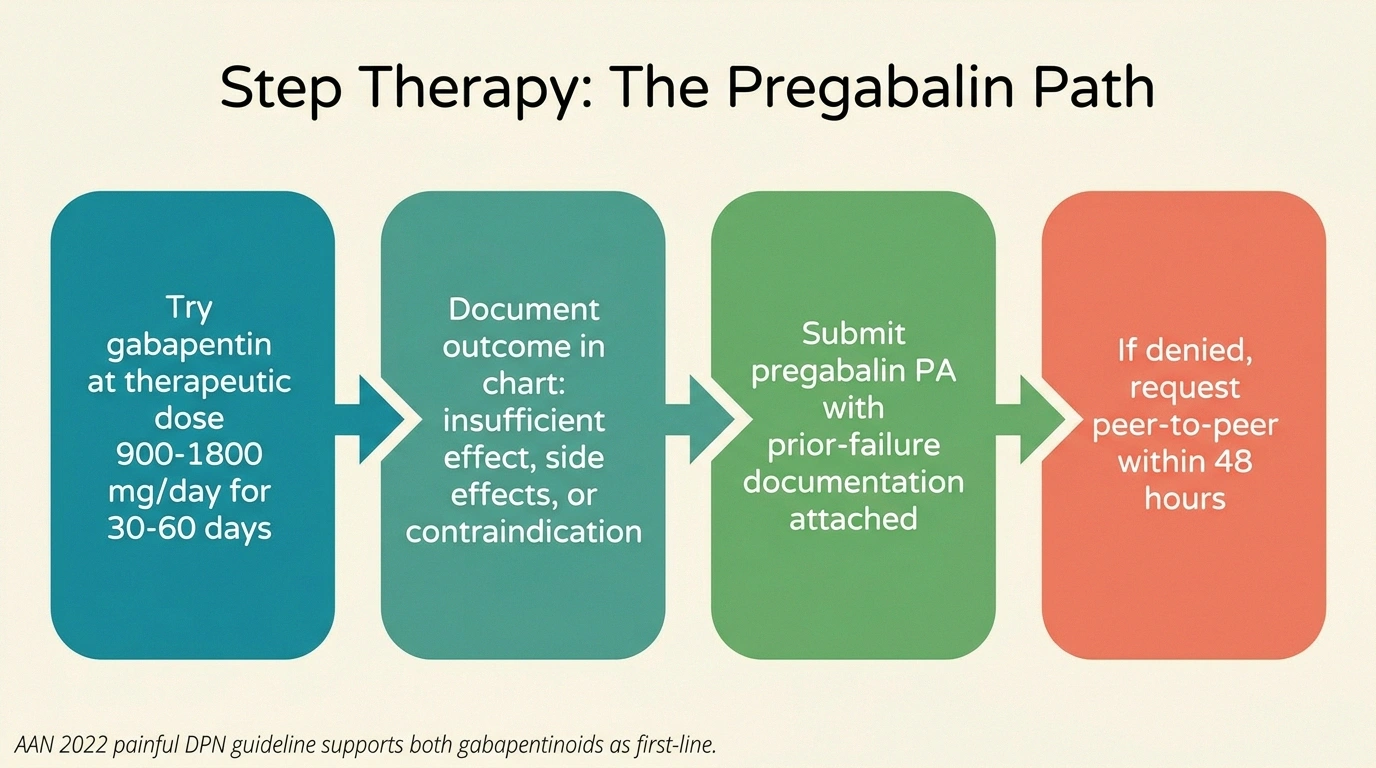
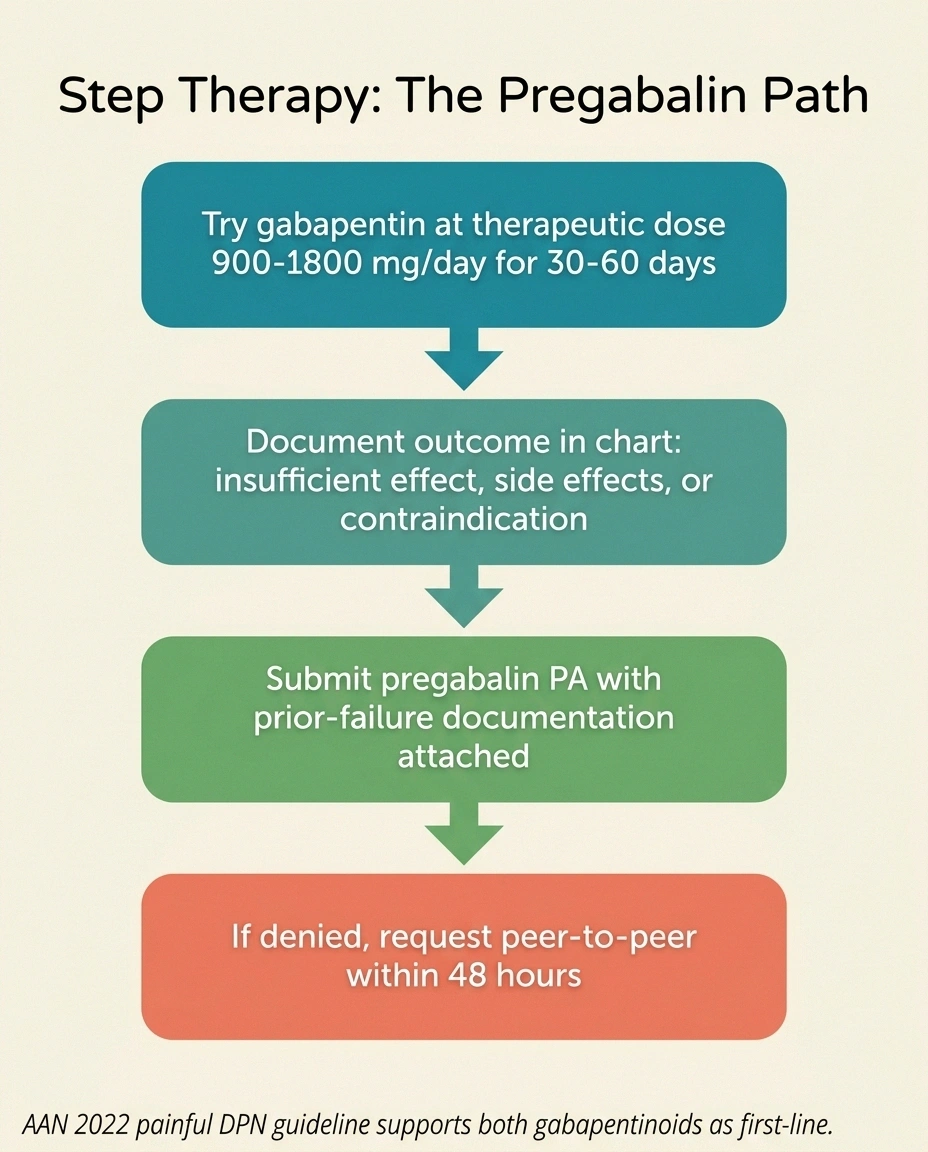
Step therapy is the single most common reason a neuropathy drug gets denied. The rule is simple: the plan wants you to try the cheaper drug first, at a real dose, for a real duration, before it will pay for the more expensive one.
Therapeutic dose 900–1800 mg/day, split three times daily. Duration 30–60 days. Document dose, duration, effect.
Insufficient pain reduction, intolerable side effects, or contraindication. Specific words the LMN can cite later.
LMN cites gabapentin trial results, requests generic pregabalin at specific dose and quantity, references AAN 2022 painful DPN guideline.
Fifteen-minute call between prescribing physician and plan medical director. Majority of properly prepared P2Ps clear the request.
Prior authorization is a paperwork step, not a personal test. Almost every PA denial happens because the packet is missing one of nine standard pieces or the step-therapy trial was not documented. When the pieces are in place and the Letter of Medical Necessity cites the right guideline, most PA requests approve on the first submission. When they do not, the peer-to-peer call reverses a majority of denials within a week.
For pregabalin, the required first step is almost always gabapentin. The plan usually wants documentation that you took gabapentin at a therapeutic dose (900 to 1800 mg per day is common; some plans want up to 3600 mg per day tried) for a real trial period (30 to 60 days is typical), and that it either failed to control pain or caused side effects you could not tolerate. If you have never tried gabapentin, the answer is not to fight the step. The answer is to try gabapentin properly first, document the outcome, and if it does not work, the pregabalin PA becomes almost automatic.
For duloxetine, the required first step depends on the plan. Some plans require an SNRI trial (venlafaxine) or a tricyclic antidepressant (amitriptyline, nortriptyline) first. Others accept duloxetine as a first-line drug for painful diabetic peripheral neuropathy because the American Diabetes Association’s Standards of Care specifically endorse it.
For IVIG in CIDP, the plan usually wants documented failure or intolerance of corticosteroids (prednisone) or plasmapheresis first, unless the neurologist documents a specific contraindication.
The step-therapy exception is the appeal tool that clears this obstacle. Your doctor writes a letter documenting the exception grounds: prior trial and failure, contraindication, or intolerance. Under many state laws and under Medicare rules, plans have short windows (often 72 hours for standard requests, 24 hours for urgent) to respond to a properly filed step-therapy exception. Our guide to medications that can cause or worsen neuropathy is useful here, too, because sometimes the “prior trial” documentation includes drugs you had to stop because they made things worse.
The PA Packet: The Nine Pieces That Move Approvals
A well-built prior-authorization packet is a small document, usually four to eight pages, that answers every question the plan reviewer is going to ask before they can ask it. Your doctor’s office knows how to build one; your job is to make sure they have the raw material.
A well-built PA packet answers the reviewer’s questions before they can ask them.
Name, DOB, member ID, group number
E11.42, G60.9, G61.81, G56.0x
Explicit; NDC when possible
EMG, biopsy, labs, imaging
Drug, dose, duration, why stopped
Individualized paragraph
AAN, ADA, ASCO, PNS
NPI, DEA, P2P callback
One page. The argument.
The nine pieces that belong in every packet:
- Patient identification. Your full name, date of birth, member ID, group number, and best contact number.
- ICD-10 diagnosis codes. The specific codes matter. Common neuropathy codes: E11.42 (type 2 diabetic polyneuropathy), E10.42 (type 1 diabetic polyneuropathy), G60.9 (unspecified hereditary and idiopathic neuropathy), G62.0 (drug-induced polyneuropathy), G62.1 (alcoholic polyneuropathy), G61.81 (chronic inflammatory demyelinating polyneuropathy, or CIDP), and G56.0x (carpal tunnel syndrome, laterality-specific).
- Requested drug name, strength, dose, and quantity. Include the National Drug Code (NDC) when possible. Be explicit: “Pregabalin 75 mg capsules, one capsule twice daily, quantity 60 per 30 days, with titration authorization to twice daily 150 mg (quantity 120 per 30 days) as tolerated.” Vague dosing invites quantity-limit denials.
- Diagnostic workup. The plan wants to see how your neuropathy was diagnosed. Attach the EMG and nerve conduction study report, the skin biopsy report if you had one, and the relevant labs (A1C, B12, methylmalonic acid, SPEP, ANA, TSH). Our walk-through of the tests a doctor may order for neuropathy can help you understand what should be in that packet.
- Prior therapy documentation. Every drug you have tried for this condition, with dose, duration, and reason for discontinuation. This is the piece that clears step-therapy denials.
- Clinical justification. A short paragraph explaining why the requested drug is medically necessary for this specific patient. Not a form letter. This is the paragraph the reviewer reads first.
- Guideline citation. One or two peer-reviewed or specialty-society citations supporting the treatment. For painful diabetic peripheral neuropathy, the American Academy of Neurology 2022 practice guideline is the standard reference. For CIDP, the European Academy of Neurology and Peripheral Nerve Society joint guideline. For small-fiber neuropathy, the recent Peripheral Nerve Society position papers.
- Prescriber information. Name, credentials (MD, DO, NP, PA), NPI number, DEA number if the drug is controlled, direct phone number for peer-to-peer, and signature.
- Letter of Medical Necessity (LMN). A one-page narrative from the prescriber that stitches the whole packet together. This is what a reviewer reads if they only read one thing.
Send the packet through the plan’s PA portal when possible. Most large plans use CoverMyMeds, Surescripts, ExpressPAth, or the plan’s own portal. Portal submissions are trackable and time-stamped. Fax and mail are still accepted, but they are slower and easier to lose.
What a Good Letter of Medical Necessity Looks Like
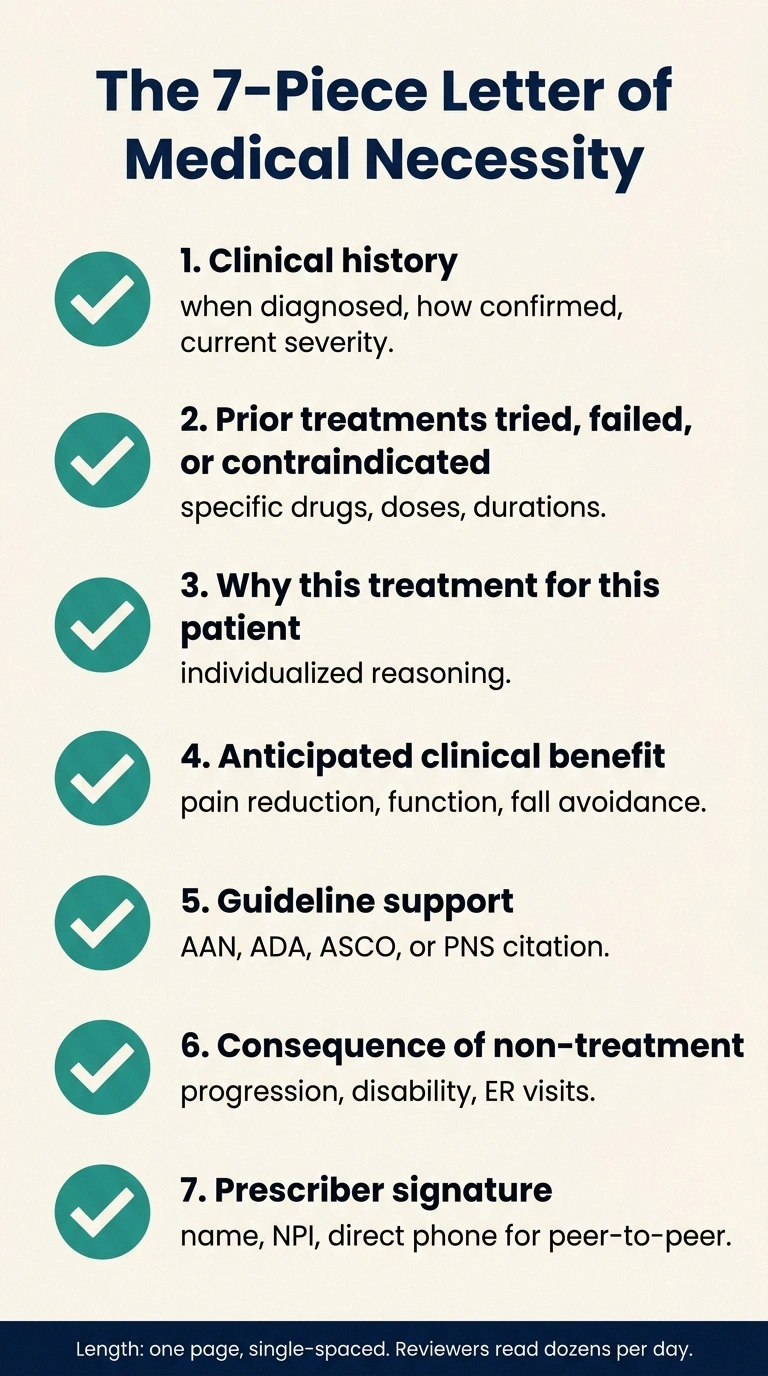
Doctors write LMNs constantly, but the ones that clear PA on the first pass share a small number of features. If you want to be helpful to your prescriber’s office, you can share this component checklist so they know what elements you are asking them to include.
A strong LMN opens with one sentence naming the patient, the diagnosis, and the requested treatment. It then walks through the clinical reasoning in short paragraphs:
- Clinical history. When neuropathy was diagnosed, how it was confirmed, and current severity. Include measurable markers where possible: pain scale, distribution of symptoms, effect on gait, sleep disruption, functional impairment.
- Prior treatments tried, failed, or contraindicated. Specific drugs, doses, durations, and reasons for stopping. This is the paragraph that beats step therapy.
- Why this specific treatment for this specific patient. Not general. Individualized.
- Anticipated clinical benefit. Pain reduction, function preservation, avoidance of falls, avoidance of higher-cost care, protection of work capacity.
- Guideline support. One clean citation, spelled out (author, journal, year, guideline title).
- Consequence of non-treatment. Progression of disease, increased fall risk, disability, emergency department visits, hospitalization.
- Prescriber signature block. Name, credentials, NPI, contact number for peer-to-peer.
Length: one page, single-spaced. Reviewers are reading dozens of these a day. A short, specific, well-cited LMN beats a long generic one.
Peer-to-Peer: The Fast Lane Almost Nobody Uses

Here is the piece of the system that almost nobody talks about, and it is one of the highest-leverage tools your prescriber has. When a PA is denied at the initial-review stage, most plans offer a peer-to-peer conversation, in which the prescribing physician can pick up the phone and speak directly with a plan medical director (usually a physician themselves).
These calls are typically fifteen minutes. They are documented in the plan’s record. The prescribing physician walks through the clinical case, and the plan medical director either approves the request on the call or escalates it. In my experience talking with prescribers, a well-prepared peer-to-peer succeeds a majority of the time, and it often does so within a day or two of the initial denial, which is dramatically faster than the formal appeal ladder.
Your job as a patient: when you get a denial, call the prescribing doctor’s office within 48 hours and ask specifically, “Would Dr. X be willing to do a peer-to-peer with the plan on this denial?” Some practices will offer it automatically. Others will not unless asked. It is not confrontational. It is a standard part of the PA workflow.
Prep the doctor beforehand by sending your own quick summary: what the drug is for, what you have already tried, and why the new drug matters for your daily life. Two paragraphs. It gives your prescriber material to reference on the call.
Common Denial Reasons and How to Fight Each One
The denial letter will tell you why the plan said no. The specific reason determines your specific move.
The peer-to-peer conversation between your prescriber and the plan medical director is the single highest-leverage tool in the PA workflow, and it is dramatically underused. Most patients never ask for it. Most prescribers will not offer it unless asked.
Call your doctor’s office within 48 hours of any PA denial and ask specifically: “Would Dr. X be willing to do a peer-to-peer with the plan on this denial?” A well-prepared P2P reverses a majority of denials within a week, often within a day.
- “Not medically necessary.” The plan says the treatment does not meet its clinical criteria. Fix: strengthen the LMN with guideline citation and prior-failure documentation, and file an appeal (see the timeline section below).
- “Non-formulary drug.” The drug is not on the plan’s covered list. Fix: file a formulary exception. The prescriber attests that on-formulary alternatives are less effective or would cause adverse effects.
- “Quantity limit exceeded.” You were prescribed more than the plan’s monthly cap. Fix: file a quantity-limit exception with dosing justification (weight-based dosing, titration failures at lower doses, clinical need for split-dose regimens).
- “Step therapy required.” Fix: document a prior trial of the required cheaper drug, or a contraindication or intolerance, and file a step-therapy exception.
- “Experimental or investigational.” The plan says the evidence is not there yet. Fix: attach FDA labels for on-label indications, peer-reviewed studies, specialty-society guidelines. Escalate to external review — Independent Review Organizations overturn “experimental” denials at higher rates when the specialty-society evidence is strong.
- “Excluded from plan.” The service is not a covered benefit at all. Fix is limited: read the Summary of Benefits carefully; if the exclusion is real, pivot to patient-assistance programs or self-pay.
- “Requires additional documentation.” The plan needs more information. Fix: fastest denial type to reverse. Submit exactly what they ask for, exactly the way they ask for it. Do not add extras. Do not truncate.
How Long PA Reviews Actually Take
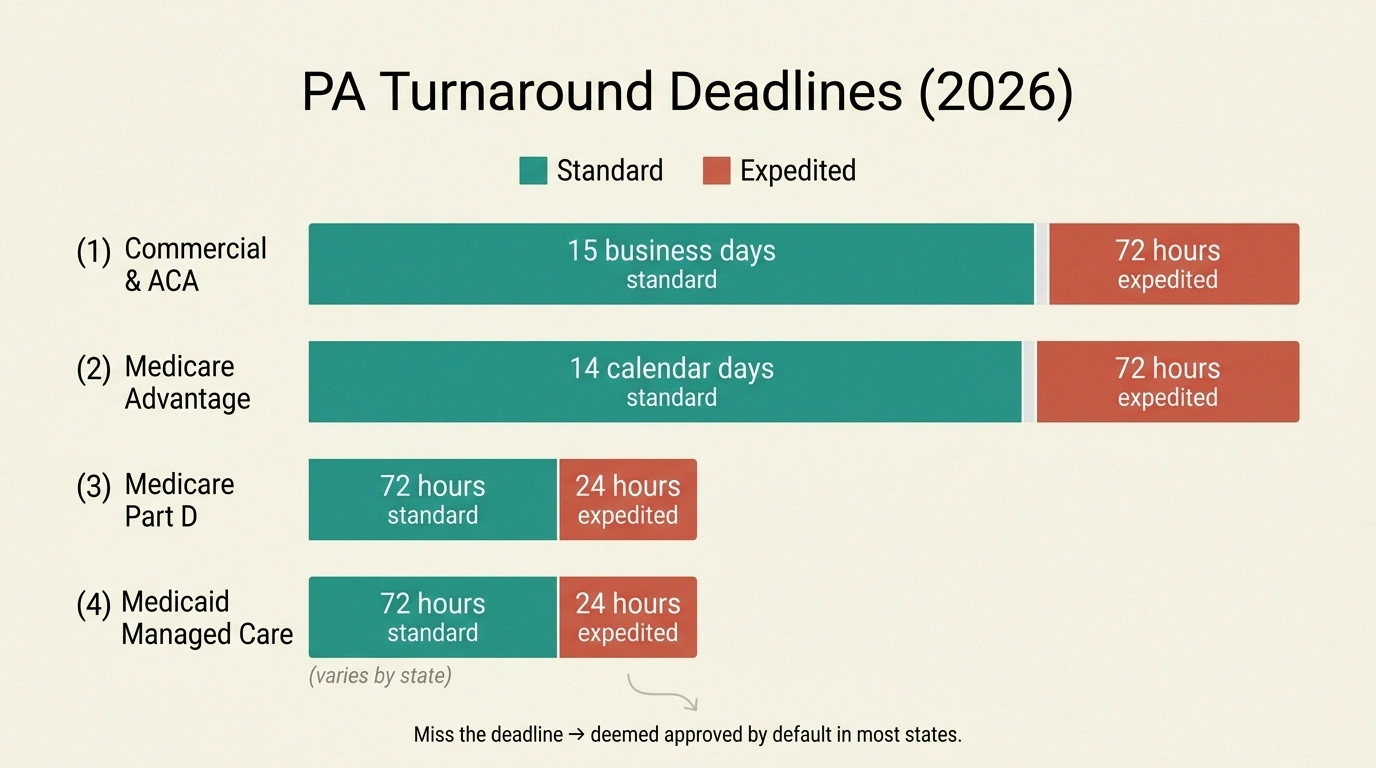
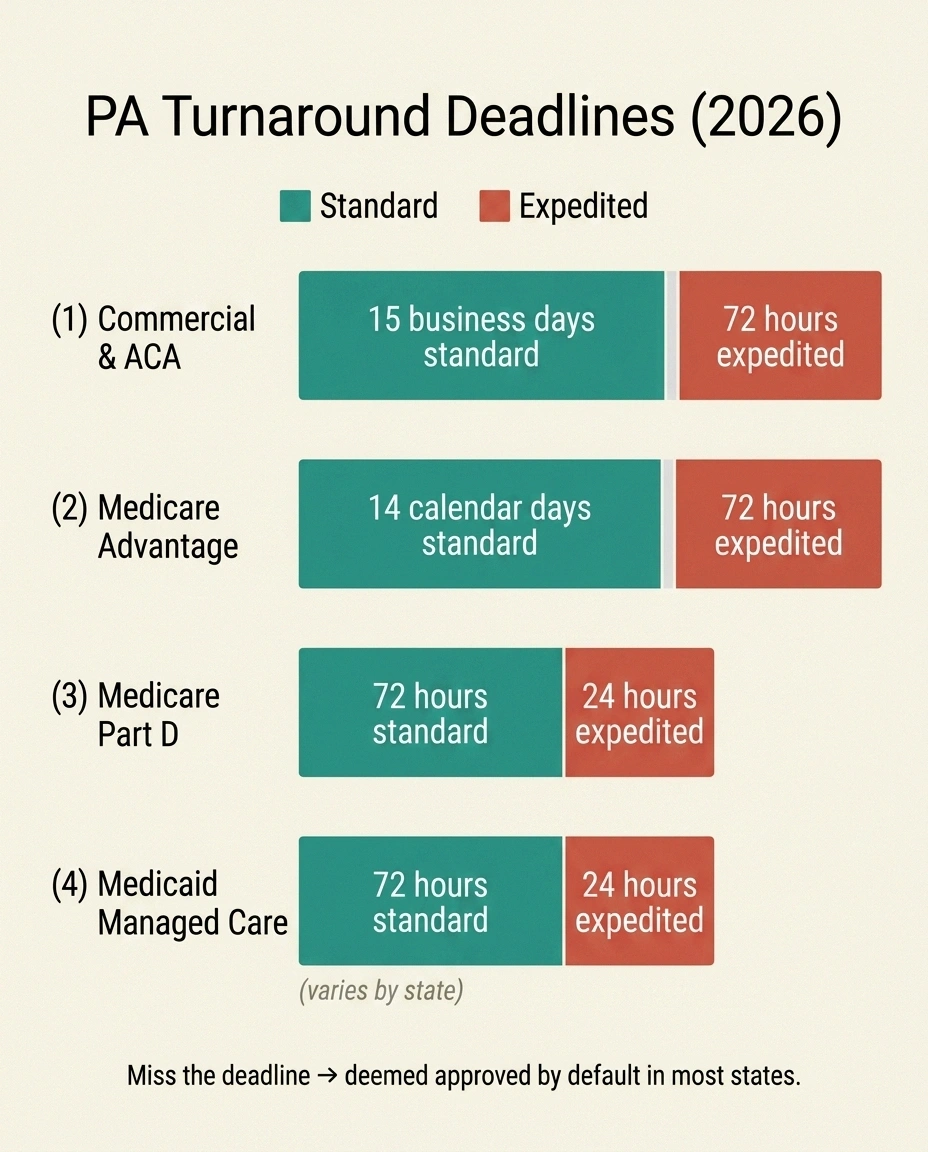
Standard PA turnaround times are governed by law for Medicare, ACA-regulated plans, and most state-regulated commercial plans. The numbers to memorize:
Miss the deadline, and under most state laws the request is deemed approved by default. Screenshot every submission.
- Commercial and ACA-marketplace plans: 15 business days for standard requests, 72 hours for expedited (urgent) requests. If your doctor certifies that waiting for a standard review would seriously jeopardize your health, the plan is required to expedite.
- Medicare Advantage: 14 calendar days for standard, 72 hours for expedited. Under recent CMS interoperability rules that began phasing in through 2025 and 2026, MA plans are expected to reduce standard turnaround toward 7 calendar days.
- Medicare Part D (drug plans): 72 hours for standard coverage determinations, 24 hours for expedited.
- Traditional Medicare Part B: most drugs and services do not require prior authorization at all, but a small number do (certain physician-administered drugs, some DME categories). Turnaround varies.
- Medicaid managed care: varies by state and plan; often within 72 hours for standard, 24 hours for expedited. Check the plan’s member handbook.
If your plan misses these deadlines, the request is often deemed approved by default under state law or contract terms. Document the submission date and time (screenshot the portal confirmation), and if the deadline passes without a decision, call the plan and cite the missed deadline directly.
If the PA Is Denied: The Appeal Ladder
A denied prior authorization is not the end. It is the beginning of the appeal process, which has its own timeline and its own escalation levels. I have covered the full appeal ladder in a longer companion piece — the short version here:
- Commercial and ACA plans: Two internal appeal levels, then external review by an Independent Review Organization whose decision binds the insurer.
- Traditional Medicare: Five levels, from your Medicare Administrative Contractor at Level 1 to federal court at Level 5.
- Medicare Advantage: Plan reconsideration at Level 1, then auto-forward to the Independent Review Entity. Levels 3 through 5 mirror Traditional Medicare.
- Medicare Part D: Five-level ladder starting with plan redetermination.
- Medicaid: State fair-hearing rights vary; check the notice for the deadline.
Deadlines matter more than merits at every level. Missing an appeal deadline is often fatal to the case even when the underlying medicine is sound. Note every deadline on the denial letter and calendar it the day the letter arrives.
Patient Assistance Programs: The Backup Plan Worth Knowing
Sometimes the appeal fails, or the drug is genuinely excluded from your plan, or you are between coverage. Patient assistance programs (PAPs) exist for exactly this window, and they cover more neuropathy drugs than most patients realize.
Where to look:
- Manufacturer PAPs. Most brand-name manufacturers run patient-assistance programs for uninsured or underinsured patients. Historical example: Pfizer ran the Pfizer RxPathways program for Lyrica. In the generic era for many neuropathy drugs, manufacturer PAPs cover fewer neuropathy medications directly, but they remain important for newer or specialty drugs (droxidopa/Northera, IVIG products, botulinum toxin, capsaicin patches).
- PhRMA’s Medicine Assistance Tool (MAT). A free directory that searches multiple manufacturer PAPs at once. The site is medicineassistancetool.org and it is a good starting point.
- NeedyMeds. Nonprofit directory of PAPs, discount cards, free and low-cost clinics, and diagnosis-based assistance funds.
- RxAssist. Similar directory, particularly strong for prescriber-facing tools.
- State pharmaceutical assistance programs (SPAPs). A number of states run their own drug-assistance programs for older adults and disabled residents. Coverage varies dramatically state to state; call your State Health Insurance Assistance Program (SHIP) to check.
- 340B pricing. If you receive care at a Federally Qualified Health Center, a Ryan White clinic, or certain hospital outpatient clinics, you may qualify for 340B pricing, which can dramatically lower the cost of many outpatient drugs.
- Cash-pay tools. GoodRx, SingleCare, RxSaver, and Mark Cuban Cost Plus Drugs. For generic gabapentin, generic pregabalin, generic duloxetine, and generic amitriptyline, cash prices at large pharmacies with a discount coupon are often lower than the plan’s copay.
If you also use supplements as part of your neuropathy management (which is a separate conversation about efficacy and evidence — see our supplements roundup and specific pages on alpha lipoic acid and B12 injections), those are out-of-pocket regardless, so factor total monthly spend when comparing plan drugs to cash-pay alternatives.
A Real-World Playbook for the Week After a Denial

If the PA on your neuropathy medication just got denied, here is the sequence I use.
Day 1. Read the denial letter twice. Note the reason code, the deadline to appeal (usually 60 to 180 days), and the address or portal for appeals. Call the prescribing doctor’s office and ask for a peer-to-peer.
Day 2 to 3. Gather documents. Denial letter, plan card, chart notes for the last 12 months, EMG report, list of prior therapies with dose and duration and reason for discontinuation. Email or drop these off with the prescriber’s office if they do not already have them.
Day 3 to 5. Peer-to-peer happens (if the prescriber agrees to it). If approved, the drug clears and you are done. If not, the prescriber’s office moves to a formal appeal or exception request.
Day 5 to 10. Formal appeal or exception request submitted with a strong LMN and supporting documentation. Confirm submission with a portal screenshot or fax confirmation.
Meanwhile. If you are running out of the medication (or never got it in the first place), ask the prescriber about a bridge supply. For step-therapy denials on pregabalin, sometimes the answer is to start the required gabapentin trial that day, at a therapeutic dose, and document it for the PA request.
Track everything on paper. Date, time, who you spoke with, what they said, what the next step is. When appeal review timelines are in play, you need a record that shows the plan met or missed its deadlines.
Special Cases Worth Knowing
Diabetic peripheral neuropathy. Painful DPN is one of the best-supported indications in the neuropathy pharmacology literature. Duloxetine and pregabalin are both first-line under the American Diabetes Association’s Standards of Care. Because both are heavily used, plans have well-developed PA pathways and the approvals move relatively quickly with proper documentation. Our diabetic neuropathy overview covers the clinical picture in more depth.
| If the denial says… | Your move… |
|---|---|
| Not medically necessary | Strengthen LMN with guideline citation + prior-failure records; file appeal |
| Non-formulary | File formulary exception with alternative-inadequacy attestation |
| Quantity limit exceeded | File quantity-limit exception with dosing justification |
| Step therapy required | Document prior trial or contraindication; file step-therapy exception |
| Experimental / investigational | Attach FDA labels + peer-reviewed evidence + specialty guidelines; escalate to external review |
| Requires additional documentation | Fastest to reverse — submit exactly what asked, exactly as asked |
| Not a covered benefit | Read Summary of Benefits; pivot to PAP or cash-pay if genuinely excluded |
Chemotherapy-induced peripheral neuropathy (CIPN). Fewer drugs have strong PA support because the evidence base for CIPN treatment is thinner than DPN. Duloxetine is the best-supported option under the American Society of Clinical Oncology 2020 guideline. Duloxetine PA denials for CIPN usually clear with an ASCO guideline citation attached to the LMN. Our chemo-induced neuropathy piece covers the treatment landscape.
Small-fiber neuropathy. This is the hardest PA fight because no drug is FDA-labeled for small-fiber specifically. Plans deny SFN-related requests as “experimental” or “off-label” more often than DPN or CIDP. Documentation of skin-biopsy-confirmed reduced intraepidermal nerve fiber density, positive autoantibodies (TS-HDS, FGFR-3, Plexin-D1) when present, and functional impact usually clears the LMN for standard drugs. IVIG for autoimmune small-fiber remains a much harder fight. Our small-fiber neuropathy page covers the diagnostic side.
CIDP. On-label indications for IVIG and plasmapheresis. Approval usually clears when the neurologist documents CIDP by EMG plus clinical criteria, and the LMN includes a specialty-society guideline citation.
Autonomic neuropathy. Midodrine and fludrocortisone (both generic) have low PA barriers on most plans. Droxidopa (Northera) requires PA and often step therapy documenting failed trials of midodrine and fludrocortisone. Our autonomic neuropathy overview covers the treatment picture more broadly.
What to Ask Your Doctor’s Office to Set Up Well
Some practices have a dedicated PA coordinator; others share the work across nurses and medical assistants. In either case, the following requests, made kindly and specifically, will speed almost every request:
- “Can you use the plan’s electronic PA portal (CoverMyMeds, ExpressPAth, or the plan’s own) rather than fax or mail?”
- “Can the LMN include a specific guideline citation?”
- “Can we attach a chart-notes summary showing my prior drug trials, doses, and reasons for discontinuation?”
- “If this comes back denied, is Dr. X available for a peer-to-peer?”
- “Can you send me a copy of the PA packet when you submit, so I have documentation?”
None of that is confrontational. All of it makes the prescriber’s job easier and yours cleaner.
The Larger Point
Prior authorization is not a personal test of your worth as a patient, and it is not a moral judgment on your neuropathy. It is a paperwork step designed around a small number of predictable questions. When you (or your doctor’s office) answer those questions clearly and cite the right evidence, most PA requests approve on the first submission. When they do not, the peer-to-peer call and the exception request usually clear them within a week. When those fail, the appeal ladder exists for exactly this purpose.
The people who get their neuropathy treatments approved are not luckier or sicker or more articulate. They are, almost without exception, the people who read the denial letter carefully, called back on the same day, and handed their doctor’s office the pieces of the packet the plan is going to want to see. That is a skill anyone can learn. It is also the skill this website exists, in large part, to help you learn.
Nothing on this page is medical or legal advice. Every plan is different. Every case is different. Read your denial notice as the authoritative document for your specific situation, verify current rules with your plan and (for Medicare) with the Medicare & You handbook, and work with your prescribing doctor’s office and your State Health Insurance Assistance Program when the terrain gets unfamiliar. And when your PA finally clears and the pharmacy calls with the good news, take five minutes to write down what worked. The next time is easier because you did.
Frequently Asked Questions
How long does prior authorization take for a neuropathy medication?
Commercial and ACA plans have 15 business days for standard requests and 72 hours for expedited requests. Medicare Advantage has 14 calendar days standard and 72 hours expedited, with CMS interoperability rules phasing toward 7 calendar days. Medicare Part D has 72 hours standard and 24 hours expedited. In practice, most PAs are decided in 2 to 5 business days when the packet is complete.
Why does pregabalin (Lyrica) almost always need prior authorization?
Because generic gabapentin is cheaper and is considered first-line for most neuropathic pain indications. Most plans require step therapy, meaning a documented trial of gabapentin at a therapeutic dose before pregabalin approval. Brand-name Lyrica has universal PA in 2026; generic pregabalin usually clears with a prior gabapentin trial documented.
Can my doctor request an expedited prior authorization?
Yes. If your doctor certifies that waiting for a standard review would seriously jeopardize your health, life, or ability to regain maximum function, the plan is legally required to expedite the decision to 72 hours for commercial and Medicare Advantage plans, or 24 hours for Medicare Part D. The prescriber must attest to the urgency in writing.
What is a peer-to-peer review, and how do I ask for one?
A peer-to-peer is a phone conversation between your prescribing doctor and a plan medical director (usually a physician) about a denied PA. Most plans offer this within days of the initial denial. Call your prescriber’s office within 48 hours of receiving the denial letter and ask specifically whether the doctor is willing to do a peer-to-peer. It is a standard part of the PA workflow and it is often the fastest way to reverse a denial.
What happens if my plan misses the prior authorization deadline?
Under most state laws and Medicare rules, if the plan does not decide within the required window, the request is often deemed approved by default. Document the submission date and time with a portal screenshot or fax confirmation, and if the deadline passes, call the plan and cite the missed deadline. Contact your State Insurance Commissioner if the plan resists.
Do generic gabapentin, generic amitriptyline, and generic nortriptyline need prior authorization?
Rarely. These older generics are cheap, well-established, and formulary-covered on almost every plan. They usually run through the pharmacy without a PA. When these three are used first and documented, they build the step-therapy record that clears PA on pregabalin or duloxetine later.
Can I get a temporary supply while a prior authorization is being decided?
Yes, in many cases. Medicare Part D requires plans to provide a transition fill (at least a 30-day retail supply) when you start a new plan or at the beginning of a calendar year if a formulary change affects your medication. Many commercial plans have similar bridge policies. Ask the pharmacy and the plan specifically about a transition fill or bridge supply.
Are compounded topical creams (ketamine, amitriptyline, baclofen combinations) covered by insurance?
Usually not. Traditional Medicare Part B does not cover most compounded drugs. Many commercial plans exclude compounded topicals from coverage. Some plans will cover with documented failure or intolerance of oral alternatives, but expect denial and be prepared to appeal or pay out of pocket. Discount programs at compounding pharmacies can substantially reduce cash prices.
About the Author