My uncle Ray retired from forty years of carpentry the year his diabetic neuropathy progressed past the point where he could trust his hands on a power saw. The last morning he loaded his truck at the jobsite, he came home and announced to his wife — perfectly seriously — that he was going to spend the rest of his life “as a fisherman now.” Two months later he sat at the kitchen table holding a fishing hook in his right hand, trying to thread a 4-pound monofilament line through the eye, and he could not feel the line at all between his thumb and index finger. He sat there for a long time before he started laughing. Then he started looking up tools.
That is the story I think about every time I write something for our community about hobbies that people refuse to give up. Fishing is one of those activities that gets woven into who you are — into your relationships with grandchildren, into your weekends, into the quiet you carry through the rest of your life. When neuropathy moves into your hands or your feet or both, fishing does not have to end. It does have to be adapted. This guide is the practical version of what Uncle Ray and a hundred other patients in our community have worked out together.
The Three Problems Neuropathy Creates for Anglers
Before we get to gear and technique, it helps to name exactly what is going wrong. Fishing puts demands on the body in three areas that neuropathy tends to compromise.
Hands and fine motor control. Knot tying, baiting hooks, removing hooks from a fish’s mouth, and managing the line during a strike all require the kind of precise pinch-and-thread coordination that neuropathy quietly steals. Patients with neuropathy in their hands often describe knot-tying frustration as one of the first things that made them consider quitting. The line moves and they cannot feel where it is. The hook tip is sharp and they cannot tell whether they have stuck themselves.
Feet, footing, and balance. Boat decks get wet. Docks have edges. Riverbanks are muddy. Many fishing spots involve uneven rock surfaces. For someone whose proprioception — the body’s internal sense of where the feet are planted — has been blunted by neuropathy, every one of these surfaces becomes a fall risk. Balance changes from neuropathy are a major reason people get hurt fishing. And the consequences of a fall in or near water are not the same as a fall in your living room.
Endurance, heat, and unfelt injuries. A long fishing day involves hours of standing or sitting in awkward positions, often in bright sun. The hands collect small cuts from hooks, fins, and fish spines, and the feet can blister inside wet boots — but neuropathy can mask all of it. By evening, an angler can step out of a boat with bleeding fingers and a blister the size of a quarter and not have noticed any of it during the day.
The good news is that every one of these problems has a workaround. Tools exist for the hands. Footwear and seating exist for the balance. Awareness and a few small habits handle the unfelt injuries. You do not have to be a less serious angler. You have to be a slightly more deliberate one.
Tools That Solve the Hand Problem
I am going to be specific here, because vagueness does not help anyone. The category of gear that has changed the most lives in our community is the knot-tying tool.
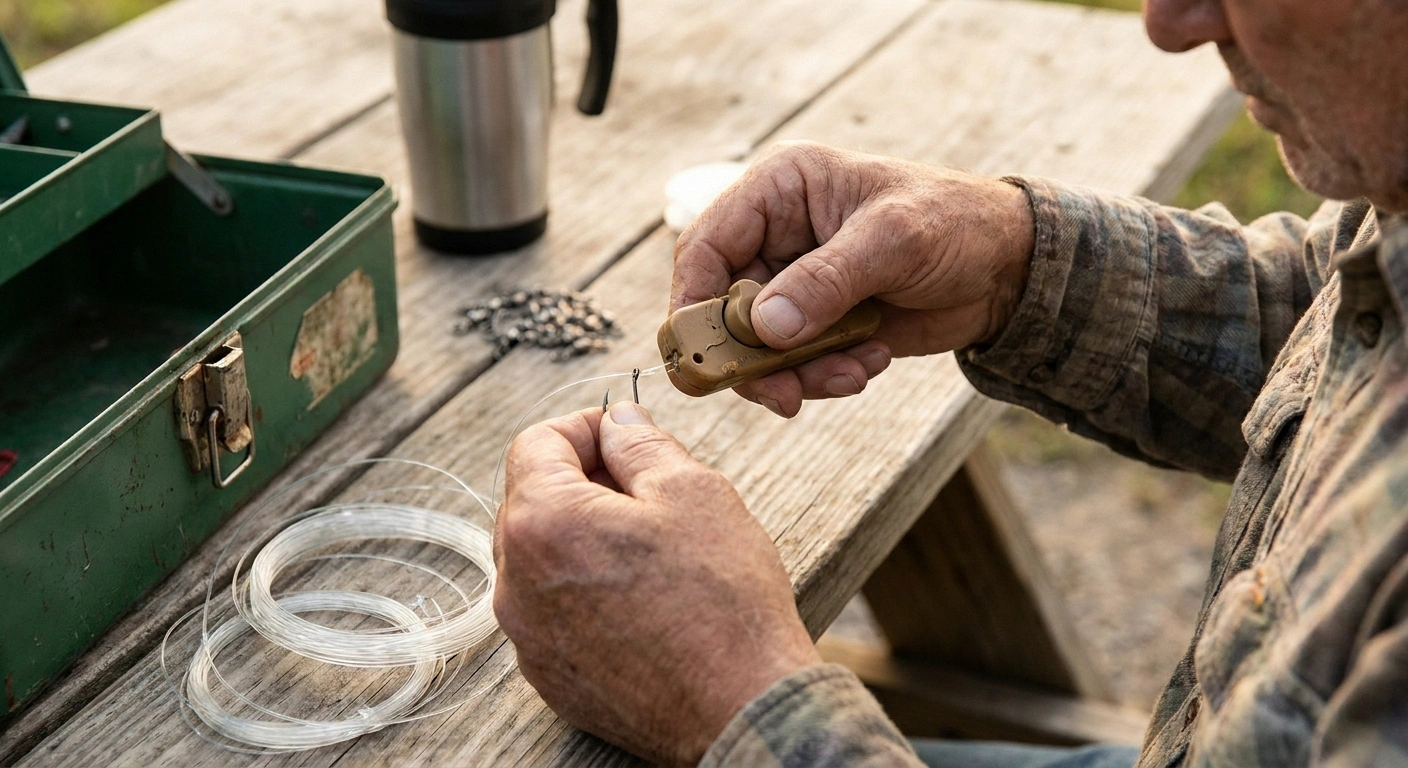
A knot-tying tool is a small handheld device that does the fiddly threading work for you. You insert the line, slide the hook eye onto a notch, twist a handle, and the tool delivers a neat clinch knot or improved clinch knot in a few seconds. Popular options include the Tie-Fast Knot Tyer, the Hook-Eze tool, and various small twist-knot devices that retail for between $5 and $15. If you tie one knot per fishing day, you will appreciate one of these. If you change lures four or five times, it changes your day completely.
No-knot connectors and snap swivels reduce knot tying to almost zero. With a snap swivel on the end of your line, you can change lures or hooks by opening and closing a small clip — no threading, no knot. The trade-off is a slightly different feel in the line and (for finicky fish in clear water) a little more visible terminal tackle. Many anglers happily make that trade.
Pre-tied leaders from any tackle shop come with the hook, swivel, and weight already rigged. You attach your main line to a small swivel at one end and you are ready to fish. Many bass and panfish anglers in our community swear by pre-tied rigs as a sanity-saving baseline.
Push-button spincast reels are easier to operate than baitcasters or even traditional spinning reels when you have numb thumbs. You hold the button down to release line, you point and cast, you let go to stop the line, you reel. There is no thumb-pressure modulation, no risk of birds-nests, no fine finger control during the cast. Many older anglers move from baitcasters to spincast reels in middle age and never look back.
Rod grips matter more than you think. A standard cork or hard plastic rod handle becomes hard to grip when you cannot feel pressure clearly. Slip-on EVA foam grips, oversized rubber rod sleeves, or even a piece of pool noodle slid over a thin handle dramatically improve confidence. Some anglers go further and add a forearm-strap rod holder that takes the wrist load off entirely.
Magnetic baiting tools hold a hook by its eye while you thread a worm or minnow. They eliminate the precise pinch grip that baiting normally requires. Several brands make them for under $10.
Hook Removal Without Stabbing Yourself
This deserves its own short section, because hook injuries are common in patients with hand neuropathy and they are often deeper than they should be — because the angler did not feel the hook go in until they saw blood.
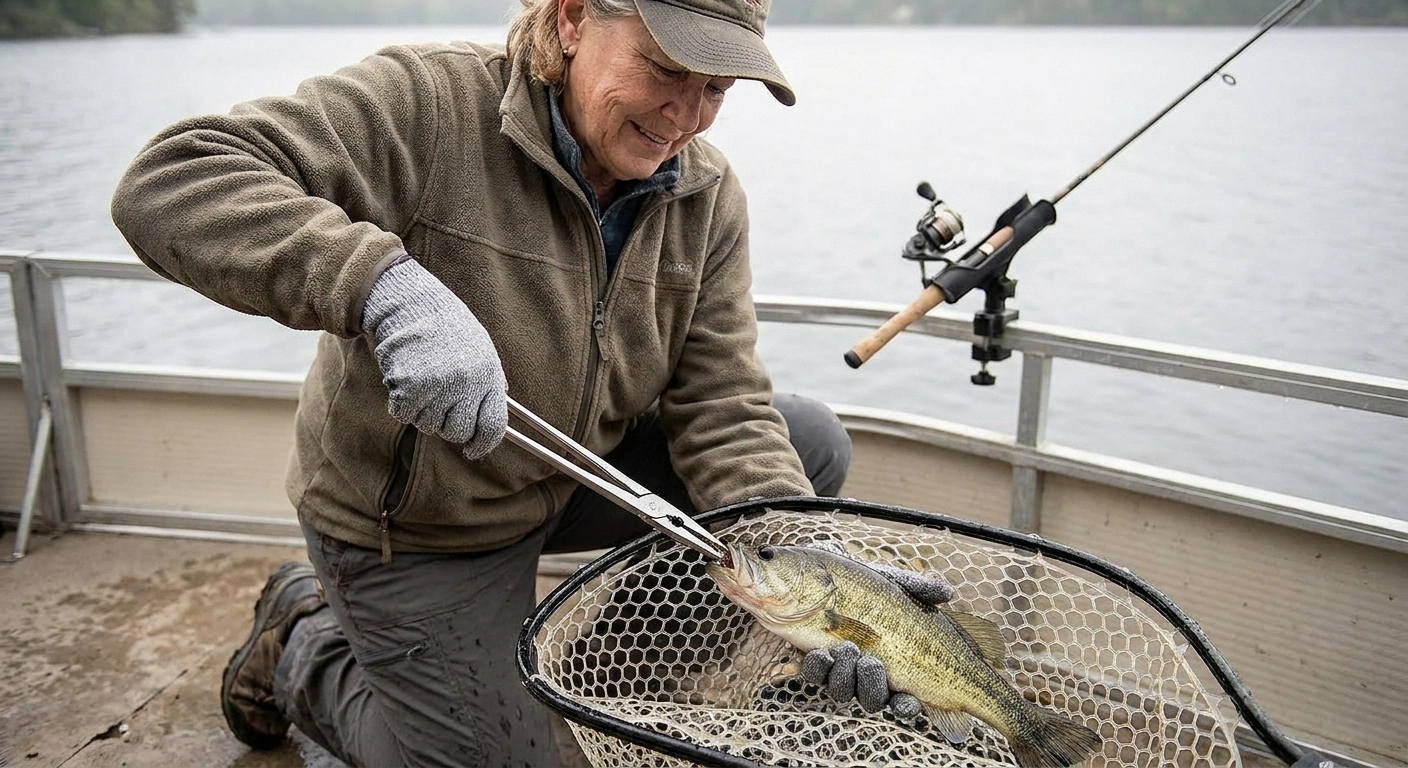
Long-handled hook removal pliers or a dedicated hookout tool keeps your hands several inches away from the hook tip. For panfish, a 5-inch hemostat is plenty. For bass and pike, a longer-handled tool keeps your fingers out of mouths with teeth. Both styles are inexpensive, between $8 and $25.
Crimp the barbs. A barbless hook backs out smoothly. A barbed hook does not. For many of us, the very small difference in fish-holding ability is worth the gigantic difference in self-extraction safety. A simple pliers-pinch on the barb takes a second and is reversible (the barb is gone, but the hook still works fine on the fish).
Cut-resistant gloves are a good idea for handling toothy fish, catfish with spines, or any fish whose gill plates are sharp. A lightweight cut-resistant glove (the kind used in kitchens) on your fish-handling hand gives you grip and protection without much loss of dexterity. They run $10 to $20.
Footing, Footwear, and the Boat Question
Most serious fishing-related injuries in patients with neuropathy are falls — not hook punctures. The single highest-yield change you can make is to take footing seriously.
Wading boots with felt or rubber-stud soles grip wet rocks and slick boat decks far better than ordinary sneakers. If you fish from a boat, look at boat-specific shoes with marine-grade non-slip soles. For shore and dock fishing, lightweight wading boots provide stability and ankle support that ordinary sneakers do not.
Avoid flip-flops, slip-ons, and any footwear without a heel cup. When your foot is partly numb, your toes do the work of “gripping” with surprisingly little instruction from your brain. A loose shoe lets the foot slide inside it, which steals the small balance corrections that keep you upright. Our broader guide to the best shoes for neuropathy goes into the principles in detail.
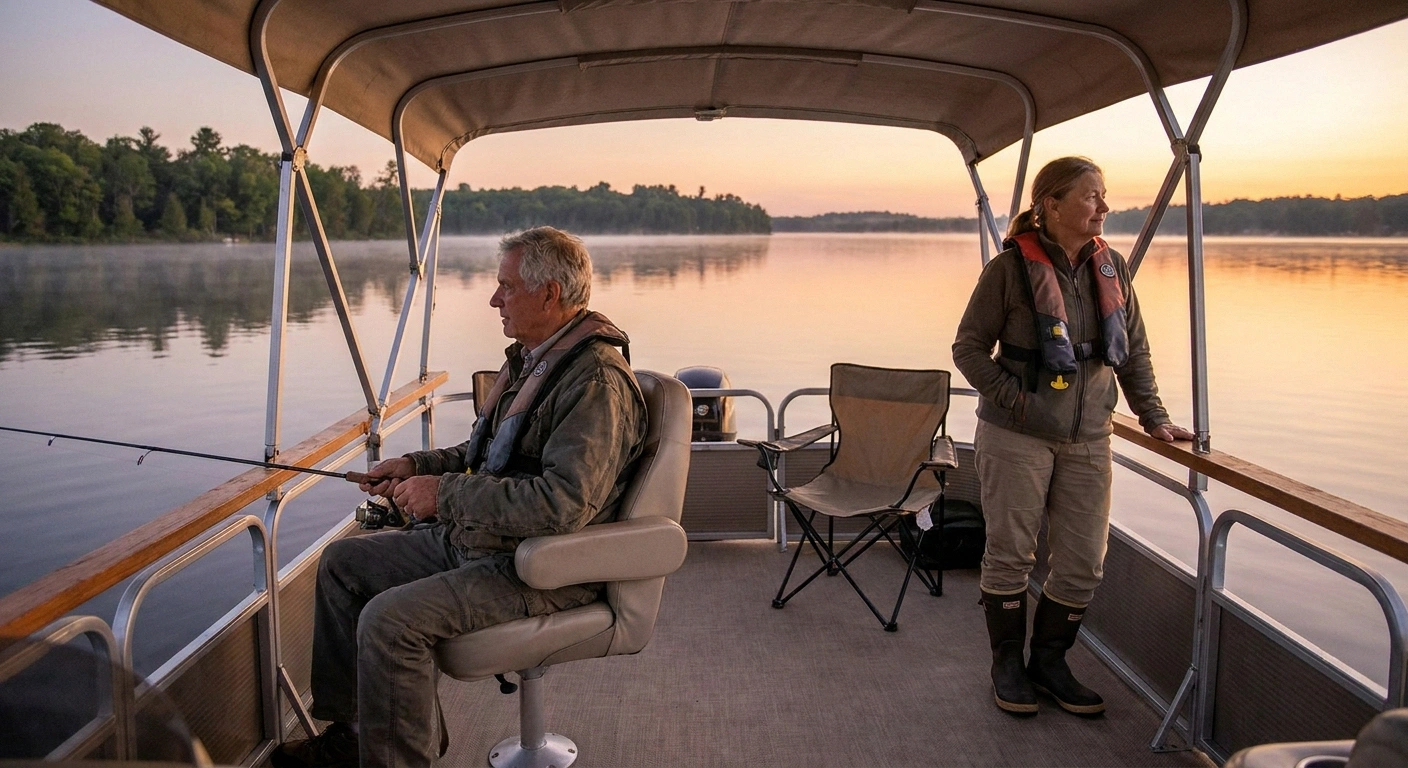
The boat question is one you have to be honest about. A 12-foot jon boat or a wide pontoon is stable, has flat decks, and lets most patients stand and move with reasonable safety. A narrow canoe or a sit-on-top kayak is much more demanding on balance. If your balance is changing, do not push the limits on a kayak or a small canoe just because it is the boat you have always used. Borrow or rent a wider boat and see how the day feels. Many lifelong canoeists in our community have moved to pontoons and have been pleasantly surprised at how much more they could fish without the constant low-level anxiety about tipping.
Sit when you can. A folding camp chair on shore, a swivel seat on a boat, an upturned bucket on a dock — anything that lets your feet rest reduces fatigue and reduces falls. There is no rule that says fishing must be done standing. Most fish do not care.
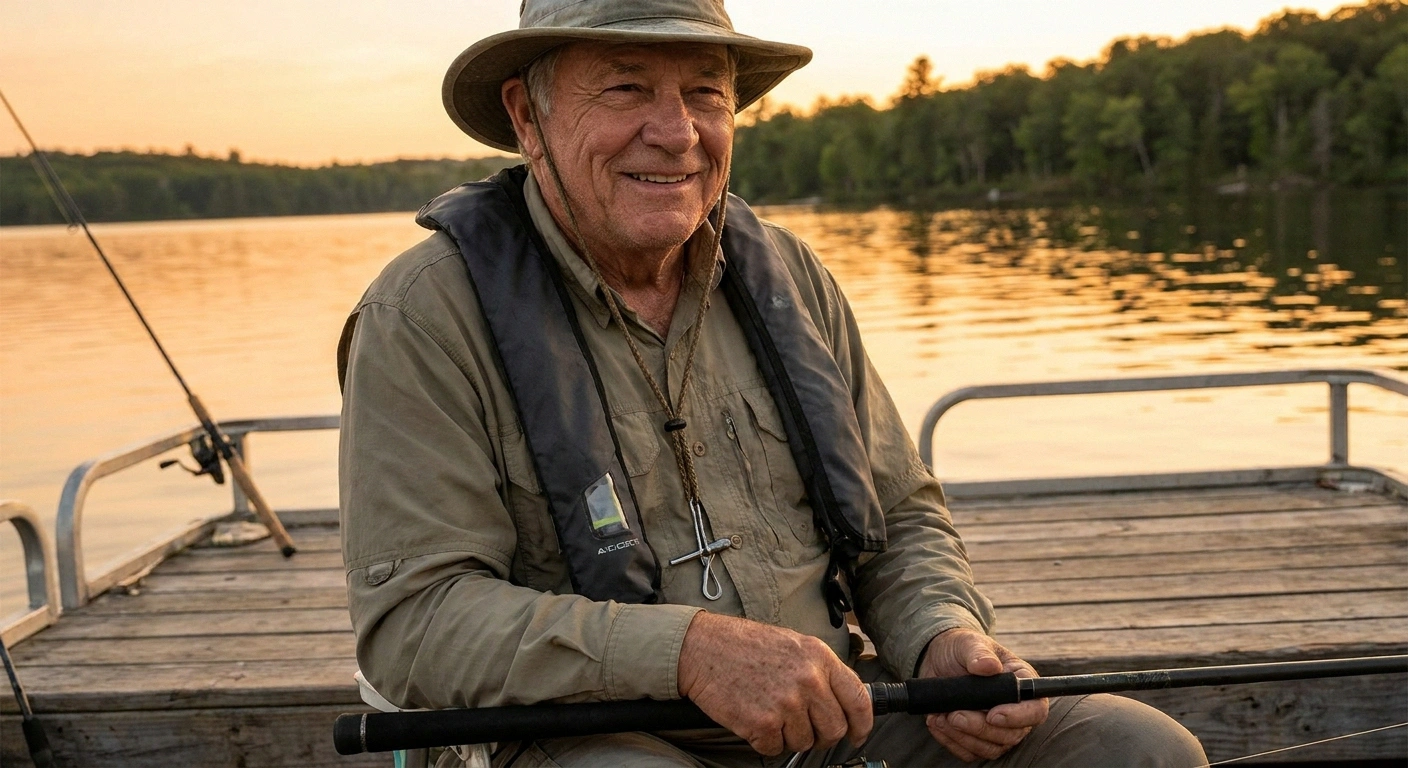
Always wear a personal flotation device. If you have balance changes from neuropathy and you are on or near water, a PFD is not optional. The cost of being wrong is a soaked vest. The cost of being wrong without one can be your life. Modern inflatable PFDs are small, comfortable, and easy to wear all day. If you have never used one, ask at any tackle shop for a fitting.
Rod Holders, Bank Sticks, and Saving Your Hands
One of the most useful changes I have seen in long-time anglers with hand neuropathy is the move from “always holding the rod” to “rod holder when waiting, rod in hand only when working a lure or fighting a fish.”
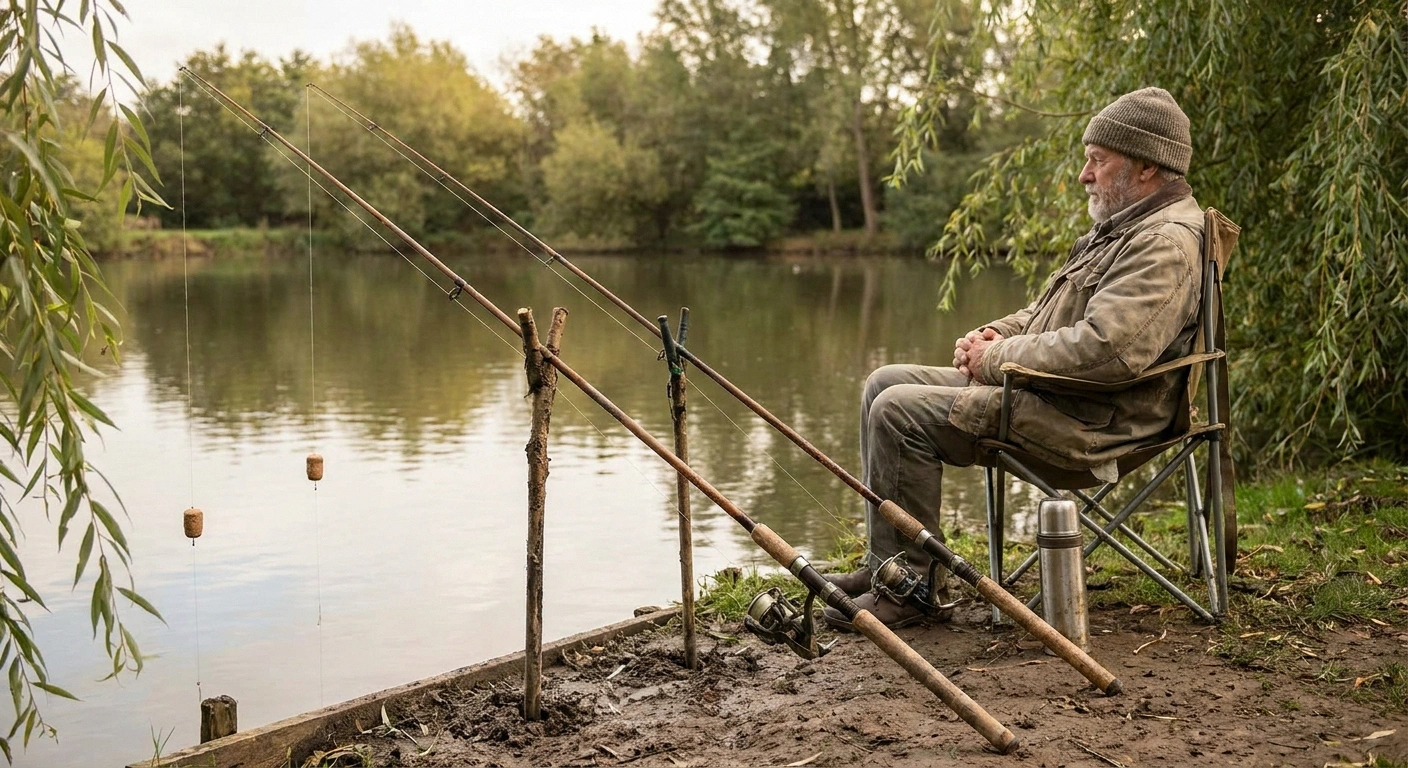
Bank stick rod holders are simple metal stakes that drive into the dirt and hold a rod at the proper angle while you wait for a bite. Two of them for $20 will let you watch a pair of rods without gripping anything. When a bite comes, you grab the rod and go.
Boat rod holders are usually built into modern fishing boats and pontoons. If yours are not, clamp-on rod holders cost less than $20 and bolt onto a gunwale, a railing, or even a folding chair.
This single change — letting the rod rest in a holder while you are not actively fishing — saves an enormous amount of hand strain. Patients who used to come home with throbbing forearms find they can fish twice as long once they make the switch.
Sun, Heat, and Unfelt Injuries
Neuropathy blunts your awareness of sunburn, blisters, dehydration, and small cuts. None of those things go away — your body just stops telling you about them in real time. The fix is to put habits in place that do the noticing for you.
under good light
reapplication interval
(set a watch alarm)
Sun gloves and lightweight long sleeves are the simplest sun protection of all. Sun gloves cover the backs of your hands without restricting grip. Lightweight, breathable long-sleeved fishing shirts keep the worst of the sun off arms and shoulders. Sunscreen on the face, neck, and any exposed skin. Reapply every two hours. You will not remember to feel for burning — set a watch alarm.
Polarized sunglasses matter for two reasons. They reduce glare so you can actually see structure in the water (which means better fishing). And they protect your eyes from UV exposure on a surface that reflects sunlight upward all day.
Hydration is sneaky. Many patients on certain neuropathy medications, including gabapentin and other pain medications, have a blunted thirst response. On a long sunny day, that is a real risk. Keep a water bottle within arm’s reach. Drink every 20 to 30 minutes even if you are not thirsty. A small thermos of cold water beats a warm one — you will drink more of the cold.
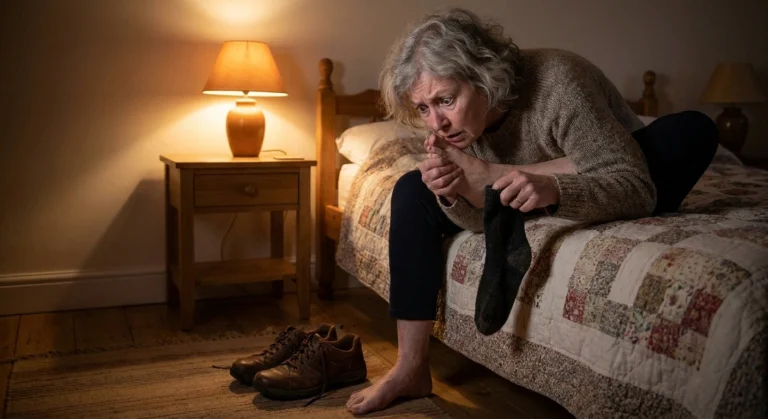
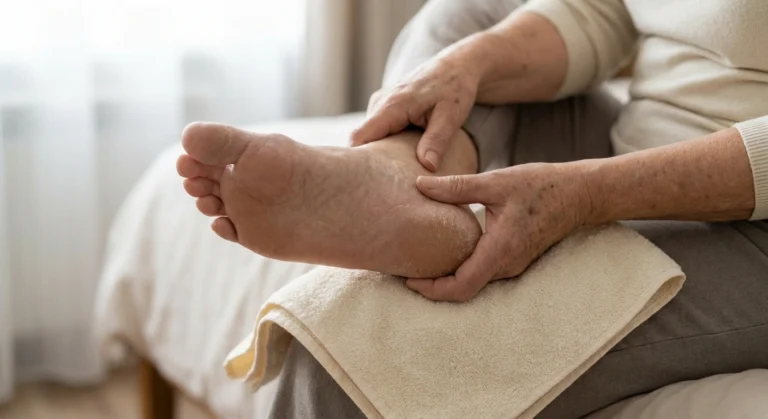
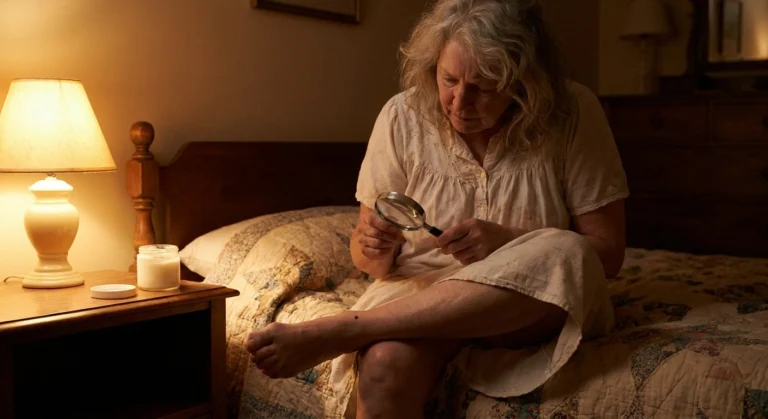
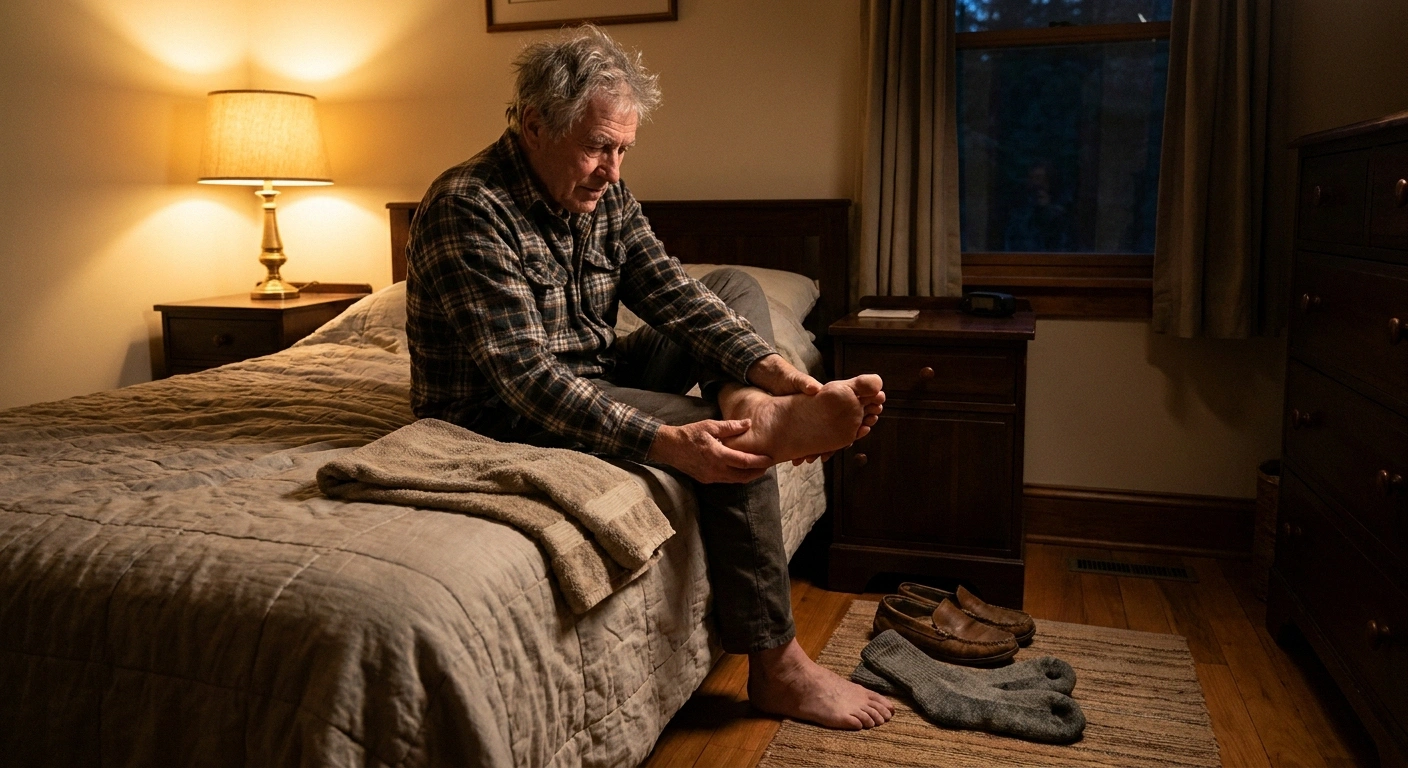
End-of-day hand and foot check. Before bed, look at your hands and feet under good light. Look for small cuts you did not feel. Look for blisters. Look for the start of a hot spot that could become a blister tomorrow. A regular foot inspection routine takes ninety seconds and prevents most of the infections that send anglers to the doctor.
A Practical Tackle-Box Loadout
If you are starting from a standard tackle box and want to neuropathy-proof it, here is the basic adaptive loadout I would put together for under $100.
- One knot-tying tool ($10)
- A small bag of snap swivels and a small bag of pre-tied panfish rigs ($8)
- 5-inch hemostat or hookout pliers ($12)
- A pair of cut-resistant gloves ($15)
- Two slip-on EVA rod grips ($10)
- A small first-aid kit with antibiotic ointment, gauze, and adhesive bandages ($10)
- Sunscreen, a refillable water bottle, and sun gloves ($20)
- One inflatable PFD or a comfortable foam vest if you do not already have one ($30 to $80, but treat as a separate must-have purchase outside the tackle-box loadout)
That little kit, plus whatever rods, reels, and bait you already use, makes the average fishing day far more manageable. The list grows as you discover specific friction points, but those eight items handle 80% of the problems neuropathy creates at the water.
Pacing the Day
Most anglers in our community have learned the hard way that “fish until you cannot stand up” is not a sustainable pacing strategy. The body will pay the price for three days afterward.
Try this pattern instead: 45 to 60 minutes of active fishing, then 10 minutes of sitting, drinking water, and checking yourself over. Repeat through the day. A four-hour trip with sit breaks usually produces more rested-evenings-the-day-after than a four-hour trip without them. Some patients in our community use the simple rule that they sit down whenever they catch a fish, while they unhook it, and stay seated for a couple of minutes longer. Built-in pacing.
Compression socks can make standing in a boat or on a bank much more comfortable for patients whose lower-leg circulation is part of the picture. Our guide to compression socks for neuropathy walks through the choices.
What to Avoid
A few categories of fishing setup are higher-risk for patients with neuropathy. Knowing them in advance saves a hard learning curve.
Solo wading in moving water. Even shallow current can sweep an angler with poor balance off their feet. Wading with a partner is a different sport from wading alone — and “always with a partner” should be a personal rule once balance is part of the picture. If you must wade alone, do it in calm, knee-deep water with a wading staff.
Night fishing without good lighting. Night vision is already worse with age, and the loss of foot feedback makes uneven shorelines treacherous in the dark. A good headlamp, a partner, and a known, level fishing spot are the minimum.
Loose-fitting waders in cold water. Waders that fill with water during a fall can hold an angler under. If you wear chest waders, wear a wading belt cinched tight at the waist. This single habit dramatically reduces drowning risk.
Long boat days in small unstable craft. If your balance has changed and you have always fished from a small flat-water canoe, this is the year to talk about renting a bigger boat. The fishing will not suffer.
When to Call for Help — and When to Call 911
Most fishing-related neuropathy problems are nuisances. A few are emergencies. The distinction is worth knowing in advance.
- Fall into cold water followed by confusion or intense shivering
- Sudden one-sided weakness, facial drooping, or slurred speech
- New chest pain or sudden severe shortness of breath
- Hook embedded near the eye or face
- Heavy bleeding through a compressed bandage
Call your doctor (not 911) within a day or two for: a hook puncture that you can clean and bandage; a cut that is not heavily bleeding but is deep enough to worry about; a foot blister that has gotten dirty; a new sore spot that does not look right; a fall that did not break anything but feels worse 24 hours later.
Call 911 immediately for: any fall into cold water followed by confusion, intense shivering, or extreme fatigue (possible hypothermia); any new sudden one-sided weakness, facial drooping, or slurred speech (possible stroke); any new chest pain, sudden severe shortness of breath, or fainting; a hook embedded near the eye or face that you cannot easily remove; any large laceration or anything bleeding heavily through a compressed bandage.
Get to a neurologist sooner rather than later if you have a sudden change in feeling — for example, a leg or hand that becomes much weaker or much more numb over hours to days, especially after a fall. This can represent a new compression injury that benefits from quick evaluation.
The Bigger Point
I think a lot about Uncle Ray sitting at that kitchen table laughing. The thing that struck me most was not that the laughter was bitter. It was not. He was genuinely delighted by the absurdity of needing a tool to thread a fishing line. And he was also already, in the same minute, thinking about what tool to buy. That mix of acceptance and problem-solving is most of what living well with neuropathy looks like.
You can fish the rest of your life with neuropathy in your hands and your feet. You will fish slightly differently than you used to. You will own a few small gadgets that you would have rolled your eyes at twenty years ago. You will be a little more careful about footing. You will wear a vest you used to consider beneath your dignity. And you will catch fish. Many of them. With grandchildren next to you, asking why the rod is wiggling. Which is, in the end, the entire point.
Frequently Asked Questions
Can I still tie my own knots with neuropathy in my hands?
Most patients can, but the cost in time and frustration goes up. A simple handheld knot-tying tool eliminates almost all of the difficulty. If you can still tie a clinch knot but it takes you two minutes and aggravates your hands, a $10 tool will return that two minutes to you and protect your hands. Either choice is fine. The point is that you have a choice.
Is it safe to fish from a boat alone if I have neuropathy in my feet?
It depends on the boat, the water, and the severity of your balance changes. A wide flat-bottomed boat on calm protected water, with a PFD on, is reasonable for many patients. A small canoe on a river, alone, is not — that is a fall away from a serious problem. When in doubt, fish with someone. The fishing-with-a-partner habit is the highest-leverage safety practice an angler with balance changes can adopt.
What is the single most useful adaptive item to buy first?
If hand neuropathy is your main issue, a knot-tying tool. If foot or balance neuropathy is your main issue, a properly fitted PFD. Both are under $50. Both pay for themselves the first time you use them.
Do compression socks help while fishing?
For many patients, yes. They reduce lower-leg swelling and fatigue during long standing days. They also keep the feet warmer, which helps when neuropathy makes cold sensitivity worse. The trade-off is that they can be uncomfortable in heavy heat. Try a 15-20 mmHg pair on a moderate day and see how your legs feel that evening compared to a day without them.
What about ice fishing?
Ice fishing involves real cold, slippery surfaces, and the risk of falling through the ice — all worse with neuropathy. If you fish on ice, never alone, always with ice picks worn around the neck, and only on ice that you have verified is safe. Heated shelters change the experience completely and dramatically reduce cold-exposure risk for hands and feet that cannot warn you they are getting cold. If you ice fish casually, a small portable shelter and a buddy are non-negotiables.
How do I handle fish if I cannot feel my hands well?
Use cut-resistant gloves. Use a landing net to bring the fish to you so you are not lifting it by the line. Hold smaller fish gently with the gloved hand by the body, not the gills. For larger fish or anything with teeth, keep your fingers out of the mouth entirely — let the long-handled pliers do the unhooking. If you cannot tell whether you are squeezing too hard, err on the side of releasing pressure and letting the fish move in the net. The fish will be fine.
Should I tell my fishing partners about my neuropathy?
Yes, especially anyone you fish with regularly. They do not need a medical lecture — just the practical version. “My balance is not what it used to be, so I will sit more than I used to, and if I look unsteady stepping into the boat, give me a hand.” Most fishing partners are glad to know. The information turns them into a safety net rather than a witness if something goes wrong.
About the Author