
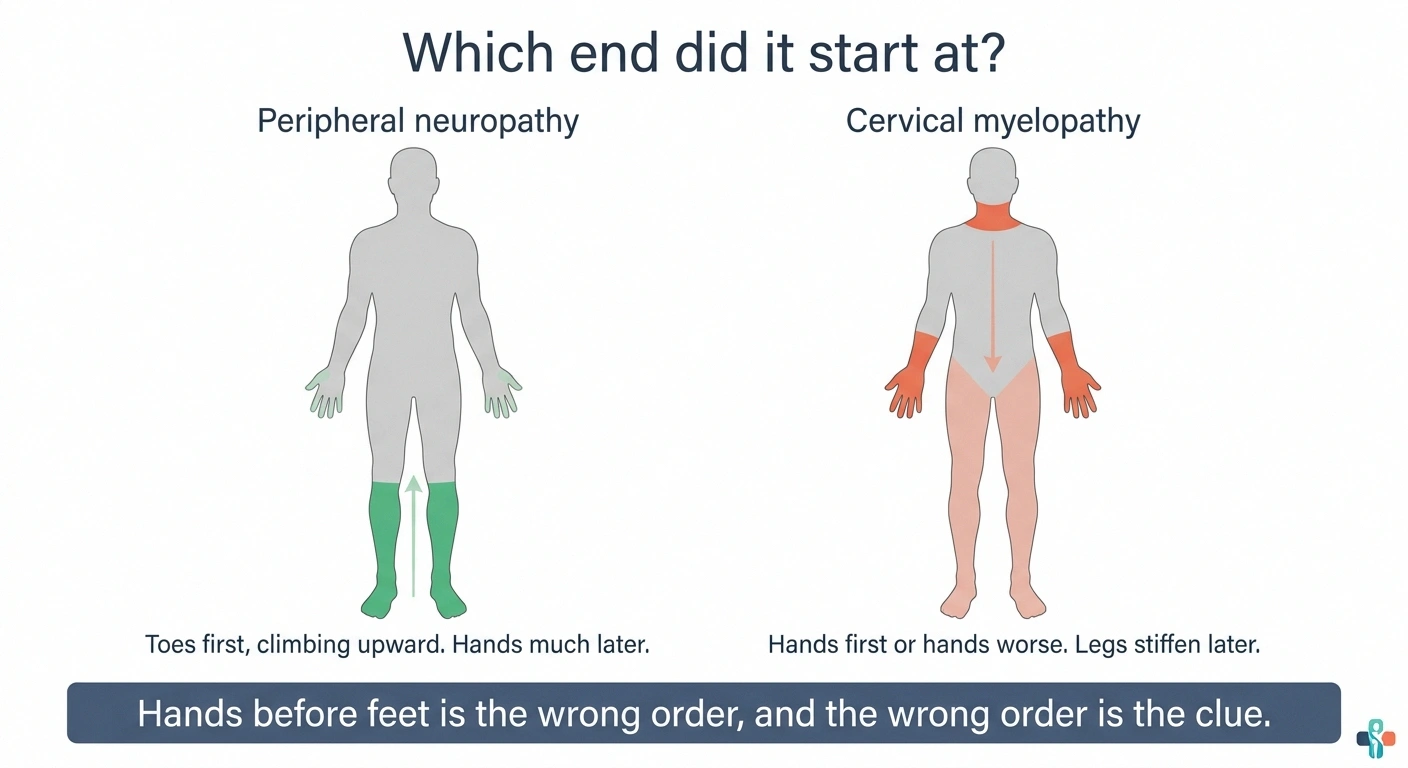
Peripheral neuropathy has a running order. It takes the longest nerves first, which is why it starts in the toes, climbs the feet, works its way toward the knees, and only then begins to show up in the fingertips. Feet first. Almost always. That pattern is so reliable that neurologists use it as a defining feature rather than a common one.
Which is why one particular complaint should make everybody sit up.
Buttons stopped working, and the feet are unchanged.
Hands failing while the feet are fine, or hands failing much faster than the feet, is the wrong running order. And the wrong running order is worth investigating, because one of the conditions that produces it is compression of the spinal cord in the neck, which behaves nothing like neuropathy and does not wait politely for a diagnosis.
This is a page about telling the two apart. It matters more than most comparisons on this site, for a reason I will get to.
Two Different Places for Something to Go Wrong
Peripheral neuropathy is damage to the nerves themselves, out in the limbs, past the point where they leave the spinal cord. The wiring is frayed. Signals get lost, or generated where nothing happened, which is where burning and pins and needles come from.
The two patterns, feature by feature
No single row proves anything. Three or four rows pointing the same way is what matters.
| Peripheral neuropathy | Cervical myelopathy | |
|---|---|---|
| Where it starts | Toes, then feet, then upward. Hands much later. | Often hands first, or hands worse than feet. |
| Main complaint | Burning, numbness, pins and needles. | Dropping things, buttons, handwriting. |
| Reflexes | Reduced or absent. Ankle jerk goes first. | Brisk or exaggerated below the neck. |
| Walking | Unsteady because the floor cannot be felt. Better in good light. | Stiff and broad-based. Light does not help. |
| Bladder | Only in autonomic involvement, usually later. | Urgency can appear alongside hand changes. |
| How it progresses | Gradual drift over years. | Steady, then a step down, then steady again. |
| Test that finds it | Nerve conduction study and EMG. | MRI of the cervical spine. EMG cannot see it. |
Cervical myelopathy is damage to the spinal cord inside your neck, usually from decades of ordinary wear: discs flattening, bone spurs forming, ligaments thickening, the canal that houses the cord slowly narrowing until it presses on the cord. The term for the common age-related version is degenerative cervical myelopathy.
The cable is being squeezed rather than frayed. Every signal running between your brain and everything below your neck passes through that spot.
That difference in location produces a difference in behaviour that you can actually observe, and it comes down to one thing: a squeezed cord makes reflexes more active, while damaged peripheral nerves make them less active. Everything below follows from that.
Which Came First, the Hands or the Feet
The most useful question you can ask yourself, and it needs no equipment.
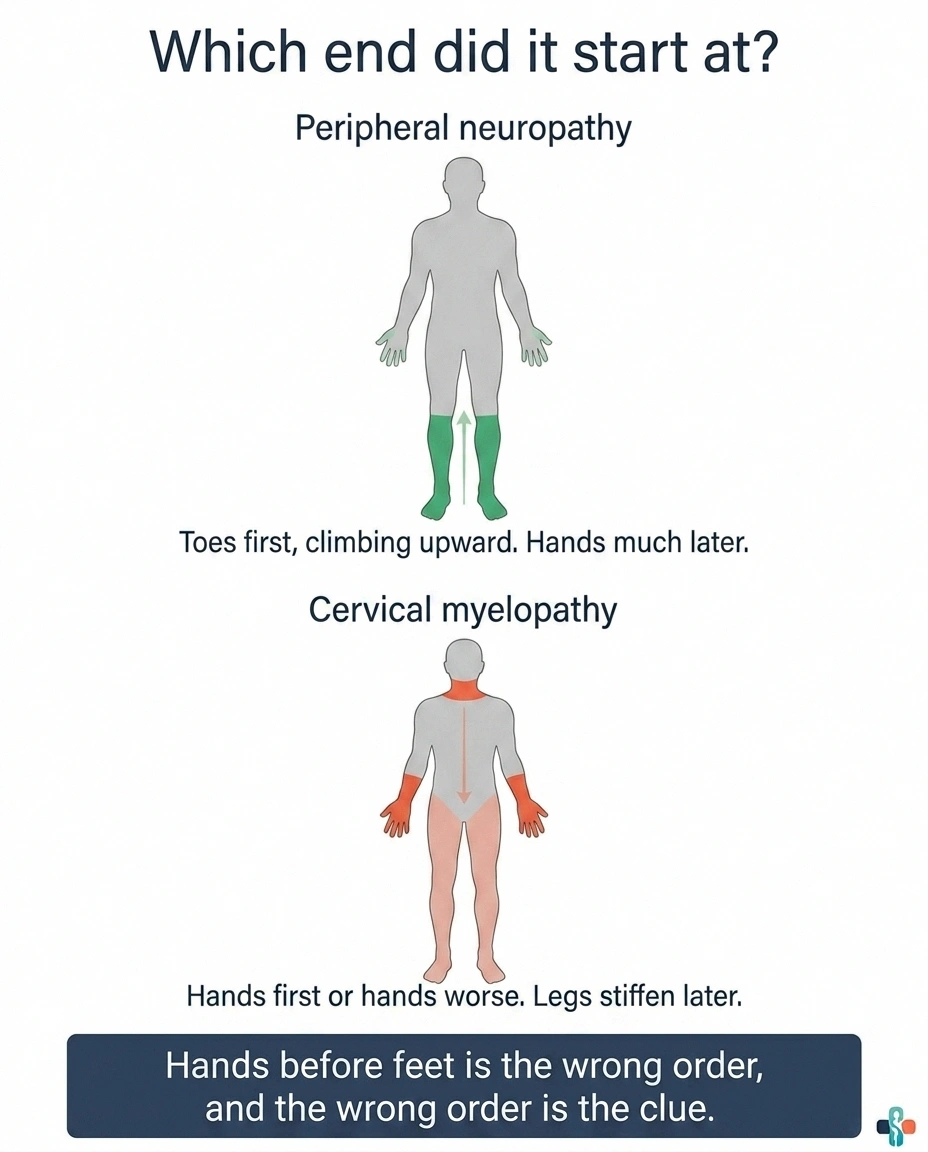
In diabetic and idiopathic neuropathy, the sequence is fixed. Toes, then feet, then up the calves, and hands enter the picture roughly when foot symptoms have reached the knee. Both sides, more or less evenly. Doctors call it a stocking and glove pattern, and the stocking comes first by a wide margin, often by years. Our page on neuropathy in the hands covers what that looks like when it finally arrives.
Cervical myelopathy breaks that rule. Hands are frequently the first thing affected, sometimes the only thing for a long while, because the nerve fibres serving the hands sit in a vulnerable position within the cord.
So: hands before feet, or hands clearly worse than feet, is a pattern that peripheral neuropathy struggles to explain and cord compression explains easily.
One thing that does not distinguish them, and this catches people out constantly: neck pain. Plenty of people with significant cord compression have no neck pain at all. Waiting for your neck to hurt before you consider your neck is a mistake, and it is a major contributor to the diagnostic delay in this condition, which runs up to two years.
Numb Versus Clumsy, Which Are Not the Same Complaint
Listen to the words people reach for. They differ, and the difference is diagnostic.
Two checks you can do at the kitchen table tonight
The ten-second fist
Open and close one hand as fast as you can for ten seconds and count. Most healthy adults clear 20. Falling well short, or noticing the fingers do not fully straighten each time, is worth reporting in those exact words. Clinicians use this test, and it performs better still when paired with a grip strength reading.
The thirty-second flat hand
Hold your hand out flat, palm down, fingers straight and pressed together, for thirty seconds. If the ring and little fingers drift outward and downward on their own, that is the finger escape sign.
Neither is a diagnosis and neither replaces an examination. Both are things a doctor will take seriously if you name them, and both are free.
Peripheral neuropathy produces sensory language. Burning. Numbness. Pins and needles. Walking on gravel. Feet on fire at night. Something is being felt that should not be, or not felt that should be. Grip and coordination usually survive well into the illness.
Cervical myelopathy produces mechanical language. Dropping things. Buttons taking minutes. Handwriting gone downhill. Cannot get an earring in. Coins slipping. Cannot pick a key out of a pocket by feel.
Neurologists have a name for the cluster: myelopathy hand. Around three quarters of people with cervical myelopathy have reduced dexterity in the small muscles of the hand, and in longer-standing cases the flesh between the thumb and index finger visibly thins out.
The test worth knowing is simple enough to try at the kitchen table. Open and close your fist as fast as you can for ten seconds and count the repetitions. Most healthy adults manage more than twenty. Struggling to reach that, or noticing that the fingers do not fully open each time, is a finding worth mentioning by name, because it is one of the specific things clinicians assess. It has been studied as a screening measure for early cervical myelopathy, and it performs better still combined with a grip strength measurement.
Related sign: hold your hand out flat, fingers straight and together, palm down, for thirty seconds. If the little finger and ring finger drift outward and downward on their own, that is the finger escape sign, and it points at the cord rather than the peripheral nerves.
Neither is a diagnosis. Both are worth reporting, and reporting in those words.
The Light Test for Your Balance
Both conditions wreck walking. They wreck it differently, and there is a way to tell.
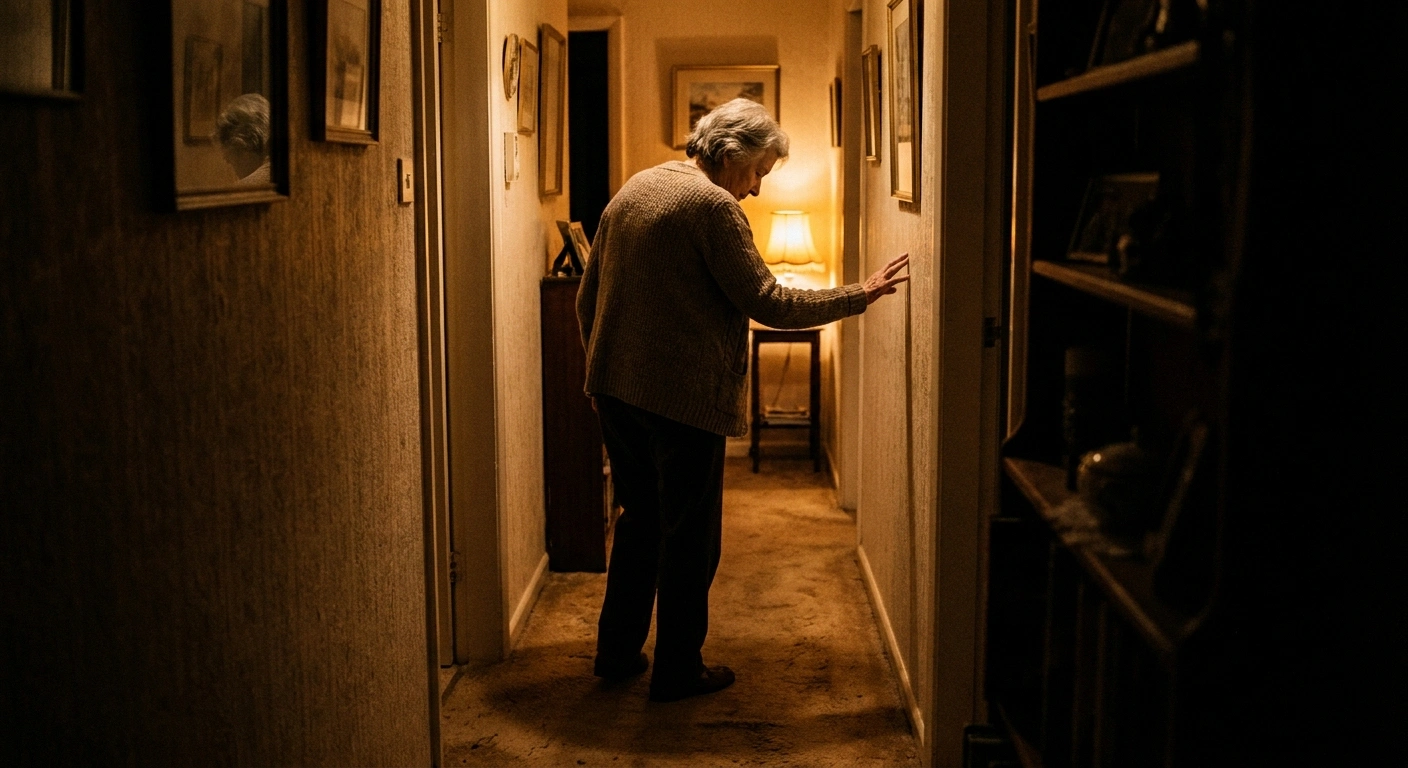
Neuropathy causes balance trouble by removing information. Your feet stop reporting where the ground is, so your brain compensates by using your eyes instead. That works, right up until it gets dark. This is called sensory ataxia, and its signature is that vision rescues it: worse in a dim corridor, worse in the shower with your eyes closed, better with a hand on a wall or a cane. We cover the mechanism in our page on losing proprioception.
Cervical myelopathy causes balance trouble by damaging the motor pathways running down the cord. The legs become stiff and the gait broad-based, feet planted wider apart than they used to be. People describe it as heavy legs, or legs not doing what they are told, rather than not knowing where the floor is.
The distinguishing question: does looking at the floor fix it?
If good lighting and a clear view of your feet make walking noticeably safer, that fits neuropathy. If your legs are equally awkward in bright daylight while you watch every step, vision is not the missing ingredient, and the problem is likely to be higher up. Our page on sensory ataxia in neuropathy goes further into the neuropathy version.
Reflexes Run in Opposite Directions
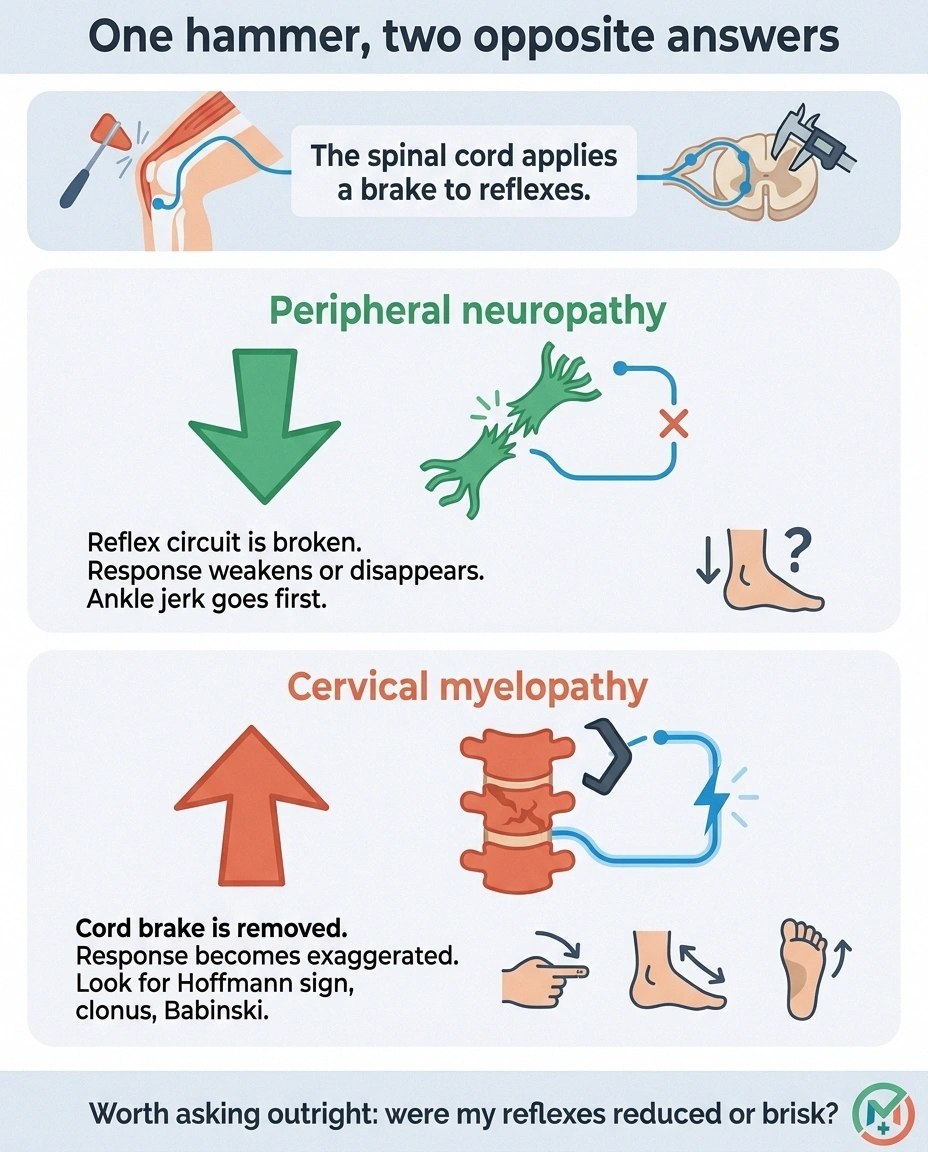
This is the objective piece, and it is the one your doctor can settle in about ninety seconds with a rubber hammer.
Why the hammer settles it faster than anything else
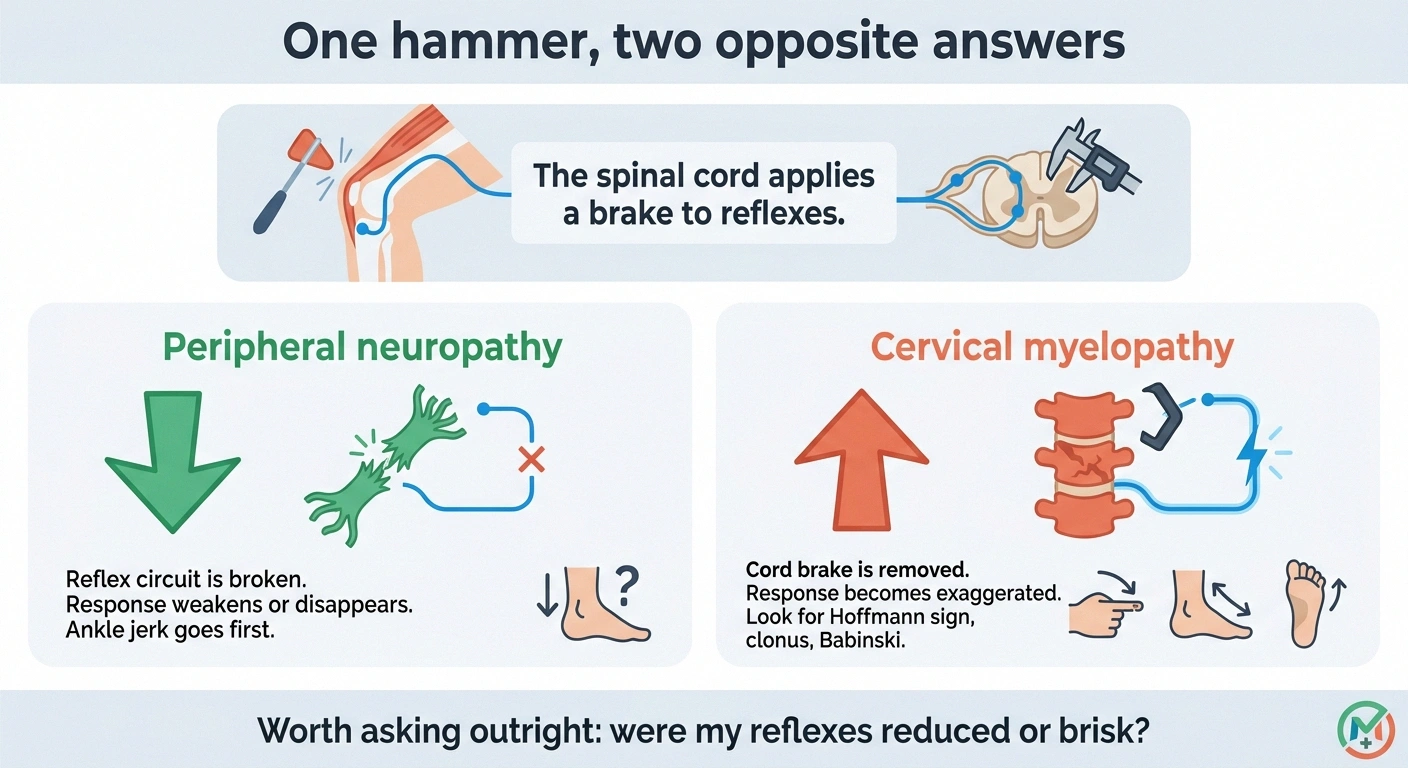
The spinal cord applies a brake to reflexes. Damaged peripheral nerves break the reflex circuit itself, so the response weakens or disappears. Compressed cord removes the brake, so the response becomes exaggerated.
Two conditions, opposite directions, one instrument. This is why the physical exam still leads the imaging rather than the other way around.
Worth asking outright at your next appointment: were my reflexes reduced or brisk? Many people are tested and never told the answer, and it is one of the most informative sentences in the whole visit.
Peripheral neuropathy reduces reflexes. The ankle jerk usually disappears first and its absence is one of the earliest reliable signs. Absent or sluggish reflexes are the expected finding.
Cervical myelopathy exaggerates reflexes below the level of compression. The cord normally applies a brake to reflex arcs; compression removes the brake. Knee jerks become brisk, sometimes dramatically so.
Alongside that, a set of signs that healthy adults simply do not have:
Hoffmann sign. The examiner flicks the nail of your middle finger downward. If your thumb and index finger twitch inward in response, that is a positive result. It appears in roughly 46% of people with milder myelopathy and up to 80% with severe disease, and a positive finding on both hands carries more weight than one side alone.
Babinski sign. The sole is stroked firmly. Normally the toes curl down. Turning up, with the big toe fanning back, is abnormal in an adult and highly specific for a problem in the cord or brain.
Clonus. The foot is pushed up briskly and, instead of settling, beats rhythmically against the examiner’s hand.
Lhermitte phenomenon. Dropping your chin to your chest fires an electric shock down your spine or into your limbs. If that happens to you, say so unprompted; it is a strong pointer at the cervical cord and patients often assume it is too odd to mention.
These signs are specific rather than sensitive, meaning that when they are present they mean a great deal, and when they are absent they do not clear you. Reported specificity for Babinski sits between 93% and 100%, and clonus between 96% and 99%. A person with early cord compression can have none of them.
Everything Else That Comes With Cord Compression

Symptoms that have no business appearing in peripheral neuropathy, and each is a reason to escalate:
Bladder urgency, hesitancy or accidents starting around the same time as the hand and gait trouble. Bladder involvement generally means the compression has been going on a while.
Symptoms crossing the trunk. A band of altered sensation around the chest or abdomen does not fit a length-dependent neuropathy.
Real weakness rather than clumsiness. Trouble rising from a chair without using your arms, or a foot that scuffs the ground.
Stepwise progression. Neuropathy typically creeps along over years. Myelopathy classically holds steady, then drops to a worse plateau, holds, then drops again. If you can name the month things changed, that is a different pattern.
Arm pain or weakness following a stripe down one arm suggests a nerve root is pinched too, which is a related but separate problem covered in our page on what arm pain and numbness can mean.
The Situation That Actually Applies to Most Readers Here
Now the reason this page exists.
Cervical spondylosis is close to universal with age. By seventy, the majority of people have degenerative changes in the neck on imaging, most of which never compress anything. Peripheral neuropathy is likewise common, particularly with diabetes.
So having both is not a coincidence. It is arithmetic. And it produces the specific failure this page is trying to prevent.
You already have a neuropathy diagnosis. It explains numbness. Something new starts, in your hands, or your walking changes, and both you and your doctor file it under the diagnosis already on your chart. The label absorbs the new symptom. Nobody looks at the neck. That exact scenario has been written up in the medical literature as cervical cord compression presenting as peripheral nerve disease, and the delay it causes is measured in years.
Which brings me to the single most useful correction in this article.
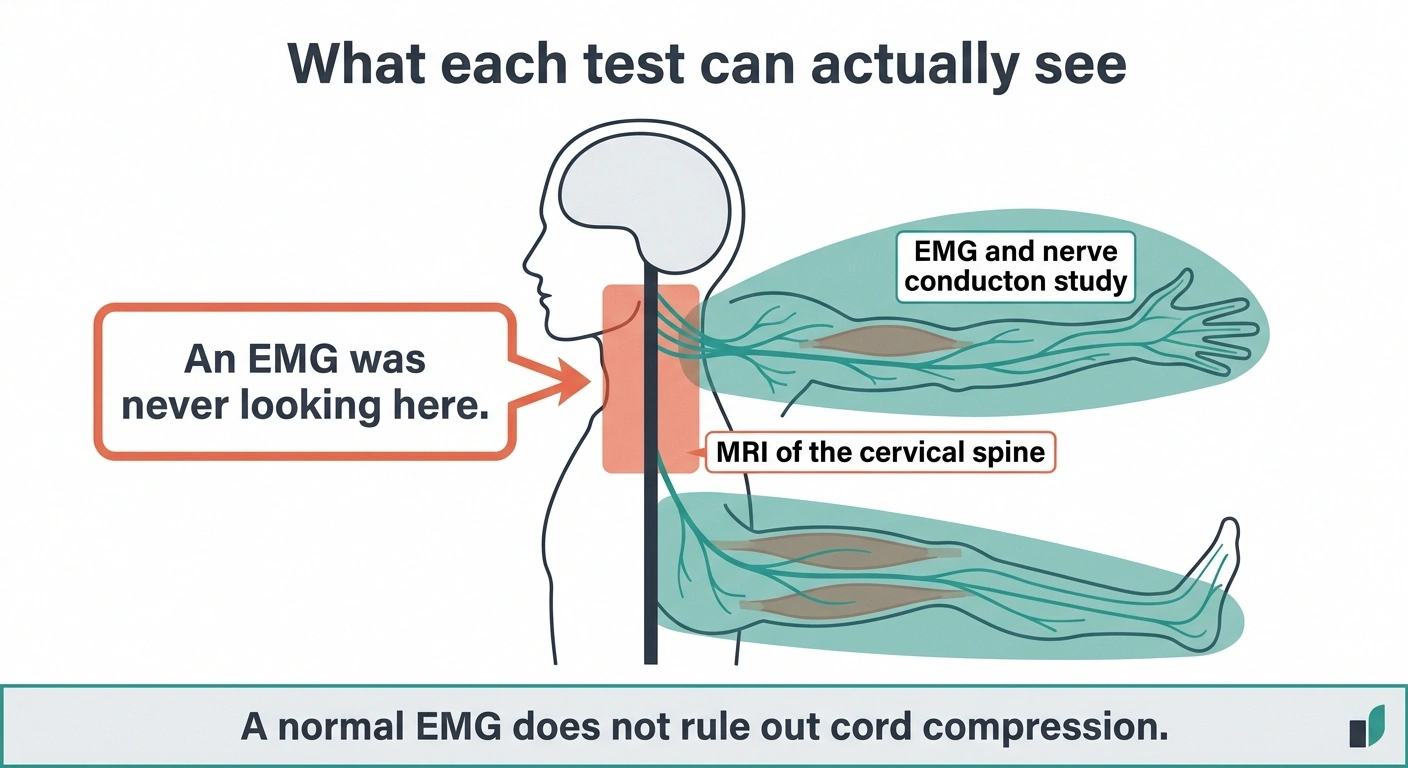
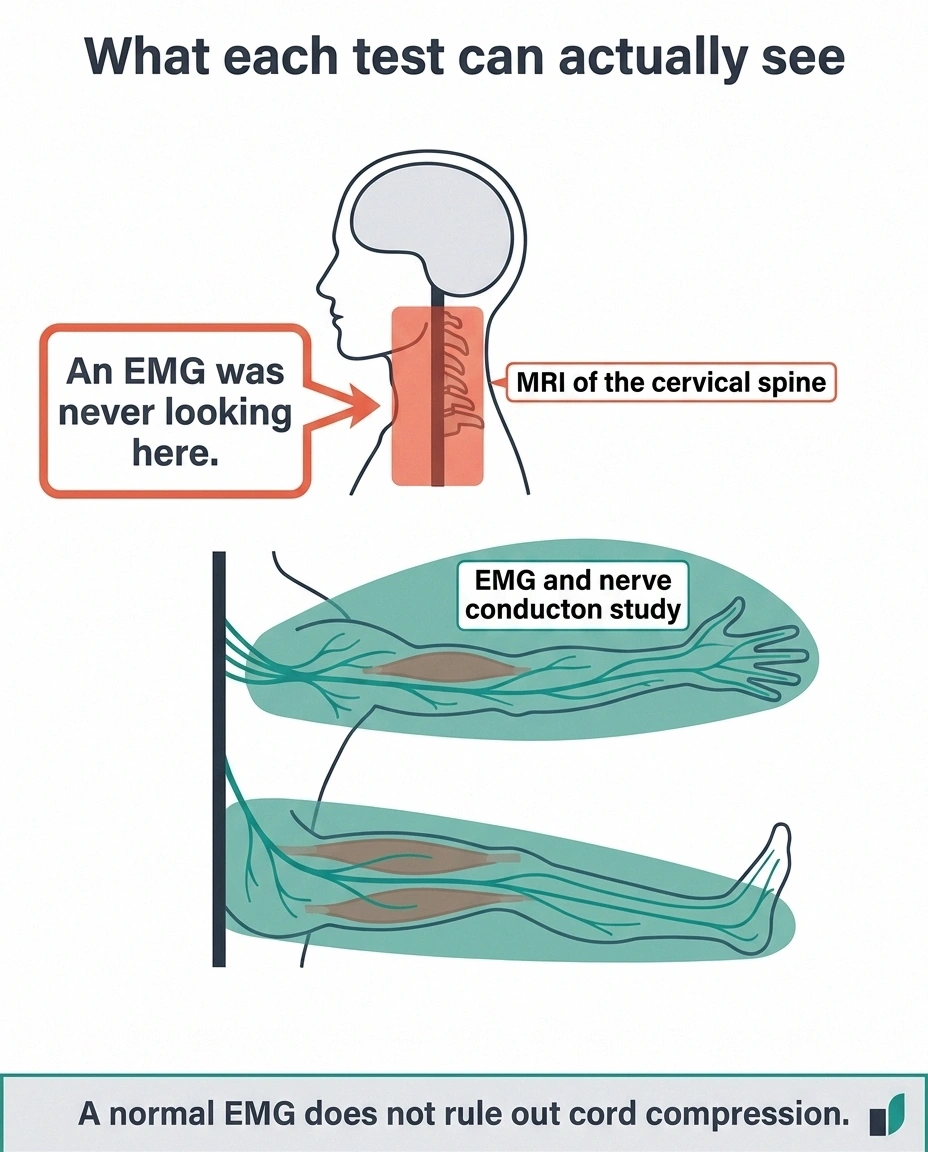
A nerve conduction study cannot see your spinal cord. EMG and nerve conduction testing measure peripheral nerves and muscles, and they are excellent at that. Cervical myelopathy sits above the level they examine. A perfectly normal EMG, or an EMG that confirms the neuropathy you already knew about, tells you nothing whatsoever about cord compression, because it was never looking there. Our pages on what an EMG involves and how to read EMG results explain what those tests do and do not cover.
The test that sees the cord is an MRI of the cervical spine. Diagnosis is made by combining upper motor neuron findings on examination with MRI showing compression at a matching level, and the exam has to prompt the scan, because degenerative changes turn up on imaging in plenty of people with no symptoms at all.
If you have neuropathy and something new is happening in your hands or your walking, the sentence that gets you the right test is not a request for a scan. It is a description: my hands are getting worse faster than my feet, and this is a change from the pattern I have had for years.
Why the Clock Matters Here and Not There

Peripheral neuropathy is not usually an emergency. Unpleasant, life-shaping, worth treating, and rarely urgent by the week.
Ask for a cervical spine opinion promptly if
- Your hands are deteriorating faster than your feet
- Buttons, coins or handwriting have changed within the last year
- Your walking is stiff or wide, and good lighting does not help
- Bladder urgency has appeared alongside the hand or gait change
- Chin to chest sends an electric shock down your body
- Someone has described your reflexes as brisk
The asymmetry is the argument. Raise it needlessly and you lose an appointment. Miss it and you keep losing hand function that surgery can protect but rarely restore.
Cervical myelopathy is different in a way worth being direct about. It is compression injuring the cord, and cord tissue does not recover well. Surgical decompression is generally very good at stopping the progression and much less reliable at giving back what has already been lost. Outcomes track closely with how much function you still have when the operation happens.
So the value of getting this right early is not comfort. It is keeping the hand function and the walking you currently have.
That asymmetry is the whole argument for a low threshold. If you raise it and the answer is that your neck is fine, you have lost an appointment and gained a scan. If you do not raise it and the answer would have been cord compression, the cost is permanent and it accumulates quietly.
The Short Version

Ask a specialist opinion promptly if any of these fit:
Hand dexterity is failing while your feet are unchanged or milder. Buttons, zips, coins and handwriting are the tells.
Your walking is stiff or wide-based, and good light does not help.
New bladder urgency has appeared alongside hand or walking changes.
Dropping your chin to your chest produces an electric sensation down your body.
A clinician has described your reflexes as brisk or exaggerated, which is the opposite of what neuropathy produces.
Things have changed in a stepwise way over weeks or months rather than drifting over years.
None of that means you do not also have neuropathy. Most people reading this will. It means one diagnosis is not obliged to explain every symptom you have, and the assumption that it must is the thing that costs people time. If you are still working out what is causing what, our page on how neuropathy gets diagnosed covers the wider workup, and our page on tingling hands and what else causes it covers the other candidates for hand symptoms.
Frequently Asked Questions
Can a problem in my neck cause numbness in my feet?
Yes. The spinal cord in the neck carries every signal travelling between the brain and the entire body below, so compression there can produce numbness, tingling and weakness in the legs and feet as well as the hands. That is one reason cervical myelopathy is mistaken for peripheral neuropathy. The distinguishing features are hand involvement out of proportion to the feet, brisk rather than absent reflexes, and a stiff, broad-based walk that good lighting does not improve.
How do I tell whether my numbness is from my neck or my nerves?
Three questions get you most of the way. Which came first, hands or feet? Peripheral neuropathy takes feet first almost without exception. Is the problem sensation or dexterity? Neuropathy produces burning and numbness; cord compression produces dropped objects and failed buttons. Does looking at the floor make walking safer? It usually does in neuropathy and usually does not in myelopathy. Reflex testing settles it, since neuropathy reduces reflexes while cord compression exaggerates them.
Can you have both conditions at once?
Frequently, and it is the most common scenario for people over sixty. Age-related neck degeneration and peripheral neuropathy are both widespread, so the same person often has both. The risk is that an existing neuropathy diagnosis absorbs the new symptoms of cord compression and delays the second diagnosis, sometimes by years.
Will an EMG or nerve conduction study detect cervical myelopathy?
No. Those tests examine peripheral nerves and muscles, which sit below the level of the problem. A normal EMG, or one that simply confirms an existing peripheral neuropathy, does not rule out cord compression, because it was never examining the cord. An MRI of the cervical spine is the test that shows compression.
What is the Hoffmann sign?
A reflex test in which the examiner flicks the nail of your middle finger downward. If your thumb and index finger twitch inward in response, the sign is positive, which suggests loss of the normal braking effect the spinal cord applies to reflexes. It is found in roughly 46% of people with milder cervical myelopathy and up to 80% of those with severe disease. A positive result on both hands is more meaningful than on one.
Does cervical myelopathy always cause neck pain?
No, and this is one of the main reasons it gets missed. Many people with significant cord compression have no neck pain whatsoever. The presenting complaints are far more often hand clumsiness, unsteady walking, or tingling in the limbs. Waiting for neck pain before considering the neck is a common and costly mistake.
Is cervical myelopathy an emergency?
It is urgent rather than an emergency in most cases, and the distinction is about time frames. Sudden severe weakness, loss of bladder or bowel control, or rapid deterioration over days needs immediate assessment. Gradual hand clumsiness and gait change warrant prompt specialist evaluation over weeks rather than watchful waiting over years, because surgery is far better at halting progression than at recovering lost function.
Will surgery fix the numbness?
Surgery is generally effective at stopping further deterioration and less reliable at restoring what has already been lost. Results depend heavily on how much function remains when the operation happens and how long the compression has been present. Many people gain some improvement in strength and dexterity, while numbness is often the last symptom to improve and sometimes does not.
About the Author