
Nobody gets prescribed Jardiance for their feet.
These drugs arrive in your life sideways. A cardiologist adds one after a heart failure diagnosis. A kidney specialist adds one when the protein in your urine starts climbing. Your regular doctor swaps something out because the guidelines moved. And then somewhere in the pharmacy leaflet you spot the word amputation, and you go looking, and what you find is a mess of law firm advertising from 2017 alongside research papers about nerve fibres in rats.
So let me sort this out, because the picture is genuinely more interesting than either extreme suggests, and there are two or three practical things in here that matter a lot if your feet have already lost sensation.
Three questions, in order. Does this class of drug harm nerves? Does it help them? And what should you actually do differently while taking one?
What These Drugs Are and How They Got Everywhere
SGLT2 inhibitors are the ones ending in “-gliflozin.” Empagliflozin (Jardiance), dapagliflozin (Farxiga), canagliflozin (Invokana), ertugliflozin (Steglatro).
They work in an oddly literal way. Your kidneys normally filter glucose out of the blood and then reabsorb almost all of it back. These drugs block that reabsorption, so the glucose leaves in your urine. You are, in the plainest terms, urinating out your blood sugar.
What made them ubiquitous was not the glucose lowering, which is modest. It was that the cardiovascular safety trials required by regulators came back showing something nobody expected: fewer heart failure hospitalisations, slower kidney decline, fewer deaths. That result was strong enough that these drugs are now prescribed to people who do not have diabetes at all.
Which is why so many readers arrive already taking one, without ever having chosen it as a diabetes drug.
Why the Nerve Question Is Not Just a Glucose Question
There is a piece of research that reframes everything below, and it deserves its own moment.
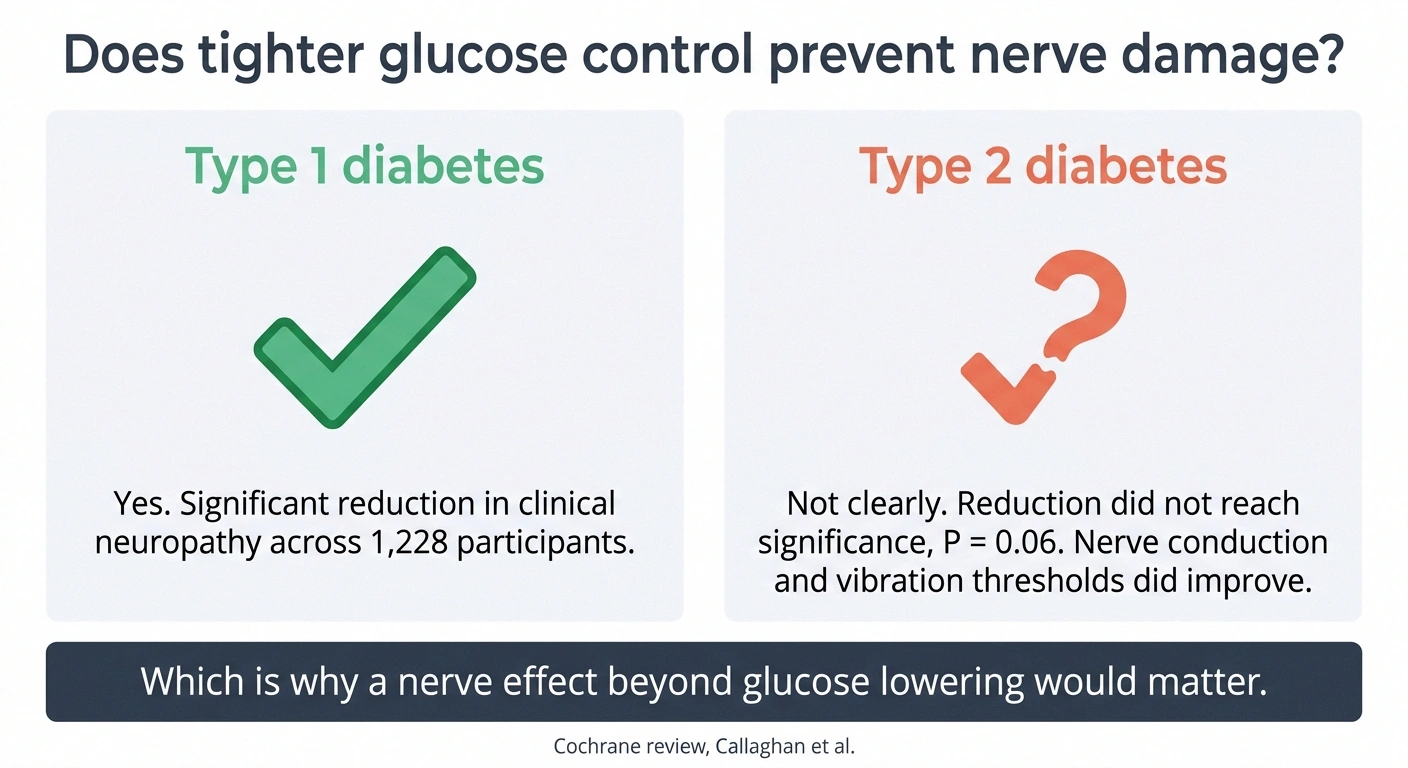
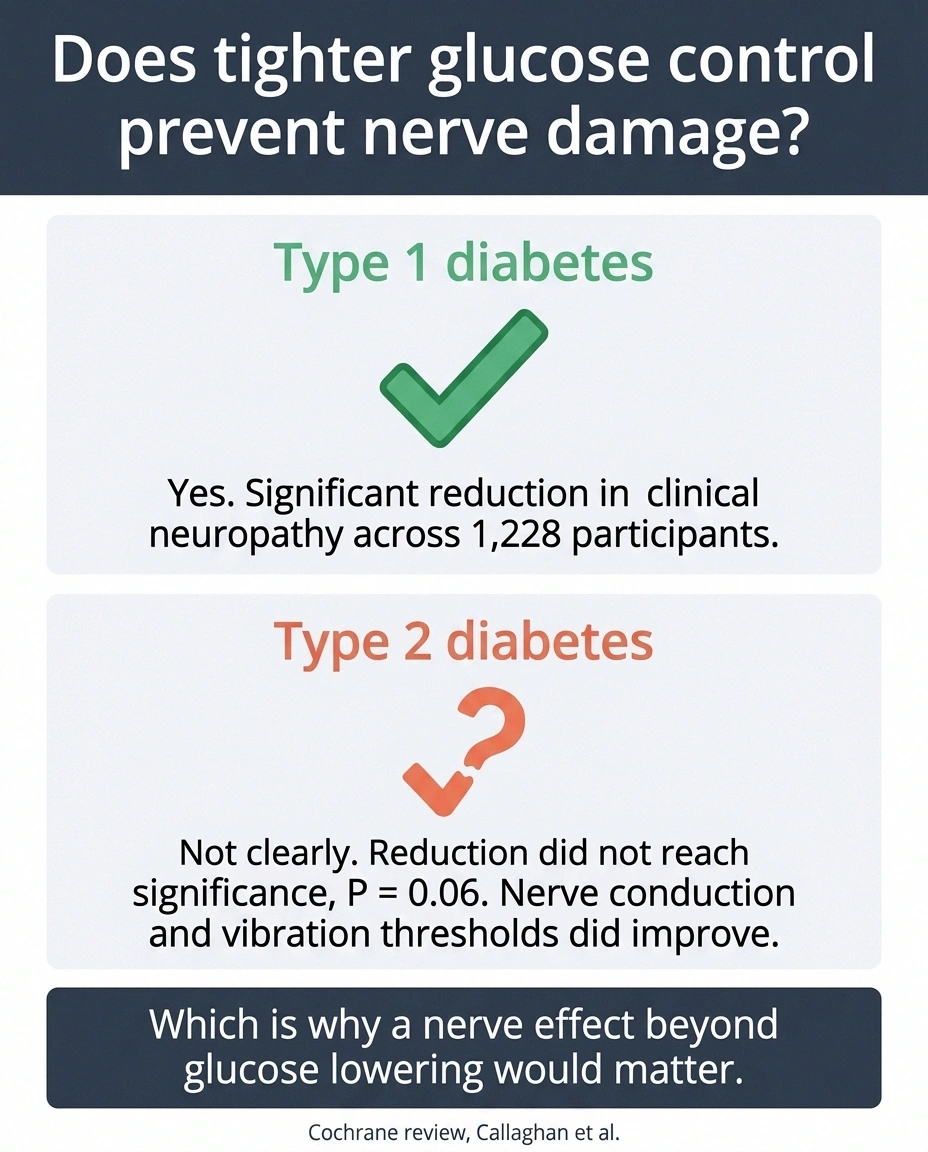
A Cochrane review led by Brian Callaghan pooled the trial evidence on whether tighter glucose control prevents neuropathy. In type 1 diabetes, the answer is a clear yes: across two trials with 1,228 participants, intensive control significantly reduced the development of clinical neuropathy.
In type 2 diabetes, it did not reach statistical significance. The p value came in at 0.06, close enough to be tantalising and not close enough to claim. Nerve conduction and vibration thresholds did improve measurably. The clinical neuropathy people actually feel did not clearly follow.
Read that twice if you have type 2, because it undercuts the advice most of us were handed at diagnosis. Chasing your A1C down is worth doing for your eyes, your kidneys and your heart. As a nerve strategy on its own, in type 2, it has never been the reliable lever it was described as. Our page on how blood sugar damages nerves covers why the mechanism is messier than the sugar number suggests.
Which sets up the real question about SGLT2 inhibitors. Not “do they lower glucose,” because they do, modestly. The question is whether they do something for nerves beyond the glucose. Because if all a drug does is lower your numbers, the Cochrane result predicts a disappointing effect on type 2 neuropathy.
The Case That They Help
The laboratory work came first and is consistently encouraging. In diabetic rodents, these drugs improved nerve conduction, reduced neuropathic pain behaviour, and preserved nerve structure. Dapagliflozin in particular has been shown to protect peripheral nerve architecture in animals with induced diabetic neuropathy. The proposed mechanisms are antioxidant and anti-inflammatory activity, which would be independent of glucose lowering.
Animal results are where enthusiasm goes to die, though, so the human trials matter more.
The DINE study (2025) looked directly at whether nerve fibres regrow. Forty people with type 2 diabetes and peripheral neuropathy were randomised over six months: twenty-two added dapagliflozin 10 mg daily to their existing tablets, eighteen carried on as they were.
Researchers counted nerve fibres two ways. Skin biopsy, which measures intraepidermal nerve fibre density, showed significant increases in both groups. Corneal microscopy, which images the tiny nerves in the front of the eye and is a sensitive early marker, told a different story: corneal nerve fibre density, branch density and fibre length all rose in the dapagliflozin group and not in the control group.
The authors concluded that dapagliflozin was associated with small nerve fibre regeneration and improved oxidative stress markers.
An empagliflozin trial published in 2025 ran a double-blind randomised design over twenty weeks at 10 mg daily and reported improvements in glycaemic control, kidney function, neuropathic symptoms, and nerve conduction velocity.
Nerve fibres regrowing is a genuinely unusual thing to read in this field, where most of the literature is about slowing loss. For context on why fibre density matters, our page on small fiber neuropathy explains what these particular nerves do and why they fail first.
Now the Part Where I Talk You Down
I want to be careful here, because hope in this field gets sold hard and I have watched people spend money on far weaker evidence than this.
Weighing what is actually known
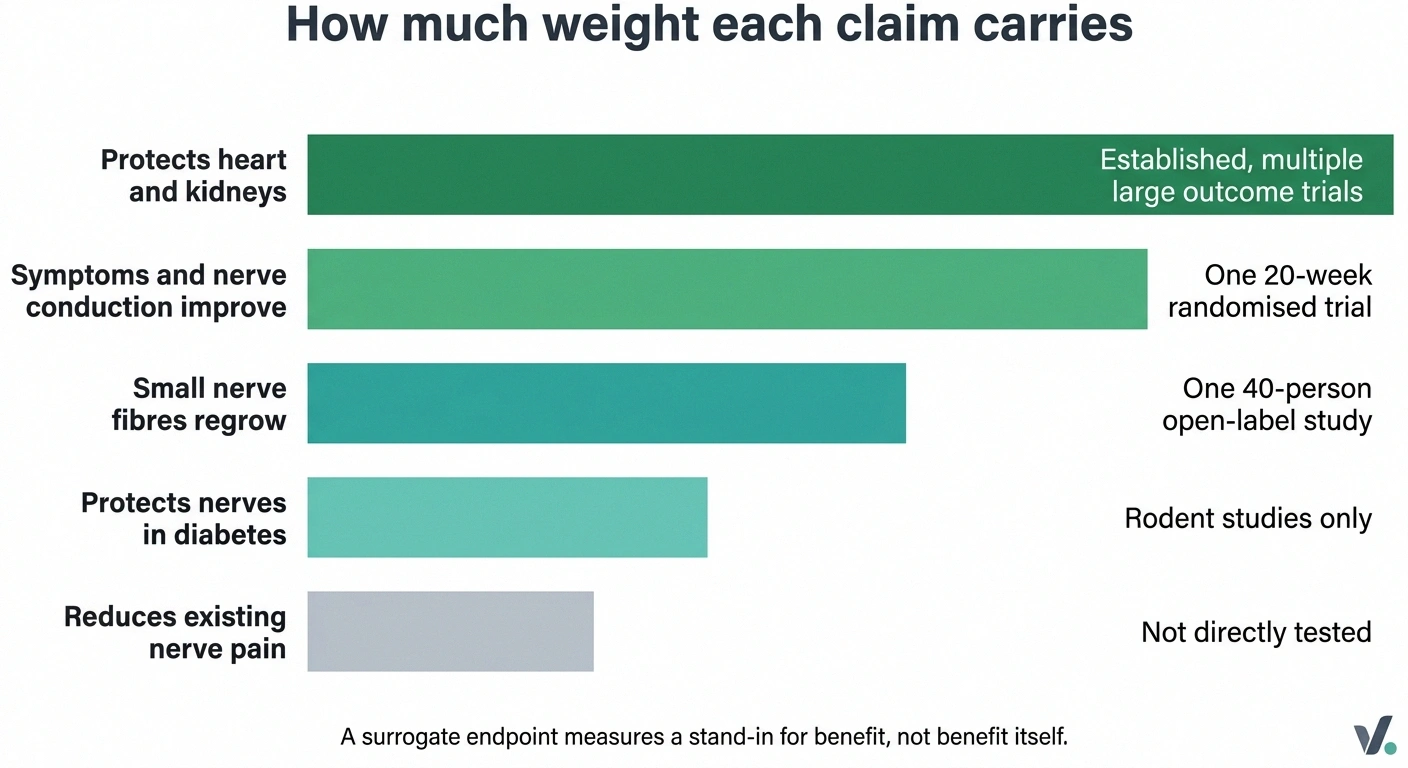
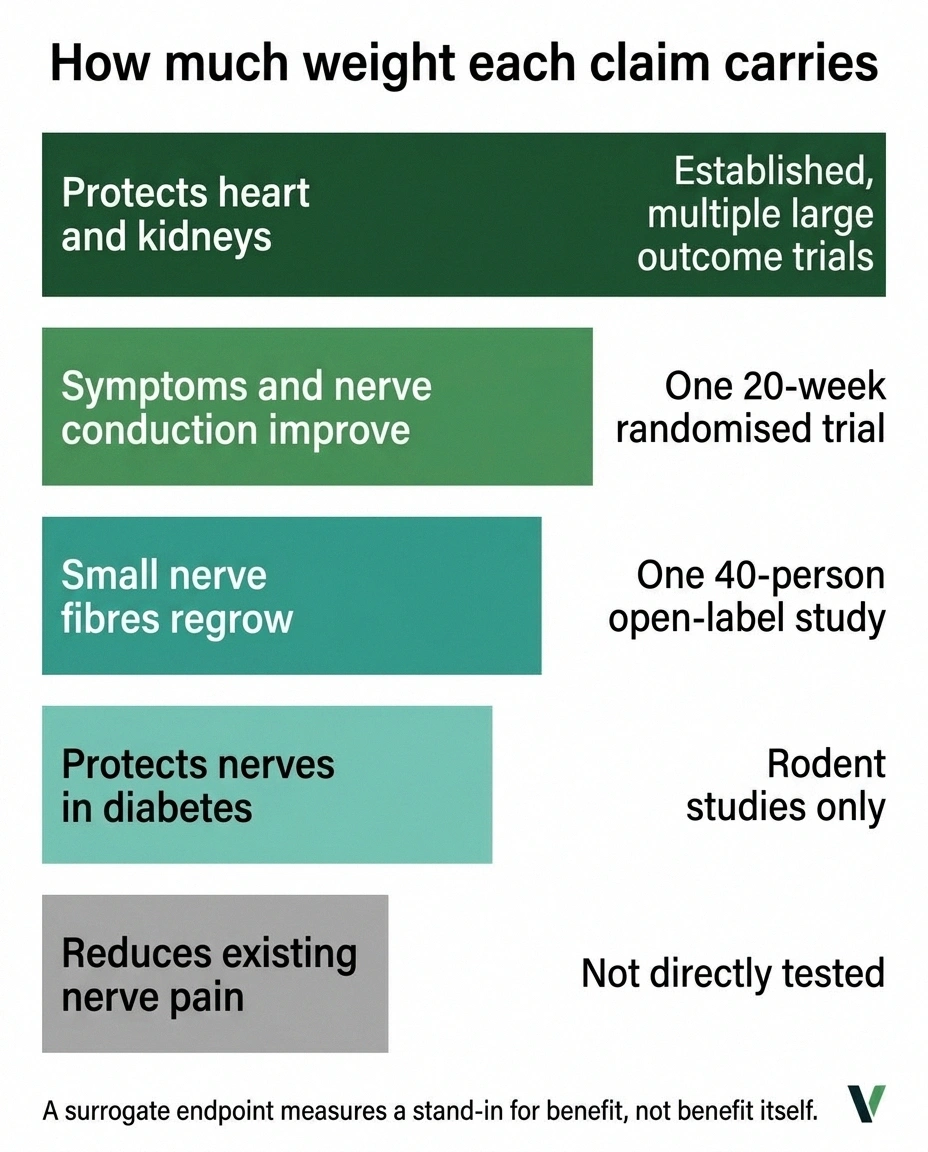
A surrogate endpoint measures something that stands in for benefit. Nerve fibre counts are a surrogate; less pain and better walking are not.
| Claim | Evidence behind it | How much weight |
|---|---|---|
| Protects nerves in diabetes | Rodent studies, consistent | Encouraging, not transferable |
| Small nerve fibres regrow | One 40-person open-label trial, 6 months, corneal imaging | Interesting, unreplicated |
| Symptoms and nerve conduction improve | One 20-week randomised double-blind trial | Promising, needs a bigger repeat |
| Protects kidneys and heart | Multiple large outcome trials, thousands of participants | Established |
| Reduces existing nerve pain | Not directly tested against a pain endpoint | Unknown |
The DINE trial had forty people in it. Forty. That is a pilot study, and pilot studies in neuropathy have a long history of not replicating.
It was open-label. Everyone knew who was taking the new drug, including the researchers, and in a condition where symptom reporting is subjective, that matters.
The endpoints were surrogates. Nerve fibre counts and corneal images are proxies for nerve health, not measures of whether anyone hurt less, walked better, or could feel the floor. Those proxies are used because they change faster than symptoms do, which is convenient for a six-month study and not the same as proving benefit.
And the skin biopsy result is the awkward one. Fibre density rose in both groups, including the people who changed nothing. When a marker moves in your control group too, some of what you are seeing belongs to the measurement rather than the drug.
Here is where that leaves things, and I think it is a fair summary. If you are already taking one of these for your heart or kidneys, the nerve data is a reason for mild optimism and no reason to change anything. If you are not taking one and your doctor is considering it for cardiac or renal reasons, the neuropathy evidence is a small point in favour rather than a decisive one. And if you were hoping to ask for a prescription purely to regrow nerves, the evidence is not there yet, and anyone selling you that certainty is ahead of the data.
The Amputation Story, in the Right Order
This is the part that frightens people, and it is almost always told without the ending.
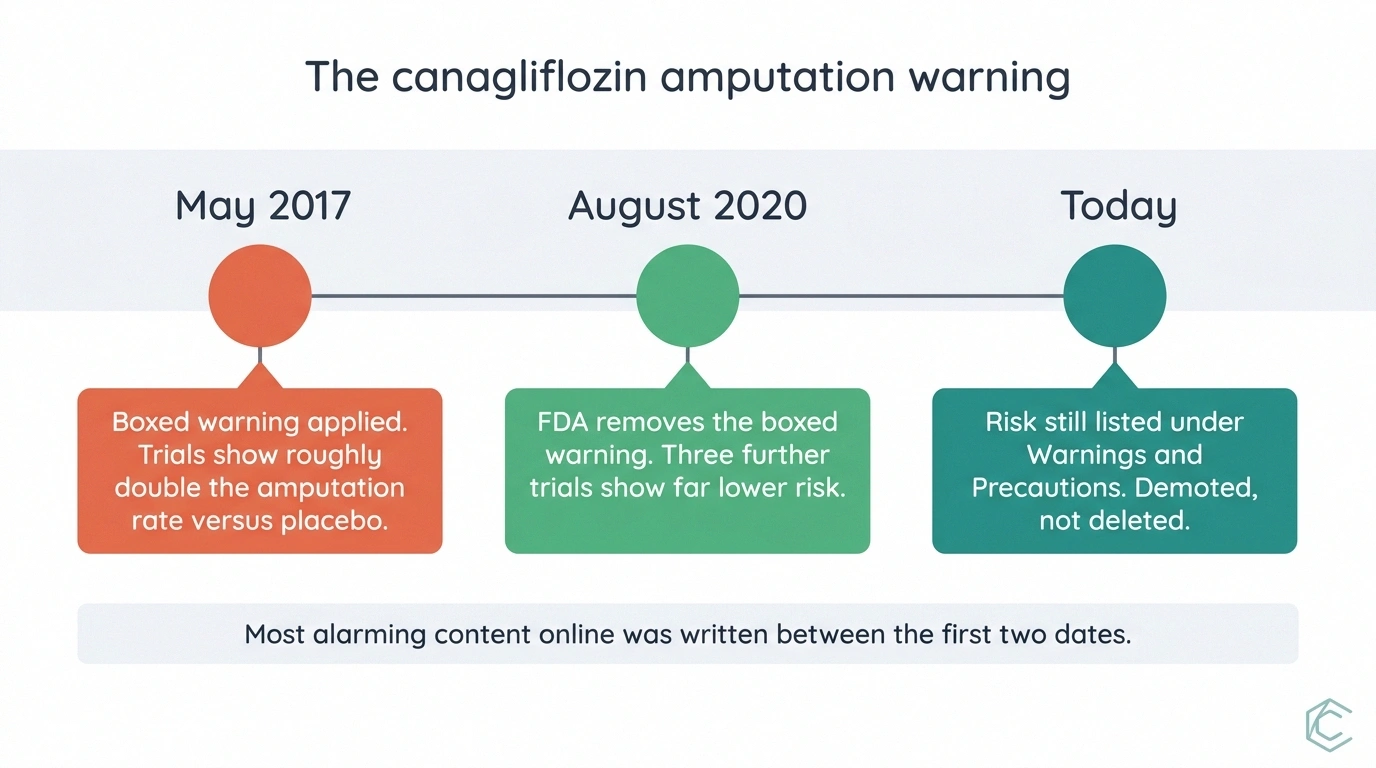
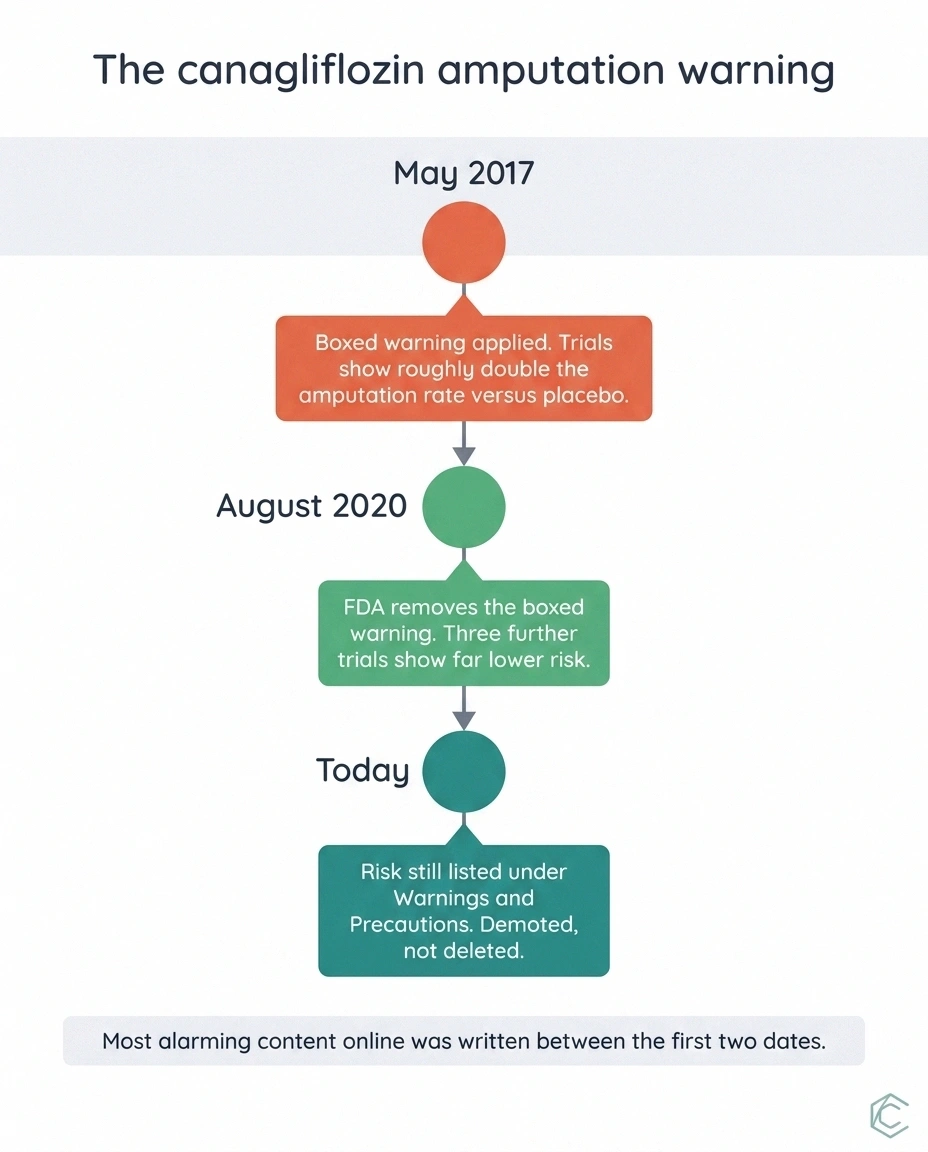
What happened to the canagliflozin amputation warning
May 2017
CANVAS and CANVAS-R show roughly double the rate of leg and foot amputations versus placebo. The FDA applies a boxed warning, its strongest label warning.
August 2020
Three further trials show amputation rates well below the original signal, alongside confirmed heart and kidney benefit. The FDA removes the boxed warning.
Today
Amputation risk remains listed under Warnings and Precautions. Demoted, not deleted. Canagliflozin carries the strongest signal in the class; empagliflozin the weakest.
Much of the alarming content still online was written between those first two dates and never updated.
May 2017. The FDA reviewed two large trials of canagliflozin, CANVAS and CANVAS-R, and found roughly twice the rate of leg and foot amputations compared with placebo. A boxed warning went on the label, which is the strongest warning the agency issues.
August 2020. The FDA removed it. Three further clinical trials had produced amputation rates substantially lower than the original signal suggested, and the cardiac and kidney benefits had been confirmed in the interim. The agency judged that a boxed warning overstated the risk.
Now. The risk is still described, in the Warnings and Precautions section of the canagliflozin label. It was demoted, not deleted. Comparative analyses since have generally found canagliflozin carrying the strongest amputation signal in the class, dapagliflozin linked to a somewhat higher toe amputation risk in some datasets, and empagliflozin looking comparatively clean.
What almost nobody explains is the likely mechanism, which is not sinister. These drugs make you urinate more, which reduces circulating volume. In someone with existing peripheral artery disease and a foot that already has borderline blood supply, a persistent drop in volume is not neutral. The pill does not cause an amputation. It may worsen the margins on a foot that was already close to the line.
That reframing matters, because it tells you exactly who should be cautious and exactly what to do about it. If you have poor circulation, a prior ulcer, a prior amputation, or a foot wound right now, that is a specific conversation to have rather than a general anxiety to carry. Our guide to diabetic foot ulcers covers who falls into that group.
For everyone else, the honest reading is that the warning was withdrawn for good reason, and the sensible response is the foot checking you should be doing anyway.
Dehydration, and Why It Is a Bigger Deal for You

If there is one genuinely underappreciated interaction between these drugs and neuropathy, it is this one, and it has nothing to do with amputation.
SGLT2 inhibitors act somewhat like a mild diuretic. Fluid volume drops. In most people that produces nothing worse than more trips to the bathroom.
Autonomic neuropathy changes the arithmetic. When the nerves controlling blood pressure are damaged, the reflex that tightens your blood vessels as you stand up is already impaired. That is why autonomic neuropathy produces dizziness on standing. Add a drug that lowers your circulating volume on top of a blood pressure reflex that no longer fires properly, and you get a stacking effect: two separate problems pushing in the same direction.
Falls follow, which for a person who cannot feel their feet well is already the primary risk to independence.
Practical version. If you have autonomic symptoms and you start one of these, take standing blood pressure readings for the first few weeks rather than relying on how you feel. Stand up in stages. Watch the hot weather especially, since heat and this drug class pull in the same direction. Anyone also on a water tablet should ask whether the dose still fits, because two diuretic effects were not designed to sit on top of each other. Our page on balance and fall prevention covers the rest.
Sick Day Rules and the Ketoacidosis Nobody Recognises
This one is short and important, and it is the item most likely to be missing from your knowledge.
Your blood sugar meter will not warn you about this one
Ketoacidosis on these drugs can happen at a normal or near-normal glucose reading, so a reassuring number on the meter means nothing. Go by symptoms instead.
Emergency room, same day, regardless of your reading:
- Nausea, vomiting or abdominal pain
- Breathing that is unusually deep or rapid
- Breath that smells fruity or like nail polish remover
- Sudden heavy fatigue or confusion
Risk climbs during illness, fasting, very low carbohydrate eating, heavy alcohol and around surgery. Get your own hold-the-drug instruction written down while you are well, because deciding this at three in the morning while vomiting is not the time.
These drugs can cause diabetic ketoacidosis at normal or near-normal blood sugar. It is called euglycaemic DKA, the FDA warned about it in 2015, and the reason it is dangerous is that the alarm you have been trained to rely on never sounds. You check your meter, the number is fine, and you conclude you are fine.
The symptoms to know instead: nausea and vomiting, abdominal pain, unusual tiredness, deep or rapid breathing, breath with a fruity smell, confusion. Any of those, on one of these drugs, is an emergency room visit regardless of what your meter says.
The situations that trigger it: illness with vomiting or poor intake, surgery, a very low carbohydrate diet, prolonged fasting, heavy alcohol, dehydration. Standard advice is to hold the drug when you are acutely unwell and unable to eat and drink normally, and before planned surgery, which is worth confirming as a specific instruction rather than assuming.
The other class effects are more predictable: genital yeast infections are meaningfully more common, urinary tract infections are not clearly increased by the pooled data, and Fournier’s gangrene, a severe infection of the perineum, carries a rare-event FDA warning from 2018. Genital pain, swelling, redness or fever needs same-day attention.
What This Means Next to Your Other Diabetes Drugs
Worth situating, because the nerve story differs by class.
Where each class sits on the nerve question
| Drug class | Relationship to nerves |
|---|---|
| SGLT2 inhibitors Jardiance, Farxiga, Invokana |
No known nerve harm. Early signals of possible benefit. Watch dehydration if you have autonomic symptoms. |
| Metformin | Depletes vitamin B12 over years, which can cause a neuropathy of its own. Preventable with a blood test and a supplement. |
| GLP-1 drugs Ozempic, Mounjaro |
Symptoms can flare temporarily when glucose falls very fast. Not permanent damage, but worth anticipating. |
| Insulin | Same rapid-improvement flare is possible. Hypoglycaemia is the larger practical concern. |
If you take metformin and have neuropathy, a B12 level is the single most useful test on this page and many people have never had one.
Metformin depletes vitamin B12 over years, and B12 deficiency causes neuropathy that can be mistaken for the diabetic kind. That is a real, preventable, testable problem, covered in our page on metformin and B12 deficiency. SGLT2 inhibitors have no equivalent depletion issue.
GLP-1 drugs like Ozempic have a more complicated relationship with nerves, including the phenomenon of symptoms flaring when glucose falls very quickly, which we cover in our page on Ozempic and neuropathy. SGLT2 inhibitors lower glucose gradually and rarely produce that effect.
If your kidney function is already reduced, the picture gets more layered still, since kidney disease causes its own neuropathy independent of diabetes. Our page on kidney disease and nerve damage explains that overlap, and it is worth knowing that the kidney protection these drugs provide may be doing more for your nerves indirectly than any direct nerve effect.
The Bit That Is Actually in Your Hands

Strip out the pharmacology and the practical advice for someone with neuropathy on one of these drugs comes down to a handful of habits.
Look at your feet daily, with your eyes, in good light, including between the toes and the soles. Not a check by feel. The sensation you would rely on is the sensation you have lost, which is the whole reason a small injury becomes a large one. Our foot care guide covers the routine.
Drink more than you think you need, especially in hot weather, during illness, and after exercise.
Learn the euglycaemic DKA symptoms well enough to recall them while feeling unwell, which is a different standard from recognising them on a page.
Take a standing blood pressure now and then if you have any autonomic symptoms.
Report any foot wound the same week rather than watching it, and understand that the reason for that urgency is your neuropathy, not your tablet.
None of that is dramatic. The reason it matters is that the mechanism that actually costs people toes is not a molecule. It is a small injury on a foot that could not report it, discovered late. That was true before you started the drug and it will be true after.
Frequently Asked Questions
Can Jardiance or Farxiga cause neuropathy?
There is no evidence that SGLT2 inhibitors cause peripheral neuropathy. The research points the other way, with animal studies and small human trials suggesting a protective or mildly restorative effect on nerve fibres. The confusion usually comes from the amputation warning, which concerned circulation in feet that already had poor blood supply, not nerve damage.
Is the amputation warning still in place?
The boxed warning on canagliflozin was removed by the FDA in August 2020, after three further trials showed the risk was lower than originally estimated and the heart and kidney benefits were confirmed. Amputation risk is still listed in the Warnings and Precautions section, so it was downgraded rather than dismissed. Anyone with peripheral artery disease, a current foot wound, or a previous ulcer or amputation should raise it specifically.
Do these drugs help nerve pain?
They are not pain medications and should not be expected to work like one. A small randomised study of dapagliflozin found increases in corneal nerve fibre measures over six months, and an empagliflozin trial reported improvement in neuropathic symptoms and nerve conduction velocity over twenty weeks. Both are early, small, and measured largely through surrogate markers rather than pain scores.
Which SGLT2 inhibitor is safest if I already have foot problems?
The amputation signal was strongest for canagliflozin, which is why it carried the original boxed warning. Some analyses have linked dapagliflozin to increased toe amputation risk, while empagliflozin has looked comparatively clean. If you have poor circulation or a history of foot ulcers, this is a reasonable basis for asking whether a different drug in the class would suit you better.
Why is dehydration a bigger concern for me than for other people?
Because autonomic neuropathy damages the nerves that regulate blood pressure, so the reflex that should tighten your blood vessels when you stand is already weakened. These drugs reduce fluid volume, which pushes in the same direction. The two effects stack, and the result is dizziness on standing and an increased risk of falls, which matters more when your balance already depends on impaired foot sensation.
What is euglycaemic ketoacidosis and how would I spot it?
It is diabetic ketoacidosis occurring while blood glucose is normal or only mildly raised, which means a blood sugar reading gives false reassurance. Warning signs are nausea, vomiting, abdominal pain, unusual fatigue, deep or rapid breathing, fruity-smelling breath and confusion. It is a medical emergency. Risk rises during illness, fasting, very low carbohydrate eating, surgery and heavy alcohol use.
Should I stop taking it when I am ill?
Standard practice is to pause these drugs during acute illness where you cannot eat and drink normally, and before planned surgery, precisely because of the ketoacidosis risk. Because the exact instruction depends on your other medications, get it written down in advance rather than deciding while unwell.
If glucose control does not reliably prevent neuropathy in type 2 diabetes, what does?
No single intervention does, which is why the approach is layered. The evidence supports addressing cardiovascular risk factors as a group, since triglycerides, blood pressure, smoking and obesity all independently predict neuropathy progression in type 2 diabetes. Regular movement, foot protection, alcohol reduction and correcting vitamin B12 deficiency all carry evidence. Glucose control remains firmly worth doing for eyes, kidneys and heart, and its nerve benefit in type 2 is smaller than most people are told.
About the Author