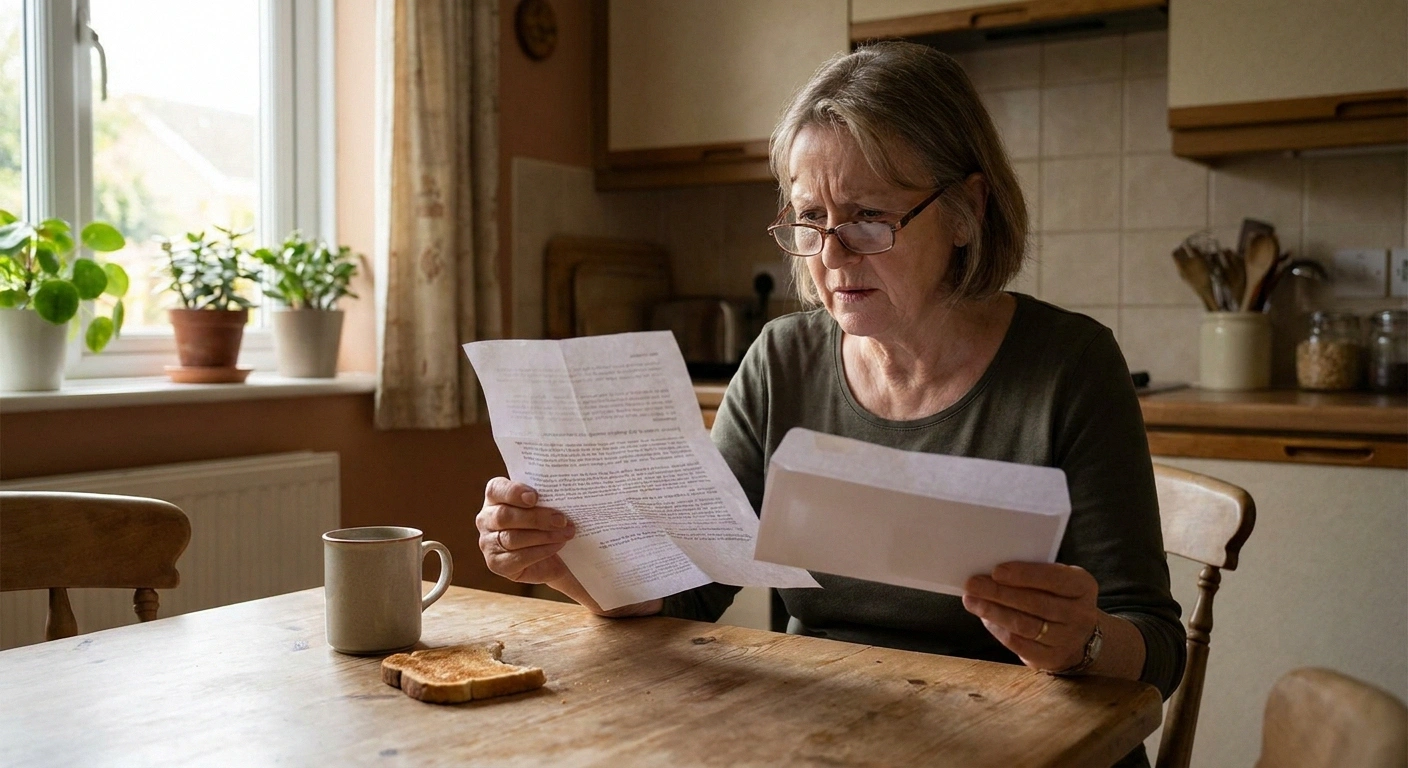
Having neuropathy won't automatically get you out of jury duty — and it doesn't sentence you to a full day on a hard bench with burning feet, either. Most courts start from a practical question: can this person serve if we adjust a few things? The federal courts put it plainly. To qualify, their juror information page says, you must “have no disqualifying mental or physical condition that cannot be addressed with an accommodation.”
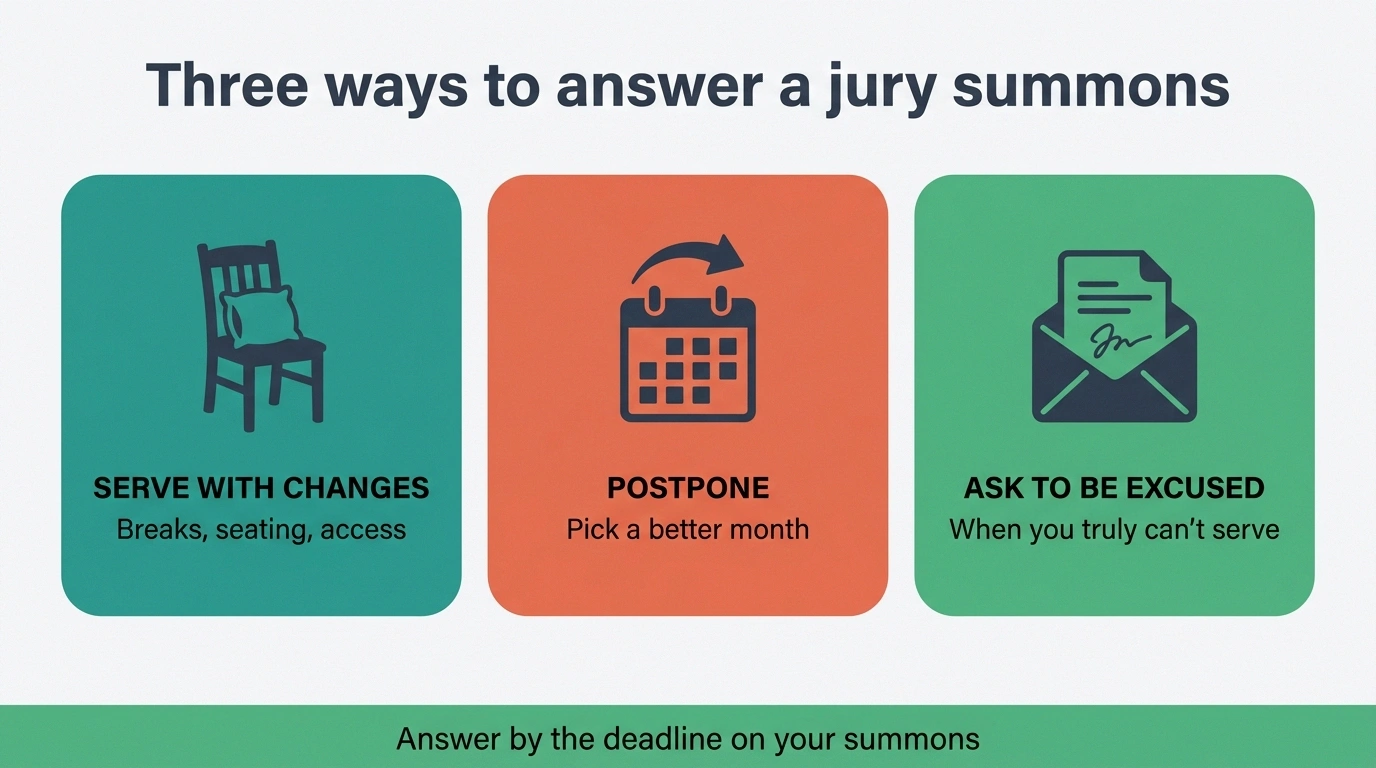
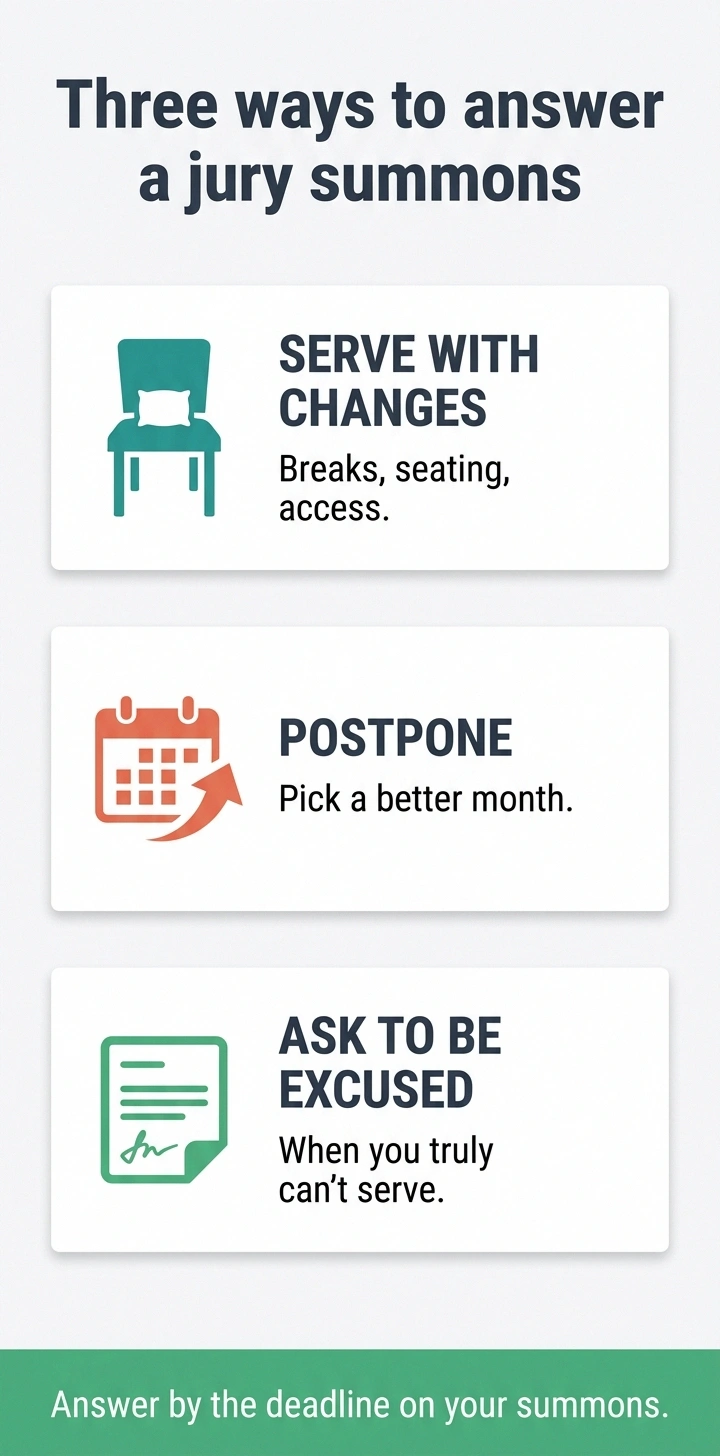
That leaves you three doors. You can serve with adjustments, such as breaks, a better seat or permission to stand. You can postpone to a better month. Or, when your body truly can't do the job, you can ask to be excused. Which door opens depends on your court, your paperwork and — more than anything — how quickly you answer.
I'm a patient advocate, not a lawyer, so read this as a map of what the courts' own rules and forms say as of September 2026. Your summons and your court's website have the final word, and I'll flag where the rules change from place to place.
Start With the Deadline on the Summons
Find two things on the paperwork first: which court sent it, and how many days you have to answer. A federal district court and your county's state court run separate systems with separate rules. Even two federal courts can differ, because each of the 94 federal districts, the national courts site notes, “maintains its own jury procedures and policies regarding excuses from jury service.”
The windows are short. The Eastern District of Virginia says, “You should make your request within five days of receiving your summons.” The Middle District of North Carolina wants requests at least 10 days before your service starts. A physician's form used by the Middle District of Pennsylvania has to be turned in “within five business days.” I put the date on my calendar the day the envelope arrives.
Then keep at it until you have an answer. Asking isn't the same as being excused. The federal court in Idaho is blunt: “Until the Court has notified you that you are excused you are required to report as directed.” The Eastern District of Virginia adds, “It is your responsibility to verify that the request has been granted.” Keep copies of what you send, and jot down the name of anyone you speak with.
Whatever you do, don't let the summons sit in a drawer. Under federal law (28 U.S.C. § 1866(g)), someone who doesn't appear as directed can be ordered in to explain, and can be fined up to $1,000, jailed for up to three days, ordered to do community service, or any combination. Virginia's official juror handbook warns, “If you do not respond, you could be held in contempt of court.”
What Courts Mean When They Say You Can't Serve
The bar for a health-based exit is higher than most people expect. Federal law treats everyone as qualified unless, among a few other things, the person “is incapable, by reason of mental or physical infirmity, to render satisfactory jury service.” That's a question about what you can do in a courtroom, not about which diagnosis sits in your chart.
Courts also have wide discretion. “Excuses for jurors are granted at the discretion of the court and cannot be reviewed or appealed to Congress or any other entity,” the federal courts' page says. California's rules go a step further: no one who can serve “with or without disability-related accommodations” may be excused “due solely to their disability.”
Virginia recently moved the other way. As of September 2026, its Code exempts, on request, “Any person under a disability that substantially impairs the person's ability to perform jury duty.” That line doesn't appear in an archived June 2025 copy of the law; the section was amended in 2026. A companion section now says no one is incompetent to serve because of a disability if they could serve “if provided reasonable accommodation.”
Put together, the honest first question for most of us isn't “How do I get out of this?” It's “What would make this workable?” If the answer is “nothing, right now,” you're in postponement or excuse territory, and both have their own sections here.
Serving With Adjustments: What You Can Ask For
Which rulebook applies depends on the building. The Americans with Disabilities Act doesn't cover federal courts. The Ninth Circuit's disability page says it outright: “The Americans with Disabilities Act (ADA) and Section 504 of the Rehabilitation Act do not apply to the federal judiciary.” Federal courts follow a Judicial Conference policy instead, which requires help such as sign language interpreters for communication disabilities, and many districts go further on their own. The Northern District of California, for one, says its policy is “to remove disability-related barriers to court services by providing reasonable accommodations.”
State and county courts are covered by Title II of the ADA. The Justice Department's rule says a public entity must “make reasonable modifications in policies, practices, or procedures” when they're needed to avoid disability discrimination, unless the change would “fundamentally alter” the program. ADA.gov lists courts among the programs that have to comply. One of its own examples is a person with diabetes who asks to bring snacks to manage blood sugar. It's set in a museum — not a courthouse — but it shows the kind of request the rule was written for.
Here's what courts' own pages describe, so you know these aren't exotic asks:
- Moving when you need to. A Duval County, Florida, clerk's medical form says jurors “are permitted to stand or reposition themselves as needed for comfort,” and that the court will “take breaks as needed by any juror.”
- A different courtroom. New York's courts say a juror with a mobility impairment “sent to a courtroom with access problems may be reassigned to a different location that has better access.”
- Scheduled breaks. The Northern District of California tells jurors, “There will be comfort breaks at appropriate times during the proceedings.”
- Asking on paper, early. The federal court in Idaho asks jurors who want to serve with an accommodation to “indicate the accommodation required on the questionnaire.” California's court rules want requests at least 5 court days ahead, with a description of what you need and the condition behind it, and they require the court to keep that information confidential.
What courts don't do matters just as much. The Northern District of California lists personal devices “such as wheelchairs” among the things its courthouses don't offer, so bring your own cane, walker or seat cushion. Wyoming's federal court asks jurors who need help to contact the jury coordinator, adding, “Advance notice is appreciated.” That's the whole method: call early, ask for something specific, and put it in writing if you can. If you'd like a script for describing nerve damage to a stranger at a counter, I've gathered a few for explaining neuropathy in a sentence or two.
Postponing When the Timing Is Wrong

If a flare, a surgery date or a medication change is the problem, a postponement usually fits better than an excuse. Federal law allows a temporary excuse “upon a showing of undue hardship or extreme inconvenience, for such period as the court deems necessary,” after which you're summoned again. California's court rules state the preference outright: “Deferring jury service is preferred to excusing a prospective juror for a temporary or marginal hardship.”
New York is the most specific. Its courts say, “You can postpone your service once,” online or by phone, if you ask at least one week before your date, and you pick a new date between two and six months from the one on your summons. Later requests go through your local commissioner of jurors. Virginia's handbook says the judge decides whether service can be deferred, and it tells jurors to “call the number listed on your summons to discuss your situation.”
When you ask, offer a date you expect to be ready. A clerk can say yes to a real date — “March, once the new medicine has settled” — far more easily than to “not now.” One federal plan, the Middle District of North Carolina's, goes further for hardships expected to last indefinitely: the person may be excused until everyone else in its pool of qualified jurors has been called.
Asking to Be Excused, and What the Note Should Say

If you truly can't serve, most courts want paperwork from someone who treats you. The Eastern District of Virginia asks you to “provide a note from your doctor.” The Southern District of New York says, “If you claim a medical hardship you must include a doctor’s note.” Texas asks for an affidavit with “a statement from a physician” attached, for an impairment that makes serving “impossible or very difficult.”
Here's the part that catches people off guard. Two official forms ask the doctor, in effect, why a jury box would be harder on you than your job. The Middle District of Pennsylvania's physician statement asks, “If this patient is employed please explain why it would be more detrimental to them to serve on the jury rather than their normal employment.” Iowa's state form asks the same kind of question and tells doctors, “PLEASE DO NOT PROVIDE MEDICAL RECORDS OR MEDICAL INFORMATION.” If you still work, have an honest answer ready.
Iowa's form also describes the job itself: jurors may need to “Sit quietly during the proceeding, for periods of approximately two hours without a break, which may continue the entire day.” That sentence helps, because it gives your doctor something concrete to measure your limits against. A useful note says what you can't do, whether the problem is temporary or permanent and, if it's temporary, when you expect to be able to serve. The Pennsylvania form asks for exactly that date.
California has a separate route for conditions that won't improve: a permanent medical excuse. The letter has to be on your treating provider's letterhead, “state that the person has a permanent disability that makes the person incapable of performing jury service,” be signed, and arrive on or before your report date. The rule's list of who can write it includes podiatrists, which is worth knowing if your foot doctor knows your neuropathy best.
One caution: describe your limits as they are. Federal law allows a fine of up to $1,000 for anyone who “willfully misrepresents a material fact on a juror qualification form.” An accurate note from someone who knows you is stronger than a dramatic one anyway. If you're pulling records together first, my guide to organizing your medical records can save you an afternoon.
Age Rules Depend on Which Court Sent the Summons
Age can open a separate door, but only if you ask, and the cutoff depends on the court. Many federal districts excuse people over 70 on request. The national courts site says the groups offered excuses “may include persons over age 70,” and the Eastern District of Virginia says, “Individuals who are 70 years old or older may ask to be excused because of their age.” Not every district lists one, though. The District of Minnesota's excuse page names no age group at all.
| Court | Age rule | Where it's written |
|---|---|---|
| Many federal district courts | Over 70 may ask to be excused, as in eastern Virginia and central North Carolina. Some districts list no age group. | Each district's jury plan |
| Virginia state courts | Over 73, exempt on request | Va. Code § 8.01-341.1 |
| Florida state courts | 70 or older, excused on request; a permanent excuse on written request | Fla. Stat. § 40.013 |
| Texas state courts | 75 or older may claim an exemption by filing a signed statement before the report date | Tex. Gov't Code § 62.106 |
| California state courts | No age exemption. People 70 or older don't have to verify a disability-based hardship. | Code Civ. Proc. § 204; Cal. Rules of Court 2.1008 |
| New York state courts | No upper age limit. A bill for an optional excuse at 70 is still in a Senate committee. | NY courts' juror Q&A; Senate bill S6090 |
None of these happen automatically. You have to ask, usually by the deadline on your summons.
States write their own rules, and some widely shared lists are out of date. Virginia's state courts use “over 73,” not 70. So a 71-year-old in Norfolk could ask the federal court to excuse her for age and still be expected at the state circuit court down the street. The table in this section lines up five states as of September 30, 2026.
Security Lines, Canes and Your Medicines
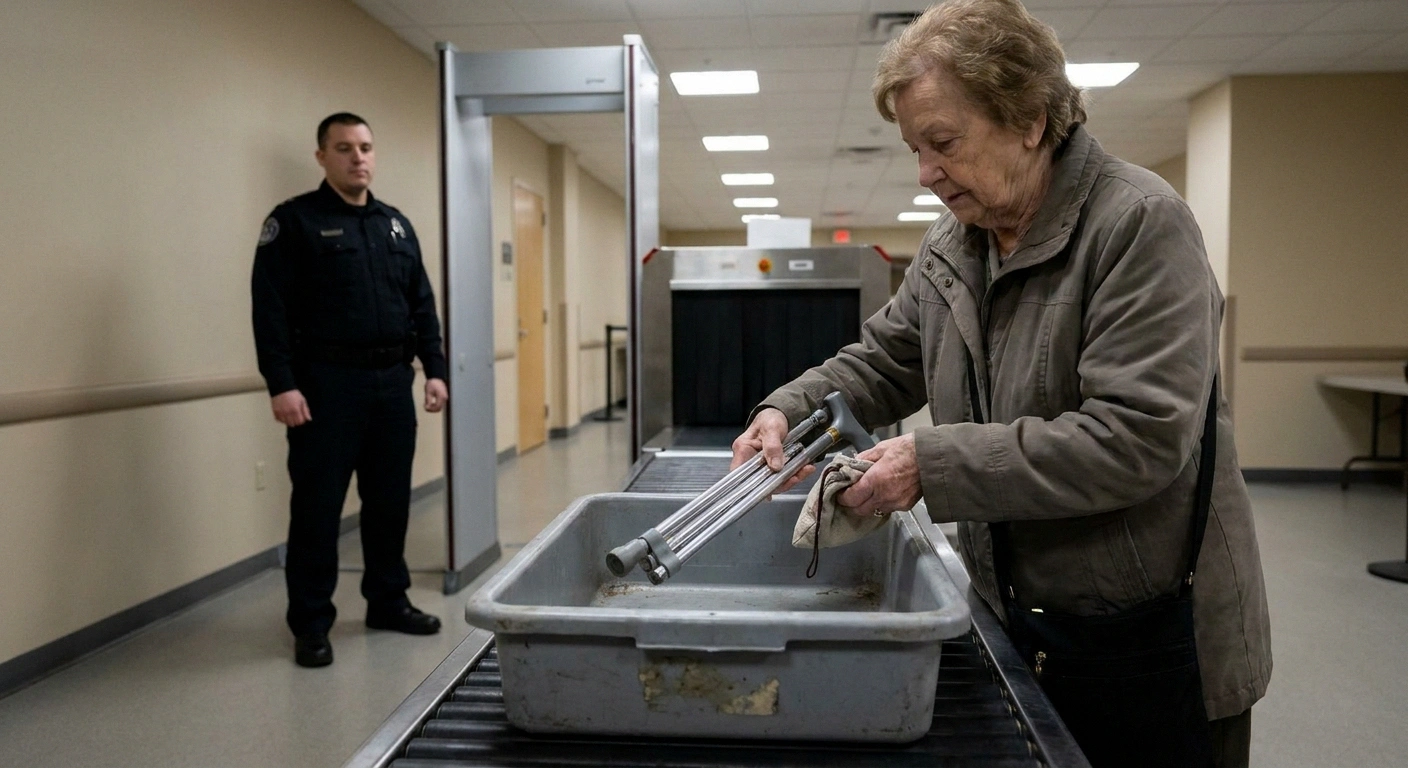
Plan for airport-style screening and extra time. The Eastern District of Virginia warns, “You and your belongings are subject to search. Please allow plenty of time to pass through security.” The Eastern District of Washington describes “X-ray screening of bags, briefcases, and other personal items,” and says people with pacemakers or cochlear implants can ask to be checked with a handheld wand instead.
Mobility counts too. The federal court in Oregon offers alternative screening “if a mobility impairment affects your ability to proceed through a metal detector.” If standing in line is the hard part for you, my tips for getting through a long line apply here. If you lean on a cane, tell the officers before you hand anything over, so you aren't left balancing on numb feet with nothing to hold.
Food and medicine rules vary more than you'd think. The Western District of New York allows liquid medicines “if medically required” but no other liquids, and it doesn't provide lunch. Connecticut's federal court lets jurors bring food and drinks as long as they go through the X-ray. So check your own court's security page before you pack, and if you manage blood sugar with snacks, ask the jury office about them in advance.
Planning for a Long Sit on Numb Feet
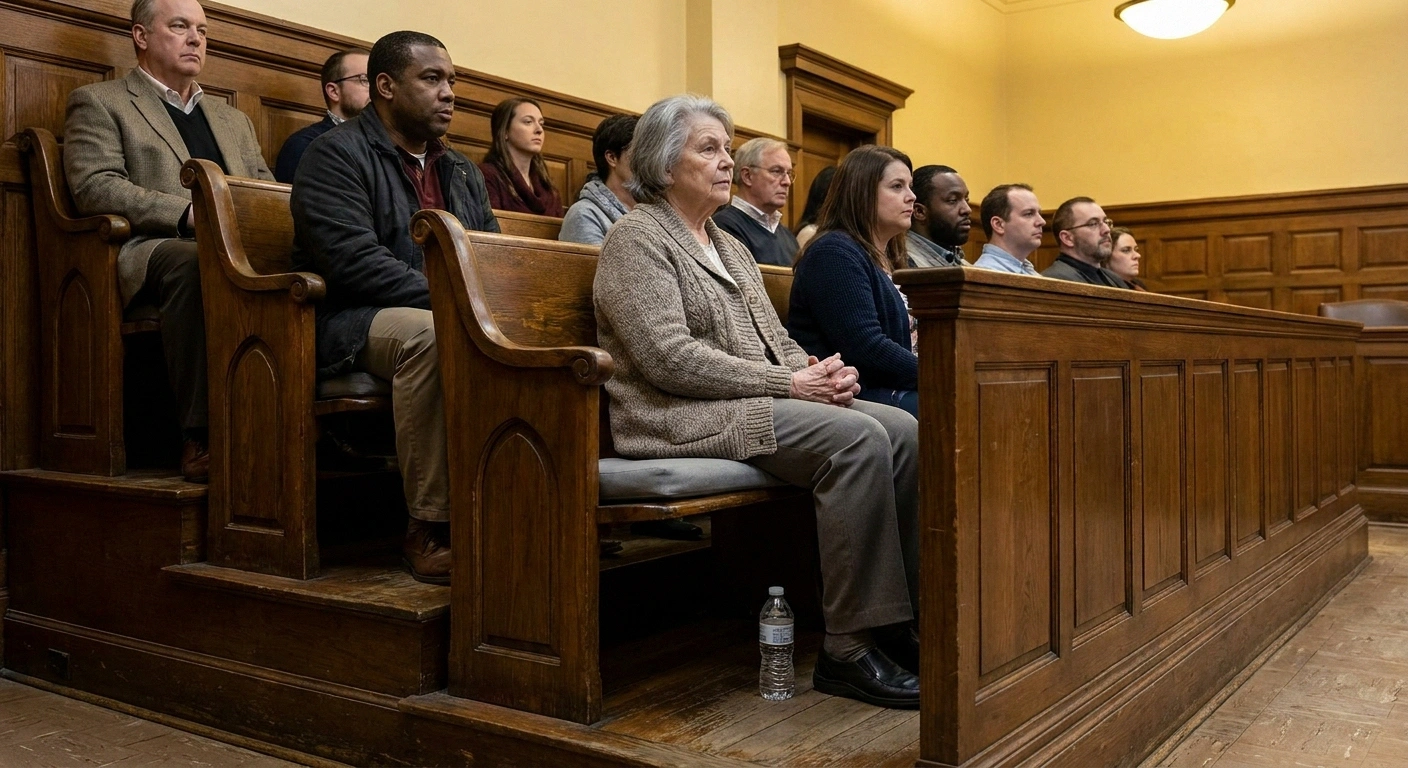
How long you'll sit depends on the court and the judge. The Eastern District of Virginia tells jurors to expect 8:30 a.m. to 5:00 p.m., with “a break for lunch and additional short breaks during the day,” though its average trial lasts one to three days and jurors rarely report every day of their two-week term. Duval County's clerk says jurors there typically sit no more than about an hour to an hour and a half at a time. California defines a capable juror as one who can pay attention “for up to six hours per day, with a lunch break and short breaks in the morning and afternoon.”
- A slim seat cushion, and shoes I can loosen during breaks
- A sweater or extra layer, since federal courts in Virginia and Washington both warn that courtroom temperatures run cool or vary
- The day's medicines, plus a printed list of what I take and when
- If you take insulin or another medicine that can cause lows, fast-acting sugar cleared with the jury office in advance, plus snacks and a lunch plan
- A small card with one line about my neuropathy for the jury clerk
- The summons itself, with the jury office's number, and any parking receipt
That's a lot of stillness for feet that burn when they aren't moving. NIH's neurology institute, NINDS, counts “Loss of position sense” among neuropathy's effects — one reason balance can wobble when you first stand after a long sit — and it advises people whose blood pressure drops on standing to “get in the habit of standing up slowly.” NIDDK, writing about nerve damage from diabetes, adds that it can make it “hard to know when you need to urinate and when your bladder is empty.” When the jury is called in or out, I take my time rising, and I'd tell the court officer early that I may need a restroom break.
If you have diabetes and take insulin or another medicine that can cause lows, one more point matters. According to NIDDK, autonomic neuropathy “can cause hypoglycemia unawareness,” so the usual warning signs of a low may not show up. A long morning in the jury box, on a schedule you don't control, is exactly when that matters. There's more in my article on hypoglycemia unawareness.
And if something goes wrong mid-trial, there's a proper channel. The federal juror handbook says a juror with a personal emergency “may send word to the judge through any court personnel, or may ask to see the judge privately.” It also promises, “Jurors will be treated with consideration for their comfort and convenience.” Hold them to it.
What Your Nerve-Pain Medicine Label Says
Testimony asks for hours of steady attention, and three medicines NINDS lists among the common neuropathy treatments all carry warnings about drowsiness or dizziness. The Neurontin (gabapentin) label says the drug “may cause significant driving impairment,” and it adds that nobody knows how long that impairment lasts after someone starts taking it. Lyrica's (pregabalin) label says its dizziness and sleepiness “may impair their ability to perform tasks such as driving or operating machinery,” and that these “generally began shortly after the initiation of LYRICA therapy and occurred more frequently at higher doses.” Cymbalta's (duloxetine) Medication Guide says it “can cause sleepiness or may affect your ability to make decisions, think clearly, or react quickly.”
- Gabapentin (Neurontin)
- In the label's shingles-pain trials, sleepiness in 21% of people taking it vs 5% on placebo, and dizziness in 28% vs 8%.
- Pregabalin (Lyrica)
- Across its adult controlled trials, dizziness in 30% vs 8% on placebo, and sleepiness in 23% vs 8%.
- Duloxetine (Cymbalta)
- No trial percentage here. Its label tells prescribers to caution patients about operating “hazardous machinery including automobiles” until they know how it affects them.
From the US FDA labels posted in September 2026 (Neurontin May 2026, Lyrica April 2025, Cymbalta July 2025). Dose questions belong with your prescriber.
None of that means you can't serve. It means timing matters. If a dose was just started or raised, that's a fair reason to mention when you ask for a postponement. Duloxetine's label adds that fainting and blood-pressure drops on standing “tend to occur within the first week of therapy but can occur at any time,” particularly after dose increases. Don't skip or shift a dose on your own for court. Ask your prescriber how the medicine is likely to handle a long day of sitting and the drive in, and line up a ride if the answer worries you. Ask about alcohol and any other sedating medicines, too, since they can add to the drowsiness. My overview of neuropathy brain fog covers the attention side in more depth.
Pay, Parking and Your Job
Federal jurors are paid $50 a day, and on a trial that runs past 10 days, the judge can raise that to as much as $60. Travel costs are reimbursed, and “in some courts, parking fees” are too, so keep your receipts. State pay varies widely. As of September 2026, New York pays $72 a day, and California pays $15 a day starting on the second day, plus at least 34 cents a mile.
28 U.S.C. §§ 1866, 1871 and 1875 (current through Sept. 16, 2026) and the federal courts' juror pay page. A juror who must stay overnight also receives a subsistence allowance.
Your job has some protection, though not necessarily your paycheck. Federal law says no employer shall “discharge, threaten to discharge, intimidate, or coerce any permanent employee by reason of such employee's jury service.” But the federal courts also say plainly that “federal law does not require an employer” to keep paying you. For state service, Virginia's handbook says, “Your employer can’t fire, demote, or otherwise penalize you for missing work while performing jury service.”
If you already have accommodations at work for your neuropathy, those are a separate set of rights, and my guide to workplace accommodations under the ADA walks through them.
The Call Saying You Missed Jury Duty

Two official warnings this year show the jury-duty scam is still going strong, and it aims squarely at people who are already anxious about a summons. The Federal Trade Commission's June 2026 alert describes the script: “They say you missed jury duty (you didn’t) and threaten to arrest you (they won’t).” Scammers now also text or email papers dressed up as arrest warrants. The FTC's answer: “Real law enforcement will never text or email you an arrest warrant,” and “Courts never demand payment over the phone. In fact, no government agency will.”
The federal court in Maryland warned in May 2026 that scammers “spoof their phone numbers to appear on Caller ID as if they are calling from a courthouse,” so a familiar-looking number proves nothing. The U.S. Marshals Service says it “WILL NEVER ask for credit/debit card/gift card numbers, wire transfers, or bank routing numbers, or to make bitcoin deposits for any purpose.” Hang up, look up your clerk of court's number yourself on your summons or the court's website, and report the attempt at ReportFraud.ftc.gov.
Frequently Asked Questions
Can I be excused from jury duty because of neuropathy?
A diagnosis alone usually isn't enough. Federal law disqualifies someone who is incapable of satisfactory service because of a physical or mental condition, and courts can excuse or postpone for undue hardship. Many courts try accommodations such as breaks and a better seat first. If you can't serve even with changes, ask by the deadline on your summons and include a note from your doctor.
What should a doctor's note for jury duty say?
It should describe what you can't do, such as sitting for long stretches, whether the problem is temporary or permanent, and when you could serve if it's temporary. Some court forms also ask why jury service would be harder for you than your job. California's permanent medical excuse must be on the provider's letterhead, be signed and state a permanent disability that makes you incapable of jury service.
How do I postpone jury duty for a medical reason?
Contact the jury office by the deadline on your summons, explain the reason and suggest a date when you expect to be ready. Federal courts can grant a temporary excuse for undue hardship, and California's rules prefer deferral for temporary problems. In New York you can postpone once online or by phone at least a week before your date, choosing a date two to six months out.
At what age can you be excused from jury duty?
It depends on the court, and you usually have to ask. As of September 2026, many federal districts excuse people over 70 on request, Virginia state courts exempt people over 73 on request, Florida excuses people 70 or older on request, and Texas allows an exemption at 75 or older. California and New York have no age exemption.
Does the ADA apply to jury duty?
For state and county courts, yes. They are covered by Title II of the ADA and must make reasonable modifications unless a change would fundamentally alter the program. The ADA does not apply to federal courts, but they follow a Judicial Conference policy for communication disabilities, and many districts have broader accommodation policies of their own.
Can I bring my medicine, a cane or snacks into the courthouse?
Usually, but the rules differ by court. One federal court in New York allows liquid medicines if medically required, one in Connecticut X-rays food and drinks, and one in Oregon offers alternative screening for people with mobility impairments. Check your court's security page before you go and ask the jury office about anything you're unsure of.
What happens if I don't respond to a jury summons?
In federal court, someone who fails to appear can be ordered to come in and explain, and can be fined up to $1,000, jailed for up to three days, ordered to do community service, or any combination. State courts have their own penalties, including contempt of court in Virginia. Asking for a postponement or excuse by the deadline is the safer path.
Is a call saying I missed jury duty real?
If the caller wants payment, treat it as a scam. The FTC says courts never demand payment over the phone, and real arrest warrants are not sent by text or email. Hang up and call the clerk of court using the number on your summons or the court's official website.
About the Author