Everyone with neuropathy knows the 3 AM clock. The bedroom is dark, the house is quiet, your partner is breathing peacefully beside you — and your feet are on fire, or buzzing, or feel like someone is stepping on broken glass. You count the hours until you have to get up. Then you spend the next day exhausted, and the exhaustion makes your nerves louder, and the louder nerves cost you another night of sleep. The loop tightens.
That bidirectional cycle — pain steals sleep, sleep deprivation amplifies pain, tomorrow gets worse — is the part that almost nobody explicitly names when they talk about sleeping with neuropathy. But once you see it, you can break it. The tools aren’t fancy. Most of them cost very little or nothing. They just need to be sequenced and used consistently.
This is what’s worked for me and for the people in my support group. Not every single thing will fit your specific situation — heat sensitive feet and cold sensitive feet need different versions of some of these tips — but if you pick three or four to try this week, you’ll probably sleep better by next weekend.
Why Your Neuropathy Is Worse at Night
Quick mechanism check, because understanding the why helps you forgive yourself for the bad nights. Your nerves don’t actually fire any worse at night. What changes is your attention and your body conditions.
During the day, your brain is busy. Work, errands, conversations, screens, light, traffic noise. All of that input crowds out the nerve signals coming up from your feet. At night, when the room is dark and quiet and your body is still, the nerve signals have nothing to compete with. They move to the foreground. The burning that was a background hum at 4 PM becomes the main event at midnight.
Body temperature drops slightly overnight, and for many neuropathy patients, cooler skin temperature triggers more burning or tingling sensations. Lying flat also redistributes fluid — pooling that built up in your legs during the day can shift, and circulation changes affect how nerves behave. None of that is in your head. It’s real physiology working against you.
The deeper-dive companion piece on why this happens is our article on why neuropathy gets worse at night. If you want the mechanism, read that. If you want the fixes, keep going.
Sleep Positions That Actually Help
Position matters more than most people think. The wrong position can stretch already-irritated nerves, compress sensitive areas, or pool fluid in places that make symptoms worse. Here’s what works.
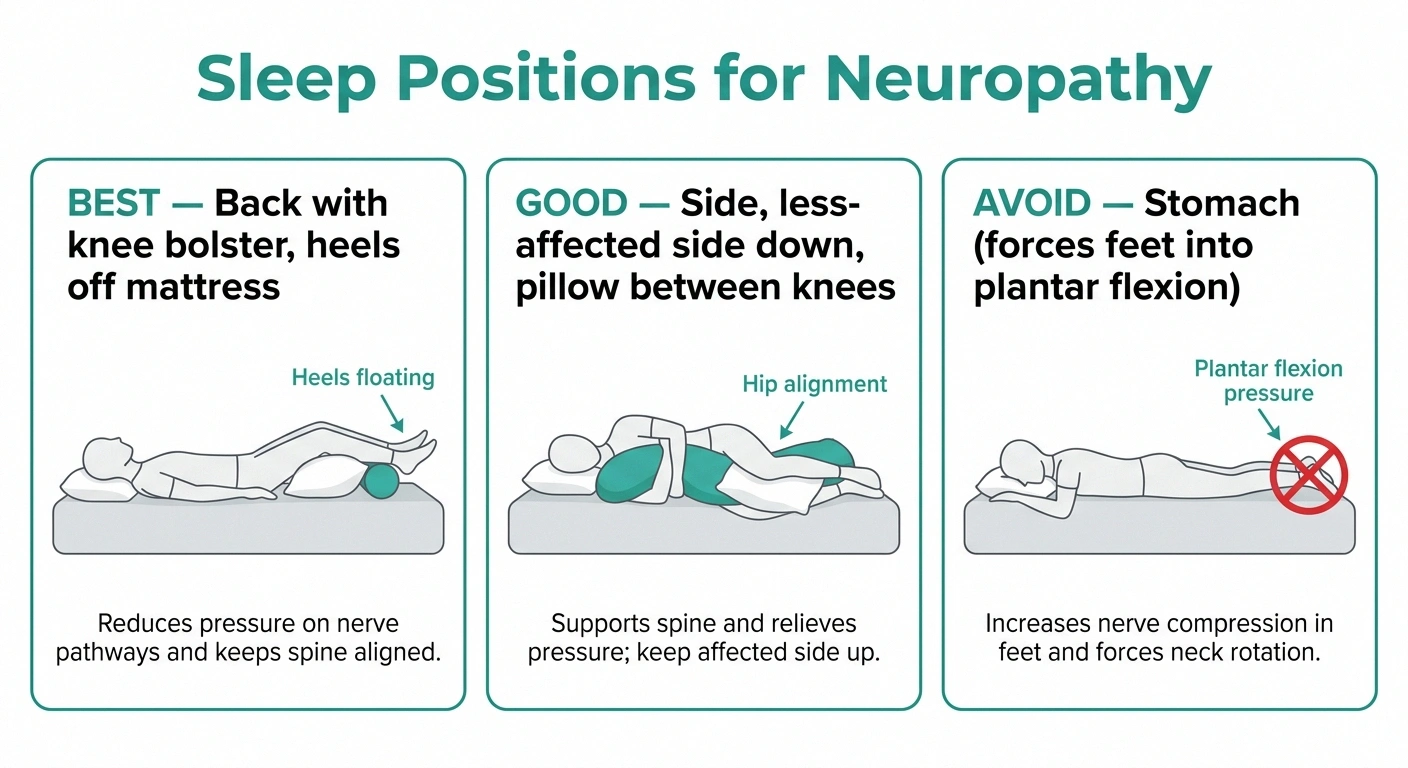
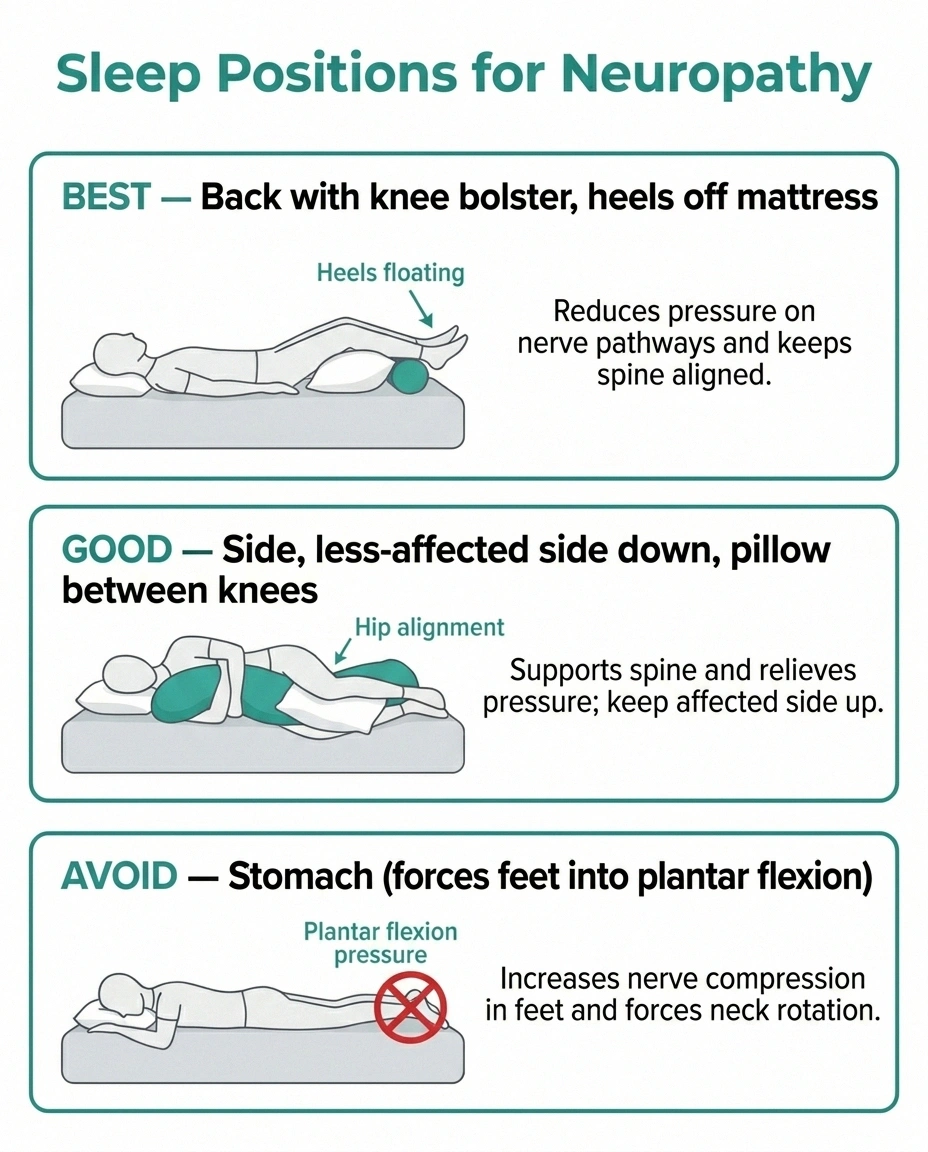
Best for most people: back-sleeping with a knee bolster and slight foot elevation. A pillow under your knees keeps your lower back in a neutral curve and takes pressure off the nerves that run from your spine down your legs. A second small pillow under your calves — not under your heels — lifts your feet about 4 to 6 inches above heart level. That gentle elevation helps fluid drain back out of your lower legs, which can reduce overnight swelling that compresses nerves.
The heels-floating detail matters. If your heels press into the mattress for eight hours, you wake up with heel pain stacked on top of your nerve pain. Letting them dangle over the edge of the pillow keeps the pressure off.
Second-best: side-sleeping on your less-affected side with a pillow between your knees. If one foot is worse than the other, sleep with the worse foot on top. Stacked hips and stacked shoulders. Don’t curl into a tight fetal ball — that compresses the sciatic nerve and shortens your hip flexors, which can create new pain by morning. If your hands or arms are also affected, hug a full-length body pillow in front of you so your arms aren’t pinned under your body weight.
Stomach sleeping is the worst. It forces your feet into plantar flexion — toes pointed down — which stretches the nerves on the top of the foot for hours and compresses the front of the ankles into the mattress. It’s a reliable burning-foot trigger. It also rotates your neck for the whole night, which can irritate cervical nerves that radiate into your hands and arms. If you’re a lifelong stomach sleeper, switching is hard, but it’s worth the effort.
On flare nights: try a recliner. Head and chest elevated 20 to 30 degrees, legs gently elevated, no pressure on your back. Some people sleep noticeably better in a recliner during a bad flare. That’s not failure — it’s adaptation. Use what works.
The 60-Minute Pre-Bed Wind-Down
The hour before bed is where the next eight hours get won or lost. Treat it like a sequenced routine, not a vague “wind down.” Here’s the timeline that works for me.
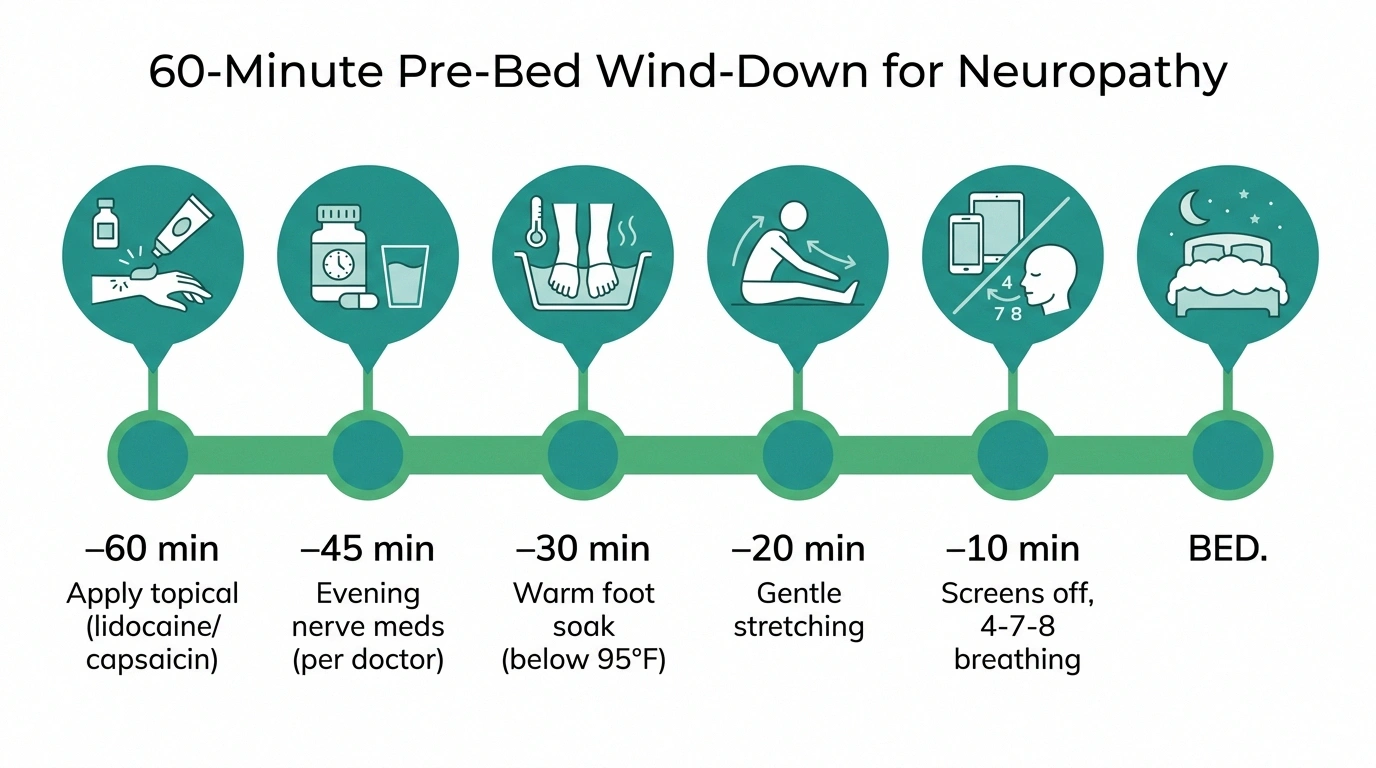
60 minutes before bed: apply your topical. If you use lidocaine cream, capsaicin, or any other topical, this is the time. Lidocaine kicks in within about 20 to 30 minutes. Capsaicin has an initial sting that can disrupt sleep onset if applied too close to bedtime, so the 60-minute lead time lets the burn fade before you lie down.
45 to 60 minutes before bed: take your evening dose of nerve pain medication if you take one. Many people benefit from talking to their doctor about whether to weight more of their daily dose toward evening — gabapentin, for example, reaches peak blood levels about 2 to 3 hours after a dose, so timing the evening pill so peak coincides with sleep onset can help. Don’t change your dose schedule on your own. But it’s worth raising with your doctor at your next visit.
30 minutes before bed: a warm — not hot — foot soak or bath. Cleveland Clinic recommends keeping water below 95°F for people with neuropathy. With reduced sensation, hot water carries a real burn risk because you can’t reliably feel when the water is too hot. Test with your elbow, your wrist, or a thermometer — never with your feet. If you’re heat-sensitive and warm water makes symptoms worse, skip this step.
20 minutes before bed: gentle stretching. Calf stretches against a wall, slow ankle circles, toe spreads, foam-roll the calves lightly. Five minutes of slow movement releases tension that otherwise turns into 2 AM cramps.
10 minutes before bed: screens off, lights dim. Try a breathing exercise — 4 seconds in, 7 seconds hold, 8 seconds out, for four or five cycles. The slow exhale drops the stress response that amplifies pain perception. Your sympathetic nervous system has been running on overdrive all day; this is how you signal it to stand down.
For burning, hot feet: flip the routine. Instead of warming, cool your feet for 5 to 10 minutes with a cool damp cloth. Not ice — direct ice on insensate skin is a frostbite risk. A small fan aimed at the foot of the bed keeps the cool sensation going through the early sleep period.
Bedding, Mattress, and the Single Highest-Leverage Purchase
If I could recommend only one product to a friend with neuropathy whose feet can’t stand the weight of a sheet, it would be a bed cradle. This is a small frame that sits at the foot of the mattress, under the covers, and lifts the sheets and blankets a few inches off your feet so nothing touches them. They’re 20 to 30 dollars on Amazon. Search “bed cradle blanket lifter.” They change sleep for some people more than any prescription has.
If a cradle isn’t an option, a free version works almost as well: pull your top sheet and blanket completely untucked at the bottom corners of the bed so your feet have room to move and breathe.
On sheets and bedding more broadly: smooth, low-friction fabric is better than rough. Silk, satin, or high-thread-count sateen cotton glide over hypersensitive skin without setting off allodynia. Rough flannel and cheap cotton can feel like sandpaper on a bad night. Lightweight layered blankets are better than one heavy comforter — you can shed a layer at 2 AM without freezing your top half. And weighted blankets are usually a hard no on the feet; the pressure is the whole point of them, and the pressure is what hurts.
For mattresses: medium-firm memory foam or latex tends to contour around pressure points without the deep-sink feeling of soft foam. Latex sleeps cooler than memory foam, which matters if heat triggers your burning. Pillow-top mattresses can trap heat. A 6 to 10 inch wedge under your calves (for back sleepers) or a contoured knee pillow between your legs (for side sleepers) keeps your alignment right without effort. For more on bedroom setup specifically, our neuropathy-friendly bedroom setup guide goes deeper on mattress and pillow choices.
Bedroom Environment: Cool Room, Warm Body
For most people with burning or hypersensitive neuropathy, a cool bedroom — around 65 to 68°F — beats a warm one. Cooler ambient temperature reduces the skin-warming that triggers burning flares for some people. If cold is what triggers your symptoms (and for some people it does — there’s no universal direction here), bump the room up to 68 to 72°F and warm the bed itself instead of the room.
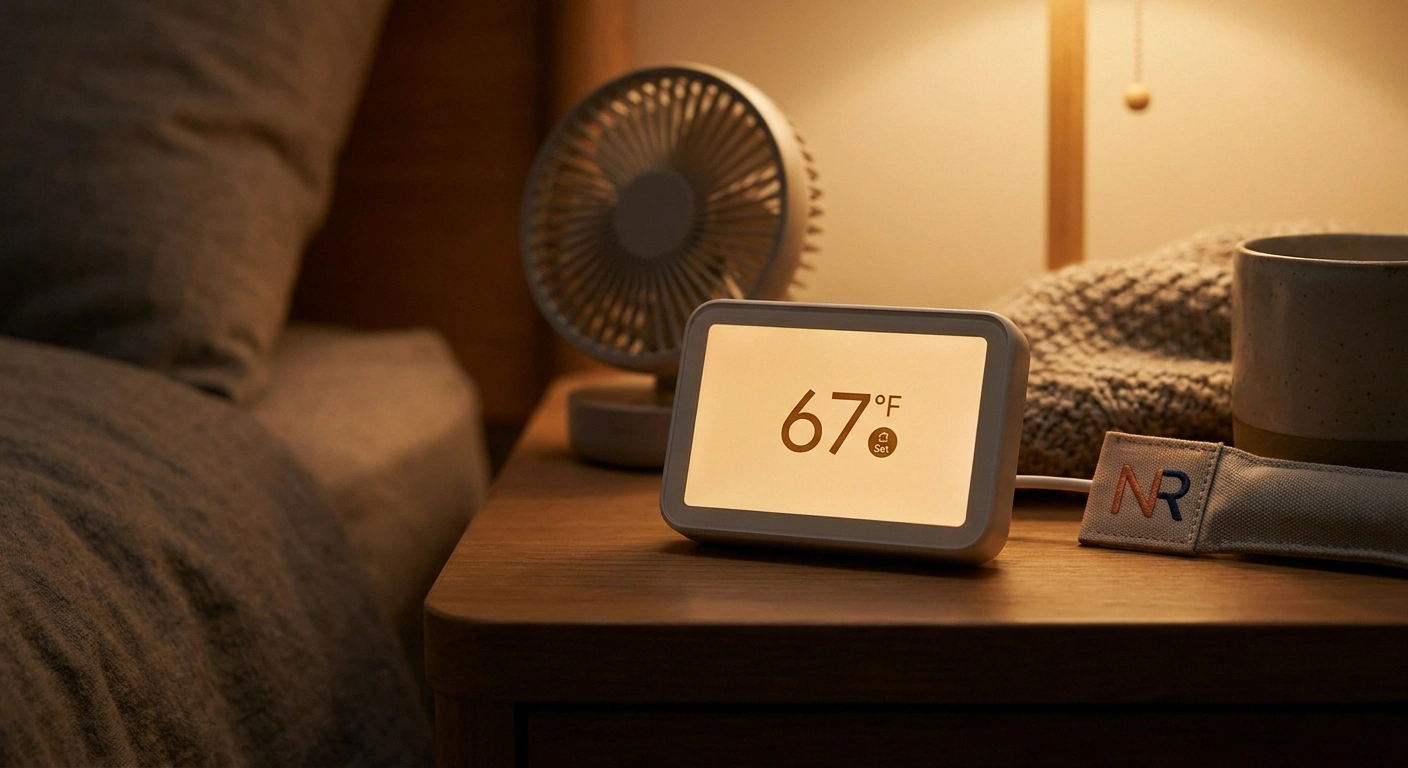
Pre-warm the bed; don’t sleep with active heat. If you use a heated mattress pad, set it on a timer so it shuts off 15 minutes before you climb in. The bed will hold warmth long enough to fall asleep without continuing to add heat all night.
Blackout curtains help — light disrupts the deep-sleep stages where your body’s pain modulation system resets. A white-noise machine or a fan masks small sounds that pull a sleep-deprived nervous system back to alertness. If you go with the fan, you get thermal regulation thrown in.
And the phone needs to leave the bedroom — or at least face-down on the nightstand with notifications off. Three AM doom-scrolling is a guaranteed pain-cycle accelerant. The blue light suppresses melatonin, the social media stress lights up your sympathetic nervous system, and you’ve just added another forty-five minutes to your insomnia. The phone in the next room is the single most underrated sleep upgrade for anyone with chronic pain.
Socks: Yes, Sometimes, No
Socks for sleeping with neuropathy is a more complicated question than it sounds. Here’s the breakdown.
Yes to soft, seamless, moisture-wicking socks if your feet are cold or if loose covers irritate. Bamboo or merino wool blends keep feet warm without trapping the sweat that worsens hypersensitivity. Look for a loose elastic top — anything that leaves a mark above your ankle is too tight. Diabetic socks at any drugstore are designed for exactly this.
No to compression socks at night unless your doctor specifically prescribed nighttime wear for a particular reason. Compression is a daytime tool — at night, when you’re horizontal, your circulation doesn’t need the same support, and continuing to squeeze the legs while lying down can be counterproductive. Take them off before bed.
Hard no to heated socks, electric blankets, and heating pads overnight. This one is critical and deserves its own section.
If your feet are too cold and you need extra warmth: wool socks plus a non-electric hot water bottle at the foot of the bed (under a blanket layer, not directly touching skin) cools naturally over an hour or two, so there’s no overnight burn risk. A pre-warmed bed (electric pad on a timer that shuts off before you get in) does the same thing safely.
If your feet are too hot or burning: bare feet, bed cradle keeping covers off, small fan at the foot of the bed. A cool damp cloth on the soles can break a burning flare in 5 to 10 minutes.
Safety: Heating Pads, Hot Water, and Ice
Reduced sensation changes the safety math on every heat and cold tool. Three rules that are non-negotiable:
- Never sleep with a heating pad or electric blanket on. Pre-warm only. Use a timer that shuts off before you climb in.
- Keep all bath and soak water below 95°F. Test with elbow, wrist, or thermometer — never feet.
- Never apply ice directly to neuropathic skin. Use cool (not cold) cloths only, 5–10 minutes max.
- Take compression socks off at bedtime unless your doctor specifically prescribed nighttime wear.
- Don’t change prescribed medication timing on your own — talk to your doctor about whether evening dosing makes sense.
Never use a heating pad or electric blanket overnight if you have neuropathy. If you can’t feel when your skin is burning, you can’t pull away in time. Documented cases include serious burns, infections, and even amputations from heat-therapy devices left on overnight in people with diabetic neuropathy. Pre-warm the bed and turn off and remove the device before you get in, or use a timer that shuts off within 15 minutes. Our dedicated piece on heating pad safety with neuropathy goes through the full set of safe-use rules.
Keep all bath and soak water below 95°F. Cleveland Clinic guidance specific to people with neuropathy. Test with your elbow, wrist, or a thermometer — never your feet.
Never apply ice directly to neuropathic skin. Reduced sensation means ice burn risk. Use cool — not cold — cloths if you need to cool burning feet, and only for 5 to 10 minutes at a time.
None of these rules are paranoid. They’re based on documented patterns of harm in exactly your situation. Three small habit changes prevent a category of injury that’s much more common than people realize.
The 3 AM Wake-Up Protocol
You will wake up at 3 AM with pain sometimes. Don’t lie in the dark fighting it. Lying still in the dark willing the pain to stop wires your brain to associate the bed with suffering — and that’s how chronic insomnia gets cemented on top of chronic pain. Have a protocol. Use it. Here’s the one I follow.
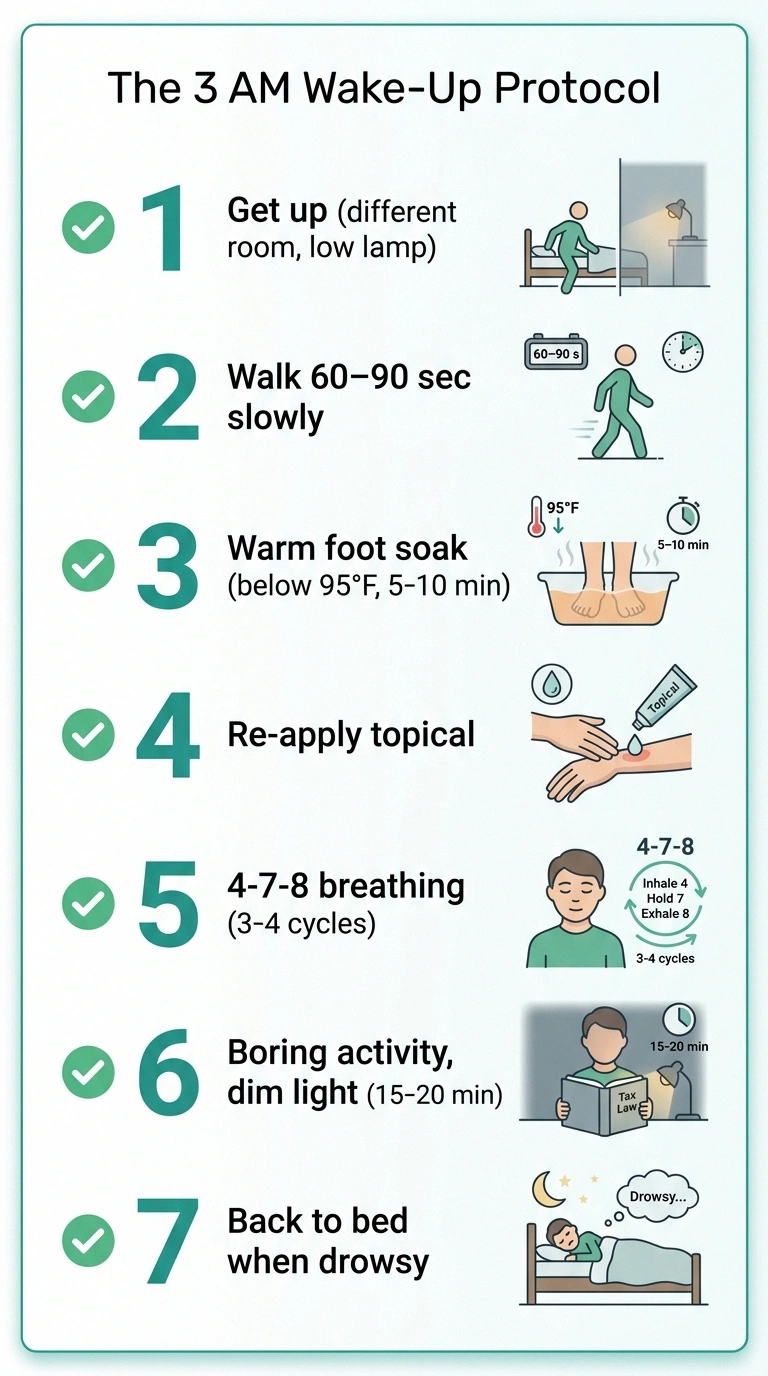
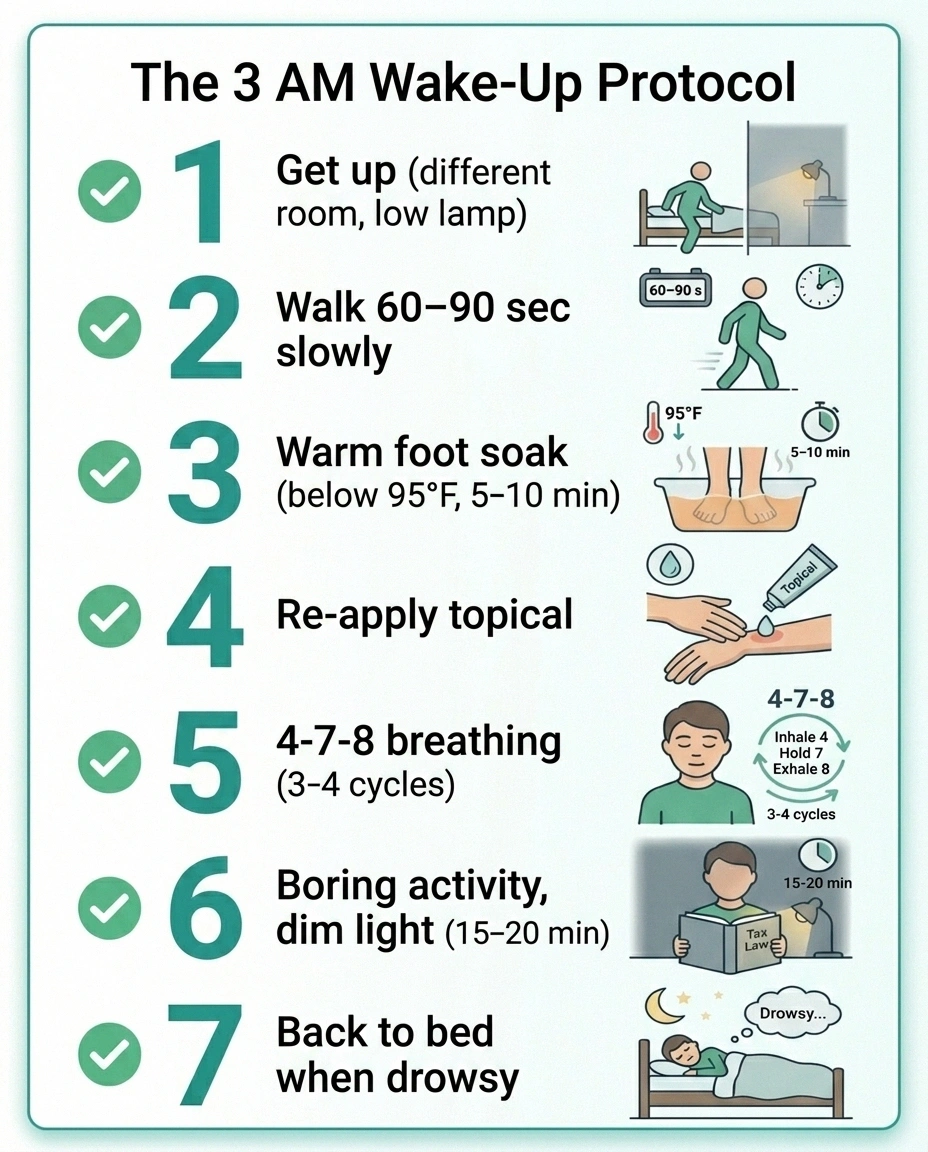
1. Get up. Move to a different room. Couch, recliner, kitchen chair. Use a single low lamp — not overhead lights, which tell your brain it’s morning.
2. Walk for 60 to 90 seconds if it’s safe. Slow, careful circles around the living room. Gentle movement restores circulation, breaks the static-position discomfort, and often takes the edge off.
3. Warm foot soak for 5 to 10 minutes. Basin of water below 95°F. Test with your elbow first.
4. Re-apply topical. Lidocaine cream to the worst spot.
5. Breathing reset. 4-7-8 breathing for three or four cycles. Drop the pain-amplifying stress response.
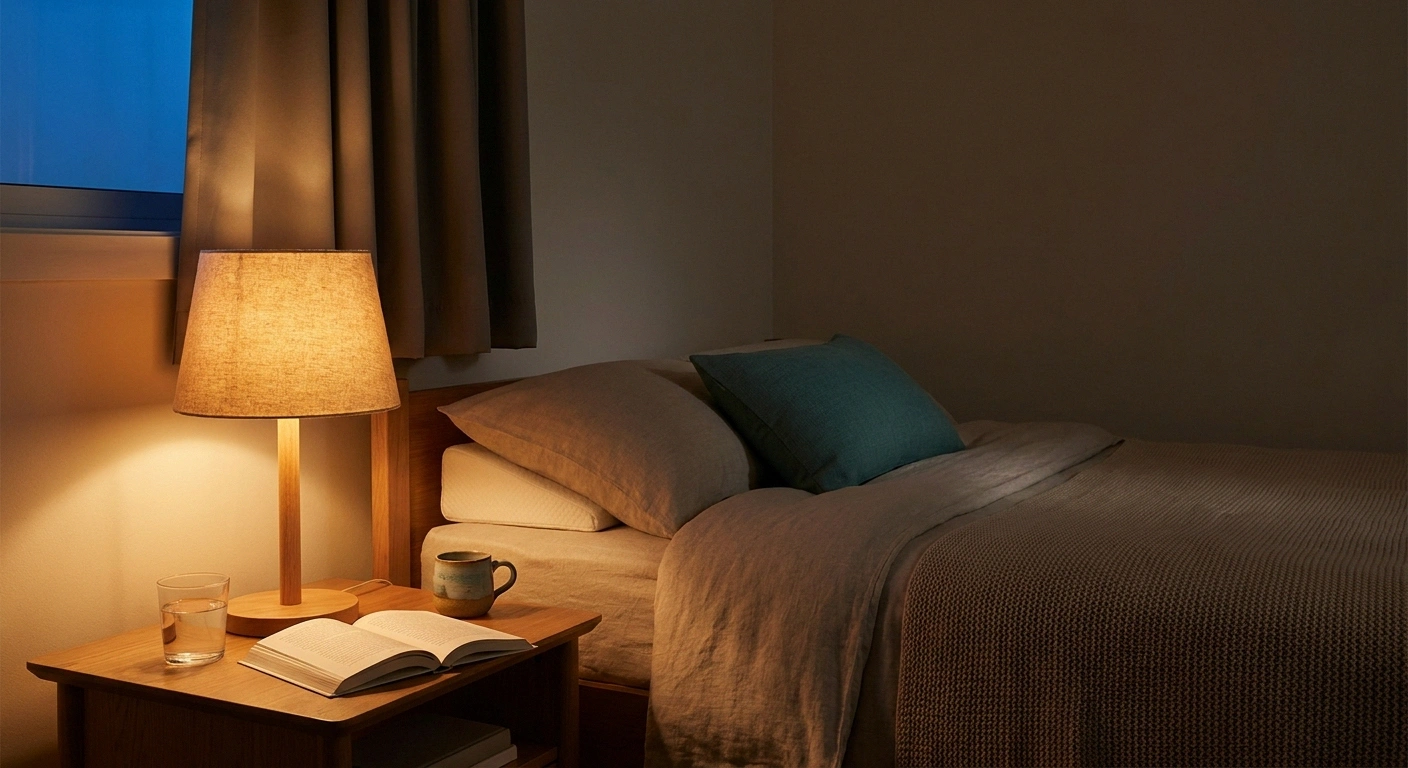
6. Boring activity for 15 to 20 minutes. A paper book in dim light. Not your phone. Not the TV. Not anything stimulating. The goal is sleepy-bored, not alert.
7. Back to bed when you feel drowsy — not before. If you’re not drowsy in 30 minutes, repeat steps 5 and 6.
The principle behind this is simple: bed is for sleeping. If you can’t sleep, you leave the bed for a bit. This is the same principle pain clinics use in formal Cognitive Behavioral Therapy for Insomnia (CBT-I) programs. It works because it stops your brain from re-learning that the bed is the place where suffering happens.
If sleep continues to be a struggle even with these tools, it’s worth talking to your doctor about whether short-term sleep aids — including melatonin, which has some specific evidence for nerve pain (see our melatonin and nerve pain piece) — are appropriate for you.
Pick One Thing Tonight
Reading a long list of tips and trying to do all of them at once is overwhelming, and overwhelm is its own form of sleep theft. Pick one. If your feet can’t stand the weight of the covers, order a bed cradle today and start there. If you’re a stomach sleeper, work on switching to your back with a knee bolster. If you’re heating-pad-ing yourself to sleep, swap to a pre-warmed bed with the device turned off before you climb in. If you’ve been white-knuckling 3 AM wake-ups, try the protocol the next time it happens.
One change. This week. See what shifts. Add the next thing once the first is a habit.
The night clock doesn’t have to own you. Most of us with neuropathy learn this the slow way, by stacking small tools one at a time until the bed is something we can return to without dread. You can get there too.
Frequently Asked Questions
What is the best sleeping position for neuropathy in the feet?
For most people, back-sleeping with a pillow under the knees and a second small pillow under the calves (so the heels float free of the mattress) is the best starting position. It keeps the lower back neutral, takes pressure off the heels, and gently elevates the feet to help with fluid drainage. Side-sleeping on your less-affected side with a pillow between your knees is a good second option. Stomach sleeping forces the feet into a position that often triggers burning and should generally be avoided.
Should I wear socks to bed if I have neuropathy?
Soft, seamless, moisture-wicking socks with a loose elastic top are fine and helpful if your feet are cold. Avoid compression socks at night unless your doctor specifically prescribed nighttime use. Skip heated socks, electric blankets, and heating pads overnight entirely — reduced sensation means you can’t feel when skin is burning, and serious injuries have been documented from heat-therapy devices used overnight by people with neuropathy.
Is it safe to use a heating pad for neuropathy at night?
No. Never use a heating pad or electric blanket overnight if you have neuropathy. Reduced sensation means you cannot feel when your skin is burning, and documented cases include second-degree burns, infections, and even amputations in people with diabetic neuropathy. Safe use is to pre-warm the bed and then turn off and remove the device before getting in, or to use a timer that shuts off within 15 minutes.
Does elevating my legs help neuropathy at night?
Yes, for many people. Gentle elevation — about 4 to 6 inches above heart level, achieved with a pillow under the calves rather than under the heels — helps drain fluid that pooled in the lower legs during the day and reduces overnight swelling that can compress nerves. Keep the heels floating free of the pillow so you don’t trade nerve relief for heel pain. Use a small wedge or just stacked pillows.
What temperature should my bedroom be for nerve pain?
For most people with burning or hypersensitive neuropathy, a cool bedroom around 65 to 68°F works best. Cooler ambient temperature reduces the skin warming that can trigger burning flares. If cold makes your symptoms worse instead of better, bump the room to 68 to 72°F and pre-warm the bed instead. There’s no universal direction — heat-sensitive and cold-sensitive neuropathy patients need different setups.
What can I do when I wake up at 3 AM in pain?
Don’t lie in the dark fighting it — that wires your brain to associate the bed with suffering. Get up, move to a different room with low lighting, walk slowly for a minute, do a warm (below 95°F) foot soak for 5 to 10 minutes, re-apply a topical pain reliever, do a few cycles of 4-7-8 breathing, and read something boring in dim light for 15 to 20 minutes. Return to bed when you feel drowsy. This is the same principle CBT-I uses for chronic insomnia, and it works.
Does a warm bath before bed help neuropathy?
For some people, yes. For heat-sensitive neuropathy patients, it can make symptoms worse. If you try it, keep water below 95°F per Cleveland Clinic guidance — hot water plus reduced sensation equals burn risk. Test with your elbow, wrist, or a thermometer, never your feet. A warm soak about 30 minutes before bed can also be paired with calf stretches and breathing exercises for a fuller wind-down.
What is a bed cradle and do I need one?
A bed cradle (or blanket lifter) is a small frame that sits at the foot of your mattress under the covers, lifting the sheets and blankets a few inches off your feet so nothing touches them. They cost about 20 to 30 dollars on Amazon. If the weight of a sheet on your feet causes allodynia (where light touch triggers pain), a bed cradle is often the single highest-impact, lowest-friction purchase you can make for sleeping with neuropathy. Many readers find it helps more than expected.
About the Author