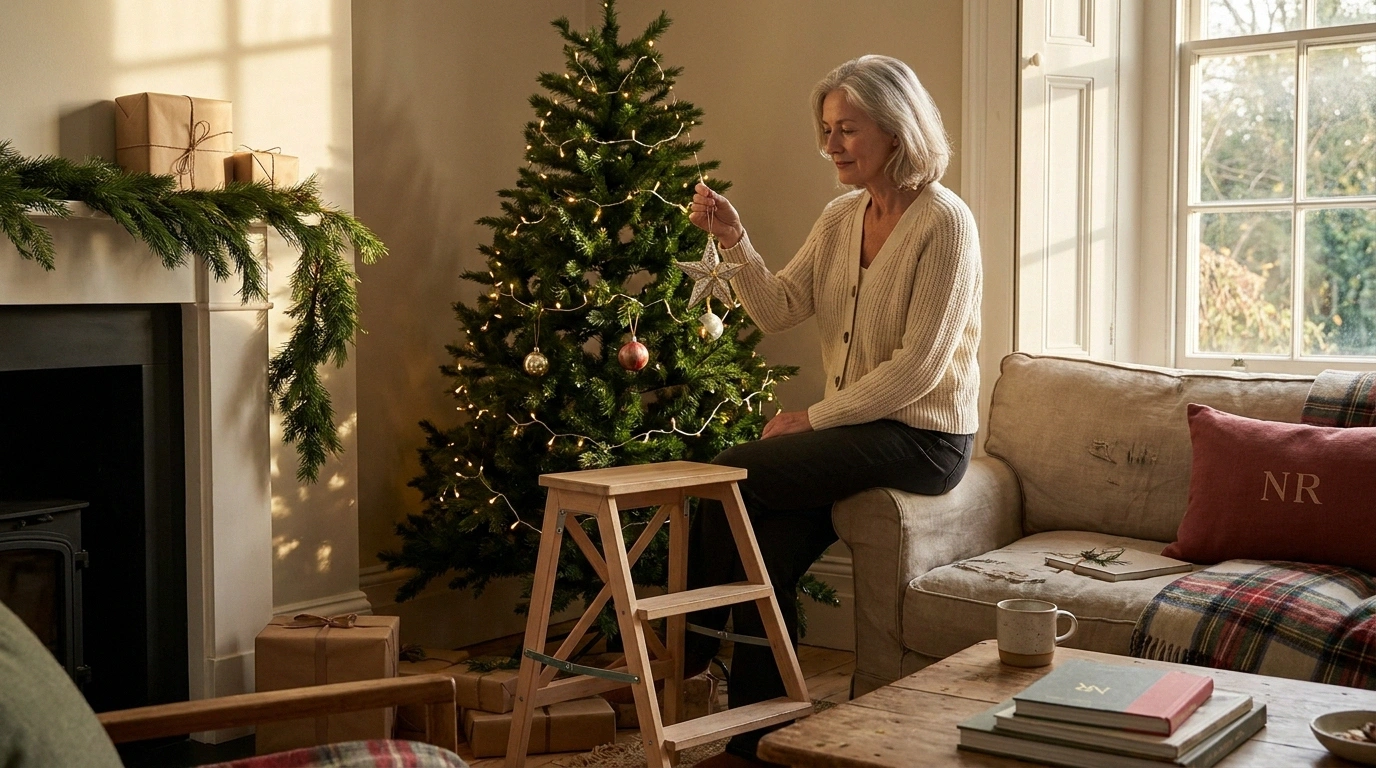
The year I almost fell was the year I nearly took the star with me. My husband was at the hardware store, the tree stood in the corner without its topper, and I told myself I was just going to grab the folding stepstool, put the star up, and be done. It was one small thing.
I got up on the second tread with the star in one hand and my other steadying the tree, and my left foot decided it had no idea where the stepstool was. Not a stumble. A total blank. I caught the tree, the tree caught me, and I sat down on the arm of the couch harder than I meant to. Nothing broke. But I sat there realizing that “just this one thing” is exactly how people my age with neuropathy end up in an ambulance. I am Janet Ellis. I live with peripheral neuropathy, I am not a doctor, and what follows is the map I wish I had that afternoon.
The Two Real Risks I Want You Thinking About
Every hazard in this guide comes back to two facts. The first is that holiday decorating is a top cause of home falls every December — ladders, stepstools, reaching for the wreath, a foot caught on a cord. With balance already compromised by neuropathy, a fall from three feet up is not a bruise. It is a hip fracture or a head injury. Our guide to neuropathy, balance, and falls covers the sensation-and-balance piece; the ER sees a documented spike in senior falls between Thanksgiving and New Year’s.
Holiday decorating with neuropathy is a stack of two separate risks — falls from ladders and stools when balance is already compromised, and burns or cuts that numb hands and cold-numb fingers cannot feel as they happen. Managing both means the right tools and planning when you decorate, and the honest willingness to hire it out or scale back when the risk stack is too high.
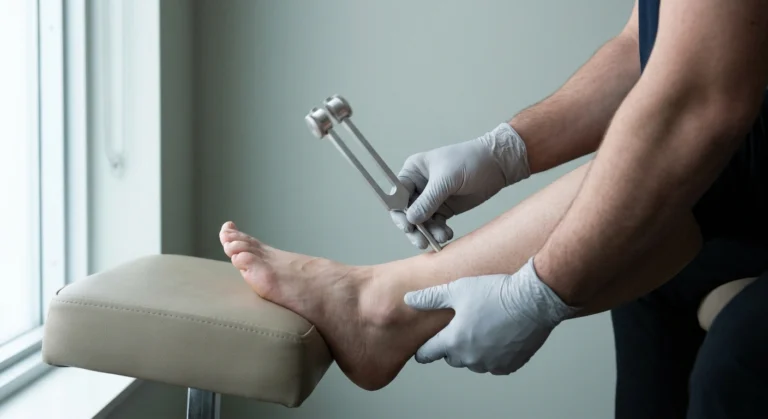
The second is the injury you do not feel while you are doing it. Numb hands do not warn you about a hot bulb, a scissor blade that slipped, or a staple gun that closed on a fingertip. Cold-numb fingers do not warn you they are heading toward frostbite while you finish the outdoor lights. The dangerous thing about neuropathy in December is not the pain — it is the absence of pain when a normal person would already be reacting.
Before You Start: A Two-Coffee Planning Session
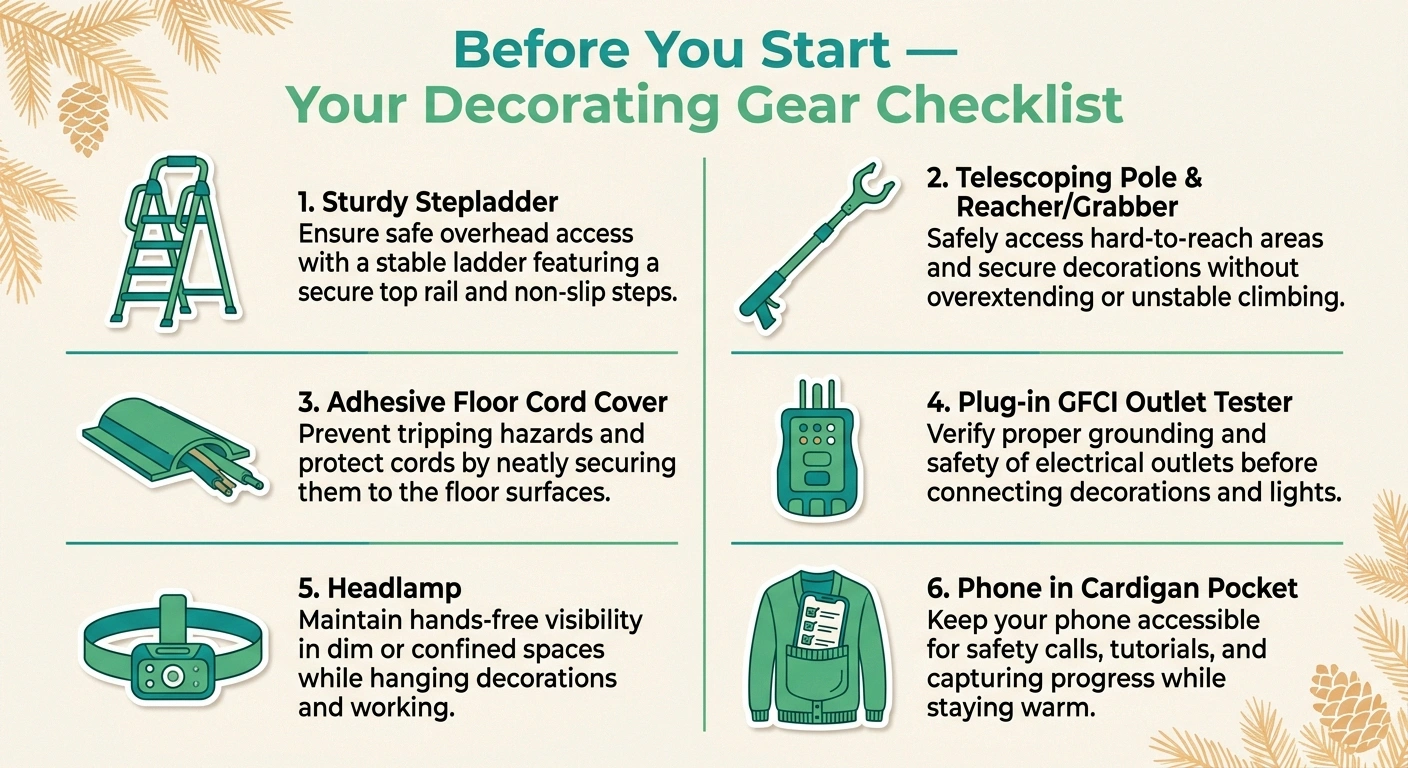
Every year on the first weekend of December, I sit at the kitchen table with a second cup of coffee and a legal pad and plan the whole thing on paper before I open a bin. Forty-five minutes. Best decorating decision I make all season.
Walk through every room you plan to touch and sort every decoration into three columns: stays the same, gets simplified, gets skipped or hired out. If the twelve-foot banister garland needed a stepladder and both knees complaining last time, it moves to “simplified” — a shorter version, or draped along the mantel. Not a moral failure. A risk audit.
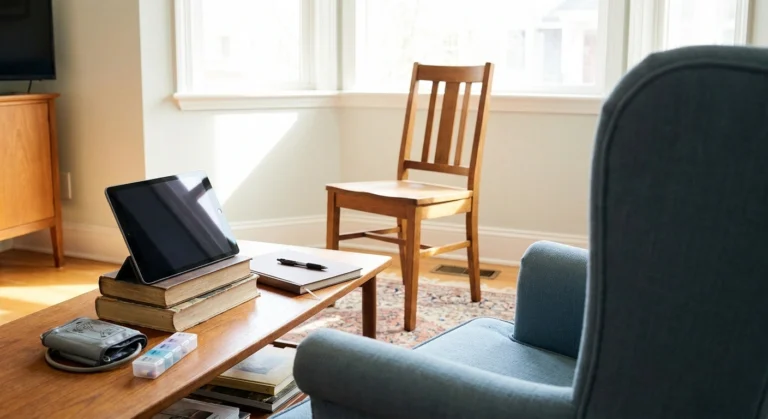
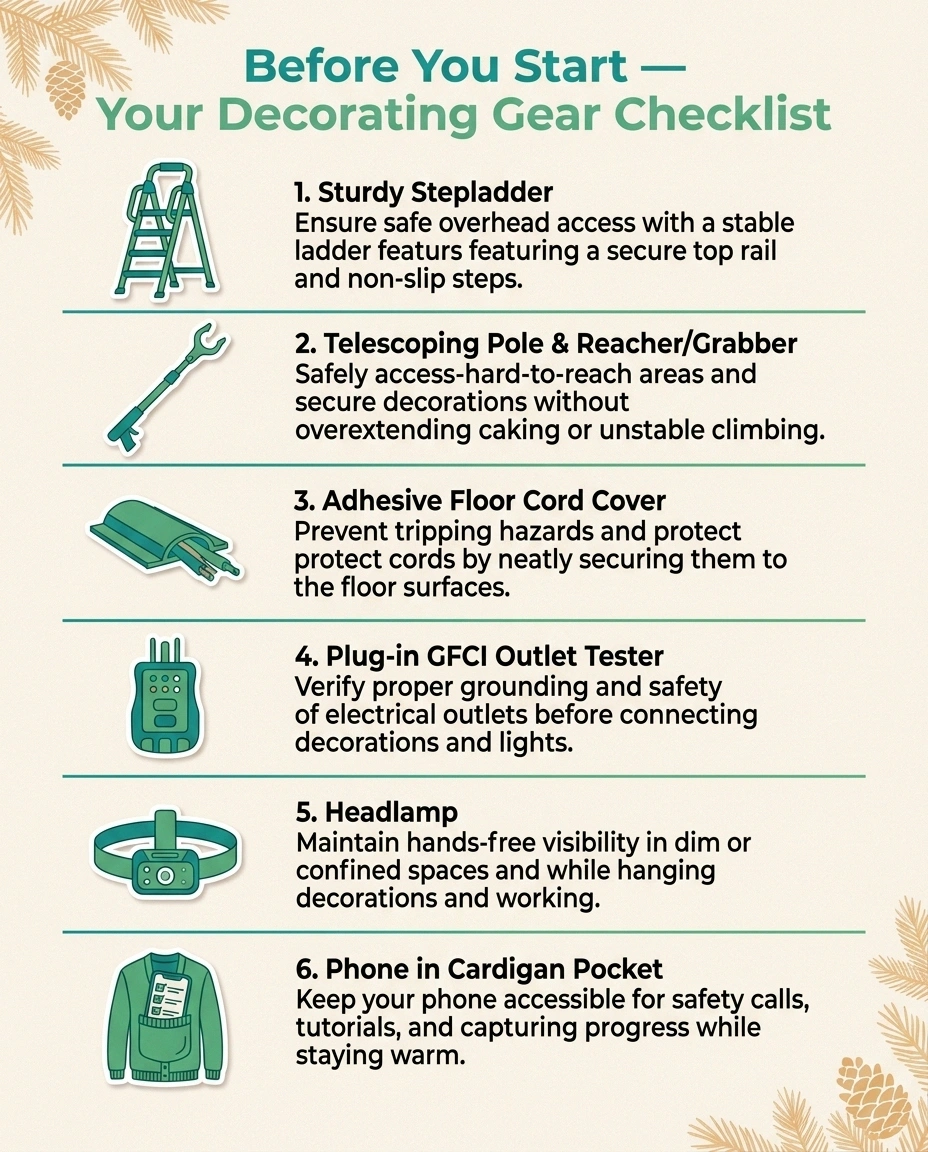
Then declutter the walkways — every path a cord will cross, every lane you will walk with your arms full. Lay out the gear before you start:
- A stepladder with a top rail and side handrail — not a flat platform stool
- An extension reacher and a telescoping pole with a hook — the two tools that eliminate half of your ladder trips
- Adhesive cord covers for anywhere a cord crosses a walkway
- A plug-in GFCI outlet tester — five dollars, tells you in three seconds whether your outdoor outlet has the ground-fault protection it needs
- A headlamp — because outdoor decorating always runs into dusk
- Your cell phone in your pocket, charged — even indoors, every time. In your pocket, not on the counter.
Ladders and Step Stools: The Big Conversation
Ladders put more older adults in the emergency room in December than anything else here, and neuropathy stacks the deck. Reduced foot sensation means you cannot always feel the rung. Balance compensations that work on flat carpet do not work six feet up. The catch-yourself reflex assumes the hand can grip — with hand neuropathy, sometimes it cannot.
Your Options for Reaching High Places
| Option | Practical Reach | Risk Level | Typical Cost |
|---|---|---|---|
| Extension reacher | Up to 8-9 ft | Lowest — both feet on floor | $15-30 |
| Telescoping pole with hook | 10-16 ft | Lowest — both feet on floor | $30-70 |
| Step stool (2-tread, no rail) | +1-2 ft over standing | High — no handhold for a numb-hand recovery | $20-40 |
| Stepladder with top rail + side handrail | +3-4 ft over standing | Moderate — never solo, never above 3rd step | $70-150 |
| Hire it out (service or grandkid) | Any height, incl. roofline | Zero — your feet stay on the ground | $20-500 |
The CDC reports that older adults are treated in emergency departments for falls roughly every 11 seconds, with about 3 million ER visits per year from senior falls. For adults 65 and older who fall from a ladder, one-third sustain head injuries, and age strongly correlates with hospitalization severity.
Muscle weakness and balance problems are the leading contributing factor in about 40% of senior fall cases — the same physiology neuropathy makes worse.
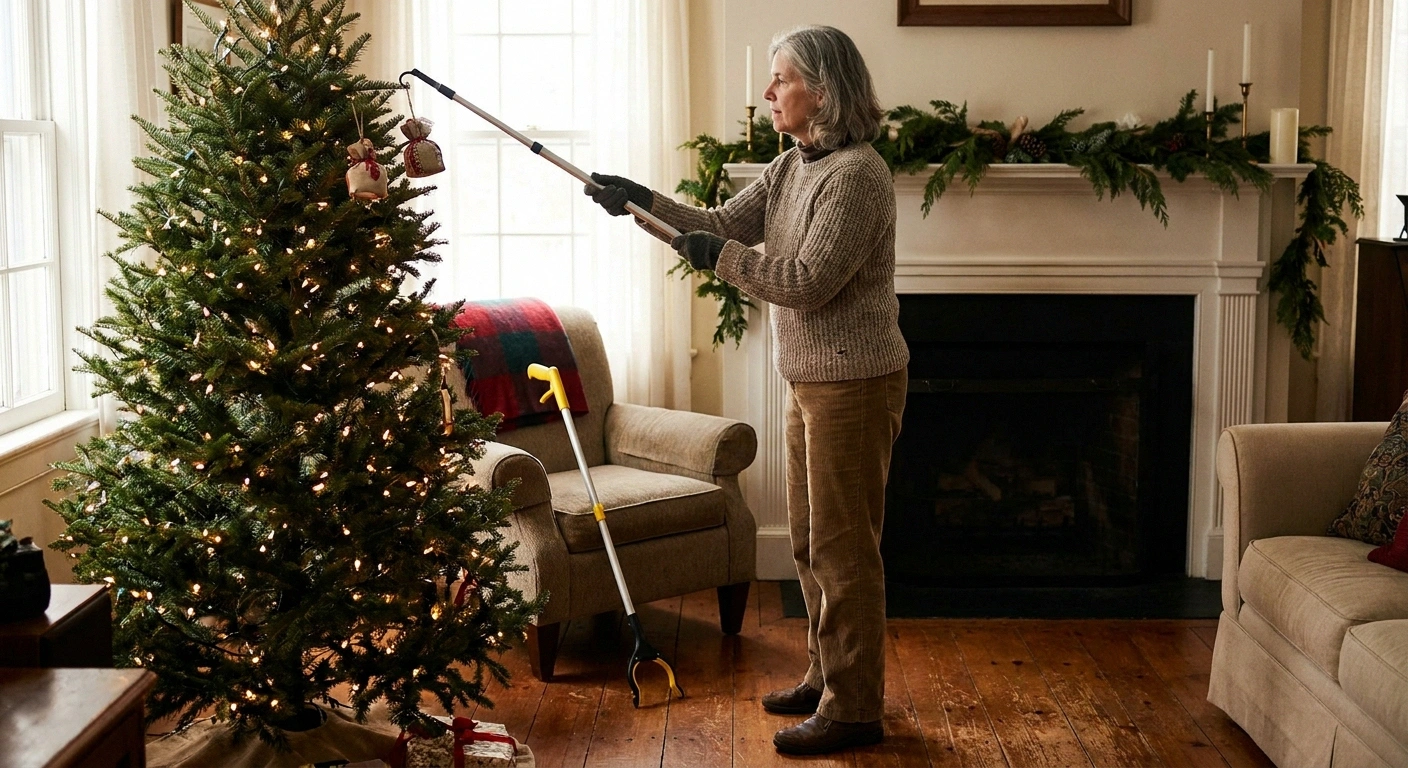
Start every ladder decision with the same question: is there a way to do this without a ladder? A telescoping pole with a hook hangs wreaths, removes high ornaments, and adjusts front-bush lights without either foot leaving the floor. An extension reacher handles anything within eight or nine feet. Between the two, I have not been on a ladder for indoor decorating in three years.
When the ladder is unavoidable, three rules. Real stepladder with a top rail and side handrail. Never solo. Never higher than the third step from the top. Above that, it is a “hire the kid or grandkid” job — a neighbor’s grandson for twenty dollars and a plate of cookies, or a seasonal light-hanging service at $250 to $500 for a normal roofline. Real money. Cheaper than a hip replacement, and does not cost you Christmas.
Light Strings, Cords, and the Fires Nobody Talks About
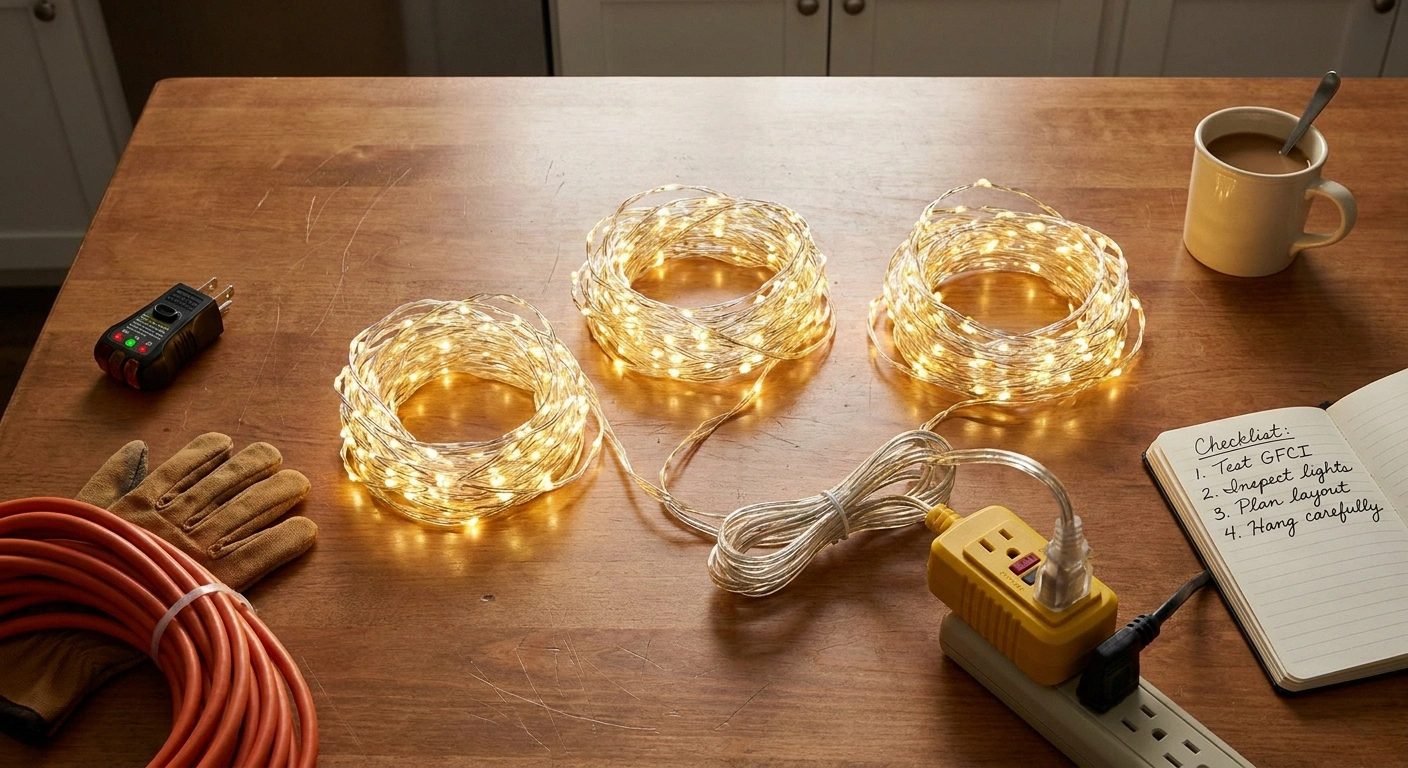
The National Fire Protection Association tracks about 860 home fires a year from holiday decorations, 210 more from the tree itself, plus 3,300 that start with extension cords. Almost every one is preventable. Here is the list I run before I plug anything in.
U.S. home fires each year start with extension cords. Another 860 home fires annually are caused by holiday decorations — plus another 210 from the Christmas tree itself.
The three biggest fixes: LED (not incandescent) strings, no more than 3 sets daisy-chained per cord, and GFCI protection on every outdoor outlet.
- Use LED strings, not incandescent. LEDs stay cool to the touch and use a fraction of the power — the biggest single fire-risk reduction available. A numb hand against a lit LED is not a burn waiting to happen.
- Inspect every strand before it goes up. Lay it out, plug it in, look. Frayed insulation, bare copper, cracked sockets, browned plastic — any one retires the strand. Do not tape it. Throw it away.
- Never daisy-chain more strings than the box allows. Most manufacturers cap this at three sets on a single extension. More overheats the wire. Run a second extension from a different outlet.
- Outdoor outlets need GFCI protection. A ground-fault interrupter shuts the outlet off in milliseconds if it detects a leak — what saves you when a cord gets wet. No GFCI outlet? A portable GFCI adapter is about fifteen dollars.
- Match the cord to the job. Outdoor-rated cords for outdoor use. Never run any cord under a rug — rugs trap heat and cords under rugs are a top cause of house fires. Use adhesive cord covers for walkways.
The Christmas Tree Logistics
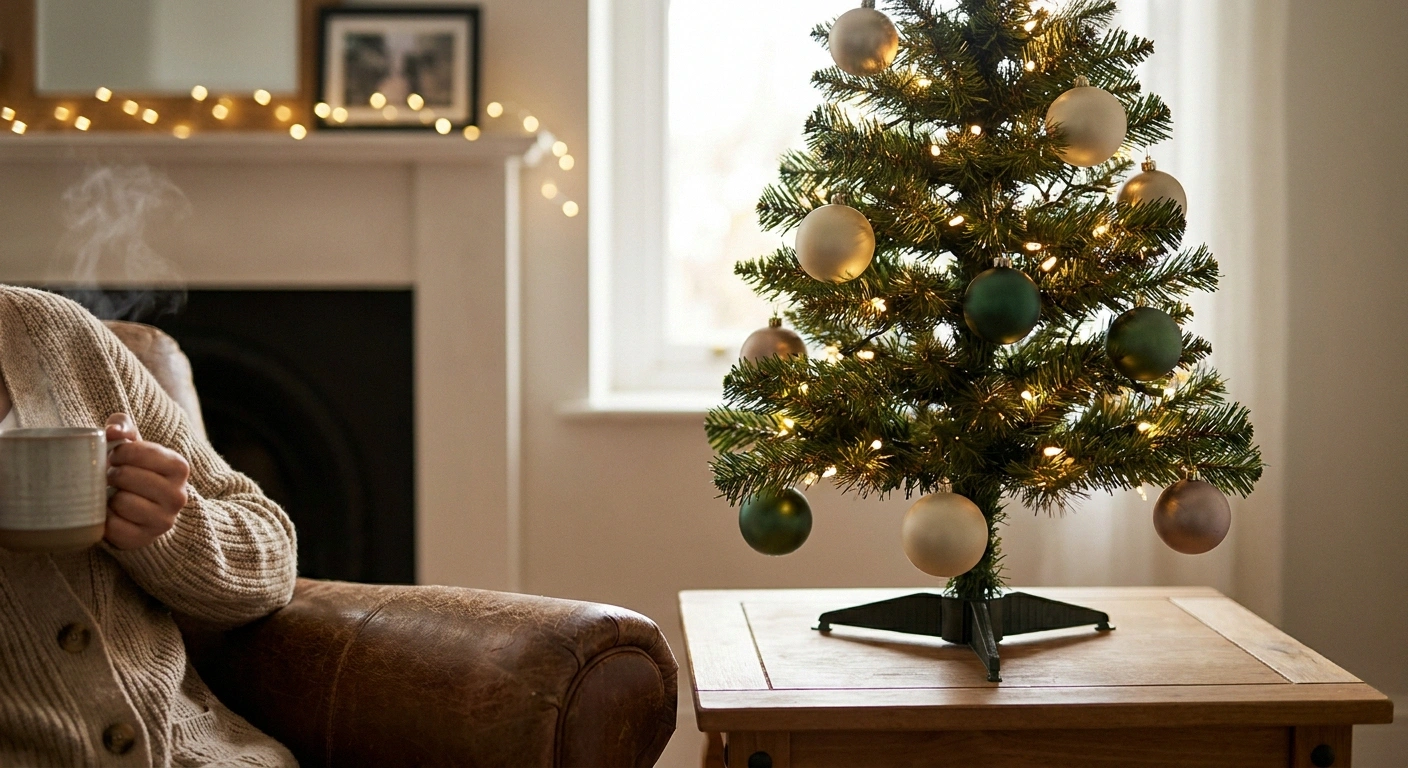
Real or artificial for someone with neuropathy? It depends on what breaks first. Real trees smell like Christmas but mean lifting a heavy trunk, watering with a full pitcher, and needles on a floor my numb feet will not feel. Artificial trees are lighter as sections and the needles are plastic. Neither is wrong.
Whatever tree you use, three rules. Let someone else carry it. Up the stairs from storage or in the door from the truck, it is a team lift — the bulky-load-plus-compromised-grip moment is where a lot of December injuries happen. Make the stand rock-solid. Wide base, screws snug, and for a real tree strap it to a wall stud with fishing line and an eye hook. Skip glass ornaments, or hang them at the top only. Glass on a floor you cannot fully feel is stitches in an ER waiting room.
If any of that felt like a lot, this is the year to think about a tabletop tree. A three-foot pre-lit artificial tree on a sturdy end table, decorated at seated eye level with your favorite ornaments, is a real Christmas tree. It is not a compromise. It lets you decorate every branch yourself, from a chair, and it looks beautiful in a window.
Sharp Things and Numb Hands (Scissors, Staple Guns, Utility Knives)
About 160 decorating-related hand injuries happen every day in December, and neuropathy in the hands changes the odds. Numb hands do not feel the moment the tool slipped, and a cut you do not notice until morning had all night to get infected.
Before I Climb — The 5-Step Check
How I handle sharp tools now: ratchet scissors (the arthritis kind) reduce grip demand and are less likely to slip. Grip guards give a numb thumb something to catch on. Leather work gloves for anything with wire — light strings, wired garland, floral picks. And never a staple gun with bare hands. Put the tool down between staples so you are not walking around with a loaded gun in your grip.
Two more habits. Keep first aid supplies in the same room — bandages, antiseptic wipes, antibiotic ointment. And after every session, look at your hands under good light. Every finger, both sides. If you find a cut you did not feel, clean it now.
The Heavy Bins From the Attic or Basement
Bins are their own hazard. A tote full of ornaments is heavier than it looks, and stairs are the second most common place people get hurt this month. Team-lift, always. Use a hand truck or small rolling cart. Small trips, not one push. And on stairs, one hand always on the rail — no armloads on stairs, ever. Two small trips beats one bad fall.
Outdoor Decorations and Cold-Numb Extremities
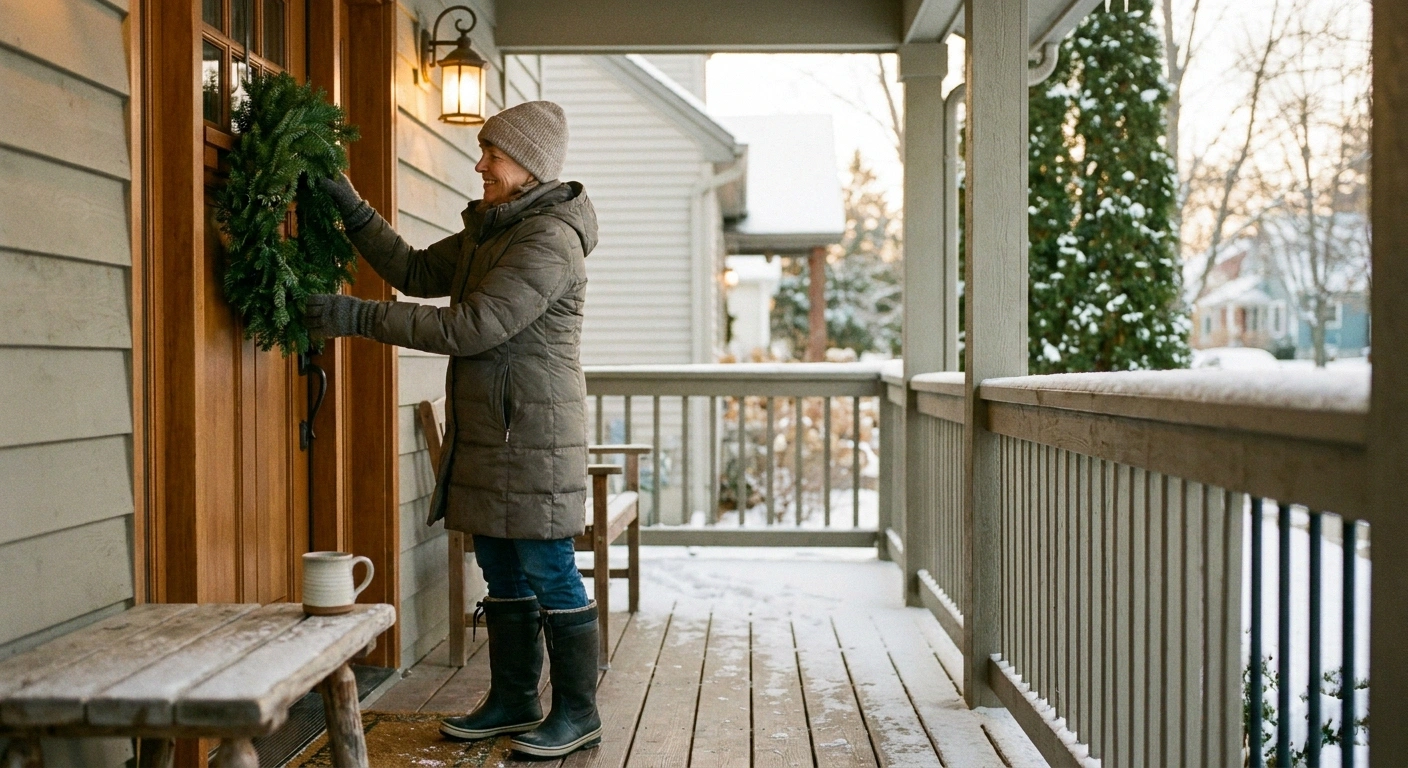
Outdoor decorating with neuropathy has the same cold-weather physics as shoveling. If it is cold enough that a normal person would feel their fingers ache, your fingers hit that point without warning — frostbite can start before you notice. The right shoe pairing matters — waterproof insulated boots, deep-lug soles, wool socks (never cotton). For anyone with diabetes, our guide to diabetic neuropathy covers the wound-and-circulation piece; a light compression sock base layer under wool helps some cold feet.
Set a timer for fifteen minutes. When it goes off, come inside, warm up, and look at your fingers and toes. Do the after-outdoor foot check the way you would after a snow walk. And the last word on roofs: if your balance is compromised, roof decorating is not a project you take on personally. Ever. Hire it out or skip it.
STOP Signals to Take Seriously
Some warning signs mean you are done for the day, and neuropathy dulls the cues that would send an ordinary person inside on time. If any of these show up, stop. Not “finish this one thing.” Stop. Sit. Warm up. Hydrate. If it does not clear, call for help.
If any of these appear while decorating, put the tools down and go inside. Sit. Warm up. Hydrate. If it does not clear quickly, call for help.
- Dizziness or lightheadedness while on a ladder or stool — come down before it becomes a fall
- Balance loss or leg weakness that was not there an hour ago
- Chest pressure, tightness, or shortness of breath — including pain in jaw, arm, or upper back
- Fingers or toes turning white, waxy, or gray — frostbite is progressing
- A hand tremor you cannot control or a grip that keeps failing
- Cold sweat, nausea, or a sudden pain flare beyond your baseline
- Dizziness or lightheadedness while on a ladder or stool — come down before it becomes a fall
- Loss of balance or leg weakness that was not there an hour ago
- Chest pressure, tightness, or shortness of breath — including pain in jaw, arm, or upper back
- Fingers or toes turning white, waxy, or gray — frostbite is progressing
- A hand tremor you cannot control or a grip that keeps failing
- Cold sweat, nausea, or a sudden pain flare beyond baseline
When to Scale Back Without Guilt
If you are dealing with real weakness, cardiac history, severe balance issues, an active foot ulcer, or a fall in the last twelve months, this is the year to scale back, and it is not a failure. Scaling back looks like: enlist the family for the physical part while you direct the look; hire a light-hanging service for the outdoors; or shift to an “accessible-only” plan — a tabletop tree, an eye-level wreath instead of the roofline, a mantel garland instead of the banister, indoor candles instead of outdoor lights. The house still looks beautiful.
The emotional weight of scaling back is real, and I will not pretend it is not. But the point of the season was never the tallest tree. The point is the people who come to see it, the coffee you drink together, and the fact that you are still here to hand somebody a plate of cookies. Everything else is decoration.
Frequently Asked Questions
Should I still put lights up outside if my balance is off?
Not the roofline. Ground-level and low-shrub lights hung with a telescoping pole while both feet stay on the ground are fine. Anything above a two-tread step, hire out or skip. A seasonal light-hanging service runs $250 to $500 — meaningfully less than a roof fall costs.
Are LED lights actually safer for neuropathy?
Yes. LEDs stay cool to the touch, which matters when numb hands cannot feel a hot incandescent bulb against skin. They also use a fraction of the power, which dramatically reduces fire risk from overloaded cords or old-strand shorts.
How can I decorate if I cannot do ladders?
Two tools do most of the work: an extension reacher for anything within eight or nine feet, and a telescoping pole with a hook for wreaths, ornaments, and light adjustments higher up. Between them, most indoor and low outdoor work happens with both feet flat on the floor. Anything higher, hire it out or shift to a tabletop tree and eye-level wreath.
What tools help when my hands are numb?
Ratchet scissors reduce grip demand and are less likely to slip. Grip guards give a numb thumb something to catch on. Leather work gloves protect against wire, pine needles, and staple guns. A bright headlamp lets you see what your hands are doing when overhead work puts your face in shadow. And check your hands under good light after every session.
When should I ask for help instead of doing it myself?
Any lift you cannot do without holding your breath. Any ladder above the third step. Anything on a roof. Any project on a day when balance is off. And any project you are only attempting because you feel guilty asking. The people in your life would rather come help than visit you in the hospital.
Are heated gloves safe to wear while decorating outside?
Yes, with one caution. Because you cannot fully feel heat, set heated gloves on low or medium, never high, and check your hands every fifteen minutes. The point is to keep circulation up, not to warm the skin so much that a low-grade burn develops without you noticing. Same rule for heated socks and insoles.
About the Author