The question arrives in some version of this form, over and over: I’ve been on Plaquenil for three years for lupus, my feet have started burning at night, and I looked up the side effects. Is the drug doing this to me?
It’s a fair question and it deserves a real answer, which is more complicated than yes or no. Hydroxychloroquine can affect nerve and muscle. That’s documented. But if you’re taking hydroxychloroquine, you have an autoimmune disease, and autoimmune diseases cause neuropathy at rates far higher than this particular drug does.
So the honest answer starts by putting the drug where it belongs in the lineup — which is near the bottom, not the top.
Start With the Odds, Not the Search Term
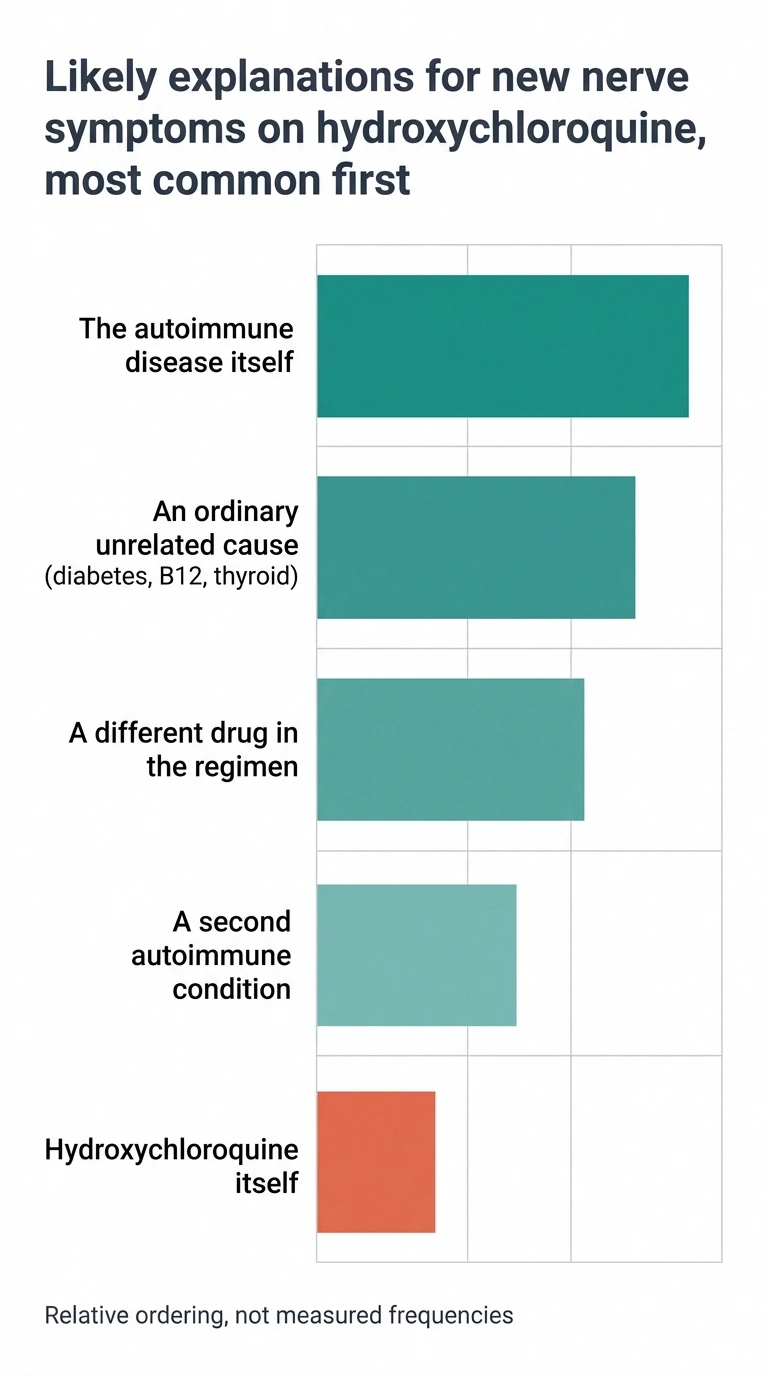
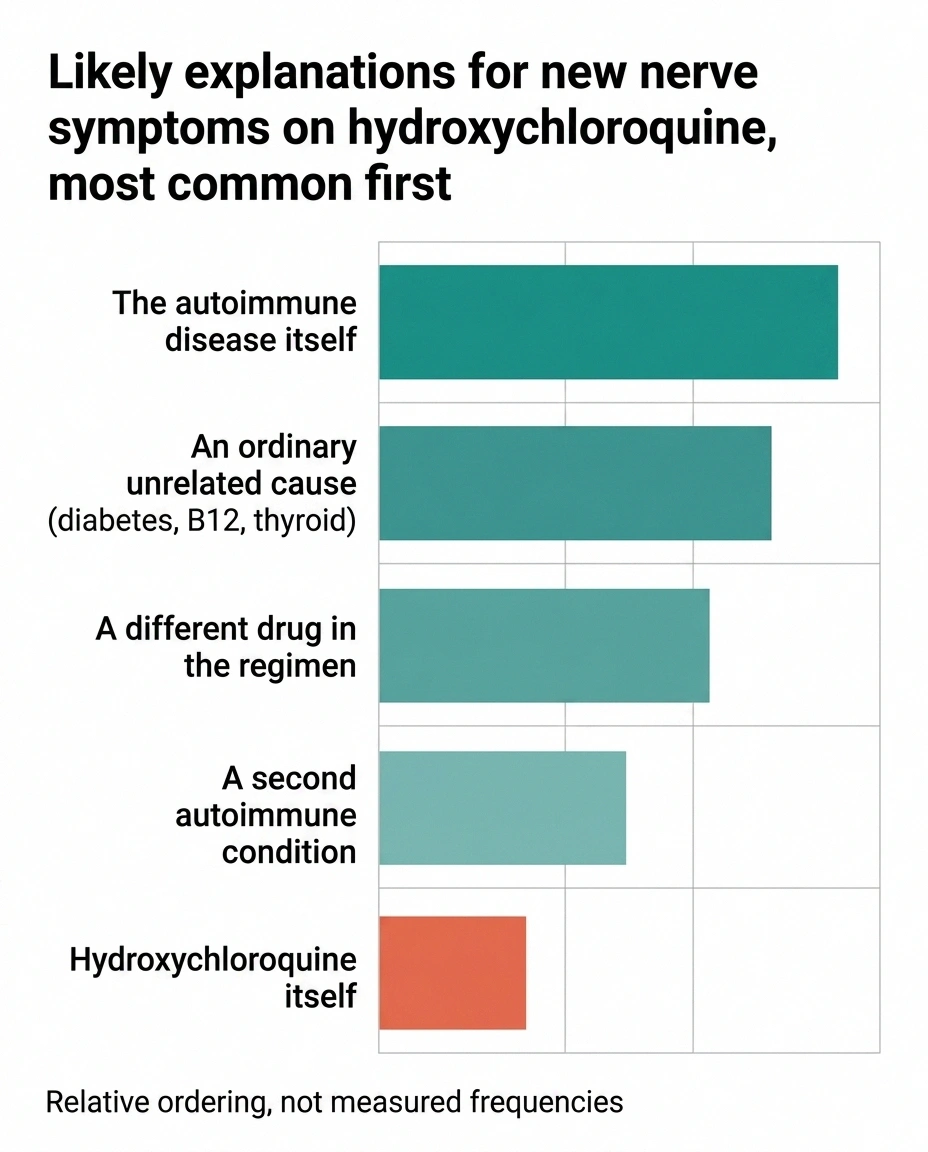
When you search a drug name plus a symptom, you get pages built around that pairing. The pairing exists, so the pages exist, and the impression you’re left with is that the drug is the likely culprit. Search engines have no way to tell you that four other explanations are more probable.
Search results are organised around the pairing you typed, not around how often each cause turns out to be the answer. This is the order a clinician works through.
Here’s the lineup for burning, tingling or numb feet in someone taking hydroxychloroquine, roughly ordered by how often each one turns out to be the answer.
First, the disease being treated. This is the big one. Lupus damages nerves through several mechanisms, and neuropathy shows up in a meaningful share of patients over time. Sjögren’s syndrome is even more strongly linked, and small fiber neuropathy in particular is common enough there that burning feet is sometimes the symptom that leads to the diagnosis rather than following it. Rheumatoid arthritis produces both entrapment neuropathies and, in longstanding disease, a vasculitic form. The reading on lupus and neuropathy, Sjögren’s and neuropathy, and rheumatoid arthritis and neuropathy covers each pattern in detail.
Second, an ordinary cause that has nothing to do with any of this. Diabetes. B12 deficiency. Thyroid disease. Alcohol. These are the most common causes of neuropathy in the general population and having an autoimmune condition doesn’t exempt anyone from them. Autoimmune patients are, if anything, at elevated risk of B12 deficiency, partly through the company autoimmune conditions keep and partly through years of acid-suppressing medication.
Third, a different drug in the regimen. Almost nobody takes hydroxychloroquine alone. Methotrexate, leflunomide, TNF inhibitors, colchicine, long-term steroids and the statin that got added for cardiovascular risk are all in the mix, and several have clearer neuropathy associations than hydroxychloroquine does. The medications that cause neuropathy list is the place to check the whole bottle lineup rather than one drug.
Fourth, a second autoimmune condition. These travel in packs. Someone with lupus has a meaningfully elevated chance of also having Sjögren’s or thyroid disease, and either can bring nerve involvement with it.
Fifth, and last, hydroxychloroquine itself. It’s real. It’s also uncommon enough that the medical literature on it is largely case reports and small series rather than population studies, which tells you something about frequency all by itself.
What the Drug Can Actually Do
The effect has a name in the literature: neuromyotoxicity. That single word is doing a lot of work, because it covers two different tissues, and the muscle side is by far the more prominent of the two.
Hydroxychloroquine and its older relative chloroquine belong to a class of drugs that interfere with the way cells clear their own waste. They accumulate inside lysosomes, the small compartments where cells break down and recycle material, and they raise the pH inside those compartments enough that the recycling enzymes stop working properly. Debris that should be cleared instead builds up. In muscle fibers and in nerve cells, both of which are long-lived and can’t simply divide their way out of the problem, that accumulation eventually shows.
Under a microscope this leaves a signature. Muscle biopsy in affected patients shows vacuolar change, fiber atrophy, and structures called curvilinear bodies — abnormal whorled deposits that are characteristic enough to make the diagnosis fairly confidently when they turn up.
The clinical picture that goes with it is a slow-onset proximal myopathy: weakness in the muscles closest to the trunk. It can be accompanied by peripheral neuropathy and, less often, effects on heart muscle. In one clinical series, patients presented with limb weakness severe enough that several needed help walking, and a striking number had difficulty swallowing, in some cases badly enough to cause significant weight loss.
Those are the severe end of a spectrum and they aren’t what most people are experiencing. But they’re worth stating plainly, because the pattern they describe is the one that should prompt an urgent call rather than a note for the next appointment.
Weakness or Numbness: The Distinction That Sorts This Out
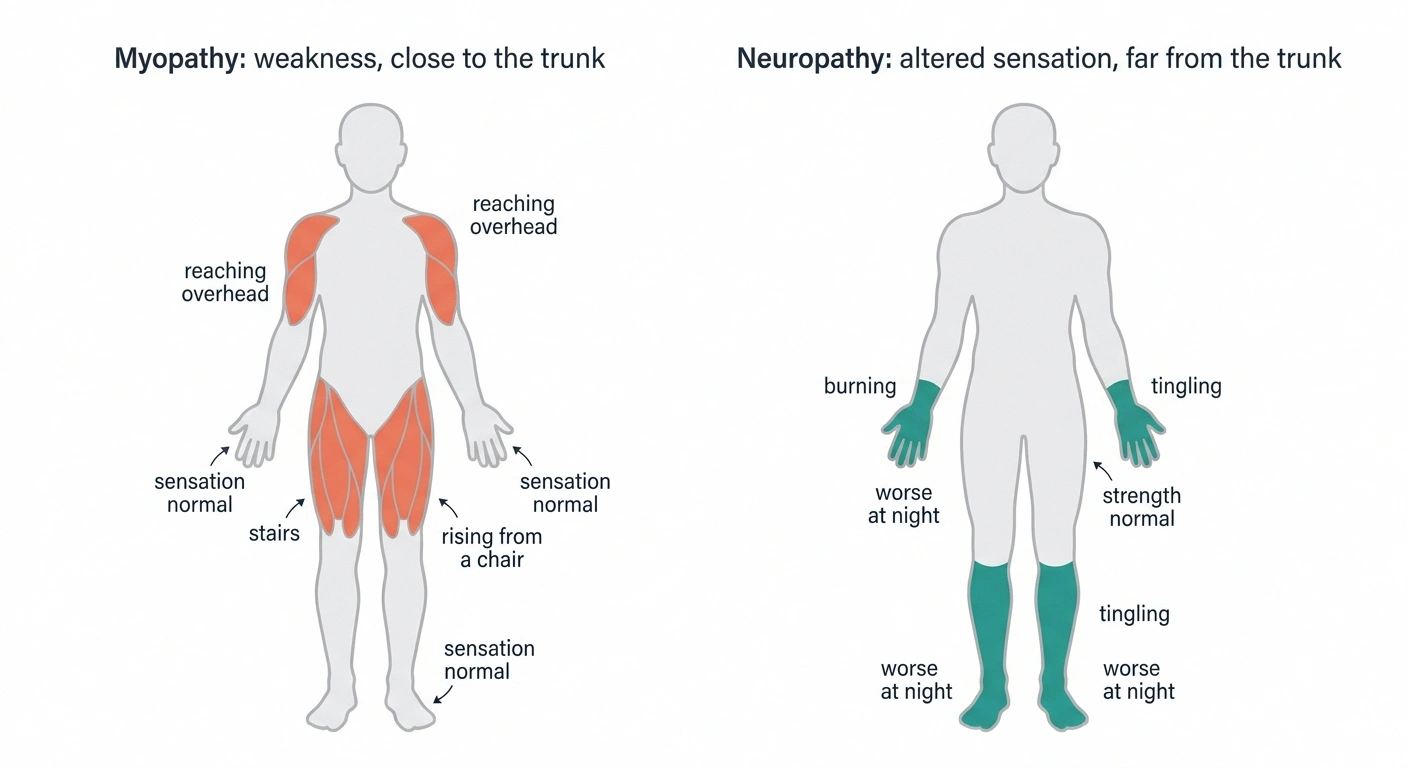
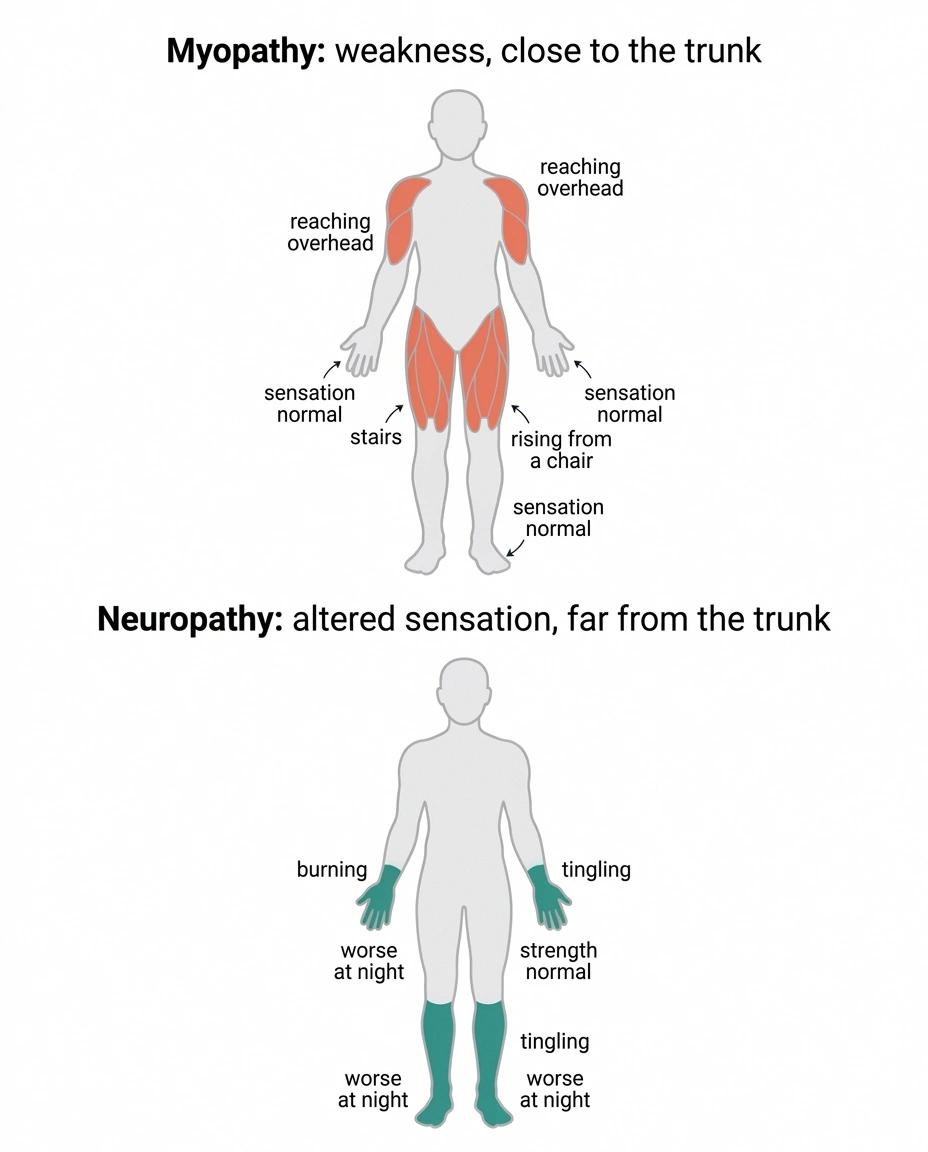
This is the most useful thing in this article, so it gets its own section.
Which column you land in changes which explanation is likely. Landing in both is itself informative and worth saying out loud.
| Myopathy | Neuropathy | |
|---|---|---|
| Main complaint | Weakness | Burning, tingling, numbness |
| Where it starts | Hips, thighs, shoulders | Toes, then feet, then fingers |
| What you notice | Stairs, rising from a chair, washing hair | Symptoms worse at night, socks that are not there |
| Sensation | Normal | Altered |
| Points toward | Drug toxicity is a more plausible contributor | The underlying disease ranks well above the drug |
Myopathy and neuropathy get lumped together by patients constantly, and they produce genuinely different symptoms. Sorting yours into the right bucket changes what the problem probably is.
Myopathy is weakness, and it’s proximal. Muscles near the trunk go first: hips, thighs, shoulders, upper arms. What people notice is functional rather than sensory. Stairs get harder. Getting out of a low chair or a car seat takes a push off the armrest. Reaching up to a high shelf or washing your hair leaves the arms tired fast. Sensation is normal. Nothing tingles, nothing burns.
Neuropathy is sensory first, and it’s distal. It starts at the far ends — toes, then feet, then fingers. Burning, pins and needles, numbness, the feeling of a sock bunched under the foot that isn’t there. Symptoms are typically worse at night. Weakness, when it eventually comes, shows up in the small muscles of the feet and hands rather than the hips.
If your symptom is difficulty rising from a chair with no change in sensation, you’re describing something in the muscle family, and hydroxychloroquine is a more plausible contributor than it would otherwise be. If your symptom is burning feet at night with normal strength climbing stairs, you’re describing a sensory neuropathy, and the underlying autoimmune disease sits well above the drug on the list of suspects. Small fiber involvement in particular, which the small fiber neuropathy guide covers, is strongly associated with several of the diseases hydroxychloroquine treats.
Both at once is possible. That combination is closer to the classic drug-toxicity picture than either alone, and it’s worth naming explicitly when you describe symptoms to your rheumatologist.
Who Is Actually at Higher Risk

Two risk factors show up consistently.
The safety threshold is 5.0 mg per kilogram of actual body weight per day. Because it uses actual weight, weight loss moves the number while the prescription stays put, and nobody recalculates it automatically.
Reduced kidney function raises risk independently of the dose, because the drug clears more slowly and tissue levels climb.
Kidney function. Hydroxychloroquine is cleared partly by the kidneys, so reduced kidney function means the drug hangs around longer and tissue levels climb. Concurrent renal impairment is one of the few consistently identified predisposing factors for neuromyotoxicity, and it’s also a risk factor for the eye toxicity. Lupus, which frequently involves the kidneys, makes this less hypothetical than it sounds.
Dose relative to body weight. Current guidance keeps the daily dose at or below 5.0 mg per kilogram of actual body weight, and generally under 400 mg per day. That threshold was set on eye-toxicity data, but it’s the dosing discipline the whole safety profile rests on. Someone who has lost a substantial amount of weight while staying on the same tablet strength may now be above the threshold without anything having visibly changed.
That last point is worth acting on. If you’ve lost fifteen or twenty pounds since your dose was set, the mg-per-kg figure has moved, and nobody recalculates it automatically. It’s a reasonable thing to raise at your next visit.
Duration matters too, in the general sense that these are cumulative-exposure toxicities rather than things that happen in month two. The eye data illustrates the shape: at 4.0 to 5.0 mg/kg the risk of retinal toxicity stays under 2% through the first decade, then climbs steeply toward 20% after twenty years.
Why Stopping On Your Own Is the Wrong Move
The reflex is understandable. You’ve read that a drug might be hurting your nerves, you have the bottle in your hand, and stopping feels like the obviously safe choice.
It isn’t, and here’s the specific reason: hydroxychloroquine is one of the few drugs in lupus care that reduces flares, reduces organ damage over time, and improves survival. Stopping it doesn’t return you to a neutral baseline. It raises your risk of a disease flare, and a lupus or vasculitis flare is itself a well-established cause of nerve damage — often faster and less reversible than anything the drug does.
The other reason is diagnostic. If you stop the drug and your symptoms improve four months later, you’ve learned very little, because these symptoms fluctuate on their own and autoimmune disease activity fluctuates with them. If you stop the drug and symptoms don’t improve, you’ve given up a valuable medication for nothing. Neither outcome answers the question you were trying to answer.
Bring it to the person who prescribed it. That’s not a deflection, it’s the only route that gets you an actual answer, because sorting this out requires bloodwork and possibly nerve testing that has to be ordered.
What to Bring to the Appointment

Rheumatology visits are short and the agenda fills fast. Walking in with these five things organized turns a vague complaint into something workable.
A symptom description in the right vocabulary. Use the weakness-versus-sensation split from above. Say which one, where it started, and which way it’s spreading. Distal and symmetrical, moving upward, is a different report from proximal weakness with normal feeling.
A timeline against your medication history. When did symptoms start, and what changed near that date? A new drug, a dose change, a flare, an infection, a significant weight change. Temporal association isn’t proof, but it’s the first thing anyone looks for.
Your current weight and your current dose. Let the mg-per-kg calculation get done out loud.
The complete medication list, supplements included. B6 is the one people forget, and taken in high doses over time it causes a sensory neuropathy that looks exactly like what you’re worried about. It’s in a great many over-the-counter supplements. Reviewing the full list against known neuropathy drug interactions is worth doing before the visit.
A request for the basic workup. B12 with methylmalonic acid, a fasting glucose and A1c, thyroid function, and kidney function. These are inexpensive, they’re the highest-yield tests for reversible causes, and they should be excluded before anyone starts blaming a drug.
If the picture stays unclear after that, an EMG and nerve conduction study can separate a muscle problem from a nerve problem directly. It’s the test that settles the myopathy-versus-neuropathy question rather than inferring it from symptoms.
If It Turns Out to Be the Drug
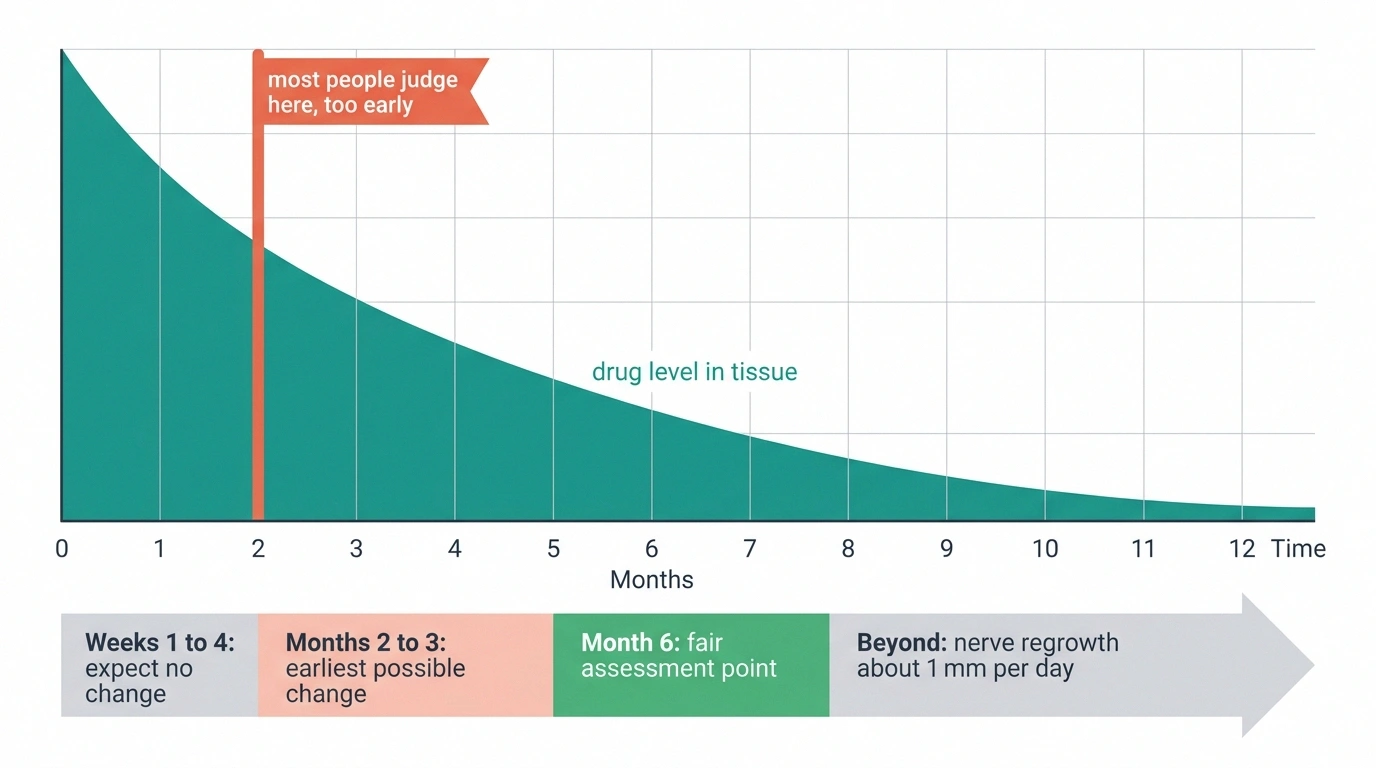
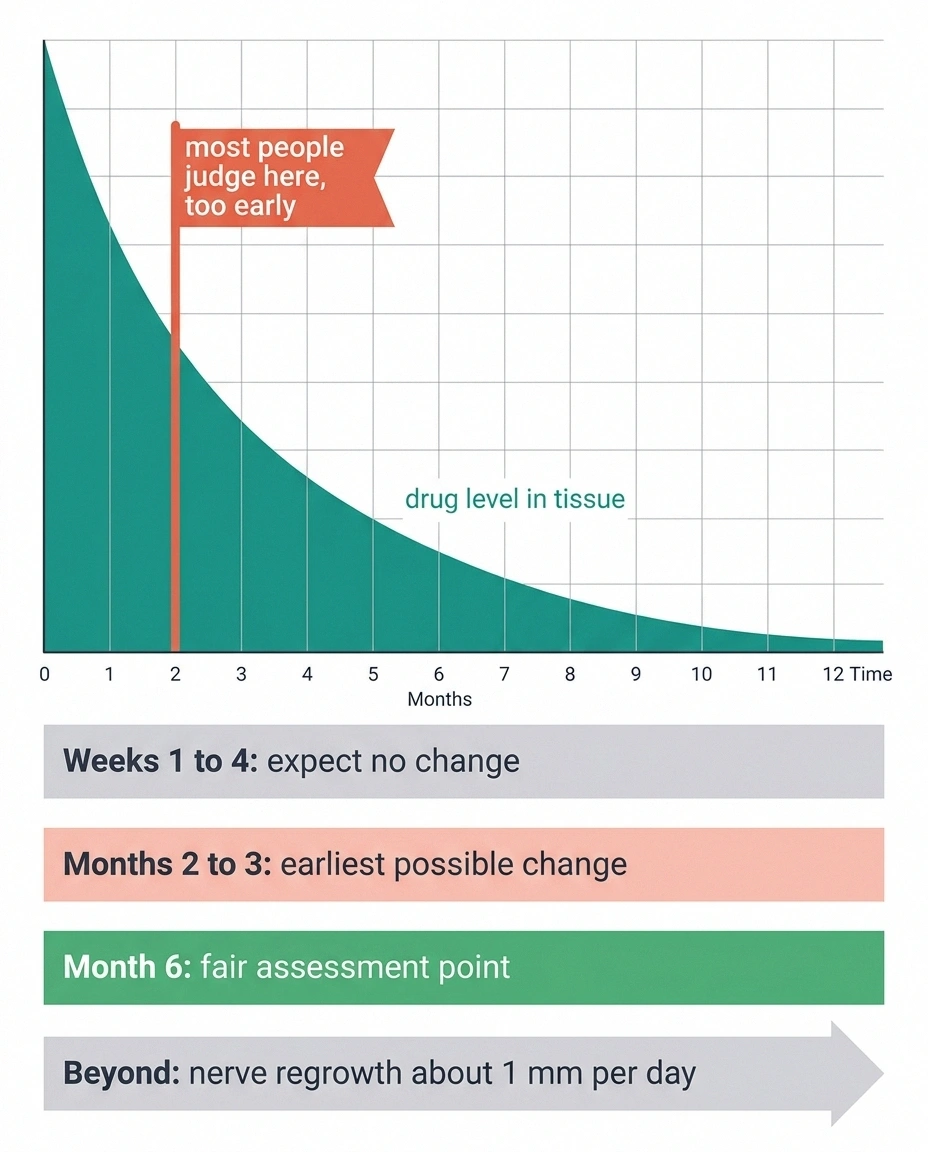
Set expectations honestly, because this is where people get discouraged.
People commonly judge the experiment far too early, conclude stopping did not help, and lose a useful medication for no information.
Stopping the drug helps. In the published series, discontinuation produced marked improvement in most patients. Improvement is slow, though — measured across months rather than weeks — and it may be incomplete. Some deficit can persist.
The lysosomal accumulation explanation predicts exactly that. The drug has a long tissue half-life and clears gradually, so nothing improves the week after the last tablet. Cells then have to clear a backlog of undigested material, and any fibers actually lost need regrowth, which for a nerve runs at roughly a millimeter a day from the point of injury.
Practically, that means a decision at month two about whether stopping helped is premature. Six months is a fairer assessment point.
The disease still needs treating, so stopping is a swap rather than a subtraction, and the replacement carries its own considerations. That’s a conversation with your rheumatologist about which alternative fits your disease, not a decision to make from a website.
The Toxicity Everyone Actually Screens For

Worth ending here, because it’s the hydroxychloroquine risk with a real monitoring program behind it, and people occasionally skip the appointments while worrying about the rarer problem.
Retinal toxicity is the well-characterized long-term risk. Current recommendations call for a baseline eye assessment within the first year of starting, then annual screening after five years of use, or from the outset for higher-risk patients. Modern screening combines several tests — visual field testing, optical coherence tomography, autofluorescence imaging — because early damage is detectable well before anyone notices a change in vision.
That last detail is the reason to keep the appointments. Early retinopathy is silent, and catching it early is what prevents progression. If your eye exams have quietly lapsed, that’s the more useful thing to reschedule this week, and the eye exam guide covers what to raise at the visit.
None of which is an argument against taking the question of your feet seriously. It’s an argument for taking it to the right people, in the right order, with the right information in hand. The underlying condition remains the most likely explanation, and understanding how the immune system attacks nerves is usually more relevant to what you’re feeling than anything on the drug label.
Frequently Asked Questions
Can Plaquenil cause neuropathy?
Yes, but it’s uncommon. Hydroxychloroquine can cause a toxicity affecting both muscle and nerve, described in the literature as neuromyotoxicity. The evidence base is mostly case reports and small series rather than large studies, which itself indicates how rarely it occurs. In someone taking hydroxychloroquine for an autoimmune disease, the disease itself is a considerably more common cause of neuropathy than the drug.
How do I tell the difference between drug side effects and my lupus?
The pattern of symptoms is the first clue. Hydroxychloroquine toxicity typically presents as proximal muscle weakness, meaning difficulty with stairs, rising from chairs, and overhead reaching, with normal sensation. Autoimmune neuropathy typically presents as burning, tingling or numbness starting in the toes and fingers with preserved strength. Bloodwork, muscle enzyme levels and nerve conduction testing distinguish them definitively.
Is hydroxychloroquine neuropathy reversible?
Largely, in most reported cases. Discontinuation led to marked improvement in the majority of patients in published series. Recovery is slow, running over months rather than weeks because the drug has a long tissue half-life, and it may be incomplete, with some residual deficit persisting in a subset of people.
Should I stop taking Plaquenil if my feet are burning?
Not on your own. Hydroxychloroquine reduces flares and organ damage in lupus, and stopping raises the risk of a flare, which can itself damage nerves more severely than the drug. Stopping without a plan also destroys the diagnostic information you were trying to obtain. Report the symptoms to the prescriber and let the workup happen first.
What dose of hydroxychloroquine is considered safe?
Current guidance is 5.0 mg per kilogram of actual body weight per day or less, generally not exceeding 400 mg daily. Because the calculation uses actual weight, significant weight loss can push someone above the threshold without any change in prescription. Asking for the calculation to be redone after a weight change is reasonable.
Does hydroxychloroquine cause muscle weakness?
It can. Proximal myopathy is the more characteristic presentation of hydroxychloroquine toxicity, more so than neuropathy. It develops slowly and affects hips, thighs, shoulders and upper arms. Severe cases in the literature have included difficulty swallowing and weakness sufficient to require walking assistance, which warrants prompt evaluation rather than waiting for a routine appointment.
How long does it take for symptoms to improve after stopping?
Months, not weeks. The drug accumulates in tissue and has a long half-life, so levels fall gradually after the last dose. Judging whether stopping helped at the six to eight week mark is too early. Six months is a more realistic assessment point, and any nerve fibers requiring regrowth recover at roughly one millimeter per day.
Do I still need eye exams if I have no vision problems?
Yes, and this is the most important monitoring item associated with this drug. Early retinal toxicity produces no noticeable symptoms and is detected only through screening. Recommendations call for a baseline exam within the first year and annual screening after five years of use, or from the start for people with additional risk factors such as kidney disease.
About the Author