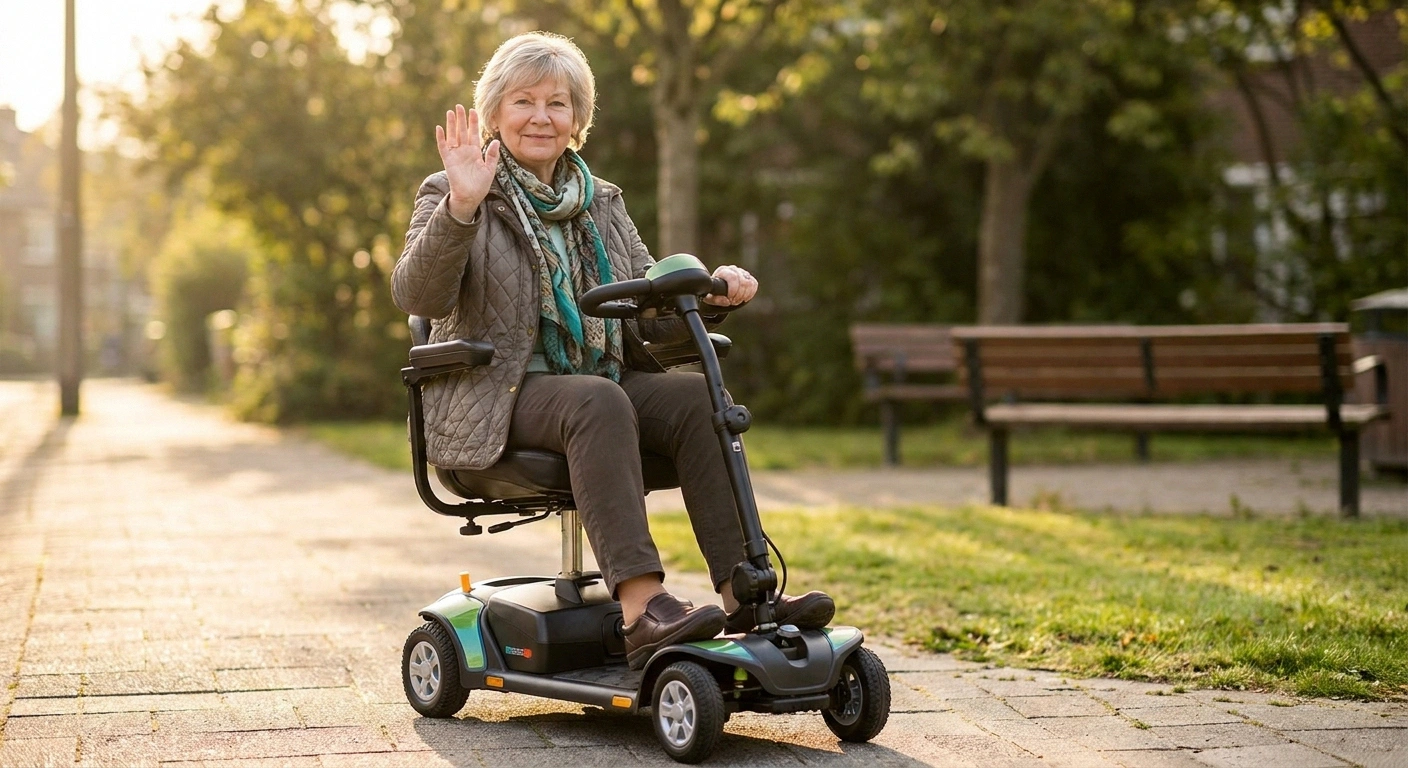
My Aunt Rosa graduated from her rollator to a mobility scooter this spring. It wasn’t a dramatic moment — just a slow, three-month realization that even with the rollator’s rest stops, she couldn’t make it through the grocery store anymore without her feet feeling like they were on fire by the frozen-foods aisle. She started skipping errands. Then she started skipping church. Then my cousin sat her down and said, “It might be time.”
She resisted for a good six weeks. She thought a scooter meant she was giving up. What she found out — once she actually had one — was that the scooter gave her back the community, the trips, and the independence that her feet had been quietly stealing. She drives it to the farmer’s market on Saturdays now. She takes it to the pharmacy. She goes to the hardware store with my uncle instead of waiting in the car.
Watching Rosa pick a scooter taught me a lot. If you’re on the fence about whether it’s time, trying to figure out three-wheel versus four-wheel, or staring at price tags from $700 to $6,000 wondering what you’re paying for — this piece is for you.
When a Mobility Scooter Actually Makes Sense
The mobility ladder for most people with progressing neuropathy: cane, then walker or rollator, then scooter, and eventually a power wheelchair for some. Each rung is an engineering solution to a specific problem. The scooter’s problem is endurance loss so severe that even a rollator with a seat can’t get you through a normal outing.
You’re a candidate when these are true:
- You can still stand up, pivot, and take a few steps safely — enough to get on and off without a transfer board or a caregiver’s arm.
- Your legs bear your body weight briefly but can’t walk any real distance, even with a rollator’s rest stops.
- Your outings have shrunk to the point where you’re canceling things you want to do because the walking is more than you can pay for.
The ability to stand and pivot briefly is the dividing line between a scooter and a power wheelchair. Scooters have you sitting on a chair with a tiller in front, and you get on and off by standing up. Power wheelchairs are for people who can’t reliably do that.
The transition from a rollator or walker to a scooter isn’t a failure of the rollator. Most people keep the rollator for indoor use — bathroom trips, moving around the house, short errands where the scooter’s turning radius is overkill — and use the scooter for longer community outings. Rosa uses both.
Three-Wheel vs. Four-Wheel Scooters — What Neuropathy Users Should Know
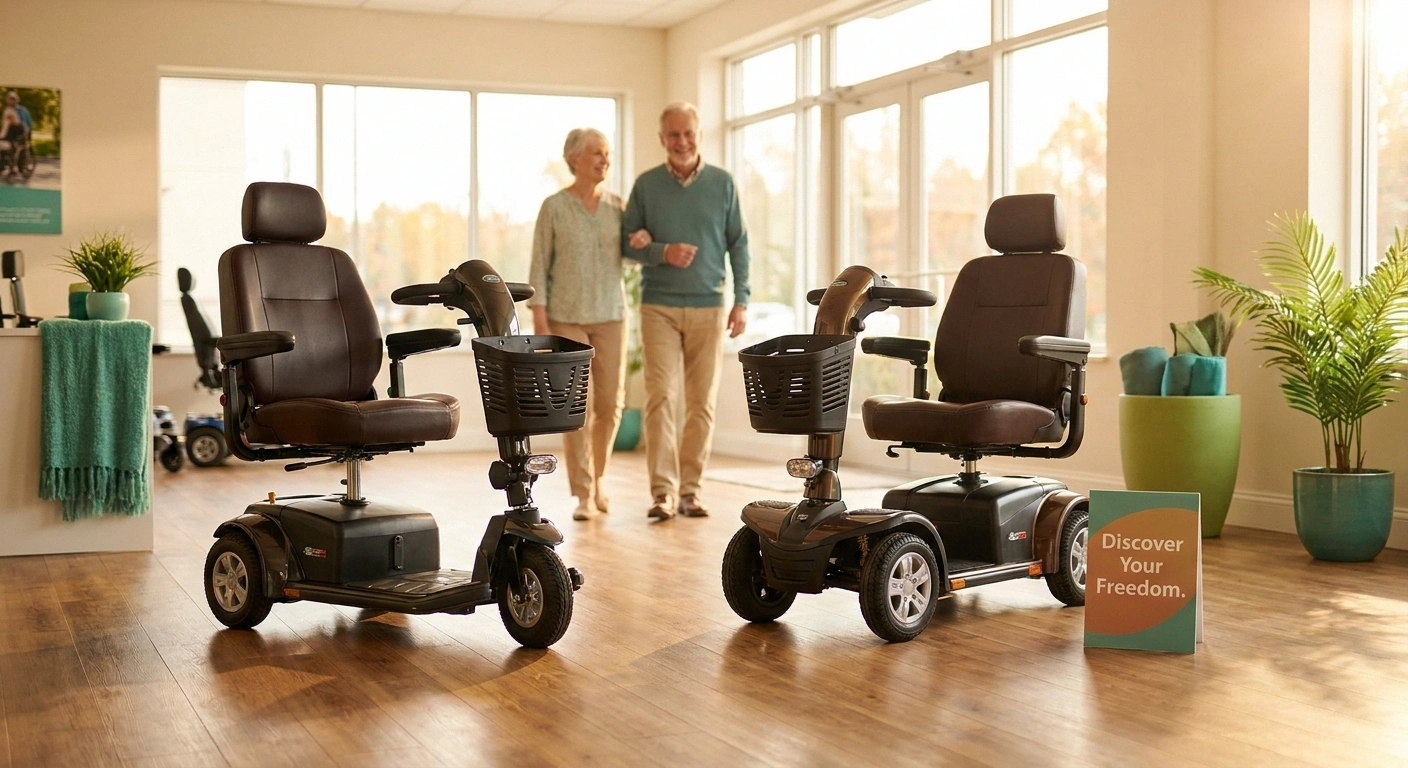
Almost every scooter is either a three-wheel or a four-wheel design, and this is the first real decision.
Three-wheel scooters have one wheel in front and two in back. The advantage is turning radius — three-wheelers turn tighter, which matters a lot in a grocery store aisle or a doctor’s waiting room. The downside is stability. On a slope, on gravel, or when you’re turning sharply, a three-wheeler feels tippier than a four-wheeler.
Four-wheel scooters have two wheels in front and two in back. Wider turning radius. Much more stable on uneven ground. Better for outdoor use, ramps, parking lots with camber, and grass. Worse in tight indoor spaces.
Rule of thumb for neuropathy users: if most of your use is indoors or in flat spaces (mall, grocery, pharmacy), a three-wheeler works well. If you’re outdoors on rougher terrain, cracked sidewalks, ramps and driveways with slope — go four-wheel every time. Neuropathy already compromises your postural reactions. Don’t add “scooter feels wobbly” to that list.
Rosa uses a four-wheeler. Her driveway has a slope and her market parking lot is on a slight hill. A three-wheeler would have been a nervous ride every time.
Travel Scooters vs. Full-Size Scooters — Making the Right Trade-Off
The next fork is size and weight class.
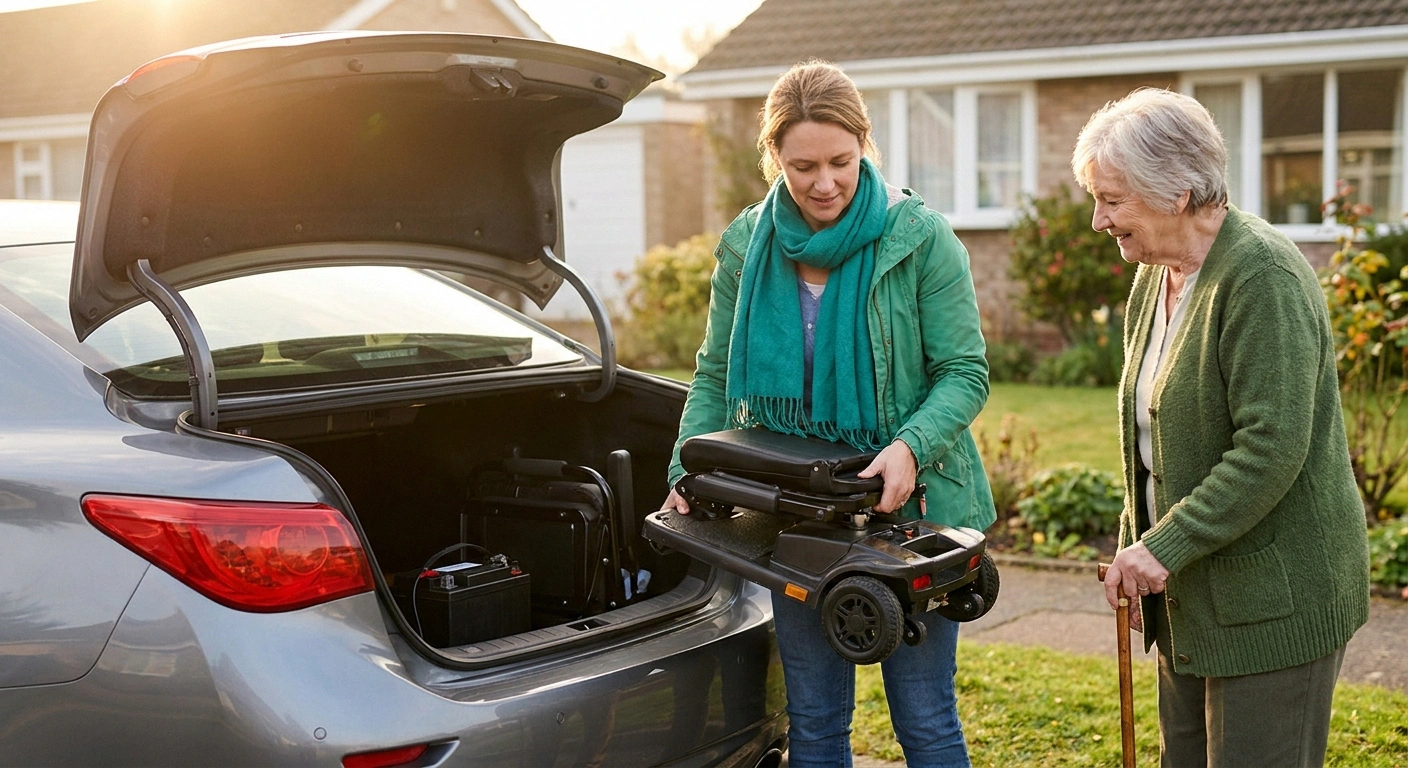
Travel scooters are light-duty. They disassemble into 3-4 pieces that fit into a car trunk, usually weigh under 100 lb total (heaviest piece often 30-40 lb), and offer modest range and top speed. Weight capacity is usually 250-300 lb. Battery range typically 8-15 miles per charge.
Full-size scooters are heavier duty. They don’t disassemble — you transport them on a vehicle lift or a wheelchair-accessible van, or they live at home. Weight capacity 300-500+ lb. Battery range 15-30 miles. Ride is smoother, seat more supportive, motor handles slopes better.
The honest question: how are you going to move it around?
If you drive a car and don’t have a lift or a van, a travel scooter is almost certainly right. You need to break it down and reassemble it, or have a family member who can. Rosa’s cousin can put hers in the back of a sedan in three minutes.
If you have a van with a lift, or the scooter lives at home for neighborhood use, a full-size scooter gives more comfort and range — but you’re mostly committed to where you can drive or roll it.
Rosa’s expensive mistake: she initially bought a full-size scooter, thinking bigger was better. Six weeks later, nobody could lift it, she didn’t have a lift-equipped vehicle, and it lived in her garage. She returned it within the window and got a travel scooter a niece could load in a trunk. Think about transportation before you buy.
Scooter Controls When Your Hands Are Numb
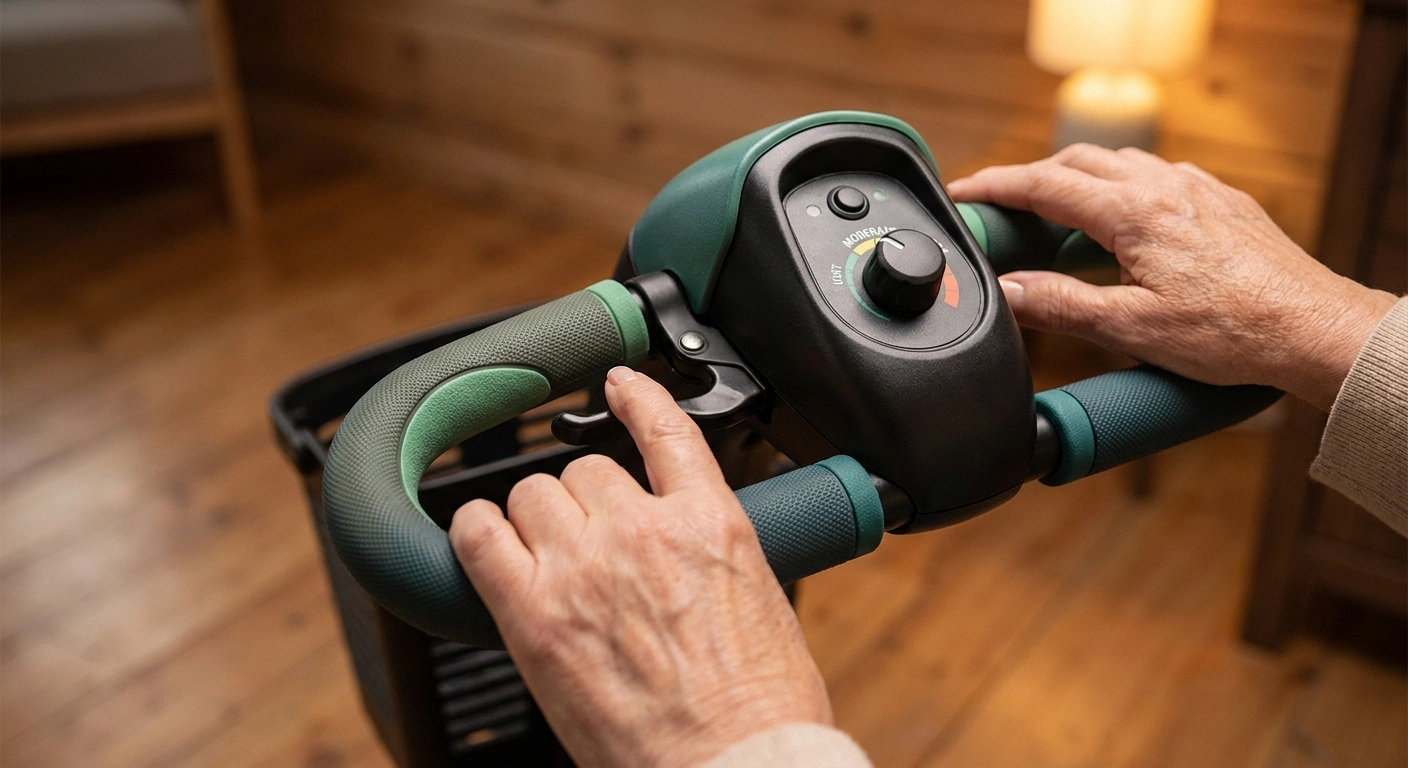
Please read this section carefully. Scooter controls are simpler than a car, but still require your hands to do specific things reliably.
The main controller is the tiller — the handlebar assembly in front of you with the throttle, direction switch, speed dial, and usually the horn and lights.
The throttle comes in two common styles, and the difference matters if your hands are affected by neuropathy:
- Thumb-lever throttle — a paddle on each grip that you push down with your thumb for forward, opposite side for reverse. Most common setup. Requires functional thumb strength and feeling in the thumb pad, because you modulate speed with thumb pressure alone. Tough if your thumbs are numb.
- Finger-lever throttle — a lever squeezed like a bicycle brake. Often easier with hand neuropathy because you use whole-hand grip strength rather than fine thumb control. Not every scooter offers this; ask specifically or look at arthritis-friendly models.
Whichever style, test it in the showroom before you commit. Sit on the scooter and drive for at least ten minutes. Can you modulate speed smoothly or are you jerking forward every time? Can you hit reverse without hunting? Can you stop cleanly at slow speed? If anything feels awkward, either the throttle style is wrong or the scooter’s speed sensitivity needs adjusting.
The speed dial is your other friend. Set it low for indoor use — walking pace or slower for grocery navigation. Set it higher outdoors when covering ground. Rosa spent her first two weeks on the slowest setting because that’s how she learned to trust the machine.
The brakes on a scooter work differently from a rollator. You don’t squeeze a brake lever. On almost every scooter, when you release the throttle, the electric motor engages a magnetic brake automatically and the scooter stops. This is easier for numb hands than a rollator’s brake — you don’t actively squeeze anything, you just stop pushing the throttle. But never try to coast a scooter downhill by releasing the throttle. It won’t coast, it’ll stop suddenly. Use the speed dial to control descent.
Foot Placement, Foot Rest, and Preventing Foot Injury

Here’s the neuropathy-specific safety concern most scooter brochures never mention: if your feet are numb, you may not feel when the foot deck is pressing into them, cutting circulation, or causing a pressure injury. A blister on a numb foot can turn into an ulcer without you noticing.
- Wear real shoes on the scooter. Not flip-flops, slippers, or bare feet. Closed toe, real sole, enough structure the deck edge can’t dig into your foot. See the shoe guide.
- Position feet flat on the deck, not hanging off the edges. Too-narrow deck = wrong scooter.
- Move your feet every few minutes on longer rides. Wiggle toes, shift weight, lift one foot briefly. Static position on numb feet is the setup for pressure injury.
- Inspect your feet daily (see daily foot-care basics). Add the scooter to the checklist — pressure marks from the deck edge, seat frame, anywhere it contacts your body.
- Watch for a warm seat or floor pan. The battery is often mounted under the seat or deck and gets warm. Numb legs or seat area may not feel heat that would be uncomfortable normally. Touch the scooter with the back of your hand before every ride.
None of this is meant to scare you. Rosa has had zero problems in four months. But she does the nightly foot check and has caught two pressure marks early — both healed once she moved her foot position on the deck by half an inch.
Getting On and Off Without Falling
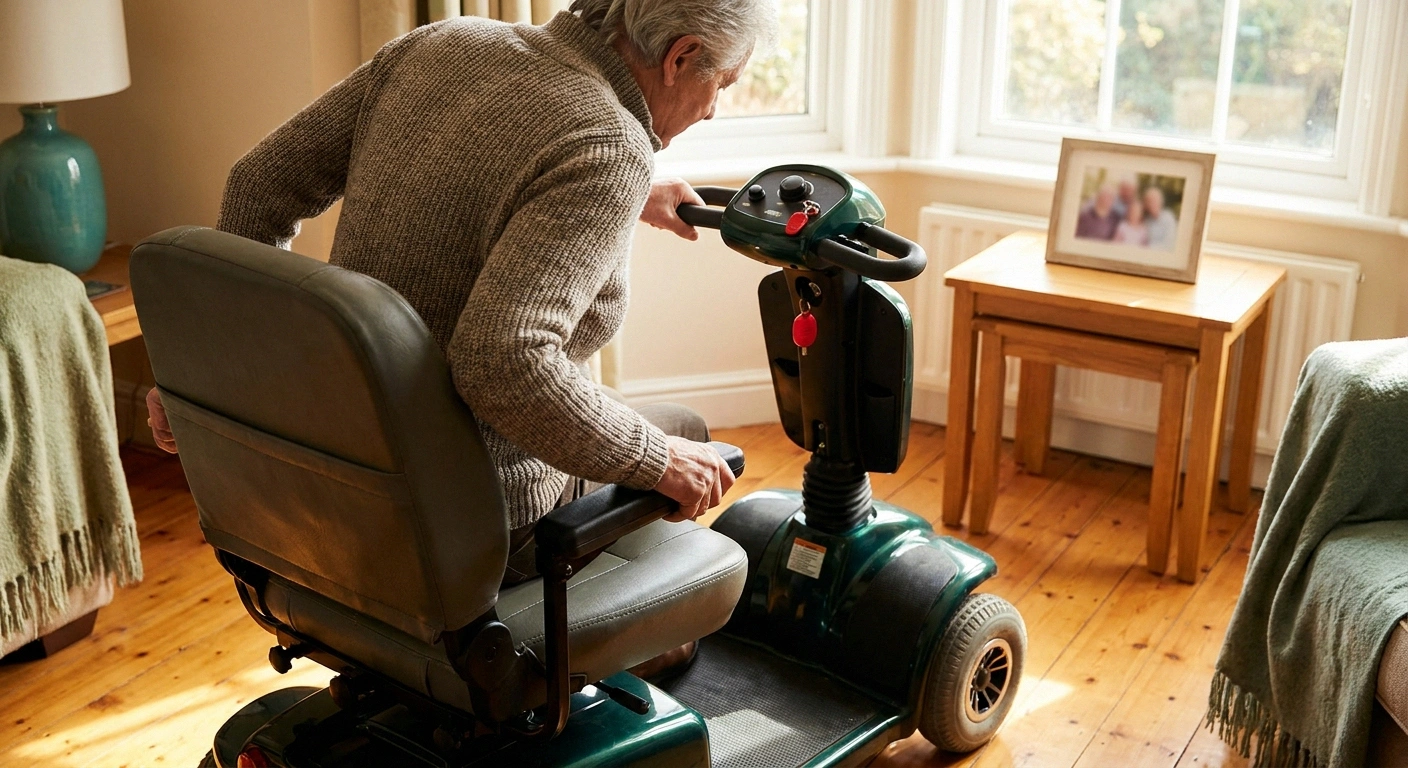
Mounting and dismounting is when scooter accidents happen — not while riding, while transferring on and off.
The safe sequence, every time:
- Park with wheels straight ahead and the tiller centered. A scooter with wheels turned can shift under you as you get on.
- Turn the key OFF or set the speed dial to zero. Prevents accidental throttle activation while mounting.
- Set the parking brake if your model has a separate one. The magnetic brake usually engages automatically when you release the throttle, but use a manual parking brake if present.
- Approach from the side. Hold the tiller with one hand and the seat back or armrest with the other. Turn your body to sit and lower yourself onto the seat controllably.
- Adjust your feet onto the foot deck before touching the throttle. Both feet in position, both hands on the tiller, then turn the key on.
Getting off is the same sequence in reverse — stop, key off, feet planted, one hand on the tiller and one on the seat back, stand up and step aside.
This is when fall prevention basics matter most. Never rush the mount. Never try to sit on a scooter that’s rolled a few inches from where you intended. If standing out of the seat starts to feel unreliable, that’s the signal for a power wheelchair conversation with your care team.
Battery Range, Charging, and What Happens If You Run Out Mid-Errand
Every scooter runs on a rechargeable battery, and it’s the single most important part of the machine.
Range depends on the battery, your weight, terrain, and how hard you push the scooter. Manufacturer specs are always optimistic. Advertised at 15 miles? Plan for 10. Cold weather and hills cut range further.
Charging is straightforward — plug into a standard outlet with the manufacturer’s charger, and charge fully overnight before every day of use. Full charge from empty is typically 6-10 hours. Don’t leave the battery discharged; it degrades faster empty. Treat it like a phone.
Battery lifespan is usually 12-24 months of daily use before range drops noticeably. Replacement batteries are $150-$400 — a recurring cost worth planning for.
What happens if you run out mid-errand? The scooter stops moving. It doesn’t coast — the magnetic brake engages and it becomes very heavy furniture you’re sitting on. Plan errands with a safety margin. If your travel scooter does 10 real miles, don’t plan a 9-mile round trip.
Rosa’s habits: charge every night without fail, check the battery level before leaving the house, keep two family phone numbers handy, and don’t take the scooter more than a mile from home unless paired with someone in a car.
Insurance, Medicare, and Cost Reality

The short version: Medicare Part B covers mobility scooters as durable medical equipment (DME), but the qualifying bar is higher than for a walker or rollator. Your physician has to document a medical condition limiting mobility (peripheral neuropathy qualifies), that the scooter is needed inside your home (not just going out), that you can’t safely use a cane, walker, or rollator, that you have enough upper body strength to operate the scooter, and that you can’t safely use a manual wheelchair.
You’ll need a face-to-face evaluation within Medicare’s window, and the scooter has to come from a Medicare-enrolled supplier. Medicare then pays 80 percent of the allowable amount; you cover the rest unless supplemental picks it up.
Two things that catch people off guard: the “inside the home” rule is strict — if your doctor writes only that you need it for community outings, the claim often gets denied. And Medicare covers standard models, not premium upgrades (bigger battery, captain’s seat, all-terrain wheels), which are self-pay. Denials often reverse on first appeal when paperwork is corrected.
Out of pocket, a basic travel scooter runs $700-$1,500. Mid-range is $1,500-$3,000. Premium (heavy-duty full-size, long range) climbs to $4,000-$6,000. Used scooters can cut that in half if you can verify battery health.
Whatever you buy, keep up your gentle strength and mobility exercises. The scooter is not a replacement for keeping your legs and core as strong as they can be — it’s a tool that lets you save your walking capacity for the moments that matter.
Frequently Asked Questions
Will Medicare pay for a mobility scooter for neuropathy?
Yes, Medicare Part B covers mobility scooters as durable medical equipment when specific criteria are met. Your doctor has to document that your mobility is impaired inside your home (not just in the community), that you can’t safely use a cane, walker, or rollator, and that you have enough upper body strength to operate the scooter but can’t safely use a manual wheelchair. After you qualify, Medicare pays 80 percent of the allowable amount and you cover the rest unless supplemental insurance picks it up. Denials are common on the first pass, and appeals are often successful when paperwork is corrected.
Warning — numb-feet safety on a scooter
- Blisters and pressure marks you can’t feel can turn into ulcers. A numb foot doesn’t send the warning signal that a normal foot does — you can develop a wound and not know until you inspect.
- Wear closed-toe shoes with real soles every single ride. No flip-flops, no slippers, no bare feet. The foot deck edge can dig into an unprotected foot without you feeling it.
- Inspect your feet nightly for pressure marks from the deck or seat frame. Same daily habit as the rest of your neuropathy foot care — the scooter just adds a few checkpoints to the list.
- Watch for a warm seat or floor pan. The battery mounts under the seat or deck and gets warm during use — warmer after long rides or during charging. If your legs or seat area are numb, you may not feel heat that would be uncomfortable normally. Touch the scooter with the back of your hand before every ride.
- Move your feet every few minutes on longer rides. Static position on numb feet is exactly the setup for pressure injury.
The mobility ladder
Each rung is an engineering answer to a specific problem. Most people move through them as their needs change — and many stay on two rungs at once (rollator indoors, scooter outdoors, for example).
Three-wheel vs. four-wheel scooters at a glance
| Feature | Three-wheel | Four-wheel |
|---|---|---|
| Turning radius | Tight — great for indoor use | Wider — needs more room |
| Stability | Tippier on slopes and turns | Much more stable outdoors |
| Best terrain | Flat indoor floors, malls | Sidewalks, ramps, driveways, camber |
| Best for neuropathy user | Almost entirely indoor use | Any outdoor use — the safer default |
| Feel on uneven ground | Nervous | Planted |
Key takeaway
A mobility scooter is the right tool when endurance loss is so severe that even a rollator with a seat can’t get you through a normal outing — as long as you can still stand up, pivot, and take a few steady steps to get on and off. It’s not a replacement for a rollator at home; most people keep the rollator indoors and use the scooter for community outings where the distances are longer.
Should I get a three-wheel or four-wheel mobility scooter?
Three-wheel scooters turn tighter in narrow indoor spaces but feel less stable on slopes and uneven ground. Four-wheel scooters have a wider turning radius but are noticeably more stable outdoors, on ramps, and on parking lots with camber. For most neuropathy users planning outdoor use — sidewalks, driveways, community events — four-wheel is the safer pick. Three-wheelers make sense if your use is almost entirely on flat indoor surfaces.
What kind of scooter throttle is easiest for numb hands?
The finger-lever throttle (squeezed like a bicycle brake) is often easier for numb hands than a thumb-lever, because it recruits whole-hand grip strength rather than fine thumb control. Not every scooter offers a finger-lever style. If your hands are affected by neuropathy, ask about throttle options or look at scooters designed for arthritis-friendly use. Test-drive whichever style for at least ten minutes to confirm you can modulate speed smoothly.
How far can a mobility scooter go on one charge?
Manufacturer specs advertise 8-30 miles, but real-world range is typically 25-40 percent lower. Travel scooters usually deliver 6-12 real miles per charge; full-size hits 15-25. Range drops in cold weather, on hilly routes, and as the battery ages. Charge fully every night regardless of use, and plan errands with a comfortable safety margin — if your real range is 10 miles, plan a 6-mile round trip, not a 9-mile one. If the scooter runs out, it stops and becomes stationary.
Is it safe to use a mobility scooter if I have numb feet?
Yes, with specific precautions. Wear closed-toe shoes with real soles every time (never bare feet or flip-flops), position feet flat on the deck (not hanging off the edges), shift and wiggle toes every few minutes on longer rides, and inspect feet every night for pressure marks or bruises you couldn’t feel during the ride. The battery is often mounted under the seat or foot deck and can get warm — touch the scooter before extended sitting to make sure you’re not on a hot surface.
Can I take a mobility scooter in the car?
Travel scooters are designed for this — they disassemble into 3-4 pieces that fit into most car trunks. The heaviest piece is usually the base at 30-40 lb, so if loading solo, verify you can lift it safely. Full-size scooters do not disassemble and require a vehicle-mounted lift, a wheelchair-accessible van, or keeping the scooter at home. Before buying any full-size scooter, confirm how you’ll transport it. This is where many first-time buyers make an expensive mistake.
When is a scooter not enough anymore?
When standing and pivoting to get on and off starts to feel unsafe, it’s time for the power wheelchair conversation with your care team. A scooter requires you to bear your body weight briefly and take controlled steps during transfer; a power wheelchair is built for people who can no longer do that reliably. Other signs: falls or near-falls during transfer, needing a caregiver’s arm every time, and losing the hand function to operate the tiller.
If you’re wrestling with the emotional side of adding a scooter, the grief around losing walking distance is a normal, human thing. Many people describe getting the scooter as the moment they got their community back — but the decision to move to it can weigh heavily first. See managing the mental-health side of neuropathy if that piece is loud right now.
Rosa took the scooter to the farmer’s market yesterday. She bought tomatoes and a bunch of basil, talked to two neighbors and a woman selling honey, and came home tired but happy — not the shaky, wrung-out tired of pushing a rollator through pain, but the good tired of a real morning out. That’s what the scooter does. It hands you back the parts of your life the neuropathy was quietly taking.
About the Author