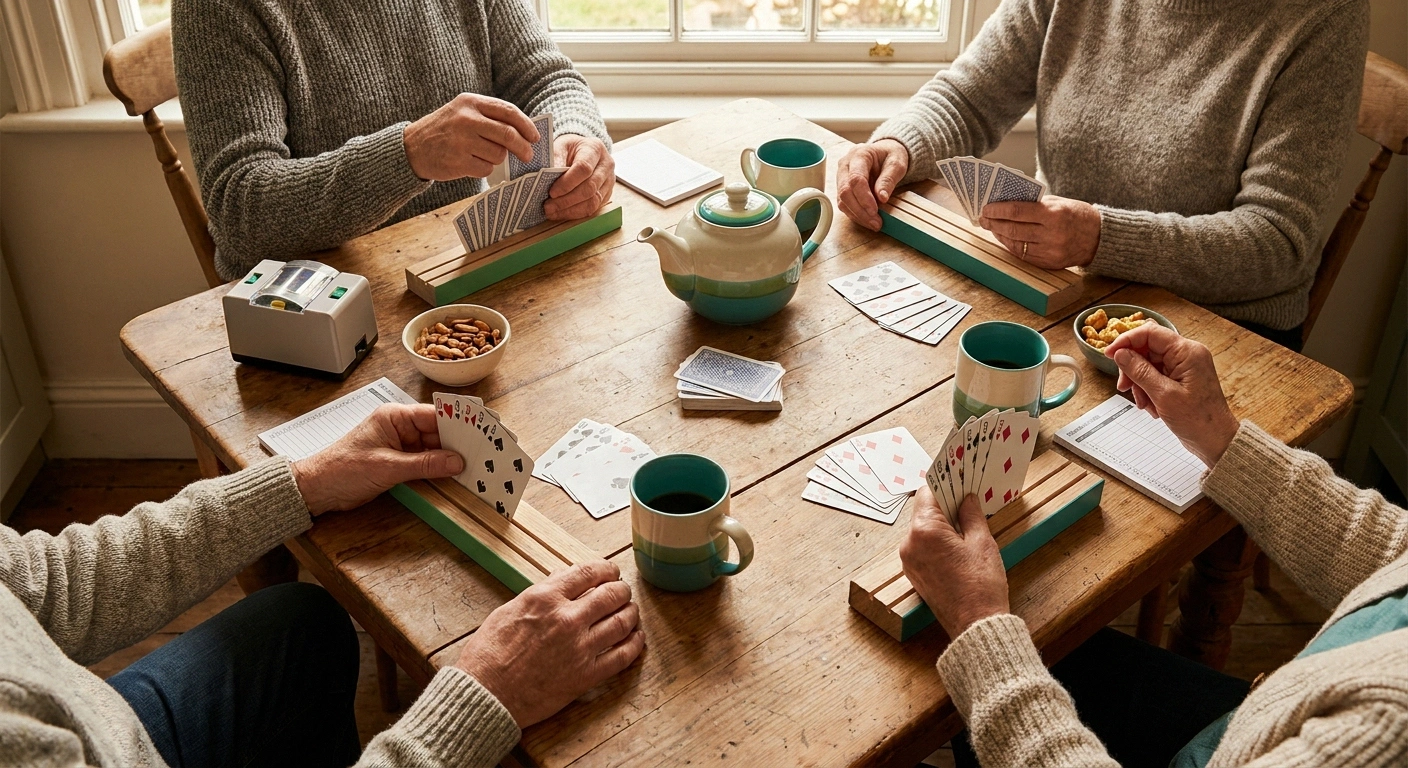
My book club has met every other Wednesday for fifteen years. About four years ago, we started ending each meeting with a hand of canasta — sometimes two, if the conversation had been especially good. I remember the exact night I couldn't fan my cards anymore. I tried three different ways and they kept dropping. Two of my friends pretended not to notice. One of them — Marcia, bless her — quietly slid her standing card holder across the table and said, “Use mine. I bought a second one last week and forgot to bring it.”
That little wooden rack changed my evenings. It wasn't expensive. It wasn't medical. It just gave me back the part of the evening I'd assumed I was losing.
If your hands have started fighting you at the card table or the game board, you are not alone, and you have not run out of options. There's a whole world of small adaptations — most of them inexpensive, many of them already in someone's drawer somewhere — that can keep card night and game night a part of your life. The point of these evenings isn't winning. It's the people around the table. Let's keep you there.
Why This Matters More Than It Sounds
I want to start with the part that doesn't make most lifestyle articles: this is more than a hobby problem. Card and board games sit at the center of a lot of social lives — weekly bridge groups, the family Pinochle ritual that's been going since the 1960s, holiday Scrabble with grandkids, Saturday dominos on the porch. When neuropathy starts taking the cards out of your hands, it's not really the cards you're losing. It's a chair at a table where you've belonged for years.
The point of game night is the people. The cards are the excuse. When neuropathy makes the cards harder to hold, the cards adapt — your seat at the table doesn't have to go anywhere.
I've watched too many people with hand neuropathy quietly stop going to game night because they were embarrassed about dropping cards or holding up the group. The withdrawal is gradual and invisible. By the time anyone notices, the routine has dissolved. So we're going to head that off. The adaptations in this article work. They're simple. And asking for one isn't asking for special treatment — it's the same kind of adjustment a friend with weaker eyes makes when she switches to a larger-print menu at the diner.
The Card-Holding Problem — and How to Solve It
For most people with hand neuropathy, this is the first thing to give. Fanning a hand of cards requires precise finger pressure, a steady thumb, and feedback you may no longer be getting from your fingertips. The cards slip. They fan unevenly. You drop one and have to bend awkwardly to retrieve it. By the third hand, you're frustrated, and frustration speeds up the dropping.
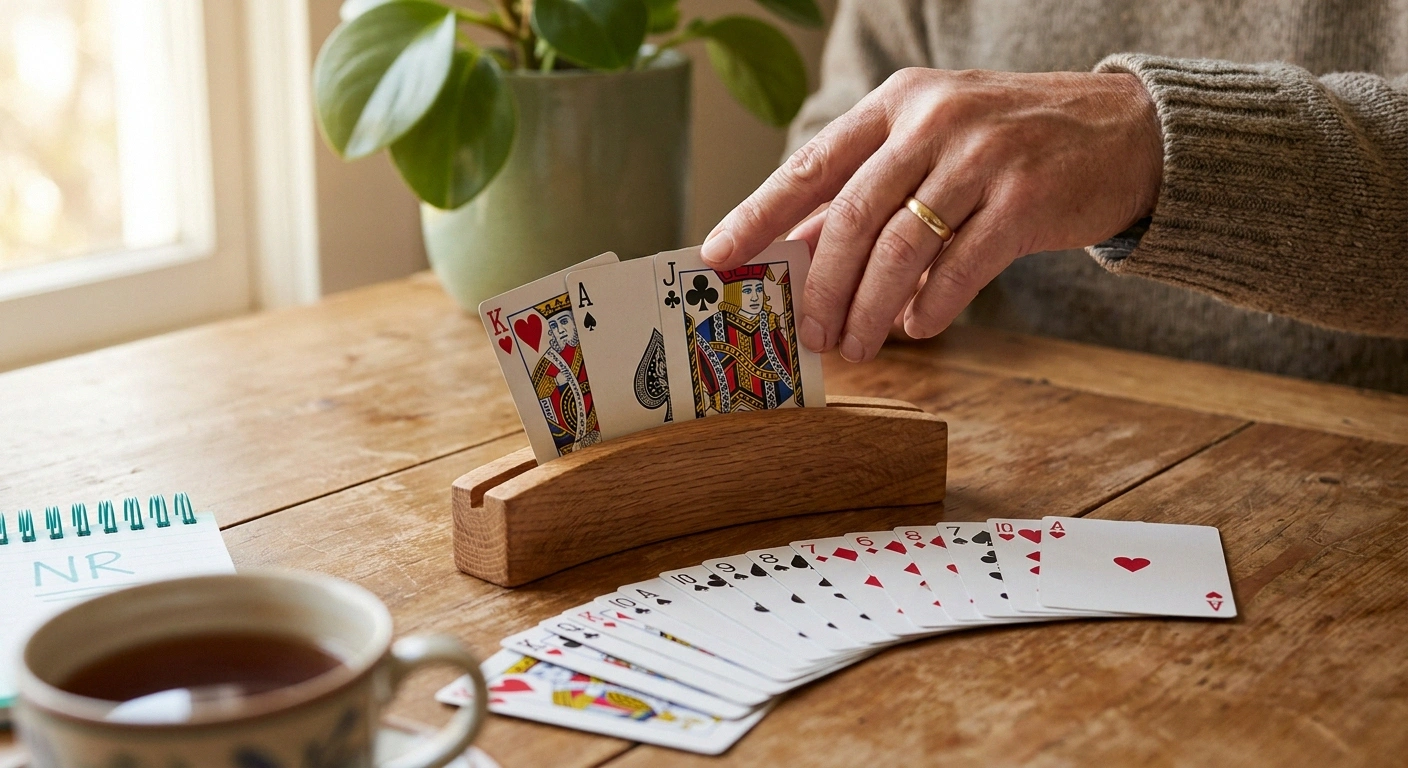
card holder
automatic card shuffler
The fix is a card holder. There are several styles and they're all inexpensive:
- Standing wooden or plastic card racks with grooves cut along the top. You slide your cards into the slot and they stand upright, fanned, fully visible to you and hidden from your opponent. Most cost between $5 and $15. This is the simplest, most reliable option for most card games — bridge, canasta, rummy, hand-and-foot, gin.
- Spinning “lazy Susan” card holders that sit in the middle of the table. Useful for solitaire-style games or for someone who needs full-table accessibility.
- Acrylic card stands that hold the cards horizontally — these work well for games where suits and ranks need to be visible to multiple players (children's games, learning games).
- Fabric pillow holders shaped like little stuffed pillows with slits cut for cards. These travel better than wooden racks and can be made at home from a small bag of stuffing and a rectangle of fabric. A grandchild who sews can make you a set in an afternoon.
The kitchen-drawer solution if you don't have a card holder yet tonight: a heavy book held upright between two coffee mugs, with cards tucked into the binding. It's not elegant. It works.
Shuffling and Dealing Without the Frustration
The riffle shuffle is one of the most underrated skills in card playing — and one of the first things to become impossible when grip and finger control go. Same with the smooth thumb-flick that experienced dealers use to slide cards across the table.
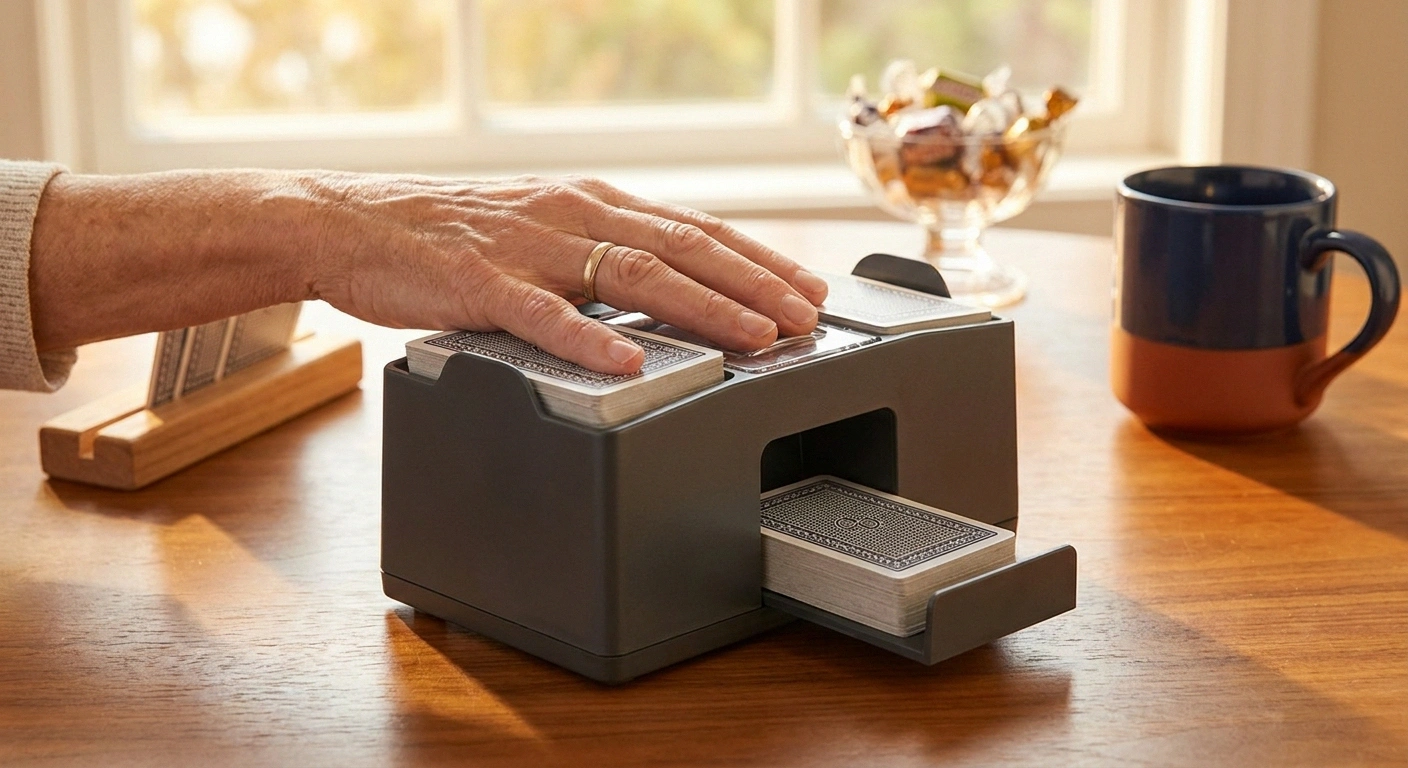
The simplest answer is an automatic card shuffler. A battery-powered model that takes one or two decks of cards runs about $15 to $30. You drop the two halves of the deck into the slots, press a button, and the machine alternates them into a single shuffled deck. Some models hold two decks at once, which is useful for games like canasta or hand-and-foot. Manual hand-cranked versions are even less expensive, though they require more hand strength.
For dealing, the easiest adaptation is the low-tech one: let someone else deal. Most card groups settle into a rotation where the player to the right of the dealer cuts the deck and the dealer hands cards out one at a time. When that becomes hard, ask if the group is willing to keep one person as the permanent dealer for the night. Most groups will. The bigger move — and I've seen this in a few of my groups — is to deal the cards face down on the table and let each player slide their pile into their card holder themselves. It removes the precision-dealing requirement entirely.
If you're stuck with regular cards, slightly worn cards actually deal easier than brand-new slick ones. The wear gives them grip.
When the Cards Are Too Small to Read
Some neuropathy patients have only hand issues; many have vision changes alongside, especially if diabetes is part of the picture. Standard playing cards have small corner indices and detailed face cards. The combination of fingertip numbness and squinting at a 4 of clubs at the end of a long evening is a recipe for frustration.
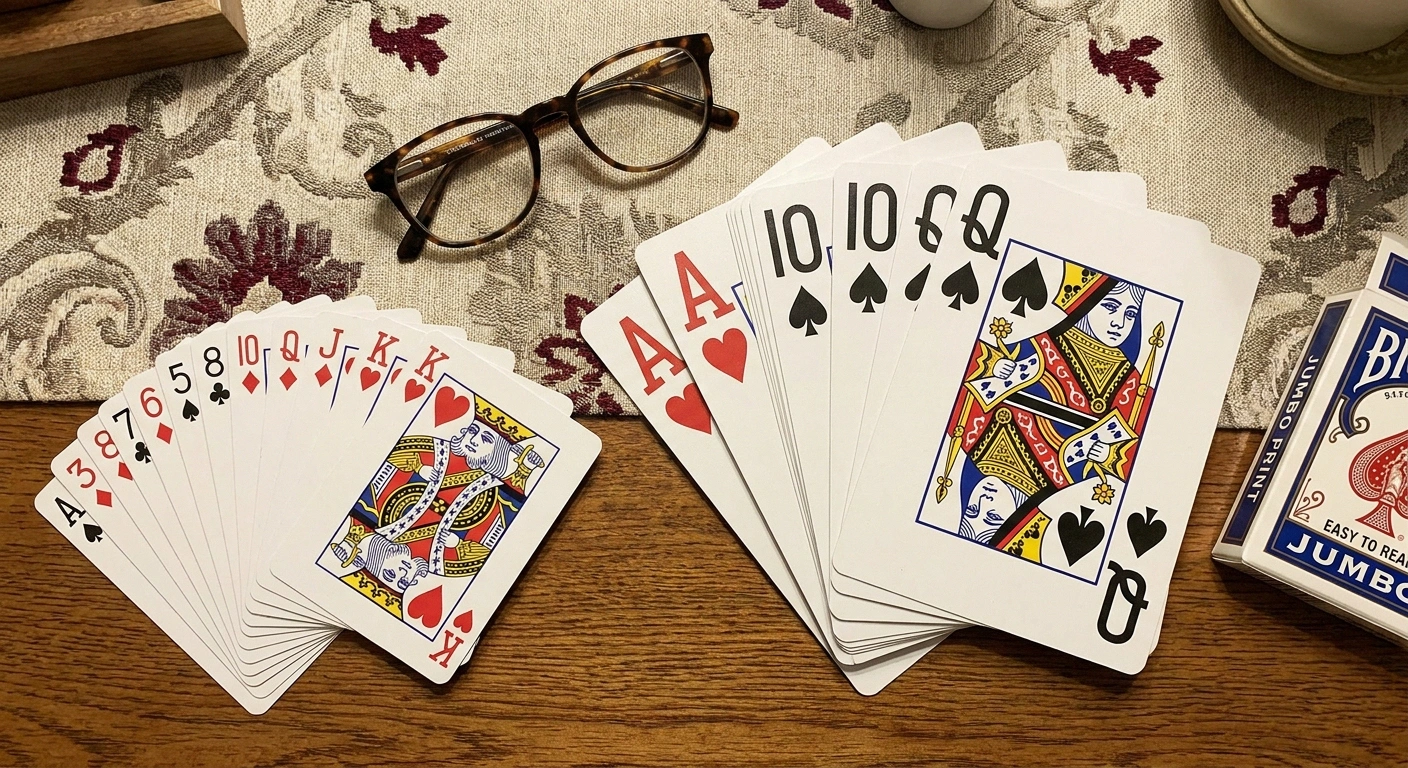
Jumbo playing cards are about 4.25 by 6 inches — substantially larger than standard cards. They're sold by every major card brand, and you can find them in big-box stores, dollar stores, and online for under $5 a deck. Low-vision decks go further, with oversized corner indices and high-contrast suit colors. For card-club groups, a single shared jumbo deck on the table is often enough — everyone benefits from being able to see them clearly.
One small piece of practical advice: jumbo cards don't fit in standard card holders. If you buy oversized cards, check that your card rack has a slot wide enough for them or buy a holder designed for jumbo decks. The mismatch is a common buyer's regret.
Board Games — Picking Up Tiny Pieces
Board games have a different problem profile. Many games — chess, checkers, Scrabble, Catan, Monopoly — involve picking up, placing, and stacking small pieces with precision. With reduced fingertip sensation, even finding a piece on the board can be hard.
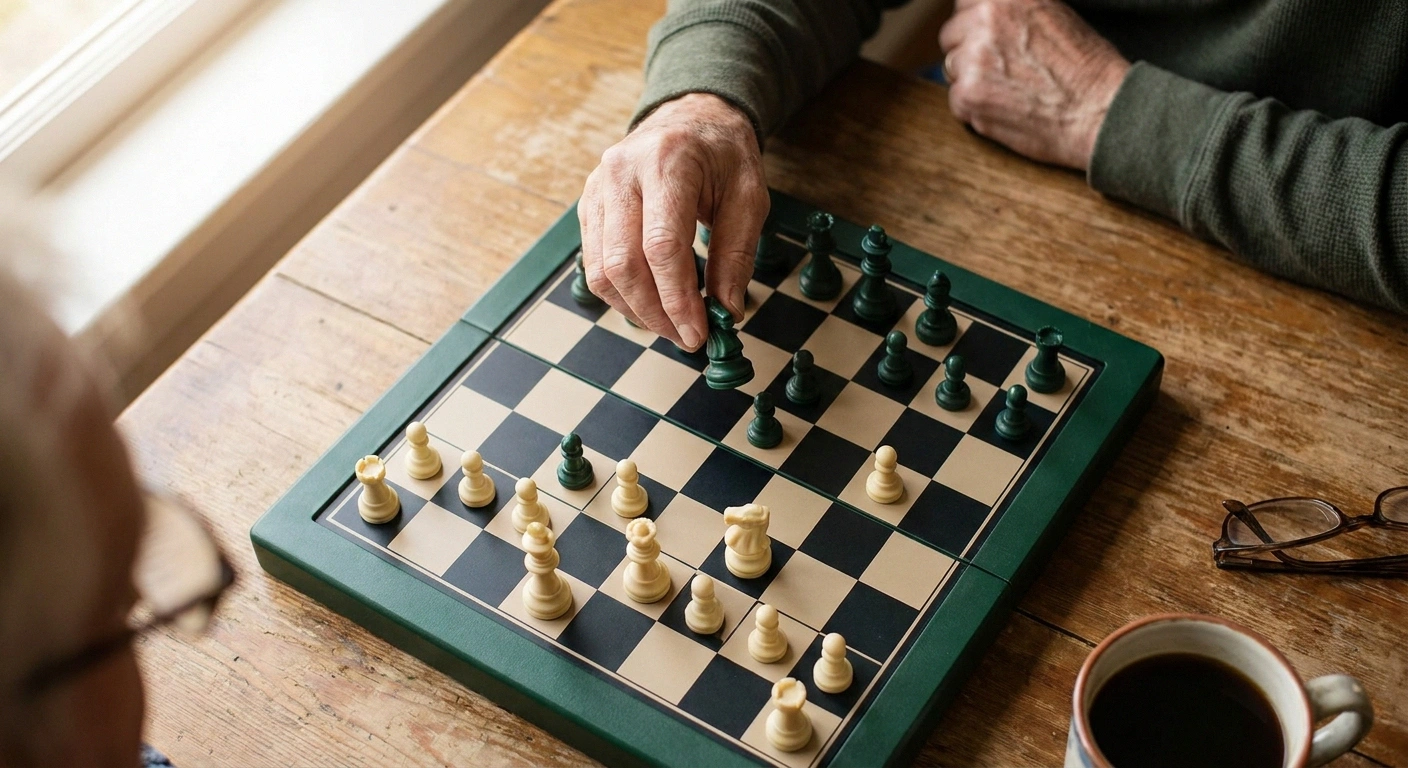
Adaptations that work:
- Magnetic boards. Magnetic chess, checkers, and travel-style backgammon use pieces that snap into place. You can pick them up without precision, and they don't slide around if your hand shakes or bumps the board. A magnetic chess set is one of the best gifts you can give a neuropathy patient who loves the game.
- Pegged games. Cribbage uses pegs, not tiles. Mancala uses stones. Some travel versions of board games use peg-style markers that fit into holes. These are easier to handle than flat tiles for anyone with grip or sensation issues.
- Large-print Scrabble. Sold under several brand names; tiles are roughly double standard size. Same game, much easier handling.
- Jumbo dominoes. Available widely. Heavy, easy to see, easy to place.
- Game piece pickers. A small bamboo or plastic grabber — sometimes sold as a “small piece tool” or “Scrabble tile picker” — lets you slide tiles or counters across the board without pinching.
- Dice cups with felt linings. Dice that scatter all over the table are a hazard for anyone with grip issues. A felt-lined cup contains the roll and softens the noise. You can make one from a coffee mug and a circle of felt cut to fit the bottom.
For game pieces that absolutely require precision — Operation, Jenga, Pick-up Sticks — those games may need to come off the rotation, at least for now. There's no shame in saying “I love this game but I can't be the one who knocks the tower over tonight; can we play Yahtzee instead?”
Choosing Games That Match Your Hands
Some games are friendlier to numb or clumsy hands by design. If you're updating your home game shelf or suggesting options to a group, these categories tend to work well:
Games that work well with adapted hands:
Chess, checkers, cribbage, backgammon, rummy, gin, hearts, spades, Rummikub, Yahtzee, large-print Scrabble, Sequence, Codenames, Forbidden Island, Pandemic.
Games that get harder — maybe save for stronger-hand days:
Jenga, Operation, Pick-up Sticks, Slapjack, Spoons, Anomia, speed-based card games, heavy-shuffling games without a shuffler.
- Slow-paced strategic games. Chess, checkers, backgammon, cribbage. The whole point is thinking, not reflexes. Hand fatigue is minimal.
- Card games with simple hand structures. Rummy, gin, hearts, spades — fewer cards per hand than bridge or canasta means less to manage.
- Cooperative games. Forbidden Island, Pandemic, Hanabi. Everyone works together against the game itself. The pressure to perform individually drops, and the social warmth goes up.
- Set-collection games. Rummikub, Sequence, Phase 10. Many of these can be played with a card holder.
- Word and trivia games. Boggle, Scattergories, Trivial Pursuit, Codenames. Minimal hand manipulation, lots of conversation.
- Dice games. Yahtzee, Farkle. Easier with a cup; the actual handling is minimal.
Games that get harder as hands change include speed games (Slapjack, Spoons, Anomia, Sushi Go Party), precision games (Jenga, Operation, Suspend), heavy shuffling games without an automatic shuffler, and stacking games. None are off-limits forever. They just may not be the right fit for the current evening.
The Social Side of Adapting
One of the things I've learned from talking to neuropathy patients across many different support groups is that the hardest part of adapting isn't picking the right card holder. It's the conversation with the people you've been playing with. There's an instinct to apologize for needing accommodations, to feel like you're disrupting the group, to consider quietly bowing out so nobody has to slow down for you.
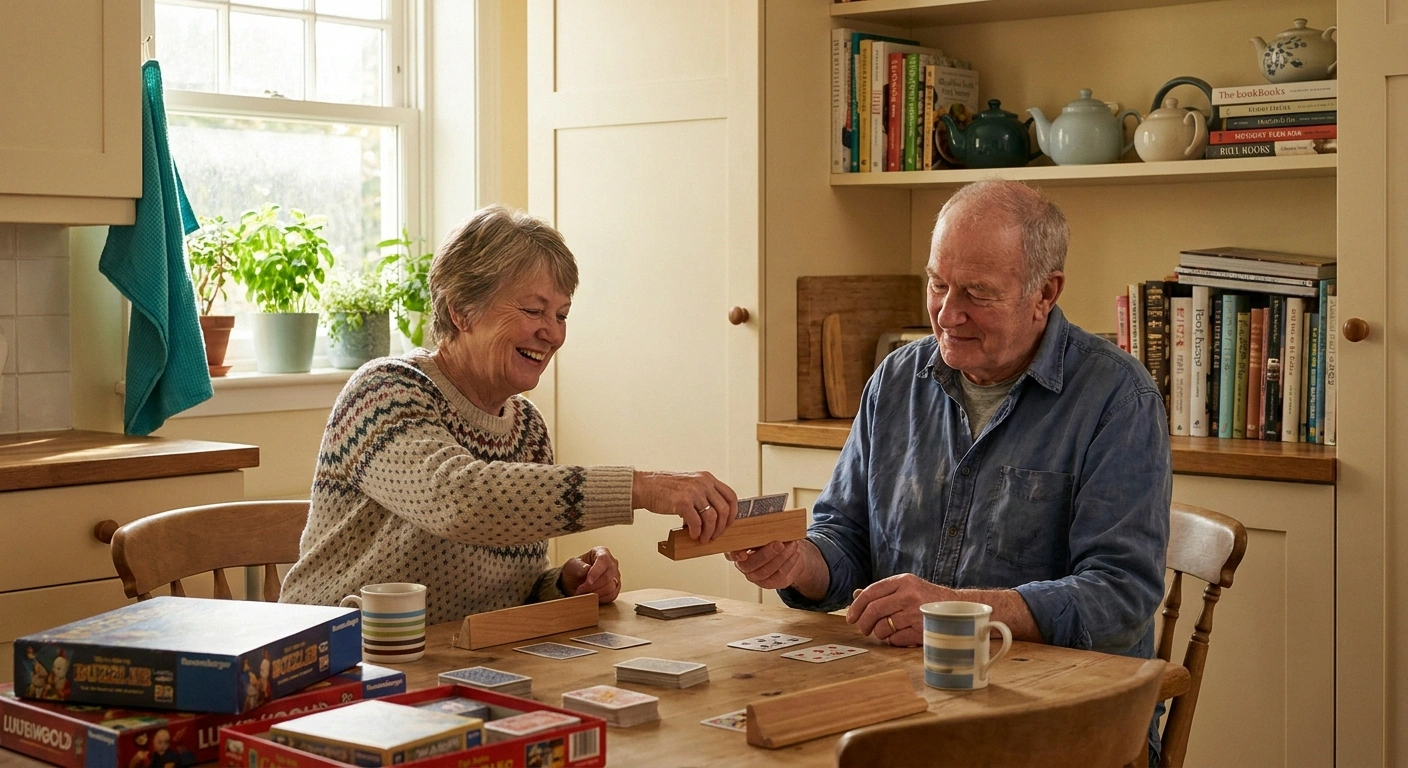
Here's what I've watched happen, over and over, when someone names the problem instead of hiding it: the group adapts faster than the person expected. Card holders appear. Someone brings the shuffler. The game choices drift gently toward what works. Nobody minds. Most of them are quietly relieved that one of you said something, because two or three other players have been quietly struggling too.
If you're not sure how to start that conversation, this often works: “I'm having more trouble with my hands lately, so I'm going to bring a card holder next time. Anyone else want me to grab one for them?” That single sentence opens the door without making the night about you.
The social losses from chronic conditions are the ones that don't show up in any medical chart. Protecting your seat at the table is one of the most valuable things you can do for your own well-being, and it's deeply connected to how you cope mentally with the long arc of neuropathy.
When Games Move to a Tablet or Phone
If hand symptoms make in-person games genuinely impossible — or if you don't have an in-person group anymore — digital versions of many classic games are surprisingly good and often easier on the hands. Apps for solitaire, cribbage, bridge, rummy, chess, Scrabble (or its digital cousin), and dozens of board games let you tap a card or piece instead of grasping it. Voice control on newer tablets handles a lot of the input for people who prefer not to tap. Online bridge clubs and chess.com communities have lively older-adult populations.
This isn't a replacement for the people around the table — almost nothing is. But for the night you can't make it out, or the day when your hands are flaring up too much for cards, having a tablet version of a beloved game means the routine continues in a different form.
When Hand Changes Are a Signal Worth Watching
Most progression in neuropathy is slow and predictable. New hand difficulty develops over months or years. The adaptations in this article are for that gradual arc.
Sudden one-sided hand weakness = call 911. If one hand suddenly cannot grip while the other is normal, that is a stroke warning, not neuropathy progression. Do not drive yourself. Do not wait it out.
Rapid worsening over weeks = call your neurologist promptly. Neuropathy progression is usually months to years. Sharp decline over a couple of weeks signals something else — a compressive nerve issue, a vitamin deficiency, a medication side effect — that needs investigation.
There are two patterns of hand change that are not just neuropathy progression and need medical attention:
- Sudden one-sided weakness or change. If you can hold cards in your left hand fine but your right hand suddenly drops them and you can't grip a fork at the same meal — that is a stroke warning, not neuropathy progression. Call 911. Don't wait. Don't drive yourself.
- Rapid progression over weeks. If your hands went from “manageable with a card holder” to “can't grip anything” over a couple of weeks, that's not the typical neuropathy timeline. Schedule with your neurologist or primary care doctor promptly. Rapid hand changes can signal a new compressive neuropathy, a vitamin or other deficiency, a medication issue, or other treatable causes worth investigating.
Keeping a brief symptom diary with dated notes about hand function — “couldn't hold cards last Wednesday, was fine the week before” — gives your neurologist real information instead of a vague impression at your next visit.
The Honest Bottom Line
The point of game night is the people. The cards are the excuse. When neuropathy starts making the cards harder to hold, the cards adapt — the people don't have to go anywhere.
A $10 card holder. A $20 shuffler. A jumbo deck. A magnetic chess set. A felt-lined dice cup. Those small purchases keep your evenings intact. Don't quietly stop showing up — bring the adaptations and sit down to play.
A $10 card holder, a $20 shuffler, a jumbo deck, a magnetic chess set, a felt-lined dice cup — those are the small purchases that keep your evenings intact. Combine them with games that match your current hand function and a group that's willing to make small adjustments, and you keep belonging where you belong.
Do not quietly stop showing up. The chair around that table is yours. Bring a card holder. Bring a shuffler. Bring a friend who needs one too. Then sit down and play.
Frequently Asked Questions
What's the best card holder for someone with neuropathy?
For most card games, a simple standing wooden or plastic card rack with a long slot cut along the top is the most reliable choice. It costs $5 to $15, holds a full hand of cards visibly to you and hidden from opponents, and works for bridge, canasta, rummy, gin, and hand-and-foot. If you play jumbo cards, make sure the slot is wide enough to accommodate them. A pillow-style fabric holder is a softer travel option if you play at multiple locations.
Are automatic card shufflers worth the cost?
For most people with hand neuropathy, yes — and they're not expensive. A battery-powered card shuffler runs about $15 to $30 for a single-deck model and $25 to $45 for one that holds two decks (useful for canasta, hand-and-foot, and large-deck games). The shuffler eliminates the riffle-shuffle problem entirely. They are widely available at general retailers and online. If you play cards at least once a week, the cost pays itself off in saved frustration within a couple of months.
What board games work best with weak or numb hands?
Magnetic chess and checkers, cribbage, mancala, large-print Scrabble, jumbo dominoes, Rummikub, Yahtzee (with a dice cup), and cooperative games like Forbidden Island work especially well. The features to look for are larger pieces, magnetic or peg-based placement, slower pacing, and minimal stacking or precision tweezer work. Games that get harder with reduced grip include Jenga, Operation, Pick-up Sticks, and any speed-based card game like Slapjack or Spoons.
Where can I buy adaptive game tools?
Adaptive playing card holders, jumbo cards, automatic shufflers, and large-print game sets are widely available at general retailers, hobby and game stores, dollar stores, and major online marketplaces. Specialty companies that focus on assistive products for older adults and people with arthritis carry a broader range, including spinning holders, magnetic boards, and grip aids. Local senior centers and occupational therapy programs sometimes lend equipment for trial use before you buy.
How do I tell my game group about my hand issues?
A simple direct sentence usually works best. Try something like, “My hands have been giving me more trouble lately, so I'm going to bring a card holder next time — anyone else want one?” That naming opens the door without making the night about you. Most groups adapt quickly and several other members are often quietly struggling with similar issues. Quietly bowing out without explanation tends to leave both you and the group worse off. Naming the problem usually leads to small adjustments that protect the routine.
Can I still play bridge with hand neuropathy?
Yes, bridge is one of the games most easily adapted. A standing card holder solves the 13-card hand problem completely. An automatic shuffler handles the deck preparation. Most bridge groups already use a regular dealer rotation that can be adjusted to a permanent dealer when needed. Many bridge clubs explicitly welcome members with mobility and dexterity adaptations, and tournament play allows the use of card holders and similar aids without penalty. Online bridge is also a strong option through dedicated bridge apps and websites for nights when in-person play is too much.
When should I be worried about hand changes?
Two patterns warrant medical attention beyond routine neuropathy management. First, sudden one-sided weakness or change — if one hand suddenly cannot grip while the other is normal, that is a stroke warning and needs 911 immediately. Second, rapid progression over weeks rather than months — if your hand function declines noticeably over a short period, schedule with your neurologist or primary care doctor promptly. Rapid changes can signal a new compressive neuropathy, a vitamin deficiency, a medication side effect, or other potentially treatable causes that need to be ruled out.
About the Author