When most people think about exercise for neuropathy, they picture walking or swimming. And those are great — but they're leaving one of the most important tools on the table. Strength training isn't just safe for people with neuropathy; it directly combats one of the condition's most damaging effects: muscle wasting.
When peripheral nerves are damaged, they can't properly signal your muscles to contract. Over time, this leads to muscle atrophy — your muscles literally shrink and weaken. A 2010 study by Allet and colleagues found that people with peripheral neuropathy who completed a twice-weekly strength and balance program for 12 weeks showed significant improvements in walking speed, balance, and reduced fear of falling — benefits that persisted for six months after the program ended.
This guide will walk you through how to strength train safely with neuropathy, which exercises to prioritize, what to avoid, and how to build a progressive routine that protects your muscles without putting your vulnerable feet and hands at risk.
Why Strength Training Matters for Neuropathy
Strength training addresses several neuropathy-specific problems that aerobic exercise alone doesn't fully solve.
A 2010 study found that 12 weeks of twice-weekly strength training improved balance, walking speed, and reduced fear of falling — with benefits lasting 6 months after the program ended.
Preventing muscle atrophy. Neuropathy causes a use-it-or-lose-it situation. When damaged nerves reduce the signals reaching your muscles, those muscles begin to waste. Resistance training sends a powerful signal to your body to maintain and rebuild muscle tissue — even when nerve signals are impaired. Research published in Brain & Life confirms that patients with peripheral neuropathy who use stretching bands for upper body strengthening alongside aerobic exercise show measurably improved outcomes.
Improving functional independence. Muscle strength determines whether you can get up from a chair without help, carry groceries, open jars, and navigate stairs. As neuropathy progresses, these everyday tasks become harder — not because of pain alone, but because of genuine muscle weakness. Targeted strength training preserves these functional abilities.
Reducing fall risk. Strong muscles — particularly in your legs, hips, and core — are your primary defense against falls when neuropathy impairs your balance. Your hip abductors prevent sideways falls, your quadriceps absorb the shock of missteps, and your core keeps your trunk stable when your feet can't provide accurate feedback about the ground beneath you.
Supporting nerve health. Resistance exercise improves blood flow to muscles and the nerves that supply them. Some animal studies suggest that resistance training may promote nerve regeneration, though human evidence is still emerging. What's clear is that maintaining strong, well-nourished muscles creates a healthier environment for the nerves running through them.
Getting Started: Principles for Safe Strength Training
The principles that make strength training safe with neuropathy are straightforward, but they're non-negotiable. Skip them, and you risk injury you might not even feel happening.
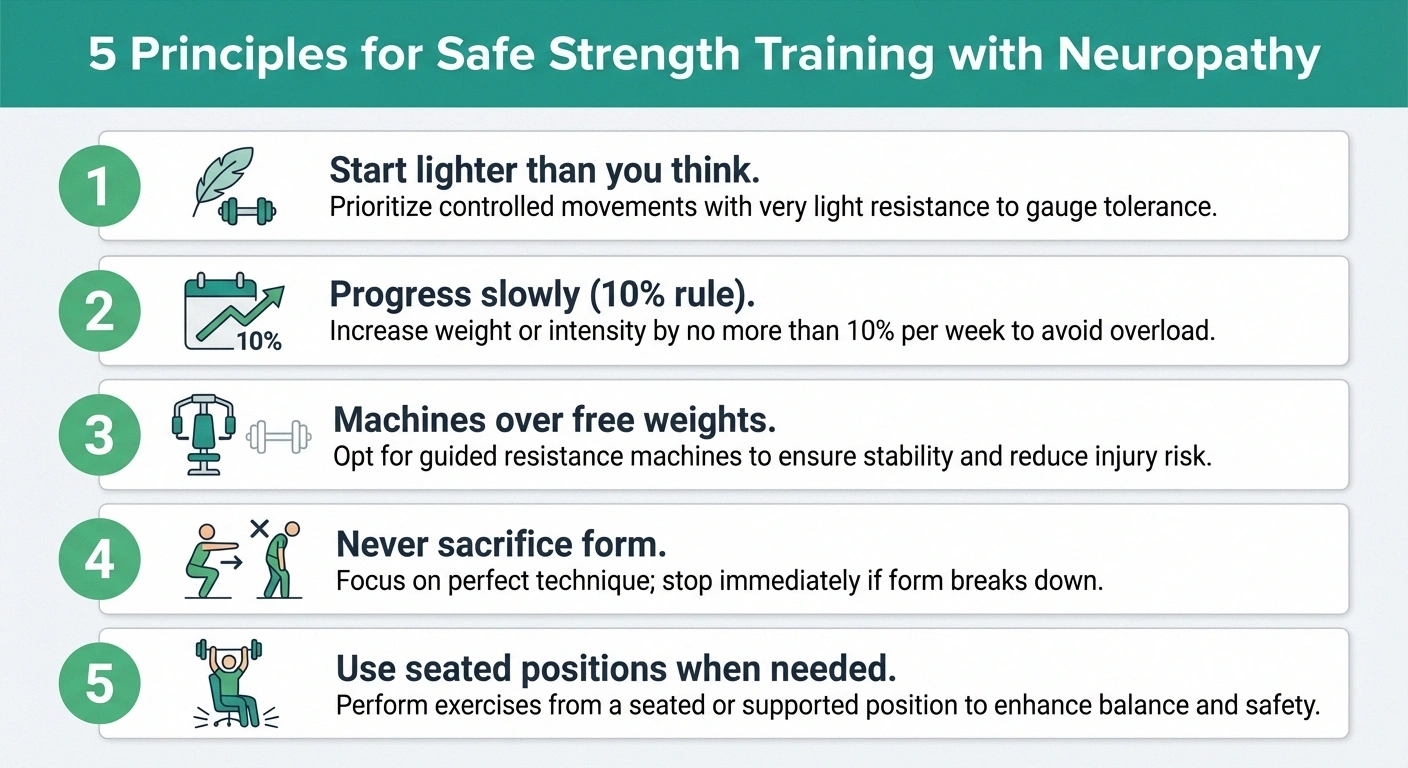
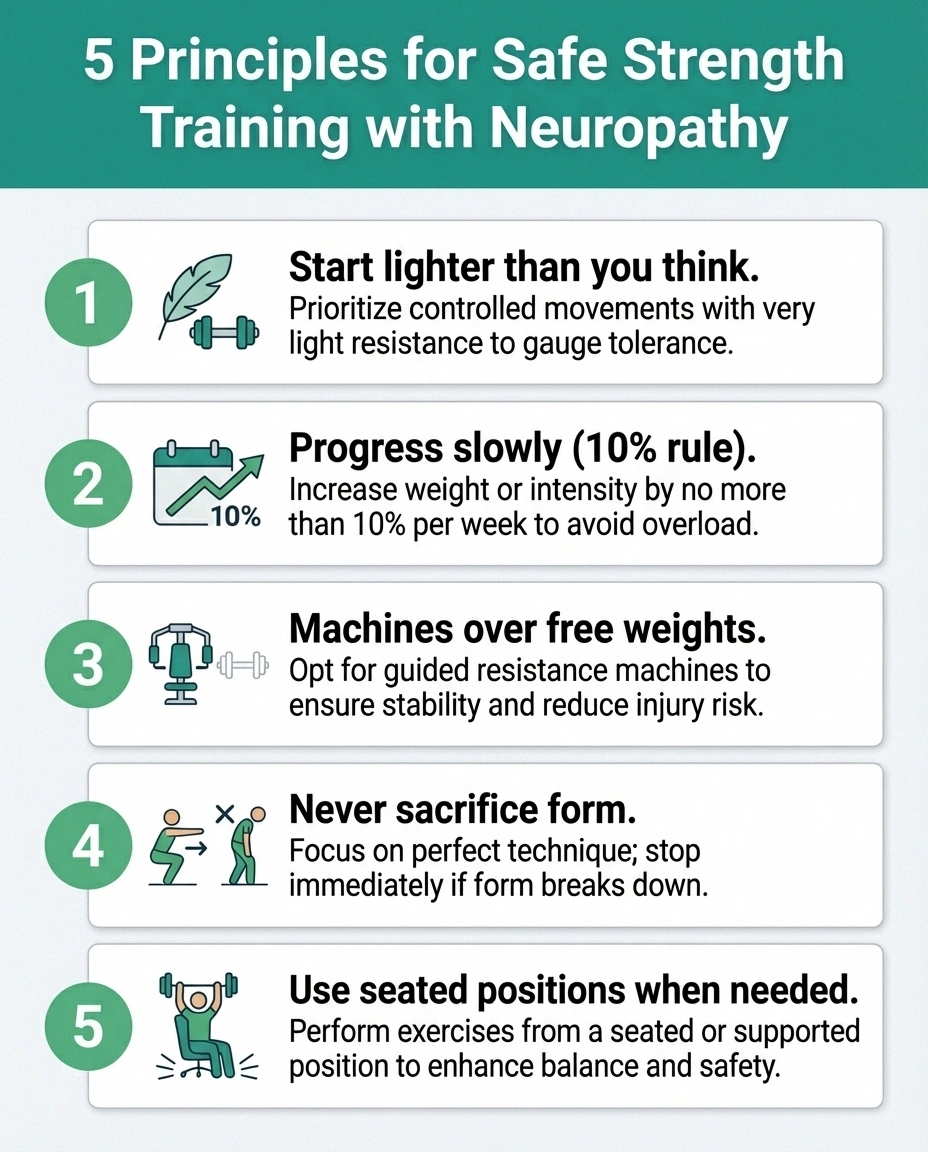
- Start lighter than you think you need to. Your first sessions should feel almost too easy. This lets you learn proper form before adding resistance. With neuropathy, you may not feel warning signs of strain — like subtle joint pain or muscle fatigue — the way you once did.
- Progress slowly. Increase weight or resistance by no more than 10% per week. If you're using resistance bands, move to the next level of resistance only when the current one feels comfortable for 15 repetitions.
- Prioritize machines over free weights when possible. Machines control the movement path, reducing the need for balance and coordination. If numbness in your hands makes gripping difficult, machines with forearm pads or handles are safer than dumbbells you might drop.
- Never sacrifice form for heavier weight. Controlled, deliberate movements through a full range of motion are more effective and far safer than jerky, momentum-driven reps with excessive weight.
- Use a seated position whenever balance is a concern. Many exercises can be done sitting in a sturdy chair, removing fall risk entirely while still challenging your muscles.
Upper Body Strength Exercises
Neuropathy doesn't only affect your feet. Many people experience numbness, tingling, and weakness in their hands and arms. Even if your upper body isn't directly affected, maintaining upper body strength supports overall functional independence and posture.
Grip Safety Note
If neuropathy affects your hands, use machines instead of free weights to reduce grip demands. People with peripheral neuropathy are more prone to entrapment neuropathies from wrist pressure. Wrist straps, padded gloves, or resistance bands are safer alternatives to heavy dumbbells.
Seated Bicep Curls
Sit in a sturdy chair with a light dumbbell (2-5 pounds) or resistance band. Keep your elbows at your sides. Slowly curl the weight toward your shoulder, pause for one second at the top, then lower with control. Perform 10-12 repetitions for 2-3 sets. If gripping is difficult, consider using wrist straps or wrapping the handle with a towel for a thicker grip.
Seated Shoulder Press
Sit with your back supported. Hold light dumbbells at shoulder height with palms facing forward. Press the weights overhead, extending your arms without locking your elbows. Slowly lower back to shoulder height. Start with 8-10 repetitions for 2 sets. This strengthens the deltoids and triceps, which are essential for reaching overhead — putting away dishes, getting items from high shelves.
Resistance Band Rows
Anchor a resistance band at chest height (around a doorknob or stair post). Sit facing the anchor point and pull the band toward your chest, squeezing your shoulder blades together at the end of each pull. Slowly return to the starting position. Perform 10-12 repetitions for 2-3 sets. Rows strengthen your upper back and improve posture — important because neuropathy pain often leads to hunching.
Wall Push-Ups
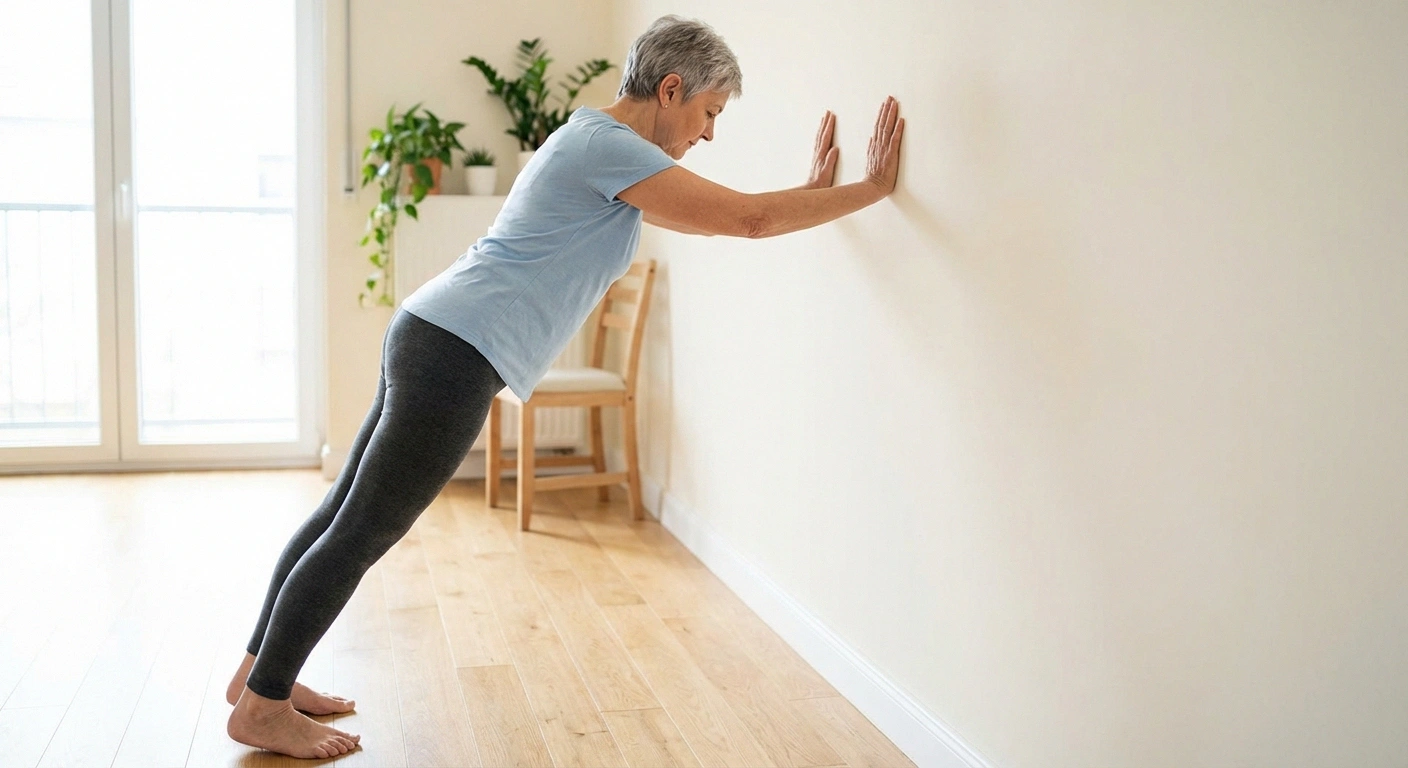
Stand facing a wall at arm's length. Place your hands flat on the wall at shoulder height. Slowly bend your elbows to bring your chest toward the wall, then push back to the starting position. Start with 10 repetitions and build to 3 sets. As you get stronger, move your feet further from the wall to increase the challenge. Wall push-ups are easier on the wrists than floor push-ups and eliminate balance concerns.
Lower Body Strength Exercises
Your legs and hips are where strength training matters most for neuropathy. Strong lower body muscles are your primary defense against falls and the key to maintaining walking ability.
🪑 Perfect Chair Squat Form
Chair Squats (Sit-to-Stand)
Sit in a sturdy chair with your feet hip-width apart. Without using your hands, stand up by pushing through your heels, then slowly lower yourself back into the chair. If you need help initially, place your hands on the armrests or on your thighs. Work toward 10-15 repetitions for 2-3 sets. This single exercise trains your quadriceps, glutes, and core — the muscles that determine whether you can get up independently.
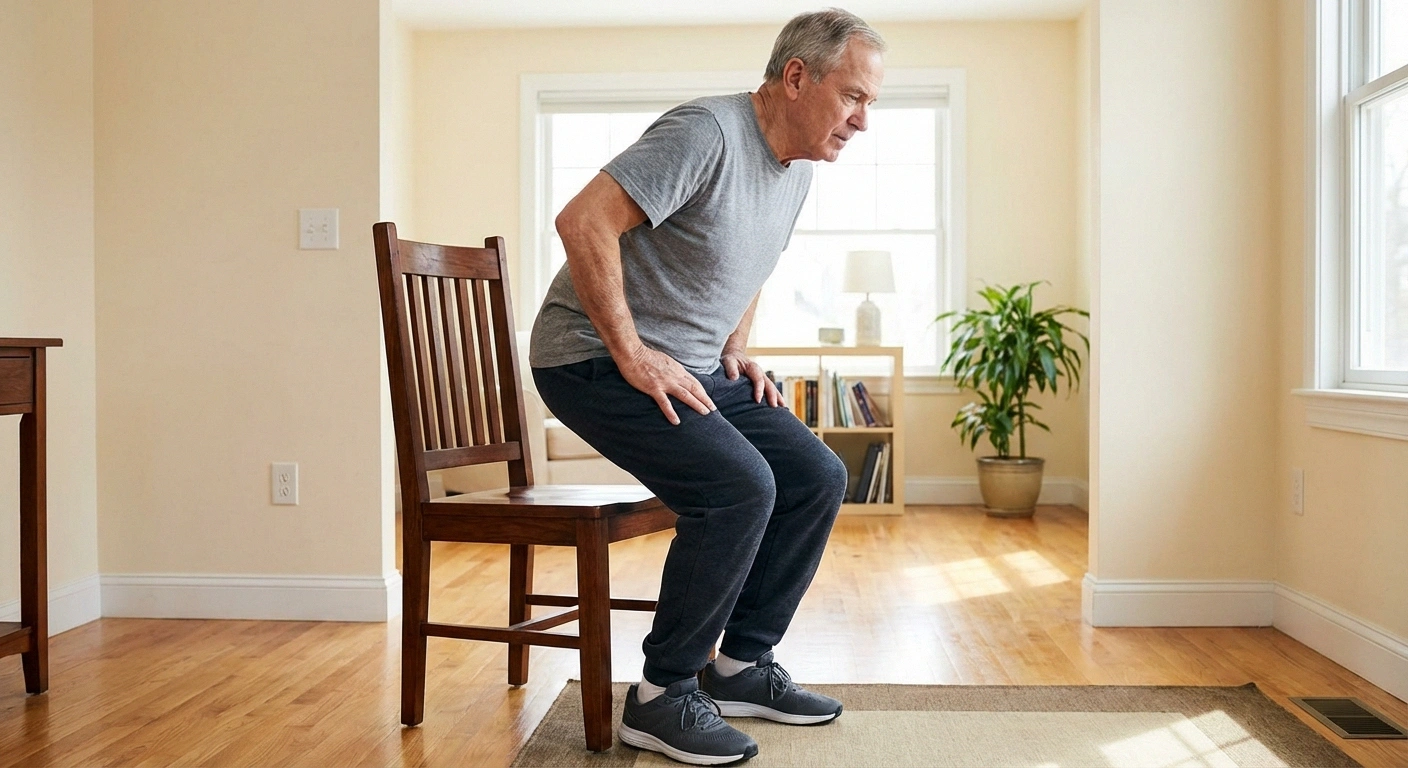
Seated Leg Extensions
Sit in a chair with your feet flat on the floor. Slowly straighten one knee, lifting your foot until your leg is extended. Hold for 3 seconds, then slowly lower. Repeat 10-15 times on each leg for 2-3 sets. For added resistance, loop a resistance band around the chair leg and your ankle. This isolates your quadriceps — the muscle group most critical for climbing stairs and preventing knee buckle.
Standing Hip Abduction
Hold onto a counter or sturdy chair back. Slowly lift one leg straight out to the side, keeping your toe pointing forward. Lift only as high as is comfortable (usually 6-12 inches), hold for 2-3 seconds, then lower with control. Repeat 10-12 times on each side for 2-3 sets. Your hip abductors are crucial for sideways stability — they're what prevent you from falling when you shift your weight unexpectedly.
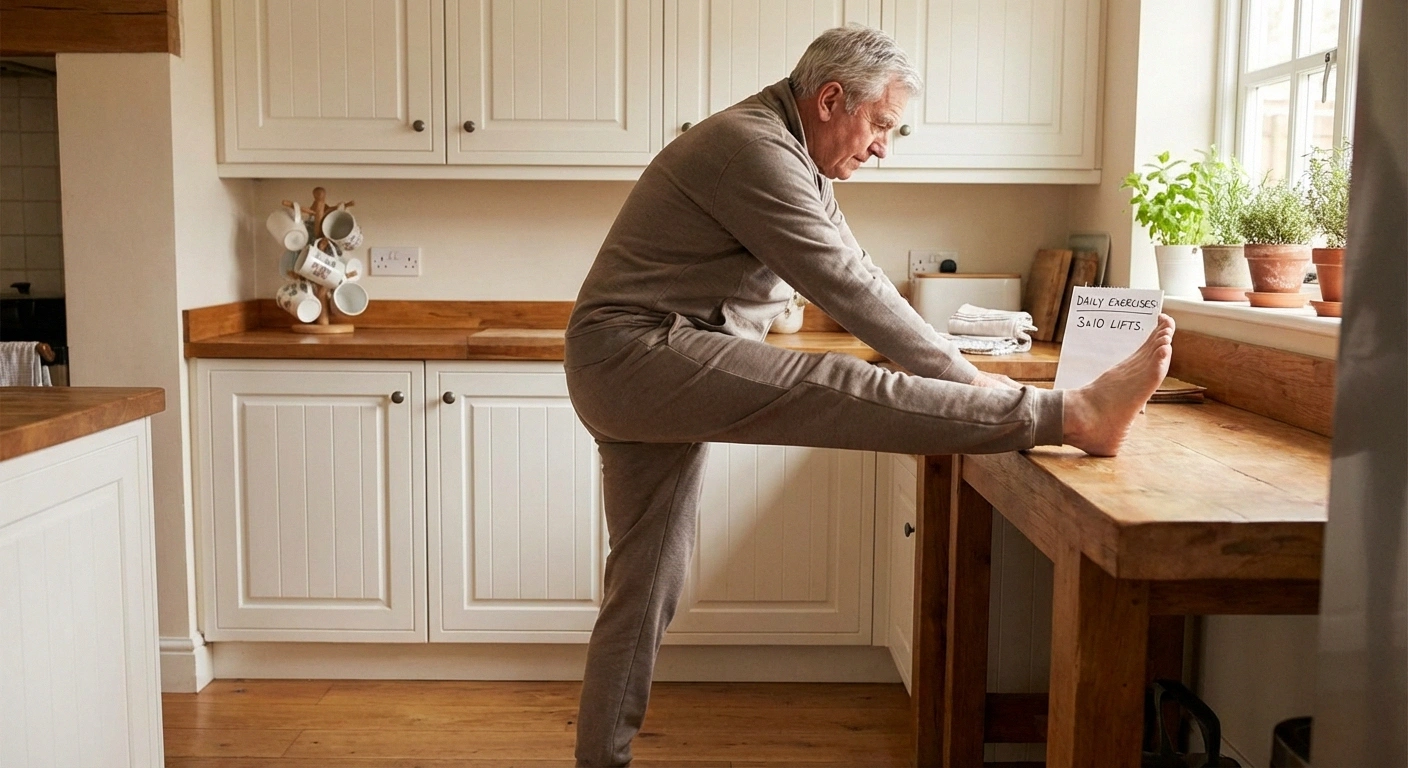
Calf Raises
Stand behind a chair with both hands on the back for support. Rise up onto your toes, hold for 3-5 seconds, then slowly lower your heels back to the floor. Perform 10-15 repetitions for 2-3 sets. For added challenge, try single-leg calf raises (with support). Strong calves improve ankle stability and help with push-off during walking.
Leg Press (Gym)
If you have access to a gym, the leg press machine is one of the safest lower body exercises for neuropathy. You're seated with back support, there's no balance requirement, and the machine controls the movement path. Start with a light weight you can press for 12-15 repetitions comfortably. Avoid locking your knees at the top of the movement.
Core Strengthening
Your core — the muscles of your abdomen, lower back, and pelvis — is your body's central stabilizer. A strong core helps compensate for the sensory information your numb feet can no longer provide. These exercises don't require any equipment.
Why Core Matters
Your core is your body's central stabilizer. When neuropathy impairs the sensory information from your feet, a strong core helps compensate — keeping you upright and balanced even when your feet can't feel the floor properly.
Seated Marching
Sit upright in a chair with your feet flat on the floor. Lift one knee toward your chest, lower it, then lift the other. Alternate for 30-60 seconds. Keep your back straight and core engaged throughout. This engages your hip flexors and deep abdominal muscles. For added challenge, extend your arms in front of you or hold light hand weights.
Pelvic Tilts
Lie on your back with knees bent and feet flat on the floor. Gently flatten your lower back against the floor by tightening your abdominal muscles and tilting your pelvis slightly upward. Hold for 5 seconds, then release. Repeat 10-15 times. This activates your deep stabilizer muscles without any balance demands.
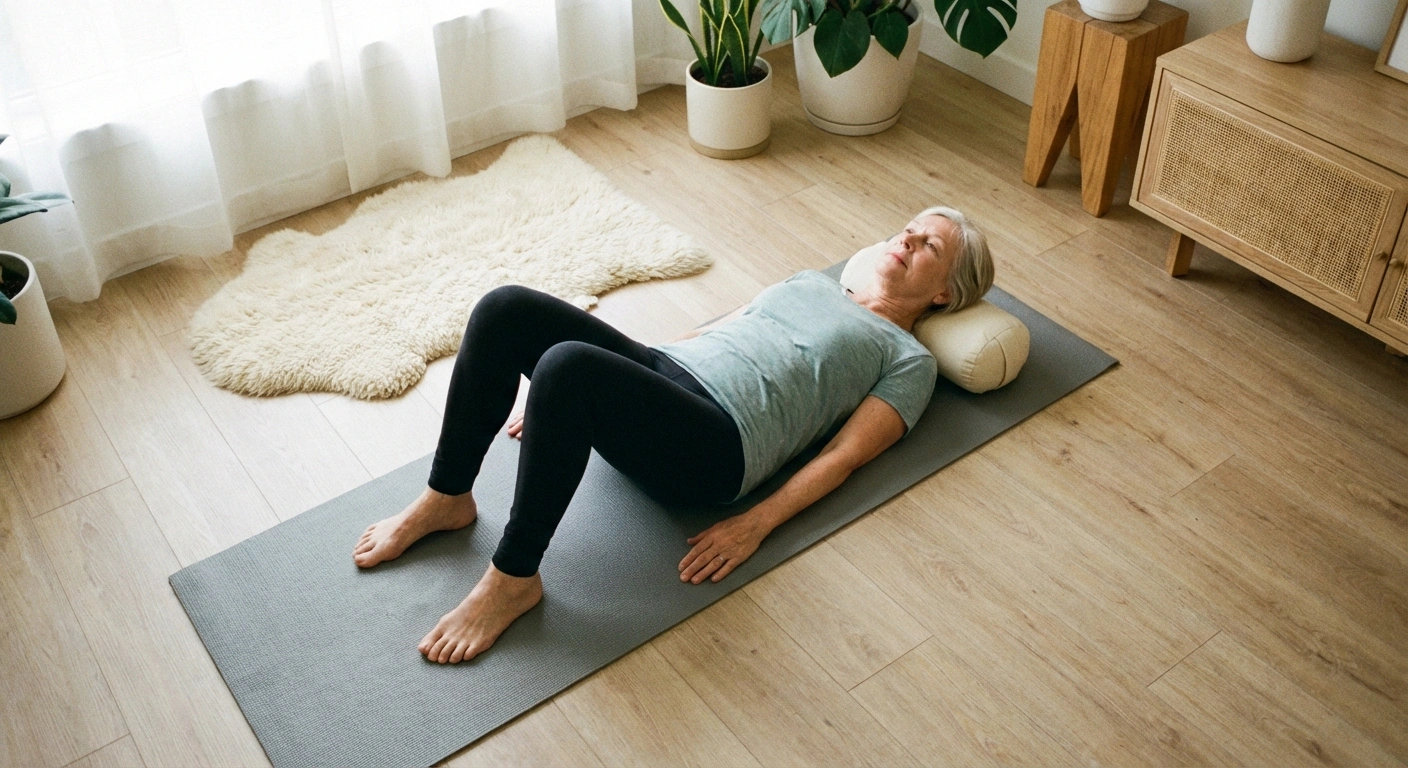
Modified Planks
Start on your hands and knees. Extend one arm forward and hold for 5-10 seconds. Return and switch arms. As you progress, try extending one leg behind you. The advanced version extends opposite arm and leg simultaneously. This challenges your core stability progressively without requiring you to hold a full plank position on numb feet.
What to Avoid: Exercises That Are Risky with Neuropathy
Some conventional strength training exercises carry outsized risks when you have peripheral neuropathy. The danger isn't usually the exercise itself — it's the combination of the exercise with impaired sensation and balance.
🔄 Risky Exercises → Safer Alternatives
- Heavy barbell squats and deadlifts. These require precise balance and the ability to feel subtle weight shifts through your feet. With numb feet, your body can't make the micro-corrections needed to stay balanced under a heavy load. Use the leg press machine or chair squats instead.
- Overhead lifts while standing. Standing overhead presses with significant weight can cause balance loss if neuropathy affects your proprioception. Do seated shoulder presses instead.
- Exercises with heavy grip demands. If you have neuropathy in your hands, exercises requiring a tight grip on heavy dumbbells or barbells risk dropping the weight. The American Academy of Neurology's Brain & Life magazine notes that people with peripheral neuropathy are more prone to entrapment neuropathies from pressure on forearms — so avoid excessive weight that forces a death-grip.
- Plyometrics and explosive movements. Box jumps, jump squats, and power cleans involve rapid force production and landing impact. With reduced sensation in your feet, you can't properly absorb landing forces or feel foot position during explosive movements.
- Single-leg exercises without support. Lunges, single-leg deadlifts, and Bulgarian split squats are excellent exercises — for people with intact proprioception. If your balance is compromised, do these only while holding onto a stable surface, or substitute with machine-based alternatives.
Sample Weekly Routine
Here's a balanced weekly strength training program designed specifically for people with neuropathy. This is a starting framework — adjust based on your current ability level and symptoms.
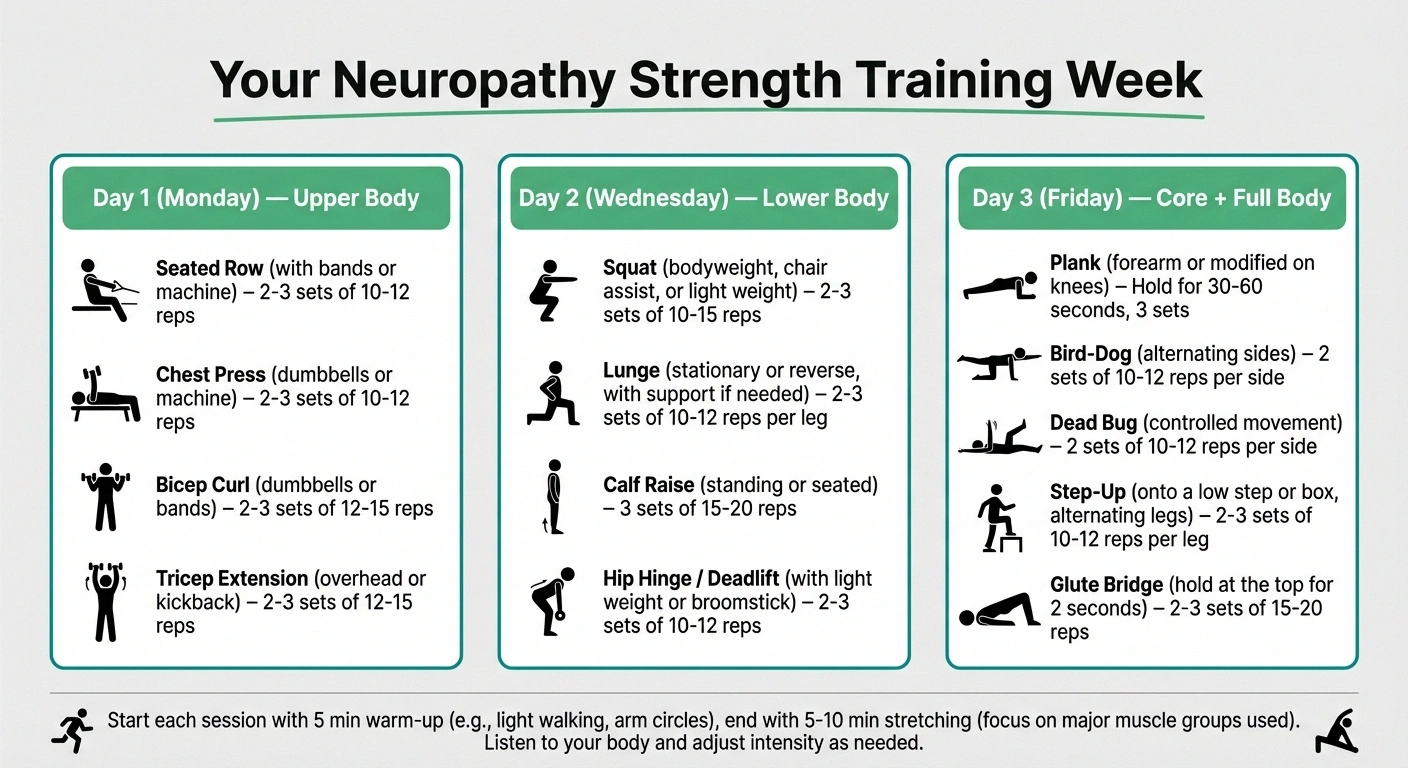
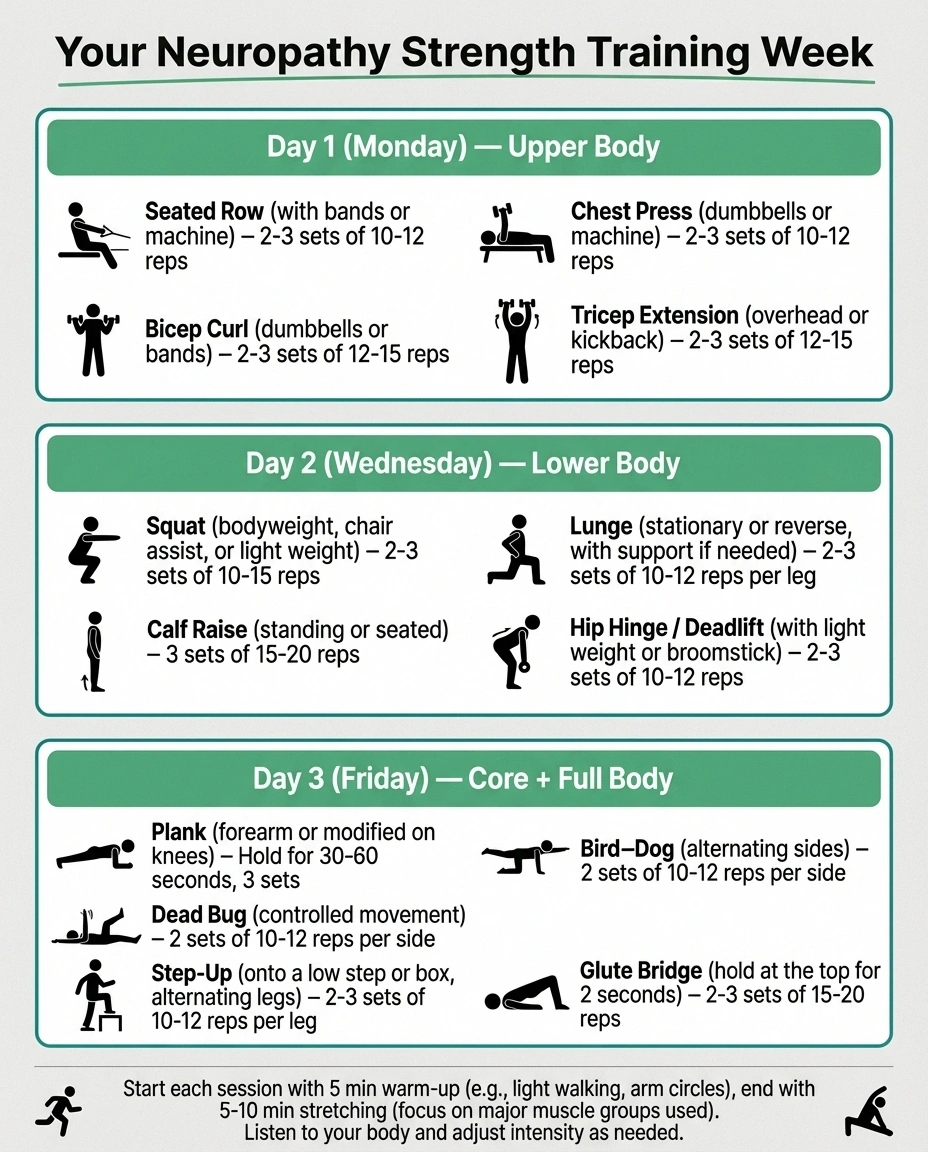
Day 1: Upper Body (Monday)
- Seated bicep curls — 2 sets × 10-12 reps
- Wall push-ups — 2 sets × 10 reps
- Resistance band rows — 2 sets × 10-12 reps
- Seated shoulder press — 2 sets × 8-10 reps
Day 2: Lower Body (Wednesday)
- Chair squats — 2 sets × 10-15 reps
- Seated leg extensions — 2 sets × 10-12 reps each leg
- Standing hip abduction — 2 sets × 10-12 reps each side
- Calf raises — 2 sets × 10-15 reps
Day 3: Core + Full Body (Friday)
- Seated marching — 2 sets × 30-60 seconds
- Pelvic tilts — 2 sets × 10-15 reps
- Modified planks — 2 sets × 5-10 second holds each side
- Resistance band arm curls — 2 sets × 10-12 reps
- Chair squats — 1 set × 10 reps (reinforcement)
Start each session with 5 minutes of gentle warm-up (seated marching, arm circles, ankle rotations). End with 5-10 minutes of stretching. On non-strength days, walk, swim, or do another aerobic activity for 20-30 minutes.
Tracking Your Progress
Progress with neuropathy can feel slow — but it's real. Track these markers to see your improvement:
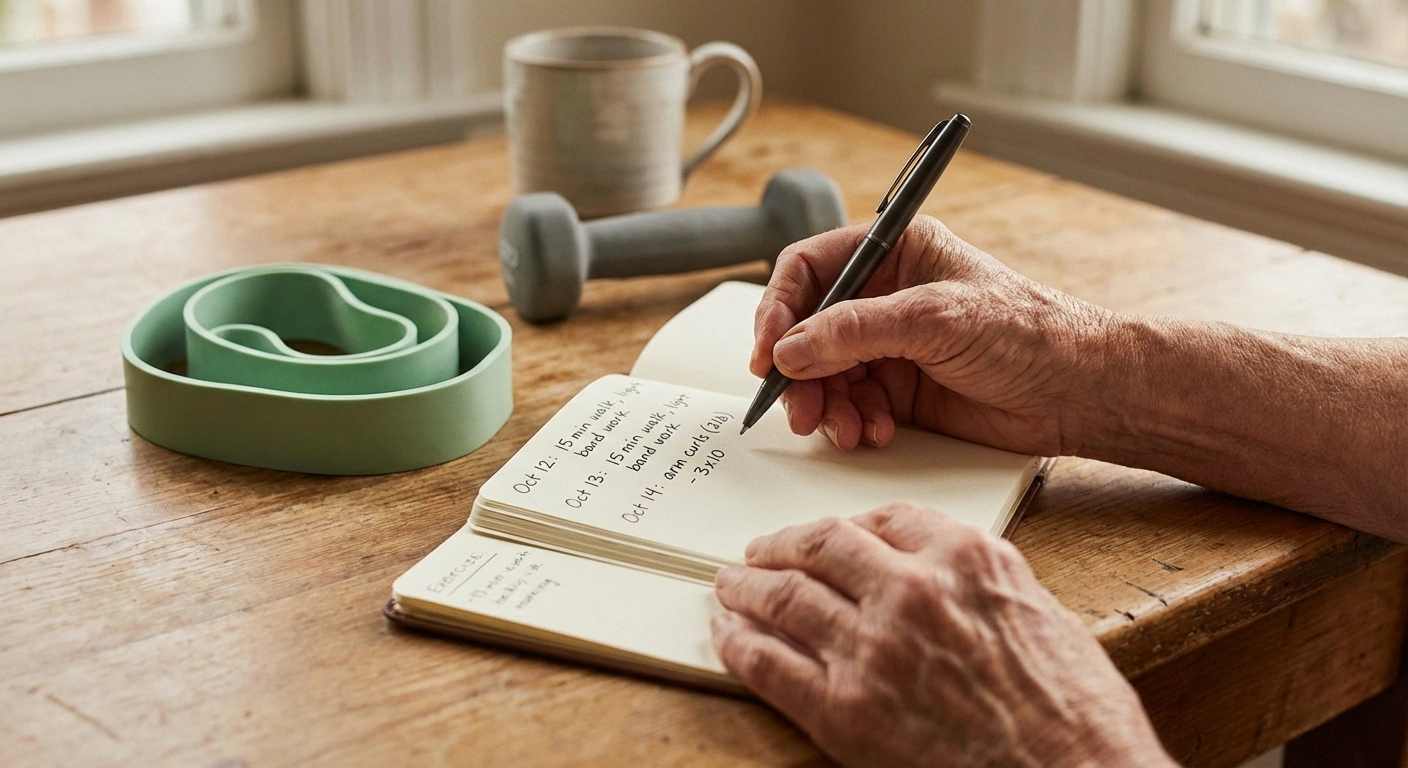
- Repetitions and resistance. Write down how many reps you complete and what weight or band you use. When 15 reps feels easy, it's time to progress.
- Chair stand test. Time how many sit-to-stands you can do in 30 seconds. Repeat monthly. This is a validated measure of lower body strength and fall risk.
- Functional milestones. Can you now carry groceries further? Climb stairs without holding the railing? Get up from a low couch without assistance? These real-world victories matter more than any number on a weight rack.
- Balance confidence. Rate your confidence in your balance on a 1-10 scale weekly. Over time, this typically improves as strength builds.
- Pain and symptom diary. Track neuropathy symptoms alongside your exercise log. Many people notice that symptoms are better on days they exercise — and this correlation becomes motivating. Use a symptom journal to identify patterns.
Working with a Physical Therapist
While this guide provides a solid foundation, working with a physical therapist who understands neuropathy can take your training to another level. A PT can:
Getting Started with PT
Ask your doctor for a referral to a physical therapist who has experience with neuropathy. Most insurance plans cover PT for peripheral neuropathy. A PT can assess your specific muscle weaknesses and design a targeted, progressive strength program tailored to your needs.
- Assess your specific muscle weaknesses and design a targeted program
- Teach proper form for exercises, reducing injury risk
- Progress your program appropriately based on your individual response
- Address specific mobility limitations or pain patterns
- Provide accountability and motivation
Many insurance plans cover physical therapy for neuropathy. Ask your doctor for a referral if you're interested in supervised training.
Frequently Asked Questions
Can I lift weights if I have neuropathy in my hands?
Yes, with modifications. Use machines instead of free weights to reduce grip demands. Wrist straps or padded gloves like compression gloves can help maintain grip. Resistance bands are often easier to hold than dumbbells. Avoid very heavy weights that force a white-knuckle grip, as this can compress nerves in your wrists and forearms and worsen hand symptoms.

How often should I strength train with neuropathy?
Two to three sessions per week is the sweet spot for most people with neuropathy. Allow at least one rest day between strength sessions targeting the same muscle groups. This gives your muscles time to recover and rebuild. Pair your strength days with aerobic exercise and balance training on alternate days for a complete program.
Will strength training make my neuropathy pain worse?
When done correctly with appropriate weight and progression, strength training should not worsen neuropathy pain. Most people find their symptoms improve over time with regular training. Some mild muscle soreness 24-48 hours after exercise is normal and different from neuropathy pain. If you experience increased burning, tingling, or shooting pain during or after exercise, reduce the intensity and consult your doctor.
What if I can't get to a gym?
You can do an effective strength program at home with minimal equipment. A sturdy chair, a set of resistance bands, and a pair of light dumbbells are all you need. Many of the exercises in this guide require nothing but a chair and your own body weight. The chair squat, seated leg extension, wall push-up, and seated marching are all equipment-free.
Is it safe to strength train with diabetic neuropathy?
Yes. The American Diabetes Association recommends both aerobic and resistance training for people with diabetes, including those with neuropathy. Strength training helps control blood sugar by increasing insulin sensitivity in muscles. Check your feet before and after exercise, wear proper footwear, and monitor your blood sugar levels. Avoid heavy weight-bearing exercises if you have active foot ulcers or Charcot foot.
How long before I see results?
Most people notice improved energy and slightly better balance within 2-4 weeks. Measurable strength gains typically appear after 6-8 weeks of consistent training. Fall risk reduction and walking improvements may take 8-12 weeks. The study by Allet and colleagues showed that 12 weeks of training produced benefits lasting six months — so the investment pays long-term dividends.
The Bottom Line
Strength training isn't just an optional add-on for people with neuropathy — it's a necessity. Muscle wasting is a predictable consequence of nerve damage, and the only way to fight it is by regularly challenging your muscles to maintain their strength. You don't need a gym. You don't need heavy weights. A chair, some resistance bands, and 20-30 minutes three times a week can meaningfully slow muscle loss, reduce your fall risk, and preserve the independence that neuropathy threatens to take away.
Start where you are. Progress at your own pace. And talk to your doctor or a physical therapist if you're unsure about any exercise. The biggest mistake you can make is doing nothing. For a broader view of all exercise types that help with neuropathy, see our complete exercise guide.
About the Author