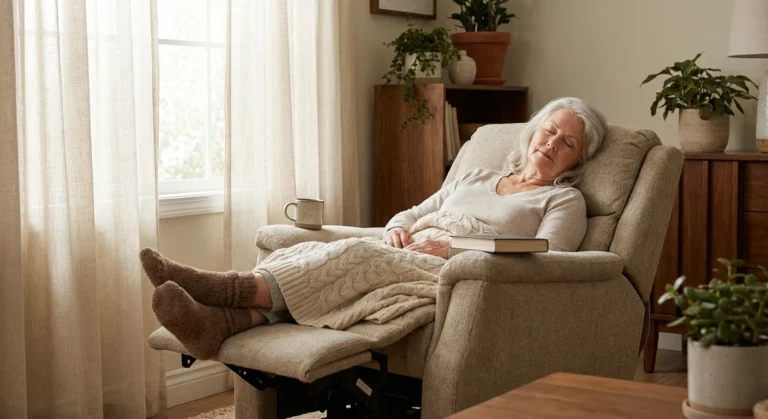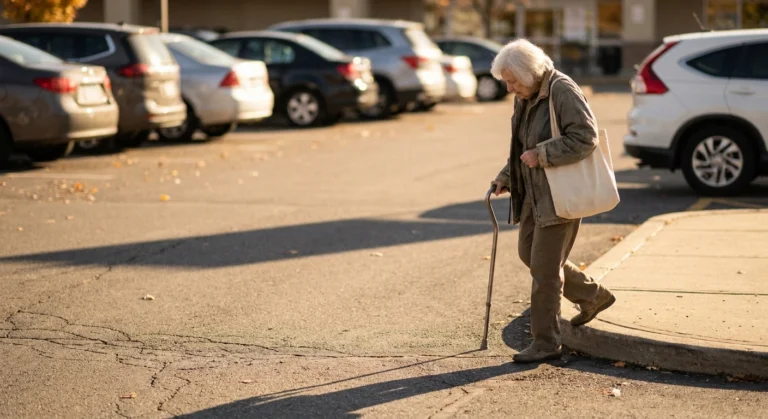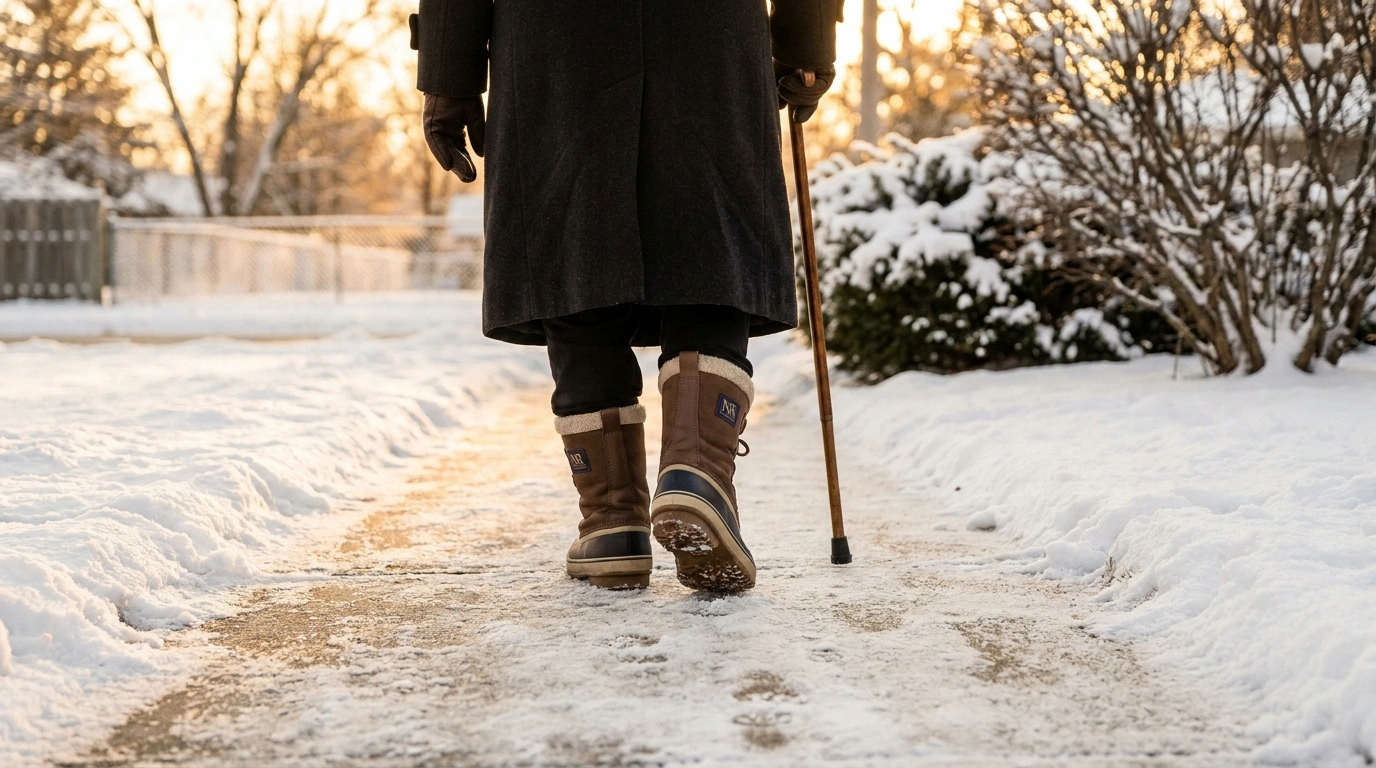
The first winter after my neuropathy got bad enough to notice, I stepped off my porch and my foot went sideways on a patch of ice I didn’t see and couldn’t feel. I caught myself on the railing — barely — and stood there breathing for a long minute. It was the moment I realized that walking outside in winter was not the same activity for me anymore that it had been the year before. The ground had changed. So had my feet. The two pieces had to be reconnected with some new thinking.
I’m Janet Ellis. I am a community advocate who has lived with neuropathy for years; I am not a doctor or a physical therapist. What I can do is share the practical map I have built — partly from research, partly from our support group, partly from my own bruised pride — for getting through the cold months without an emergency room trip. None of this is fancy. All of it is genuinely useful.
Why Ice and Snow Are Especially Risky With Neuropathy
Two of the things neuropathy steals are the things you most need on a slippery surface. The first is sensation — the small signals from the bottoms of your feet that say “this surface is moving” or “this is colder than it should be.” A foot with normal sensation will catch a tiny slide before it becomes a real one. A foot with reduced sensation will only notice the slide when it has already started, which is too late to react. The second thing is proprioception, your sense of where your feet are in space. Our guide to proprioception loss in neuropathy covers this more fully, but on ice it shows up as: you can’t make the small corrections most people make automatically when their weight shifts on an uneven surface.
The right footwear plus a pair of slip-on ice cleats plus the short-step “penguin walk” technique handle most winter walking risk for people with neuropathy. Knowing when to stay home on the worst days handles the rest.
Add in the cold itself, which makes any nerve symptoms worse for many people (more on that in our piece on why winter makes neuropathy worse), and the result is a season where a routine like “going to get the mail” becomes a genuine balance challenge. Falling on ice carries a serious injury risk for older adults regardless of neuropathy. Adding neuropathy on top compounds it.
The point of this guide is not to scare you out of going outside. The point is to redesign how you go outside so that going outside stays possible — without you breaking a hip.
Footwear: Where Most of the Difference Is Made
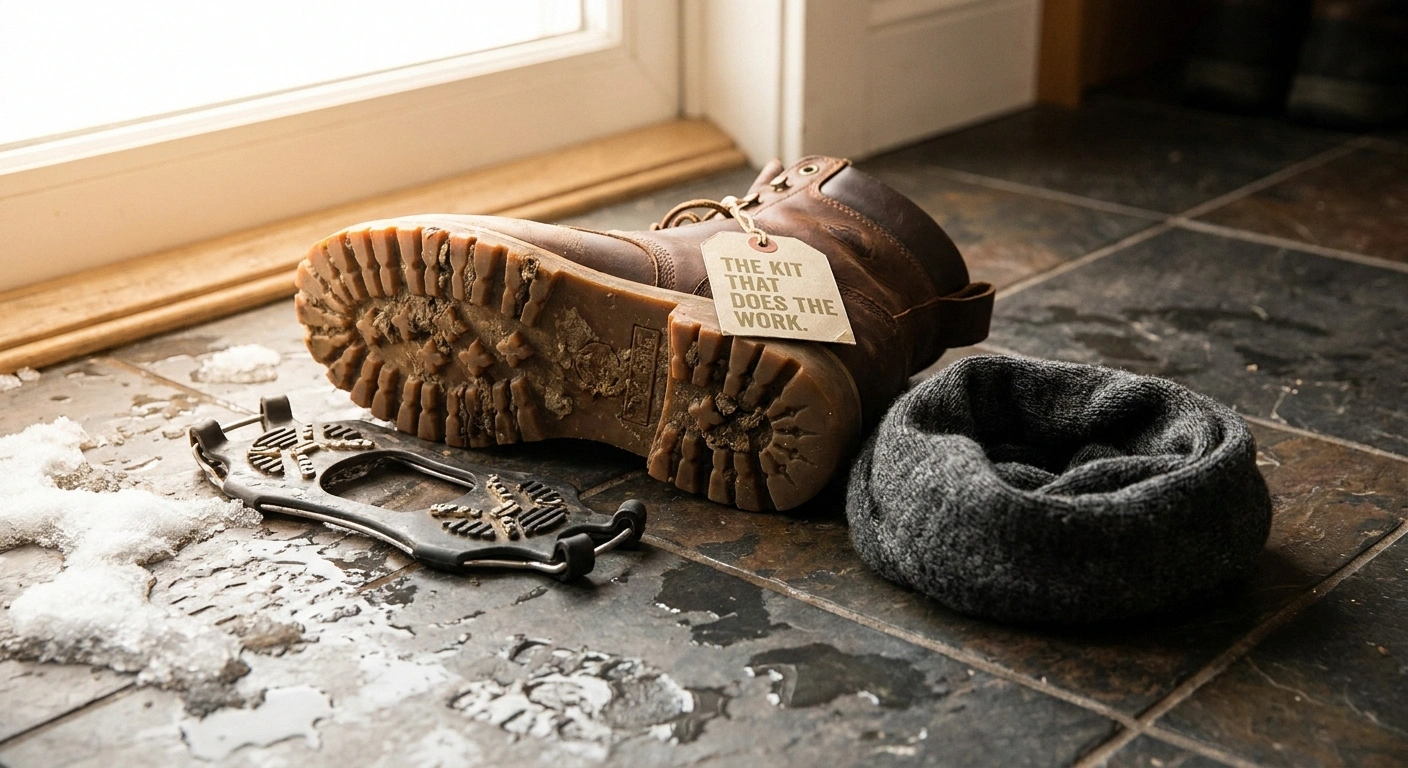
Almost every fall I have heard about in our group started with the wrong shoes. The right winter footwear for neuropathy looks different from regular winter footwear because the stakes are different. Here is what to look for:
- Deep, aggressive lug soles. The tread on a summer shoe will not grip on ice. You want soles that look more like a hiking boot than a sneaker — with deep grooves cut at varied angles to grip terrain.
- Wide, stable platform. Narrow soles wobble. A wider sole creates a broader base of support, which compensates for the proprioception you no longer have.
- Stiff heel counter. The back of the boot should not collapse when you press on it. A stiff heel keeps the foot aligned and reduces ankle roll.
- Room in the toe box. Cold feet swell. Tight shoes pinch nerves further. Buy winter boots a half-size larger than your summer shoes to leave room for warm socks and natural swelling.
- Insulation that doesn’t crush your feet. Look for Thinsulate or wool linings rather than foam that compresses. Compression can worsen neuropathy symptoms.
- Easy on and off. If you have hand neuropathy too, deal with lace difficulty before you are outside in the cold. Velcro straps, zippers, or simple slip-on bootie styles take less dexterity.
Our broader guide to the best shoes for neuropathy applies most of the year; the winter version of this advice is the same principles plus traction and insulation.
Ice Cleats: The Single Highest-Value Add-On
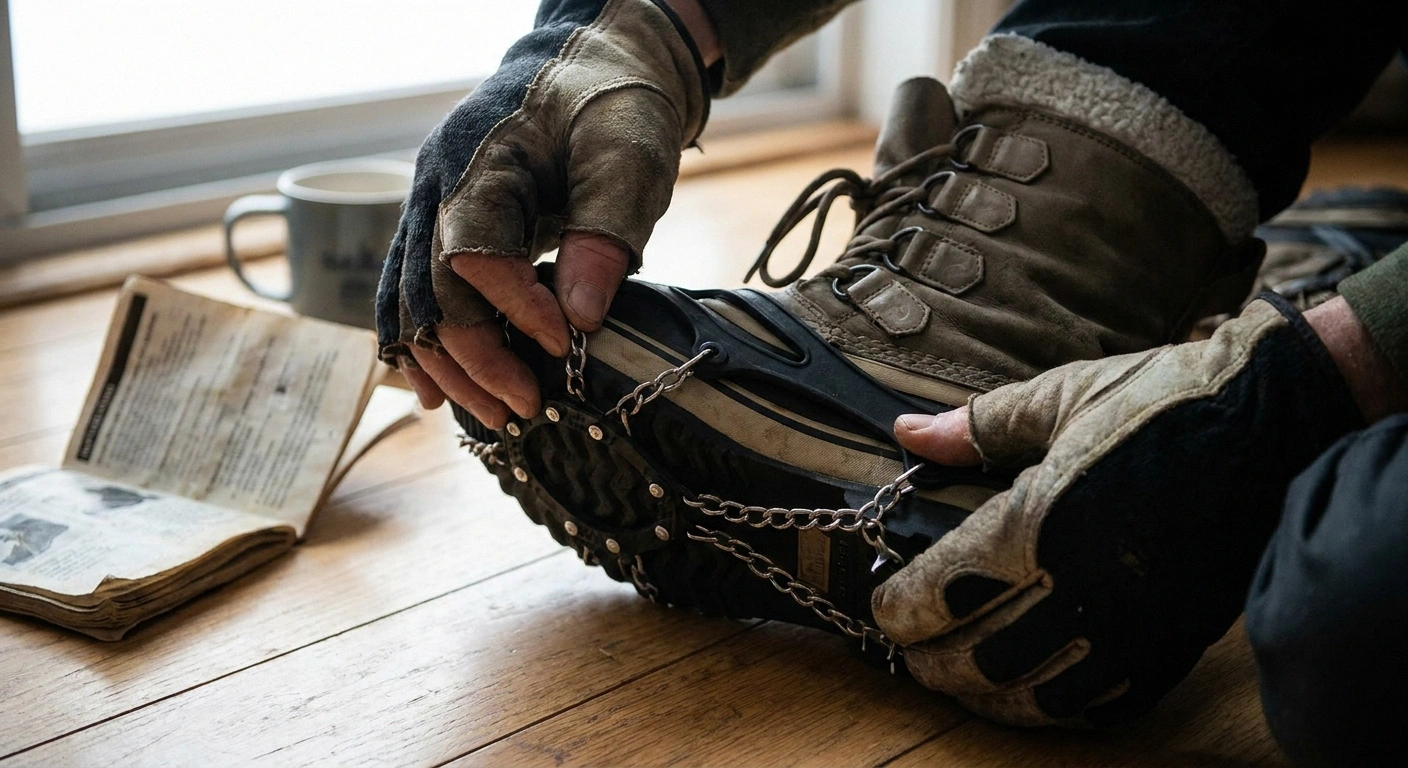
If I could only recommend one purchase for winter walking with neuropathy, it would be a pair of slip-on ice cleats. These are simple rubber-and-metal devices (common brand names include Yaktrax, Stabilicers, Kahtoola, and many others) that you stretch over the bottom of your existing boot. The metal grippers — coils, studs, or spikes depending on the model — bite into ice the way bare rubber cannot.
Using Ice Cleats Safely — 5 Steps
A few practical notes on choosing and using them:
- The right model depends on your terrain. Coil-style cleats handle packed snow and light ice well; stud or spike models handle real ice and steep grades better. If you live where ice storms happen, get the more aggressive version.
- Sizing matters. A loose cleat slides on the boot and is dangerous. Try them on before the first storm.
- Take them off indoors. Metal grippers on smooth indoor surfaces — tile, polished wood, vinyl, hospital floors — are far more slippery than bare boot soles. Many falls happen when someone wears their cleats into a store or doctor’s office. A small bag in your pocket for the removed cleats solves this.
- Practice on flat ground first. The walking feel is slightly different. Take a few minutes on a flat sidewalk before you tackle slopes or steps.
- Inspect them regularly. Worn metal grippers do not work. Replace cleats every season or two depending on use.
The cost is modest — usually twenty to forty dollars — and they extend the range of conditions you can safely walk in by a wide margin.
How to Walk Differently on Ice
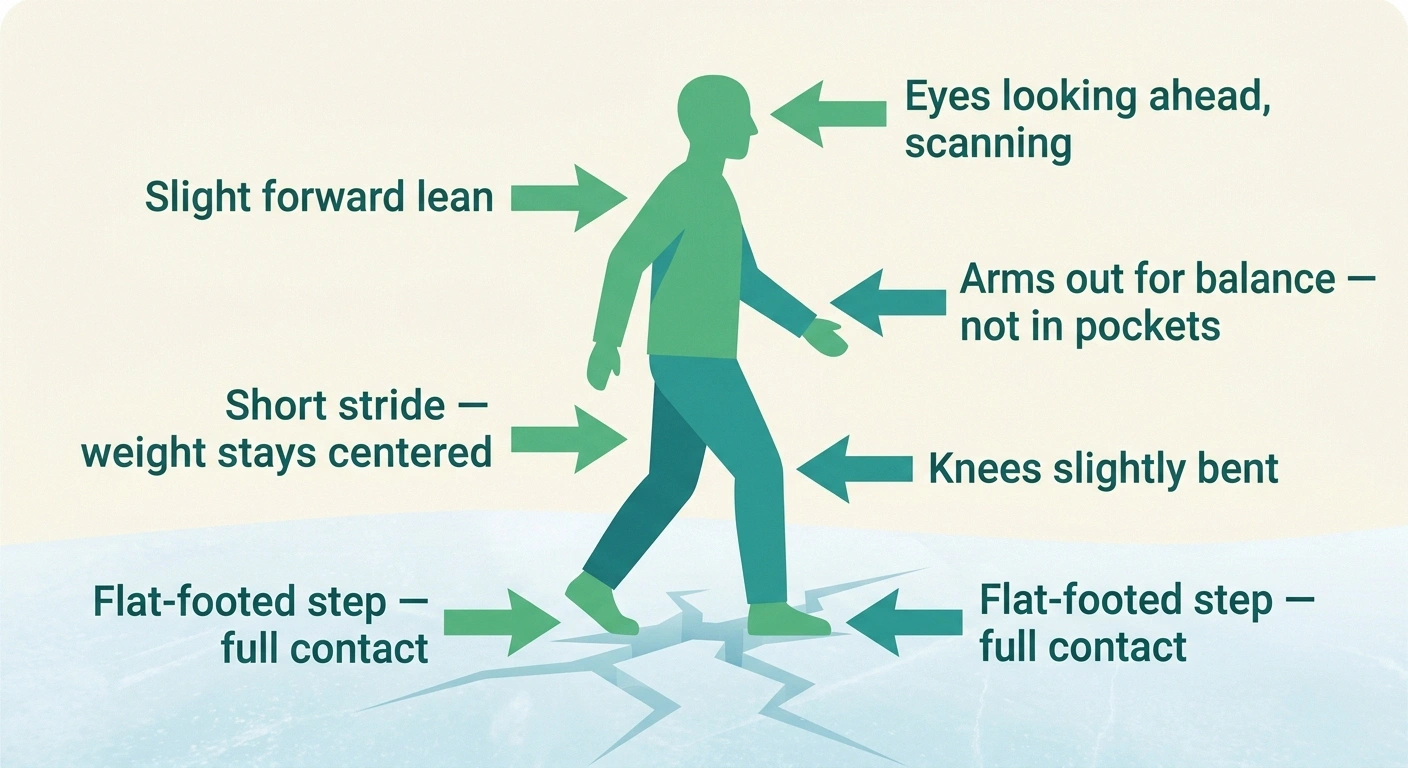
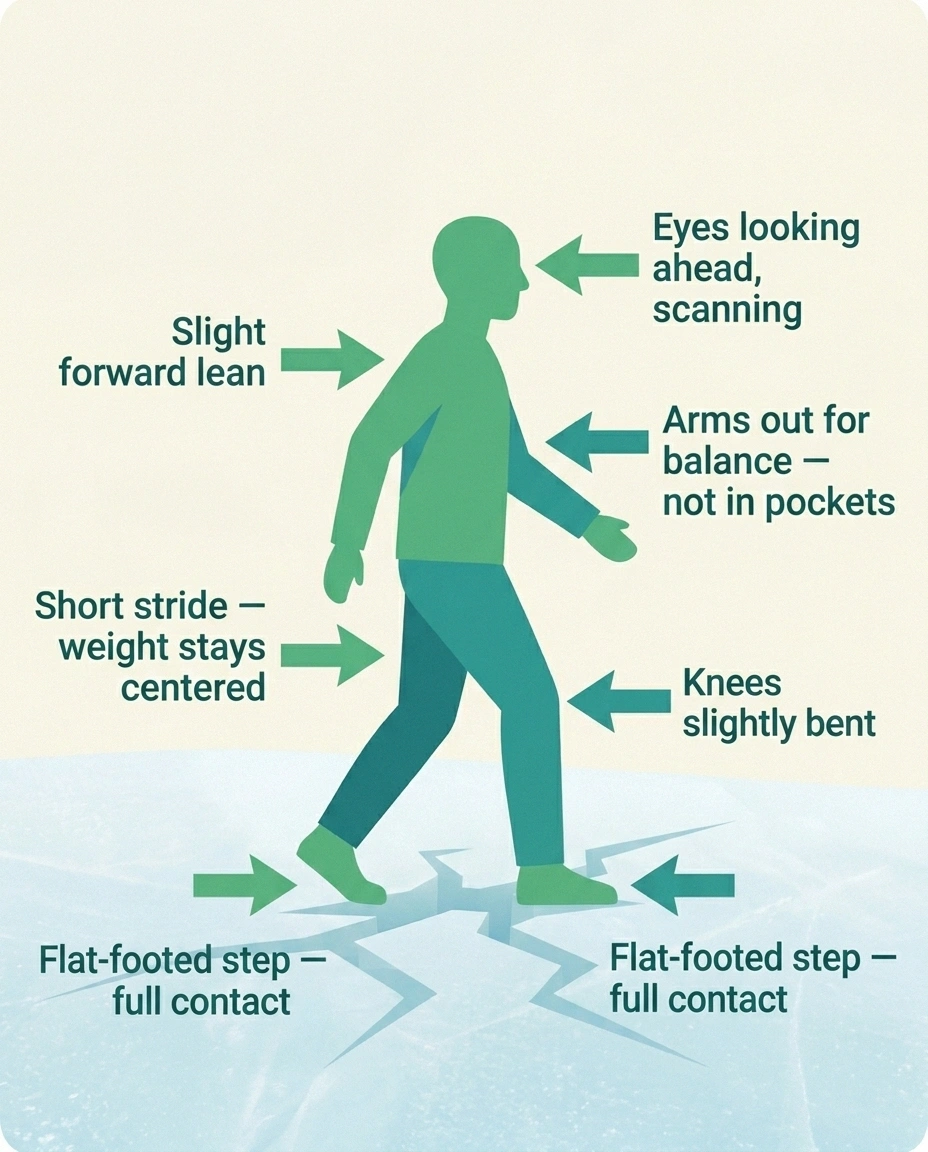
This is the technique that physical therapists call the “penguin walk” and it works. The principle: shorten your stride, keep your weight centered over each step, and let your feet do less reaching and more catching.
The “Penguin Walk” — Why It Works
Physical-therapy and fall-prevention research consistently finds that short, flat-footed steps with a slight forward lean reduce falls on slippery surfaces. The mechanics: a wider contact patch with each step grips better, body weight stays centered over the supporting foot rather than reaching ahead, and a soft-knee posture absorbs small slips before they become falls. Older adults trained in this technique fall less on icy surfaces in field studies — even without changing footwear.
- Take shorter steps. A long stride puts your weight ahead of your front foot. A short stride keeps it over your supporting foot, which is where you want it on uncertain footing.
- Walk flat-footed. Normal walking lands on the heel and pushes off the toe. Both motions reduce contact area with the ground. On ice, set your whole foot down at once and lift your whole foot at once.
- Bend your knees slightly. Soft knees absorb small slips. Locked knees turn small slips into falls.
- Lean slightly forward. Counterintuitive but real. A small forward lean over your hips keeps your weight on your supporting leg.
- Keep your hands out of your pockets. Your arms balance you in a slip. They cannot balance you if they are zipped inside a coat. Wear good warm gloves and let your arms hang free.
- Look ahead, not at your feet. Counterintuitive again. Looking down narrows your field of view and makes you miss the bigger picture — the patch of ice three steps ahead, the snowbank to your right. Scan the ground ten feet ahead the way a driver scans the road.
Canes and Walking Aids in Winter
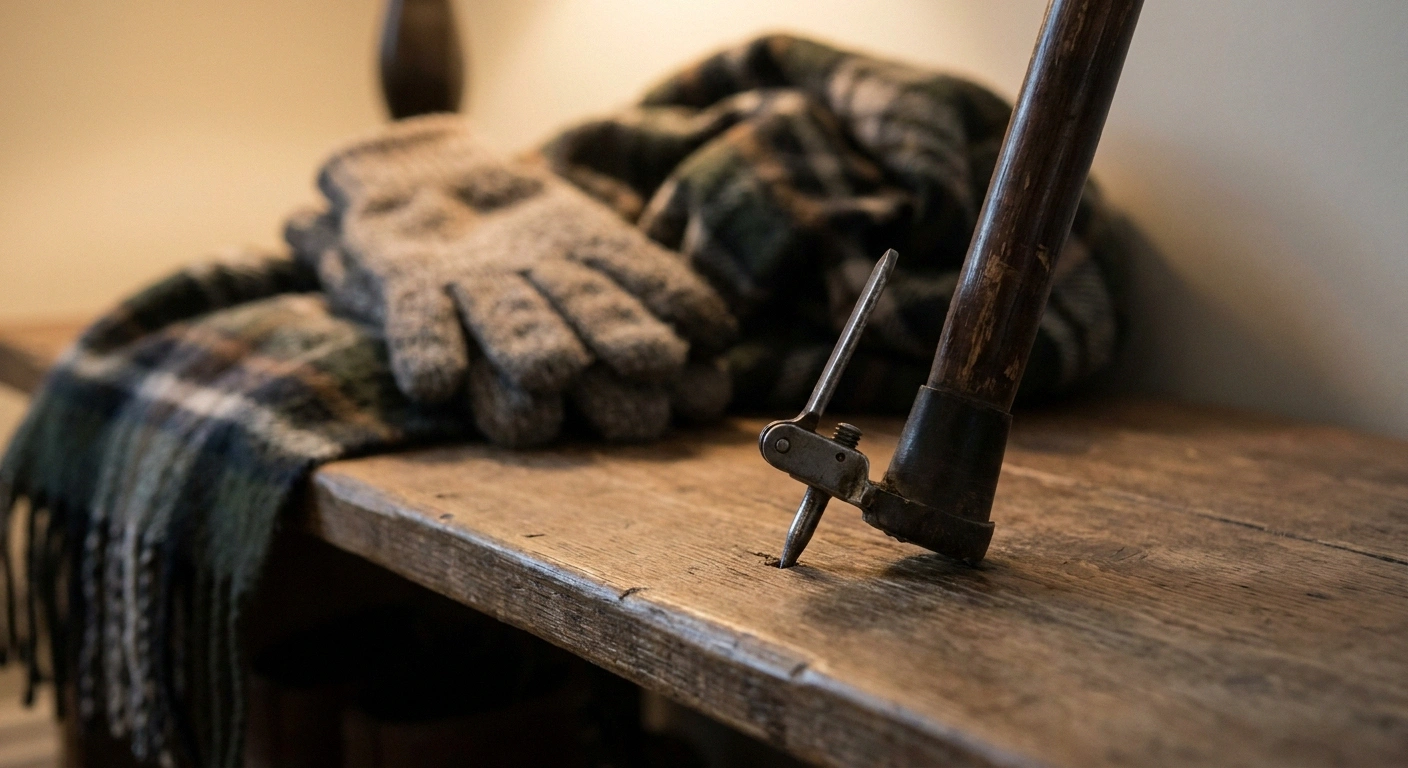
If you already use a cane in good weather, winter is when it earns its keep. If you have been holding off, winter may be the season to start. Our guide to walking aids and canes for neuropathy covers the broader choice; here are the winter-specific points:
- Ice tips exist and are essential. A standard rubber cane tip is no better on ice than a regular shoe. Flip-down ice tips (a small spike that swings out from a hinged housing) attach to most canes and give you a real point of grip. Flip them up when you go indoors so you do not damage floors or slip on smooth surfaces.
- Carbide tips are sharper. Standard steel ice tips dull. Carbide ice tips stay sharp much longer and cost only a few dollars more.
- Two canes or a walker may be the right answer. If you find yourself unsteady on ice with one cane, two canes (one in each hand) give you a much wider base of support. Walkers with snow-rated wheels exist for those who need more stability — they are not graceful, but a graceful fall is worse.
- Wrist straps prevent dropping. Cold hands lose grip. A wrist strap keeps the cane attached to you even if your hand briefly opens.
The Stay-Home Decision
The most important winter walking skill, honestly, is knowing when not to walk. Some days the right answer is to stay home. The rule of thumb I use myself and recommend in our group:
If any of these apply, the trip can wait or be delegated:
- A freezing-rain or ice-storm warning is in effect
- Your sidewalks have not been cleared and the porch already feels uncertain
- Your feet have gone numb from the cold — the warning signal for frostbite is gone
- Your balance is having a worse-than-usual day
- You would be walking after dark, in unfamiliar terrain, alone
The trip you skip today is the broken hip you do not have next week.
- If a freezing-rain warning is in effect, do not go out. Even the best cleats and the best technique cannot reliably handle freshly-glazed ice on every surface. Reschedule the errand.
- If sidewalks have not been cleared, do not go out without testing. Step onto your porch first. If you can feel that your support there is uncertain, the walk to the car will be worse.
- If you cannot feel your feet at all because of the cold, come back inside. Loss of cold sensation does not mean you are safe — it means you have lost the warning signal. People with neuropathy can develop frostbite without feeling the pain that warns most others to come in.
- If your balance is having a bad day, lower the bar. Some neuropathy days are worse than others. On a worse day, the same conditions outside are riskier than on a better day. Listen to that.
It is genuinely OK to ask someone else to do the errand. It is genuinely OK to wait one day. The trip you skip today is the broken hip you do not have next week.
Driveways and Walkways You Control
The pavement near your own front door is one of the few winter surfaces you can actually change. Make it as forgiving as possible:
- Have a clearing plan in place before the first storm. Whether it is a family member, a neighbor’s teenager paid a small amount per snowfall, or a service contract, do not wait until snow is on the ground to figure out who shovels. Make sure they also clear the path to your mailbox, garbage cans, and side door — not just the main route.
- Use de-icer or sand. Salt-based de-icers melt ice; sand provides traction without melting. Both have their place. If you have neuropathy-prone dogs, look for pet-safe formulas.
- Mark the edges of paths. Driveway markers or simple flags help your eye trace the boundary of the cleared path when snow blurs it.
- Light it up. Winter evenings come early. A motion-sensing porch light or stairwell light removes one of the variables that makes winter walking harder.
- Inspect handrails. Outdoor handrails take a beating in cold weather. Wiggle yours before you depend on them. A loose handrail in October is a fall in January.
Cold-Weather Foot Care
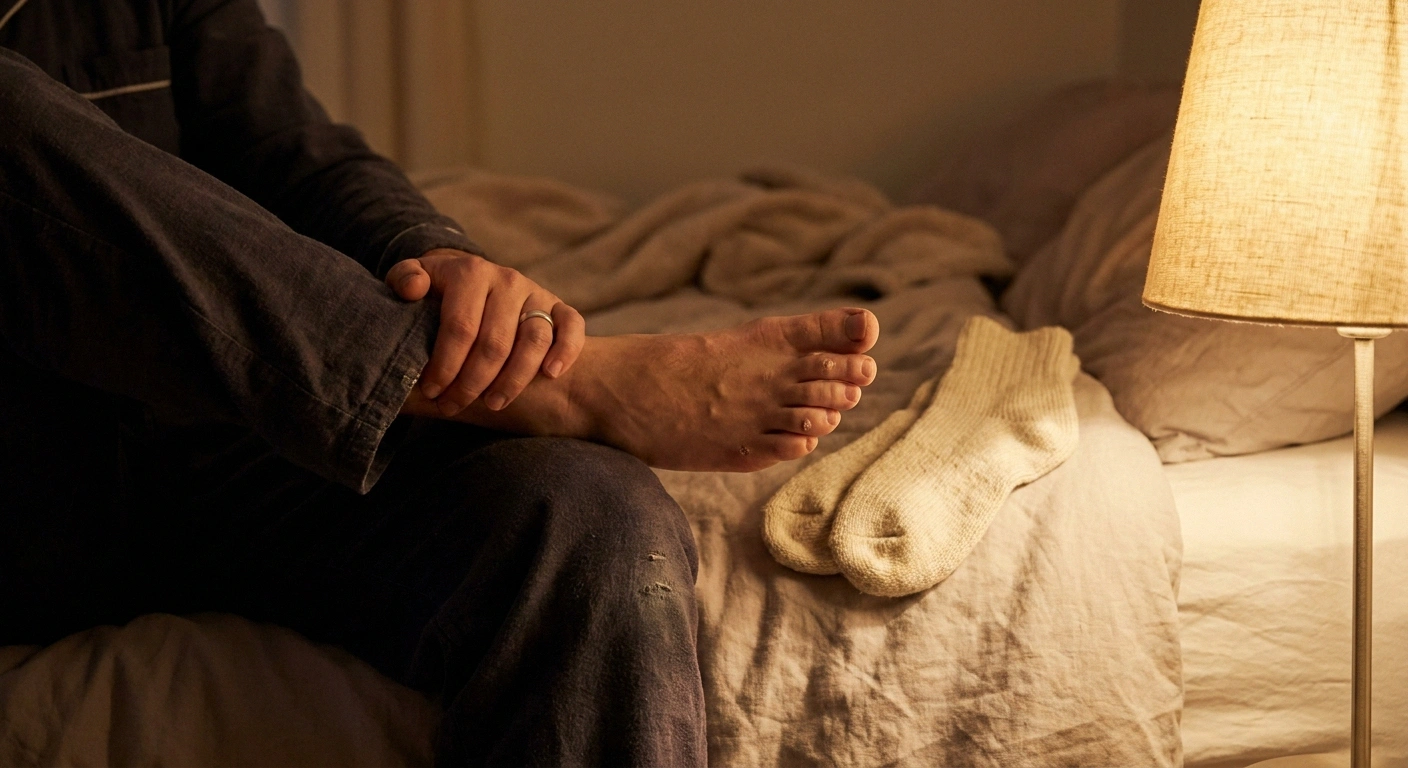
Winter creates a foot-care problem that is specific to neuropathy. With reduced sensation, you may not feel:
- Cold serious enough to risk frostbite or chilblains
- Wetness inside the boot from snow that got past the cuff
- A blister forming from a poorly-fitting winter boot
- Skin chapping or cracking from indoor-outdoor temperature swings
The protective discipline is the same as the rest of the year, just more important. Look at your feet every day — really look, with good light, ideally before bed. Check for color changes, blisters, cracks, or anything new. If something looks wrong, it is wrong, and a clinician should see it. Our guide to neuropathy foot care covers the daily check in more detail.
A few winter-specific footnotes: change wet socks immediately when you come inside; let boots fully dry between uses (consider owning two pairs and rotating); use a moisturizer on dry winter skin to prevent cracking; and resist the impulse to warm cold feet against a heater or in very hot water, both of which can burn skin you cannot feel.
Indoor Walking Alternatives
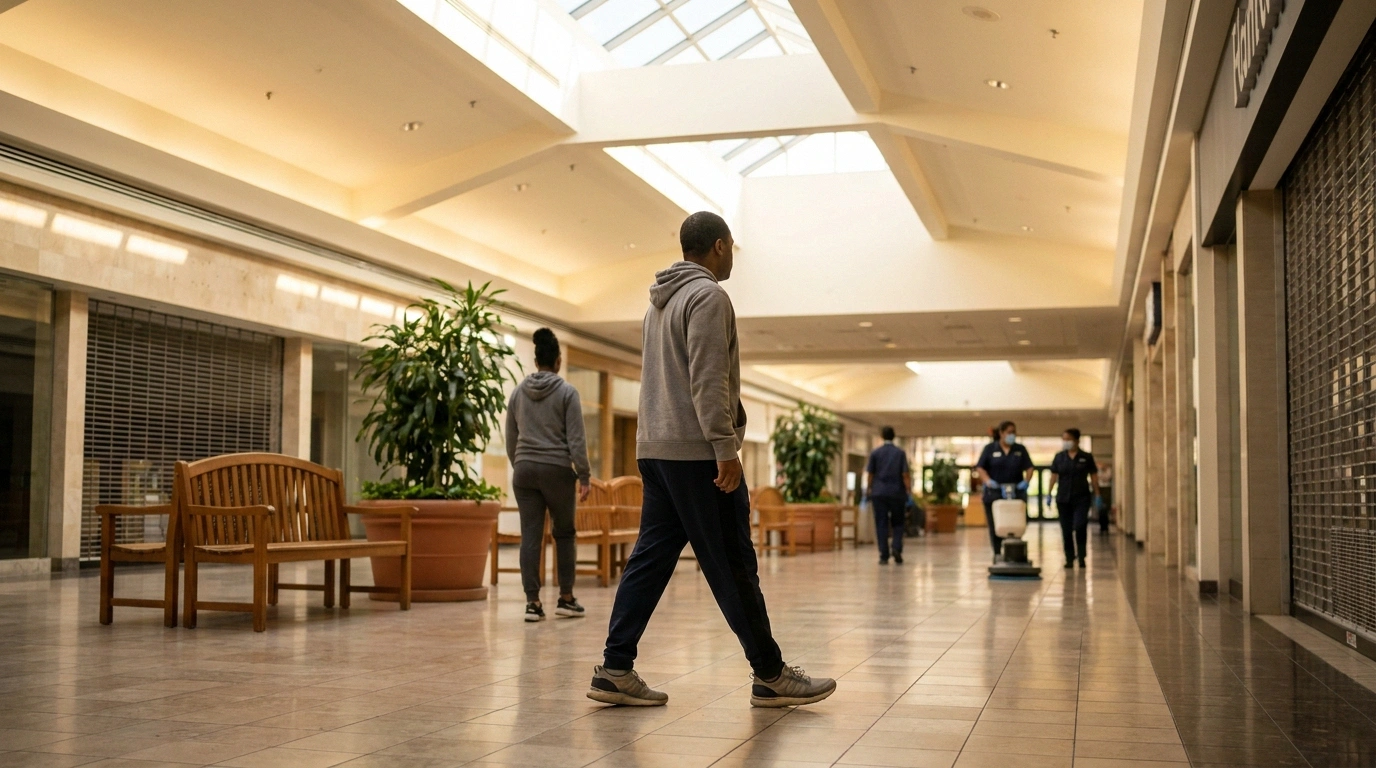
If outside walking is unsafe more days than not, indoor walking is a real option, not a consolation prize. The benefits of walking for neuropathy do not require an outdoor sidewalk.
The benefits of walking for neuropathy do not require outdoor terrain. Circulation, balance maintenance, mood — all of these come from the act of walking, not from where you walk. Indoor options to keep on the rotation:
- Mall walking. Many shopping malls open their doors early specifically for walkers, often before stores open. The surface is flat, the temperature is controlled, and there are benches every hundred feet for resting.
- Community centers and gyms. Some YMCA branches and senior centers have indoor walking tracks. Day passes are usually inexpensive.
- Treadmill at slow speed. A treadmill with side handles, set to one to two miles per hour, gives you walking exercise with continuous support. Start with five minutes and build up.
- Hospital corridors. Some hospitals open their main corridors to community walkers in cold months. Check with the hospital where you usually go.
- In-home loops. If nothing else works, walking a loop in your own home — kitchen to living room to hallway and back — for ten or fifteen minutes a few times a day adds up. It will feel silly the first few times. Keep doing it.
A Quick Winter Walking Kit
What I keep ready by my door from November to March:
The Winter Walking Kit — By the Door, Nov to March
- Insulated boots with deep lug soles, broken in
- One pair of slip-on ice cleats in a small bag
- A cane with a carbide flip-down ice tip
- Wool socks (two pairs, rotated)
- Warm gloves I can grip with
- A small flashlight or headlamp for early-dark days
- A phone in a coat pocket (not buried in a bag) for asking for help if I need it
- De-icer near the porch for quick top-ups on the front steps
None of this is expensive. Together it has kept me on my feet through five winters of bad neuropathy. It will not eliminate risk, but it lowers it enough that the season feels possible again.
Frequently Asked Questions
Is it safe to walk on ice with neuropathy?
Walking on ice carries elevated risk for anyone with neuropathy because reduced foot sensation means you detect slippery surfaces later than someone with intact feeling. The combination of slip-on ice cleats, deep-lug boots, a cane with an ice tip, and the short-step “penguin walk” technique can make winter walking reasonably safe for many people. On freezing-rain days or with untreated icy sidewalks, the safer choice is to stay home and reschedule.
What are the best ice cleats for someone with peripheral neuropathy?
For most people with neuropathy, mid-range slip-on cleats with metal coils or studs work well. Common brands include Yaktrax, Stabilicers, and Kahtoola. Choose a model with secure fit, easy on and off (cold hands struggle with fussy attachments), and grippers matched to your terrain — coils for packed snow and light ice, spikes for real ice and steep grades. The exact brand matters less than getting a snug fit and remembering to take them off before going indoors.
How do I keep my feet warm with neuropathy in winter?
Insulated boots with room for the foot to breathe (not tight), wool socks that wick moisture, and changing into dry socks immediately if your feet get wet. Avoid warming cold feet directly against a heater or in very hot water — neuropathic skin can be burned without you feeling it. Indoor temperature control matters too: heated slippers or a footstool near a radiator helps when sitting.
Should I use a cane in winter even if I do not use one in summer?
For many people with neuropathy, the answer is yes. Winter ice changes the balance demand on your feet in ways the rest of the year does not. A cane with an ice tip gives you a third point of contact and a second to react if you slip. Treat it as winter equipment, not a permanent admission. You can put it away when the sidewalks clear.
What do I do if I fall on ice and have neuropathy?
If you can move safely and feel no severe pain, get to a stable surface and rest for several minutes before standing again. Check yourself for injuries before bearing weight. Because neuropathy can dull pain signals, take any fall seriously — bruising, swelling, or limited range of motion warrants a clinical exam even if the pain is not severe. Tell whoever assesses you that you have neuropathy, so they understand the symptom picture may be muted.
Can I shovel snow with neuropathy?
For many people with neuropathy, snow shoveling combines several risk factors — cold, unstable footing, sudden cardiovascular exertion, hand-grip demand. If you have any cardiac risk factors at all, snow shoveling has a real association with heart attacks even in people without neuropathy. The safer answer for most people with neuropathy is to outsource the shoveling or use a lightweight snow blower. If you must shovel, do small loads, take breaks, and never push past breathlessness.
Where should I walk indoors when the sidewalks are icy?
Good options include mall walking before stores open, community centers and senior centers with indoor tracks, hospital corridors that are open to community walkers, treadmills at slow speed with handrails, and loops within your own home. The benefits of regular walking — circulation, balance maintenance, mood — do not require outdoor terrain. Indoor walking is a complete substitute, not a consolation prize.
Does cold weather make neuropathy symptoms worse?
For many people with neuropathy, yes. Cold can sharpen burning or tingling sensations, cause cramping or muscle tightness, and make distal blood flow worse. The protective response is warmth — properly insulated boots, layered socks, glove liners, hand warmers if needed — without applying direct intense heat to skin you cannot fully feel. Our guide on cold-weather neuropathy goes deeper into this.
About the Author