
There's a moment that most people with neuropathy recognize — the moment when walking stops feeling automatic. Maybe it's the subtle uncertainty of where your foot is landing, the wobble when you turn a corner, or the growing fear of falling that slowly shrinks your world. When that moment arrives, the right walking aid isn't a sign of giving up. It's a decision to keep going.
Whether you're considering a cane for the first time or wondering if there's something better suited to your specific balance challenges, this guide covers everything neuropathy patients need to know about walking aids — from basic canes to rollators, trekking poles, and the newer assistive technologies designed specifically for nerve damage-related mobility issues.
Why Neuropathy Creates Unique Mobility Challenges
Neuropathy-related mobility issues are fundamentally different from the mobility problems caused by arthritis, muscle weakness, or joint replacement. Understanding this difference is crucial for choosing the right walking aid.
When peripheral neuropathy damages sensory nerves in your feet and legs, you lose proprioception — your body's internal GPS system that tells your brain exactly where your feet are in space and how much pressure they're exerting. This means your balance problems aren't primarily about strength (though muscle weakness may develop). They're about information loss.
Your brain is making thousands of micro-corrections every second to keep you upright. When the sensory data stream from your feet drops out or becomes unreliable, those corrections become delayed, inaccurate, or absent entirely. A study published in the Archives of Physical Medicine and Rehabilitation found that patients with peripheral neuropathy had a fall rate nearly 50% higher than healthy controls — and that this rate quadrupled when visual feedback was removed (simulating walking in the dark).
The good news from that same study: using a cane significantly reduced the fall rate, particularly in neuropathy patients. The cane acts as a third point of contact that feeds sensory information through your hand and arm — essentially creating an alternative data channel to compensate for the lost foot sensation.
Types of Walking Aids for Neuropathy
Not all walking aids serve the same purpose. The right choice depends on your specific symptoms, balance level, activity needs, and living environment. Here's what's available and who each option serves best.
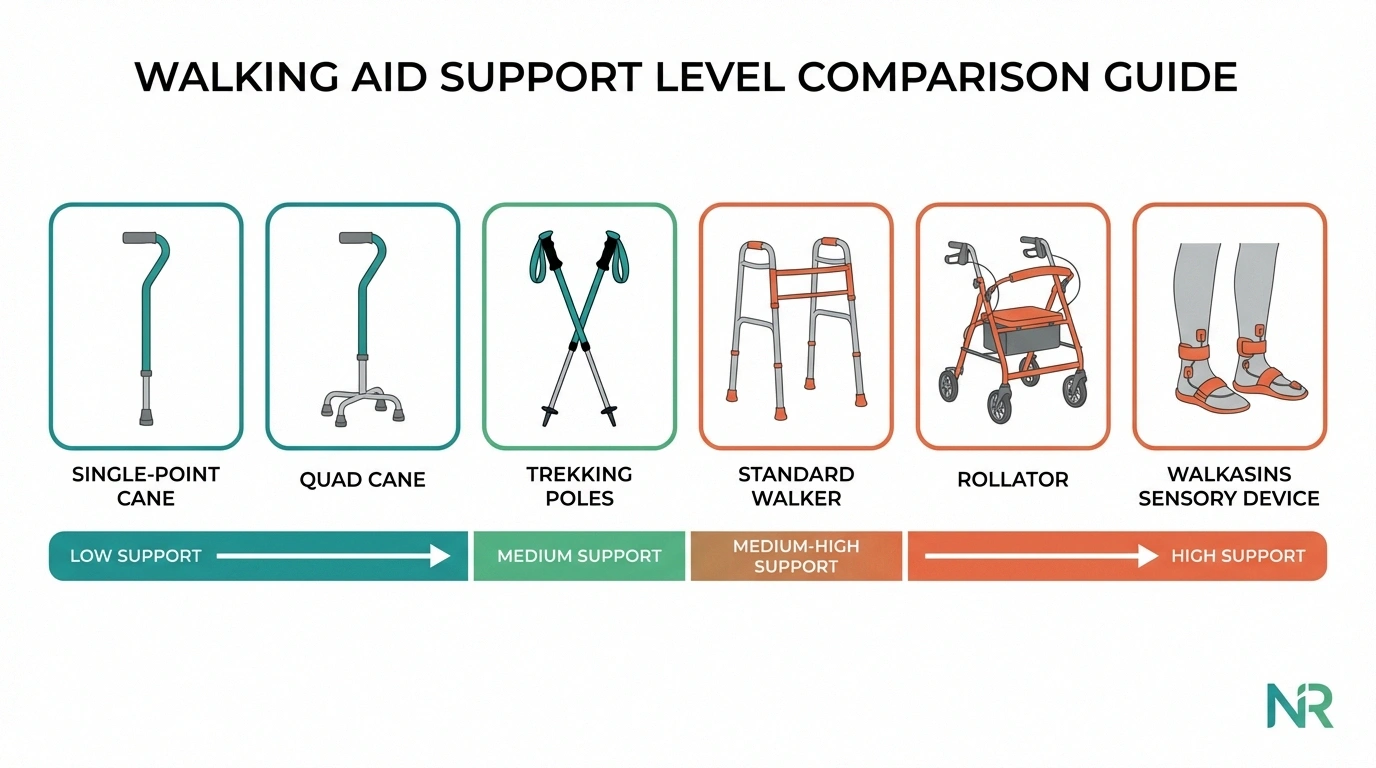
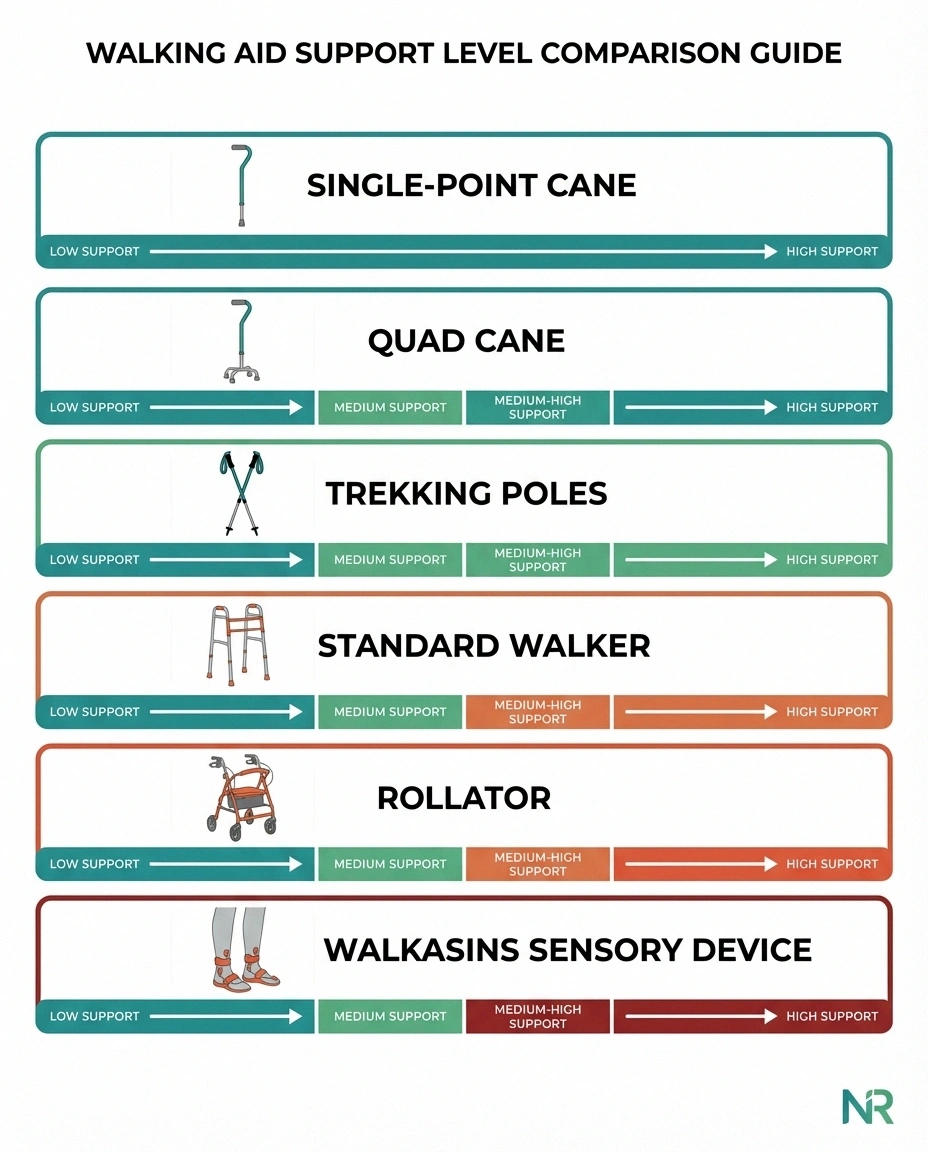
Standard Single-Point Canes
A traditional cane with a single tip is the simplest walking aid and works well for people who need light balance support and sensory feedback. For neuropathy patients, the sensory benefit may be as valuable as the physical support — touching the ground through a cane gives your brain proprioceptive data about the surface beneath you.
Best for: Mild to moderate balance issues, one-sided weakness, people who want minimal equipment and maximum independence.
Key features to look for: Adjustable height (essential for proper fit), ergonomic grip that reduces hand pressure (especially important if you also have neuropathy in your hands), shock-absorbing tip, and lightweight construction (aluminum or carbon fiber).
Quad Canes (Four-Point Base)
Quad canes have a base with four small feet instead of a single tip, providing a much wider support base. They stand upright on their own — a surprisingly practical benefit when you need to free your hand for a doorknob, handrail, or grocery item.
Best for: Moderate balance issues, people who need to lean more heavily on their aid, anyone who needs their cane to be freestanding.
Trade-off: Heavier than single-point canes and can be awkward on uneven surfaces or stairs. The wider base also requires more floor clearance, which can be tricky in tight spaces.
Trekking/Hiking Poles (Two-Pole System)
An increasingly popular option among neuropathy patients is using a pair of trekking poles instead of a single cane. Two poles provide bilateral support and better symmetry — you're not favoring one side the way you do with a single cane. Many members of neuropathy support communities have reported switching from canes to hiking poles and finding them more natural and less stigmatizing.
Best for: Active people with moderate balance issues, outdoor walking, people who want bilateral support without a walker, and anyone self-conscious about using a cane (poles have a “fitness” rather than “medical” association).
Key features: Adjustable length, cork or foam grips (absorb sweat and reduce vibration), rubber tips for pavement and carbide tips for trails, wrist straps for security.
Standard Walkers
A four-legged walker without wheels provides maximum stability. You lift it, move it forward, then step into it. This offers the most support but also the slowest, most deliberate gait.
Best for: Significant balance impairment, substantial foot numbness, people recovering from neuropathy-related falls, or those who need to put significant weight on the aid.
Consider: Walkers with front wheels (“two-wheel walkers”) offer a middle ground — you push them forward rather than lifting, which creates a more natural gait while still providing strong support.
Rollators (Four-Wheel Walkers)
Rollators have four wheels, hand brakes, and typically include a built-in seat. They allow a more natural walking pace than traditional walkers and the seat provides a rest option when fatigue hits during longer walks.
Best for: People who walk moderate distances, need periodic rest breaks, want storage for personal items (most rollators have a basket or pouch), and have enough hand strength and coordination to operate the brakes.
Critical consideration for neuropathy patients: If you have significant hand neuropathy affecting grip strength, test the brake mechanism before purchasing. Squeeze-type hand brakes require reliable grip force — if your hands are compromised, look for rollators with push-down or loop-lock braking systems that don't depend on grip strength.
Walkasins and Sensory Feedback Devices
A newer category of assistive technology specifically designed for peripheral neuropathy is the sensory substitution device. Walkasins, for example, is an FDA-registered wearable device that detects foot pressure through a sensor-equipped insole and transmits that information as gentle vibrations to the skin just below the knee — essentially rerouting the sensory signal around the damaged nerves in your feet.
Clinical studies have shown that Walkasins can improve balance and gait in people with peripheral neuropathy. This isn't a walking aid in the traditional sense, but it can be used alongside canes or walkers to provide the sensory feedback that nerve damage has taken away.
How to Choose the Right Walking Aid
Choosing a walking aid for neuropathy isn't just about picking the fanciest equipment — it's about matching the aid to your specific functional needs. Here's a practical decision framework:

Step 1: Assess your balance level honestly. Can you stand on one foot for 10 seconds? Walk heel-to-toe in a straight line? Turn in a circle without wobbling? If these tasks are difficult or impossible, you likely need more than a simple cane. Your physical therapist can perform standardized balance assessments to quantify your needs.
Step 2: Consider your primary environments. Do you mainly walk inside your home, outdoors on sidewalks, or across uneven terrain? A rollator works beautifully on smooth surfaces but struggles on grass, gravel, or snow. Trekking poles handle varied terrain better. Your home's layout (narrow hallways, stairs, carpet vs. tile) also matters.
Step 3: Factor in your hand function. If your neuropathy affects your hands as well as your feet (which is common), you need an aid with an ergonomic, cushioned grip that doesn't require strong grip force. Foam or gel-padded handles distribute pressure better than hard plastic.
Step 4: Think about portability. Will you need to take your from canes to advanced balance technology aid in a car, on public transit, or through airports? Folding canes, collapsible trekking poles, and folding rollators are available for people who need to transport their aids regularly.
Step 5: Get professionally fitted. The correct height for a cane or walker is when your elbow bends at a 15-20 degree angle while gripping the handle. Too short forces you to lean forward (increasing fall risk). Too tall pushes your shoulder up (causing neck and shoulder strain). A physical therapist or certified orthotist can ensure proper fitting.
Proper Cane Technique for Neuropathy
Having the right cane is only half the equation — using it correctly is what actually keeps you safe. Many people instinctively use a cane on the wrong side, which actually increases their fall risk.
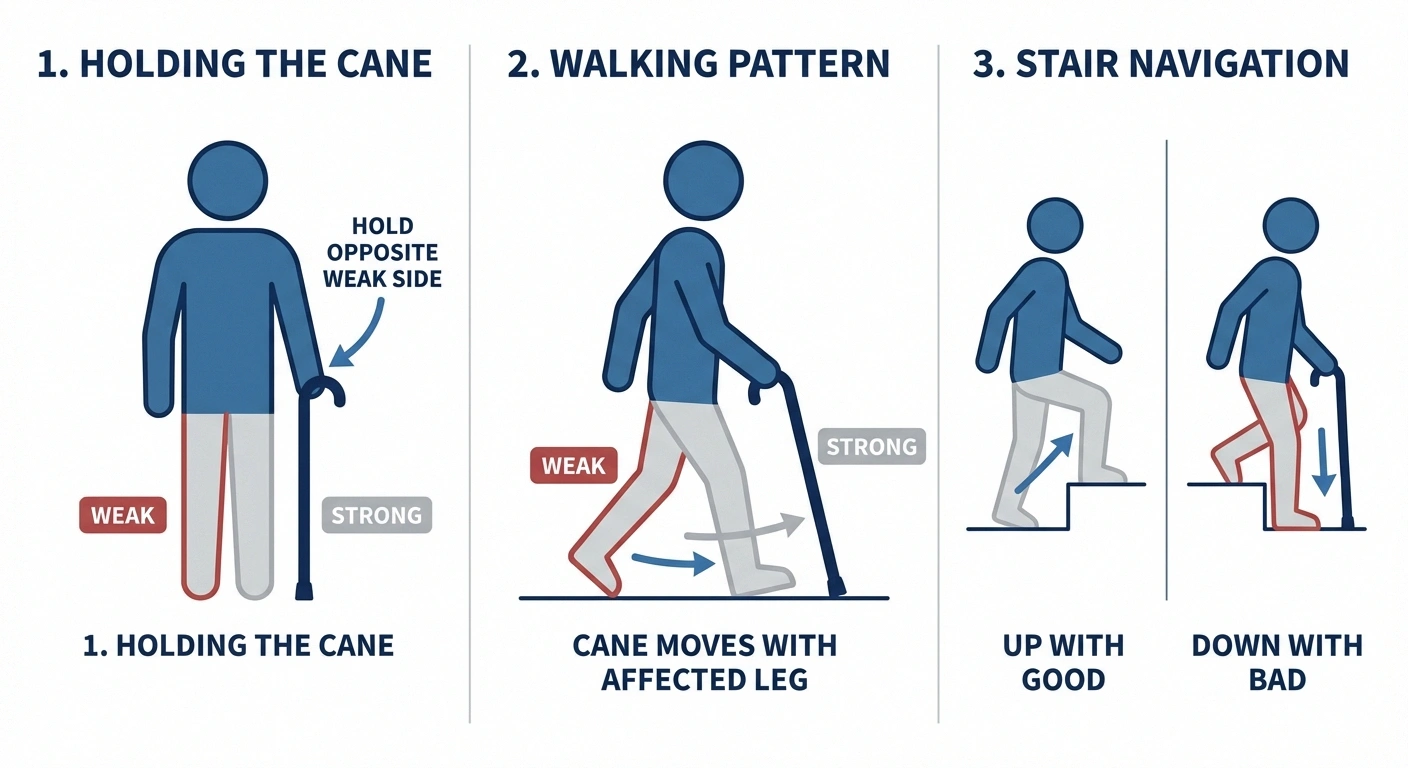
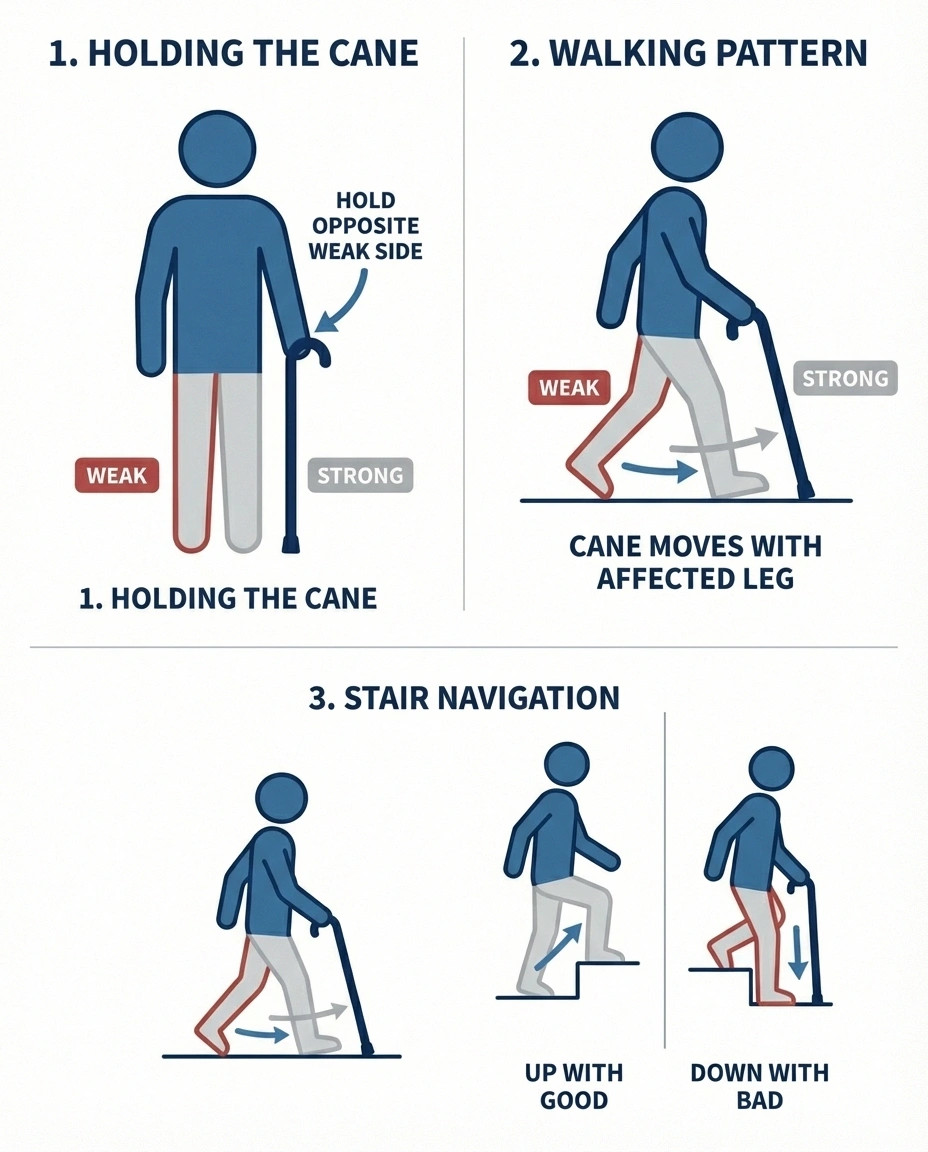
Going down — lead with cane + weaker leg, then bring stronger leg down
Which hand holds the cane? Hold the cane in the hand opposite your weaker or more affected side. This creates a wider base of support and mimics the natural arm-leg coordination of walking. If both sides are equally affected (common with polyneuropathy), use your dominant hand.
Walking pattern: Move the cane forward at the same time as your affected leg, then step through with your stronger leg. The cane and your weaker leg form a stable base while your stronger leg swings through.
Stairs: Going up — lead with your stronger leg, then bring the cane and weaker leg up to the same step. Going down — lead with the cane and weaker leg, then bring the stronger leg down. The memory aid: “up with the good, down with the bad.”
Nighttime and dark environments: Since the study mentioned earlier found that removing visual feedback quadrupled fall rates in neuropathy patients, nighttime navigation deserves special attention. Use your cane even for short trips to the bathroom. Consider motion-activated nightlights along your common nighttime paths. The cane provides the sensory feedback your eyes can't provide in the dark — this is where its value is potentially highest.
Fall Prevention Beyond Walking Aids
A walking aid is one piece of a broader fall prevention strategy. For neuropathy patients, comprehensive fall prevention includes:
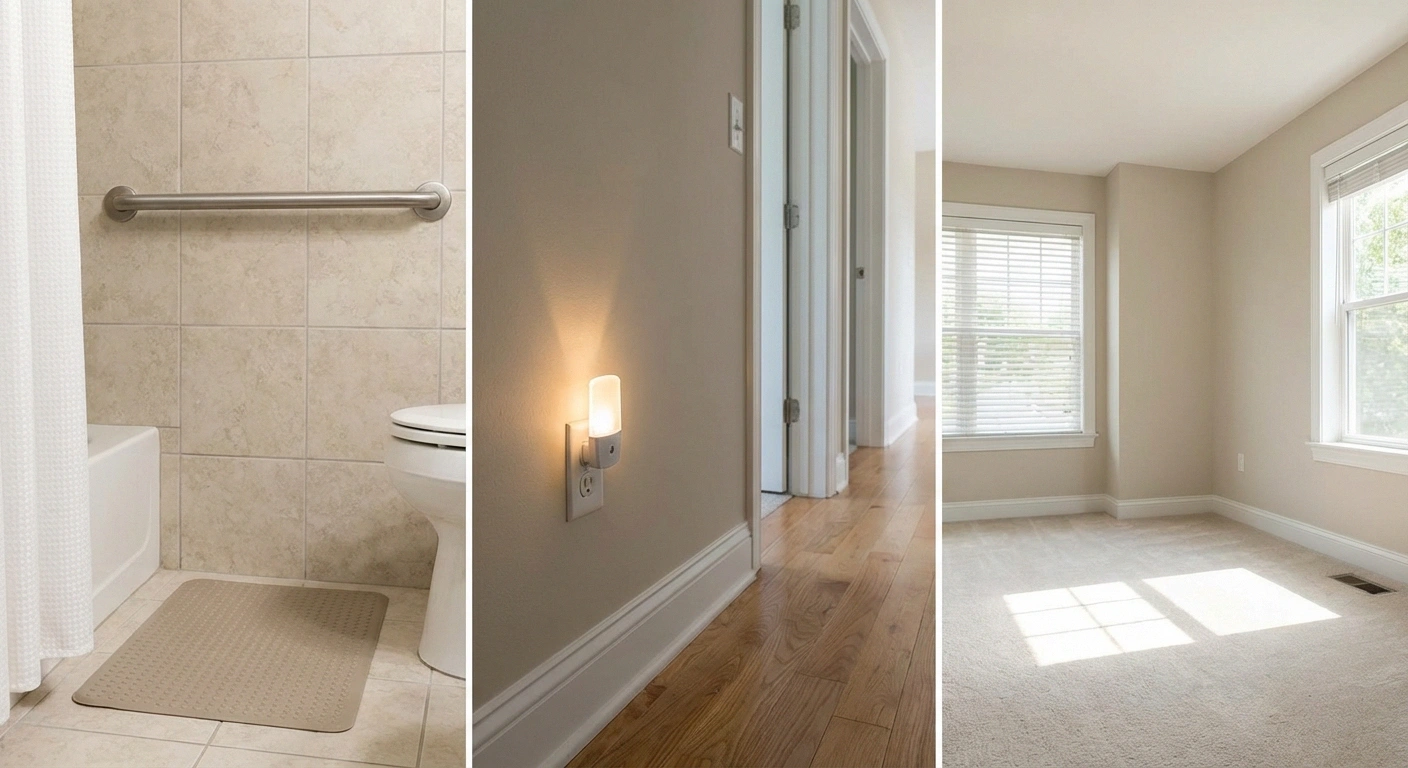
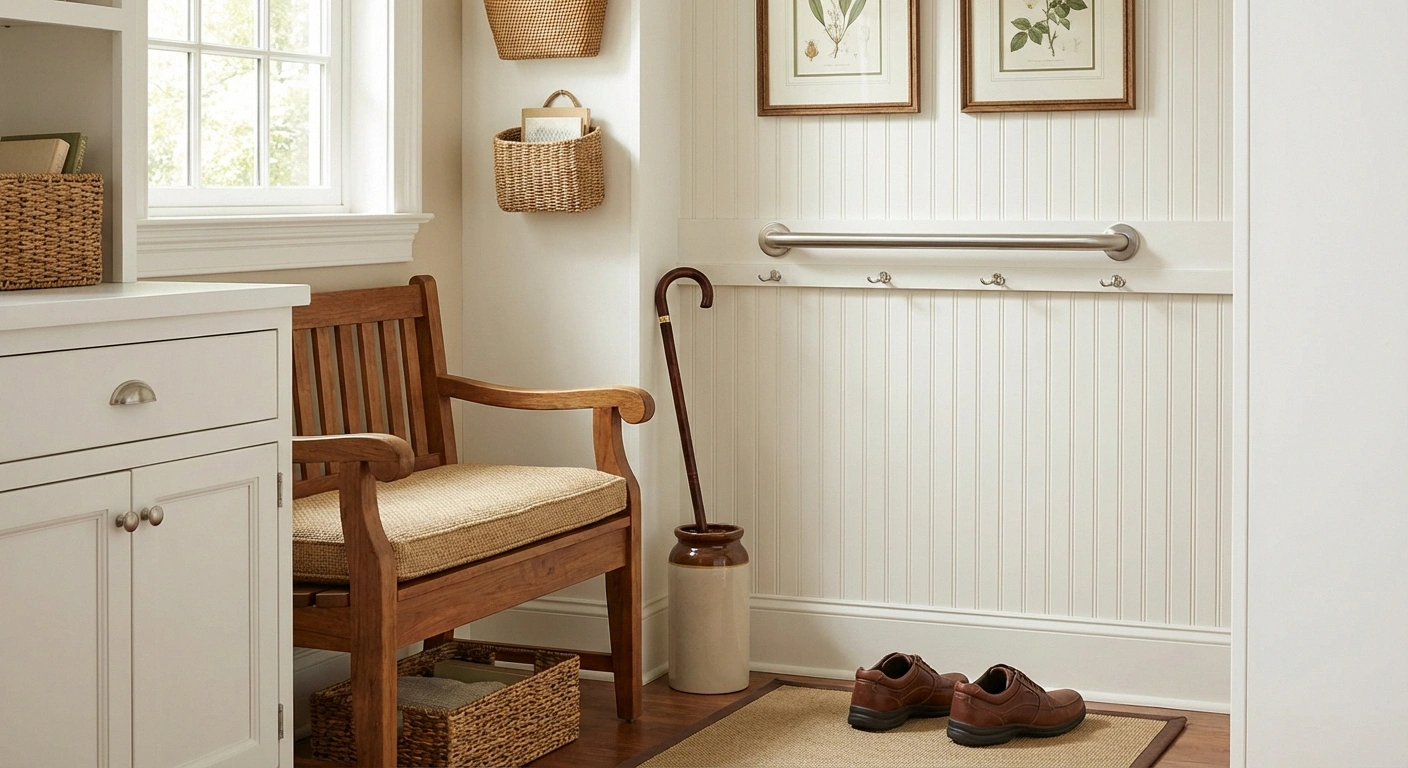
- Home modifications: Grab bars in the bathroom, non-slip mats, removing loose rugs, improving lighting (especially in hallways, stairs, and bathrooms), and clearing floor clutter
- Footwear: Proper shoes with non-slip soles and good ankle support — even inside the house. Walking barefoot with neuropathy significantly increases fall risk because you lose even the minimal sensory feedback that shoes provide
- Balance exercises: Regular balance training and physical therapy can improve your body's compensation strategies and slow balance decline
- Vision checks: Since neuropathy patients rely more heavily on vision for balance, regular eye exams and current prescription glasses are especially important
- Medication review: Some medications (including neuropathy medications themselves) can cause dizziness or drowsiness that compounds balance issues. Ask your doctor to review your medication list with fall risk in mind
Overcoming the Emotional Side of Using a Walking Aid
Let's address something that the medical guides usually skip: for many people, the hardest part of getting a walking aid isn't choosing one. It's the emotional weight of needing one.

There's often grief involved — grief for the version of yourself that walked without thinking about it, for the spontaneity you've lost, for the visible signal to the world that something is wrong. These feelings are legitimate, and they don't make you weak. They make you human.
What helps is reframing what a walking aid actually represents. It's not a symbol of decline — it's a tool that expands your world instead of shrinking it. The person who uses a cane to walk through the park, visit friends, and run errands is more independent than the person who stays home because they're afraid of falling. The aid itself is an act of agency, not surrender.
If the emotional adjustment is difficult, you're not alone. Connecting with a neuropathy support group where others have navigated the same transition can make an enormous difference. And speaking with a counselor about the emotional impact of living with neuropathy is always a worthwhile investment.
Insurance and Cost Considerations
The practical question of cost matters. Here's what you need to know:
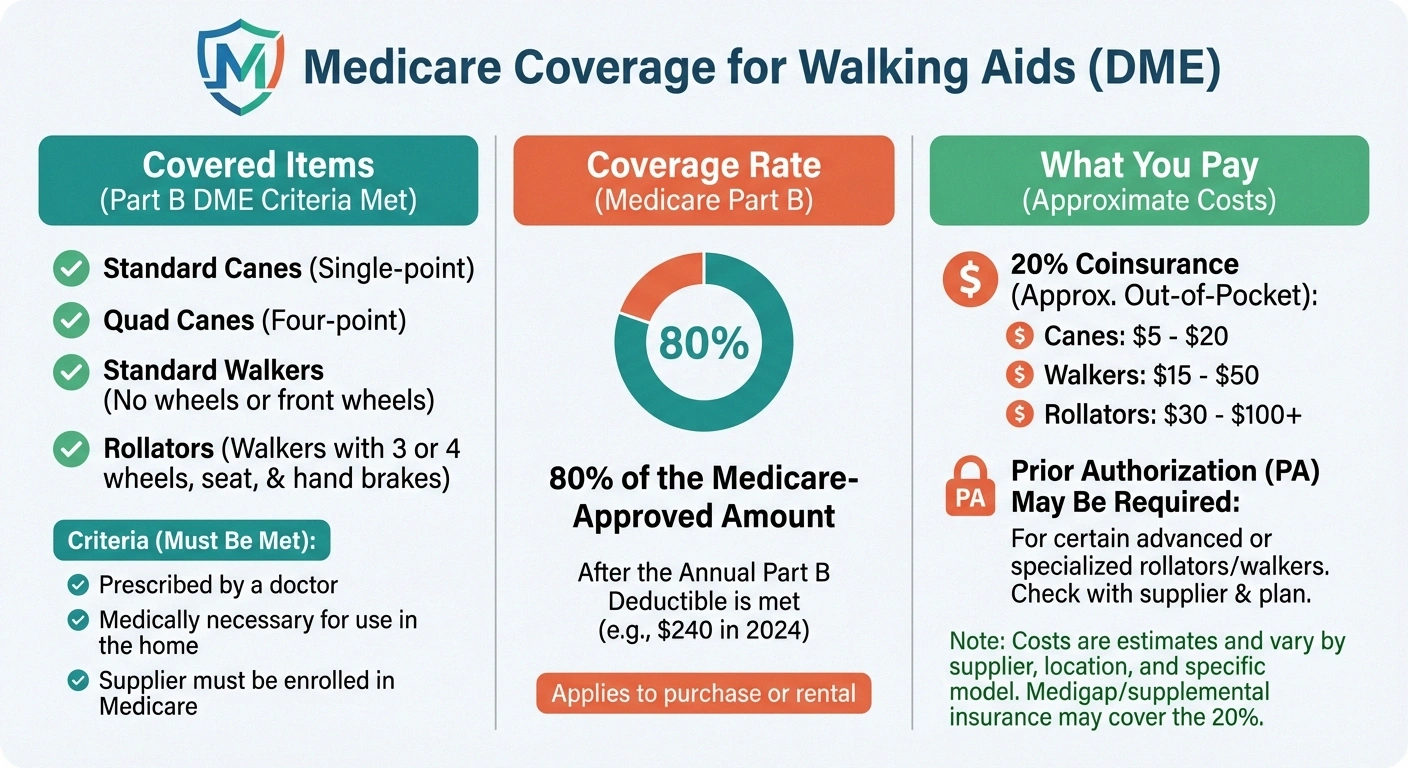
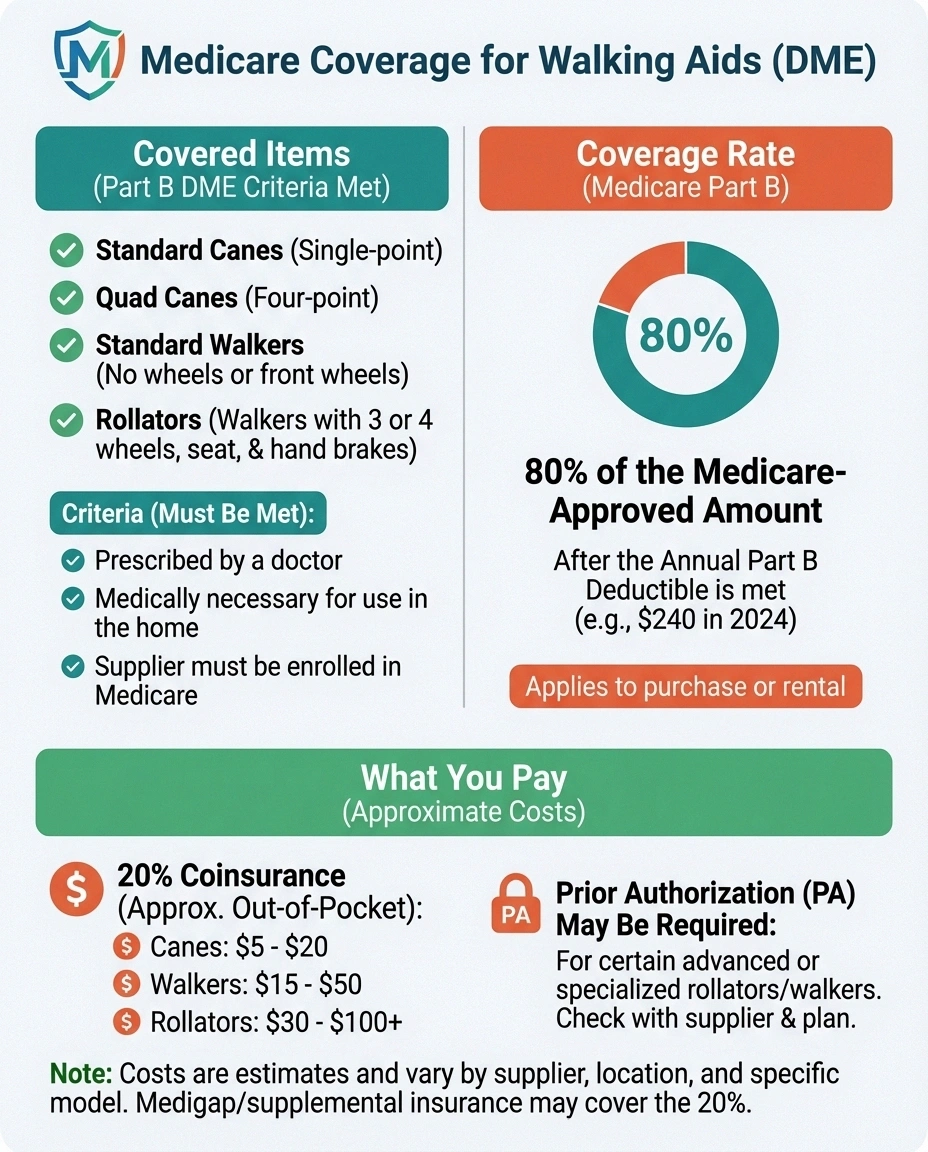
Medicare coverage: Medicare Part B covers canes, walkers, and rollators when prescribed by a doctor as “durable medical equipment” (DME). You'll typically pay 20% of the Medicare-approved amount after meeting your Part B deductible. The equipment must be purchased from a Medicare-enrolled supplier. Check with your plan for specifics and whether prior authorization is needed.
Private insurance: Most private insurers also cover walking aids with a doctor's prescription. Coverage varies, so call your insurer before purchasing. Keep in mind that insurance-covered options may be limited to basic models — if you want a specific brand or feature, you may need to pay the difference out of pocket.
Out-of-pocket costs: Basic canes start around $15-30. Quad canes run $25-60. Rollators range from $60 for basic models to $300+ for lightweight, feature-rich versions. Trekking poles designed for stability cost $30-80 for a pair. Specialty devices like Walkasins are significantly more expensive ($2,000+) but may be covered by insurance in some cases.
Try before you buy: Organizations like TechOWL (an assistive technology service with locations around the country) allow you to rent and try different mobility aids before committing to a purchase. This is especially valuable because the “best” walking aid on paper may not be the best one for your body and lifestyle.
Frequently Asked Questions
Should I use a cane or walker for neuropathy?
A cane is usually sufficient for mild to moderate balance issues from neuropathy. If you have significant instability, a history of falls, or severe foot numbness, a walker or rollator may be safer. Your physical therapist can assess your specific balance level and recommend the most appropriate aid.
Which side should I hold my cane on?
Hold the cane in the hand opposite your weaker or more affected side. If both sides are equally affected, which is common with polyneuropathy, use your dominant hand for better control.
Can a walking aid slow down neuropathy progression?
A walking aid does not directly slow nerve damage. However, by keeping you mobile and active, it indirectly supports nerve health because regular physical activity and walking have been shown to improve symptoms and may slow progression in some types of neuropathy.
Are trekking poles better than a cane for neuropathy?
For outdoor walking and exercise, many neuropathy patients find trekking poles provide better bilateral support and a more natural gait than a single cane. However, poles are less practical for indoor use and require both hands. Many people use both, choosing the right tool for the environment.
Does Medicare cover walking aids for neuropathy?
Yes, Medicare Part B typically covers canes, walkers, and rollators when prescribed by a doctor as durable medical equipment. You pay 20 percent after your deductible and must use a Medicare-enrolled supplier. Ask your doctor for a prescription and check with your specific plan about prior authorization requirements.
When should I start using a walking aid?
Consider a walking aid when you notice balance difficulties, feel unsafe walking on uneven surfaces, have had a fall or near-fall, or find yourself avoiding activities because you are worried about falling. Earlier adoption is better than waiting for a serious fall. If you are unsure, ask your doctor for a balance assessment.
Moving Forward With Confidence
The right walking aid, properly fitted and correctly used, doesn't just prevent falls — it restores the confidence that neuropathy erodes. It lets you say yes to the walk around the block, the trip to the grocery store, the visit with friends. That confidence has a ripple effect on everything from your mental health to your physical fitness to your quality of life.

Start by talking with your physical therapist or doctor about which type of aid matches your needs. Try different options if you can. And remember: choosing to use a walking aid is choosing to stay in the world rather than retreat from it. That's not a concession — it's one of the strongest things you can do.
About the Author