There is no qualification process. That is the first thing to understand, and almost every page you will read on this subject is built on the assumption that there is one.
No federal agency issues service dog credentials. No doctor signs a form that makes a dog official. No registry has legal authority, and the ID cards and vests sold online carry no more weight than a printed certificate you made yourself. Under the Americans with Disabilities Act a service animal is simply a dog individually trained to do work or perform tasks for a person with a disability, where the task relates directly to that disability. That is the whole definition.
Which means the real question is not whether you qualify. It is whether a dog can do something specific for you that nothing else does as well, and whether you can handle and care for the animal that would be doing it. Both halves matter, and the second half is where most of these decisions actually turn.
What a Dog Can Actually Do About Nerve Damage
A task is a trained behaviour that addresses a defined limitation. Sorting by which neuropathy problem it solves makes the list far more useful than sorting by training category.
Match the task to the deficit, not to the diagnosis
Programs respond to specific requests. Bring three to five of these ranked by how often the problem occurs in your week, not a description of your condition.
You cannot feel where your foot is
Counterbalance in a rigid harness. Bracing at curbs, thresholds and the top of stairs.
Your grip drops things
Retrieval. Every dropped key, pill and phone currently costs a bend, and bending costs balance.
Starting to walk is the hard part
Momentum pull. Gentle forward assistance to initiate movement or manage a slope.
You have gone down before
Fetch a phone to where you landed, or go and get another person. Needs the least physical capacity from the dog.
Crowds are where your feet get hurt
Blocking. The dog holds a buffer in queues and busy aisles so nobody steps on feet you cannot feel.
Blood sugar drops without warning
Scent alert. A separate specialisation. Asking one dog for this plus mobility work narrows the field sharply.
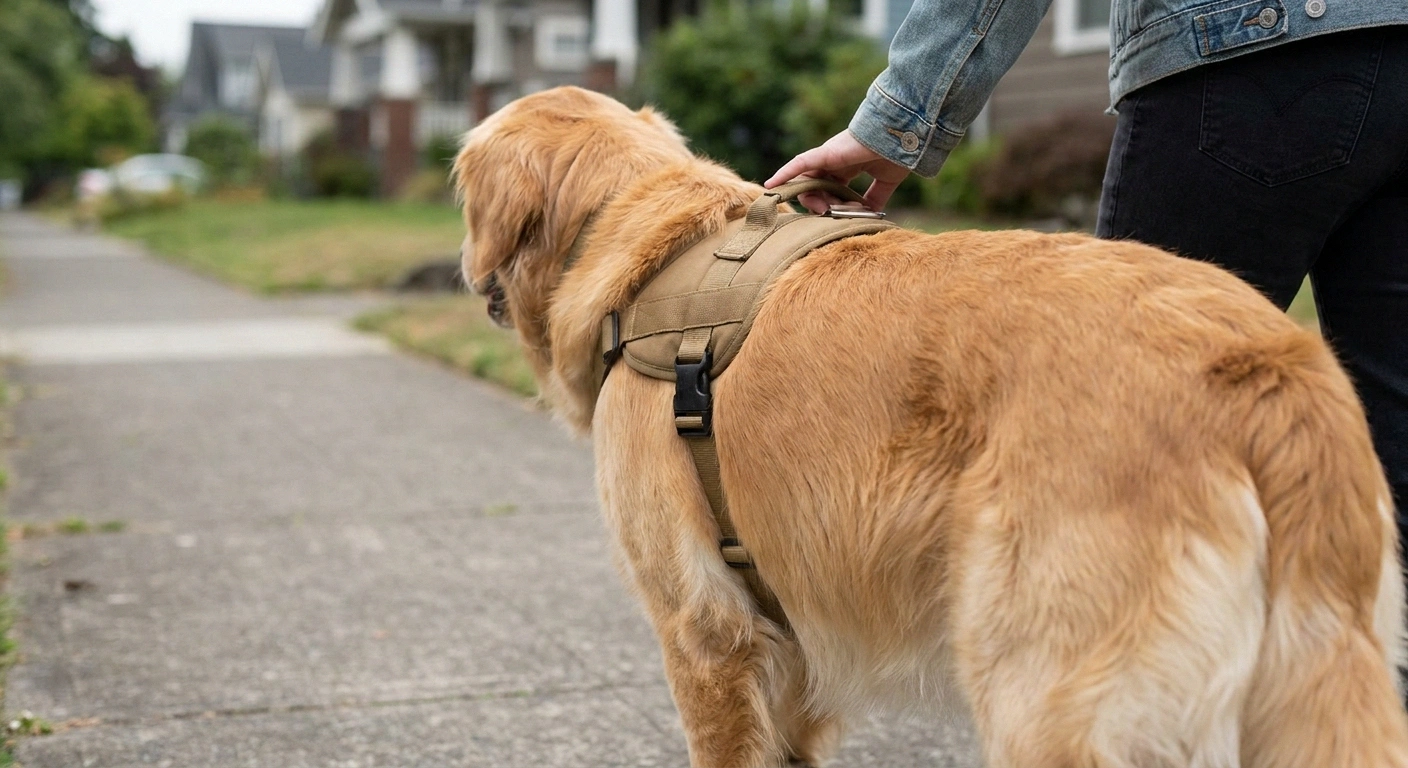
For balance and position sense. Counterbalance is the headline task. The dog wears a rigid harness and provides a stable point of contact you can steady against, which partially replaces the position feedback your feet have stopped supplying. Momentum pull, where the dog provides gentle forward assistance, helps people who struggle to initiate movement or to get up a slope. A dog can also be trained to brace at a curb, a threshold or the top of a stairway, which are the specific places falls tend to happen.
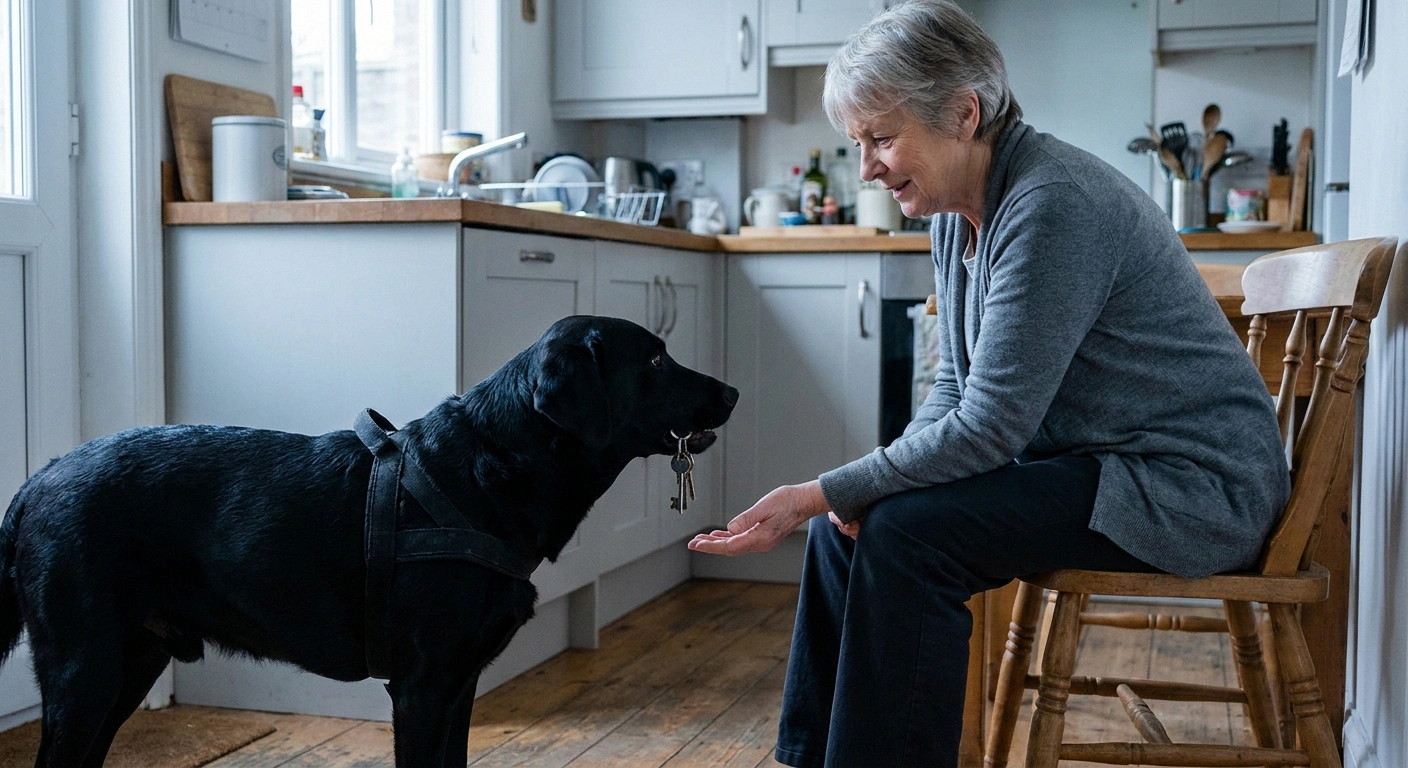
For hands that do not grip or feel reliably. Retrieval is the most underrated task on this list. A dropped set of keys, a phone, a dropped pill, a shoe. Every one of those is currently a full bend-and-recover manoeuvre that costs you balance and sometimes causes a fall. A dog that retrieves reliably eliminates dozens of those a week. Dogs can also open and close doors and drawers, pull laundry from a machine, and bring a specific item on cue.
For getting up. A dog can be trained to brace so you can push up from the floor, to fetch a phone to you where you have landed, or to go and get another person in the house. Bracing under somebody rising from the floor is the heaviest task on this list, and only a minority of dogs are structurally suited to it. That is a question for the program and for a therapist who has watched you get up, not a matter of the dog’s willingness. Going to fetch a person is often the most valuable option of the three anyway, and it asks the least of the dog physically.
For the feet themselves. Crowd blocking is a real task. The dog positions itself to create a buffer in a queue or a busy aisle, which keeps other people from stepping on feet that you would not feel being stepped on and might not notice injuring.
Two Specialisations That Sit Outside Mobility Work
Two more tasks come up constantly in this conversation, and both are worth separating out because neither is a mobility skill and people routinely assume one dog can carry everything.
For diabetic neuropathy specifically. Some dogs are trained to alert to low blood sugar, detecting the change before the handler feels it. This is a scent-detection skill and a completely different specialisation from mobility work. It is worth knowing that a dog trained for one is not automatically capable of the other, and asking a single dog to do both is a much taller order than it sounds.
For the psychological load. Trained deep pressure therapy, where the dog applies body weight across the lap or chest on cue, is a task. Passive comfort from the dog’s presence is not, however genuinely valuable it is. The distinction matters legally, and it is the line between a service dog and an emotional support animal. Neither is better than the other. They have different legal footing and different training demands, and the emotional weight of chronic nerve pain is a real problem worth addressing either way.
Size Is Not a Preference, It Is Physics
This is where most enthusiasm meets arithmetic.
Run the calculation on yourself
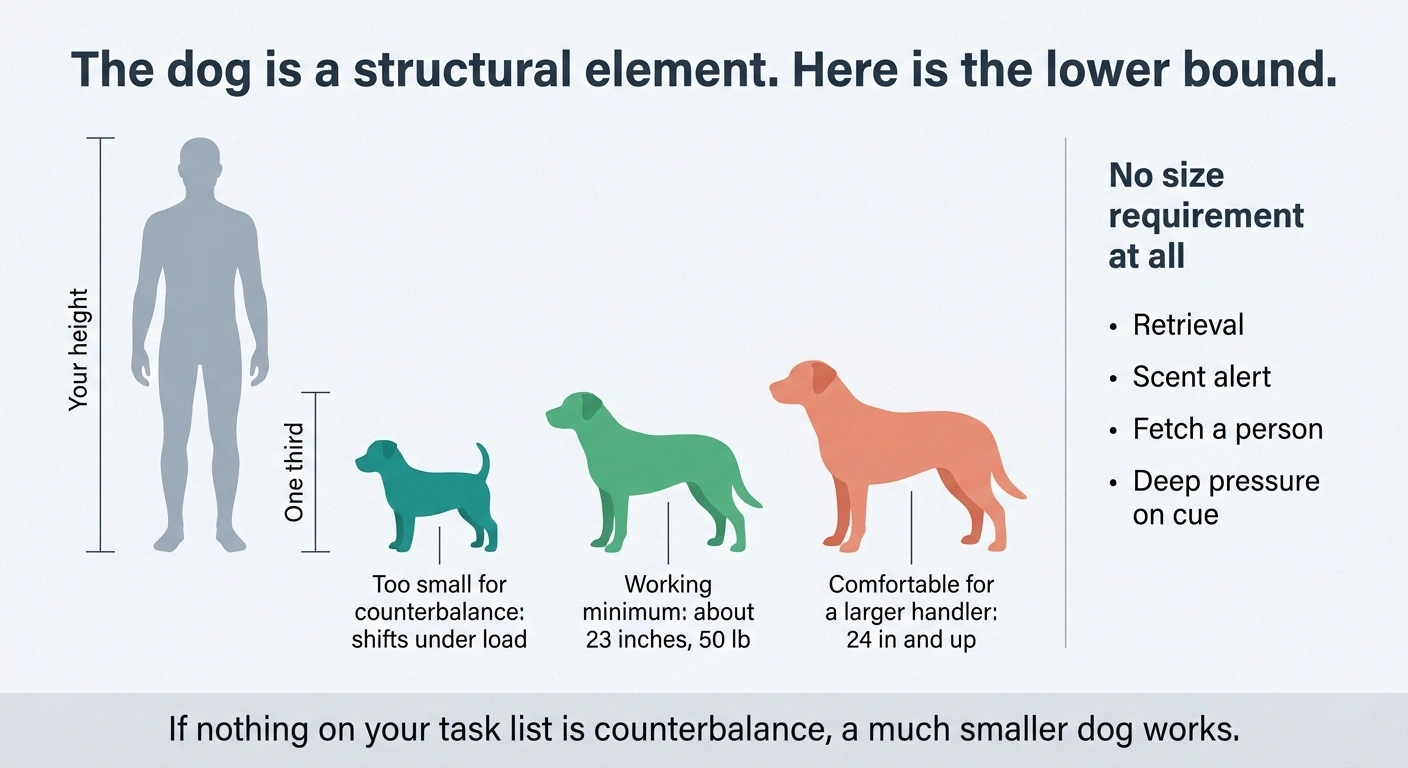
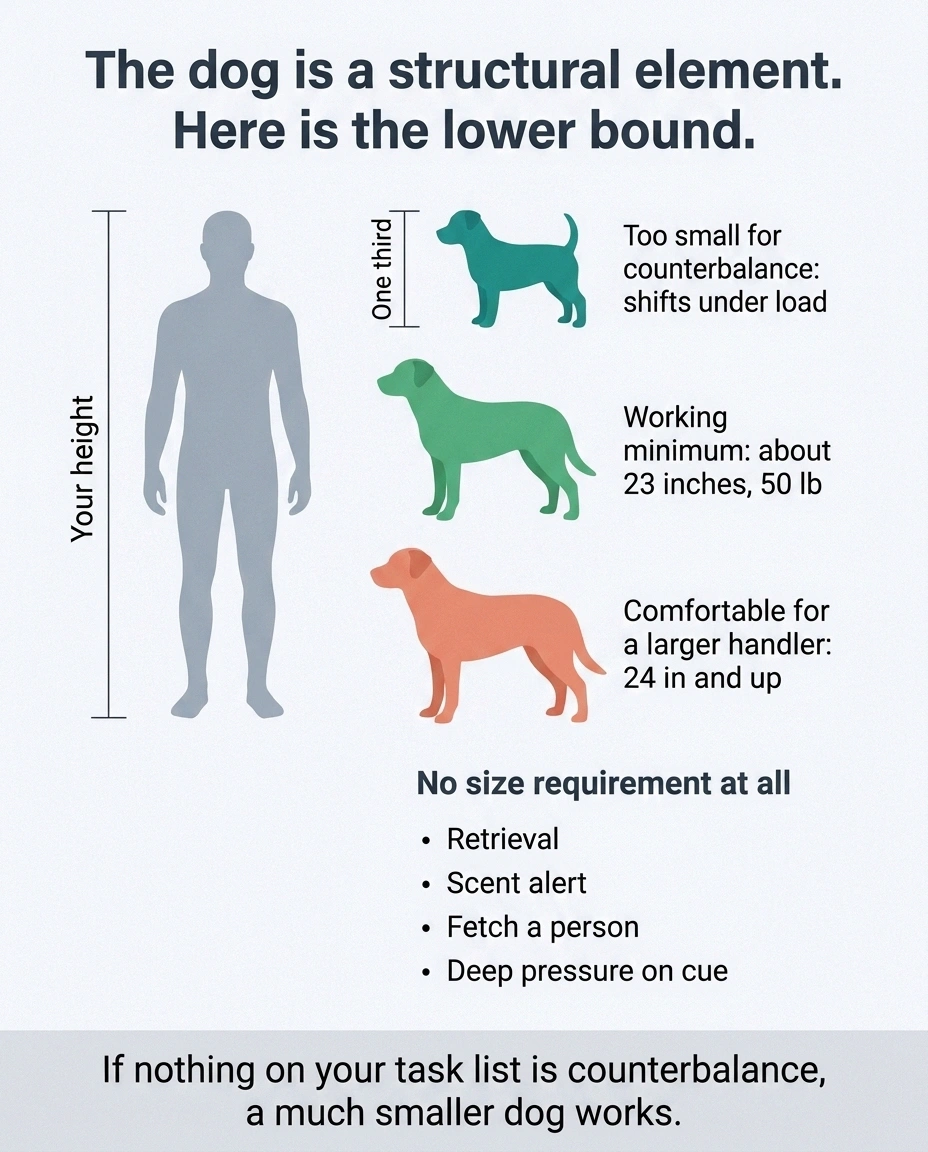
Light mobility guideline: the dog should stand at least a third of your height at the shoulder and weigh around thirty percent of what you do. Below that line, leaning on the dog moves the dog.
| If you are | Shoulder height, minimum | Dog weight, minimum |
|---|---|---|
| 5 ft 4 in, 150 lb | About 21 in | About 45 lb |
| 5 ft 9 in, 190 lb | About 23 in | About 57 lb |
| 6 ft 1 in, 230 lb | About 24 in | About 69 lb |
Retrieval, alert and fetch-a-person tasks carry no size requirement at all. If your list has no counterbalance on it, a much smaller dog works.
A dog providing counterbalance is a structural element. If you steady yourself against something that moves when you lean on it, you fall further than you would have without it. So there is a lower bound on the dog, and it is set by you.
The working guideline for light mobility work is a dog at least a third of your height at the shoulder and around thirty percent of your body weight. In practice that means most mobility dogs are at least twenty three inches at the shoulder and fifty pounds or more, and for a larger handler considerably more than that. Labradors, golden retrievers, standard poodles, and various large working crosses dominate for exactly this reason.
Counterbalance and momentum pull sit in the light-to-medium band. Full weight-bearing bracing, where the handler puts real load through the dog, is a different category with genuine joint injury risk to the animal, and reputable programs restrict it based on the dog’s structure and age. If a trainer offers to teach hard bracing to a dog that is small, young, or of unknown structural soundness, that is a signal to walk away.
Now the part that gets skipped. A fifty-five pound dog needs walking twice a day in weather you did not choose, it needs to be groomed and vetted and fed, and it will pull unexpectedly at some point. If your balance is poor and your feet are numb, being attached to a large animal has its own risk profile. Handlers manage this well when it is planned for, and badly when nobody mentioned it. Ask yourself honestly what a bad symptom week looks like and who walks the dog during it.
The Money and the Waiting
Program-trained mobility dogs are commonly quoted at fifteen to thirty thousand dollars, and specialised placements can reach fifty. That figure is not a markup. It reflects eighteen to twenty four months of daily professional training, veterinary care, and the reality that a meaningful share of candidate dogs wash out of the program and the cost of those dogs is carried by the ones that graduate.
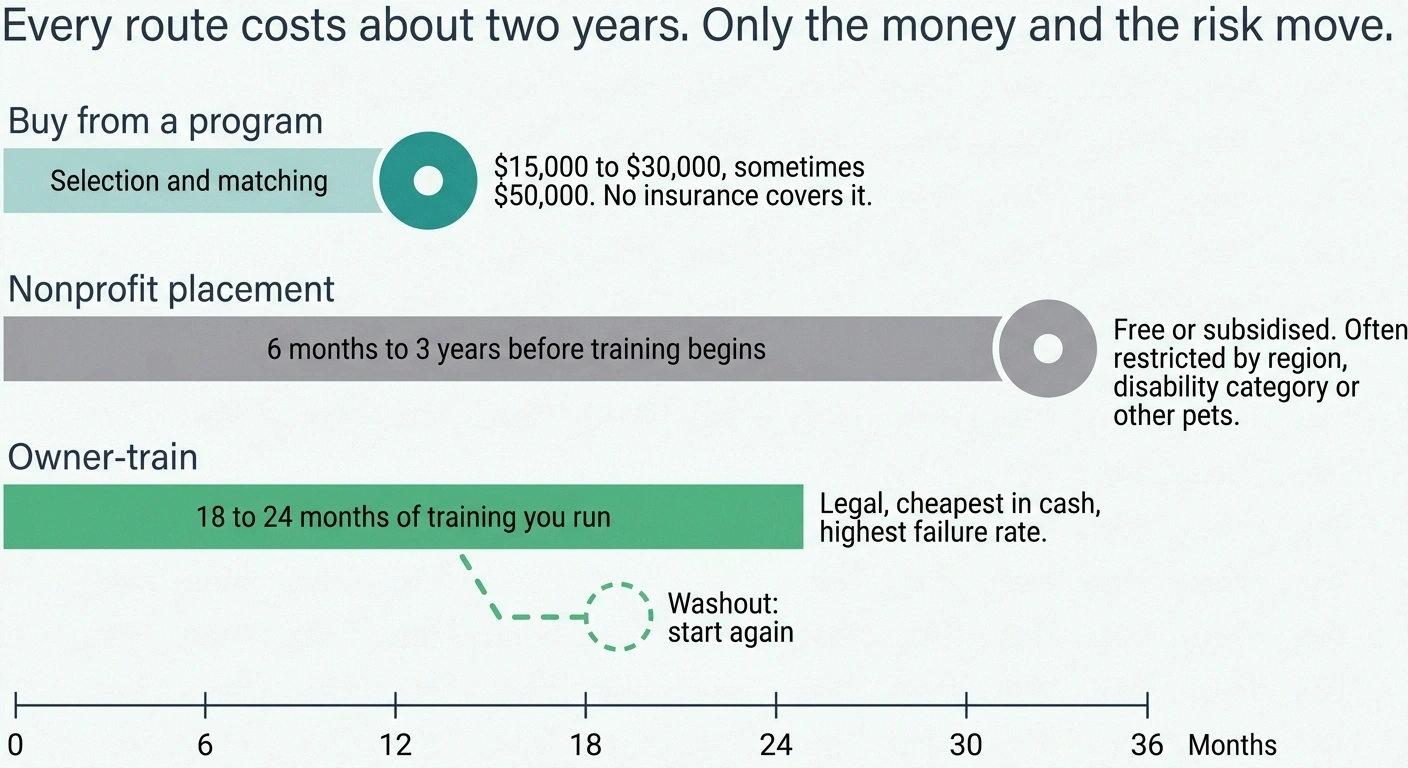
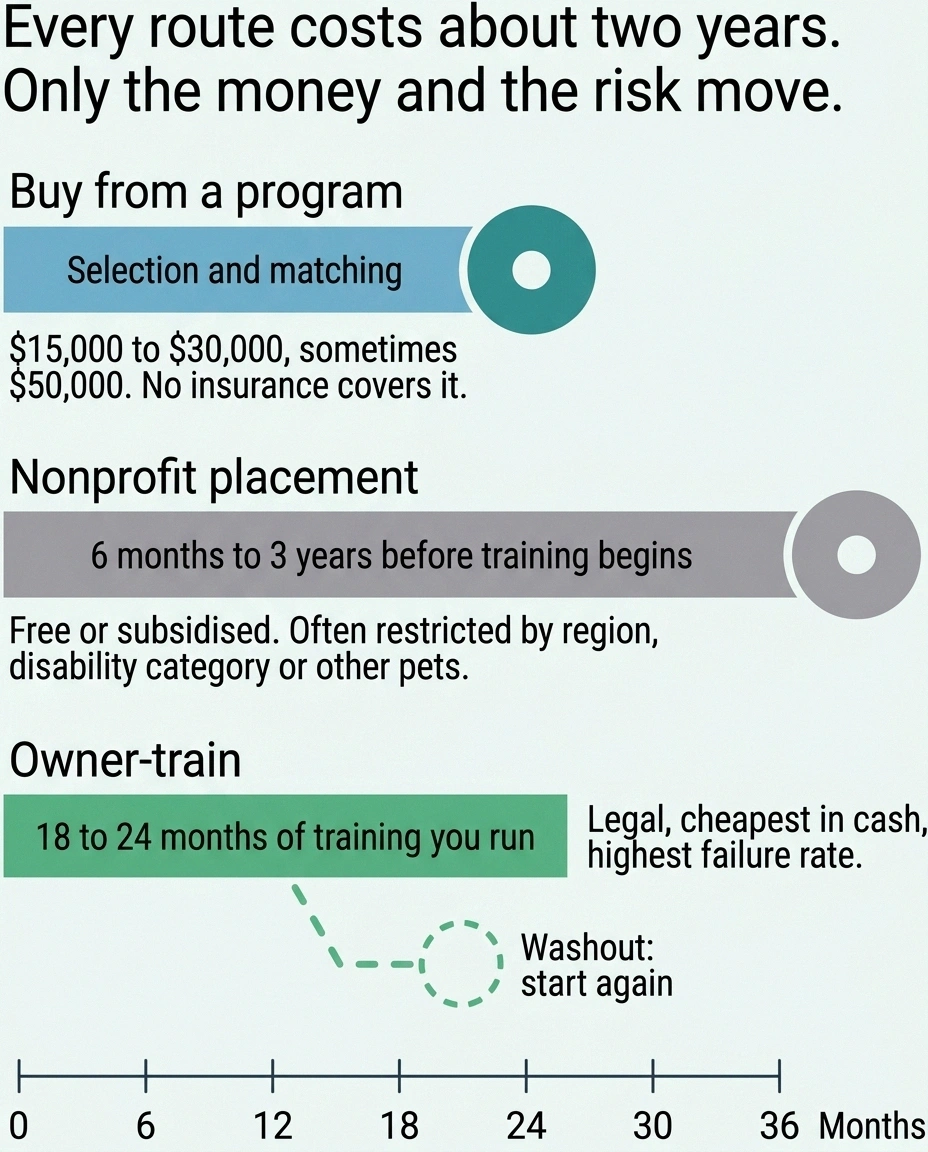
Three routes, priced in dollars and in years
Every route costs about the same amount of time. Only the cash and the failure risk move.
- Buy from a program · $15,000 to $30,000, sometimes $50,000
- Shortest wait, highest certainty, and the price reflects two years of daily training plus the candidate dogs that washed out along the way. No insurance covers it.
- Apply to a nonprofit · free or subsidised, 6 months to 3 years of waiting
- The wait is before training begins, not instead of it. Many programs restrict by geography, disability category, or other pets in the household. Read the eligibility page before writing the application.
- Owner-train · low cash, 18 to 24 months, highest washout rate
- Legal under federal law and genuinely difficult. Needs a candidate dog picked for temperament rather than looks, professional coaching for task work, and a real willingness to stop if the dog turns out to be unsuited to public work.
Nonprofit programs place dogs free or heavily subsidised. The trade is time and application effort. Waiting lists commonly run six months to three years before training even starts, and many programs restrict placements to a service area, or to particular disability categories, or exclude households with certain other pets. Read the eligibility page before investing in an application.
Owner training is legal and it is the route many people end up on. It is also the route with the highest failure rate. You are looking at eighteen to twenty four months, a candidate dog selected for temperament rather than for looks, professional coaching for the task work, and an honest willingness to wash the dog out and start again if it turns out to be unsuitable for public work. A dog that is anxious in a supermarket cannot be trained out of that reliably, and pushing an unsuitable dog through is unfair to the dog and dangerous to the handler.
Health insurance does not cover any of this. Some grant programs, disability nonprofits and service organisations help with funding, and veterans have separate routes through the VA for certain conditions.
Where You Can Go, and the Only Two Questions Anyone May Ask
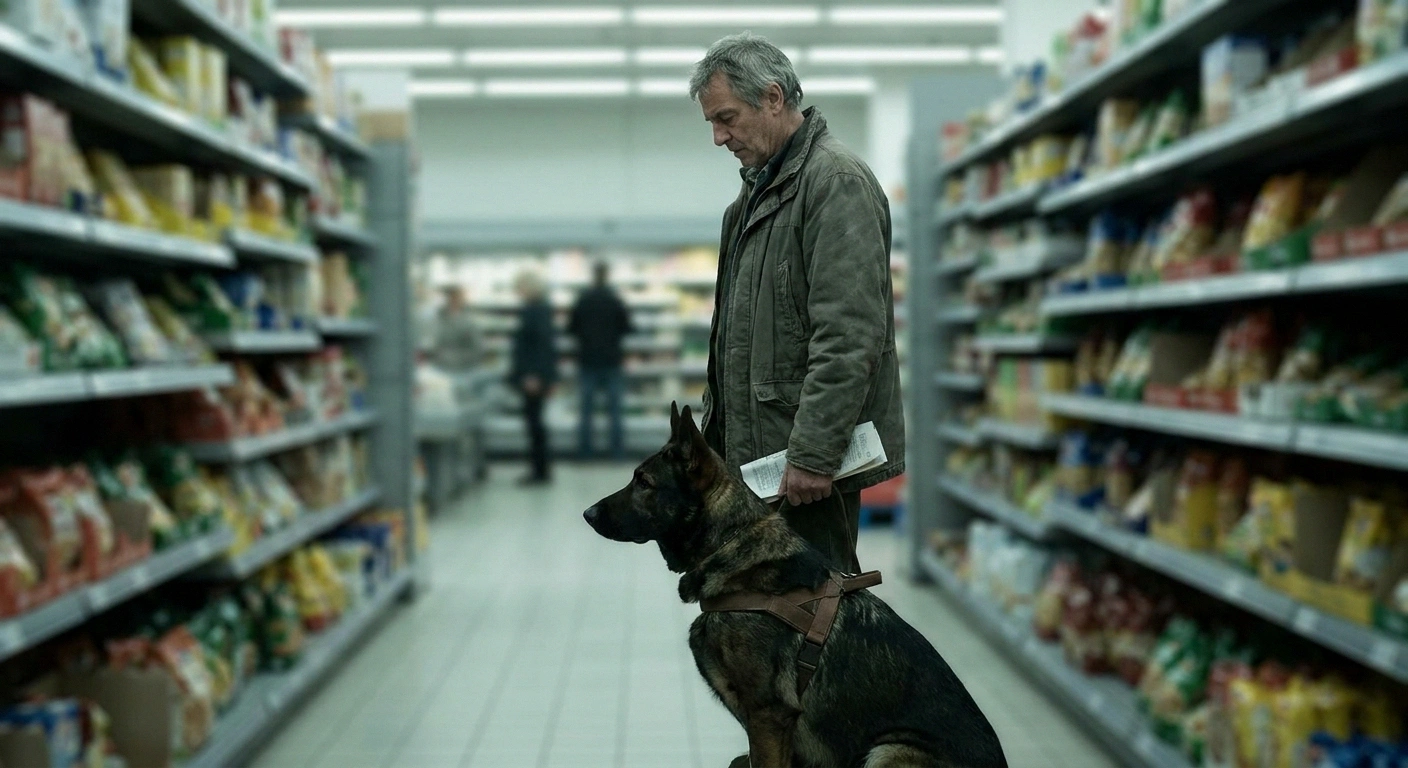
A service dog goes with you into restaurants, shops, hotels, hospitals, government buildings, public transport and anywhere else the public is allowed. No pet policy overrides this, and no deposit or fee may be charged.
Have the sentence ready before you need it
Access problems almost always start with a request for paperwork that does not legally exist. A prepared answer ends most of them at the door.
“Yes, he is required because of a disability. He is trained to retrieve dropped items and to steady me at steps.”
That answers both questions they are allowed to ask. Nothing further is owed.
They may not ask your diagnosis, request a certificate, registration or ID, or make the dog demonstrate the task. If refusal continues, note the date, time and names and file afterward. Doorways are a bad place to win an argument and a good place to lose an afternoon.
When it is not obvious what the dog does, staff may ask exactly two questions:
- Is the dog required because of a disability?
- What work or task has the dog been trained to perform?
They may not ask what your disability is. They may not ask for documentation, registration, a certificate or an ID card. They may not require the dog to demonstrate the task. Knowing this protects you, because the request for paperwork is the single most common access problem handlers report, and the correct response is a calm statement of the two answers rather than producing a document that has no legal standing anyway.
A business may ask you to remove a dog that is out of control and not brought back under control, or that is not housebroken. That is the whole list. You keep your right to be served without the dog present.
Two other laws work differently and it is worth knowing which one you are under. Housing runs on the Fair Housing Act, which covers assistance animals more broadly than the ADA does and reaches into no-pets buildings, and which does allow a housing provider to request documentation of the need. Air travel runs on the Air Carrier Access Act, and airlines may require a Department of Transportation service animal form submitted in advance. Neither of those is the same standard as walking into a supermarket.
The Ordinary Weekday Nobody Describes
Placement day is where most accounts of this stop. It is roughly where the work begins.
A working dog is with you constantly, which sounds like the point and takes some adjustment. Every trip to a shop now includes a second party who has to be positioned, watched and occasionally corrected. Handlers describe the first few months as tiring in a way they did not anticipate, because your attention is split at exactly the moments you were previously concentrating on your own feet.
You will be approached. Strangers talk to the dog, reach for the dog, ask what is wrong with you, and occasionally photograph you. Handlers develop a short line they can deliver a dozen times without irritation, and having one ready before you need it makes a real difference. So does deciding in advance how much you are willing to explain, which is nothing at all if you prefer.
The dog also has days off, in the sense that it is a dog. It sheds, it needs a garden or a walk at six in the morning, and it will occasionally be uninterested in working. Programs build in a maintenance schedule for exactly this reason, and skipping the maintenance training is how a reliable dog becomes an unreliable one over about a year.
None of this is a reason not to do it. It is the part that determines whether the placement holds, and knowing it in advance is what separates people who thrive with a service dog from people who return one.
Deciding Whether This Is the Right Tool at All
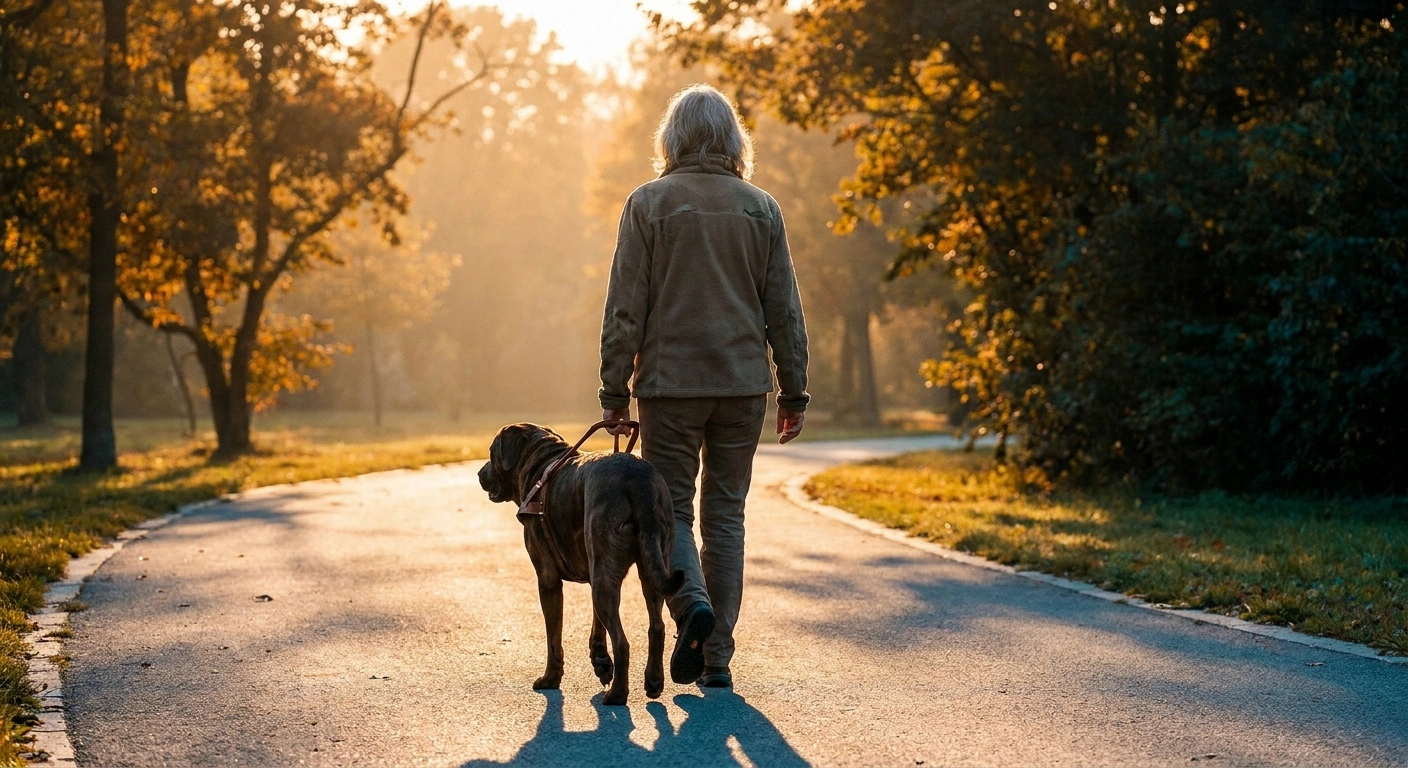
A dog is a ten year commitment with a heartbeat. Before the cost and the waiting lists, it is worth being clear-eyed about whether a different tool solves the same problem faster.
What else solves each piece, and how soon
| The problem | Available this week | What the dog adds |
|---|---|---|
| Balance support | Rollator with a seat, roughly $150 to $400, and more stable than any dog | Support that does not occupy both hands or announce itself as equipment |
| Dropped objects | Grabber tool, about $15 | Retrieval from another room, and items you did not notice dropping |
| Nobody finds you after a fall | Pendant alarm, roughly $25 to $50 a month | Fetches a person or a phone without you pressing anything |
| Leaving the house less and less | Nothing on this list | This is the column where a dog has no equipment equivalent at all |
If only one row applies to you, buy the equipment. If the bottom row is the one you recognised, that is the case for the dog.
For pure balance support, a rollator with a seat is available this week, costs a couple of hundred dollars, does not need feeding, and is more stable than any dog. It is also socially invisible in a way many people dislike, which is a real factor and not a trivial one.
For retrieval, a grabber tool costs fifteen dollars and handles a great deal of what a retrieval task covers, though it will not bring you your phone from another room.
For fall response, a pendant alarm answers the question of who finds you, without the dog.
Where a dog genuinely outperforms all of these is in combination. If you need balance support and retrieval and crowd protection and a way to summon help, and you want all of it in something that also gets you out of the house every day, no equipment package matches that. The social effect is not a side benefit either. People who were becoming housebound frequently are not, afterward.
The honest case against, for a specific reader: if your symptoms are progressing quickly, if you live alone and could not walk a dog through a bad fortnight, if your household finances would not absorb an emergency veterinary bill, or if your balance is poor enough that a sudden pull would put you down, then the answer may be a rollator and a grabber and a review in a year. That is not a consolation prize. It is a correct match between the tool and the situation.
Starting the Process Properly
If you are going ahead, the order matters.
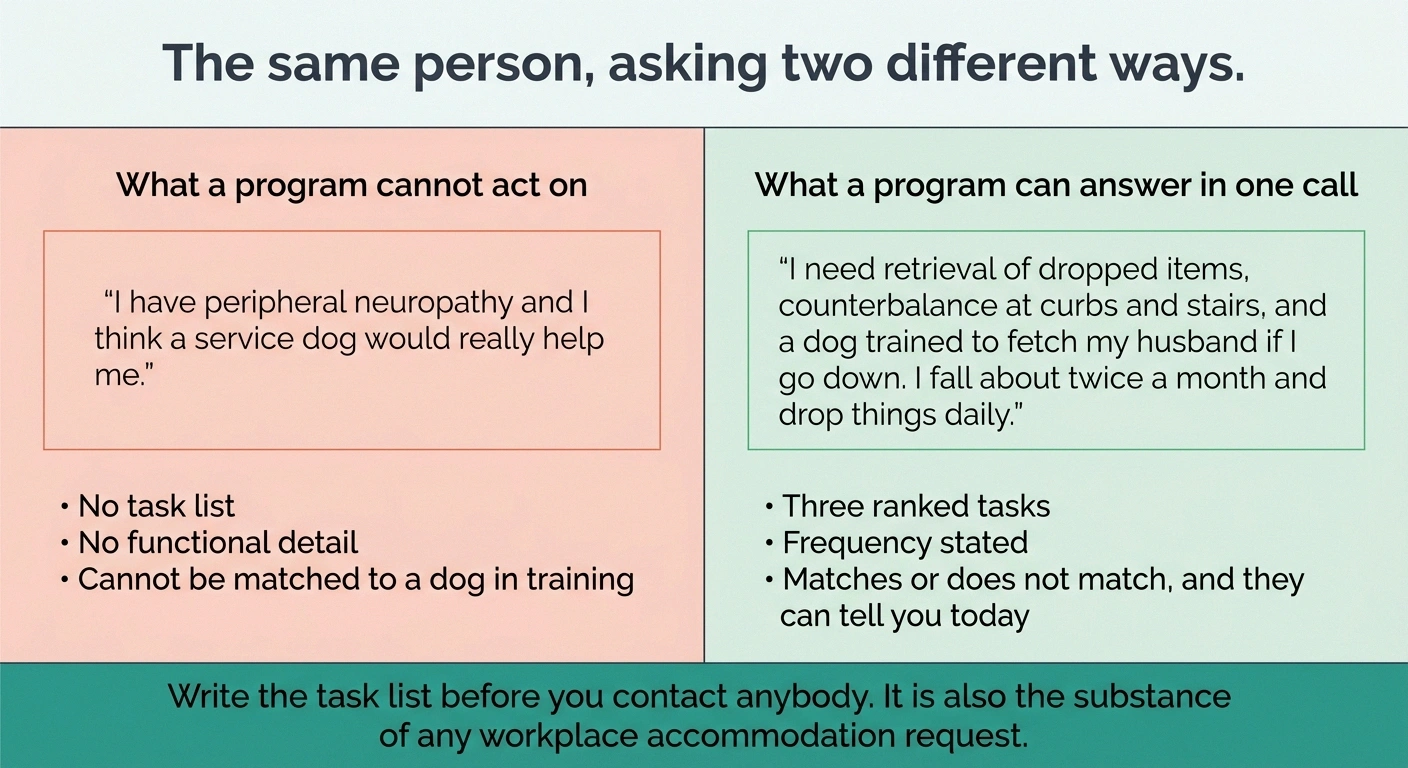
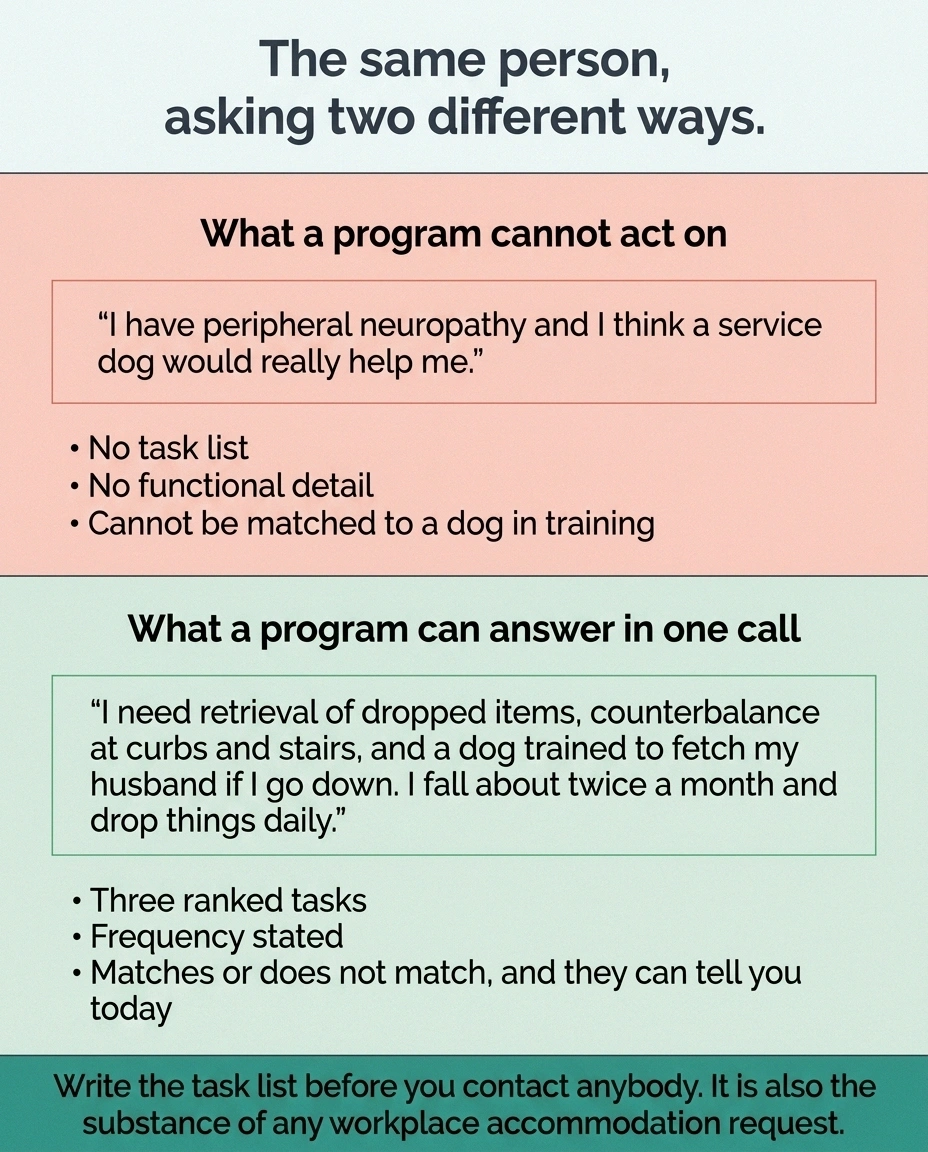
Get the functional limitations documented first. Not the diagnosis, the limitations. How far you can walk, what happens on stairs, how often you fall or nearly fall, what you drop and how often. Programs ask for this and it is also the substance of any conversation about accommodations at work, so the effort is not single-use.
Then write your task list before you talk to anybody. Three to five specific behaviours in order of value to your daily life. A program that hears “retrieval, counterbalance at curbs, and fetch my partner if I go down” can tell you in one conversation whether they place dogs that do that. A program that hears “I have neuropathy and I think a dog would help” cannot.
Talk to a physical therapist or an occupational therapist about the counterbalance question specifically. They can assess whether a mobility dog would stabilise you or destabilise you, and this is genuinely worth a professional opinion rather than a guess. It is the same assessment that produces useful recommendations for the house, so it is one appointment answering several questions.
Then apply widely to nonprofits, because acceptance rates are low and waits are long, and use the wait productively. If you are also considering owner training, the wait is the time to find a trainer with mobility-task experience and to learn what a suitable candidate dog looks like.
And check the practical layer nobody thinks about until it bites. Your lease or building rules under the Fair Housing Act. Whether the dog affects your commute, since a mobility dog on public transport or in a car needs planning around, and driving with neuropathy already has its own considerations. Who takes the dog if you are hospitalised. These are answerable, and much easier answered in advance.
Frequently Asked Questions
Can I get a service dog for neuropathy?
There is no qualification process to pass. Under the ADA, a service dog is any dog individually trained to perform tasks related to a disability, and neuropathy that limits walking, balance, grip or sensation supports that. The practical questions are which specific tasks you need, whether a program will place a dog with you, and whether you can physically manage and care for a large dog.
Do I need to register or certify my service dog?
No. There is no federal registration, certification or ID requirement, and the websites selling those documents have no legal authority. Businesses cannot require paperwork. What actually matters is that the dog is trained to perform a task and behaves reliably in public.
What questions can a business ask me?
Two. Whether the dog is required because of a disability, and what work or task it has been trained to perform. They cannot ask about your condition, request documents, or make the dog demonstrate anything.
How much does a mobility service dog cost?
Program-trained dogs commonly run fifteen to thirty thousand dollars, sometimes up to fifty for specialised placements. Nonprofits place dogs free or subsidised with waits of six months to three years. Owner training is far cheaper in cash and much more expensive in time, at eighteen to twenty four months with a high washout rate.
Can my current dog become a service dog?
Sometimes, and less often than people hope. The dog needs the right temperament for public work, appropriate size and structure for any mobility task, sound health, and eighteen to twenty four months of training. Age matters too, since a dog starting this at seven has limited working years left. An honest assessment by an experienced trainer before you invest is worth the fee.
How big does the dog need to be?
For counterbalance work, a common guideline is at least a third of your height at the shoulder and about thirty percent of your body weight, which for most adults means twenty three inches or taller and fifty pounds or more. A dog that shifts when you lean on it makes a fall worse rather than better. Retrieval and alert tasks have no size requirement.
What is the difference between a service dog and an emotional support animal?
Training. A service dog performs specific trained tasks and has public access rights. An emotional support animal provides comfort by its presence, has no public access rights under the ADA, and is covered in housing under the Fair Housing Act. Trained deep pressure on cue is a task; a dog being calming to have nearby is not, however much it helps.
What if a store refuses to let my dog in?
State the two answers calmly: the dog is required because of a disability, and here is the task it performs. If they still refuse, ask for a manager, note the date, time and names, and file a complaint with the Department of Justice afterward rather than escalating in the moment. Access disputes are resolved far more effectively on paper than at a doorway.
About the Author