Two very different people type this question into a search bar, and they need opposite answers.
One of them has not had shingles. For that person the honest reply is unusually good news, and it is rare that I get to write a sentence like this one: the shingles vaccine is the most effective nerve-pain prevention currently available to anyone over fifty. Not a supplement. Not a cream. A two-dose vaccine that stops roughly nine out of ten cases of the nerve pain before it can start.
The other person already has the burning. They had shingles months ago, the rash healed, and the pain stayed. They are hoping the shot will do something about it. For that person the answer is no, and I would rather say so on the first screen than let them book an appointment expecting relief.
Everything below sorts those two situations apart, and then adds a third one that almost nobody writes about, which is what this decision looks like when you already have peripheral neuropathy from something else.
What the Vaccine Does, and the One Thing It Cannot Do
Post-herpetic neuralgia is nerve damage left behind by a viral infection. The chickenpox virus never leaves your body. It sits dormant in nerve roots for decades, and when it reactivates it travels back out along a nerve and produces the rash we call shingles. The rash is the visible part. The damage to the nerve is the part that can outlast it, sometimes by years.
Where the line falls
Vaccination is an upstream intervention. It changes the odds of an event that has not happened yet, and it has no reach backwards into an event that has.
One consequence people miss: the older live-virus vaccine, Zostavax, was withdrawn from the US market in November 2020, and everyone who received it is still advised to get the two-dose recombinant series. Having had the old shot is not a reason to skip the new one, and the protection from the old one wanes considerably by year six.
If you had a shingles vaccine before 2021, you are almost certainly due.
Shingrix, the recombinant zoster vaccine, works one step upstream of all of that. It trains your immune system to recognize and suppress the virus so it does not reactivate in the first place. No reactivation, no inflamed nerve, no lingering pain.
Read that mechanism again, because it explains the limitation. The vaccine prevents post-herpetic neuralgia by preventing shingles. It has no repair function. It does not regrow damaged nerve fibers, it does not calm an already-irritated nerve, and it does not shorten pain that has already set in. If the nerve is already damaged, the vaccine arrives too late to be relevant to that nerve. This is the single most common misunderstanding about it, and it is an easy one to fall into, because “prevents nerve pain” and “treats nerve pain” sound close enough in ordinary English.
The distinction matters practically. It means the value of this decision drops the day you get shingles and rises every year you do not.
The Numbers, and Why You See Two Different Sets
In the clinical trials, two doses of Shingrix were more than 90% effective at preventing shingles. Against post-herpetic neuralgia specifically, effectiveness came in at 91% for adults aged 50 to 69, and 89% for adults 70 and older.
The question to ask of any figure you read
| If the page counts | The number gets | What it is really telling you |
|---|---|---|
| Any pain still present at 30 days | Very large | How long a shingles episode takes to settle, which is weeks for most people |
| Pain still present at 90 days | Much smaller | How often the nerve was left genuinely damaged, which is the thing worth preventing |
| Pain still present at 6 months | Smaller again | The share unlikely to resolve without treatment |
The 90-day threshold is the standard clinical definition, and it is the one the 5, 10 and 20 percent figures in this article use.
Those figures hold up unusually well for a vaccine given to older adults, where immune response typically falls off with age. The near-identical performance in the 70-plus group is the reason this vaccine replaced the older live-virus one.
Now the confusing part. If you read around on this topic you will run into wildly different claims about how likely shingles is to leave you with lasting pain. Some pages say 5%. Others say 60%. Both are printed with confidence and neither is lying.
The gap comes down to a definition. Post-herpetic neuralgia is usually defined as pain that persists 90 days after the rash appears. Plenty of people still have some discomfort at 30 days, and a page that counts those people produces a much scarier number than a page counting pain at three months. When you see a figure, the useful question is how long the pain had to last to be counted.
Using the 90-day definition, the cohort data looks like this: roughly 5% of people under 60, about 10% of people aged 60 to 69, and around 20% of people 80 and older will still have pain three months out. The risk roughly quadruples across those decades.
Who Actually Ends Up With the Nerve Pain
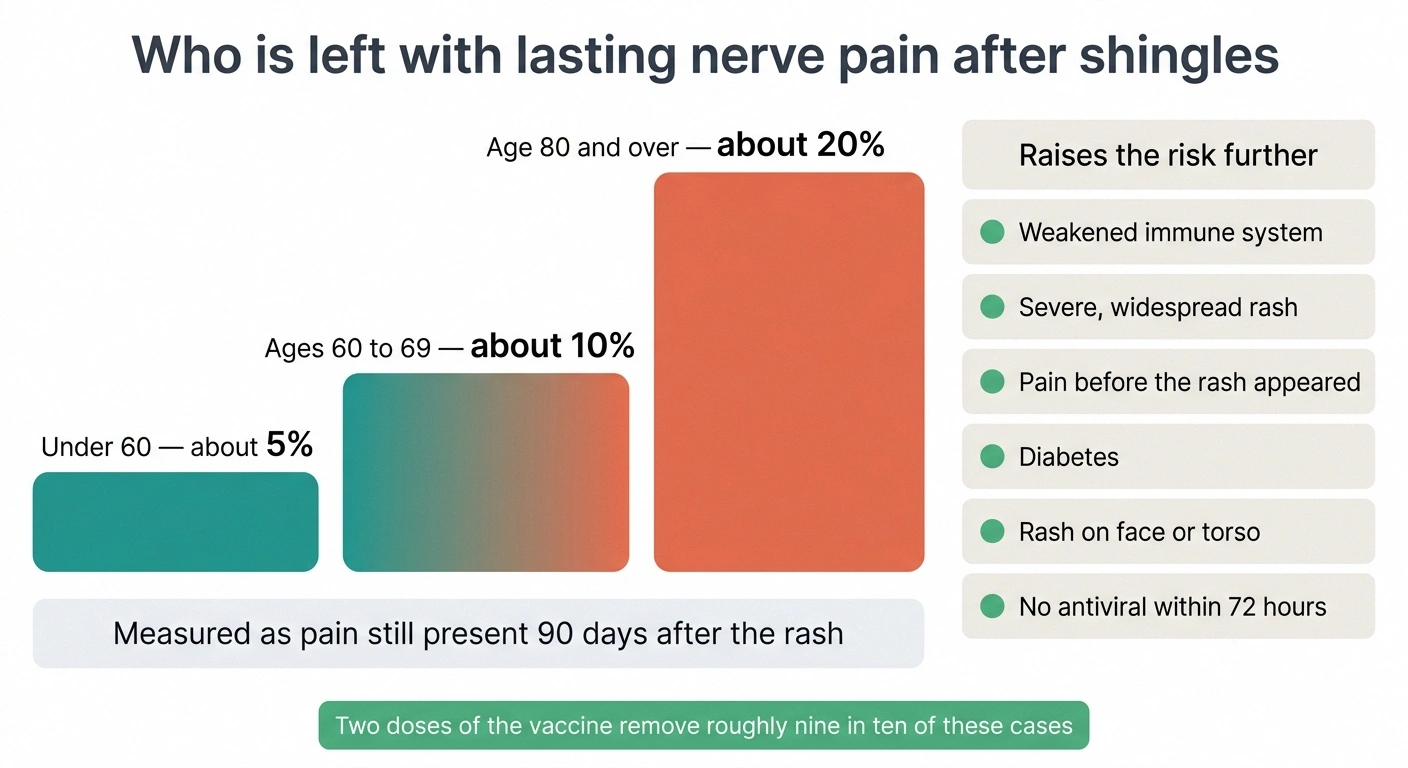
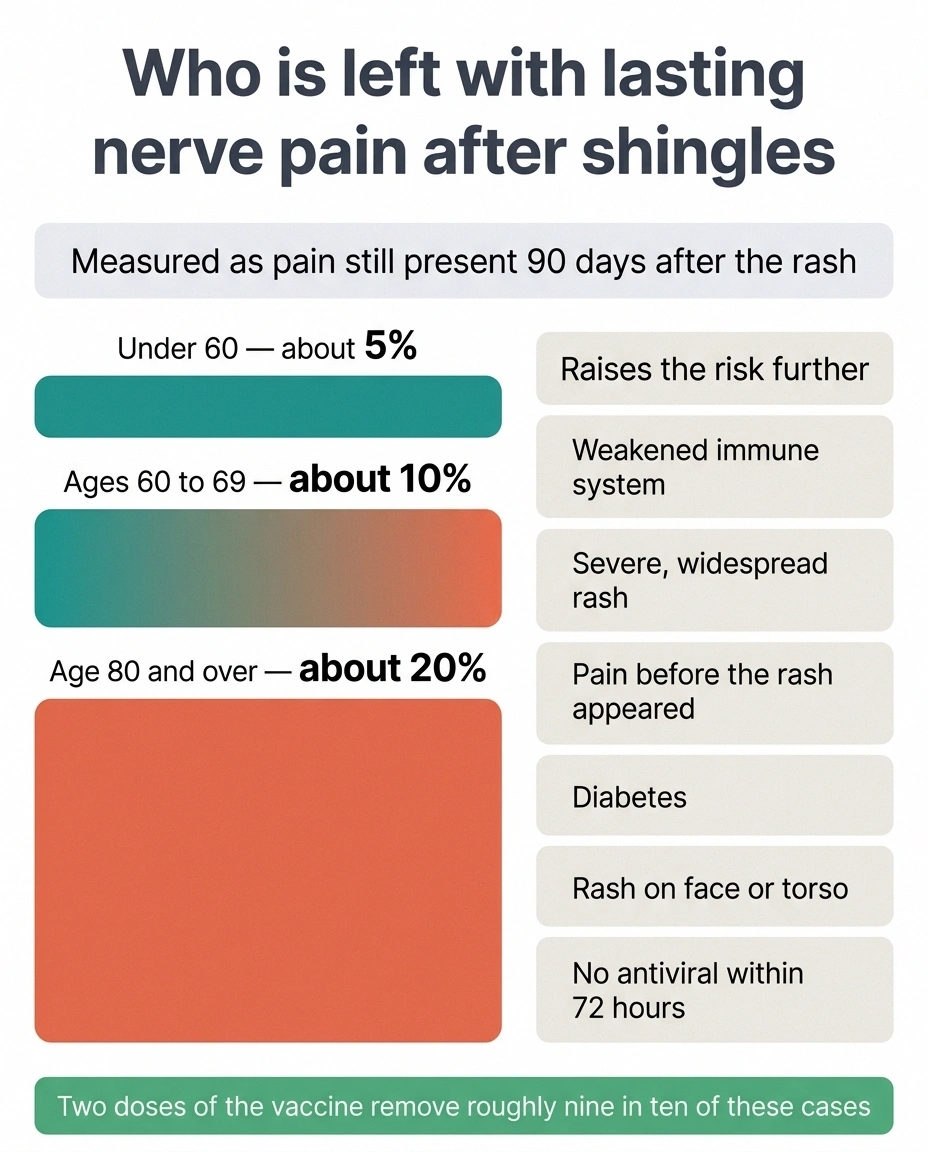
Age is the strongest predictor, but it is not the only one, and several of the others are common in the group reading this site.
- Being 60 or older. The single largest factor, and it keeps climbing after that.
- A weakened immune system. From medication, from cancer treatment, or from a condition that affects immune function.
- A severe rash. More lesions, wider spread. The severity of the acute episode tracks with the odds of lasting damage.
- Pain before the rash appeared. Prodromal pain, sometimes days ahead of any visible sign, is associated with worse outcomes.
- Diabetes. Which puts a substantial slice of the neuropathy population in a higher-risk bracket before anything else is counted.
- Rash on the face or torso rather than a limb.
- Not starting an antiviral within 72 hours. More on this below, because the evidence here is weaker than most people assume.
- Not having been vaccinated.
Look down that list and notice how much of it you cannot control on the day. You cannot choose how severe your rash will be or where it lands. The controllable items are the vaccine, and, to a lesser degree, how fast you get seen once a rash appears.
If You Already Have Neuropathy, the Math Is Different
This is the section the general health sites do not write, and it is the reason this page exists on a neuropathy site rather than a vaccine site.
Four drug families, two conditions, one prescription pad
- Gabapentinoids
- Gabapentin and pregabalin. First-line for both peripheral neuropathy and post-herpetic neuralgia. If you are already at an effective dose, there is limited room to escalate for a new pain.
- SNRIs
- Duloxetine. Well established in diabetic neuropathy, weaker evidence in post-herpetic neuralgia specifically.
- Tricyclics
- Amitriptyline, nortriptyline. Long-standing evidence in post-herpetic neuralgia, and one of the few places the two conditions genuinely share a first-line option.
- Topicals
- Lidocaine 5%, capsaicin. The one category with real headroom, because they act locally and stack with whatever you already take by mouth. This is why they matter more here than they do for widespread neuropathy.
If you already have diabetic neuropathy, chemotherapy-induced damage, or idiopathic neuropathy, a shingles episode does not land on healthy tissue. It lands on a nervous system that is already compromised, in a person who is already managing daily nerve pain, and often on a body that has fewer coping reserves left.
Three things change in that situation.
Your baseline risk is already elevated. Diabetes appears on the risk-factor list for post-herpetic neuralgia in its own right. If your neuropathy is diabetic in origin, you are not starting from the general-population odds.
Diagnosis gets harder. Burning, shooting, electric pain is already your normal. A new nerve pain arriving in a band across your ribs or down one side of your face is easy to mistake for a bad flare of the thing you already have, particularly in the two or three days before a rash shows up. That delay is the exact window in which antiviral treatment is supposed to start.
The treatments overlap. The first-line drugs for post-herpetic neuralgia are the same drugs used for peripheral neuropathy: gabapentin, pregabalin, duloxetine, tricyclics. If you are already taking one of them at a working dose for your existing neuropathy, you have less headroom. There is not always a fresh drug to escalate to, because you are already on it.
None of that is a reason to panic. It is a reason to treat the vaccine as a higher-value decision than the general recommendation implies. The people with the most to lose from a shingles episode are the people whose nerves are already carrying damage.
The 72-Hour Window, and What It Is Really Worth
You will read everywhere that starting an antiviral within 72 hours of the rash prevents post-herpetic neuralgia. The claim is repeated so consistently that it has the texture of settled fact. The evidence is softer than that.
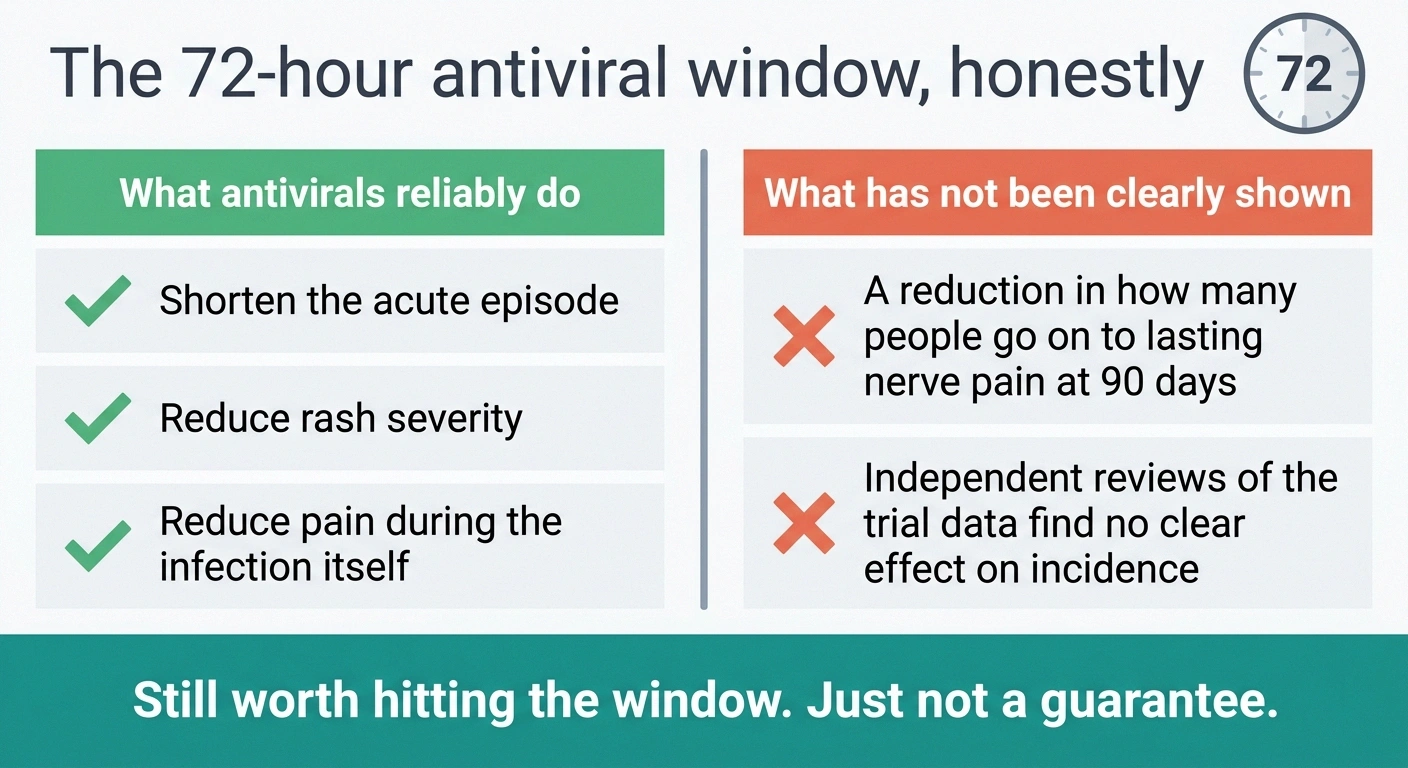
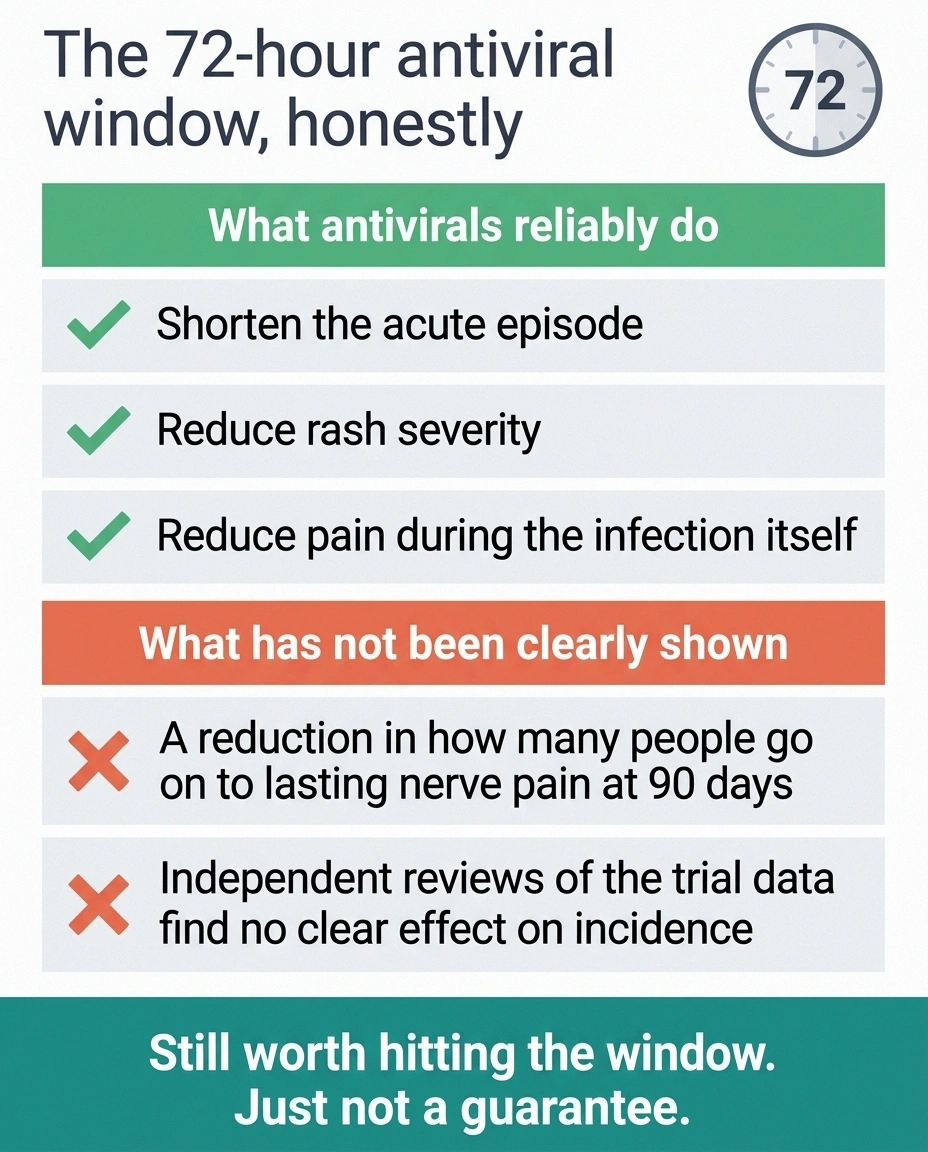
What antivirals reliably do is shorten and blunt the acute episode. Faster healing, less severe rash, less pain during the infection itself. That part is well supported and it is a good enough reason on its own to get seen quickly.
What they have not clearly been shown to do is reduce the number of people who go on to develop lasting nerve pain at 90 days. Independent reviews of the trial data have found no clear effect on post-herpetic neuralgia incidence, and a large cohort study found no overall association, though the picture looked somewhat better in severely immunosuppressed patients.
So the practical guidance stays the same and the reasoning changes. Get seen inside 72 hours. Take the antiviral. Do it because it makes the next two weeks meaningfully better and because the downside is small, not because it is a reliable shield against the pain that follows. Treating it as a shield is how people end up feeling betrayed by their own medical care when the pain sets in anyway.
If You Already Have Post-Herpetic Neuralgia

The vaccine will not help the pain you have. Getting vaccinated after an episode is still reasonable, because shingles can recur and a second episode in a different nerve territory is a real possibility, but it will do nothing for the nerve that is already hurting.
What is worth your attention instead is on our main post-herpetic neuralgia page, and the short version is that PHN responds to some things better than general peripheral neuropathy does.
- Topicals do unusually well here. Lidocaine 5% patches are a first-line option specifically for post-herpetic neuralgia, and they work best when the painful area is well defined and localized, which PHN often is.
- Capsaicin has a real evidence base in this condition. Both the over-the-counter capsaicin creams and the prescription-strength Qutenza 8% patch were studied heavily in PHN populations.
- The oral drugs are the same ones you may already know, and the dosing conversation is the same conversation.
The other thing worth saying plainly is that post-herpetic neuralgia improves on its own more often than most nerve conditions do. A meaningful share of people are substantially better at a year. That is not a promise and it is cold comfort in month two, but it is a genuinely different trajectory from progressive neuropathies, and it is worth knowing.
What It Costs in 2026, and the Part B Trap
Here is where a lot of people get tripped up, and it has nothing to do with medicine.
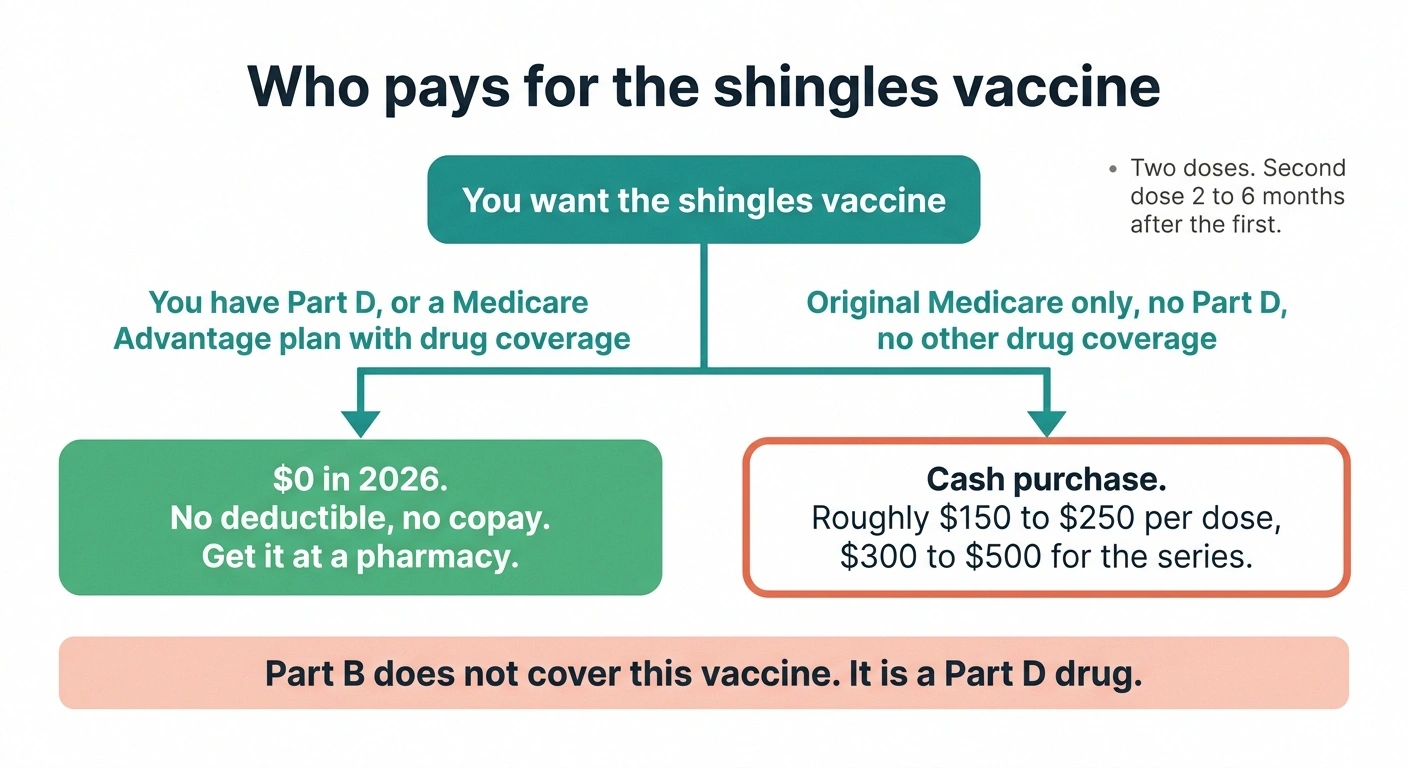
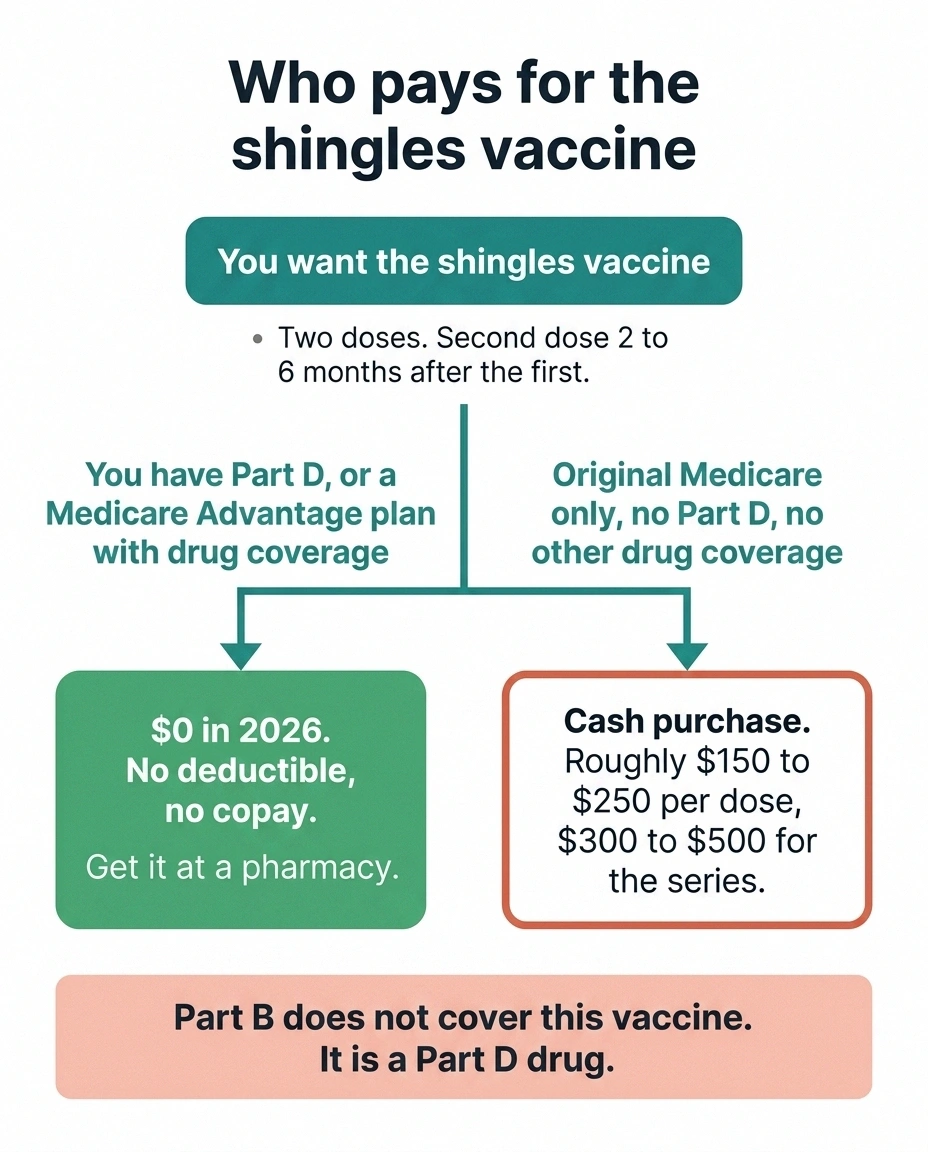
Original Medicare Part B does not cover Shingrix. Part B covers the flu shot, the pneumococcal vaccines, hepatitis B for at-risk beneficiaries, and vaccines needed to treat an injury. Shingrix is not on that list. It is a Part D drug.
Since the vaccine cost-sharing changes took effect, Part D covers recommended adult vaccines including Shingrix at no cost to the beneficiary. In 2026 that means $0 out of pocket, no deductible, no copay, whether your Part D coverage is standalone or bundled into a Medicare Advantage plan.
The trap is the gap. If you are on Original Medicare with no Part D plan and no other drug coverage, you fall between the two and the vaccine is a cash purchase. That runs roughly $150 to $250 per dose, so $300 to $500 for the full series. It is the same shot either way. The only variable is whether you happen to carry the right part of Medicare.
One practical consequence: get it at a pharmacy, not at your doctor’s office. Pharmacies bill Part D directly and routinely. A physician’s office may bill it in a way that produces a bill you did not expect. If you are sorting out what your plan does and does not pay for more broadly, our guide to Medicare coverage for neuropathy covers the wider picture.
Side Effects, and the Second Dose Nobody Warns You About

Shingrix is a reactogenic vaccine. That is the clinical term for “it makes a lot of people feel rough for a day or two,” and it is worth knowing in advance rather than discovering it.
Common reactions include a sore arm, sometimes quite sore, along with redness and swelling at the injection site, fatigue, muscle aches, headache, shivering, fever, stomach upset and nausea. These typically last two to three days.
The part that catches people out is that the second dose is frequently worse than the first. People sail through dose one, decide the warnings were overblown, and then lose a day to dose two. Plan for it. Do not schedule the second shot the day before something you cannot move.
Two doses, with the second given two to six months after the first. Both doses are needed for the protection figures quoted earlier. A single dose is not the deal.
On the question that a neuropathy audience always asks: there are isolated published case reports of neuropathy following Shingrix vaccination. They are rare, they are case reports rather than controlled evidence, and a temporal association is not a demonstrated cause. I mention it because I would rather you hear about it here than find it somewhere that presents a single case report as an established risk. If you have a history of Guillain-Barré syndrome or an inflammatory neuropathy such as CIDP, that history is worth raising specifically before you book, because it changes the conversation in a way that ordinary peripheral neuropathy does not.
Getting It Done

The whole decision, compressed:
Five things worth settling before you go
- Confirm the pharmacy is billing your Part D plan rather than Part B. Ask them to check before they draw it up, not after.
- Book dose two on the spot. The gap is 2 to 6 months, and dropout between doses is the main way people end up half protected.
- Pick a day for dose two with nothing important the following morning.
- Ask whether you can have it alongside a flu or COVID vaccine at the same visit. Co-administration is generally acceptable, and combining reactions into one rough day rather than two is a reasonable preference to state.
- If you have a history of Guillain-Barré syndrome or an inflammatory neuropathy, raise that first with the clinician who manages it, before booking anything.
- Healthy adults 50 and over are recommended to get it. Immunocompromised adults 19 and over are recommended to get it.
- Having had shingles already does not disqualify you. Wait until the acute episode has resolved. There is no fixed required interval, though many clinicians suggest waiting a few months.
- Having had the old live vaccine, Zostavax, does not disqualify you either. Shingrix is recommended regardless.
- Go to a pharmacy if you are on Medicare, for the billing reason above.
- Book the second dose while you are standing there. Dropout between dose one and dose two is the main way people end up under-protected.
- Do not schedule dose two before a day that matters.
If your neurologist or primary care doctor has been managing your neuropathy for a while and you want to fold this into an existing appointment rather than making a new one, our notes on how to raise things with your doctor may help you get it onto the agenda without it becoming the whole visit.
The uncomfortable truth about prevention is that it never feels like it worked. You will not know which year you would have gotten shingles, and you will not get to compare the version of yourself who spent a winter with burning ribs. It is the least satisfying kind of good decision. It is still a good decision.
Frequently Asked Questions
Will the shingles vaccine help nerve pain I already have?
No. The vaccine prevents post-herpetic neuralgia by preventing the shingles episode that causes it. It has no effect on nerve damage that has already happened, and it does not treat active pain. If you have current post-herpetic neuralgia, the useful options are topical lidocaine, capsaicin, and the oral nerve-pain medications.
Can I get Shingrix if I have already had shingles?
Yes. Having had shingles does not protect you from getting it again, and vaccination is recommended after an episode. Wait until the acute episode has fully resolved. There is no single required waiting period, though a gap of a few months is commonly suggested.
Does Medicare pay for the shingles vaccine?
Medicare Part D covers it at $0 in 2026, with no deductible and no copay. That includes Medicare Advantage plans with drug coverage. Original Medicare Part A and Part B do not cover it. If you have no Part D coverage you will pay roughly $150 to $250 per dose.
How effective is it against post-herpetic neuralgia specifically?
Two doses were 91% effective at preventing post-herpetic neuralgia in adults aged 50 to 69, and 89% effective in adults 70 and older. Both doses are required for those figures.
I already have peripheral neuropathy. Is the vaccine safe for me?
Existing peripheral neuropathy is not a contraindication, and the case for vaccination is arguably stronger in this group because shingles nerve pain would stack on top of damage you already have. A prior history of Guillain-Barré syndrome or an inflammatory neuropathy such as CIDP is a different matter and worth raising with the clinician who manages your neuropathy before you book.
How much time do I have to start an antiviral once a rash appears?
The standard target is 72 hours from the appearance of the rash. Antivirals reliably shorten and reduce the severity of the acute episode. The evidence that they reduce the risk of lasting post-herpetic neuralgia is mixed, so treat the window as worth hitting rather than as a guarantee.
Why does the second dose hit harder?
The adjuvant in Shingrix produces a strong immune response, and the response to the second exposure is often more pronounced than the first. Sore arm, fatigue, aching and low fever for two to three days are common. It is a sign the vaccine is doing what it is designed to do, which does not make the day any more pleasant.
Is it too late if I am already in my eighties?
No. Effectiveness against post-herpetic neuralgia was 89% in the 70-and-over group, which is the age band where both the risk of shingles and the risk of it leaving lasting pain are highest. The absolute benefit is larger in older adults, not smaller.
About the Author