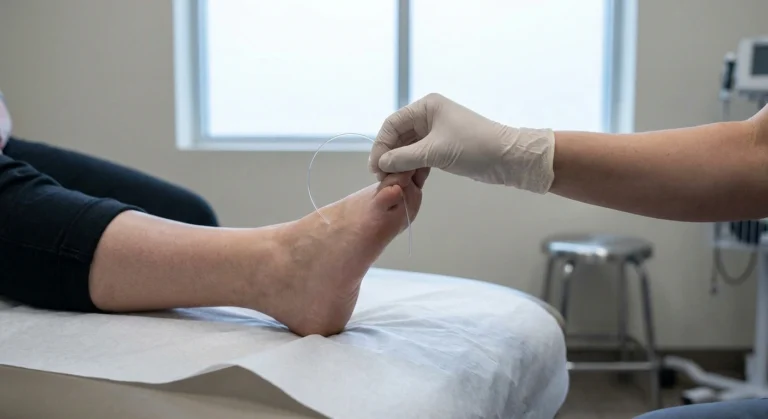
Anyone who’s spent time around a dialysis chair has heard the same complaint, in slightly different words, a hundred times. “My feet feel like they’re on fire.” “It’s like ants under my skin at night.” “My legs won’t stop jumping.” For decades, doctors knew kidney patients had nerve pain. For a long time, they didn’t have a name for it. We do now: uremic neuropathy — the nerve damage that comes with advanced kidney disease, especially once you’re at or near the point of dialysis.
I’m Janet. I write here as a patient advocate, not a kidney specialist. But uremic neuropathy is something I’ve spent real time learning, partly because so many people in my support group live in that overlap world — diabetic neuropathy plus kidney disease — and partly because it’s one of the most under-explained corners of the kidney-care experience. If your doctor mentioned the words and you walked out of the office wondering what they actually meant, this is for you.
None of this replaces the conversation with your nephrologist and neurologist. But it should make those conversations make a lot more sense.
What Uremic Neuropathy Is, in Plain Terms
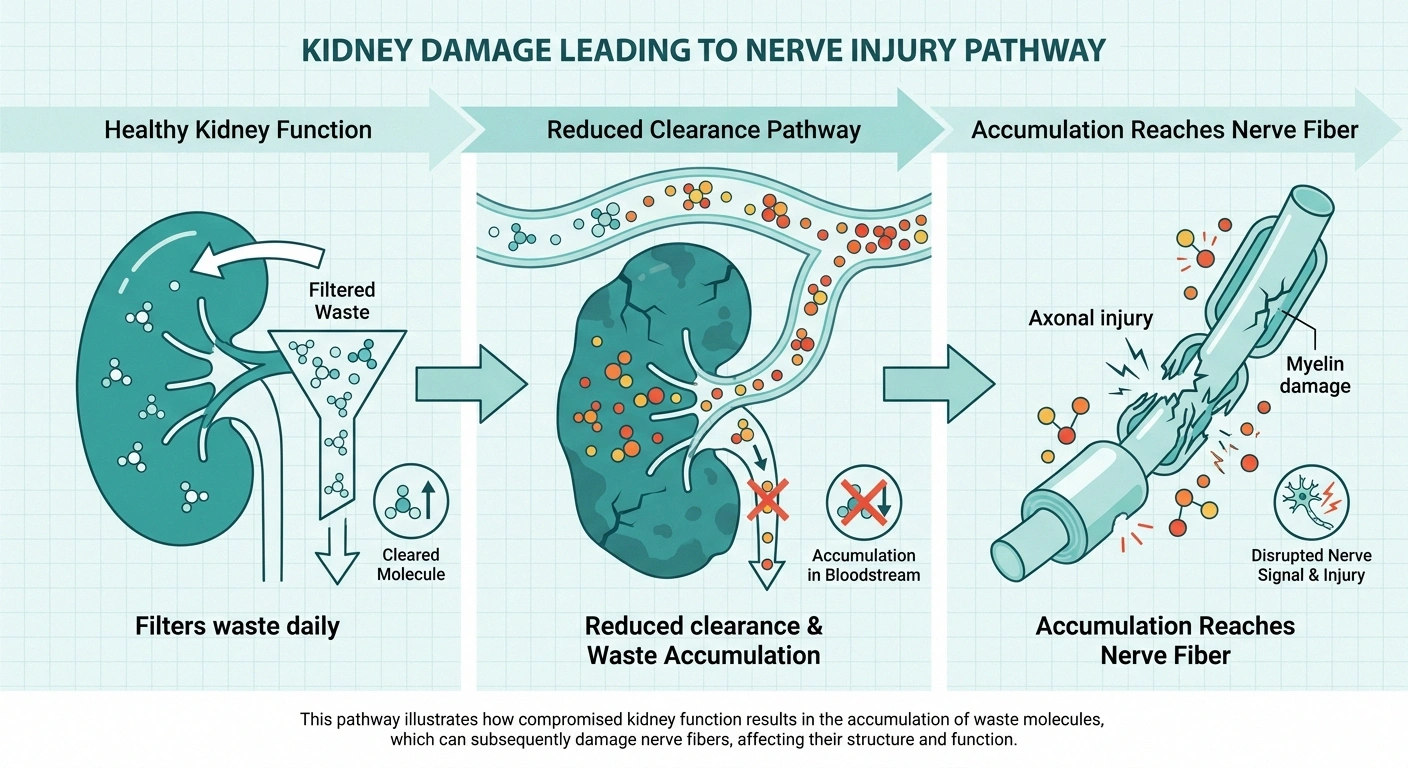
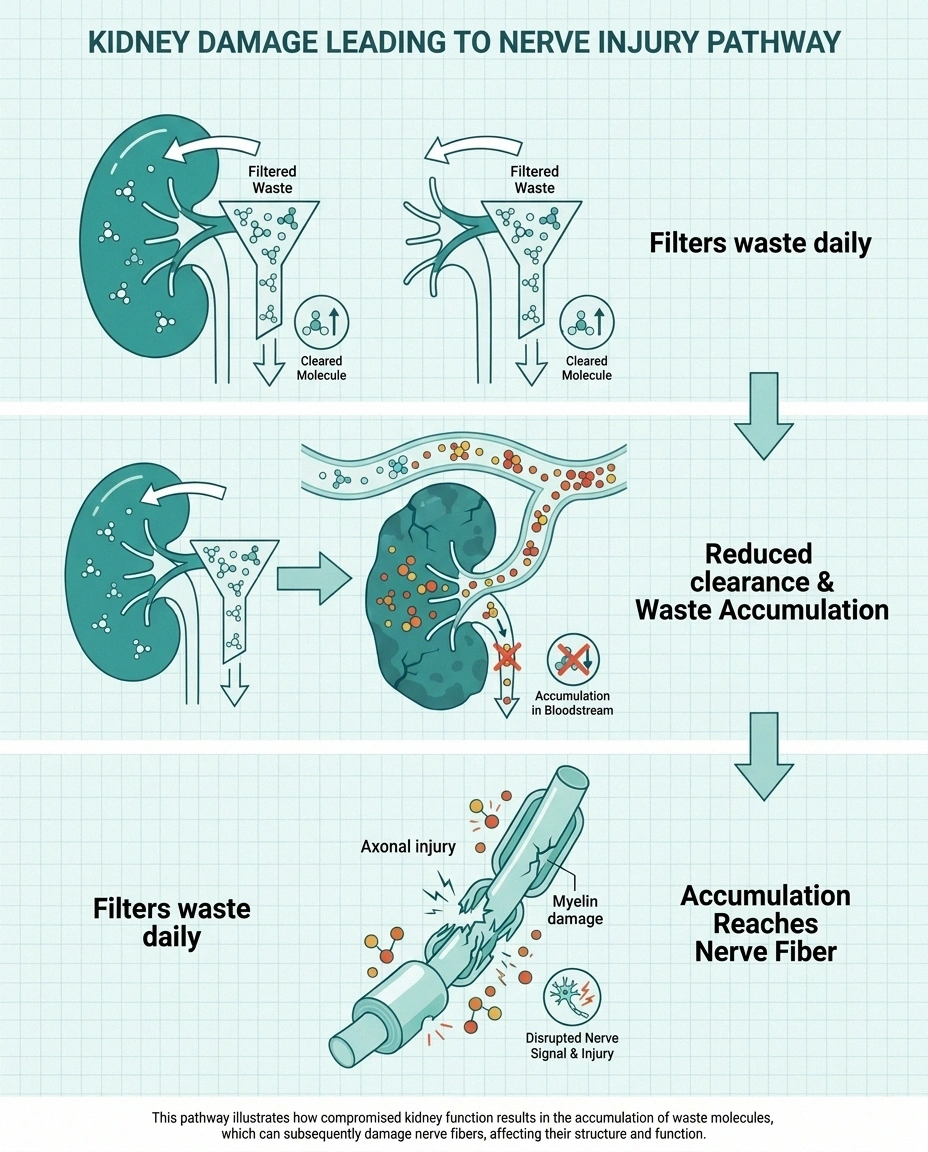
Your kidneys do many jobs, but one of the quiet ones is filtering out a long list of waste molecules your body makes every day. When the kidneys are working well, those wastes leave through your urine and you never think about them. When the kidneys slow down — chronic kidney disease (CKD) — those wastes accumulate in your blood. The medical term for that buildup is uremia.
Key Takeaway
Uremic neuropathy is nerve damage caused by waste molecules that accumulate when the kidneys can’t filter them well. It affects 60–90% of dialysis patients, follows a feet-first symmetric pattern, and overlaps heavily with diabetic neuropathy. The only intervention that meaningfully reverses it is a successful kidney transplant — but optimized dialysis, careful medication dosing, and aggressive foot care all make a real difference in daily life.
Many of those accumulated wastes are nerve-toxic. They sit in the bloodstream day after day, slowly damaging the long peripheral nerves that run down to your feet and out to your hands. Some attack the myelin — the insulation that helps nerve signals travel quickly. Others damage the axon itself — the wire underneath the insulation. Most uremic neuropathy involves both.
The result is a fairly classic pattern: numbness, burning, pins-and-needles, and weakness that starts in the toes and gradually creeps upward over months or years. Both feet, both legs, eventually both hands. Doctors call this pattern “distal symmetric polyneuropathy” — distal because it starts in the parts farthest from your spine, symmetric because both sides are affected together, and poly because it involves many nerves rather than one.
If you also have diabetic neuropathy, you may already recognize this pattern. The two conditions feel similar from the outside — and many kidney patients have both at once, since diabetes is the leading cause of kidney failure in the United States. Untangling which is which is often impossible. The good news is the management overlaps almost entirely.
Who Gets It and When
Uremic neuropathy is rare in early kidney disease. As filtering function drops, the risk climbs.
Uremic Neuropathy Risk by CKD Stage
- Stages 1–3 CKD (mild to moderate decline) — uremic neuropathy is uncommon at this stage. Numbness or tingling here usually has another cause: diabetes, B12 deficiency, a thyroid problem, or something pinching a nerve. Worth investigating; not usually “uremic.”
- Stage 4 CKD (severe decline, eGFR 15–29) — symptoms start appearing in a noticeable minority of patients.
- Stage 5 CKD and dialysis (ESRD) — uremic neuropathy affects somewhere between 60% and 90% of patients depending on how carefully you look. Many people have it without realizing, because it’s gradual and they assume the discomfort is “just dialysis.”
That’s a hard sentence to read. If you or someone you love is heading toward dialysis or already on it, the odds of some nerve involvement are quite high. The flip side is that it’s almost always survivable, often manageable, and in some cases reversible after a kidney transplant.
What It Actually Feels Like

The descriptions I hear most often from people with uremic neuropathy:
- Burning, especially at night, in the soles of the feet. Many people sleep with their feet outside the covers because the pressure of bedding hurts.
- Numbness in the toes that creeps up the foot. People will say “I can’t tell where my feet are in the dark” — that’s a hint that the position-sense fibers are involved.
- Restless legs syndrome (RLS) — the maddening urge to move your legs when you finally sit down to rest. RLS is much more common in CKD than in the general population. It deserves its own conversation with your doctor because it has separate, effective treatments.
- Muscle cramps, particularly during or right after dialysis. Some of this is fluid shifts, but uremic neuropathy contributes.
- Weakness in the feet and lower legs, sometimes with foot-slap or tripping. This is the motor side of the nerve damage.
- Itching skin that’s hard to explain — though true CKD-related pruritus has separate mechanisms and shouldn’t be lumped in.
- Autonomic symptoms — feeling lightheaded when you stand up (orthostatic hypotension), bloating after small meals (mild gastroparesis), erectile dysfunction in men, bladder changes. These come from the involvement of the autonomic nervous system. If they’re present, your nephrologist will recognize the pattern as autonomic neuropathy overlap.
What it does not typically feel like: sudden severe weakness, paralysis appearing over days, or a one-sided pattern. Those suggest something else — a stroke, a compressed nerve, or one of the much rarer dialysis-related neuropathies. If anything appears suddenly or on one side only, call your doctor that day.
How It’s Diagnosed
The diagnosis of uremic neuropathy is usually a combination of three things.
What the Research Says
Dialysis modality matters: high-flux dialyzers and hemodiafiltration remove a broader range of waste molecules than older low-flux dialysis. Multiple studies suggest these modalities slow uremic neuropathy progression vs. low-flux alone.
Transplant is the only reliable reversal: nerve conduction studies in transplant recipients typically show meaningful improvement within 6–12 months post-transplant. The longer uremic neuropathy has been present, the less complete the recovery.
First, your story and your exam. A nephrologist or neurologist will ask about the symptoms above, when they started, whether they’re symmetric, and how they’re progressing. They’ll check sensation with a tuning fork and a soft monofilament, test reflexes, and look at how you walk.
Second, an EMG and a nerve conduction study (NCS). These are the same tests done for many forms of neuropathy. An electrode is placed on the skin over a nerve and a small electrical pulse is sent through it; the test measures how fast and how strongly the nerve responds. In uremic neuropathy, conduction speeds are typically slow, response sizes are reduced, and the pattern is symmetric in the longest nerves. If you want a deeper look at what these tests involve, our piece on neuropathy diagnosis walks through them step by step.
Third, ruling out other causes. This matters because so many kidney patients have multiple things going on. The standard list includes checking B12 levels, thyroid function, blood sugar control (HbA1c), a basic protein electrophoresis (looking for monoclonal proteins, which can cause their own neuropathy), and a careful review of medications. Some prescriptions cause nerve damage on their own, and the kidney-patient medication list tends to be long.
A nerve biopsy is rarely needed. The clinical picture plus the EMG plus a normal-or-explained workup of other causes is usually enough.
What Actually Helps — Starting With the Root

This is the part of the conversation that matters most. Symptomatic treatments are useful — we’ll get to them — but the only intervention that meaningfully changes the trajectory of uremic neuropathy is treating the kidney problem itself.
Optimizing dialysis matters. Several decades of research suggest that more thorough removal of waste molecules — including the so-called “middle molecules” that small dialysis pores can miss — slows or stabilizes uremic neuropathy in many patients. Practically, that means high-flux dialyzers and, where available, hemodiafiltration (which combines convection with diffusion and removes a broader range of toxin sizes). Talk to your nephrologist about what your unit offers; not every center has the equipment for online hemodiafiltration, but the conversation is worth having.
Kidney transplantation is the only intervention that has been shown to halt and partially reverse uremic neuropathy in a substantial number of patients. Symptoms typically begin to improve within months of a successful transplant — sometimes dramatically. This is one reason transplant evaluation is worth pursuing even for patients who are stable on dialysis and have decent quality of life. Nerve symptoms aren’t usually the deciding factor, but they’re part of the picture.
Other root-level levers that matter:
- Tight diabetes control if you’re diabetic. The diabetic and uremic contributions to your nerve damage are intertwined; better glucose control helps the diabetic component.
- Treating B12 deficiency. Common in kidney patients, especially if you’ve been on metformin for years or follow a plant-based diet. B12 deficiency neuropathy looks similar to uremic neuropathy and can compound it. Methylcobalamin or B12 injections are inexpensive and very low-risk.
- Iron and erythropoietin management. Iron deficiency contributes to restless legs syndrome; correcting it can reduce the leg-jumping at night.
- Avoiding nerve-toxic medications when possible. Some chemotherapy agents, certain antibiotics (especially long courses of nitrofurantoin or metronidazole), and a few others should be used with extra caution in kidney patients. Your nephrologist will already be screening for this; bring it up if you have any doubts.
Symptomatic Treatments — With Important Renal Cautions
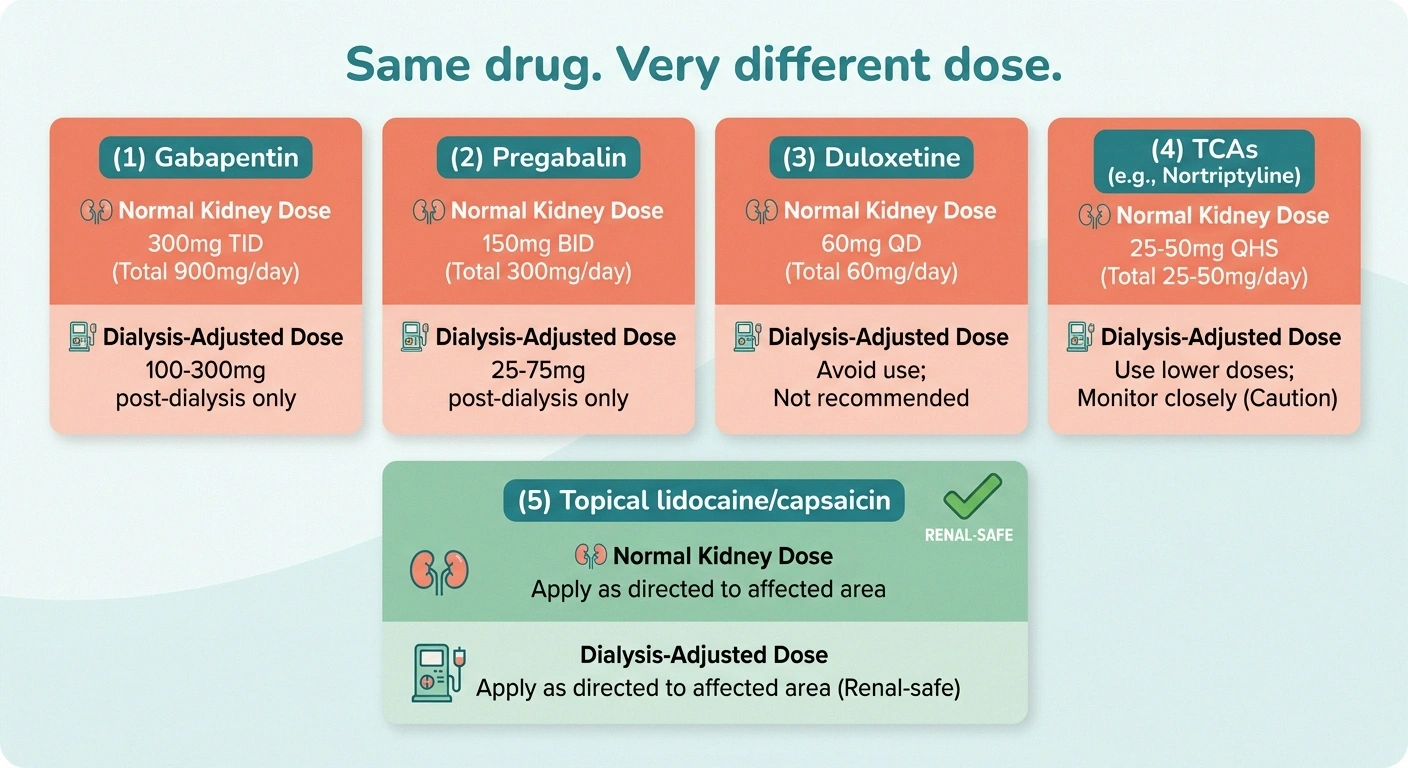
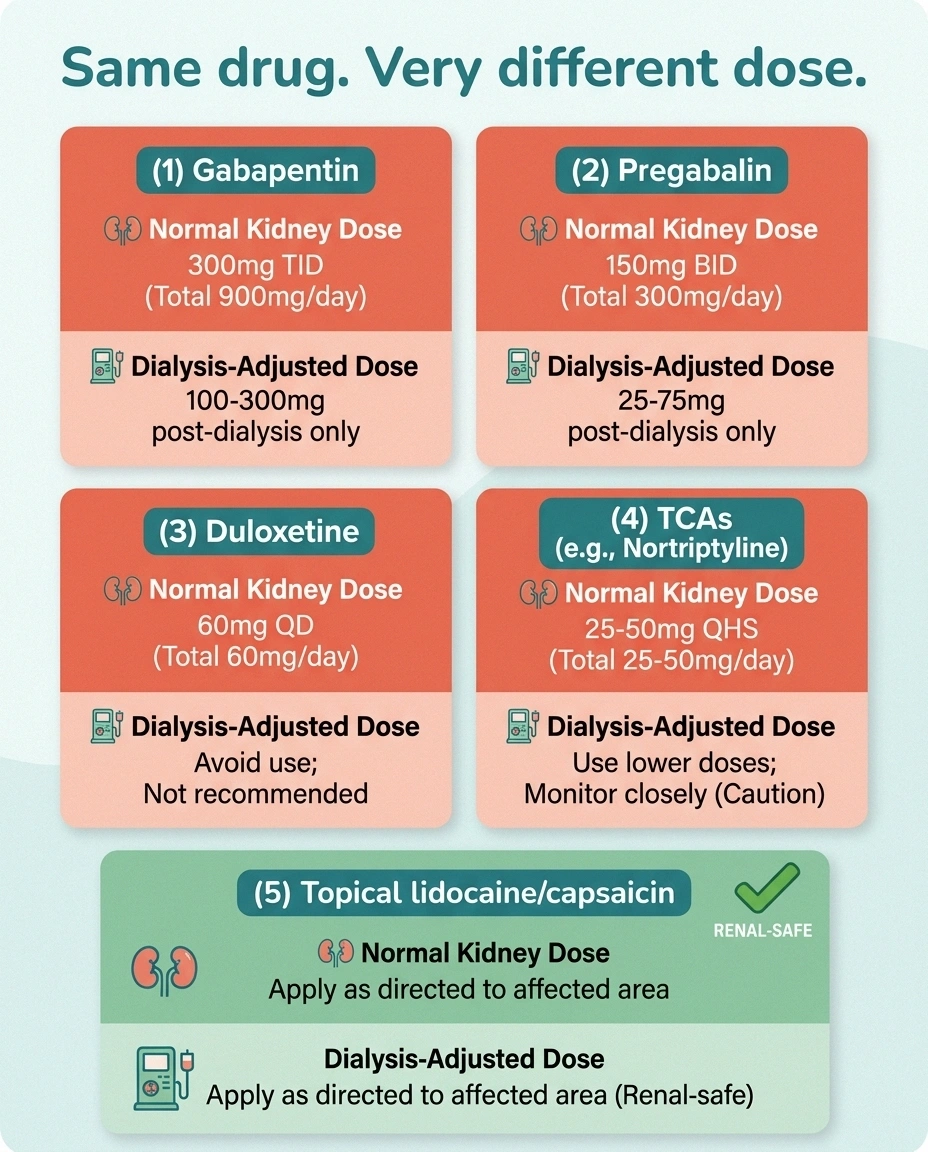
Most of the prescription drugs used for neuropathic pain were studied and dosed in patients with normal kidney function. When kidney function drops, the way these drugs are processed changes, sometimes dramatically. Doses that are routine for someone with healthy kidneys can pile up in someone with stage 4 or 5 CKD and cause serious side effects — sedation, confusion, muscle jerks, even falls.
The Question to Ask Every Time
“Is this dose adjusted for my kidney function?”
- Gabapentin in dialysis: typically 100–300 mg after each session, not three times daily
- Pregabalin in dialysis: typically 25–75 mg per day, not 150–600 mg
- Duloxetine: avoid or use very cautiously in severe CKD
- TCAs: start at the lowest dose; orthostatic hypotension stacks with autonomic involvement
- Opioids: generally avoided long-term in this population
Standard “general population” nerve-pain doses can build up to dangerous levels in dialysis patients. Never self-adjust.
This is the most important section to read with your prescriber. Never adjust your own dose. Never take a dose your nephrologist hasn’t signed off on.
The general landscape:
- Gabapentin. Cleared almost entirely by the kidneys. In a patient with normal kidneys, a typical starting range might be 300 mg three times daily, titrated upward. In someone on dialysis, that dose would be far too much. Common dialysis dosing is 100–300 mg taken after each dialysis session — sometimes only on dialysis days. The full nerve-pain dose used in the general population can build up to dangerous levels. Read more about how gabapentin is typically used and then have a focused conversation about your specific dose given your specific kidney function.
- Pregabalin (Lyrica or generic). Same issue, slightly different math. Cleared almost entirely by the kidneys. A typical starting dose in someone with normal kidneys is 75 mg twice daily; in dialysis patients it’s often 25–75 mg per day, sometimes given only after dialysis. Our pregabalin guide covers the drug in general; renal-dose adjustments are critical for kidney patients.
- Duloxetine. Not removed by dialysis. Manufacturers caution against using it in severe renal impairment because of unpredictable accumulation. Some nephrologists still use it carefully at low doses; others avoid it entirely. Discuss.
- Tricyclic antidepressants (amitriptyline, nortriptyline). These can be used in kidney patients but at lower starting doses and with attention to side effects like dry mouth, constipation, and orthostatic dizziness — all of which are already common in dialysis patients.
- Topical treatments (lidocaine patches, capsaicin patches, compounded creams) are appealing in kidney patients because they don’t depend on systemic clearance. Limited evidence base for uremic neuropathy specifically, but few downsides. Worth trying for focal symptoms.
- Opioids. Generally avoided in chronic uremic neuropathy because of cumulative side effects, fall risk, and the modest evidence base for nerve pain in any population. Reserved for short courses or specific situations.
If a clinician hands you a prescription for a typical-dose nerve medication and your kidneys are at stage 4 or 5, it’s reasonable to ask: “Is this dose adjusted for my kidney function?” That single question has saved more than one of my support-group friends from a hospital admission for confusion and falls.
Restless Legs Syndrome Deserves a Separate Conversation
If your main complaint at night is an irresistible urge to move your legs — not pure burning or tingling, but a need to do something with your legs — that’s restless legs syndrome, and it has its own treatment ladder.
If Restless Legs Wake You at Night — Run This Checklist
- Ask your nephrologist to check your ferritin. Iron stores often run low in dialysis. Treating to a higher target frequently calms RLS without RLS-specific drugs.
- Review your medication list for RLS-worsening culprits. Diphenhydramine (Benadryl, ZzzQuil), some SSRIs, mirtazapine, and some anti-nausea drugs are common offenders.
- Trial of a renal-dose-appropriate gabapentinoid taken in the evening if iron and meds are optimized — gabapentin enacarbil or low-dose pregabalin.
- Dopaminergic drugs (ropinirole, pramipexole) are used carefully and not first-line anymore — augmentation risk over months to years.
First-line steps for RLS in kidney patients:
- Check ferritin. Iron stores tend to run low in dialysis patients. Bringing ferritin into the optimal range (often above 100–200 ng/mL for symptomatic RLS) helps a large fraction of patients without any RLS-specific medication.
- Review medications. Some antidepressants (SSRIs, mirtazapine), some antihistamines (diphenhydramine, common in over-the-counter sleep aids), and some anti-nausea drugs can worsen RLS. Adjustments here help some people.
- Specific RLS drugs. Gabapentin enacarbil (Horizant) and low-dose pregabalin are now first-line for moderate-severe RLS in CKD. Dopaminergic drugs (ropinirole, pramipexole) are used but carry a long-term risk of “augmentation” that makes the RLS worse — they’re used more cautiously than they used to be.
RLS is treatable. If yours is bad, push to get it addressed separately from your general neuropathy management.
Foot Care and Fall Prevention Become Critical
Numb feet on a dialysis schedule, with the orthostatic dizziness that often comes with autonomic involvement, are a serious fall risk. Falls in this population can cause fractures that are very hard to recover from. The basics are not optional:
Foot-Care Floor for Kidney Patients With Neuropathy
- Daily foot check. Look at the tops, bottoms, and between every toe — a small cut you can’t feel can become a serious infection in someone with poor circulation. Use a mirror on the floor for the soles if you can’t see them well.
- Properly fitted, supportive shoes. No bare feet at home, no sandals without back straps. The general principles we cover in our best shoes for neuropathy piece apply with extra urgency in kidney patients.
- Stand up slowly from sitting and especially from lying down. Wait 30 seconds before walking off if your blood pressure tends to drop. Compression stockings can help.
- Home safety check. Grab bars in the bathroom, night-lights along the path from bed to toilet, no loose rugs. Our piece on balance and falls in neuropathy has a room-by-room walkthrough.
- Regular foot-care visits. A podiatrist who knows your kidney status — and works with your nephrology team — should be part of your care, not an afterthought.
Living Well With Uremic Neuropathy
It’s easy to read a chapter like this and feel buried. Kidney disease alone is a lot to manage. Adding nerve symptoms feels like piling on. But the people I know who do best with this combination share a few habits worth borrowing.
They build a small care team that talks to itself — nephrologist, neurologist or pain specialist, podiatrist, and a pharmacist they trust. They keep a one-page medication list current and bring it to every visit. They track symptoms on a simple weekly journal (pain, numbness coverage, falls, RLS episodes) rather than trusting memory. They ask the dosing question — “is this dose adjusted for my kidney function?” — every time something new is prescribed. They take foot care seriously without making it the center of their identity.
And they don’t wait until things are unbearable to ask for help. Uremic neuropathy can be slow and silent until it isn’t. Catching changes early — a new area of numbness, a new fall, worsening RLS, new orthostatic dizziness — is far easier to address than waiting until something breaks.
If a Kidney Transplant Is Even Possible, Pursue It

This is worth saying again because it’s the only intervention that meaningfully reverses uremic neuropathy. Transplant evaluation is rigorous, the waiting list is long, and not everyone is a candidate. But of all the kidney patients I’ve known whose nerve symptoms improved markedly, the most common reason was a successful transplant. Symptoms don’t always disappear, but the trajectory usually shifts.
If transplant evaluation is on your nephrologist’s table, take it seriously. If it hasn’t been raised and you wonder why, ask. Living donor transplant shortens the wait considerably and is worth a family conversation early in the process.
Frequently Asked Questions
Will my uremic neuropathy go away once I start dialysis?
Dialysis can slow the progression and modestly improve symptoms for some patients, especially with high-flux or hemodiafiltration treatments. It rarely reverses established uremic neuropathy completely. The intervention that most reliably reverses it is a successful kidney transplant. Symptomatic medications can also reduce day-to-day discomfort while you wait.
Why does my doctor keep my gabapentin dose so low?
Gabapentin is cleared almost entirely by your kidneys. In someone with healthy kidneys, the drug clears quickly and doses can be high. In a dialysis patient, the same dose builds up in the bloodstream and can cause serious sedation, confusion, falls, and muscle jerks. The low dose your doctor uses is a safety dose, not an under-treatment. Pregabalin has the same issue with similar adjustments.
Is uremic neuropathy the same as diabetic neuropathy?
They overlap in symptoms — both cause distal symmetric numbness, burning, and weakness — and many patients have both at once since diabetes is the leading cause of kidney failure. The underlying mechanisms differ but the management overlaps almost entirely. Practically, treating one helps the other.
Will losing weight or changing my diet help my nerve symptoms?
Diet matters in kidney disease for many reasons, but the dietary changes most relevant to nerve symptoms are the ones that improve underlying drivers — blood sugar control if you’re diabetic, B12 sufficiency, and adequate (not excessive) protein. Work with a renal dietitian; the rules are different than for the general population.
I have horrible itching all over — is that uremic neuropathy?
Generalized itching in CKD is typically a separate condition called CKD-associated pruritus, with its own mechanisms and treatments. It can coexist with uremic neuropathy. Newer drugs like difelikefalin (Korsuva) target the itch specifically. Mention itching at your next nephrology visit; it’s often underreported and under-treated.
Can supplements help my uremic neuropathy?
Few supplements have good evidence in uremic neuropathy specifically, and several are dangerous in kidney patients (high-dose vitamin C, magnesium, potassium, certain herbs). Methylcobalamin (B12) is reasonable if you’re deficient. Beyond that, run any supplement past your nephrologist before starting. Several common nerve-support supplements safe for the general population are not safe for kidney patients.
Why do I get such bad muscle cramps during dialysis?
Dialysis cramps come from rapid fluid shifts, sometimes combined with the underlying uremic neuropathy. Slower fluid removal, careful sodium modeling, and adjustments to your dialysis prescription often help. Tell your dialysis team — they have tools for this.
Is restless legs syndrome part of uremic neuropathy?
RLS is more common in CKD and dialysis patients than in the general population and often overlaps with uremic neuropathy, but it’s its own condition with separate treatments. The first step is checking your iron stores (ferritin) and reviewing medications that worsen RLS. Specific RLS drugs are available if those basics don’t help.
About the Author