
Last spring, my book club friend Marge told me she was down to walking half a block before her legs felt like they were going to give out. She'd been diagnosed with diabetic neuropathy a few years earlier, so she assumed this was just the neuropathy getting worse. But when she leaned forward on a grocery cart in the produce aisle, her legs felt fine again. When she stood up straight, the heaviness came right back. She could ride the exercise bike at physical therapy for twenty minutes without a problem. Walking, though — she just couldn't walk.
That's not neuropathy. That's a very specific pattern that comes from a completely different problem in the low back, called lumbar spinal stenosis. And the thing is — Marge had both. Her feet burned all day from her diabetic neuropathy, and her legs would give out after a block from her spinal stenosis. She wasn't wrong that her nerves were involved. She was just wrong about which nerves and where.
Sorting out spinal stenosis from peripheral neuropathy is one of the more common tangles I see, especially in people in their sixties and seventies. Both cause leg pain, numbness, and walking problems. Both make people scared of falls. Both get worse over time if nothing is done. But they come from different places, need different tests, and respond to genuinely different treatments. Getting the distinction right — or figuring out that you have both — changes what actually helps.
What Lumbar Spinal Stenosis Actually Is
Lumbar spinal stenosis is a narrowing of the spinal canal in the low back. That narrowing usually comes from decades of everyday wear on the spine: discs that have lost height and bulge into the canal, small facet joints that have thickened with arthritis, and a spinal ligament called the ligamentum flavum that has slowly thickened and stiffened. As the canal shrinks, the nerve roots that pass through it — the ones on their way to your legs — have less room to work with.
Nerve roots can tolerate a surprising amount of crowding when everything is quiet. Standing up straight and walking, though, mechanically extends the low back and further pinches the canal — squeezing the already-crowded nerve roots and setting off the signature symptoms.
Those signature symptoms have a name: neurogenic claudication. In plain terms, it's a heavy, aching, burning, or crampy feeling in the buttocks, thighs, or calves that comes on with standing and walking and eases off with sitting or leaning forward. Some people describe it as their legs “going wooden.” Others say it feels like walking through wet sand. What makes it distinctively spinal stenosis is that timing — it's provoked by upright activity and relieved by flexion.
This is where the “shopping cart sign” comes from. People with spinal stenosis often can walk the whole grocery store as long as they're leaning on the cart, which puts them in slight forward flexion. The moment they let go and stand upright at the register, the legs go heavy again. The same trick — leaning forward — helps them on treadmills at a grade, on stationary bikes, and walking uphill.
Back pain can be part of the picture, but it doesn't have to be. Some people with significant spinal stenosis have surprisingly little back pain. Their whole problem lives in the legs when they try to walk.
What Peripheral Neuropathy Actually Is
Peripheral neuropathy is a very different animal. Instead of a mechanical problem in one place in the spine, it's damage to the peripheral nerve fibers themselves — usually starting in the longest nerves, which end at the feet. That's why diabetic neuropathy and other systemic neuropathies almost always start as symptoms in the feet and creep upward over months and years.
The signature symptoms are different from spinal stenosis in almost every way. Burning, tingling, or numbness — usually in both feet, in a symmetric stocking-shaped pattern. Present at rest as well as during activity. Not eased by sitting down. Not eased by leaning forward. Often worse at night for reasons unrelated to position — the quieting of daytime nervous-system noise makes background nerve misfiring more noticeable.
Because peripheral neuropathy damages the sensory nerves that tell your brain where your feet are in space, it also produces balance trouble. But that balance trouble is different from stenosis balance trouble. People with peripheral neuropathy have their worst balance in the dark, on uneven ground like sand or gravel, or when their eyes are closed. During the day on a flat sidewalk, they can compensate visually — as long as they can see their feet, they can walk. This background of unsteadiness is one reason falls become a real concern with peripheral neuropathy.
The Distance-and-Position Rule
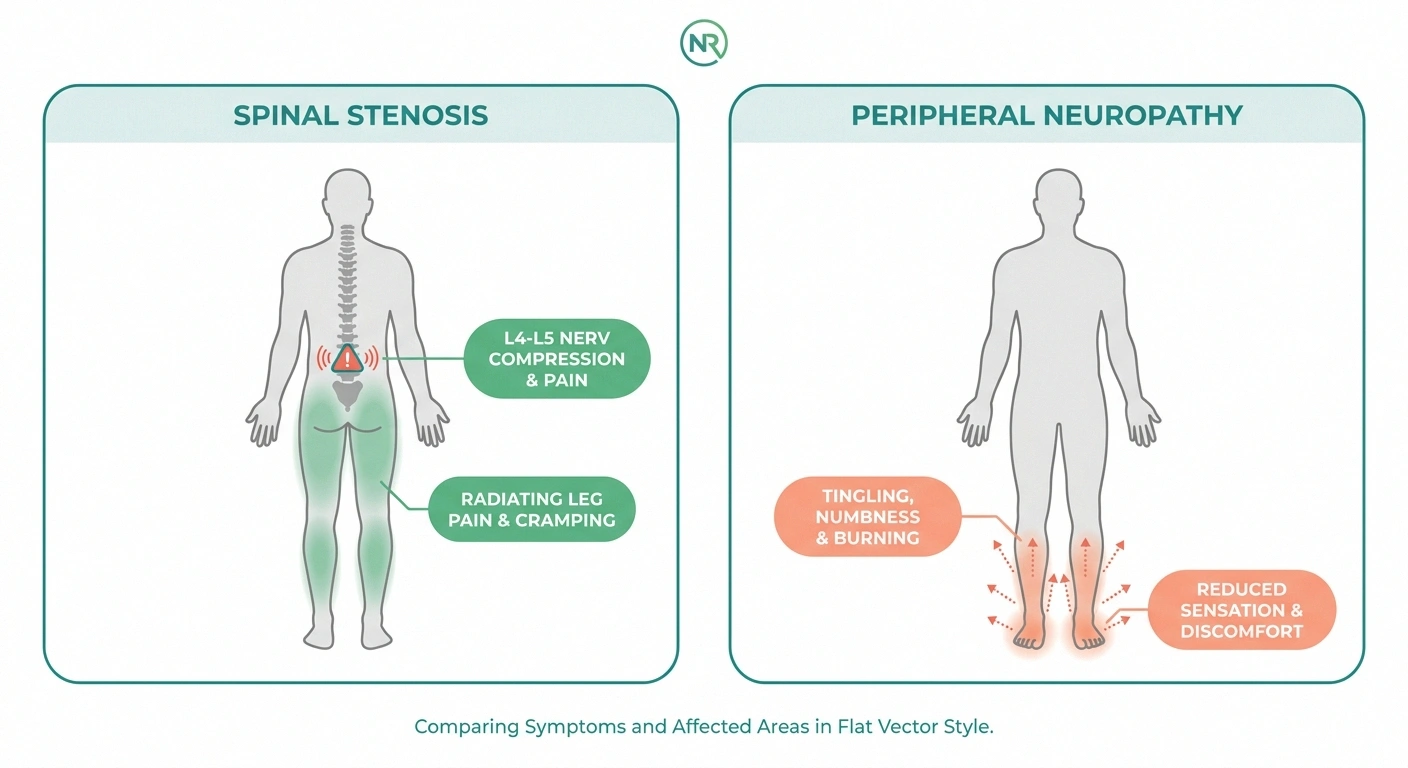
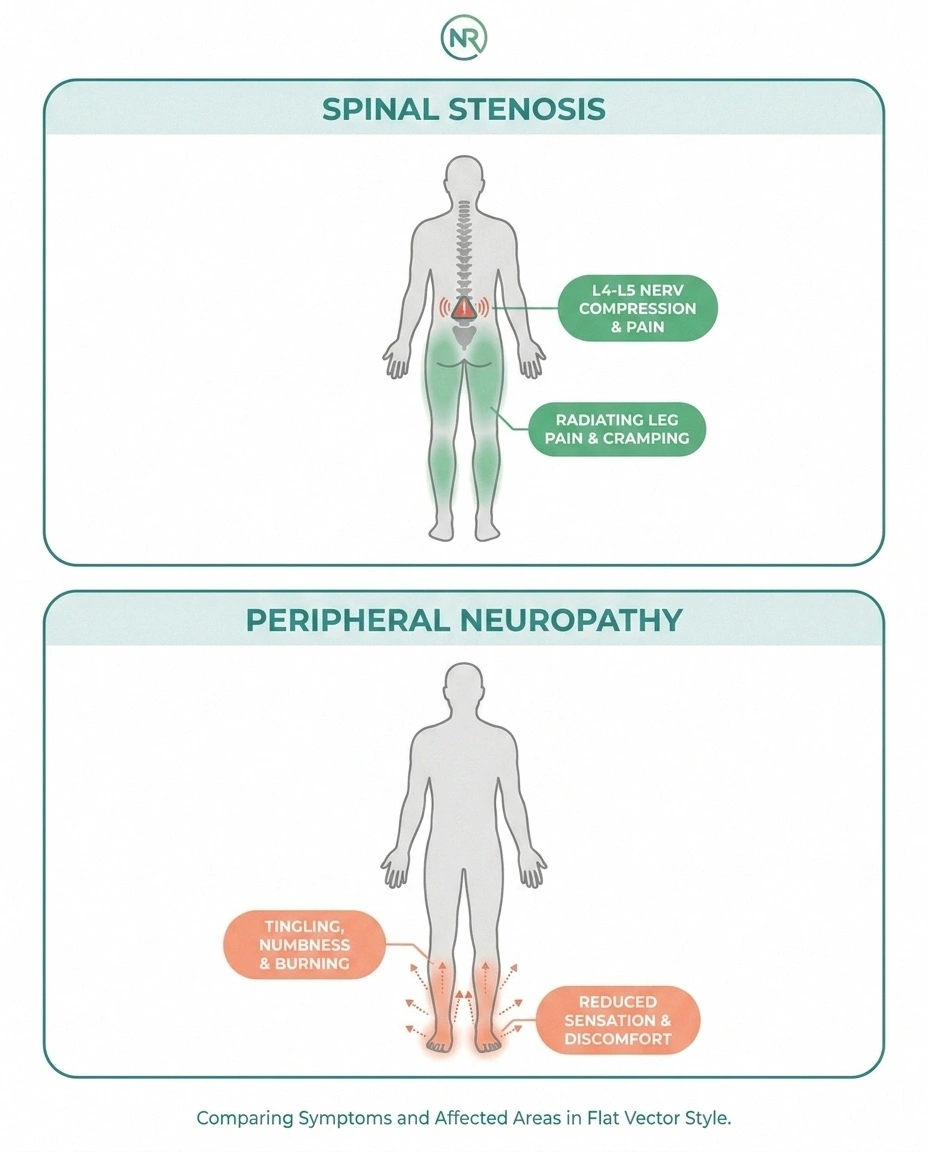
Here's the single best distinguisher between spinal stenosis and peripheral neuropathy — and it's something you can pay attention to over the next few days without any testing.
| Test | Points to Stenosis | Points to Neuropathy |
|---|---|---|
| Shopping cart | Can walk whole store leaning on cart | Position of body doesn't help |
| Stationary bike | 20 min bike, 2 blocks walking limit | Bike and walking equally bothered |
| Sitting-down rest | Symptoms off in 5-10 min, on again in 10 steps | Feet still burning after 20 min sitting |
| Evening on the couch | Legs quiet at rest | Feet burning as much as at noon |
| Uphill vs downhill | Uphill easier (flexion), downhill harder | No grade preference |
Spinal stenosis is distance-dependent and position-dependent. You can walk fine for the first block. Then a specific distance triggers the heavy-legs feeling. Sitting down for a few minutes turns it off. Leaning forward on a shopping cart lets you walk further before it turns on. Standing straight or walking downhill turns it on faster.
Peripheral neuropathy is neither. Your feet burn or tingle in a fairly constant way. Walking may make them hurt more, but so does standing in place, and so does sitting on the couch at 9 p.m. Leaning forward doesn't change anything. Distance doesn't gate the symptoms — they don't start at a certain number of blocks and then improve with rest.
Here are some specific real-world tests you can run:
The shopping cart test. If you can walk the whole grocery store leaning on the cart but not the parking lot standing up straight, that's spinal stenosis. If it doesn't matter whether you're leaning forward or not, that's not spinal stenosis.
The stationary bike test. If you can bike comfortably for twenty minutes but can't walk two blocks, that's a classic spinal stenosis pattern — biking puts you in flexion so the canal opens up. Peripheral neuropathy doesn't distinguish between the two.
The rest test. If your leg symptoms turn off within five to ten minutes of sitting down and turn back on within ten steps of getting up, that's a stenosis pattern. If your foot symptoms are still there after twenty minutes of sitting, that's not stenosis.
The evening test. If your feet burn as much at 10 p.m. on the couch as they do at 2 p.m. walking to the mailbox, that's peripheral neuropathy. Stenosis symptoms mostly quiet down at rest.
The uphill-versus-downhill test. Walking uphill (which puts you into flexion) is easier with stenosis. Walking downhill (which extends the low back) is harder. Peripheral neuropathy usually doesn't have a grade preference.
What Each Feels Like When Walking

The way people describe the walking experience differs between the two conditions, and hearing the words often helps sort things out.
Spinal stenosis walking often gets described as: “My legs feel like they weigh a hundred pounds after a block or two.” “It's like walking through wet cement.” “My legs cramp up and I have to sit down.” “I can go further if I'm leaning on something.” “The pain is in my buttocks and thighs, not my feet.” “I have to plan my routes around benches.” One important note: the symptoms tend to be above the ankle — buttocks, thighs, calves. Feet are less prominent.
Peripheral neuropathy walking often gets described as: “My feet burn no matter what I'm doing.” “It feels like I'm walking on marbles.” “I can't feel where the floor is.” “I have to look at my feet on stairs.” “It's worse in the dark.” “My feet felt this way even before I started walking today.” The symptoms are strongest below the ankle — feet and sometimes lower shins — and they don't turn off when you sit down.
Neither pattern is diagnostic on its own. But when the pattern is clean, it points strongly. And when the pattern is muddled — someone has features of both — that's often the biggest clue of all, because the muddling itself suggests the person has both conditions.
When It's Both

This is a big one. Lumbar spinal stenosis and peripheral neuropathy commonly coexist in older adults, especially in people with diabetes. The reason is straightforward — both are age-related conditions with overlapping risk profiles. Older people are more likely to have spinal arthritis and disc changes that produce stenosis. Older people with diabetes are also more likely to have distal polyneuropathy. Put them together and you get a leg-and-foot picture that has ingredients from both.
What the hybrid case looks like: burning feet at rest (the neuropathy piece) plus a distance-dependent worsening when walking that's relieved by leaning forward (the stenosis piece). Balance trouble both from loss of foot sensation and from actual leg weakness after a hundred yards. Two different kinds of leg fatigue that get treated by two different specialists.
The reason this matters is that treating only one of the two conditions leaves the other one running unchecked. A patient who has spine decompression surgery for stenosis often gets significant relief of their walking distance — but their feet still burn at night from the untouched neuropathy. A patient who tightens up their blood sugar and starts gabapentin for their neuropathy may find their foot symptoms improve — but their two-block walking limit hasn't budged, because the spine issue is still there.
Untangling the hybrid case usually requires both an MRI of the low back and nerve conduction studies of the legs. The MRI shows the stenosis. The nerve conduction study shows the neuropathy. When both are positive, the treatment plan has to address both.
Red Flags: The Cauda Equina Emergency

Before going further, a set of symptoms that require going to the emergency room today, not next week. Cauda equina syndrome is a rare but serious form of severe nerve root compression at the bottom of the spine, and it's a surgical emergency because delaying treatment can lead to permanent damage.
- New loss of bladder or bowel control
- Numbness in the “saddle area” — inner thighs, groin, buttocks
- Rapidly progressing weakness in both legs (days, not months)
- Sudden severe worsening of any of the above
Get emergency care if you develop:
New loss of bladder or bowel control. New urinary retention (can't urinate when you feel you should be able to) or new incontinence (leaking without warning) after leg symptoms have been developing is a cauda equina red flag.
Saddle anesthesia. Numbness in the area that would touch a bicycle seat — the inner thighs, the groin, the buttocks.
Rapidly progressive bilateral leg weakness. Not gradual worsening over months. Days-to-hours weakening of both legs is a very different picture.
Sudden severe leg pain with any of the above. The combination is what matters.
Peripheral neuropathy essentially never causes these symptoms. If they appear, the spine is where the answer lives, and time matters.
Testing Your Doctor May Order

Three main tests come up in this differential, and each answers a different question.
MRI of the lumbar spine is the gold standard for diagnosing spinal stenosis. It shows the size of the spinal canal, the position of the nerve roots, and any disc or ligament changes crowding them. In borderline cases, some clinicians will get standing or flexion-extension MRI to see how the canal changes with position, though a standard supine MRI is enough for most diagnoses. Importantly, MRI findings need to fit the clinical picture — plenty of older adults have some canal narrowing on imaging without having symptomatic stenosis. The story matters as much as the picture.
Nerve conduction studies and EMG are the standard for characterizing peripheral neuropathy. They measure how fast electrical signals travel down peripheral nerves and how the muscles respond. In neuropathy, you see symmetric slowing or reduced signal in the longer nerves of both legs, with a length-dependent pattern. These tests can also spot the coexistence of a lumbar radiculopathy (a specific nerve root problem from the spine) — so they help disentangle the hybrid case. The neuropathy diagnosis process walks through what these appointments look like from the patient's side.
Blood work is for finding treatable causes of peripheral neuropathy — A1C, B12, folate, thyroid, complete blood count. Not for spinal stenosis. If neuropathy is on the table, this is standard.
A physical exam usually includes assessing your gait, checking sensation and reflexes, doing a straight-leg raise, watching you walk across the room, and asking you to bend forward and stand back. A neurologist or spine physician can often narrow the differential substantially from the history and exam alone before any test is ordered.
Why the Answer Changes What Helps

The treatments for these two conditions are largely different, which is why an accurate diagnosis actually saves time and effort.
For spinal stenosis, first-line treatment is usually conservative: physical therapy focused on core strength, hip flexibility, and specific flexion-based movements that open the canal; activity modification (breaks, using a cart when walking longer distances, choosing flatter routes); over-the-counter or prescription pain medications; and sometimes epidural steroid injections into the spine to reduce inflammation around compressed nerve roots. Injections don't cure the mechanical problem but can buy months of walking tolerance.
When conservative treatment doesn't hold, or when leg weakness is progressing, decompressive spine surgery (a laminectomy, sometimes with fusion) becomes the option. Recovery takes weeks to months. Outcomes for well-selected patients are often significantly better walking tolerance and less leg pain — though not everyone is a candidate, and the decision requires a careful discussion with a spine specialist.
For peripheral neuropathy, treatment is fundamentally about the underlying cause plus symptom management. If diabetes is driving it, tighter blood sugar control is the most important lever. If a nutritional deficiency is behind it, replacement helps. Symptomatic treatment includes medications like gabapentin, pregabalin, or duloxetine; topicals; physical therapy focused on balance and gait; and a range of conservative and complementary approaches that support the whole picture.
Notice how little overlap there is. Epidural steroid injections don't help peripheral neuropathy. Blood sugar control doesn't decompress a spine. A wrist splint doesn't help either. This is why the mismatch matters — the wrong diagnosis leads to the wrong first move.
How to Protect Your Walking Either Way

A few things help both conditions and are worth doing regardless of which one you're sorting out.
Stable, cushioned shoes with a firm heel counter. Whether the problem is a squeezed nerve root or a burning foot, the same principles apply — the foot needs a supportive foundation. The right shoe choice reduces foot pain and improves balance for both conditions.
Gentle regular walking within your limits. For stenosis, walking to your onset point, resting, and continuing tends to preserve tolerance better than avoiding walking entirely. For peripheral neuropathy, consistent walking supports circulation and helps balance. Deconditioning makes both conditions worse. Cardio like stationary biking, swimming, or recumbent bike is well-tolerated by both.
Core and hip strength. A stronger trunk supports the spine and helps balance. This is especially useful for the stenosis piece but also improves gait steadiness for people with sensory loss.
Blood sugar control (for people with diabetes). Uncontrolled diabetes worsens both peripheral neuropathy and the vascular health of nerve roots. Every point of A1C improvement helps.
Balance work. Whether the balance trouble is from spinal cord narrowing or from foot sensation loss, targeted balance exercises reduce falls and improve confidence.
Know the emergency signs. New bowel or bladder changes, saddle numbness, rapid progression of weakness — these are the reasons to skip the appointment queue and go straight to the emergency room.
The reason Marge is doing better now, a year after her book club story, is that we finally sorted it out with a spine specialist and her endocrinologist working in parallel. She had spinal decompression surgery for the stenosis — her walking distance went from half a block to about six blocks. She's still on gabapentin at night for the neuropathy piece, still watches her A1C, still wears her supportive shoes to the grocery store. She's not who she was at forty. But she's someone who can walk her granddaughter's dog around the neighborhood again, and that's the point.
Frequently Asked Questions
Can spinal stenosis cause peripheral neuropathy?
Not directly. Spinal stenosis compresses nerve roots at the spine and can cause radiculopathy (specific nerve root problems from that compression). Peripheral neuropathy is damage to the peripheral nerves themselves from a systemic cause like diabetes or vitamin deficiency. They're separate conditions. Someone can absolutely have both at once, but one doesn't turn into the other.
How do I know if my leg pain is coming from my back or my nerves?
The best home clues are position and distance. If your legs feel better when you sit down or lean forward, and if there's a walking distance that reliably triggers your symptoms, spinal stenosis is likely. If your feet burn at rest, in the evening, in bed, and don't change with position — that's more consistent with peripheral neuropathy. If both patterns are present, you may have both conditions and the differential is best sorted with a doctor plus MRI and nerve conduction studies.
Can spinal stenosis feel like burning feet?
Occasionally, yes, but it's less common. Spinal stenosis symptoms are usually in the buttocks, thighs, and calves — above the ankle. When feet burn, that's more classically peripheral neuropathy. In a hybrid case, both patterns show up.
Does peripheral neuropathy get better after spine surgery?
No, because they're not the same condition. Spine surgery for stenosis addresses the compressed nerve roots — the walking distance and leg-heaviness piece often improves substantially. But peripheral neuropathy from diabetes or another systemic cause is not affected by spine surgery. If foot burning persists after spine surgery, the neuropathy piece needs its own workup and treatment.
Can vascular problems mimic these too?
Yes — vascular (arterial) leg pain from peripheral artery disease can also cause distance-dependent leg pain that improves with rest, called vascular claudication. It's a different mechanism (blood supply, not nerve compression) and gets sorted out with different tests. Comparing nerve pain with vascular pain covers that distinction in more depth. In older adults, especially smokers and diabetics, all three — neuropathy, spinal stenosis, and vascular claudication — sometimes coexist and require careful sorting.
Is spinal stenosis surgery worth it?
For well-selected patients — those with clear neurogenic claudication limiting quality of life who haven't responded to conservative care — decompressive surgery outcomes are generally good, especially for the walking-distance and leg-heaviness symptoms. It's not the right move for everyone. Age, other health conditions, and how much back pain versus leg pain is present all factor in. This is a conversation with a spine surgeon.
Should I stop walking if it hurts?
Not entirely. For spinal stenosis, walking to your onset point, resting, and continuing typically preserves tolerance better than avoiding walking. For peripheral neuropathy, gentle regular walking supports circulation and balance and is protective. What both conditions dislike is deconditioning. The trick is finding your safe distance and building from there — this is exactly what a physical therapist can help with.
Does spinal stenosis ever affect the hands?
Lumbar (low back) spinal stenosis doesn't — the lumbar spine is below the hand nerves. Cervical (neck) spinal stenosis can affect hands and produce a related but different clinical picture, often with hand clumsiness or balance changes. If you're having hand symptoms plus leg symptoms, that combination warrants an evaluation that considers both the neck and the low back.
About the Author