
Last week, my friend Connie texted me a screenshot of her continuous glucose monitor and asked, “How is this possible? My A1C is 6.8. My doctor says I'm doing great. But my feet have been on fire for six months and getting worse.”
The screenshot showed a line that looked like the cardiogram of a startled rabbit. Spikes to 240. Crashes to 70. Climbs back to 200. All within twelve hours. Average? About 140 — which is exactly what produces an A1C of 6.8.
I told her what I tell everyone who shows me a graph like that: “Your A1C looks fine because A1C only measures the average. It does not see the roller coaster. And your nerves can feel the roller coaster.”
This is what researchers call glycemic variability — and over the last decade, neuropathy clinics have come to view it as a separate, independently dangerous problem from high blood sugar alone. You can have a “good” A1C and still be silently injuring your peripheral nerves every single day, just because your glucose is swinging too far, too often, in too short a time.
If your blood sugar is technically “controlled” but your feet still burn, tingle, go numb, or feel like you're walking on broken glass, this article is for you. We are going to look at why blood-sugar swings damage nerves in ways a steady high level does not, how to actually measure your variability (the tests your doctor probably is not ordering), and the concrete habits that flatten the curve.
What Glycemic Variability Actually Means
Glycemic variability is a fancy term for a simple idea: how much your blood sugar bounces around during a day and from day to day. It is not the same as “average glucose.” It is not the same as A1C. It is a measure of movement.
Imagine two people. Both have an average glucose of 140 mg/dL over a week. Same A1C. Same lab report.
Person A's glucose hovers between 120 and 160 most of the time. Smooth ride.
Person B's glucose lurches from 70 to 240 several times a day. Same average — wildly different physiology.
Researchers measure this swing in several ways: standard deviation of glucose readings, coefficient of variation (a percentage), and a measure called MAGE (Mean Amplitude of Glycemic Excursions) that captures the size of the biggest peaks and valleys. Time-in-range — the percentage of the day you stay between 70 and 180 mg/dL — has become the most useful real-world number, because it captures both how high you go and how often you go there.
For most adults with diabetes, the target is at least 70% time-in-range, with less than 25% time above 180 and less than 4% time below 70. The closer you get to those numbers, the calmer your variability — regardless of what your A1C says.
Why Swings Hurt Nerves More Than Steady Highs
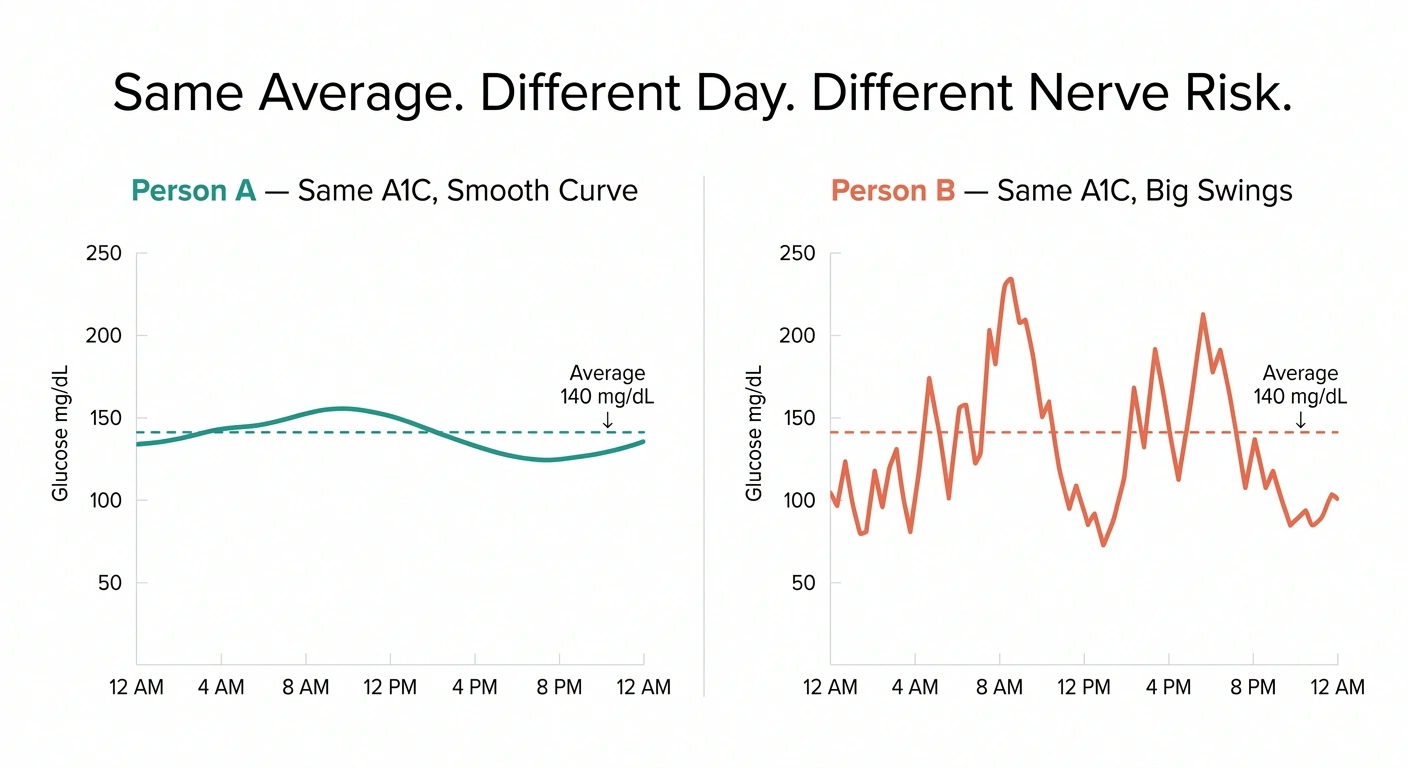
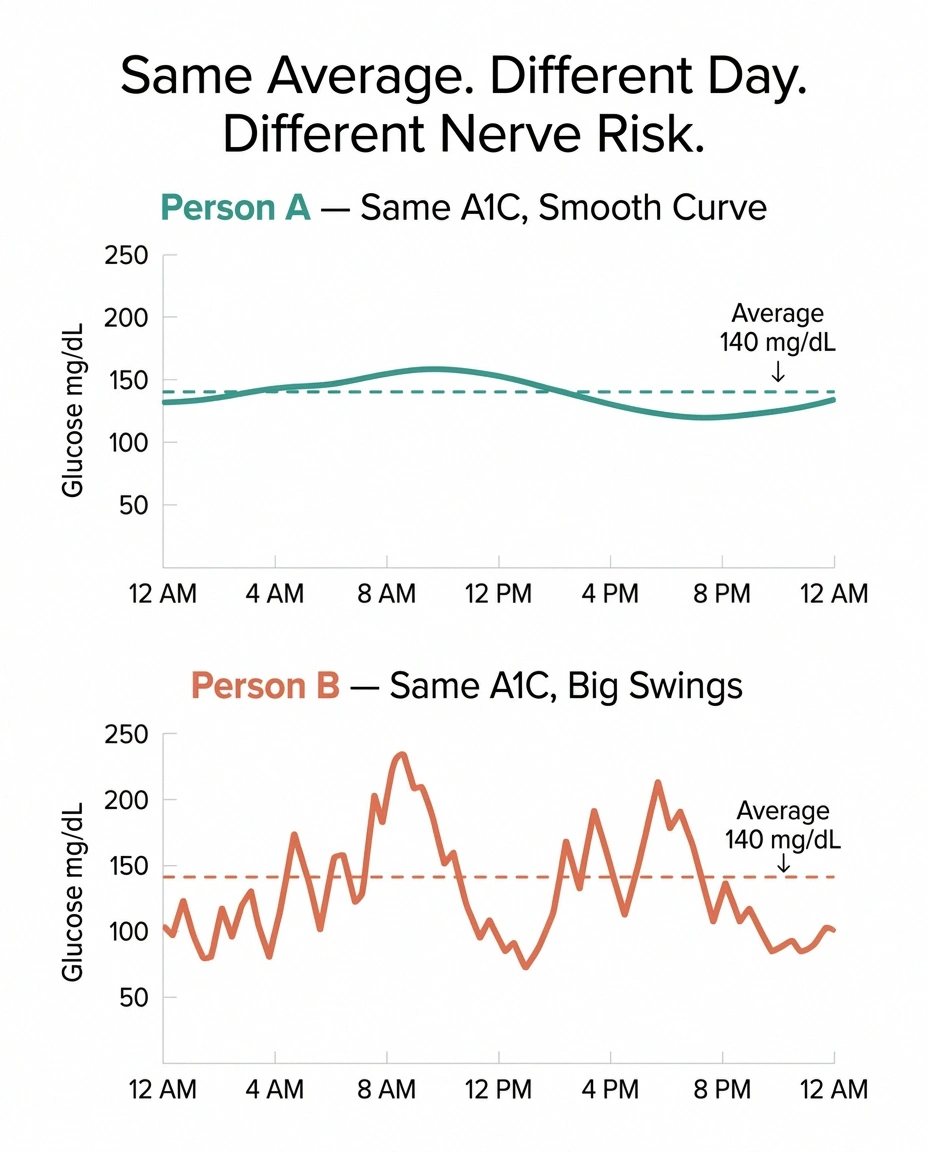
For a long time, the prevailing assumption was simple: high blood sugar damages nerves, and lower is better. We now know that picture is incomplete. The act of swinging between high and low — especially when those swings happen often — appears to generate nerve injury through mechanisms that a stable high level does not trigger as aggressively.
(70–180 mg/dL)
Three things seem to be going on:
1. Oxidative stress spikes during glucose surges. When glucose rapidly rises after a meal, the mitochondria inside your nerve cells get overwhelmed and start producing free radicals — unstable molecules that damage proteins, fats, and DNA. A steady high glucose level produces some of this damage, but rapid surges produce bursts of free radicals that the body's antioxidant defenses cannot fully neutralize in time. The nerve takes a hit each time. This is why supplements like alpha-lipoic acid get studied so heavily for diabetic neuropathy — they are antioxidants that target exactly this kind of damage.
2. Endothelial dysfunction in tiny nerve blood vessels. Your nerves are fed by microscopic blood vessels called vasa nervorum. The inner lining of those vessels (the endothelium) is exquisitely sensitive to glucose swings. Rapid rises trigger inflammation in the vessel wall, the wall stiffens, blood flow drops, and the nerve gets a little less oxygen than it should. Repeat this hundreds of times a year and the nerve starts to die back from its longest endings inward — which is exactly the pattern we see in diabetic neuropathy (feet first, then lower legs, then hands).
3. Hypoglycemia injures nerves directly. The crash side of the swing matters too. When glucose drops below 70 — and especially below 60 — nerves are temporarily starved of fuel. The peripheral nerves are particularly vulnerable because they cannot store glucose the way muscle can. Repeated mild hypoglycemic episodes appear to contribute to nerve damage independent of the highs.
Put those three together and you get the modern view: it is not just how high your glucose goes, it is how often and how fast it moves. A person with an A1C of 7.5 and smooth glucose may have healthier nerves than a person with an A1C of 6.8 and constant swings.
The A1C Blind Spot
A1C is a fine test for what it was designed to do: estimate average glucose over the past two to three months. It is cheap, well-validated, and tracks long-term risk for things like retinopathy and kidney disease.
But A1C cannot see the shape of your day. Two people with identical A1Cs can have completely different glucose patterns — and completely different neuropathy trajectories.
This blind spot is why so many people end up in the situation Connie was in: “My numbers look fine, but my feet are getting worse.” If you have been told your diabetes is “well-controlled” and your nerve symptoms are still progressing, glycemic variability is one of the first things to investigate.
It is also why some research suggests that adding a continuous glucose monitor (CGM) — even for someone on oral medications and not insulin — can be a useful diagnostic tool to find hidden swings. You cannot fix what you cannot see.
How to Actually Measure Your Variability

You need data over time. A single fingerstick at 7 a.m. tells you nothing about what happens after lunch or while you sleep. There are three practical approaches:
Option 1: Continuous glucose monitor (CGM). This is the gold standard. A small sensor on the back of your arm reads glucose every few minutes for 10 to 14 days and reports a complete picture: time-in-range, average glucose, standard deviation, coefficient of variation, peaks, valleys, and overnight patterns. The two big consumer-friendly options in the U.S. are the Dexcom G7 and the Abbott FreeStyle Libre 3. Both require a prescription. Cost has dropped dramatically — many insurance plans now cover them for non-insulin-using type 2 diabetes when there is a documented reason, and out-of-pocket pricing for two weeks of monitoring is far more accessible than it used to be.
If your doctor has not offered a CGM trial and you are still having nerve symptoms despite an okay A1C, ask. The phrase that often works: “I would like a two-week diagnostic CGM trial to look for glycemic variability that my A1C is not catching.”
Option 2: Structured fingerstick monitoring. Less data, but still revealing. Test seven times a day for three days in a row: fasting, before each meal, two hours after each meal, and bedtime. Log every reading with the time and what you ate. After three days you will have 21 data points that show your post-meal spikes and your overnight pattern. This is how diabetes was managed for decades and it still works.
Option 3: Wearable + log combo. If a CGM is not accessible, a basic glucometer plus a written food/symptom log catches a surprising amount. Test before and ninety minutes after meals for a week. Note your foot symptoms each evening on a 0-to-10 scale. Patterns emerge fast. Connie tried this for two weeks before she got her CGM and was already able to identify three specific meals that produced large spikes — and her symptoms tracked the spikes within hours.
Whatever method you use, the goal is the same: build a picture of how your glucose moves, not just where it averages.
What Causes Big Swings — The Usual Suspects

Once you have data, the next question is what is driving the swings. Most of the time it comes down to a short list:
High-carbohydrate meals without fat or protein. A bowl of cereal with skim milk. A bagel for breakfast. White rice as a side. Pasta as a main. Sugary drinks. Even “healthy” foods like a smoothie made of fruit and juice can spike glucose to 250 in 45 minutes for many people with type 2 diabetes. Carbs eaten alone hit the bloodstream faster than carbs eaten with fat, protein, and fiber.
Meal timing. Skipping breakfast and eating a huge lunch produces a much bigger spike than spreading the same calories across two smaller meals. Eating dinner at 9 p.m. and going to bed produces a different overnight pattern than eating at 6 p.m. and walking afterward.
Insufficient or mistimed medication. If you take a sulfonylurea (like glipizide or glyburide), it can produce lows several hours later — especially if you skip a meal. If you take long-acting insulin without short-acting coverage at meals, post-meal spikes can be enormous. Some medications have peaks that do not match your meal pattern.
Stress, illness, and poor sleep. Cortisol drives glucose up. A bad night of sleep can produce a 30-point higher fasting glucose the next morning. A cold or sinus infection can push glucose 50 points higher for days.
Dawn phenomenon. Many people with diabetes wake up with a fasting glucose 20 to 40 points higher than their bedtime number — caused by an overnight surge of cortisol and growth hormone. This is normal physiology, not a failure on your part, but it does add to overall variability.
Sedentary days. Glucose lingers higher and longer when you sit. The first ten minutes of walking after a meal can drop a post-meal spike by 30 points or more.
Flatten-the-Curve Habits That Work

You cannot eliminate glucose variability — bodies move, hormones cycle, life happens. But you can reduce the swings dramatically with a handful of evidence-backed habits. None of these are revolutionary. The revolutionary part is doing them consistently.
1. Eat protein and fat before or with carbs, never carbs alone. If you are going to have toast, have an egg first. If you are going to have pasta, eat a salad with olive oil first. If you are going to have fruit, pair it with a tablespoon of almond butter. This single change — never carbs alone — flattens post-meal spikes by 20 to 40 percent in most people. It works because fat and protein slow gastric emptying, which slows how fast the carbs hit your bloodstream.
2. Walk for 10 to 15 minutes after meals. Even a slow walk activates muscles to pull glucose from the blood. A post-meal walk has been shown in multiple studies to cut peak glucose by 20 to 30 percent. If you cannot walk because of foot pain or balance issues, a stationary recumbent bike for 10 minutes, marching in place while seated, or even standing and shifting weight side to side will help. Research on this is robust enough that some endocrinologists now write “walk after meals” on the prescription pad. (More on movement options in does walking help neuropathy.)
3. Front-load your calories earlier in the day. A larger breakfast, moderate lunch, and small dinner produces less total variability than the typical American pattern of skip-breakfast, snack, huge dinner. Your insulin sensitivity is highest in the morning.
4. Cap added sugars and ultra-processed carbs. The single biggest variability source for most people is liquid sugar (soda, juice, sweet coffee drinks) and refined-flour foods (white bread, cereal, pastries, chips, crackers). You do not have to eliminate them. Capping them is enough.
5. Get serious about sleep. Seven hours minimum. Same bedtime, same wake time, as much as you can manage. Sleep debt directly elevates cortisol, which directly elevates glucose. The night-time symptom pattern you may already be familiar with has a glucose component that improves with better sleep.
6. Build in stress relief. Walking, breathing exercises, prayer, gardening — pick what works for you and do it daily, not just when you feel overwhelmed. Cortisol management is glucose management.
7. Coordinate medication timing with meals. If you take medication, the when matters as much as the what. If your post-meal spikes are huge, talk to your prescriber about timing or about a different class. Do not adjust on your own.
The Nutrition Pieces That Move the Needle

Beyond the “what to do” list, a few specific food strategies have the strongest evidence for cutting variability:
Vinegar before high-carb meals. One to two tablespoons of apple cider vinegar or red wine vinegar — diluted in water — taken 10 minutes before a carb-heavy meal blunts the post-meal spike by 15 to 25 percent in multiple small trials. The acetic acid slows starch digestion. It tastes terrible. It works.
Fiber first. Eating salad or non-starchy vegetables at the start of a meal — before the carbs — produces a meaningfully lower post-meal glucose curve. This has been documented in well-designed crossover trials.
Resistant starch. Cold cooked potatoes, cold rice, cooked-and-cooled pasta, green bananas, and oats contain starch that resists digestion in the small intestine. It feeds gut bacteria instead of spiking glucose. A 1-cup serving of cooked-then-cooled rice produces a noticeably smaller glucose response than the same rice served hot.
Magnesium-rich foods. Many people with diabetes are low in magnesium, and magnesium plays a role in insulin signaling and glucose control. Nuts, seeds, leafy greens, and dark chocolate are the easiest sources. There is more on supplemental options in our magnesium for neuropathy guide.
The Mediterranean pattern. Of all the named diets studied for diabetes and nerve health, the Mediterranean pattern (olive oil, vegetables, legumes, fish, nuts, modest dairy, modest wine, limited red meat, very limited sugar) has the most consistent evidence for both lower variability and better long-term nerve outcomes. See the best neuropathy diet for a deeper look.
What to Talk About at Your Next Appointment

If your nerve symptoms are progressing despite a “controlled” A1C, here is a script that has worked for many of our readers:
“My A1C is X, which looks reasonable, but my nerve symptoms in my feet are getting worse. I would like to investigate whether glycemic variability is contributing. Could we:
- Order a two-week diagnostic CGM trial to see my time-in-range and post-meal patterns?
- Review my current medication timing relative to my biggest meal spikes?
- Talk about whether a medication adjustment — possibly adding a GLP-1 agonist or SGLT2 inhibitor — might help smooth my pattern?
- Refer me to a certified diabetes care and education specialist (CDCES) for a deeper look at my routine?”
Those four asks together will move most appointments forward. If your provider is dismissive of glycemic variability as a concept — and some still are — it is reasonable to seek a second opinion, especially from an endocrinologist or a board-certified neuropathy specialist.
What About Type 1 and Non-Diabetic Variability?
Most of what we have discussed applies to type 2 diabetes, but a quick word on two other situations:
Type 1 diabetes. Glycemic variability is an even bigger issue here because of the precise insulin balancing required. CGM use is closer to universal in T1D for exactly this reason. The same principles — pre-meal protein/fat, post-meal movement, sleep, stress — still apply, on top of the insulin dosing work.
Non-diabetic glucose swings. Reactive hypoglycemia (a glucose drop a few hours after a high-carb meal) and pre-diabetic glucose variability are increasingly recognized as nerve risks too, even without a diabetes diagnosis. If you are having unexplained foot symptoms and have never had your glucose checked under a meal-stress test or with a CGM, that is worth raising. Idiopathic neuropathy sometimes turns out to be early metabolic neuropathy that was hiding behind normal fasting numbers.
A Realistic Timeline for Improvement
Here is the honest part: flattening your glucose curve will not reverse nerve damage that has already happened. What it can do is slow or stop further damage and, in some cases, allow partial recovery of the small nerve fibers that have not yet died.
(stop getting worse)
improvement
partial recovery
The literature on this is encouraging but modest. People who achieve stable glucose with high time-in-range tend to see stabilization within three to six months, mild symptom improvement within six to twelve months, and continued slow improvement over one to three years. The earlier in the disease you intervene, the more recovery is possible.
This is consistent with what is known about whether neuropathy can be reversed more broadly: small fibers can regenerate if the injury source is removed, and glucose variability is one of the most common ongoing injury sources.
If your feet have been on fire for six months and your A1C is “fine,” do not let that A1C convince you nothing is wrong. Look at the shape of your day. Look at the swings. And start flattening the curve, meal by meal, walk by walk.
Connie ordered a CGM the week we talked. Two weeks later she had a printout that showed she was averaging four major spikes per day — all tied to specific meals she had assumed were “fine.” She changed three of those meals, started walking after lunch, and tightened her bedtime. Her time-in-range went from 51% to 78% in eight weeks. Her foot burning is not gone — six months is not a long horizon for nerve recovery — but for the first time in a year, it has stopped getting worse. That is what flattening the curve buys you: a chance.
Frequently Asked Questions
Can my A1C be normal and I still have glycemic variability damaging my nerves?
Yes. A1C measures the average glucose over two to three months and cannot detect swings. Two people with an identical A1C can have completely different glucose patterns — one steady, one full of large spikes and dips. The person with the swings is at higher nerve-injury risk even with the same A1C. This is one of the most common reasons nerve symptoms progress in people who have been told their diabetes is well-controlled.
Do I need a CGM if I'm not on insulin?
You may not need one long-term, but a two-week diagnostic CGM trial can be extremely useful for finding hidden glucose patterns that fingersticks miss. Many insurance plans now cover CGMs for non-insulin-using type 2 diabetes when there is a documented reason, and some endocrinologists actively prescribe a short trial as a diagnostic tool. Talk to your provider about it.
What is a good time-in-range target for someone with diabetic neuropathy?
The general target is at least 70% of the day between 70 and 180 mg/dL, with less than 25% time above 180 and less than 4% time below 70. People with nerve symptoms who are actively trying to slow progression often aim higher — 80% or more time-in-range. Your endocrinologist can set targets specific to your situation, your age, and your other health conditions.
Does eating protein before carbs really make a difference?
Yes — this is one of the most consistently documented findings in glucose variability research. Eating 15 to 30 grams of protein and some fat 15 to 20 minutes before a carb-heavy meal can cut the post-meal glucose spike by 20 to 40 percent. The mechanism is delayed gastric emptying, which slows how fast carbs hit the bloodstream. It is one of the easiest practical changes you can make.
Will walking after meals actually lower my blood sugar?
Yes, and the effect is large. A 10 to 15 minute walk starting within 30 minutes of finishing a meal can reduce the peak post-meal glucose by 20 to 30 percent. The benefit comes from muscle contraction pulling glucose out of the blood. If walking is painful or unsafe because of foot or balance issues, alternatives like a recumbent bike, seated marching, or standing weight shifts work too — the goal is muscle activation, not specifically walking.
Can stress and poor sleep really raise my glucose enough to matter?
Yes. Cortisol — the body's main stress hormone — raises glucose, and cortisol is elevated by both poor sleep and chronic stress. A single bad night of sleep can elevate the next morning's fasting glucose by 20 to 40 mg/dL in people with diabetes. Chronic high stress can move your average glucose up by a similar amount. This is one reason sleep and stress management belong on the diabetes care list alongside diet and medication.
Should I cut out all carbs to stop the swings?
Probably not — and this is worth a real conversation with your care team. Very-low-carb and ketogenic diets do produce excellent glucose control and low variability in many people with type 2 diabetes, but they are not the right fit for everyone. They can cause other problems (constipation, lipid changes, social challenges, hypoglycemia risk if you are on certain medications). The Mediterranean pattern produces excellent variability outcomes too, with more food variety and an easier long-term adherence record. The right choice depends on your other health conditions, your preferences, and what you can sustain for years.
How quickly can I expect nerve symptoms to improve if I flatten my glucose curve?
Most people see stabilization (symptoms stop getting worse) within three to six months of achieving consistent high time-in-range. Mild symptom improvement typically takes six to twelve months. Continued slow improvement can happen over one to three years. Recovery is partial in most cases — fibers that have already died do not come back, but fibers that were injured but still alive can heal. The earlier in the disease you intervene, the better the outlook.
About the Author