
You reach for your phone. It isn't your phone.
That is how most people meet this symptom. A short, low buzz somewhere in the foot, exactly like a phone going off in a pocket, except there is no pocket and no phone. It stops. An hour later it starts again. After the third or fourth time you begin to notice that it happens most when you are still, and that it is always the same foot, or always both.
Buzzing feet are a real neurological symptom with a real mechanism, and they are common enough in nerve conditions that describing them accurately at an appointment is genuinely useful. They are also produced by several things that have nothing to do with nerve damage, and a few of those are easy to rule out yourself in a couple of minutes.
What follows is how the vibration sense works, why damaged nerves generate a buzz when nothing is vibrating, and how to tell this apart from the four sensations it is most often confused with. I write as someone living with neuropathy who has spent years learning to describe her own symptoms precisely, not as a clinician. But the pattern-reading here is standard, and it will make your next appointment shorter.
What People Mean by Buzzing
The word covers a surprisingly wide range, and the range matters, because different descriptions point in different directions.
Five things that get called buzzing, and the one question that separates each
| What it is | Where it sits | The separating question |
|---|---|---|
| Nerve-generated buzz | Toes and forefoot, usually both | Does a hand laid on the spot feel a perfectly still foot? Then it is being generated, not detected. |
| Restless legs | Calves and deep in the legs | Could you hold still for fifteen minutes if paid to? Restless legs makes that close to impossible. |
| Muscle fasciculation | Arch and outer border of the foot | Can you see it in good light? Twitches are visible and lumpy; nerve buzz is invisible and smooth. |
| Internal tremor | Chest, abdomen, limbs broadly | Is it confined to your feet? Internal tremor ignores the stocking pattern that nerve damage follows. |
| Phantom phone vibration | Wherever the phone rides | Does it stop after three days with the phone in a bag instead of a pocket? |
More than one can be true at once. Restless legs and nerve damage overlap frequently enough that reporting them as two separate items, rather than one blurred complaint, changes what gets investigated.
Some people mean a fine, fast flutter, like a moth trapped under the skin. Some mean a deep low hum, closer to a washing machine on spin two rooms away. Some mean a rhythmic pulse that comes in bursts of a second or two. Some mean a steady, unbroken electrical fizz that never fully switches off.
The clinical word for the vibration sense is pallesthesia. When it misbehaves and produces vibration where none exists, that falls under the broad heading of paresthesia, the same family that contains pins and needles, crawling, and tingling. Nobody at the front desk will ask you which one you have. But if you can say “a low steady hum in both forefeet, worse sitting, better walking” instead of “my feet feel weird,” you have given the person across the desk something to work with.
One distinction is worth settling before anything else. Does the skin actually move? Put your hand flat on the spot and hold it there for ten seconds. If you can feel movement with your hand, or see the skin rippling, that is a muscle doing something and it belongs in a different section below. If your hand feels a perfectly still foot while the foot insists it is buzzing, the sensation is being generated inside the nervous system.
The Nerve Fibers That Carry Vibration
Your foot does not have one kind of nerve fiber. It has several, sorted by size, and they carry different jobs.
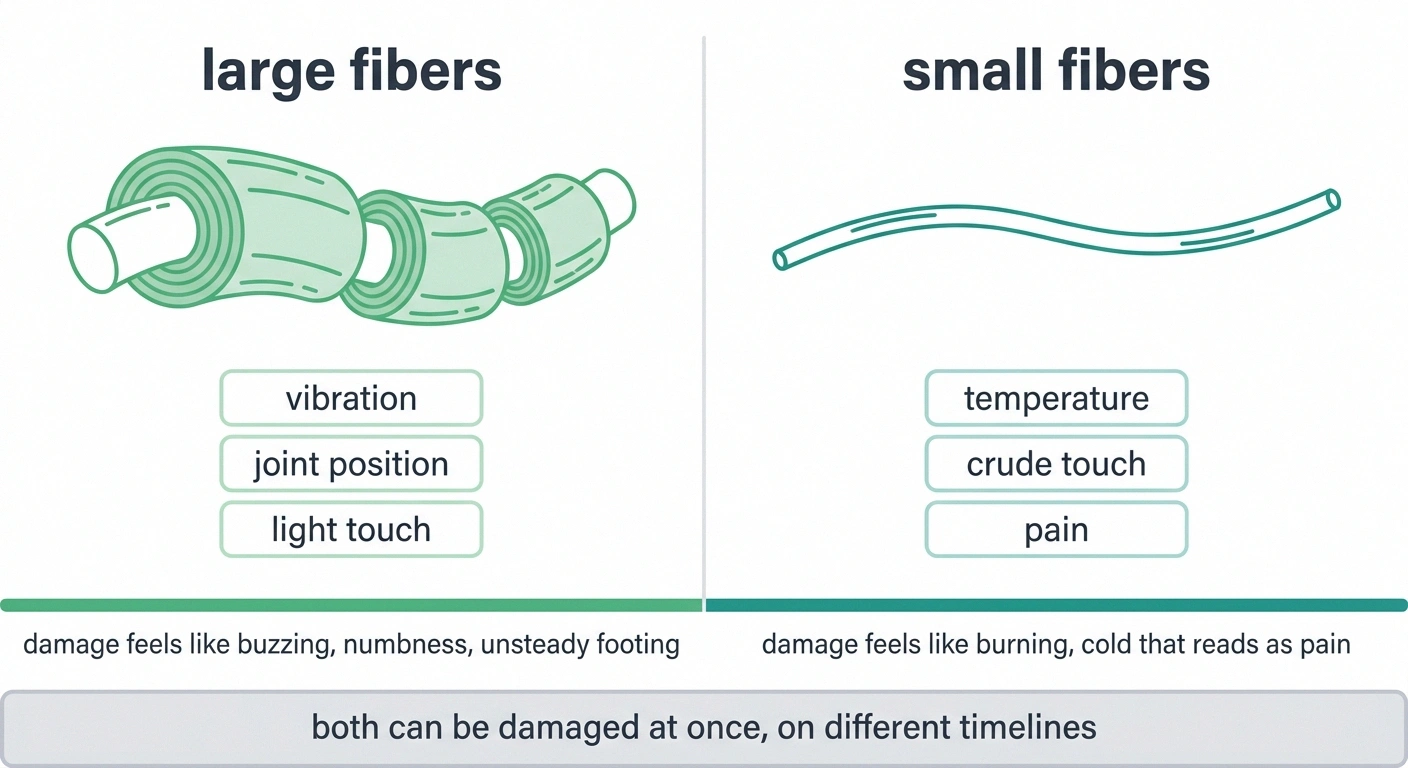
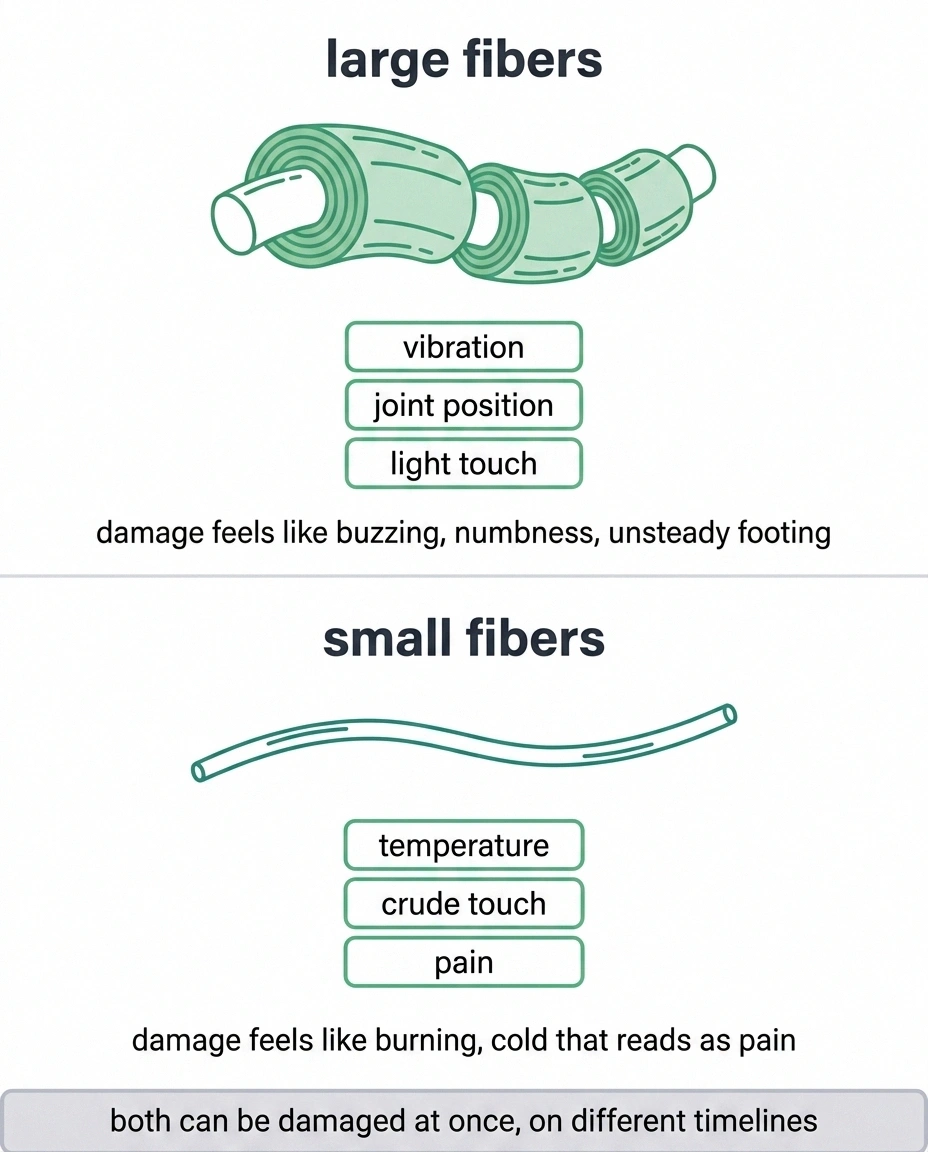
The thin, unmyelinated fibers carry temperature, crude touch, and pain. When those fail you get burning, and you lose the ability to tell hot bathwater from warm. That is the territory of small fiber neuropathy, and the classic complaint there is burning feet rather than buzzing.
Vibration runs on the other side of the house. Deep in the tissue of your foot sit pressure sensors called Pacinian corpuscles, built in onion-like layers and tuned to respond to rapid oscillation. They feed into large, thickly insulated fibers that carry signals fast, and those fibers run up the back of the spinal cord to the brain alongside the fibers that tell you where your joints are in space.
Two consequences follow from that shared wiring, and both are useful.
First, buzzing is a large-fiber symptom. It tends to travel with numbness, with reduced sensitivity to light touch, and with the sense that the floor has become vaguely unreliable. That last one is why buzzing and balance trouble so often show up in the same person around the same time. The fibers that report vibration and the fibers that report joint position are neighbors, and they get damaged together.
Second, buzzing and burning can behave completely independently in the same pair of feet. Plenty of people have loud buzzing and no burning at all. Plenty have the reverse. Some have both and find that they rise and fall on different schedules. That is not a contradiction and it does not mean anything is being reported wrong. Two different fiber populations, two different symptoms, two different timelines.
Why Damaged Fibers Invent a Signal
The intuitive expectation is that a damaged nerve goes quiet. Cut the wire, lose the signal. That is half right and it explains numbness.
What it does not explain is the noise, and the noise is usually the first thing people notice.
A healthy sensory nerve is not a passive wire. It is an active membrane with molecular gates that open and close to generate an electrical pulse, and it sits at rest just below the threshold where those gates fire. Injure the fiber and that resting balance drifts. Damaged and regenerating nerve endings accumulate extra sodium channels, which is roughly like turning up the gain on a microphone. The fiber begins to fire without an input. Nothing is touching your foot. The line reports vibration anyway.
Your brain has no way to audit that. It receives traffic on the vibration channel and it does the only thing it can do, which is to tell you your foot is buzzing. The sensation is genuine. The event it is reporting is not.
This also explains a detail that confuses people: the buzzing frequently starts while sensation still tests as normal. Extra firing does not require the fiber to be dead. It only requires the fiber to be irritable. That is why buzzing often shows up early, sometimes years before anything measurable turns up on a test, and it is a large part of why people get told nothing is wrong and go home unsatisfied.
Buzzing Feet or Restless Legs
Restless legs syndrome overlaps with this symptom so heavily in ordinary language that the two get confused constantly. People with restless legs describe crawling, humming, fizzing, buzzing, and a sensation of carbonation in the calves. Those are the same words.
The separator is not the sensation. It is what you do about it.
Restless legs comes with an urge. Not a preference, an urge, and moving the leg relieves it almost immediately. The relief lasts as long as the movement does. Symptoms follow a daily clock, quiet in the morning and building through the evening, and they are worst during enforced stillness: a long flight, a theater seat, the first thirty minutes in bed.
Neuropathy buzzing has no urge attached. Walking may distract from it or briefly change its character, but it does not switch off the moment you stand up and return the moment you sit down. It also does not respect the evening clock nearly as strictly.
Ask yourself one question. If someone paid you a large sum of money to keep both legs perfectly still for fifteen minutes, could you do it? Someone with buzzing feet can, uncomfortably. Someone with genuine restless legs generally cannot, and will describe the attempt as unbearable rather than merely unpleasant.
The two can coexist, and in people with nerve damage they often do. Both being present is a common finding and is worth mentioning as two separate items rather than one blurred complaint.
When the Twitch Is Visible

Some buzzing is a muscle, not a nerve ending, and you can settle this yourself with your eyes.
A fasciculation is a small involuntary contraction of a bundle of muscle fibers. In the foot they are most common in the arch and along the outer border. They look like something small moving under the skin, they can usually be seen in good light, and a hand laid on the spot can feel them. They are extremely common in healthy people, particularly after exercise, caffeine, poor sleep, or dehydration, and on their own they mean very little.
They feel different from nerve buzzing once you know what to compare. Fasciculations are lumpy and irregular, a series of individual events rather than a continuous tone. Nerve buzzing is smooth and even, more like a held note.
The combination that changes the conversation is twitching plus weakness plus visible muscle thinning, particularly if it is spreading. Twitching by itself, in a foot with normal strength, is one of the most common benign findings in all of neurology.
Internal Tremor Is a Different Complaint
There is a related symptom worth separating out, because people who have it often land on pages about buzzing feet and come away more worried than they need to be.
Internal tremor is a felt shakiness inside the body that nobody else can see. It is usually described in the chest, the abdomen, or the limbs broadly rather than in the feet specifically, and people compare it to the feeling of having just been badly startled, held for hours. It shows up in anxiety, in thyroid overactivity, after too much caffeine or too little sleep, in stimulant use, and in electrolyte disturbances. It is also reported by roughly a third to nearly half of people with Parkinson's disease, and in a minority it is the first symptom they notice.
The distinction that usually sorts it out is geography. Neuropathy buzzing is distal. It lives in the toes, the forefoot, sometimes the fingers, and it respects the stocking-and-glove pattern that nerve damage produces because the longest fibers fail first. Internal tremor does not follow that map. It sits in the trunk, or everywhere, or nowhere in particular.
If the buzz is in your feet and only your feet, this section is probably not about you.
The Phone in Your Pocket

Phantom vibration is a documented phenomenon and it deserves thirty seconds of your attention before you take anything else seriously.
The cheapest test on this page: three days, zero dollars
Run it before you book anything. If it comes back positive you have saved yourself a workup; if it comes back negative you have removed one variable and made everything after it easier to interpret.
- Move the phone off your body entirely. A bag, a desk, a counter. Not a different pocket.
- Keep it there for three full days including evenings, since evenings are when notifications cluster.
- Note the buzz twice a day on a one-to-ten scale, morning and bedtime, before you think about it.
- On day four, put it back in the usual pocket and watch the next 48 hours.
Reading the result: a buzz that drops noticeably and returns when the phone does was learned, not damaged. A buzz that holds steady across all five days is coming from somewhere else, and the rest of this page applies.
If you carry a phone in a front pocket, a hip pocket, or a boot, your nervous system has spent years learning that a specific buzz in a specific place is meaningful. Learning that thoroughly has a cost: the pattern-matcher starts producing false positives. Studies of phone users find the experience is close to universal among people who keep a phone on their body, and it does get referred into the thigh, the calf, and occasionally the foot.
The test is simple. Put the phone somewhere else entirely for three days, in a bag rather than on your body, and see whether the buzzing changes. If it stops, you have your answer and it cost you nothing.
Vibration exposure from work has the same flavor and is worth a moment's thought too. People who spend years with power tools, floor sanders, mowers, or heavy machinery develop genuine nerve changes in the exposed limb, and an afterbuzz that persists for hours past the end of a shift is a recognized occupational finding.
One Foot Buzzing, Not Two
How many feet are involved changes the investigation substantially, so it is worth being precise about.
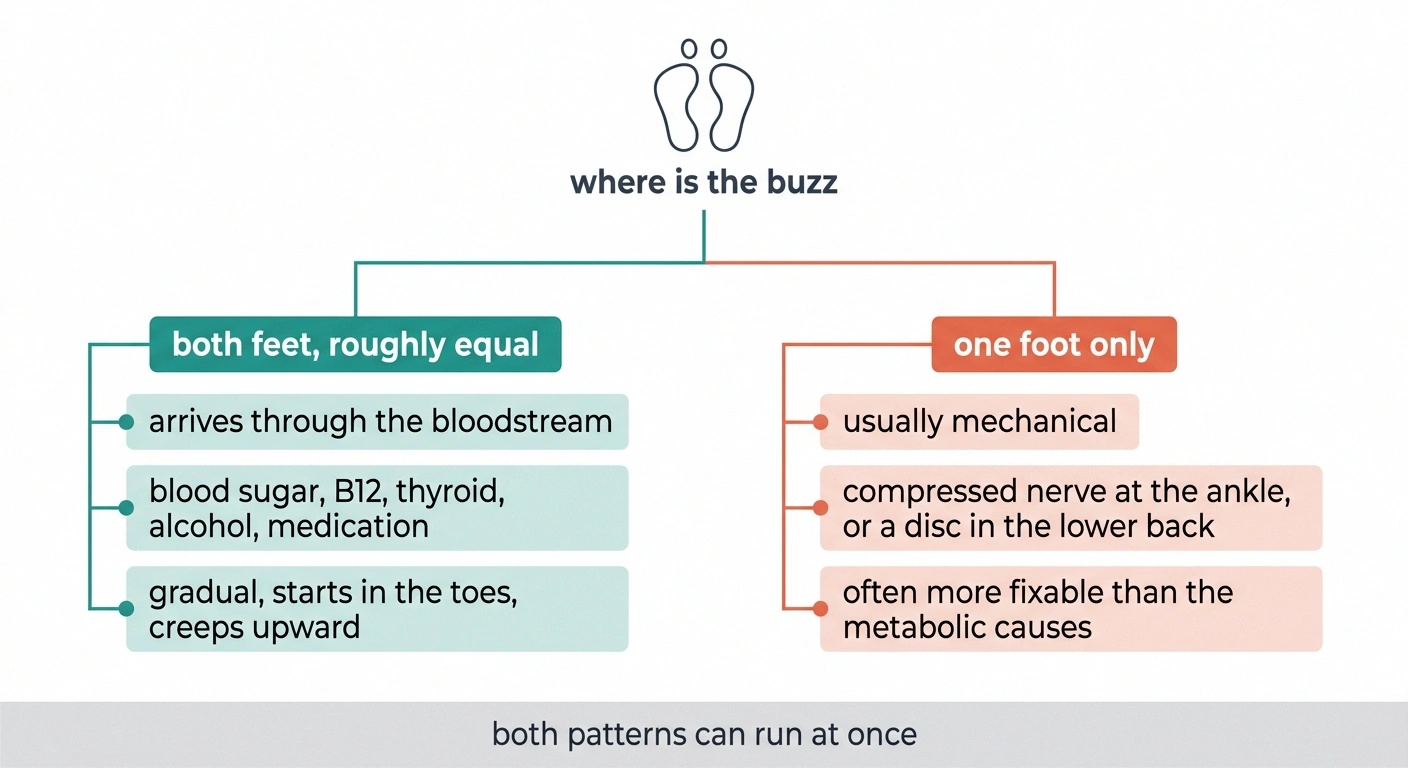
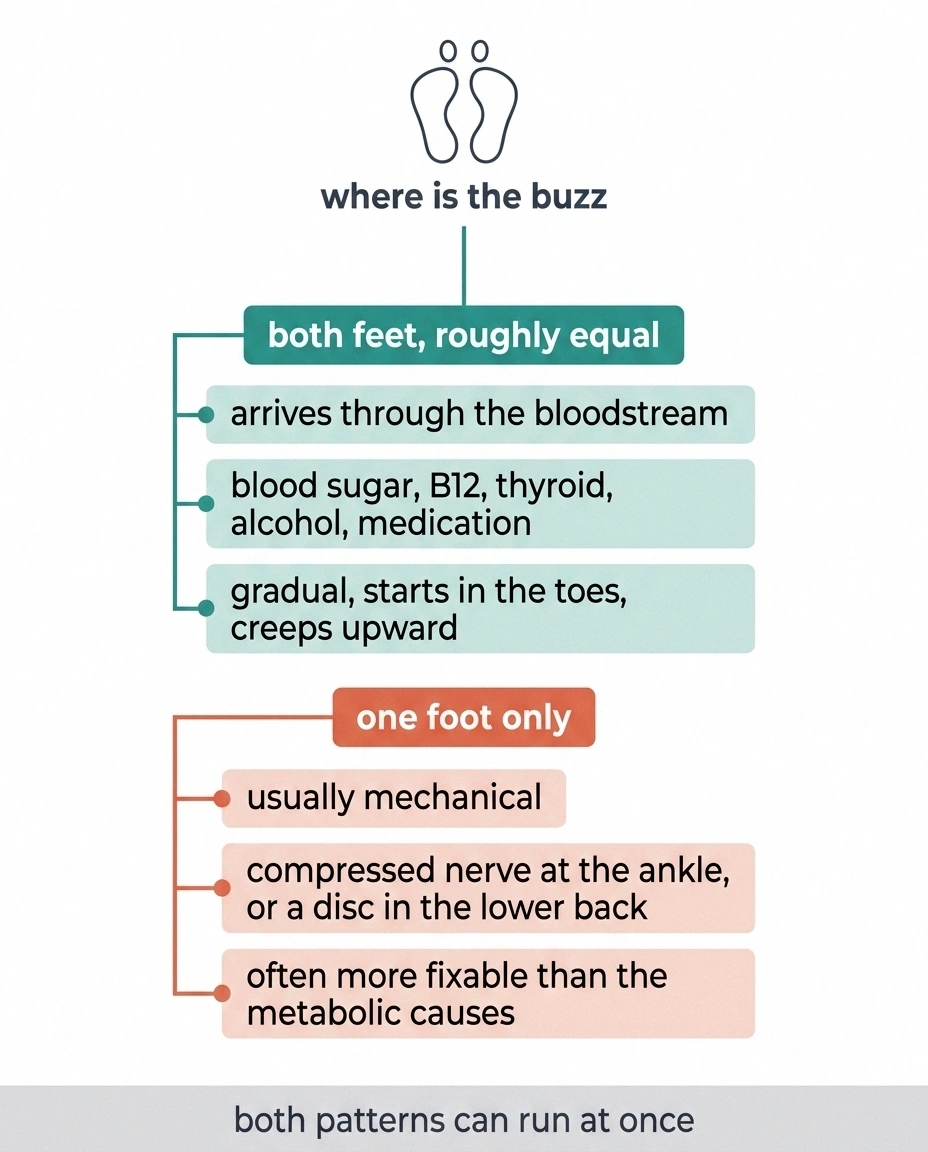
Causes that arrive through the bloodstream reach both feet in equal measure. Blood sugar, a vitamin deficiency, a thyroid problem, a medication, alcohol: none of them can find the left foot and skip the right. So the classic pattern from those causes is symmetric, distal, and gradual, starting in the toes and creeping upward over months or years.
A buzz confined to one foot points somewhere else. The usual suspects are mechanical. The tibial nerve can be compressed as it passes through a narrow channel on the inside of the ankle, which produces buzzing and burning in the sole and is sometimes worse after standing all day. A disc in the lower back can press on a root and refer sensation down a stripe of the leg into part of the foot, which typically also aches with coughing, sneezing, or straining. Both of those are structural problems, and structural problems are frequently fixable.
Both patterns can run at once. A nerve already frayed by a systemic problem tolerates local compression poorly, which is why people with diabetes develop entrapments at higher rates than people without. Noticing that one foot is much louder than the other is worth reporting even when both are involved.
Why It Gets Louder at Night
Almost everyone with this symptom reports that it is worst in bed, and there are three unglamorous reasons rather than one interesting one.
Competing input disappears. All day your feet are pressed into shoes, carrying weight, feeling the floor. That traffic occupies the same pathways and drowns out a low-level abnormal signal. Take it away and the buzz is the loudest thing on an empty channel.
Attention has nowhere else to go. This sounds dismissive and is not. Sensory perception is competitive, and a symptom you have been outrunning all day arrives intact the moment you stop moving.
Temperature and fluid shift. Skin temperature rises under blankets and fluid redistributes when you lie flat, both of which alter how irritable a damaged fiber is. This is the same set of mechanisms behind the broader pattern of neuropathy symptoms getting worse at night, and the practical fixes for one tend to help the other.
The Tuning Fork Test You Can Ask For

Here is a specific, free thing to request by name at your next visit.
A 128 Hz tuning fork struck and placed on the bony bump of the big toe joint tests the exact fiber population that generates your buzzing. The clinician asks when you stop feeling it, and compares that to when they stop feeling it through their own fingers on the fork. It takes under a minute, it requires no referral, and most primary care offices have a fork in a drawer.
Two variants are worth knowing about. The timed version records how many seconds you perceive the vibration, which gives a number you can track across visits rather than a yes or no. And a graduated fork, marked with a scale, produces a score on the same principle.
Why bother asking? Because it converts a symptom nobody can see into a measurement that goes in the chart. If your vibration threshold is reduced on both sides, that is objective evidence of large-fiber involvement, and it changes what happens next. If it is normal, that is genuinely reassuring information, and it redirects attention toward the other explanations on this page. Either result is more useful than another appointment where you describe a buzz and nobody writes anything down.
The same visit usually includes checking reflexes at the ankle, light touch with a monofilament, and a look at your gait. Together those make up the standard bedside examination that opens any neuropathy workup.
What Blood Work Is Looking For
The unglamorous truth about buzzing feet is that a fair share of cases trace back to something a routine blood panel can find, and several of those are correctable.
Ask for these by name
Five tests, one draw, and between them they account for the majority of causes that a first pass can find and fix.
| Test | What it catches | The catch nobody mentions |
|---|---|---|
| A1c | Three months of average blood sugar | Nerve damage is measurable in the prediabetic range, so a normal fasting glucose settles nothing. |
| B12 | The most correctable single cause | Low-normal results still coincide with symptoms. Methylmalonic acid is the follow-up that catches them. |
| TSH | Thyroid underactivity | Often produces buzzing plus fatigue plus cold intolerance, and gets blamed on age instead. |
| Kidney panel | Uremic nerve irritation | Frequently already on file from a recent visit, so ask before agreeing to repeat it. |
| Liver panel | The pattern of sustained heavy drinking | Answer the intake question honestly. An undercount here sends the workup down the wrong branch. |
Blood sugar sits at the top of the list. Diabetic neuropathy is the most common cause of large-fiber symptoms in the feet, and the damage does not politely wait for a diabetes diagnosis. Nerve changes are measurable in prediabetes, at glucose levels that most people have been told are nothing to worry about. An A1c is the number to ask for.
B12 comes next and deserves a specific warning. A result at the low end of the normal range can still coincide with real nerve symptoms, particularly in people over sixty, in long-term metformin users, in people on reflux medication for years, and in anyone following a strict plant-based diet without supplementation. Methylmalonic acid is the follow-up test that catches what a plain B12 level misses. The broader picture of which vitamin deficiencies damage nerves is worth reading, because B6 is the strange one in the group: too little causes neuropathy, and too much causes it as well.
Thyroid function, kidney function, and a check for the pattern of chronic heavy alcohol use round out the ordinary first pass. If those come back clean and symptoms are progressing, testing widens toward inflammatory and autoimmune causes, and toward the nerve conduction studies that measure large-fiber function directly.
The Buzzing That Needs Attention Now
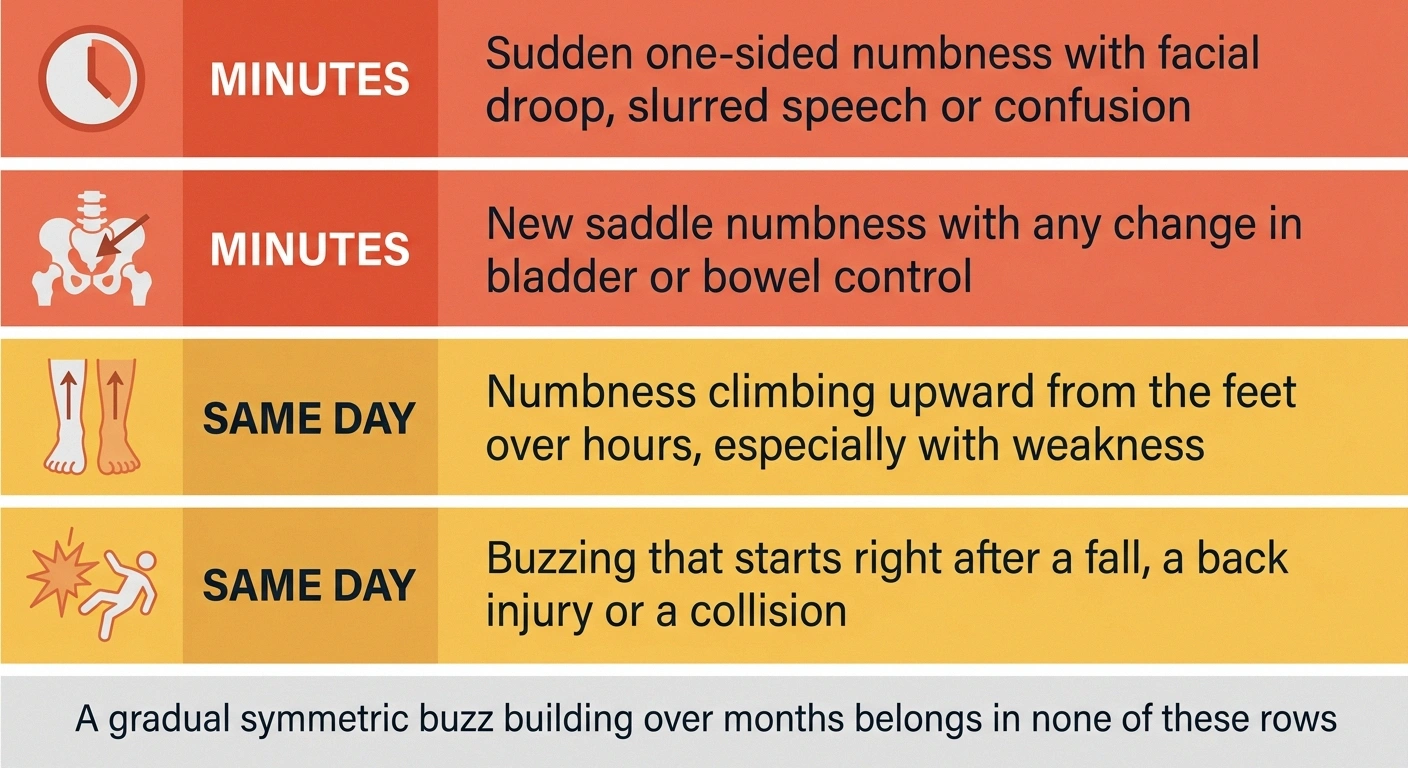
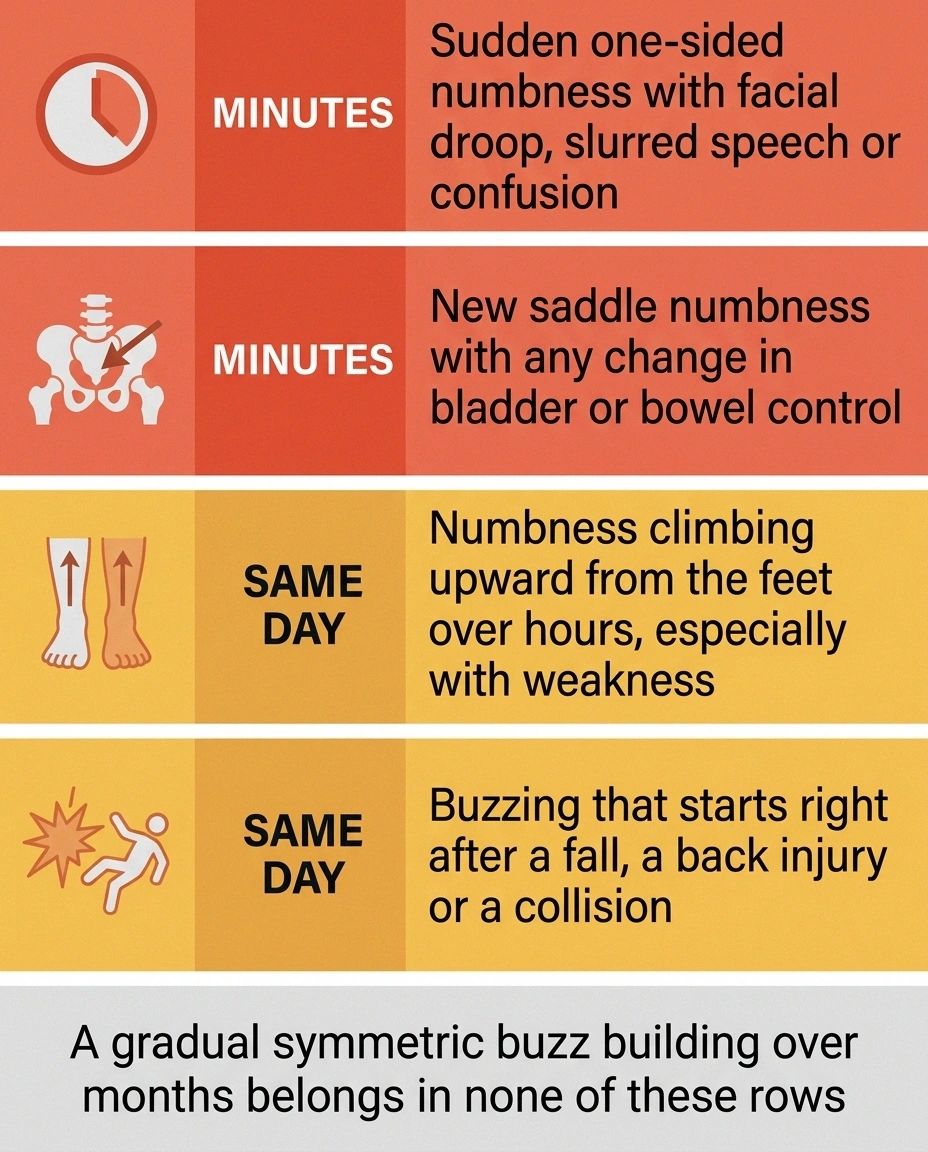
Almost none of what this article covers is urgent. A gradual, symmetric buzz that has been building over months belongs in an ordinary appointment, and there is no benefit to an emergency room visit for it.
Four presentations, and the clock on each
A gradual, symmetric buzz that has been building for months belongs in none of these rows. It belongs in an ordinary appointment, and the rest of this page is written on that assumption.
Four situations are different, and they are worth knowing so you can stop worrying about the rest.
Sudden one-sided numbness or buzzing that arrives with facial drooping, slurred speech, confusion, or weakness on that side is a stroke presentation and needs emergency services immediately, not a drive to urgent care. Buzzing and numbness climbing upward from the feet over hours to days, especially with weakness, needs same-day evaluation. New numbness or buzzing in the saddle region with any change in bladder or bowel control is a spinal emergency. And buzzing that follows a fall, a back injury, or an accident deserves same-day attention rather than watchful waiting.
If your symptom does not appear on that list, you have time to get this looked at properly.
What Actually Quiets It
Nothing switches this off on demand, and anyone selling you a promise that it will is selling something. Several things genuinely reduce it, and they are worth ranking honestly.
Treating the cause outranks everything else. Blood sugar brought into range, a B12 deficiency corrected, a compressing structure relieved, a drinking pattern changed: these address the fiber irritability rather than the perception of it, and they are the only interventions with a shot at making the buzzing genuinely smaller rather than merely less noticeable.
Competing sensation works and it is free. Walking on a textured surface, a firm foot massage, a cool floor under bare feet, a weighted blanket over the feet at night. All of these load the same pathways with real input and crowd out the abnormal signal for as long as they last. Effect is temporary and effect is still worth having.
Sleep position and temperature are worth an experiment. Feet outside the covers, a fan aimed low, socks off rather than on. Many people find a cooler foot buzzes less, and finding out costs one night.
Movement helps most people, and specifically regular walking rather than occasional long walks. Circulation to the small vessels feeding peripheral nerves improves with consistent activity, and consistency beats intensity here by a wide margin.
Medications aimed at nerve pain sometimes reduce buzzing and sometimes do nothing for it, because they were developed and tested against pain rather than against paresthesia. If buzzing is your dominant symptom and pain is minor, say that explicitly, because it changes whether a given drug is a sensible trial at all.
What to Expect Over Time

The honest answer has three branches, and which one you are on depends on the cause rather than on the loudness.
Six weeks, four columns, one index card a week
Record it twice a day at fixed times rather than when the buzzing is loud, because recording only the bad moments builds a chart that reads worse than the reality.
Time
8am and bedtime, every day, regardless of how it feels
Loudness
One to ten, first number that comes to mind, no deliberating
Which foot
Left, right, or both, plus how far up it reaches
The hour before
Standing, sitting, walking, alcohol, poor sleep, new medication
Six weeks is the shortest span that shows a direction rather than noise. Bring the card itself to the appointment instead of summarizing it out loud, and add one line at the bottom: how far up the leg the buzzing reached on week one compared with week six. That single measurement is the one a clinician can compare against next year.
Buzzing from a correctable deficiency or from a compression that gets relieved often fades over months. Nerve fibers regenerate slowly, roughly a millimeter a day at best, and the distance from the lower leg to the toes explains why improvement is measured in seasons rather than weeks. Some people notice the buzz gets briefly louder before it gets quieter, which is a known feature of regeneration and not a sign of deterioration.
Buzzing from an ongoing metabolic cause tends to track the cause. Bring the driver under control and progression usually slows or stops. Existing damage may or may not improve, and the honest expectation is stabilization rather than reversal. Whether and how much any of this reverses is covered separately in our piece on the stages of neuropathy.
Buzzing with no identified cause after a full workup, which is a real and frustrating category, tends to be slowly progressive at worst and stable at best. That is a more optimistic picture than most people assume when they hear the word idiopathic.
Whichever branch you are on, a symptom diary beats memory. Write down the time of day, what you had been doing, and a number from one to ten. Six weeks of that turns an argument about whether things are getting worse into a chart, and a chart is much harder for anyone to wave away, including yourself.
Frequently Asked Questions
Why do my feet feel like they are vibrating when nothing is touching them?
Damaged or irritated sensory nerve fibers accumulate extra sodium channels along the injured segment, which lowers the threshold at which they fire. The fiber generates a signal without any input, and because it is a fiber that carries vibration, your brain interprets the traffic as vibration. The sensation is real; the vibration is not.
Is buzzing in the feet a sign of diabetes?
It can be, and it is common enough that a blood sugar check is a reasonable first step. Nerve changes are measurable in prediabetes, before glucose reaches the diabetic range, so a normal fasting glucose does not settle the question on its own. Ask for an A1c.
What vitamin deficiency causes vibrating feet?
B12 is the most common and the most correctable. Deficiencies in B1, folate, and copper produce similar large-fiber symptoms. B6 is unusual because both deficiency and excess damage nerves, which is why high-dose B6 supplements should not be taken without a reason to take them.
Is buzzing in the feet the same as restless legs syndrome?
No, though the descriptions overlap almost completely. Restless legs includes an urge to move that movement relieves within seconds, follows an evening clock, and is worst during enforced stillness. Neuropathy buzzing carries no urge and does not switch off when you stand. The two frequently occur together in the same person.
Can anxiety cause buzzing feet?
Anxiety produces tingling and buzzing through muscle tension, altered breathing, and heightened attention to bodily sensation, and it reliably makes existing nerve symptoms louder. What it does not usually do is produce a symptom confined to the feet in a stocking pattern that persists unchanged for months. Persistent distal buzzing deserves a workup rather than an explanation.
Why is the buzzing worse at night?
Three reasons stack. Daytime sensory input from shoes, weight-bearing, and movement drowns out a low-level abnormal signal, and that input disappears in bed. Attention has less competition. And warmth under blankets plus fluid redistribution when lying flat both increase how irritable a damaged fiber is.
Should I be worried about buzzing in only one foot?
It is a reason to be specific rather than a reason to be alarmed. A one-sided pattern points toward a mechanical cause such as nerve compression at the ankle or a disc pressing on a nerve root in the lower back, rather than toward a systemic cause carried in the bloodstream. Structural problems are often more fixable than metabolic ones.
Will the buzzing ever go away?
It depends entirely on the cause. Buzzing from a corrected deficiency or a relieved compression frequently fades over months, since nerve fibers regrow at roughly a millimeter a day. Buzzing from ongoing metabolic damage usually stabilizes rather than resolves once the driver is controlled. A brief increase in buzzing during recovery is a recognized part of regeneration rather than a setback.
About the Author