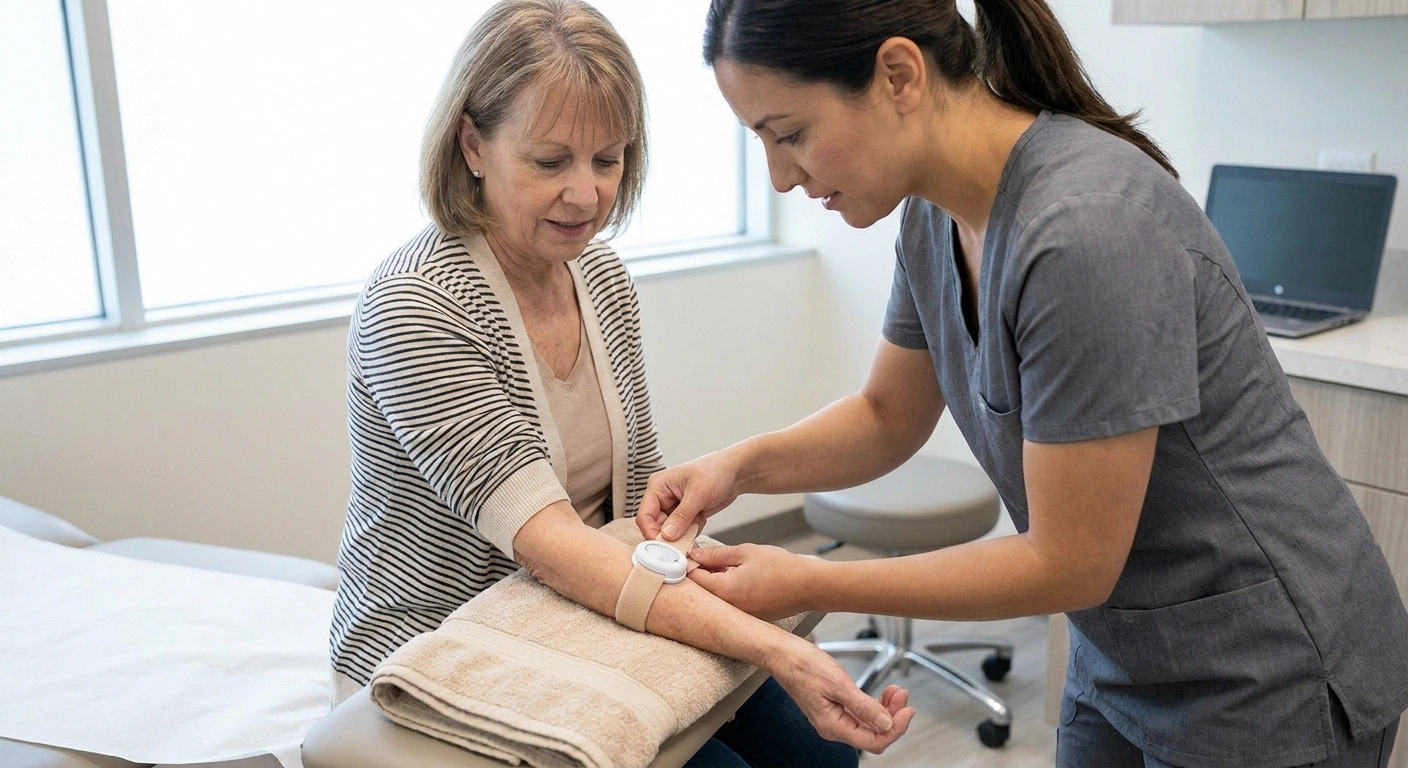
The order slip says QSART. Nobody explained what that stands for, the scheduler said to allow ninety minutes, and the prep sheet mentions stopping certain medications without saying which ones.
QSART stands for quantitative sudomotor axon reflex test. It measures sweat. That sounds like an odd thing to do to someone whose complaint is burning feet, and the reason it makes sense is the most useful thing to understand before you walk in.
Here is the whole appointment: what the machine is measuring, what the hour contains, what it feels like on the skin, the preparation people routinely get wrong, and how to read the report when it comes back. Including the result nobody prepares you for, which is a normal one.
What the Test Actually Measures
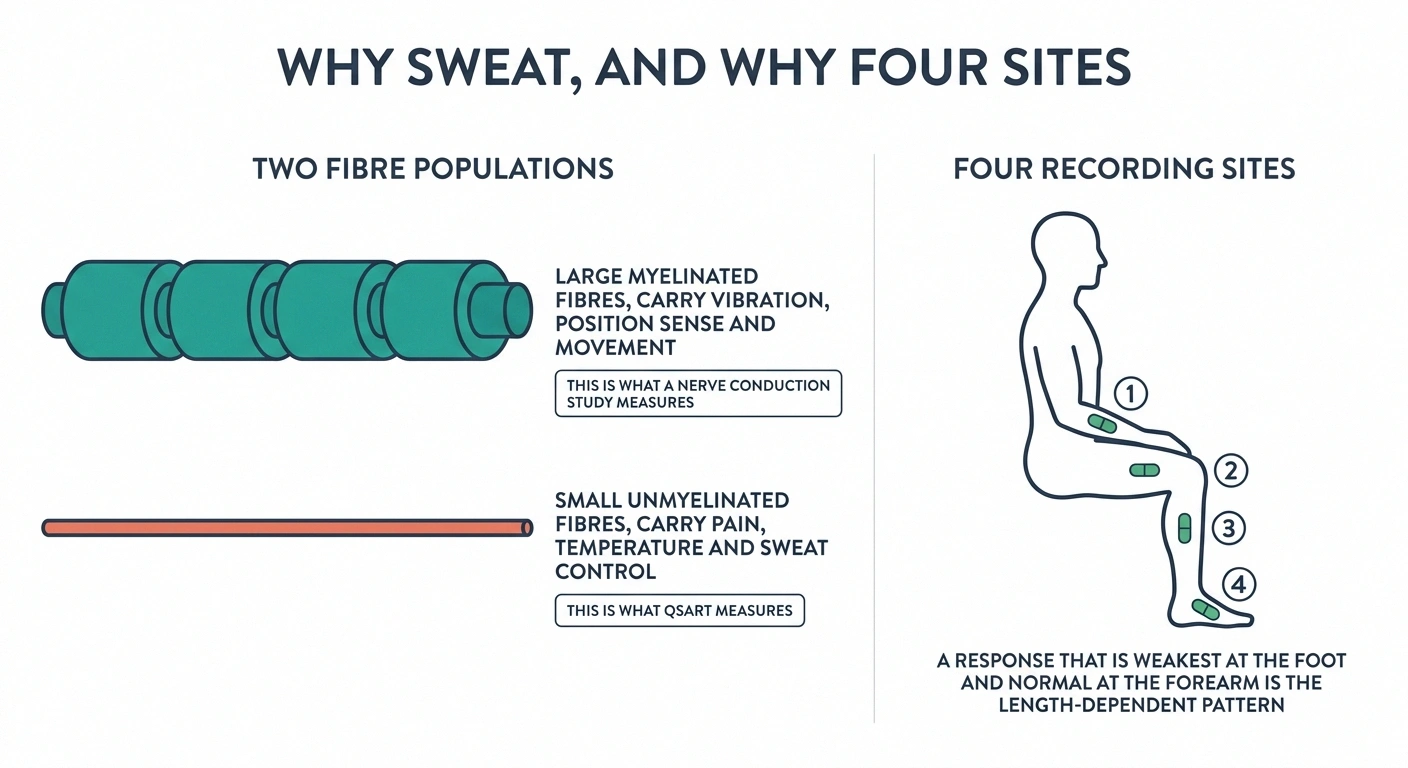
Your sweat glands do not decide on their own when to work. They take orders from a specific class of nerve fiber: thin, unmyelinated, autonomic fibers called postganglionic sympathetic sudomotor fibers. Those fibers are small. They are, in fact, exactly the population of small fibers that standard nerve testing cannot see.
This is the gap QSART exists to fill. A nerve conduction study and EMG measures large, myelinated fibers by timing electrical signals down a nerve. Large fibers carry vibration, position sense, and motor commands. They are fast, they are well insulated, and they show up beautifully on a nerve conduction study.
Small fibers carry pain and temperature. They are slow, thin, and electrically quiet. A nerve conduction study runs right past them. So a person can have severe burning, stabbing, and temperature confusion in both feet, get a nerve conduction study, and be told the results are normal.
That normal result is not a mistake. It is the correct answer to a question about the wrong fibers.
QSART asks about the small fibers directly, using sweat as the readout. If the sudomotor fibers supplying a patch of skin are damaged, that patch sweats less than it should when provoked. Measure the sweat, and you have measured the fibers. This is the reason a test for small fiber neuropathy involves a humidity sensor rather than an electrode timing a signal.
The word “axon reflex” in the name describes the trick. The test does not stimulate the sweat gland directly. It stimulates a nerve ending nearby and lets the signal travel up the axon, turn around at a branch point, and come back down a different branch to the gland. Only an intact fiber can complete that loop. A damaged one cannot, and the sweat response drops or disappears.
The Hour in the Lab, Step by Step
QSART is rarely done by itself. At most centers it is one part of a package called the autonomic reflex screen, and knowing the whole sequence removes most of the surprise.
You will be asked to lie down on a table in a room where the temperature and humidity are controlled and usually cooler than you expect. That control is not comfort-related. Sweat output is meaningless without a stable baseline to compare it against, so the room is a piece of equipment.
The capsules go on. Four small plastic capsules are strapped to the skin: one on the forearm, two on the leg at different heights, and one on the foot. The spread is deliberate. Neuropathy that starts at the toes and creeps upward produces a distinctive pattern across those four sites, and a single recording site would not reveal it.
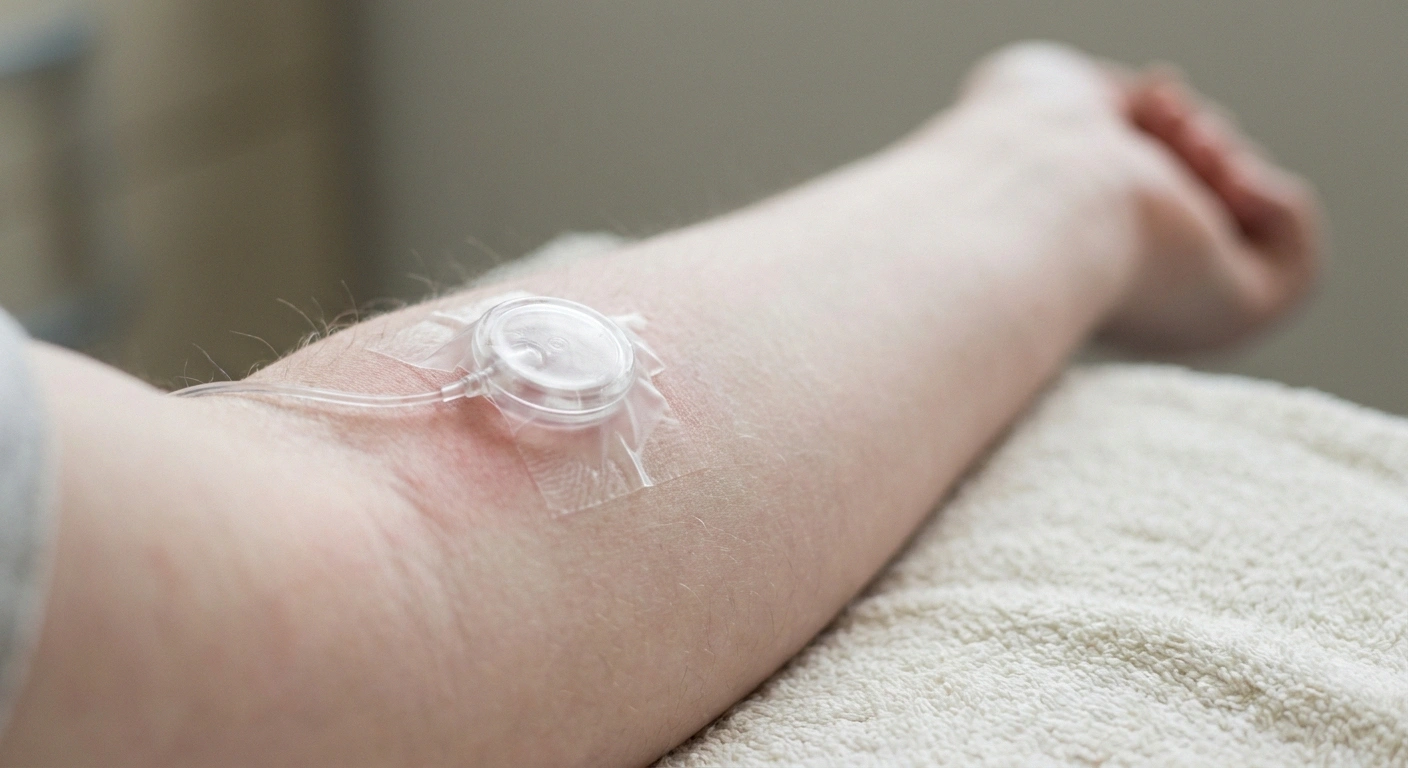
Acetylcholine is driven into the skin. A solution of acetylcholine sits in the outer chamber of each capsule, and a mild electrical current pushes it through the skin surface. This is iontophoresis, and it is the part everyone asks about. More on the sensation in a moment.
The machine records. The inner chamber of each capsule measures humidity continuously. Sweat output rises, peaks, and falls, and the software captures the shape of that curve at all four sites.
Then the rest of the screen. Heart rate response to deep breathing comes next, where you breathe in a directed rhythm while your heart rate is tracked. Valsalva analysis follows, with a blood pressure monitor on your fingers while you blow into a valve against resistance. The screen usually ends with head-up tilt, strapped to a table that tilts to about seventy degrees while blood pressure, heart rate, and symptoms are monitored for roughly ten minutes.
Start to finish, an hour to ninety minutes. The QSART portion itself is a fraction of that.
Yes, It Stings
Every clinical description of this test uses the phrase “mild electrical stimulation.” Patients describe it differently.
Two vocabularies for the same four minutes
The gap between these two columns is where the anxiety lives. Knowing both in advance is most of the fix.
| On the prep sheet | In waiting-room language |
|---|---|
| Mild electrical stimulation | Hot and prickling, like a small patch of sunburn under a lid |
| Transient local erythema | Four pink circles that fade over the afternoon, sometimes with a faint itch the next day |
| Orthostatic challenge | Being tilted upright until you feel the thing you came in about, on purpose, with staff watching the numbers |
| Allow 90 minutes | Roughly 10 of those minutes involve the sensation people are worried about |
The common report is a hot, prickling, sunburn-like sensation under the capsule that builds while the current runs and fades quickly once it stops. Some people find it barely noticeable. Some find it genuinely unpleasant for the few minutes it lasts. Almost nobody describes it as painless, and the mismatch between the clinical language and the actual sensation is why people arrive unprepared.
Two things worth knowing. First, the intensity is largely predictable from the current, and the technologist can talk you through it. Second, if you have skin that is already hypersensitive to touch, that hypersensitivity applies here too, and it is worth saying so out loud before the capsules go on rather than after.
The diagnostic literature reports no specific risk attached to the procedure, which is a fair summary rather than a promise that nobody ever reacts. Skin redness under the capsule sites is common afterward and settles on its own. Some people notice a faint itch at the sites for a day. Tell the technologist beforehand if you have a skin condition where the capsules go, react badly to adhesives, or have any implanted electrical device, since those are the things that change how the session is run.
The tilt portion is a different kind of unpleasant for some people. If your autonomic system is the problem, standing up is the provocation, and the test is designed to provoke. Feeling lightheaded on the tilt table is not a complication. It is data. You are strapped in, staff are watching the monitors, and the table comes down if you need it to.
The Prep List People Get Wrong
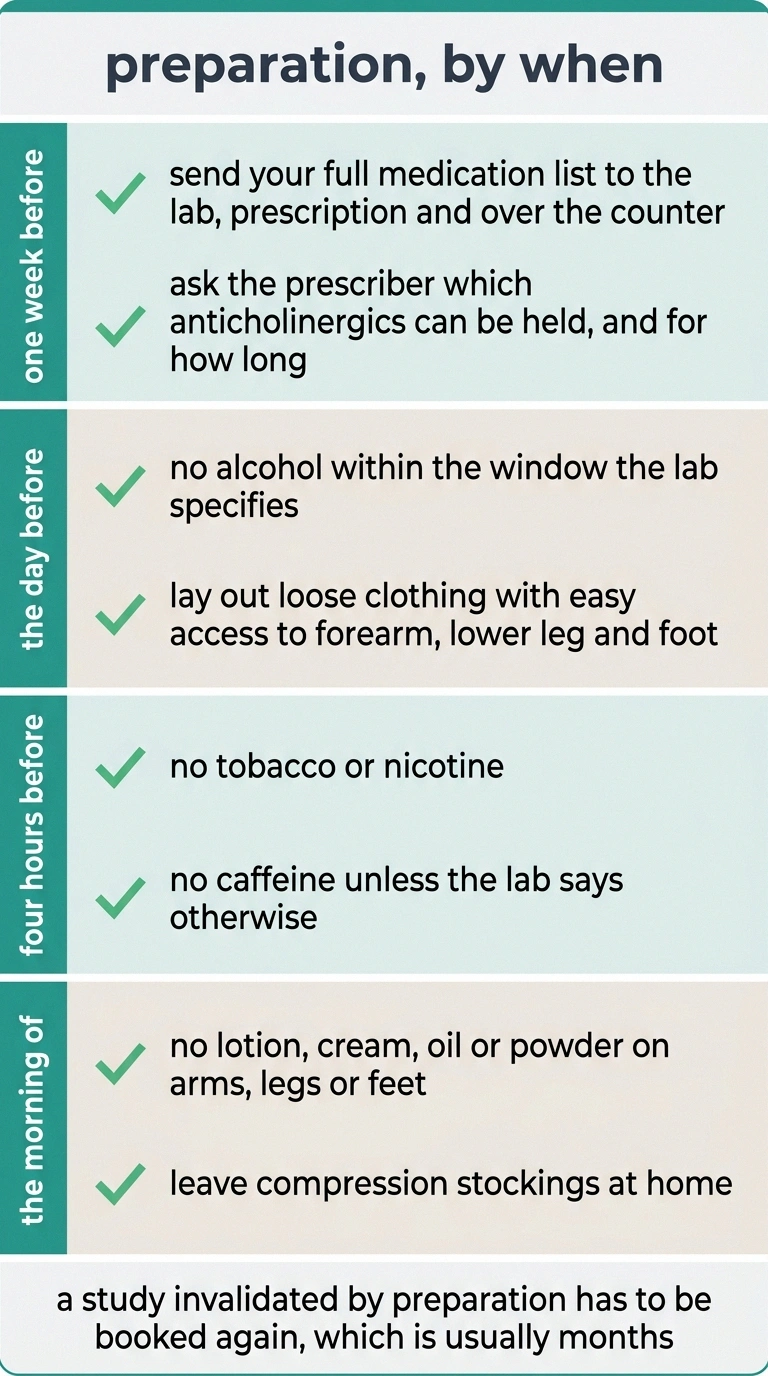
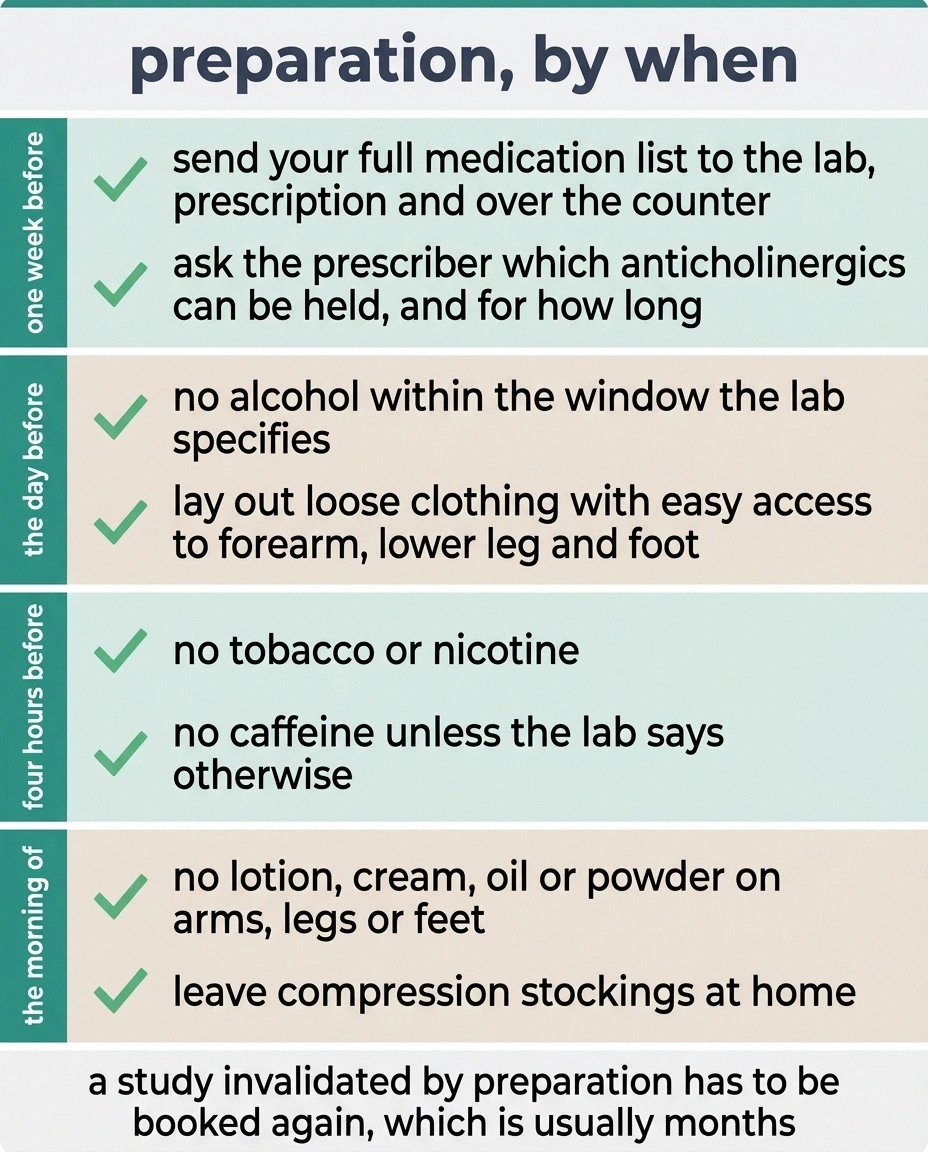
This is the section to read twice, because preparation errors do not announce themselves. Sometimes they make a study uninterpretable, and an uninterpretable autonomic study means booking the whole thing again. The more troublesome case is subtler: they can skew the numbers toward looking abnormal, because a sweat response suppressed by a medication looks a great deal like one suppressed by nerve damage.
Medications. Anything with anticholinergic activity suppresses sweating, and suppressed sweating is exactly what the test is looking for. Run your full list past the lab, prescription and over-the-counter, at least a week ahead. Several drug classes commonly taken by people with neuropathy sit squarely in this category, including certain antidepressants used for nerve pain, some bladder medications, some antihistamines, and some sleep aids. Do not stop anything on your own reading of this paragraph. Get the list from the lab and then talk to the prescriber about which ones are safe to hold and for how long.
No lotion, cream, oil, or powder on the test sites the day of. A moisture barrier on the skin interferes with both the iontophoresis and the humidity reading. This includes the foot cream that is part of your daily routine.
No tobacco or nicotine for at least four hours beforehand. Nicotine affects autonomic tone.
No compression stockings or garments on the test day, with one important exception. If you wear compression for a prescribed reason, such as orthostatic intolerance, lymphoedema, or venous disease, do not simply leave it off. Tell the lab you wear it and let them decide, because for some people going without is its own risk. Either way, wear loose clothing that gives easy access to the forearm, the lower leg, and the foot.
Caffeine and alcohol are typically restricted for a set window beforehand. Labs differ on the exact number of hours, which is why the lab's own sheet outranks any general advice.
Call the lab if the sheet is vague. The staff who run autonomic labs deal with this daily and would far rather answer a question on the phone than repeat a study.
Reading Your Results
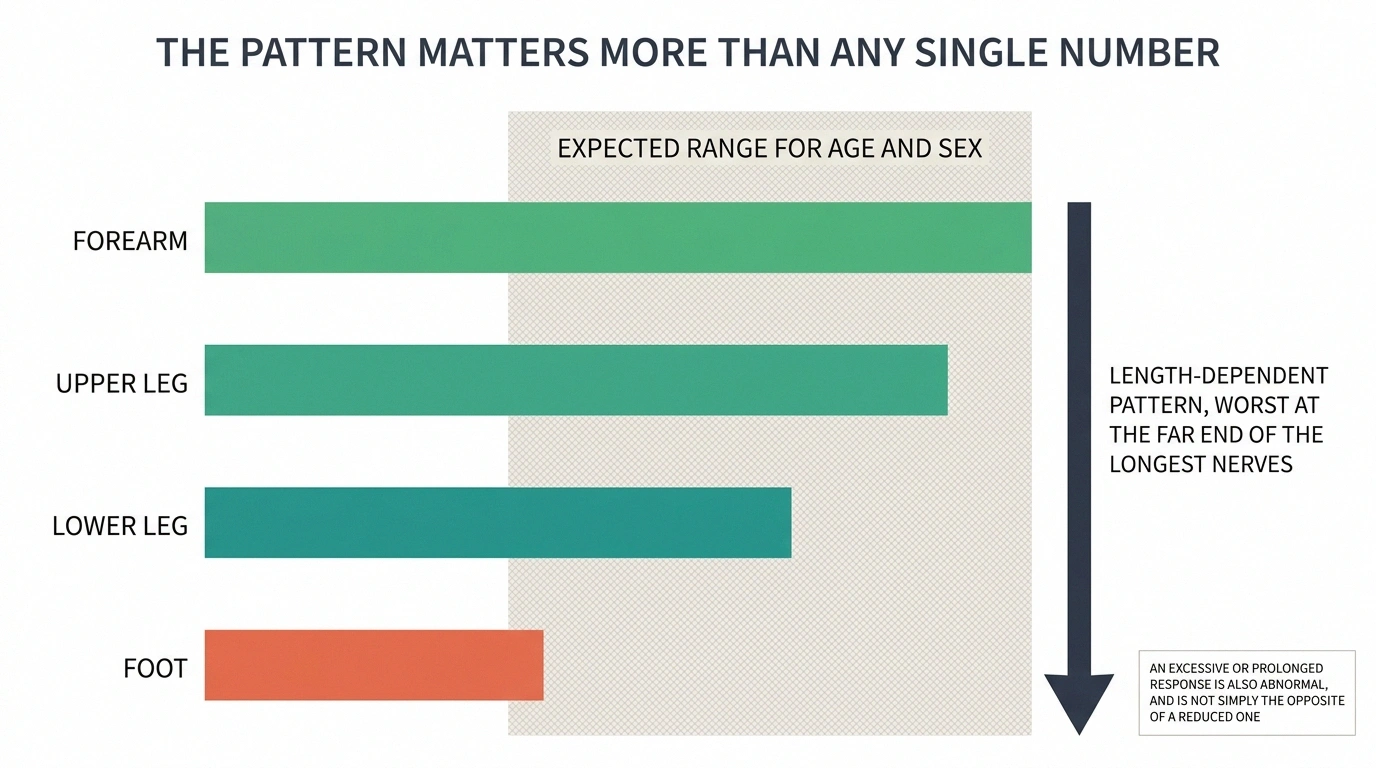
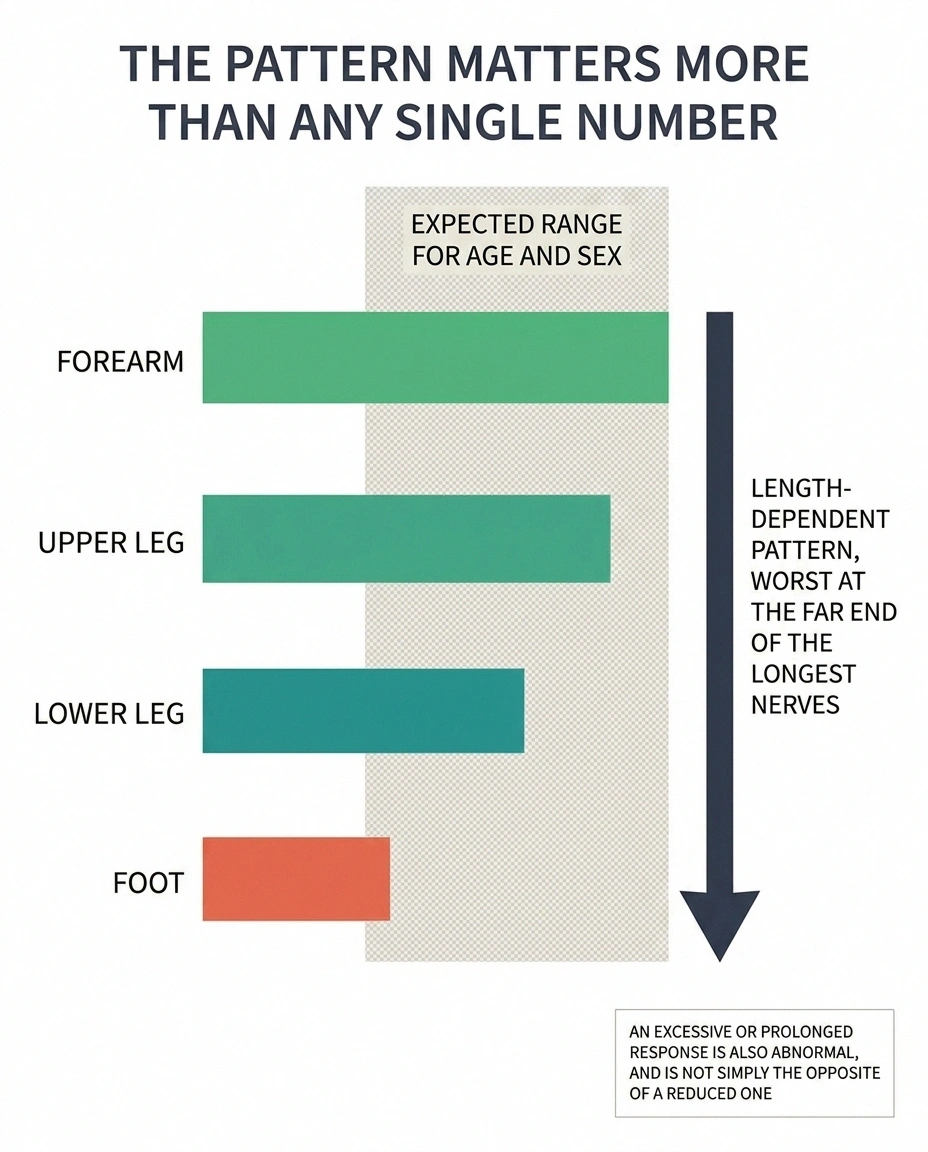
The report describes sweat volume at each of the four sites, compared against normal values matched for your age and sex, and it describes the shape of each response over time.
Three findings carry most of the meaning.
Reduced or absent sweat output at one or more sites indicates postganglionic sudomotor failure at that site. The fibers supplying those glands are not completing the reflex.
A distal-to-proximal gradient is the classic length-dependent pattern: worst at the foot, better at the leg, normal at the forearm. Longer nerves fail at their far ends first, which is the same reason symptoms usually begin in the toes and climb. If that pattern is new to you, our overview of how neuropathy progresses through its stages covers the underlying logic.
Excessive or prolonged responses occur too, and they are not simply the opposite of failure. They can reflect fibers in an irritable, partially injured state rather than a dead one.
Sweating is only one autonomic function, so the rest of the screen matters for interpretation. The tilt and Valsalva portions assess cardiovascular autonomic control, which is a separate territory from sudomotor control and can be affected independently. Our guide to autonomic neuropathy and how it shows up covers what those other domains mean in daily life, from blood pressure swings to digestion.
Bring the report to the appointment where it gets explained, and ask for the actual numbers rather than the summary line. The summary tells you the conclusion. The numbers tell you how confident to be in it, and whether a repeat study a year from now would show a change worth acting on.
When QSART Is Normal and You Still Hurt
This happens, and it is the hardest version of the appointment to walk out of.
Three things a clean QSART does not rule out
- Sensory small fibre damage
- The fibres carrying pain and temperature are a different population from the ones running your sweat glands. One can be injured while the other still works, which is the commonest reason for a normal result alongside real burning.
- A cause that has not been looked for yet
- Thyroid disease, B12 deficiency, coeliac disease, hepatitis and several autoimmune conditions are found on blood work, not on a sweat test. A normal QSART is not a reason to stop the cause hunt.
- Early disease
- Sudomotor loss is a threshold finding rather than a dial. A study that is normal today can be abnormal in eighteen months, which is the argument for keeping the report rather than discarding it.
QSART measures one specific fiber population doing one specific job. Small fiber neuropathy can affect sensory small fibers that carry pain and temperature while sparing the sudomotor fibers that drive sweat glands, at least early on. When that is the pattern, the sweat test comes back clean and the burning is still real.
A normal QSART narrows the field. It does not close the case, and it is not a verdict on whether your symptoms are genuine.
The usual next moves are a skin biopsy to count nerve fibers directly, a review of the blood work for causes that have not been excluded, and a careful look at conditions that produce similar symptoms through different mechanisms. Our rundown of the blood tests worth having on record is a reasonable checklist to bring to that conversation, and if burning is your dominant symptom, the differential in our piece on what causes burning feet is worth reading alongside it.
The reverse case exists as well. An abnormal QSART in someone with mild symptoms is meaningful information, because sudomotor fibers can fail before the symptoms become impressive. Early detection is the argument for testing at all.
QSART, Skin Biopsy, and Sudoscan Compared
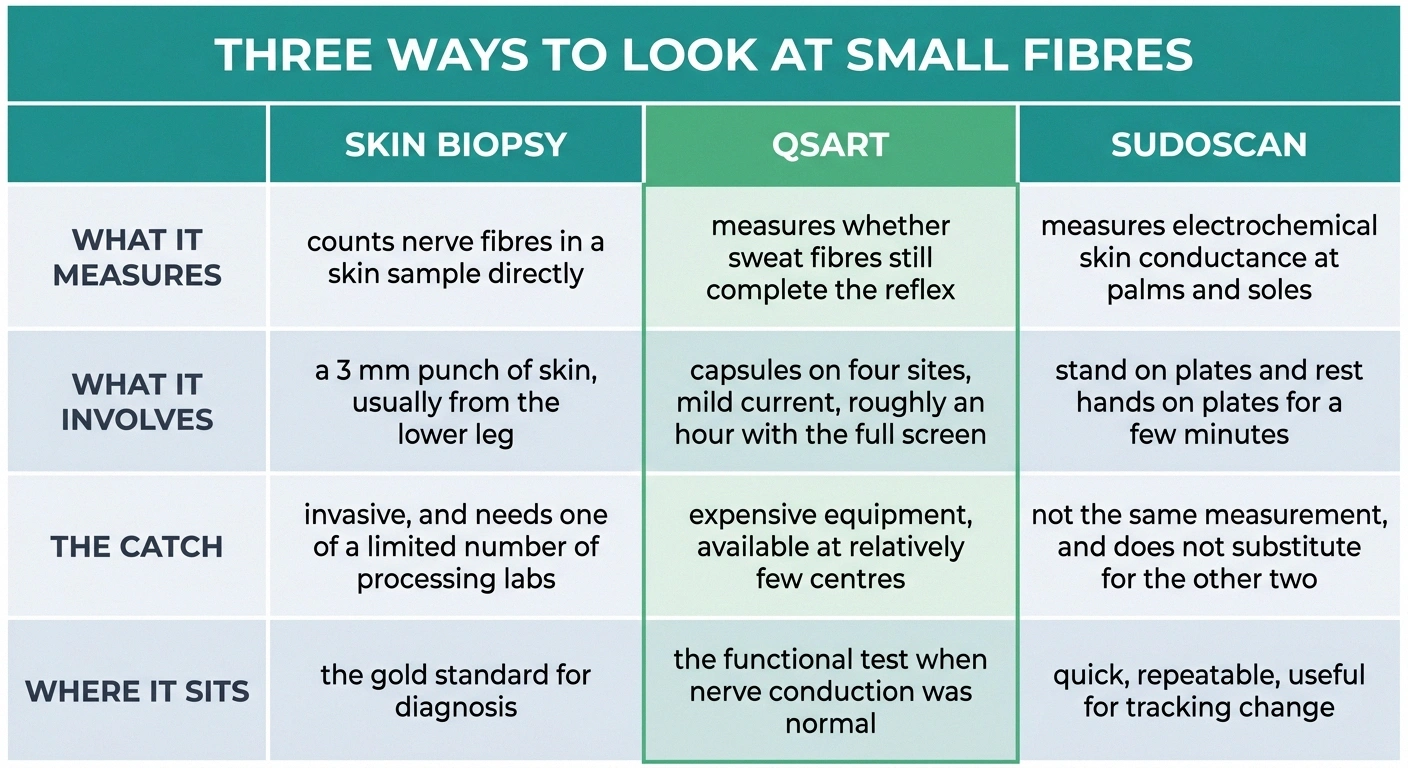
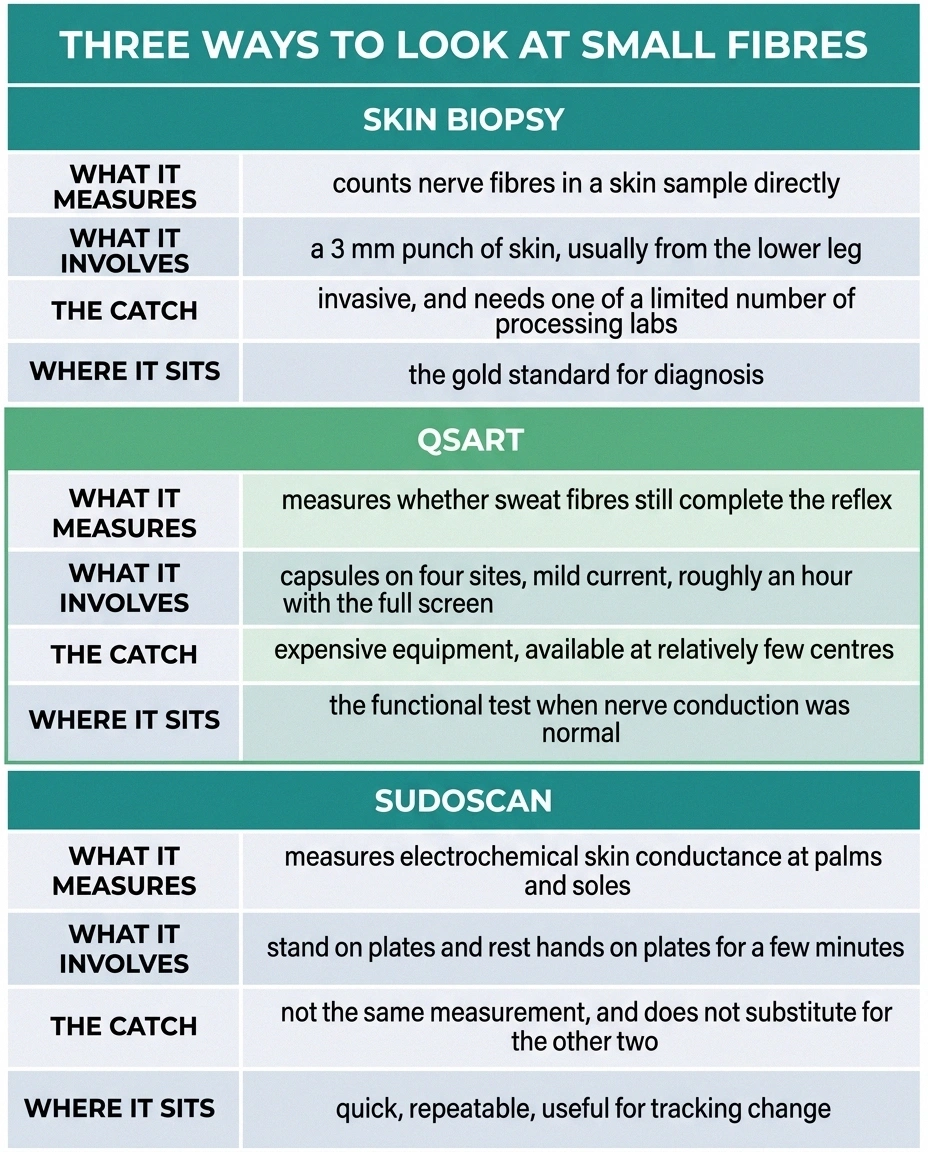
Patients arrive at this question fast, usually phrased as which test is the good one. The honest answer is that they measure different things and that availability, not accuracy, decides for most people.
Skin biopsy with intraepidermal nerve fiber density is the gold standard for diagnosing small fiber neuropathy. A three-millimeter punch of skin is taken, usually from the lower leg, and the nerve fibers crossing into the epidermis are counted under a microscope. It is a direct count of the fibers themselves rather than an inference from their function. The drawbacks are that it is invasive, carries the small risks any skin biopsy carries, and requires one of a limited number of labs equipped to process the sample.
QSART measures function rather than anatomy, which is a genuine advantage in some situations and a limitation in others. It is non-invasive. It requires expensive equipment and is available at relatively few centers, which is its practical constraint.
Sudoscan measures electrochemical skin conductance at the palms and soles. It takes a few minutes, involves standing on plates and resting hands on plates, produces immediate numbers, and is comfortable enough to repeat often. That repeatability makes it useful for tracking change over time. It is not the same measurement as QSART and does not substitute for it.
In practice, the neurologist orders what the institution has. Being able to ask which small-fiber tests are available locally, and what a normal result on each would and would not rule out, is a more productive question than asking for one test by name. Our broader guide to the tests a doctor may order for neuropathy sets out where each one sits in the sequence.
Access, Cost, and Getting Scheduled

Availability is the real bottleneck. QSART requires equipment most neurology offices do not own, and it is concentrated at academic medical centers and dedicated autonomic laboratories. Waits of several months are common, and travel is often part of the arrangement.
Four questions for the scheduler, while you still have them on the line
- Which components does your autonomic screen include, and how long does the whole appointment run here? The package varies between centres and the number you were given may be for a different one.
- Can you email me the preparation sheet today rather than post it? The medication question needs a week, and the sheet arriving three days out is the commonest reason studies get repeated.
- Who reviews my medication list, and what is the deadline for sending it? Getting a name and a date turns a vague instruction into something you can follow up.
- Is my prior nerve conduction study already in the file? Insurers generally want documented symptoms plus a normal large fibre study on record before they approve small fibre testing.
On cost, the useful thing to understand is what makes coverage more likely rather than what the number is, since the number depends entirely on your plan and the facility. Insurers generally want documentation of the symptoms that suggest small fiber involvement and documentation that large-fiber testing was normal. That is the sequence: symptoms, then a nerve conduction study, then small-fiber testing when the first test does not explain the picture.
Which means the practical move is not to argue for the test in the abstract. It is to make sure the symptom documentation and the prior normal nerve conduction study are both in the chart before the request goes in.
Two other things worth doing at the time of scheduling. Ask for the preparation sheet at booking rather than in the mail, so you have a full week to sort out the medication question. And ask how long the whole appointment runs at that specific lab, because the autonomic reflex screen is a package and the components vary between centers.
What to Do With the Result

An abnormal QSART gives your symptoms a physical finding, which changes conversations. It supports a small fiber neuropathy diagnosis, it argues for a search for the underlying cause if one has not been found, and it establishes a baseline that a repeat study can be measured against later.
The test names the damage. This is what names the cause.
Worth confirming which of these are already in your chart before the follow-up appointment, because the gaps are what the visit should be spent on.
| Looking for | Usually found by |
|---|---|
| Blood sugar handling, including prediabetes | HbA1c, and a two-hour glucose tolerance test when the A1c is borderline |
| Vitamin and metabolic causes | B12 with methylmalonic acid, folate, thyroid function |
| Autoimmune and inflammatory causes | ANA, ENA panel, ESR and CRP, coeliac serology |
| A monoclonal protein | Serum protein electrophoresis with immunofixation, serum free light chains |
| Infectious causes | Hepatitis B and C serology, HIV |
It does not, by itself, name a cause. Diabetes, prediabetes, autoimmune disease, B12 deficiency, thyroid disease, certain medications, alcohol, and a long list of less common conditions can all produce small fiber damage, and a meaningful fraction of cases stay idiopathic after a thorough search. The test tells you the fibers are affected. The cause hunt is a separate project, run mostly through blood work.
A normal QSART with continuing symptoms means the search is not finished. Sudomotor fibers can be spared while sensory small fibers are not, and there are other tests. If autonomic symptoms are part of your picture, patterns like sweating in the wrong places or not at all are worth raising specifically, because they point at the same fiber population from a different direction.
Either way, walk in prepared, get the prep right, and ask for the numbers. That is the part of this appointment you control.
Frequently Asked Questions
Does a QSART test hurt?
Most people describe a hot, prickling, sunburn-like sensation under the capsules while the current runs, which fades quickly once it stops. Clinical descriptions call it mild electrical stimulation, which understates it for some people. It is brief, the diagnostic literature reports no specific risk attached to the procedure, and skin redness at the capsule sites afterward is normal and settles on its own. Tell the technologist beforehand if you have a skin condition where the capsules go, react badly to adhesives, or have an implanted electrical device.
How long does a QSART take?
The QSART portion itself takes a fraction of the visit. Because it is usually performed as part of a full autonomic reflex screen alongside heart rate response to deep breathing, Valsalva analysis, and tilt table testing, plan on one to one and a half hours in the lab. Ask the specific center, since the package varies.
What medications do I need to stop before a QSART?
Anything with anticholinergic activity can suppress sweating and invalidate the study, which includes some antidepressants used for nerve pain, some bladder medications, certain antihistamines, and some sleep aids. Get the exact list from the lab performing the test, at least a week ahead, then confirm with the prescriber which are safe to hold and for how long. Do not stop medications on your own.
Can a QSART be normal if I have small fiber neuropathy?
Yes. QSART measures sudomotor fibers that drive sweat glands, and small fiber neuropathy can affect the sensory fibers carrying pain and temperature while sparing sudomotor function, particularly early on. A normal result narrows the field without closing the case. Skin biopsy and a review of the blood work are the usual next steps.
Is QSART better than a skin biopsy?
Neither is better in the abstract. Skin biopsy is the gold standard because it counts nerve fibers directly, but it is invasive and requires a specialized processing lab. QSART is non-invasive and measures function rather than anatomy, but it needs expensive equipment available at relatively few centers. Availability usually decides which one you get.
What does an abnormal QSART mean?
Reduced or absent sweat output at a test site indicates that the postganglionic sudomotor fibers supplying that skin are not completing the axon reflex. A pattern that is worst at the foot and improves further up the body is the length-dependent picture typical of peripheral neuropathy. The finding supports the diagnosis; it does not identify the cause, which is pursued separately.
Why do they test sweat for a nerve problem?
Sweat glands are controlled by small unmyelinated autonomic nerve fibers, the same size class as the sensory fibers that carry pain and temperature. Standard nerve conduction studies only measure large myelinated fibers and cannot see this population, which is why they often come back normal in small fiber neuropathy. Sweat output is a measurable proxy for whether those small fibers are working.
Is QSART covered by insurance?
Coverage varies by plan and facility. Approval is generally more likely when the chart documents symptoms consistent with small fiber involvement and a prior normal nerve conduction study showing large-fiber function is intact. Getting that documentation in place before the request is submitted matters more than how the request is worded.
Where can I get a QSART test?
Academic medical centers and dedicated autonomic testing laboratories. The equipment is expensive and not widely distributed, so waits of several months and some travel are common. Ask your neurologist which small-fiber tests are available locally before committing to a specific one by name.
About the Author