Every decluttering guide ever written assumes four things about your body. It assumes you can stand for a couple of hours. It assumes you can get down to floor level and back up. It assumes you can carry a loaded box across a room. And it assumes that when you pick something up, you can feel it.
Neuropathy breaks all four at once. Not one of them, which you could work around. All four, in the same afternoon, in a room you have deliberately filled with objects that were not on the floor that morning.
So when the standard advice does not work, the conclusion people reach is usually about themselves. They decide they lack discipline, or that they are too far gone, or that the mess is now permanent. I have watched people in my support group say all three about a spare room that a person without foot pain would have cleared in a weekend.
It is not discipline. A person who can walk to the shops and back can be genuinely unable to finish a linen cupboard, and that is not a contradiction once you look at what each activity actually asks of a body with damaged nerves. The cupboard is harder. It is harder in ways that are specific, predictable, and almost entirely fixable by changing how the job is done rather than how much you push.
The mismatch is between the method and the body, and the method is the part you can change. What follows is decluttering rebuilt around sitting instead of standing, around small zones instead of whole rooms, and around the fact that the process itself makes a home briefly more dangerous to walk through. It works. It just looks nothing like what you see on television.
Why This Particular Chore Is So Punishing
Understanding the specific reasons helps, because it stops the whole thing feeling like a character flaw.
Four demands, all arriving in the same hour
Most chores ask for one of these. Decluttering asks for all four at once, which is why it defeats people who manage everything else in the house.
Decluttering is mostly standing still. That matters more than it sounds. Walking pumps blood through the legs with every step, while standing in one spot lets it pool, and for a lot of us that is when the burning arrives. Twenty minutes of standing in front of a cupboard is harder on neuropathic feet than a twenty minute walk. People notice they can manage the walk and not the cupboard and find it baffling, and this is why.
It is also repetitive bending and straightening, which challenges balance in exactly the way neuropathy undermines. Every time you bend forward and come back up, your body has to know where it is in space, and that sense is delivered by nerves in your feet and ankles that may be reporting poorly. Add a head-down position and a brief change in blood pressure, and you have a genuine wobble.
Then there is what the job does to the room. Halfway through, the floor holds bags, stacks, an open box and a pile of things bound for another room. Your feet cannot feel obstacles they would once have detected through a sole, and you are navigating a familiar space that has temporarily stopped being familiar. It is worth being blunt: the middle of a decluttering session is one of the higher-risk moments in an ordinary week for anyone whose balance is already compromised by nerve damage.
Finally, the fatigue is delayed. You feel capable at ninety minutes, stop at two hours, and pay for it that evening and most of the next day. That delay makes it almost impossible to judge the right stopping point from how you feel in the moment.
Sit Down to Sort
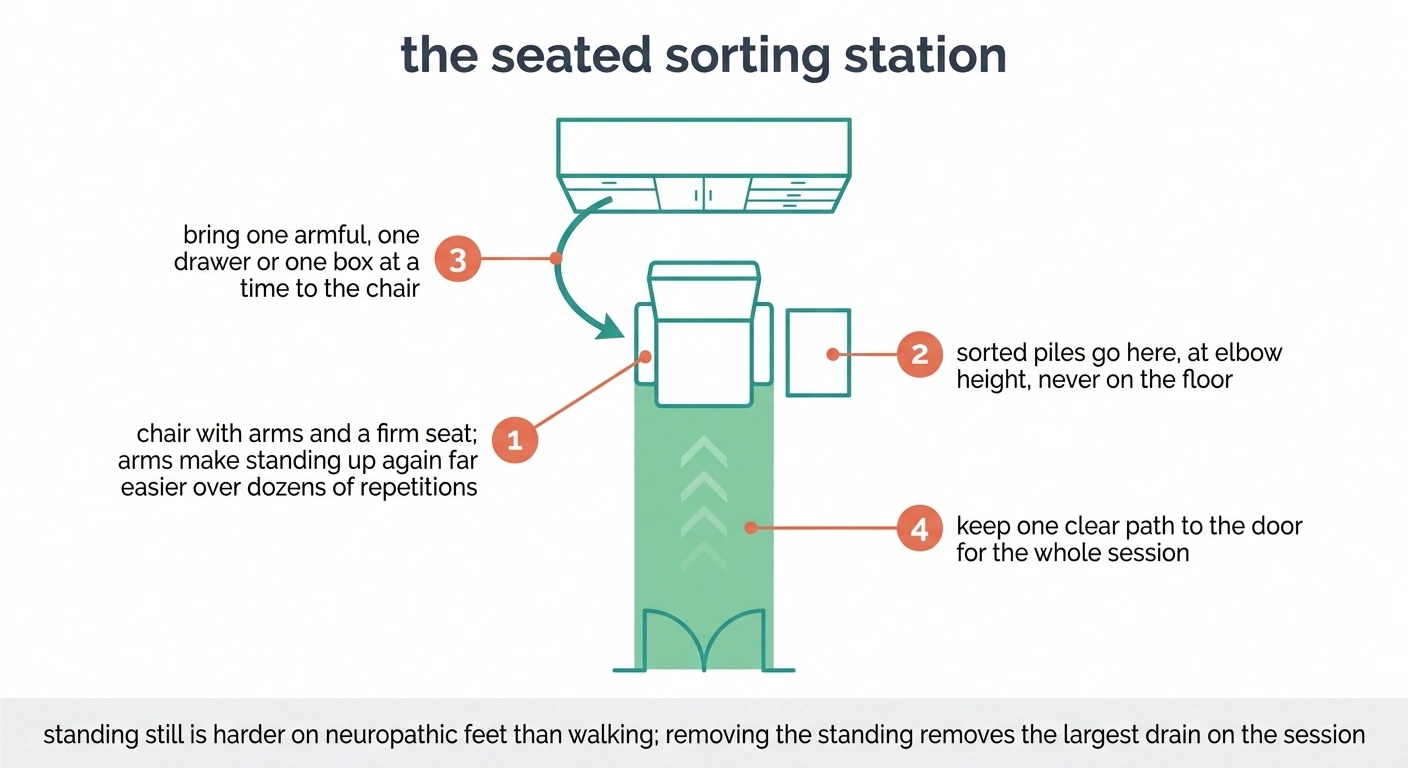
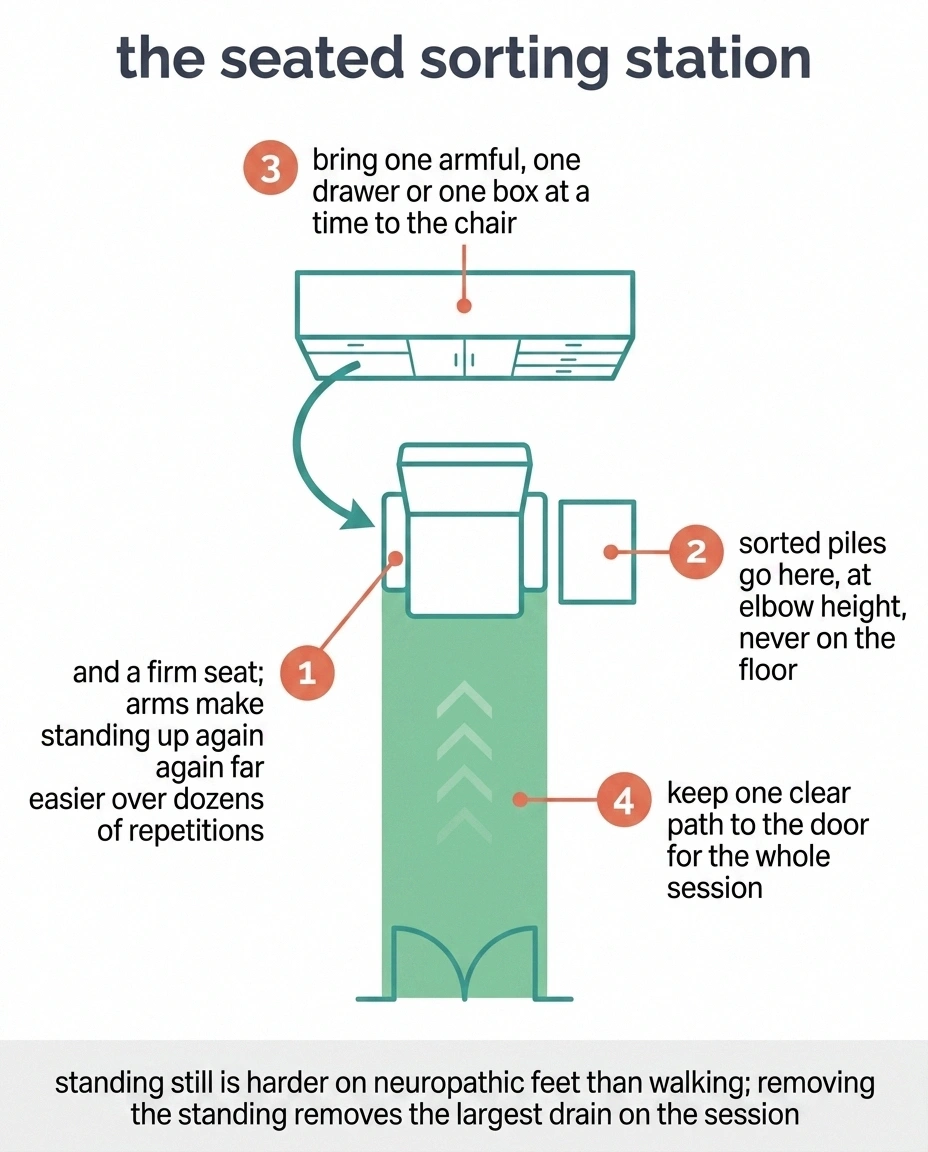
If you take one thing from this page, take this. Do not stand up to sort. Bring the objects to a chair.
The instinct is to go to the cupboard and work through it where it lives, because that is how everyone does it and it seems inefficient to move things twice. But standing at a cupboard is the thing your body handles worst, and sitting is the thing it handles best. Trading a small amount of efficiency for a large amount of endurance is a good deal every single time.
The setup takes two minutes. Put a dining chair where you can reach the shelf or drawer, or in the middle of the room with a small table beside it. Bring one armful, or one drawer, or one box to the chair. Sort it there with the sorted piles on the table rather than the floor. Deal with those piles. Then get the next armful.
What this buys you is real. Sitting removes the standing-still problem entirely, which is the largest single drain. It steadies your hands, because a body that is not working to stay upright has more to give to fine control. It cuts the bending, since things arrive at lap height instead of you travelling down to meet them. And it gives you a fixed base to work from when your feet are unreliable.
A few refinements are worth the trouble. Use a chair with arms, which makes standing up again far easier over dozens of repetitions. Choose a firm seat rather than a soft one. If you can work at a table, better still, because a surface at elbow height beats a lap for anything fiddly. And if a rolling office chair is available and your floors are hard, you can move between areas without standing at all, which is a genuinely useful trick on a bad day.
One Small Zone, Not One Whole Room
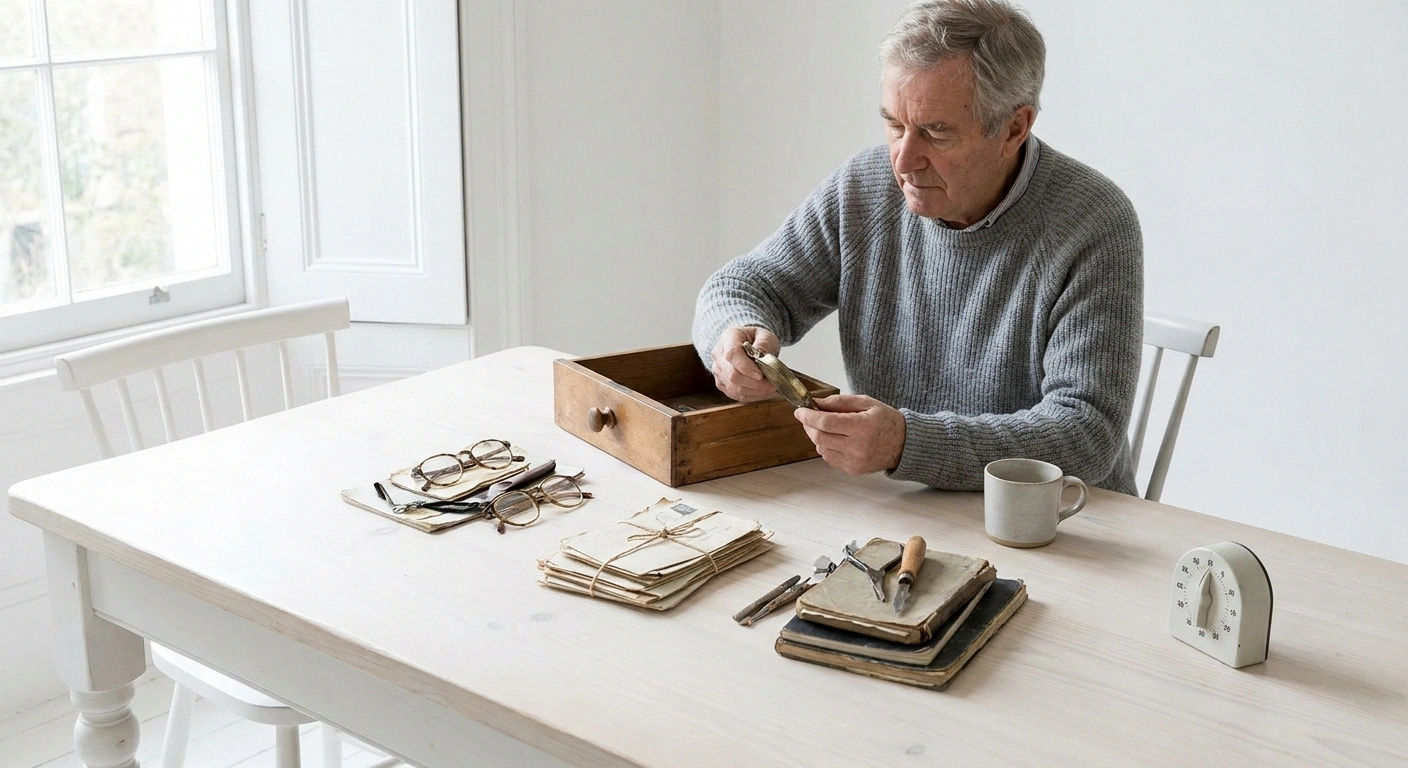
The second failure point is scope. People take on a room, run out of body partway through, and leave it worse than they found it. Then the sight of the half-finished room becomes a reason not to start again.
Why three short sessions beat one long one
| One two-hour push | 120 minutes of work, then two or three days when nothing else gets done either. Net for the week: 120 minutes, and the rest of the week costs you. |
| Three 30-minute sessions | 90 minutes of work and no recovery debt, so cooking, walking and everything else survives the week intact. |
| The part that decides it | Every short session ends with a finished shelf and a safe floor. The long one ends mid-job, which leaves the room more hazardous than before you started. |
Set a timer and stop when it sounds, mid-pile if necessary. The fatigue from this work arrives hours later, so feeling fine at the forty-minute mark tells you nothing useful about whether to continue.
The fix is to shrink the unit of work until it fits inside one session with room to spare. Not a room. Not even a cupboard. One shelf. One drawer. One corner of the wardrobe floor. One box.
The test is simple: can you finish this completely, including putting the discards outside the room, in the time you have decided to work? If there is any doubt, halve it. A finished shelf is worth far more than a half-emptied room, and not only for the obvious reason. Finishing leaves the space safe to walk through, which the half-emptied room does not.
Cap the time before you start, and cap it by the clock rather than by feel. Somewhere between twenty and forty minutes is right for most people, and the fact that you feel fine at forty is not evidence you should continue, because the bill arrives later. Set a timer and stop when it goes, mid-pile if necessary.
Three shorter sessions across a week move more material than one long session followed by three recovery days, and the arithmetic is not close. This is the same pacing logic that works for walking with neuropathy, where short frequent efforts beat occasional long ones for exactly the same reason.
Working Around Hands That Cannot Feel
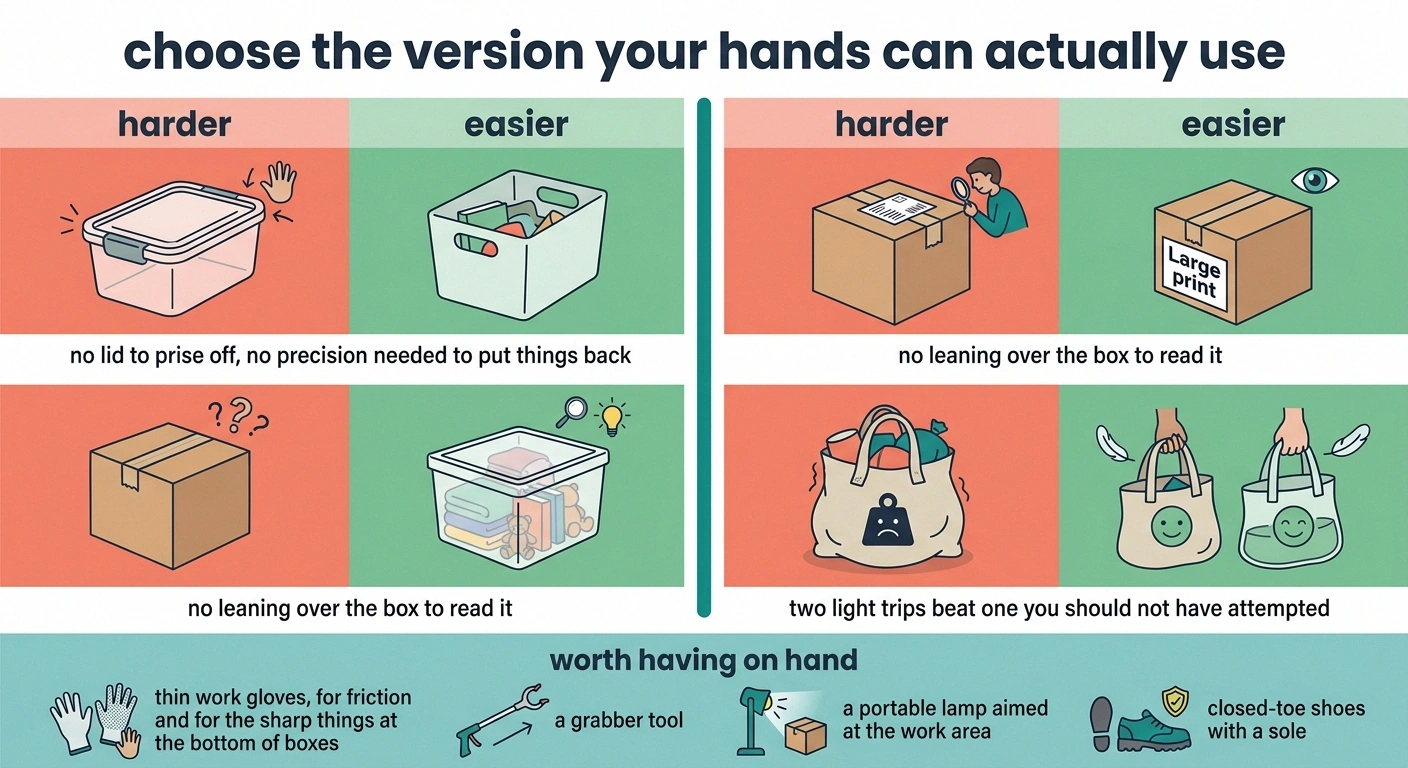
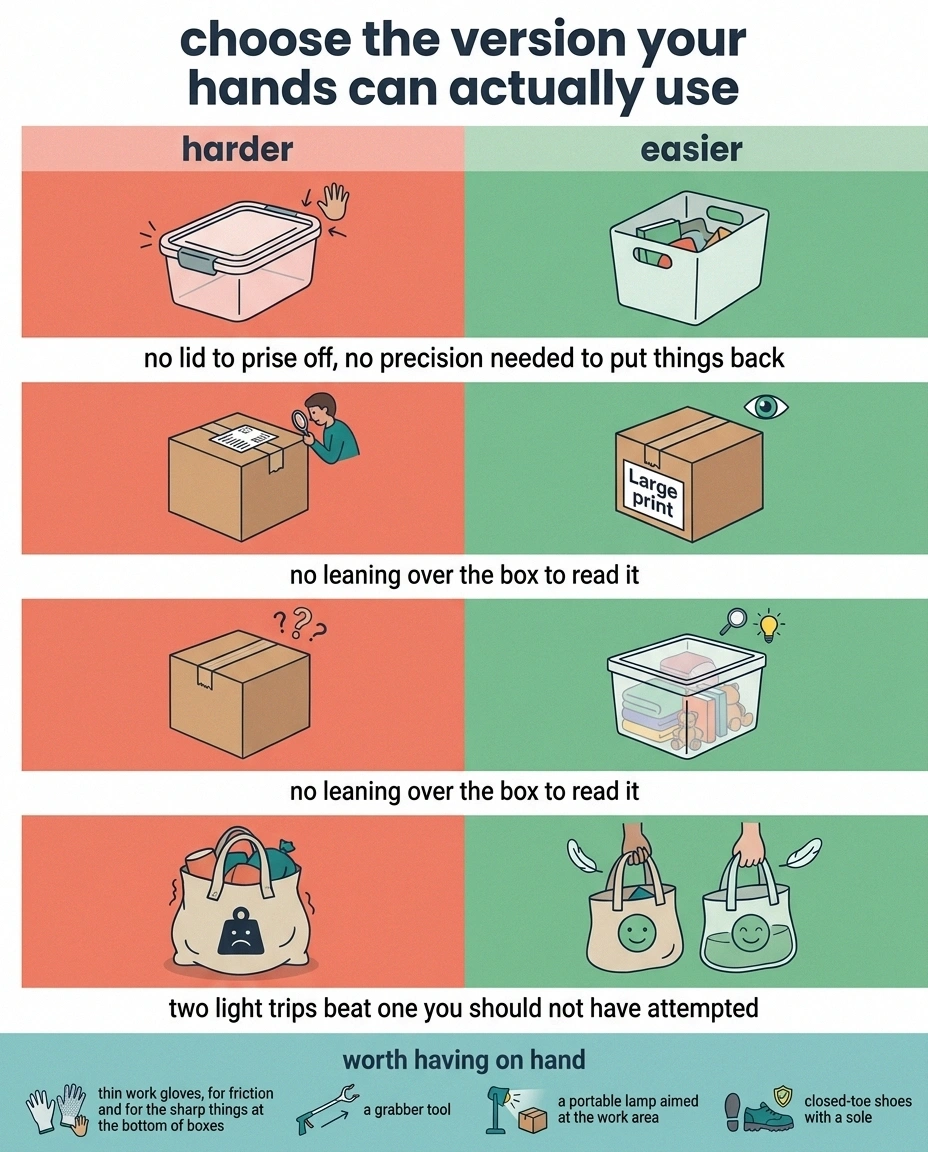
If neuropathy has reached your hands, sorting brings its own problems, and they are mostly about grip force. You cannot feel how hard you are holding something, so you either hold too tight and tire quickly, or too loose and drop it.
The single most useful adjustment is to look at what you are holding rather than relying on feel, particularly with anything heavy, breakable or sharp. Vision substitutes for sensation surprisingly well once you commit to it.
Some other things that help:
Wear thin work gloves. They add friction, which lets a weaker grip hold the same object, and they protect against the sharp edges and broken things that live in the bottom of storage boxes. That protection matters more than usual, because a numb hand may not report a cut immediately.
Handle heavy items with two hands and keep them low, close to your body, and over a surface rather than over the floor. Assume anything you drop will land where you least want it.
Empty boxes rather than lifting them. A full box is heavier than it looks and awkward to hold at the exact moment your grip is least reliable. Take out the contents in handfuls, then move the empty box.
Choose the right container for the future, not just for now. Bins with wide open tops and cut-out handles are far easier than tubs with tight snap-on lids, and clear sides mean you can identify contents without opening anything at all. Labels in large print on the front, not the top, save you leaning over things.
Take proper breaks when your hands start to burn or cramp rather than pushing through, and use them. Gentle movement, warmth, and a few minutes of doing nothing all help. Some people find massage techniques useful in the same way for hands as for feet, and there is more on managing neuropathy symptoms in the hands if that is your main problem area.
The Floor Is the Enemy
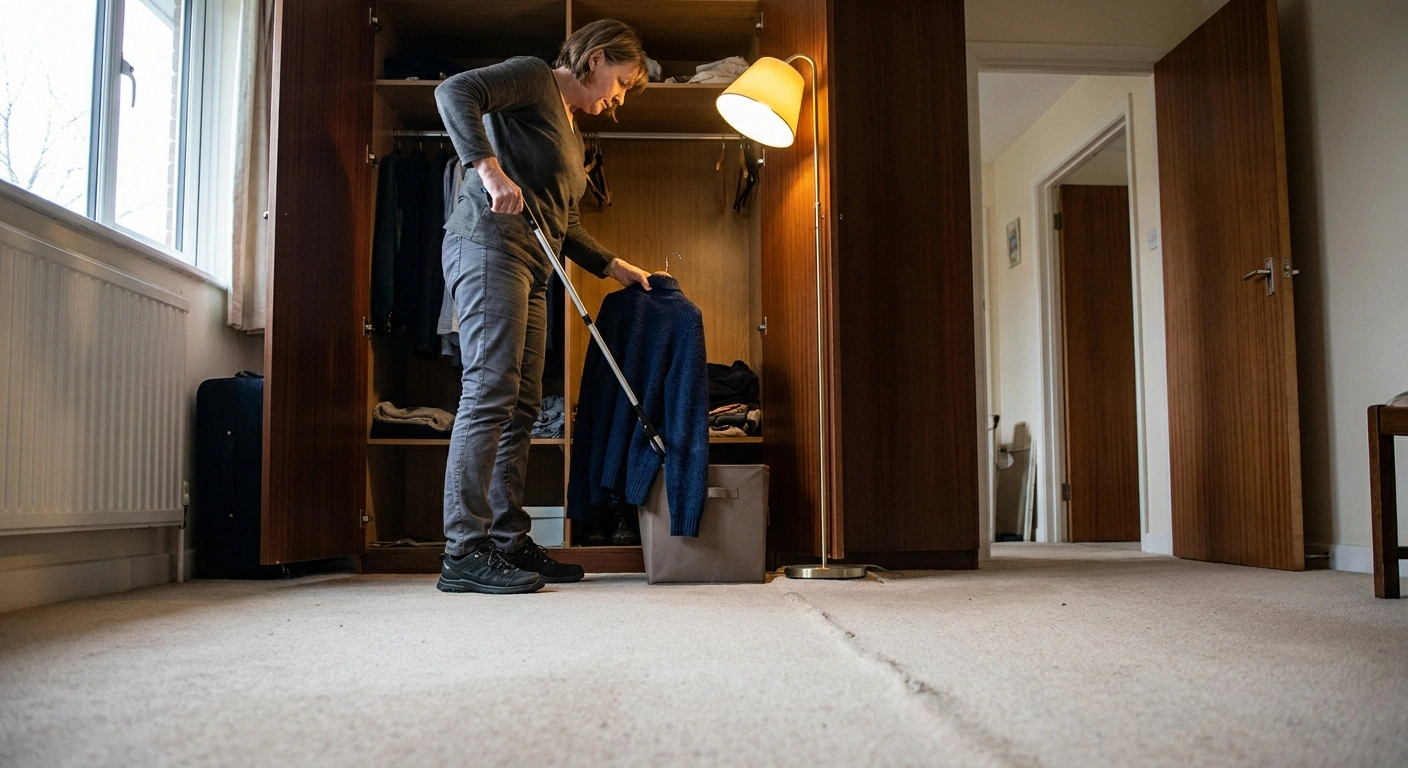
Two separate floor problems arise, and they need separate answers.
The five minutes at the end that matter most
Build these into the session rather than treating them as tidying up afterwards. Set the timer five minutes early so this happens while you still have something left.
- Walk the path. Trace the route from the door to where you were working and clear anything standing in it, including things you put down deliberately.
- Move bags out of the room entirely. Not against a wall. A bag against a wall is still on the floor at two in the morning.
- Close and stack empty boxes. An open box is a shin-height obstacle with an invisible edge.
- Check the route you use at night. Bedroom to bathroom especially, since that trip happens in low light with the least alert version of you.
- Look at your feet. A stubbed toe or a small cut from a box edge may not have announced itself, and finding it tonight is easier than finding it in a week.
The first is reaching things at floor level. A grabber tool, the kind sold for picking up litter, is genuinely transformative here and costs very little. It handles clothing, paper, light boxes and anything soft, and it removes dozens of bends from a session. For anything it cannot manage, use the chair: sit down beside the low shelf rather than crouching at it.
The second problem is the one people do not anticipate, which is everything you have put on the floor. Bags for charity, piles for other rooms, the box you are filling. In a home you partly navigate from habit, with feet that under-report obstacles, these are exactly the wrong things to introduce.
Three rules make this manageable. Keep one clear path from where you are working to the door, and keep it clear the whole time rather than clearing it at the end. Put sorting piles on a table, a bed or a second chair rather than on the ground. And take discards out of the room as they accumulate, rather than letting them build into a wall you have to step around.
Light the space properly while you work, brighter than you would normally bother with. When your feet cannot tell you where the floor is, your eyes are doing that job, and they need help. A portable lamp aimed at the work area is worth the small effort of fetching it.
And wear shoes. Real ones, closed at the toe, with a sole. Not slippers, not socks, and certainly not bare feet. You are handling objects that can fall, on a floor that has changed since this morning, and this is precisely the situation supportive footwear exists for. It is also worth looking your feet over once you finish, because a stubbed toe or a small cut may not announce itself, and checking rather than feeling is the habit that catches those early.
Getting Things Out Without Extra Trips
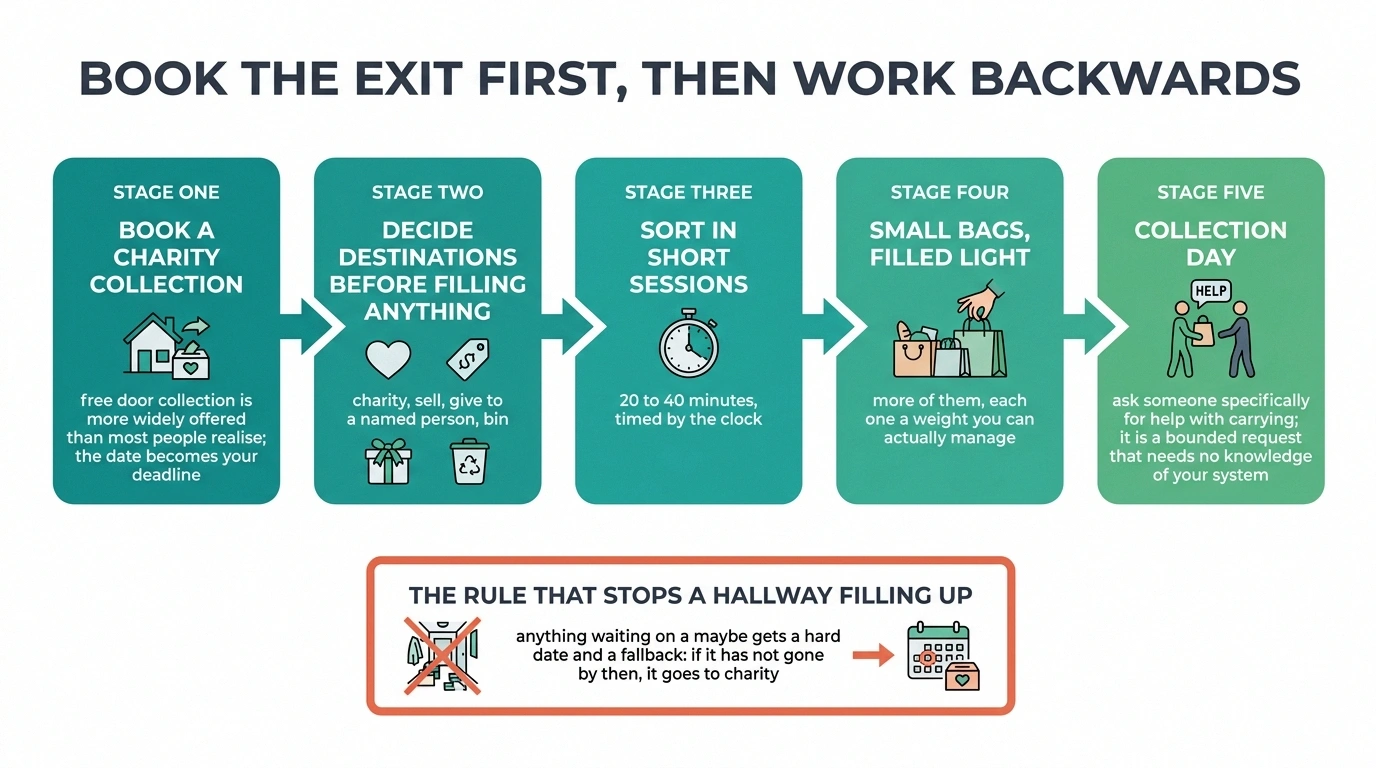
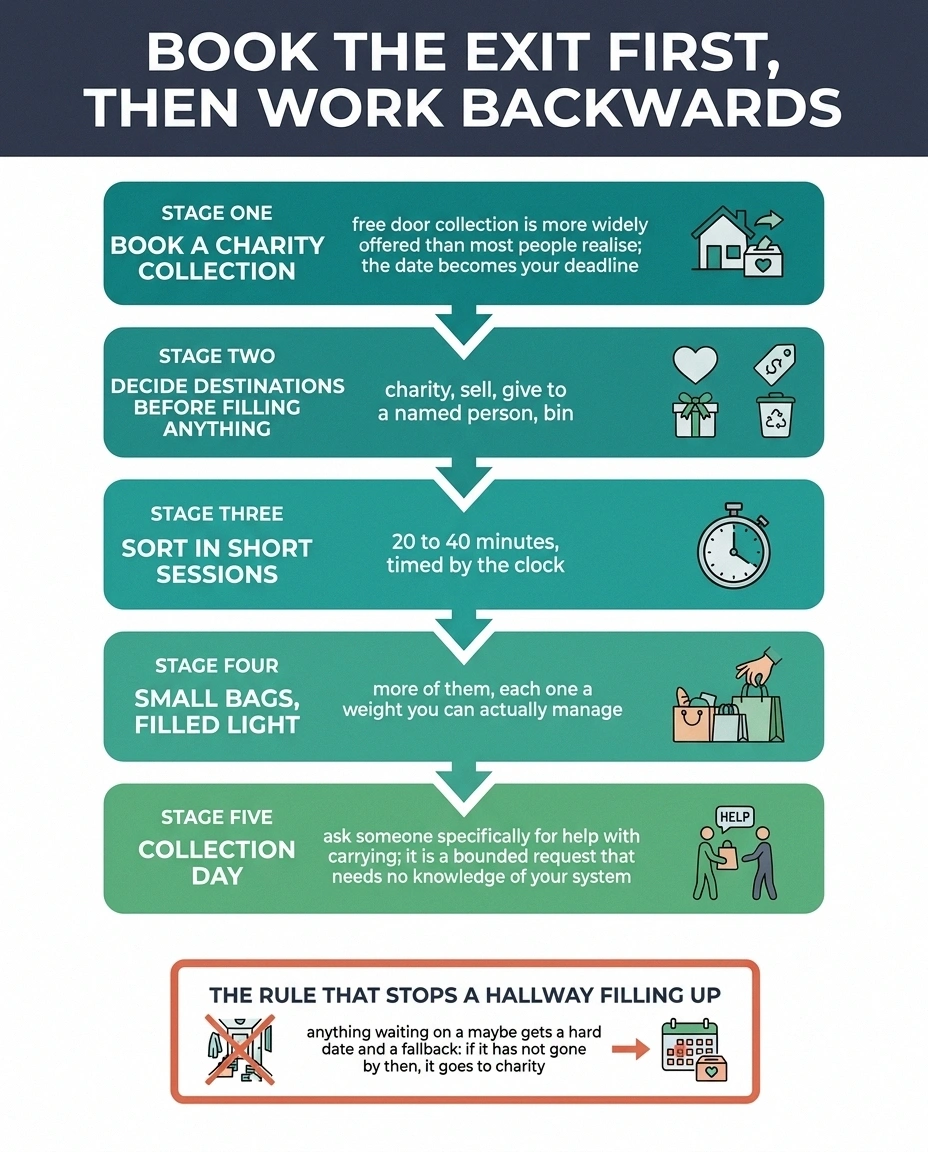
Plenty of decluttering stalls at the last step. The sorting is done, and then eleven bags sit in the hallway for six weeks because getting them anywhere requires energy that never quite appears.
Plan the exit before you start filling bags. It is much easier to decide where things are going while you are still fresh.
Charity collection from your door is the best option available to most people, and it is far more widely offered than most realise. Many organisations will collect furniture and bagged goods free, and some will take a large volume in one visit. Booking that collection first, then working backward from the date, converts a vague intention into a deadline that does the motivating for you.
Ask for help with the carrying specifically. This is the request people find easiest to make and easiest to have granted, because it is bounded and obvious. Nobody has to know your system or make any decisions. They come, they lift, they leave.
Use small bags rather than large ones, filled to a weight you can actually manage, even though it means more of them. Two light trips beat one that you should not have attempted.
For anything being sold or given to a specific person, set a hard date and a fallback. If it has not gone by then, it goes to charity. Items waiting on a maybe are the ones that sit in a hallway for a year.
Keeping It That Way With Less Effort
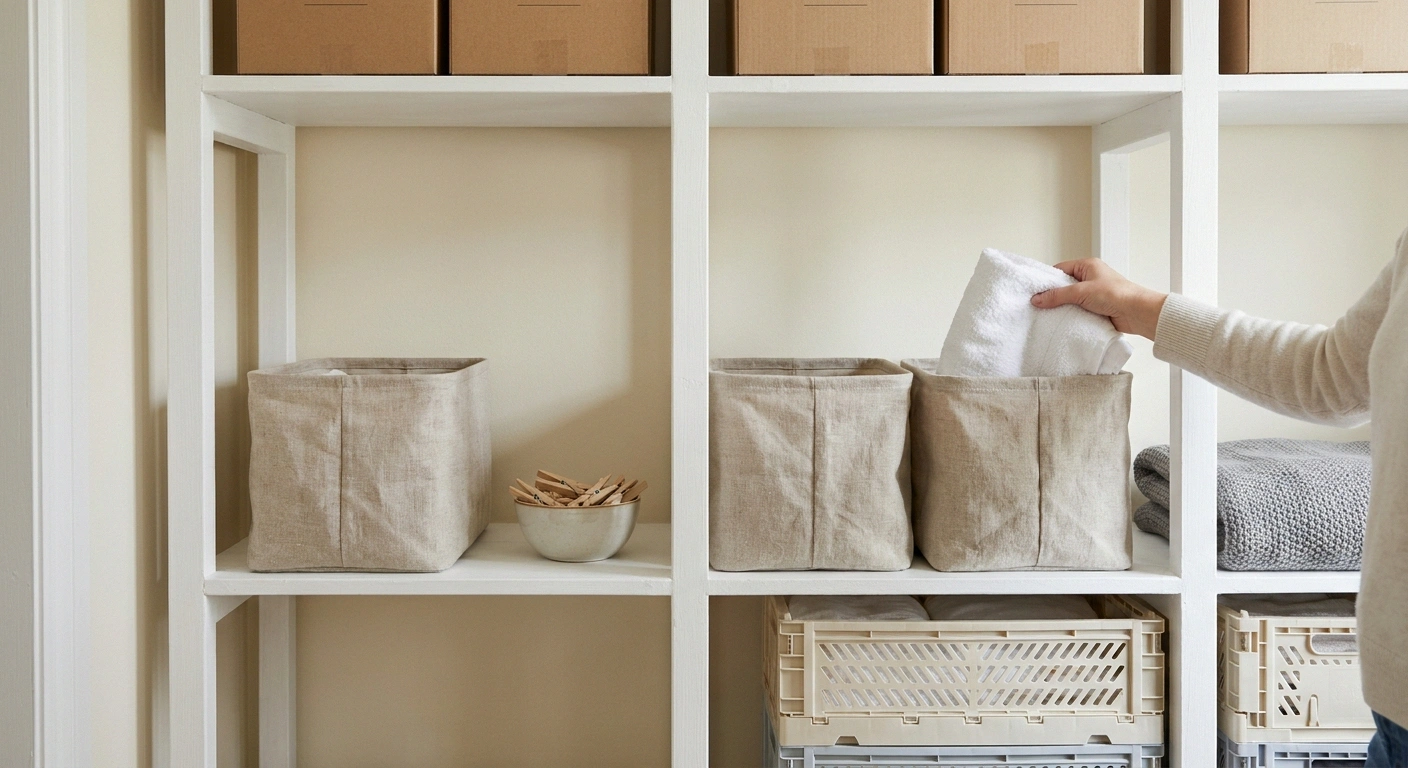
A decluttered room that requires effort to maintain will not stay decluttered, so the way you put things back matters as much as what you removed.
Storage sorted by what retrieval costs you
Organise by how often you need something rather than by what kind of thing it is. Category-based storage looks tidier on a shelf and costs more every single day.
Hip to shoulder
No bending, no reaching, no stool.
Everything used weekly. This band is the most valuable space in the house and is usually wasted on decorative items.
Knee to hip, or above shoulder
One bend or one reach per use.
Monthly items. Keep these lighter, since a reach above shoulder height with a heavy object is where balance goes.
Floor level and top shelf
Expensive to reach, so pay the cost once.
Once-a-year things: decorations, spare bedding, documents. You will fight this shelf one time instead of fifty.
Leave every shelf at roughly two-thirds full. A packed shelf needs precision to put things back into, and precision is exactly what a tired hand does not have after an hour of sorting. Slack is what makes a system survive a bad week.
Store by how much energy retrieval costs, not by category. Things you use weekly belong between hip and shoulder height, where no bending or reaching is involved. Things you use monthly can go higher or lower. Things you use once a year can go wherever is most awkward, because you will only fight that battle once.
Leave gaps. A shelf packed to capacity requires precision to put things back into, and precision is expensive when your hands are unreliable. A shelf at two-thirds capacity accepts things thrown at it, which means things actually get put away.
Reduce the number of steps between using something and returning it. A basket in the room where an item is used will keep that room tidier than a perfect storage system two rooms away. This is not a compromise; it is the design working with you.
Put a small bin or bag in the places clutter accumulates, and empty it when convenient. Catching things where they land beats collecting them later.
Accept a slightly lower standard in exchange for a system you can run on a bad day. A home that stays reasonably clear with a bad-day-proof system is better than one that looks immaculate for three weeks and then collapses. Recovering from that collapse costs more than the tidiness was worth, and the discouragement lands harder than people expect. Living with a chronic condition already takes a steady toll on mood and motivation, and there is no reason to build a system that adds to it.
Bringing In Help Without Losing Control
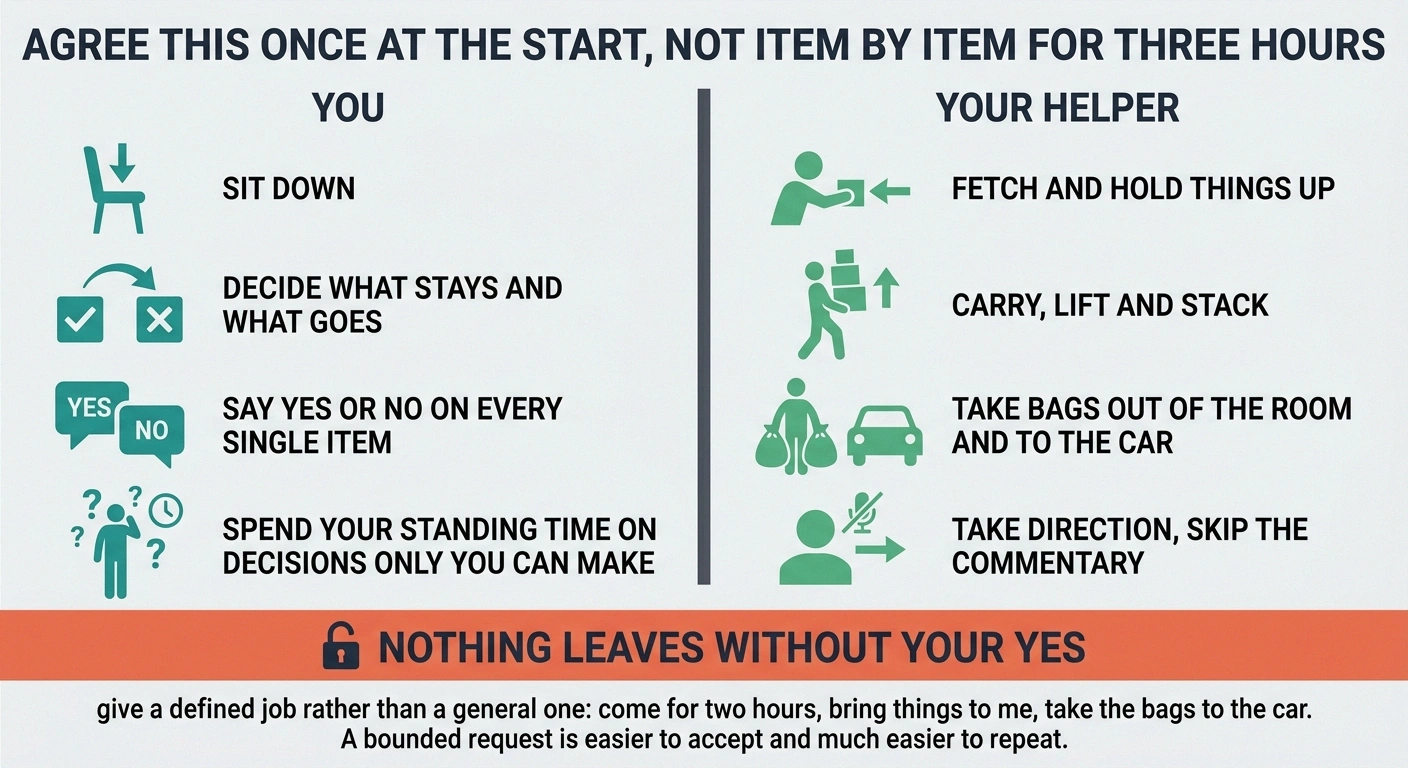
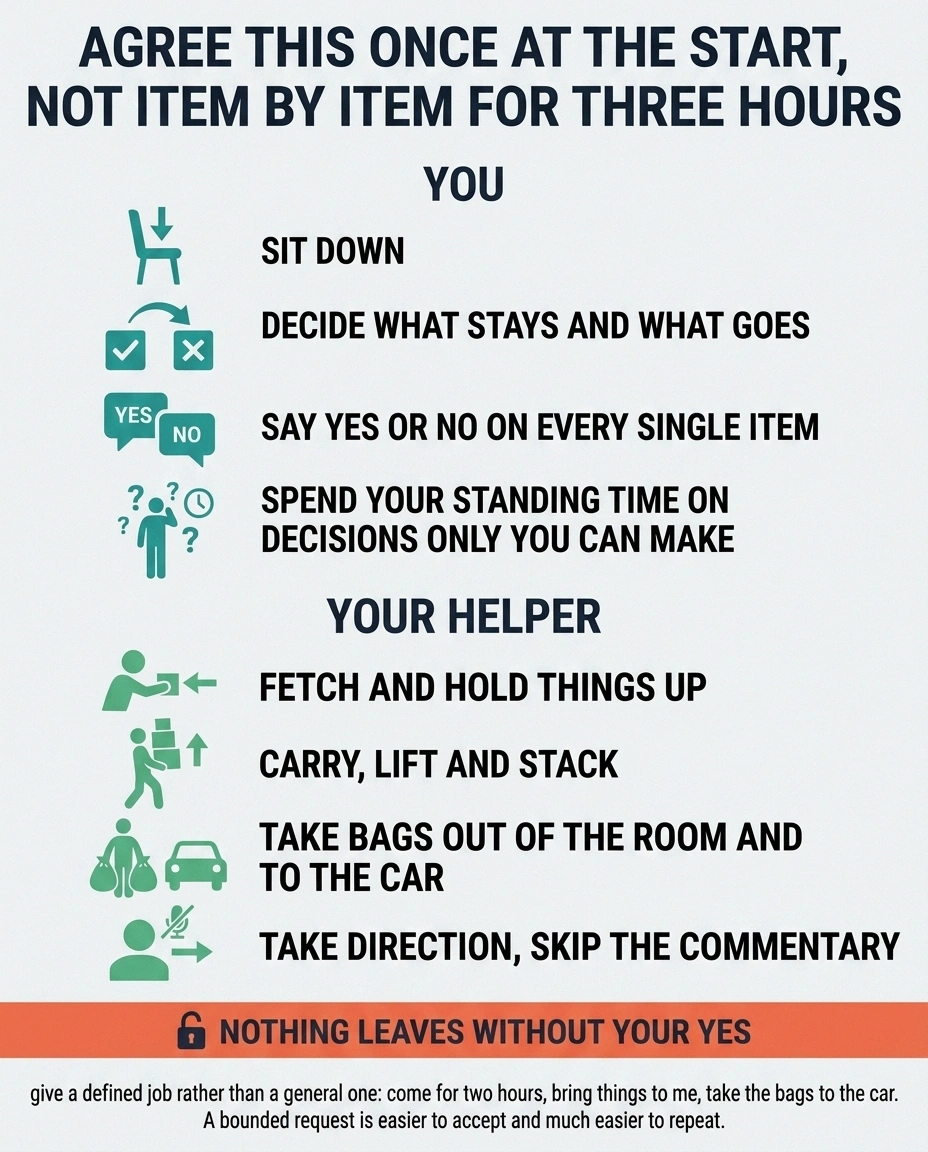
There is a version of this where you do the deciding and someone else does the moving, and it is the most effective arrangement I know of for anyone whose limitation is physical rather than emotional.
The reason people resist it is fear of losing authority over their own belongings, and that fear is reasonable. The way around it is to define the roles explicitly before anyone starts.
You sit. You decide. They fetch, hold up, carry and remove. Nothing leaves without your yes. If you find that hard to say out loud, saying it once at the beginning is far easier than renegotiating it item by item for three hours.
Family and friends work well when they can take direction and skip commentary. It helps to give them the specific job rather than the general one: come for two hours, bring things to me, take the bags to the car. A defined task is easier to accept and much easier to repeat.
Professional organisers exist and some specialise in working with people who have chronic conditions or limited mobility. They are not cheap, and for a large project they are often better value than they appear, because they turn something that would take a year of failed weekends into two or three sessions.
One more thing worth saying, because I have needed to hear it myself. Asking for the lifting is not a concession. It is what lets you spend your limited standing time on the decisions only you can make, instead of on carrying a box to a car. That is a sensible allocation of a finite resource, and treating it as anything else costs you the room you were trying to clear.
Frequently Asked Questions
How long should a decluttering session be with neuropathy?
Twenty to forty minutes suits most people, timed by the clock and stopped when the timer goes, even mid-task. The fatigue from this kind of work is delayed, so feeling fine at forty minutes is not evidence you can safely continue. Three short sessions in a week clear more than one long one followed by days of recovery.
How do I declutter if I cannot stand for long?
Bring the objects to a chair instead of standing at the cupboard. Put a chair beside the shelf or drawer, carry one armful or one drawer at a time to it, sort in your lap or on a small table, then deal with the piles. Standing still is harder on neuropathic feet than walking, so removing it removes the largest drain on the session.
Is decluttering actually risky with neuropathy?
The middle of a session carries real fall risk, because you have introduced bags, piles and boxes onto floors you navigate partly from memory with feet that under-report obstacles. Keeping one clear path to the door, putting piles on furniture rather than the ground, removing discards as you go and lighting the area brightly addresses most of it.
What helps when my hands are numb and I keep dropping things?
Look at what you are holding rather than relying on feel, especially for anything heavy, sharp or breakable. Thin work gloves add friction so a weaker grip holds better and protect against cuts you might not notice. Empty boxes rather than carrying them full, and handle heavy items with two hands over a surface rather than over the floor.
How do I reach things on the floor without bending?
A grabber tool handles clothing, paper and anything light, and removes dozens of bends from a session for very little money. For anything it cannot manage, sit down beside the low shelf and work from the chair rather than crouching.
Should I wear shoes while decluttering at home?
Yes, closed-toe shoes with a proper sole rather than slippers or socks. You are handling objects that can fall, on a floor that has changed since the morning, with feet that may not report an impact. Look your feet over once you finish too, since a stubbed toe or small cut may not announce itself.
How do I get bags out of the house if I cannot carry much?
Book a charity collection from your door before you start sorting, which is more widely offered than most people realise and also gives you a deadline. Use more small bags rather than fewer heavy ones. Ask someone specifically for help with carrying, since it is a bounded request that requires no knowledge of your system.
How do I stop it filling up again?
Store by retrieval cost rather than by category: weekly items between hip and shoulder height, yearly items wherever is most awkward. Leave shelves at about two-thirds capacity so putting things back needs no precision. Keep a basket in the room where an item is actually used rather than a perfect system two rooms away.
About the Author