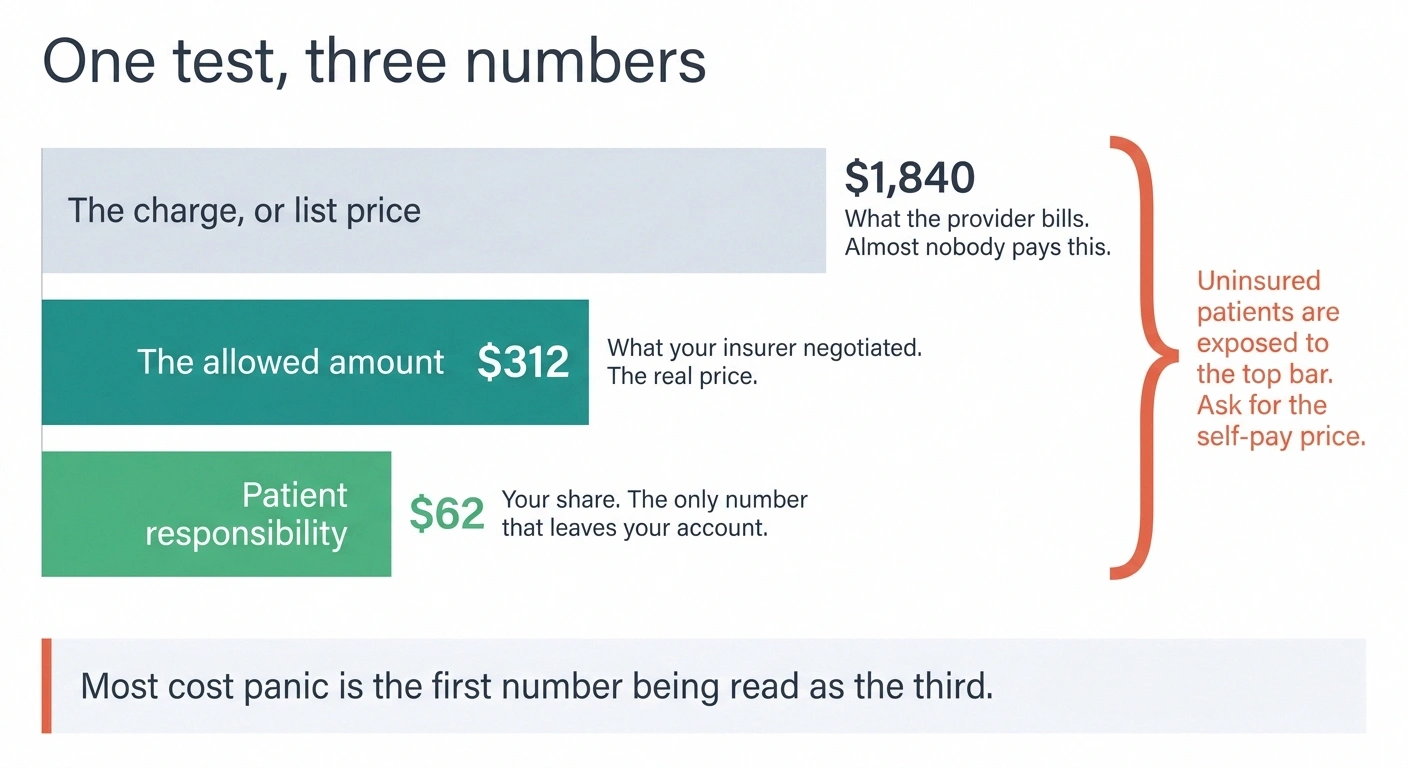
An explanation-of-benefits statement arrives three weeks after a nerve conduction study. The line item reads $1,840. Further down, the allowed amount reads $312. Further down still, patient responsibility reads $62.
Three numbers, one test. Almost every panicked question about neuropathy costs traces back to reading the first number as though it were the third.
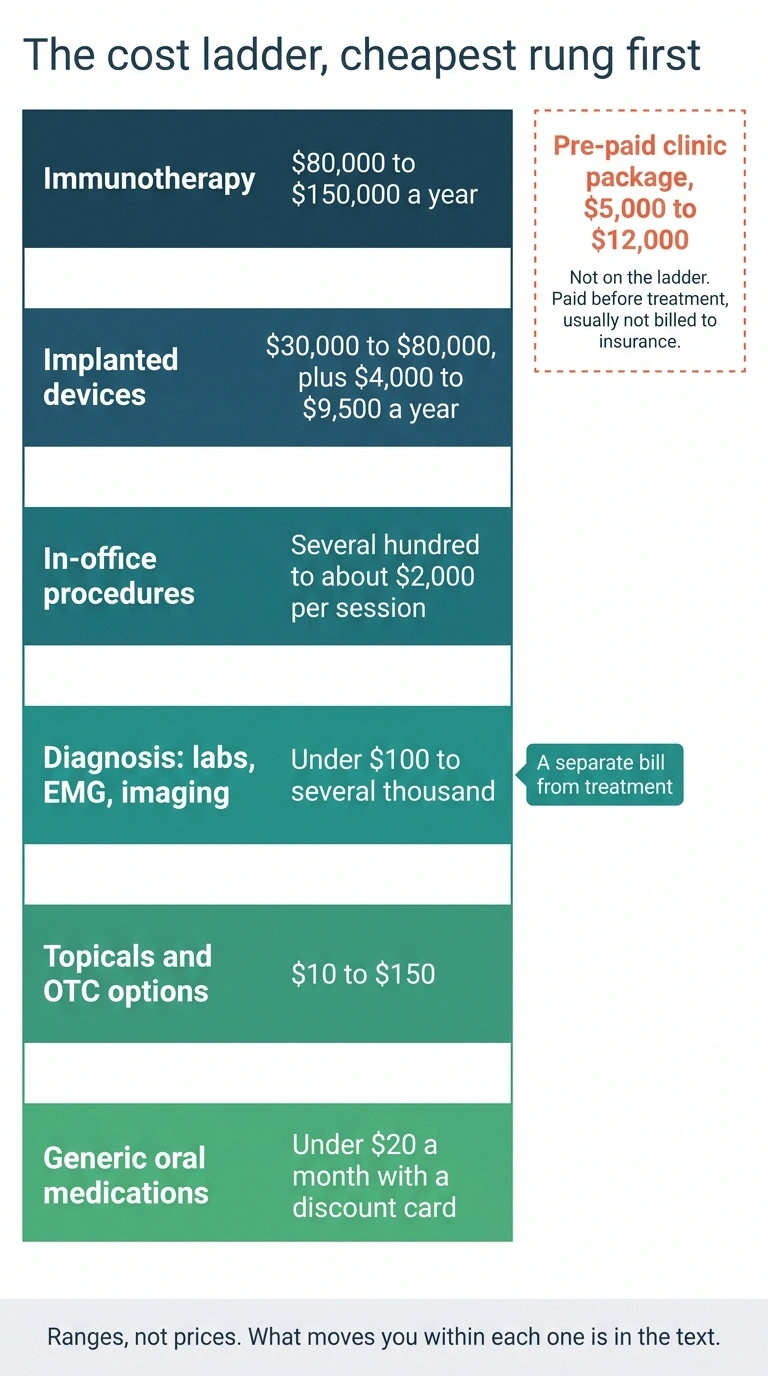
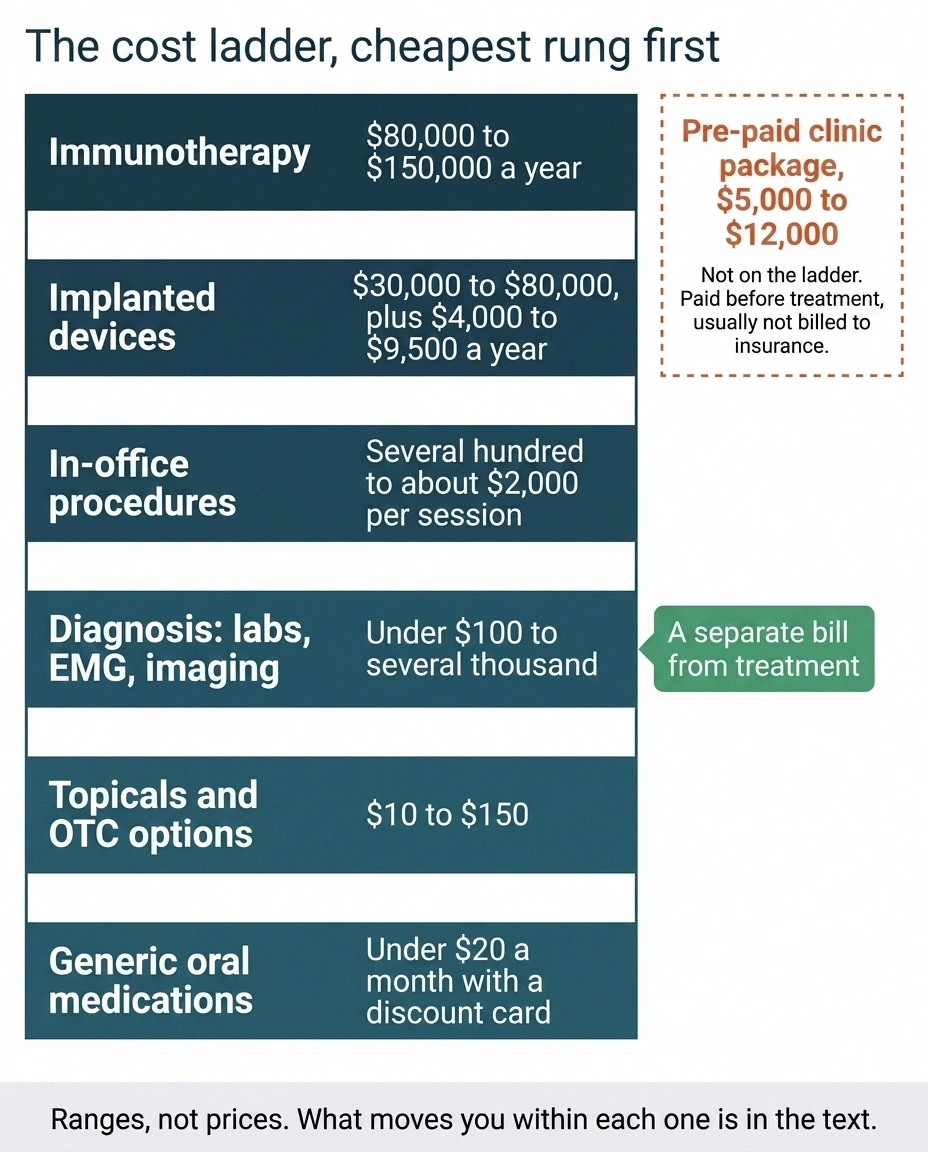
This page prices the whole ladder, from a $4 prescription to a $136,000 infusion year, in the order you would actually encounter it. Everything here is a range, and every range comes with the reason it is wide, because a range without that explanation tells you nothing you can plan around.
The Three Numbers on Every Medical Bill
Before any figure below means anything, this distinction has to be clear.
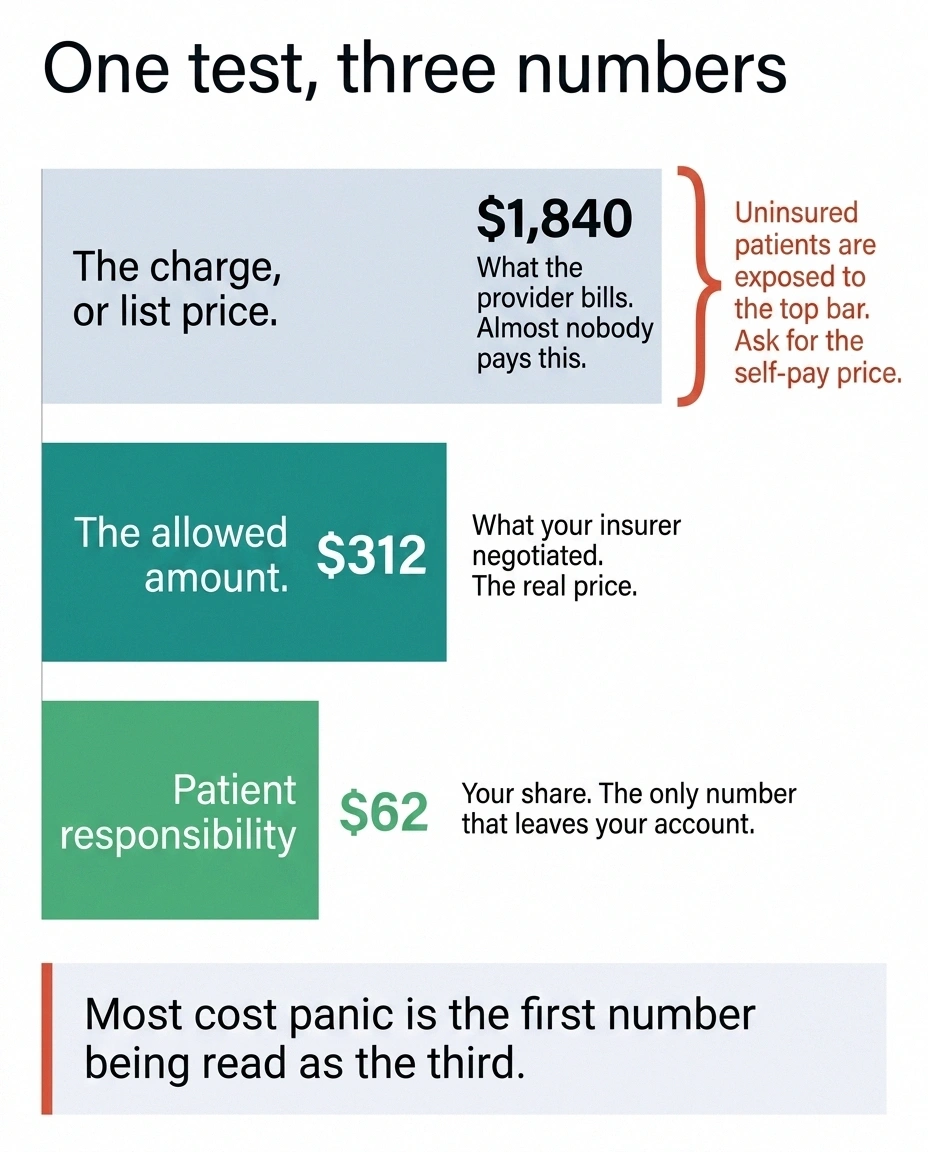
The charge, or list price. What the provider bills. It is set high, it is largely fictional, and essentially nobody with insurance pays it. It exists because negotiations start somewhere.
The allowed amount. What your insurer has negotiated as the real price for that service. Typically a fraction of the charge, sometimes a small one.
Patient responsibility. Your share of the allowed amount, determined by your deductible, coinsurance and copay. This is the only number that leaves your account.
Two consequences follow. If you are uninsured, you are exposed to the charge rather than the allowed amount, which is why asking for the self-pay or cash price before a service is one of the highest-value questions in medicine, and why it frequently produces a lower number than the insurance rate. And if you have not met your deductible, you pay the full allowed amount, which is why the same test costs one person $62 in November and another person $312 in January.
Rung One: Generic Oral Medications
The cheapest rung, and the one nearly everyone starts on.
Price-checking a prescription, start to finish
The same generic can differ fourfold between two pharmacies in the same town. This takes about five minutes and is worth repeating annually, since prices and formularies both move.
- Run the drug, dose and quantity through a discount-card site to get a baseline cash price and a list of local pharmacies with their individual prices.
- Search your plan’s formulary document for the drug name and note its tier. Insurers publish these as searchable files.
- Compare the tier copay against the discount cash price. For cheap generics the cash price frequently wins, and you can pay that way even while insured.
- Ask whether a 90-day supply is cheaper per month than three 30-day fills. It usually is, and mail-order is often cheaper again.
- If your drug sits on a high tier, ask the prescriber whether a tier 1 alternative exists in the same class. This is the step that saves the most and takes the least time.
One caution on discount cards: purchases made with one usually do not count toward your insurance deductible. If you are heading toward your out-of-pocket maximum this year anyway, running everything through insurance may be the better arithmetic.
Gabapentin, duloxetine, amitriptyline, nortriptyline and generic pregabalin are all available as generics, and at most pharmacies a month’s supply of any of them lands in the single-digit to low-double-digit dollars with a discount card. Exact prices move constantly and vary by pharmacy within the same town, sometimes by a factor of four, so the useful habit is to price-check rather than to memorize a number.
Three things drive the cost of this rung above what it should be.
Brand versus generic. Brand Lyrica and brand Cymbalta cost many multiples of their generics with no clinical advantage for most people. If either name appears on your bottle, that is a question for the prescriber.
Formulary tier. For an insured patient, tier placement matters more than the drug’s cash price. A tier 1 generic might cost $4 while a tier 3 drug on the same plan costs $75, and the two drugs may be equally cheap to produce. Your plan’s formulary is public and searchable.
Paying the copay when cash is cheaper. For very cheap generics the discount-card cash price is often below the insurance copay. Pharmacies are permitted to tell you this now, but you still have to ask.
Our page on affording neuropathy medications covers manufacturer assistance programs and the paperwork each one requires.
Rung Two: Topicals and Over-the-Counter Options
Still inexpensive, with a wide spread.
Over-the-counter lidocaine 4% patches run roughly $10 to $30 a box. Prescription lidocaine 5% patches are considerably more and are frequently denied without prior authorization. Over-the-counter capsaicin creams sit in the $10 to $25 range.
Compounded creams from a compounding pharmacy are the outlier on this rung, commonly $50 to $150 a jar and often not covered, because compounded formulations generally lack the trial evidence insurers require. The evidence picture is covered in our page on compounded pain creams, and the short version is that the price is real and the support for it is thinner than the marketing suggests.
A TENS unit is a one-time purchase, typically $25 to $80 for a home device, with replacement pads adding roughly $10 to $20 every month or two. Supplements are the quiet budget line that nobody counts: at $20 to $60 a bottle, a shelf of six is $150 a month, spent without a decision ever being consciously made.
Rung Three: Diagnosis, Which Is a Separate Bill
Worth separating out, because people blame treatment for costs that came from finding out what they had.
What a straightforward first year adds up to
An illustrative insured case: diabetic neuropathy, diagnosed and managed on a generic, no procedures. Not a quote, and your plan’s deductible will move every line.
| Line | When | Typical patient share |
|---|---|---|
| Primary care and neurology visits | Year one | Copay per visit, three to five visits |
| Blood panel | Once, at diagnosis | Often fully covered |
| EMG with nerve conduction study | Once, at diagnosis | Deductible-dependent; the largest single line |
| Generic medication | Every month | Low double digits per month |
| Protective footwear | Once or twice | Varies; may be a covered benefit |
| Year two onward | Ongoing | Substantially lower, with diagnosis behind you |
The shape matters more than any figure. Year one is front-loaded by diagnosis, which is why people who judge lifetime cost from their first twelve months consistently overestimate it.
Blood work. A basic neuropathy panel is inexpensive, often under $100 through a lab-direct service and frequently covered outright. Our page on the lab tests worth requesting lists them.
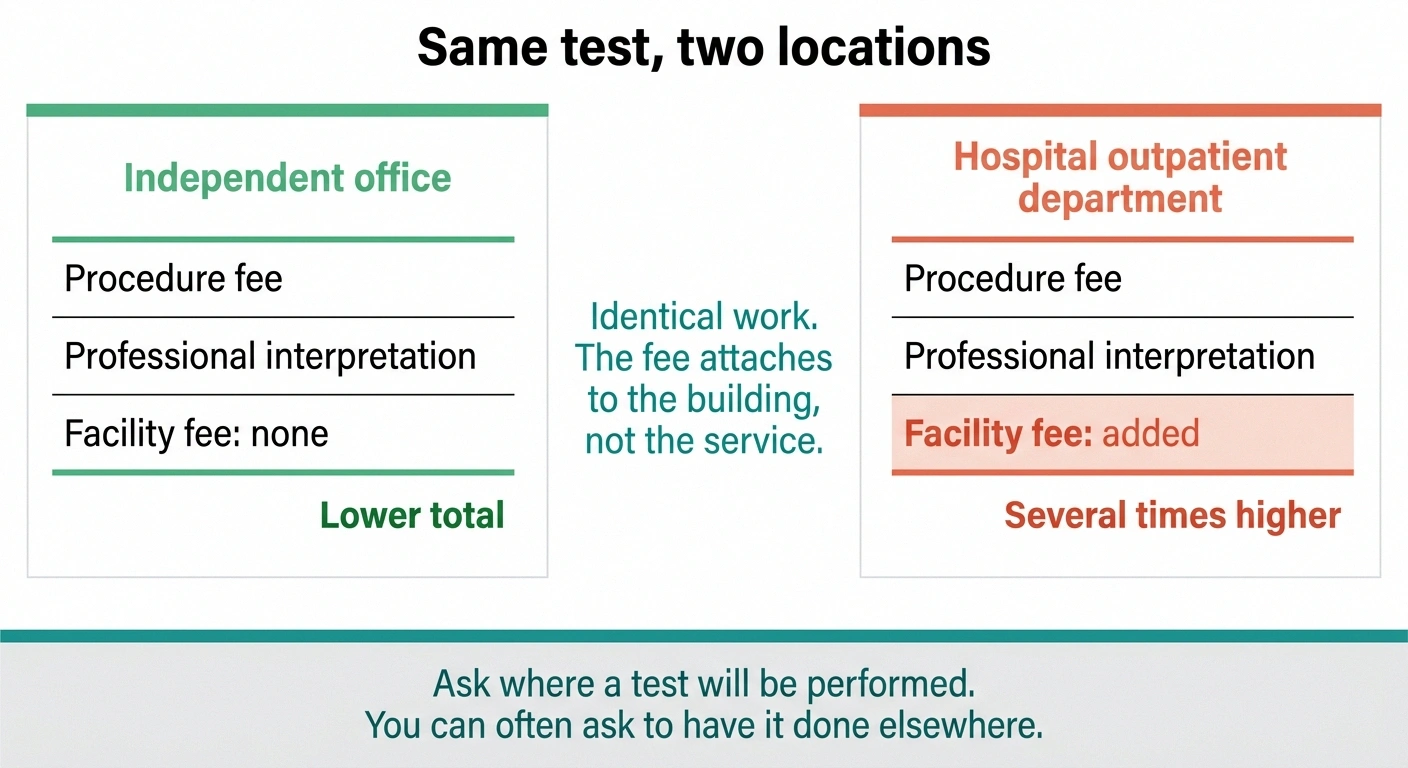
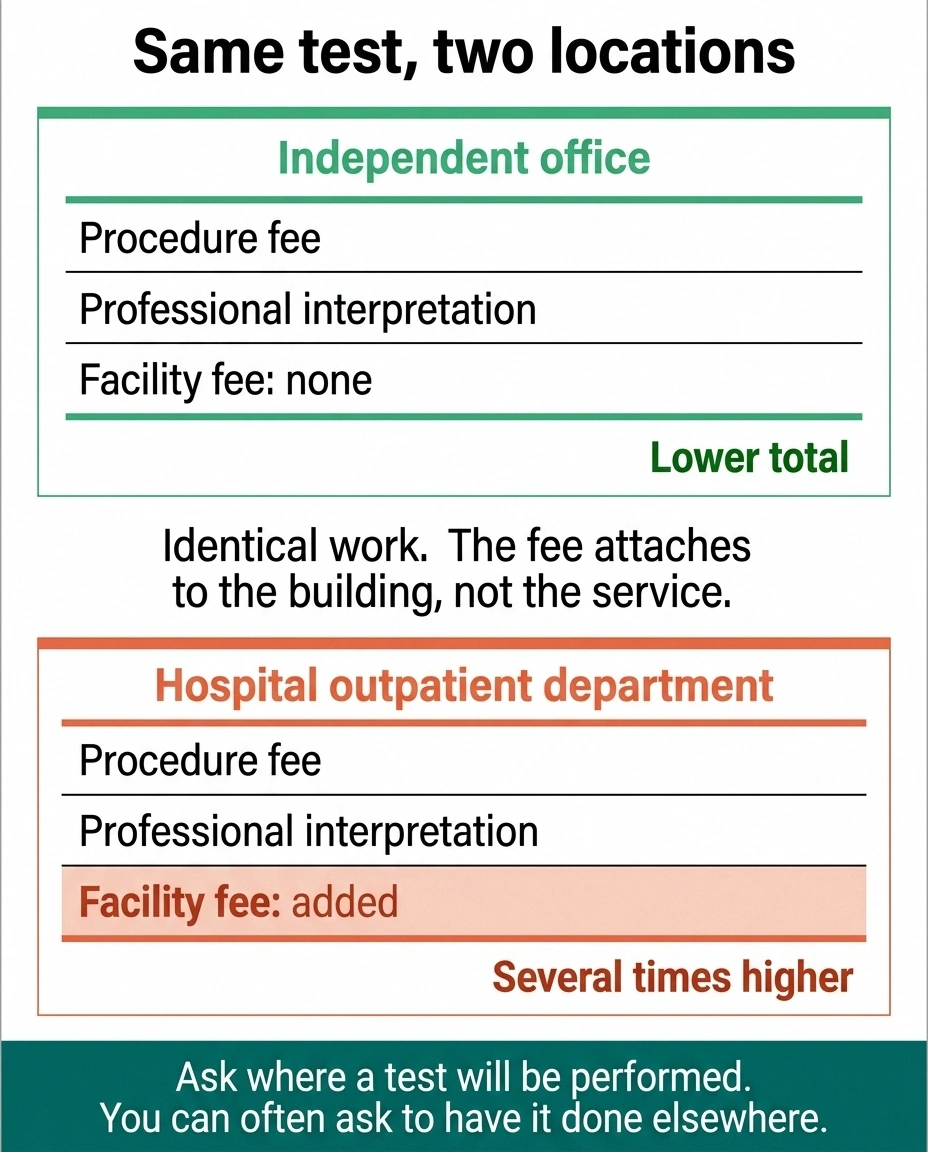
EMG and nerve conduction study. A standalone nerve conduction study runs roughly $150 to over $500 per limb, and a combined EMG with nerve conduction study commonly lands around $400 to $500 at cash price. The same study billed through a hospital outpatient department rather than a neurologist’s office can cost several times that for identical work, because facility fees attach to the location rather than the service. Asking where a test will be performed is a legitimate cost question. Our explainer on what an EMG and nerve conduction study involves covers the procedure itself.
Skin biopsy for small fiber neuropathy. Harder to price honestly, and rather than invent a figure it is worth explaining why. The reference laboratories supply the collection kits at no charge, so the cost is the procedure fee plus the laboratory’s professional interpretation, and those arrive as separate line items from separate entities. Ask for both estimates, not one.
Imaging. An MRI to rule out a structural cause ranges from a few hundred dollars at a standalone imaging center to several thousand at a hospital. The gap for the same scan is one of the largest in this entire article.
Rung Four: In-Office Procedures
Costs climb sharply here, and the billing structure changes with them.
Qutenza, the capsaicin 8% patch, illustrates the pattern well. Retail pricing for a single-patch kit sits around $940 to $1,030, and two-patch pricing has been listed near $1,967. But it is applied in a clinical setting under supervision, so it is usually billed under a J-code as a medical benefit rather than run through your pharmacy benefit. That changes which deductible applies, which coinsurance applies, and whether prior authorization is required. The retail sticker is frequently not the number you encounter at all.
Nerve blocks and injections generally run a few hundred to roughly two thousand dollars per session depending on the block and the setting, and they are typically repeated.
Physical therapy is billed per visit, commonly $75 to $200 self-pay, with insured plans often capping annual visits. A prescribed course of eight to twelve visits is the standard shape of that bill.
Rung Five: Implanted Devices
Spinal cord stimulation is the largest one-time expense most neuropathy patients will consider, and the published figures are genuinely startling: $30,000 to $80,000 in the United States depending on treatment phase, device type and coverage, with ongoing maintenance running $4,000 to $9,500 per year. For uninsured patients, typical out-of-pocket costs are reported at $15,000 to $50,000 or more.
Before the trial period, get these four answers in writing
The trial is deliberately the checkpoint before the largest expense. It only functions as one if you know these before it starts.
What does the trial itself cost me, separately from the implant?
It is billed on its own, and a meaningful share of trials do not proceed. You need that number in isolation.
What counts as a successful trial here?
There is a conventional threshold expressed as a percentage of pain reduction. Ask what this practice uses and who decides.
What is the annual running cost after implant?
Programming visits, battery replacement and eventual revision surgery are recurring lines, not hypotheticals.
Where will the implant be performed?
Hospital versus ambulatory surgery center changes the facility component, which on a procedure this size is not a rounding error.
One more worth confirming: whether you will have met your annual out-of-pocket maximum by the time the implant is scheduled. A procedure in early January and the same procedure in late November can carry entirely different personal costs.
Four things move you within that range.
The trial period and the permanent implant are billed separately, and roughly a quarter to a third of trials do not proceed to implant. Device generation matters, since rechargeable and closed-loop systems cost more than older units. Facility setting produces the usual hospital-versus-surgery-center gap. And the maintenance line is the one most often missed at the decision point, because battery replacement surgery, programming visits and eventual revision are real recurring costs rather than hypotheticals.
For an insured patient who has met their out-of-pocket maximum, a $60,000 procedure and a $30,000 procedure cost the same amount. That is the single most important thing to establish before comparing quotes.
Rung Six: Immunotherapy

The top of the ladder, and it applies to a specific minority: people with immune-mediated neuropathies such as CIDP rather than the far more common diabetic or idiopathic forms.
Intravenous immunoglobulin is priced at roughly $80,000 to $150,000 per year when the full cost of the product, the infusion visits and the monitoring are counted together. One published analysis put the cost for an average CIDP patient in the United States above $136,000 per year.
Two notes keep this in proportion. First, almost nobody pays that personally; it is an insurance-negotiation number, and out-of-pocket maximums cap individual exposure, though the prior-authorization burden is heavy and denials are common. Second, home-based subcutaneous immunoglobulin has changed the picture for some patients by removing infusion-center facility fees.
The Rung That Is Not on the Ladder
The pre-paid cash package deserves its own section because it does not sit anywhere on the ladder above. It is the largest avoidable financial risk in this category.
The shape is consistent. A clinic advertises a neuropathy program, offers a free screening, and presents a package priced somewhere between $5,000 and $12,000, payable up front or through third-party medical financing, and not billed to insurance. The contents vary and typically combine devices, supplements, and a schedule of visits.
Two structural features make this different from every other line on this page. The money is paid before any of the treatment happens, which removes the natural checkpoint where you stop paying for something that is not working. And the reason it is not billed to insurance is usually that it would not be covered, which is itself a statement about the evidence behind it.
Before signing anything, ask which individual components would be covered if they were billed to insurance separately, ask what happens to unused visits if you stop, and ask for the refund terms in writing. A practice confident in its treatment will answer all three without friction.
What Coverage Usually Looks Like
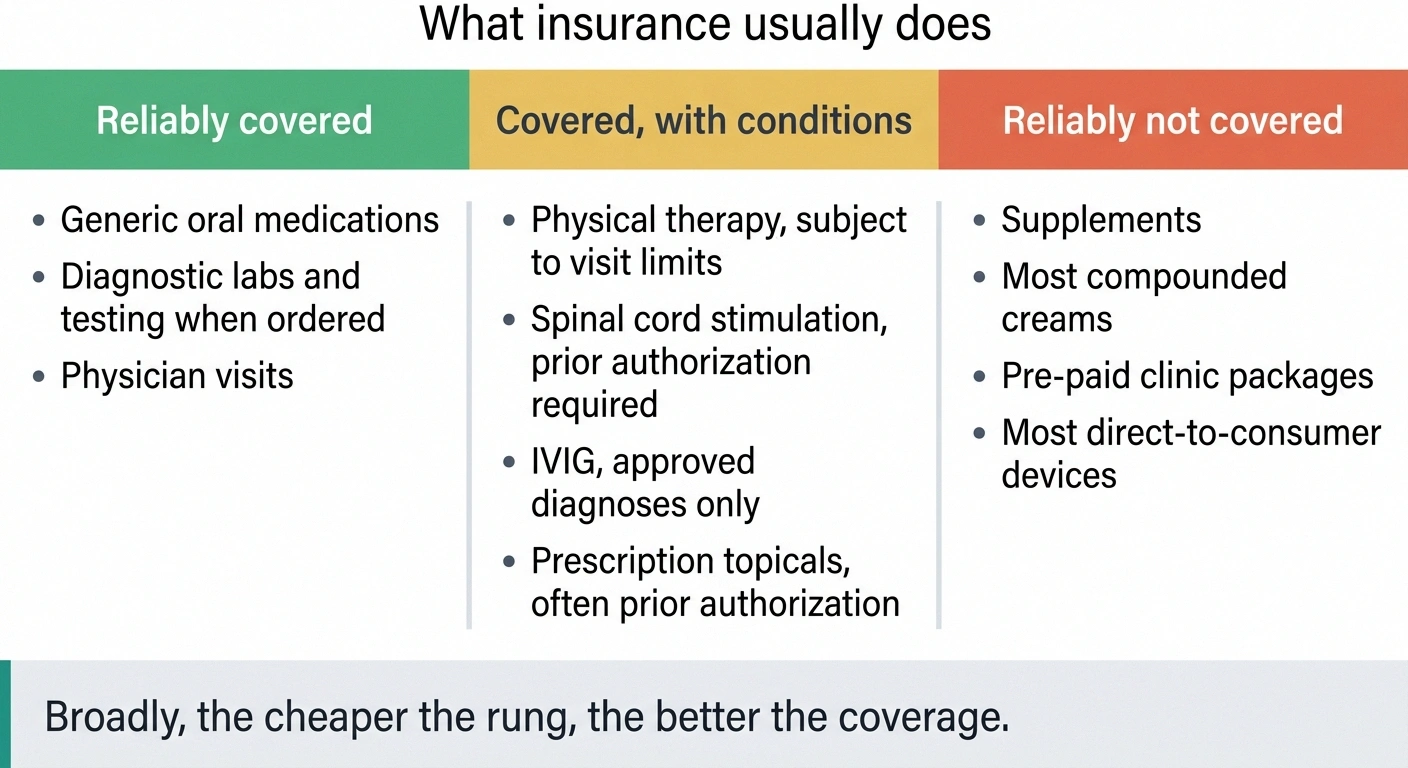
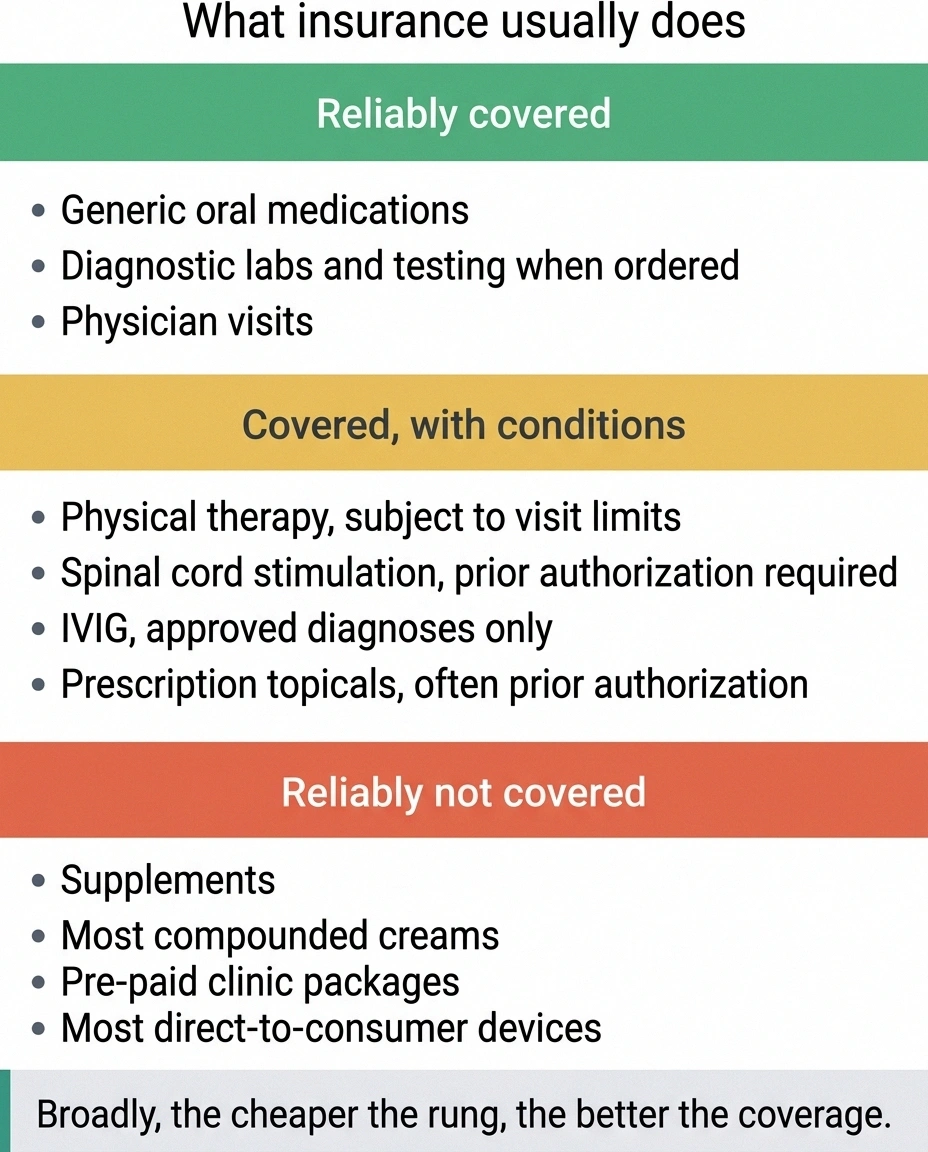
Broadly, the further down the ladder you go, the better covered it is. Generic oral medications are near-universally covered, diagnostic testing is well covered when ordered by a physician for a documented indication, physical therapy is covered with visit limits, spinal cord stimulation is covered with prior authorization and documented failure of conservative treatment, and IVIG is covered for approved diagnoses with substantial paperwork.
Five words that appear when something is denied
A denial is frequently a paperwork state rather than a final answer, and knowing what each term means tells you which lever applies.
- Prior authorization
- Approval required before the service. A denial here often means a form was incomplete rather than that the treatment was rejected. The prescriber’s office submits it.
- Step therapy
- You must try and fail a cheaper option first. If you already tried it years ago under a different insurer, that history counts, but only if it is documented and submitted.
- Letter of medical necessity
- A written argument from your clinician explaining why this specific treatment is required for you. The most effective single document in an appeal, and it has to be asked for.
- Peer-to-peer review
- Your clinician speaks directly to a physician at the insurer. Frequently overturns a denial and is frequently not attempted unless requested.
- External review
- An independent body outside the insurer reviews the decision, available after internal appeals are exhausted. There is a filing deadline, so note the date on the denial letter the day it arrives.
The reliably uncovered items are supplements, most compounded creams, cash-pay clinic packages, and most devices marketed directly to consumers.
Medicare has its own structure and its own specific gaps, and rather than compress that here it is covered properly in our Medicare and neuropathy coverage guide. If cost has reached the point of affecting work or independence, disability benefits for neuropathy and, for veterans, VA disability ratings are separate tracks worth understanding early rather than late.
Five Questions That Actually Lower a Bill

Each of these has changed a number for someone.
“What is the cash or self-pay price?” Ask before the service, every time, even with insurance. For imaging and lab work especially, this number is sometimes lower than the insured rate.
“Where will this be performed, and is there a facility fee?” The identical test at an independent office versus a hospital outpatient department can differ several-fold. You can often ask to have it done elsewhere.
“Is there a tier 1 alternative on my formulary?” Directed at the prescriber, with the formulary open. This one takes ninety seconds and frequently saves more than any other question here.
“Will this be billed as a pharmacy benefit or a medical benefit?” For in-office drugs such as Qutenza and infusions, the answer determines which deductible applies and can move your share by thousands.
“Have I met my out-of-pocket maximum this year?” If yes, expensive covered care costs you nothing further, and elective procedures scheduled for January instead of December can be an expensive accident of timing.
Frequently Asked Questions
How much does neuropathy treatment cost per year?
For most people it is far less than the frightening numbers suggest. Someone managed on a generic oral medication with periodic follow-up visits often spends a few hundred dollars a year, with the first year higher because diagnostic testing lands in it. Costs escalate only for the minority who progress to implanted devices or immunotherapy, and even then insured out-of-pocket exposure is capped by the plan’s annual maximum rather than by the procedure’s price.
Why do neuropathy clinics charge so much?
Pre-paid packages priced between $5,000 and $12,000 are generally not billed to insurance, and the usual reason a service is not billed to insurance is that it would not be covered. Package pricing also collects payment before treatment begins, which removes the point at which you would otherwise stop paying for something that is not helping. Asking which specific components would be covered if billed individually is a clarifying question.
Does insurance cover an EMG for neuropathy?
Generally yes, when a physician orders it for documented symptoms, though it is subject to your deductible and coinsurance like any other service. The larger variable is not coverage but location, since the same study performed in a hospital outpatient department rather than a neurologist’s office carries a facility fee that can multiply the total for identical work.
What is the cheapest effective treatment for neuropathy?
Generic oral medications are by a wide margin the least expensive option with real trial evidence behind them, typically under $20 a month with a discount card. Correcting an underlying cause is cheaper still in the long run, since a B12 deficiency corrected with an inexpensive supplement or blood sugar brought into range through diet and exercise addresses the mechanism rather than the pain signal.
Is a spinal cord stimulator worth the cost?
That is a decision about your own situation rather than a general fact, but two financial points help frame it. The trial period is billed separately from the permanent implant and gives you a genuine test before the largest expense commits, and ongoing maintenance at $4,000 to $9,500 a year is a real recurring line that is easy to overlook when comparing one-time quotes. For an insured patient who has already met their out-of-pocket maximum, the headline device price may not reach them at all.
Why did I get three separate bills for one test?
Because three separate entities were involved and each bills independently. A skin biopsy generates a procedure fee from the clinic and an interpretation fee from the pathology laboratory; imaging generates a facility fee and a radiologist’s reading fee. This is normal rather than an error, but it does mean a single quoted price often covers only one component, so it is worth asking whether an estimate includes everything.
Can I negotiate a medical bill for neuropathy care?
Frequently yes, particularly if you are uninsured and were billed at the charge rather than an allowed amount. Requesting an itemized bill, asking for the self-pay rate to be applied retroactively, and asking about financial assistance or hardship policies are all standard and are all more effective before the account goes to collections than after.
Are supplements a cost-effective part of neuropathy treatment?
They are the least visible line in most people’s budgets and rarely the best value, since six bottles at $20 to $60 each adds up to well over a thousand dollars a year spent without a single deliberate decision. The exception is correcting a documented deficiency, where an inexpensive supplement addresses an actual mechanism. Testing first turns a recurring guess into a targeted purchase.
About the Author