
Two documents, one veteran, and they appear to contradict each other.
The first is the VA’s own presumptive conditions list, which names peripheral neuropathy outright. The second is the denial letter, which says the claim does not meet the requirements for presumptive service connection.
Both are correct. The gap between them is a single clause that most veterans never see until it has already cost them a claim, and it sits in parentheses next to the condition’s name.
This article is about that clause, what it disqualifies, and the route around it that a large share of Vietnam-era veterans qualify for without knowing it exists.
The Clause That Decides Most of These Claims
On the VA’s Agent Orange eligibility page, the entry does not read “peripheral neuropathy.” It reads peripheral neuropathy (early onset), and it carries a qualifier attached to almost nothing else on the list:
Which Agent Orange conditions run against a clock
Three conditions carry a manifestation deadline. The rest of the list does not.
| Condition | Timing requirement |
|---|---|
| Peripheral neuropathy (early onset) | 10% disabling within 1 year |
| Chloracne | 10% disabling within 1 year |
| Porphyria cutanea tarda | 10% disabling within 1 year |
| Type 2 diabetes mellitus | None |
| Hypothyroidism | None |
| Ischemic heart disease, Parkinson’s disease, several cancers | None |
The green rows are why the secondary route exists. A condition with no clock can anchor a claim that a condition with a clock cannot.
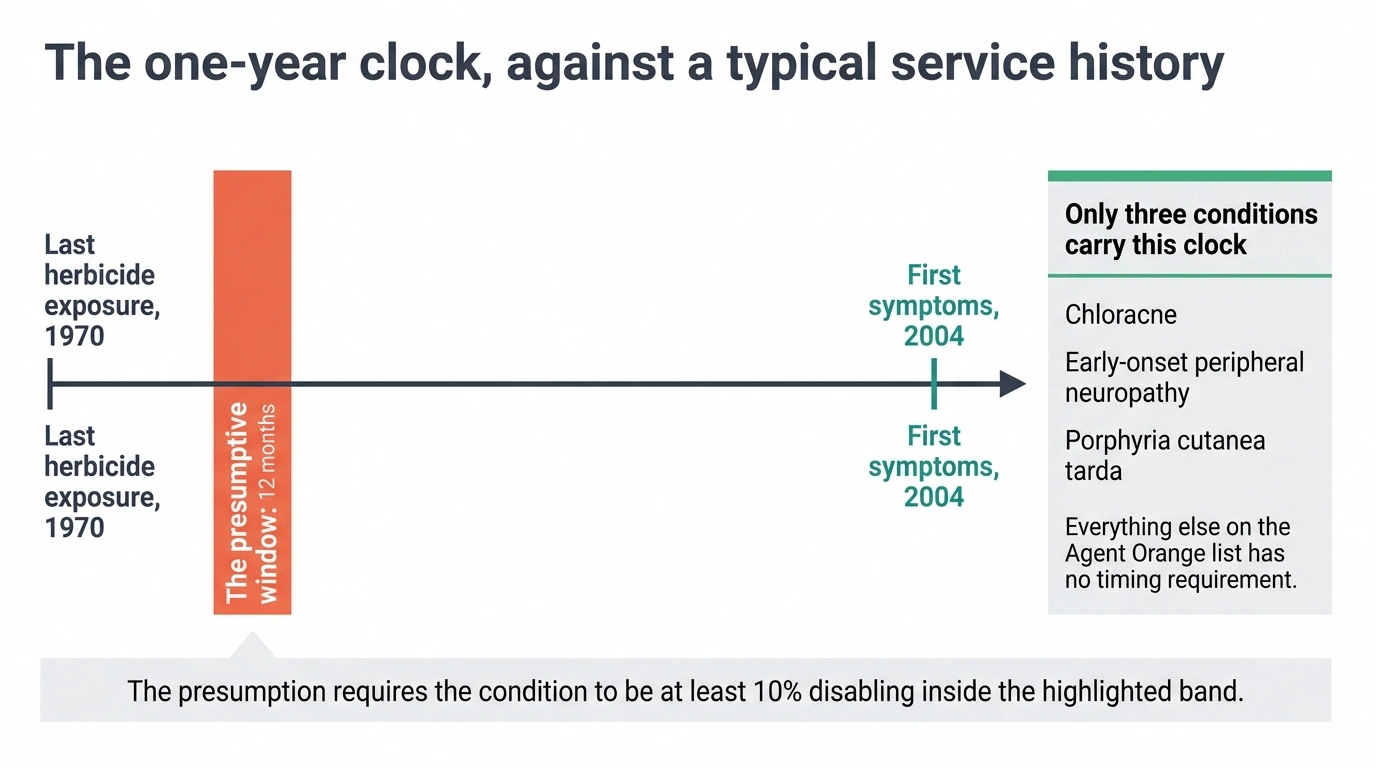
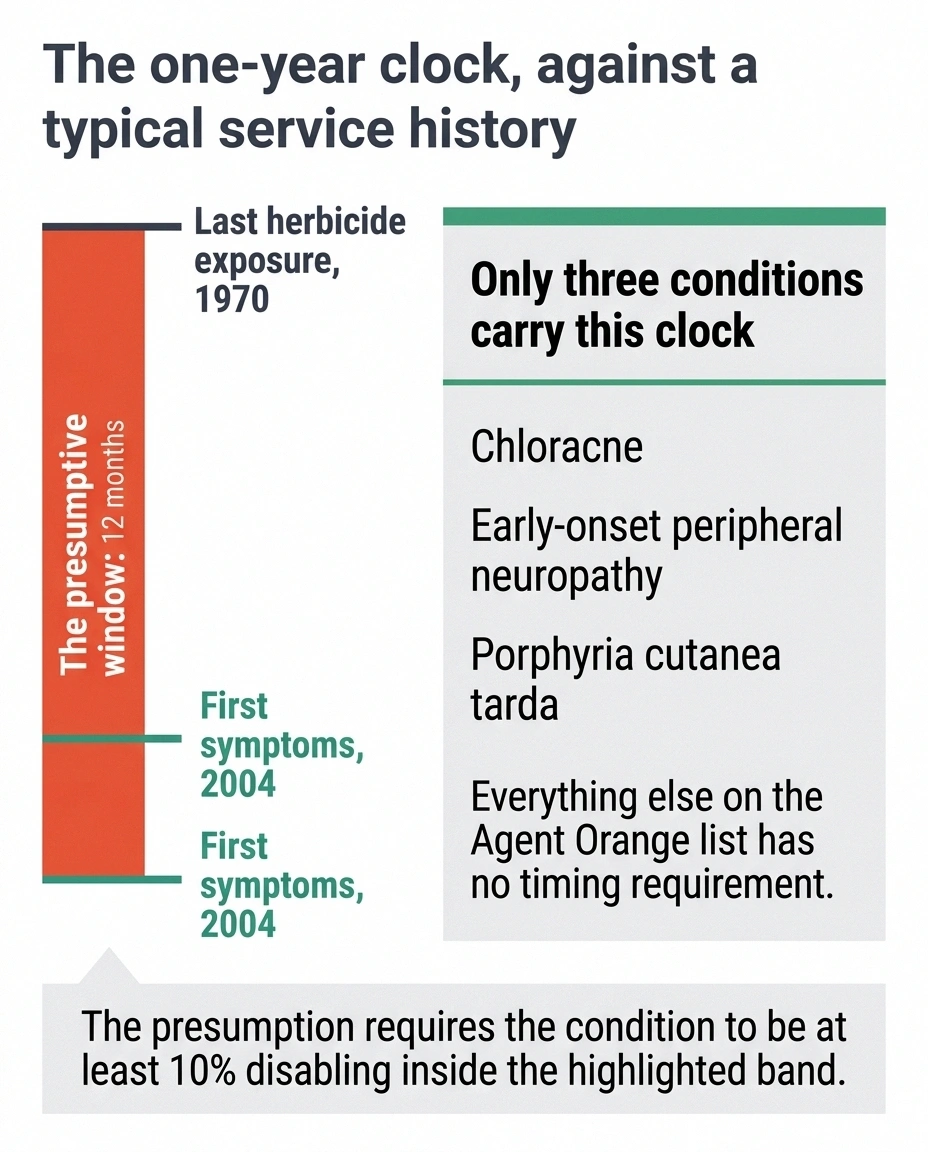
This condition must be at least 10% disabling within 1 year of herbicide exposure.
Read that against a typical service history. A veteran leaves Vietnam in 1970. Numbness in the toes starts in 2004. Thirty-four years separate the exposure from the symptom, and the presumption requires one.
Only three conditions on the entire Agent Orange list carry this one-year clock: chloracne, early-onset peripheral neuropathy, and porphyria cutanea tarda. Everything else on the list, including several cancers, ischemic heart disease, Parkinson’s disease, hypothyroidism, and high blood pressure, can appear at any point in a veteran’s life and still qualify.
So the presumption for nerve damage is real. It is also, for practical purposes, narrow enough that most veterans searching for it will not fit inside it.
Why “Early Onset” Does Not Mean What It Sounds Like
The phrase is a regulatory term, not a medical one, and the mismatch causes genuine confusion in both directions.
Veterans read “early onset” and think it describes them if they were young when symptoms began. A man diagnosed at 48 may reasonably conclude that counts as early. It does not. The clock does not start at birth or at diagnosis. It starts at the last date of herbicide exposure, and it runs for twelve months.
There is a second wrinkle worth understanding. The rule requires the condition to have reached 10% disabling within that year, not merely to have existed. Faint tingling that nobody documented and nobody rated does not satisfy it. What satisfies it is evidence, usually contemporaneous medical records, showing nerve symptoms of compensable severity inside the window.
Fifty years later, that evidence is often gone even for veterans whose symptoms genuinely did start early. Service treatment records get thin. The VA hospital that treated someone in 1972 may not have digitized much of anything.
This is worth naming plainly because a lot of veterans conclude from a denial that the VA does not believe their nerve damage is real. That is usually not what happened. The denial is typically about a date, not about the diagnosis.
Where and When Exposure Is Presumed
Before any condition matters, the VA has to accept that exposure happened. For most claims this is automatic, based on where and when a veteran served. The current presumptive locations and windows:
Four claim terms, kept straight
- Presumed exposure
- The VA accepts that herbicide contact happened, based on where and when you served. Settled by a DD-214 or unit records, not by anything medical.
- Presumptive condition
- A diagnosis the VA links to that exposure without requiring you to prove causation. Exposure and condition are two separate gates, and a claim can clear one and fail the other.
- Direct service connection
- Your service caused the condition, proven with individual evidence rather than a presumption. Available when a presumption does not fit, and it needs a nexus opinion.
- Secondary service connection
- An already service-connected condition caused or worsened a second one. The second condition never has to appear on any presumptive list at all.
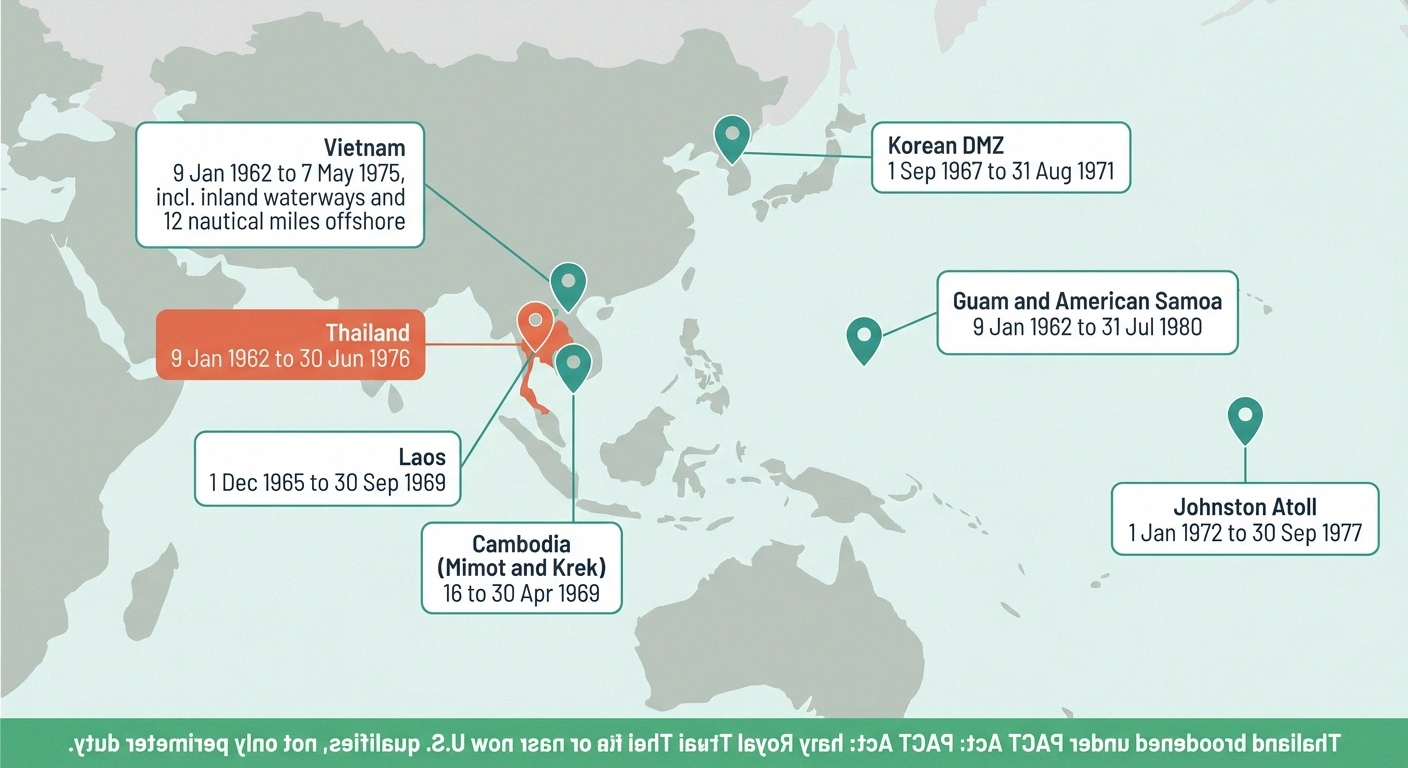
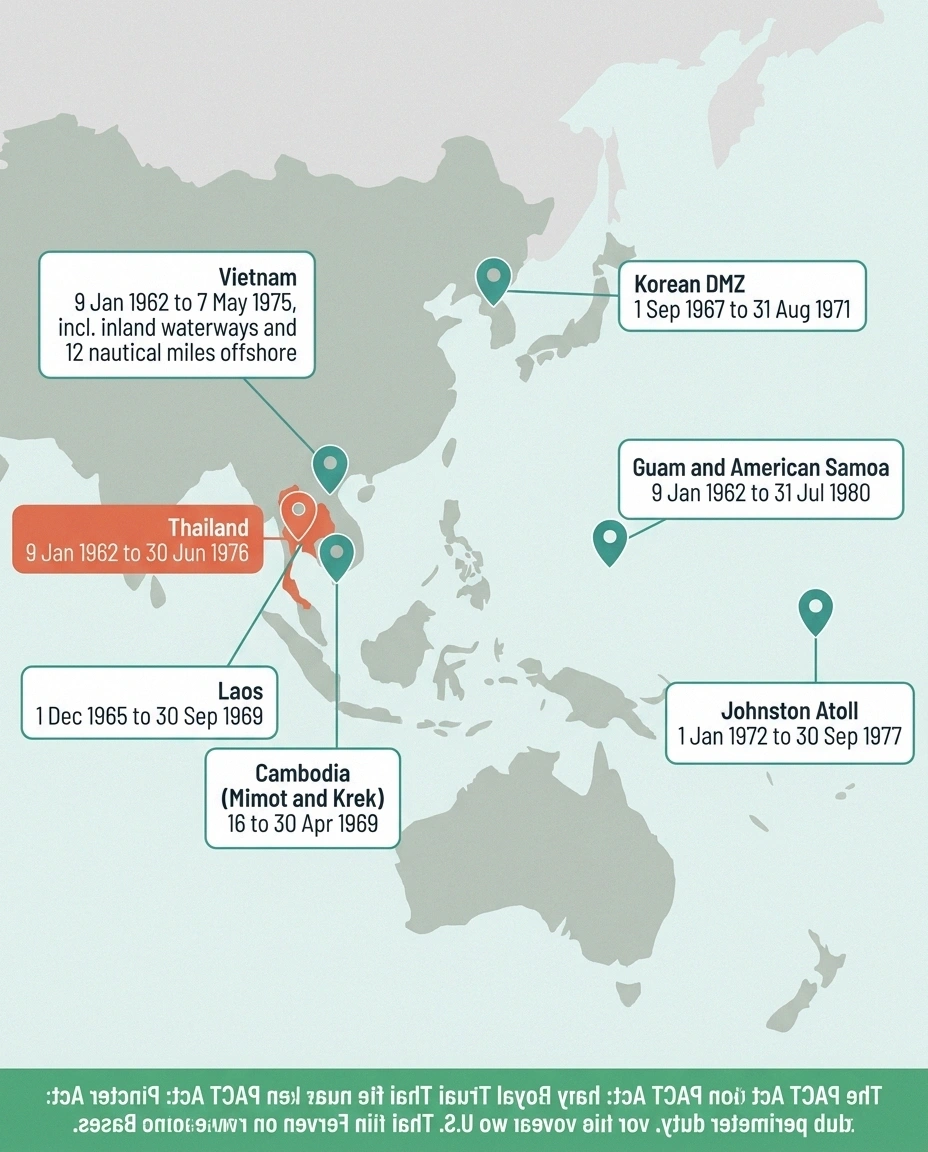
- Vietnam: January 9, 1962 through May 7, 1975, including inland waterways and waters up to 12 nautical miles offshore
- Thailand: January 9, 1962 through June 30, 1976
- Laos: December 1, 1965 through September 30, 1969
- Cambodia, at Mimot or Krek: April 16 through April 30, 1969
- Guam and American Samoa: January 9, 1962 through July 31, 1980
- Johnston Atoll: January 1, 1972 through September 30, 1977
- Korean Demilitarized Zone: September 1, 1967 through August 31, 1971
Two of these changed recently enough that veterans denied years ago may now qualify on facts that have not changed at all.
Thailand is the significant one. Before the PACT Act, the presumption reached only Air Force veterans who served near a base perimeter and Army veterans assigned to perimeter security. Everyone else had to prove exposure individually, which in practice meant most Thailand claims failed. The presumption now covers service on any U.S. or Royal Thai military base in Thailand during the window, regardless of job or proximity to a fence line.
Guam, American Samoa and Johnston Atoll are also newer additions. A veteran who served on Guam in the 1970s and was told decades ago that herbicide exposure could not be presumed was told something that was accurate then and is not accurate now.
In February 2024 the VA proposed extending presumed exposure further, to certain locations in the United States, Canada and India. Veterans with service at herbicide testing or storage sites stateside should keep an eye on where that rulemaking lands.
The Route Most Veterans Actually Have
Here is the part that competing pages tend to skip, and it is the most useful thing on this page.
Look again at the presumptive list. Type 2 diabetes mellitus is on it, with no timing requirement and no severity threshold. A Vietnam veteran diagnosed with type 2 diabetes in 1998, or 2011, or last spring, has a presumptive condition. The one-year clock that governs early-onset neuropathy does not touch diabetes at all.
And diabetic peripheral neuropathy is one of the most thoroughly documented complications in all of medicine. It is not a contested link. It is the expected downstream consequence of years of elevated blood sugar, and roughly half of people with long-standing diabetes develop some form of it.
That produces a claim that looks completely different from the one most veterans file:
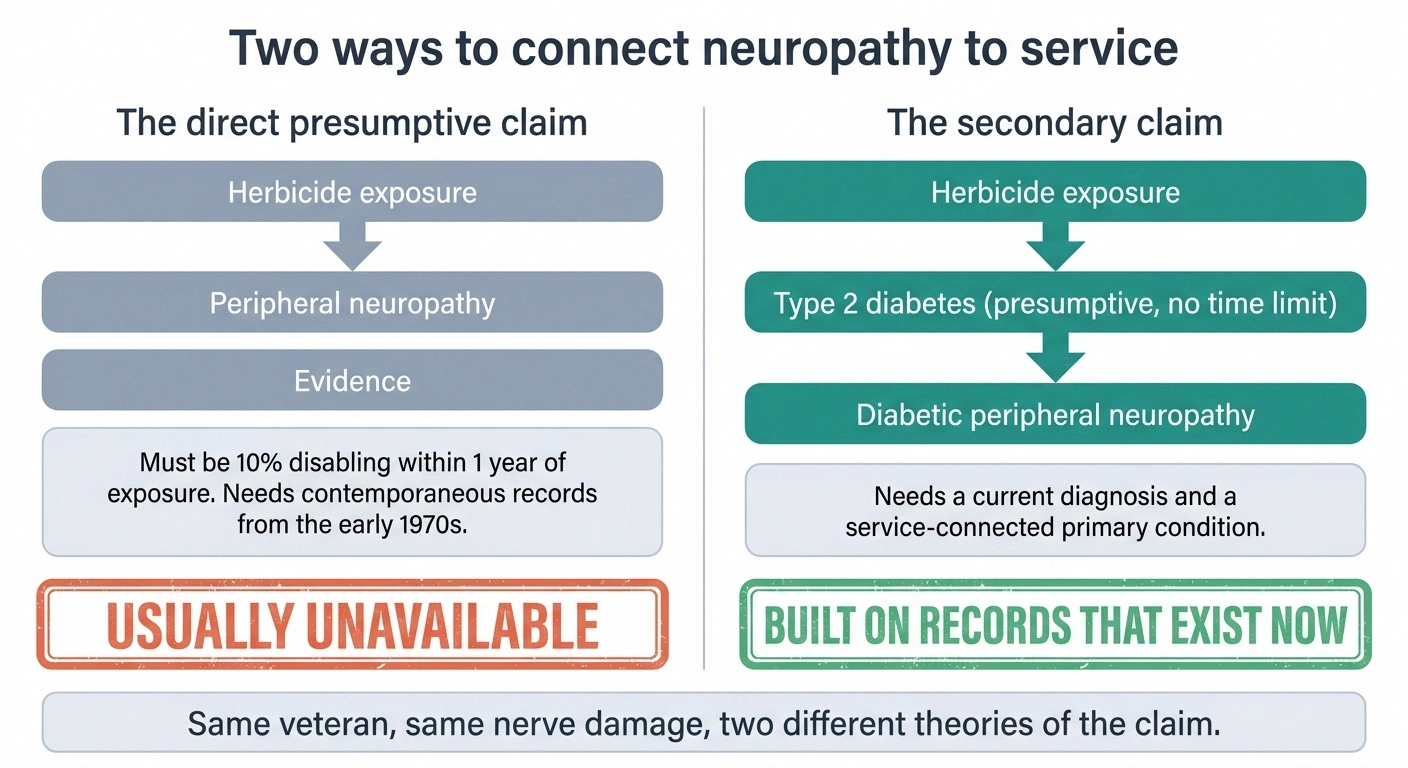
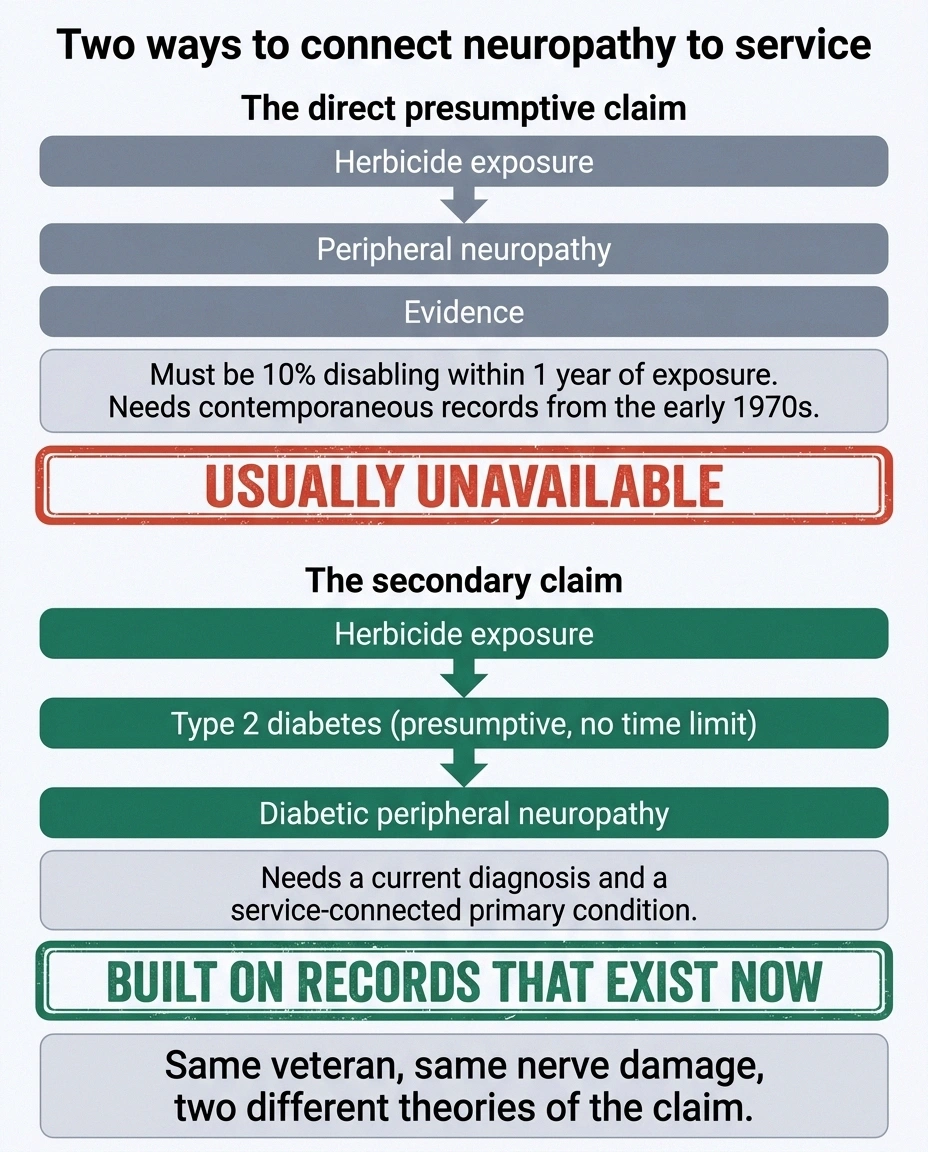
- The presumptive claim: Agent Orange caused my neuropathy directly, and it appeared within a year of exposure. Requires evidence from the early 1970s that usually no longer exists.
- The secondary claim: Agent Orange caused my type 2 diabetes, which is presumed. My diabetes caused my diabetic peripheral neuropathy, which is a recognized complication. Requires a current diagnosis and a service-connected primary condition.
The second claim is built on records that exist right now. Current lab work, a current neurology or podiatry note, a current diagnosis. No archaeology in fifty-year-old paperwork.
The mechanism of injury is different in the two claims, and it is worth being honest about that rather than papering over it. In the secondary claim the nerve damage is being attributed to blood sugar, not to dioxin. The herbicide exposure is doing its work one step upstream. That is not a loophole. It is how secondary service connection is designed to function throughout the entire VA system.
Type 2 diabetes is not the only presumptive condition that can anchor a secondary neuropathy claim, though it is by far the most common. Hypothyroidism, also presumptive and also unrestricted by timing, is another recognized cause of peripheral nerve damage.
How the Rating Is Built, Limb by Limb
Veterans often expect one number for one condition. Nerve ratings do not work that way, and the structure matters because it changes what to document.
Ask for these to be recorded per limb, not per person
A single line reading “neuropathy of the lower extremities” collapses four possible ratings into one. These are the findings a rater can actually score.
- Which specific nerve or nerve group is involved, named, in each limb separately
- A severity term the rating schedule uses: mild, moderate, moderately severe, severe, or complete
- Sensory testing results limb by limb, including where the boundary of altered sensation sits
- Muscle strength grading and any documented atrophy, which separate moderate from severe
- Reflex findings at ankle and knee on each side
- Whether both sides are affected, stated explicitly, since that is what triggers the bilateral factor
Bring this list to the examination rather than after it. Re-examinations are scheduled at the VA’s convenience, not yours.
Peripheral neuropathy is rated per affected nerve, per limb, on a severity ladder that runs from mild through moderate, moderately severe, severe, and complete paralysis. Depending on which nerve group is involved, a single limb can carry anywhere from 10% to 80%.
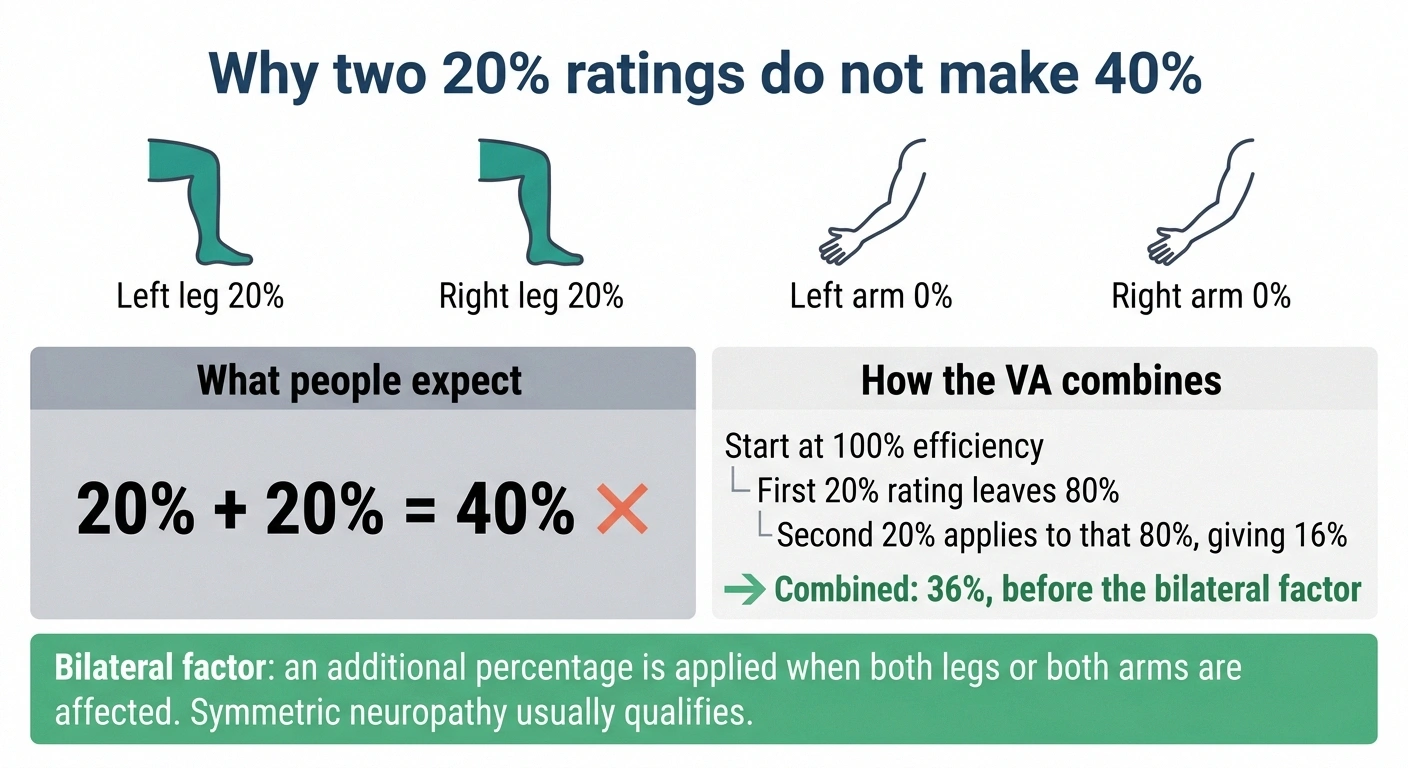
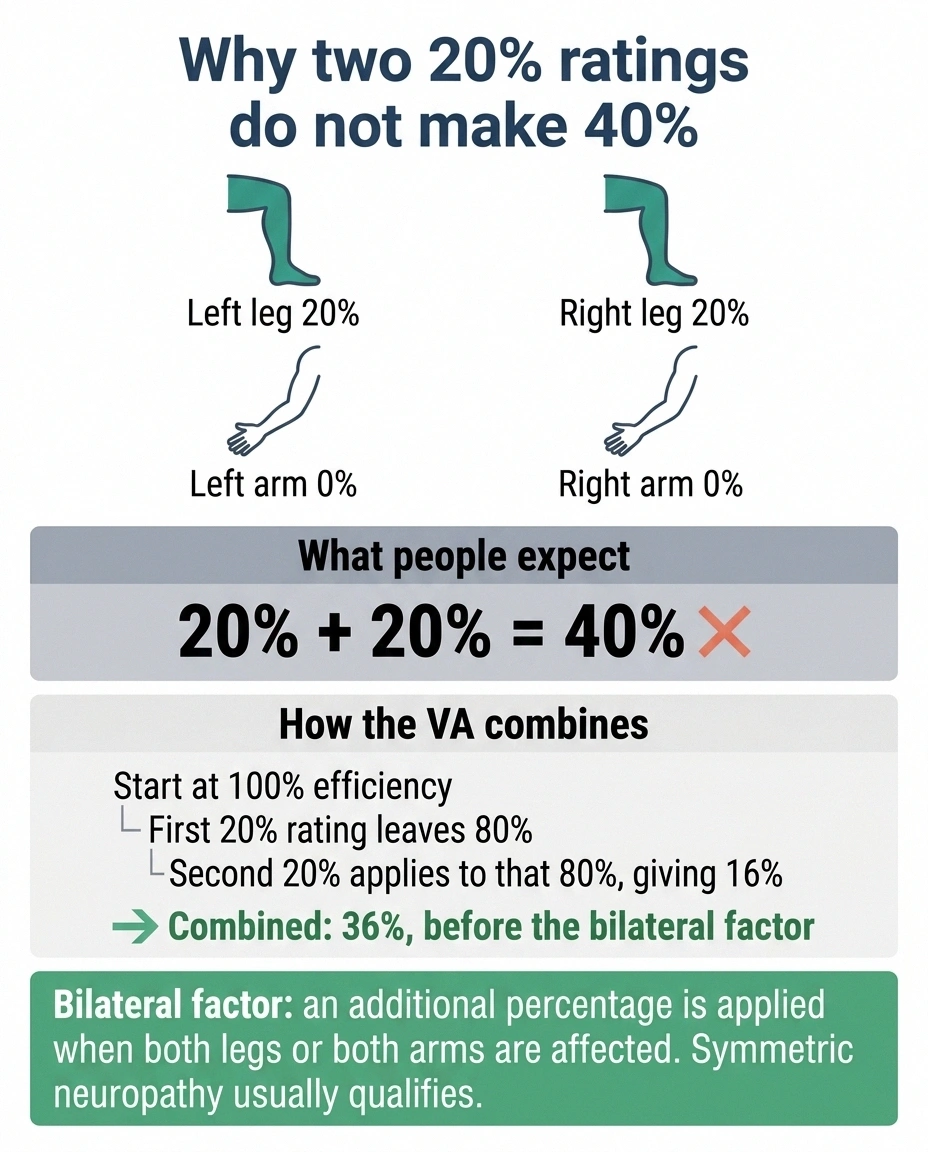
Those individual ratings are then merged using the VA’s combined ratings table, which is not addition. Two 20% ratings do not make 40%. The table works on remaining efficiency, so each additional rating is applied to what is left after the previous one, and the combined figure lands lower than the arithmetic sum.
One provision works in the veteran’s favor. When both arms or both legs are affected, the VA applies a bilateral factor, adding a percentage to the combined value before rounding. Neuropathy from diabetes or herbicide exposure is characteristically symmetric, starting in both feet at once, so the bilateral factor applies to a large share of these claims.
The practical consequence: an examination that documents only “neuropathy of the lower extremities” as a single finding is leaving rating percentage unclaimed. Each limb needs its own findings. Our fuller breakdown of the diagnostic codes and severity tiers lives in the neuropathy VA disability rating guide.
What to Have in Hand Before You File

Four things carry most of the weight in these claims.
Two sentences, one legal standard apart
Falls short: “It is possible that this veteran’s diabetes contributed to the peripheral neuropathy.”
Meets the standard: “It is at least as likely as not that this veteran’s service-connected type 2 diabetes caused the diagnosed peripheral neuropathy.”
The phrase carries a defined meaning: a 50% probability or greater. At exactly 50%, the tie goes to the veteran, which is a rule with no equivalent in most other areas of law. A clinician writing “possible” or “may have” has described something weaker than 50% and given the rater grounds to deny. It is worth showing the physician the required wording rather than assuming they know it, since most clinicians write these rarely.
A current, specific diagnosis. Not “numbness in the feet” in a primary care note. A named condition from a clinician who examined you, ideally supported by the objective testing described in our walkthrough of how neuropathy gets diagnosed. Nerve conduction studies are the common evidence here, though be aware that they measure large fibers and can read normal in small fiber neuropathy, which is worth knowing before a normal result gets treated as proof of nothing wrong.
Proof of service in a presumptive location and window. Usually a DD-214, sometimes unit records or travel orders for locations where the paperwork is less clean. Thailand and Korea claims often need the extra layer.
A documented primary condition, if going the secondary route. The diabetes diagnosis, the treatment history, the A1c values over time.
A nexus opinion, where the connection is not automatic. This is a written statement from a qualified clinician saying it is at least as likely as not that the service-connected condition caused the claimed one. The phrase “at least as likely as not” is the actual legal standard, meaning a 50% probability, and using that language matters because a letter saying a connection is merely “possible” does not meet it.
One thing to avoid: filing a claim that leads with the herbicide-to-nerve theory when the diabetes pathway is available and better supported. The theory you lead with shapes which evidence the rater weighs.
Two Groups the Location List Handles Differently

Two populations sit at the edges of the exposure rules and are worth calling out, because both spent years being told they did not qualify.
Blue Water Navy veterans. Sailors who served offshore rather than in-country were excluded from presumed exposure for decades on the reasoning that herbicide never reached the ships. That changed with legislation restoring the presumption for service in the territorial seas out to twelve nautical miles. The distance matters, and the ship’s deck logs are what establish it. A veteran whose vessel operated inside that boundary, or entered an inland waterway, is covered. One that stayed further out is not, and the paperwork resolving which is which usually comes from the ship’s records rather than from anything in a personnel file.
C-123 aircrew and maintenance personnel. After the spraying missions ended, the aircraft that flew them remained in service into the early 1980s, carrying residue. Reserve crews who flew and maintained those specific airframes are recognized for herbicide exposure even though their service was years after Vietnam and nowhere near it. This one turns entirely on aircraft tail numbers and unit assignment, which is an unusual kind of proof and one that catches people off guard.
What links these two groups is the same lesson the Thailand change teaches. The exposure rules have been amended repeatedly over three decades, generally in the direction of broader coverage. A denial issued under an older version of the rules is not a permanent answer, and refiling on unchanged facts is a legitimate and reasonably common move.
When the Neuropathy Is Not From Agent Orange or Diabetes
Not every case of nerve damage in a veteran traces back to either one, and assuming it does can delay finding something treatable.
B12 deficiency, thyroid disease, alcohol use, chemotherapy, certain medications, and inherited conditions all produce peripheral neuropathy, and several of them respond to treatment in a way that herbicide-related damage does not. Some are separately service-connectable on their own facts. Our overview of toxic neuropathy causes covers the exposure-related side of that list, and the stages of neuropathy explains how the condition typically progresses when it is not addressed.
Chasing the benefits claim and chasing the cause are two separate projects. Both are worth doing, and neither substitutes for the other.
If the Claim Is Denied
A denial on the presumptive theory is not the end of the file, and it is frequently the beginning of a stronger one.
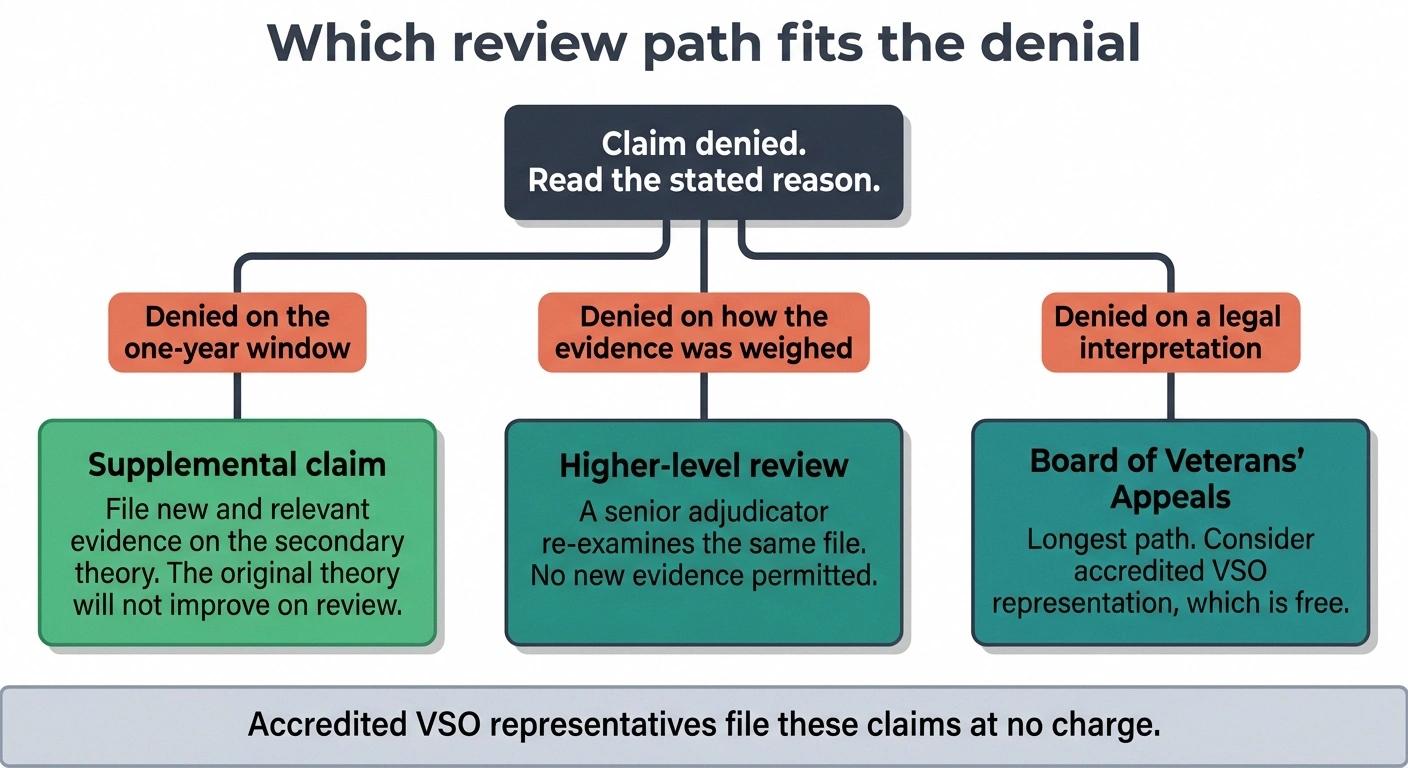
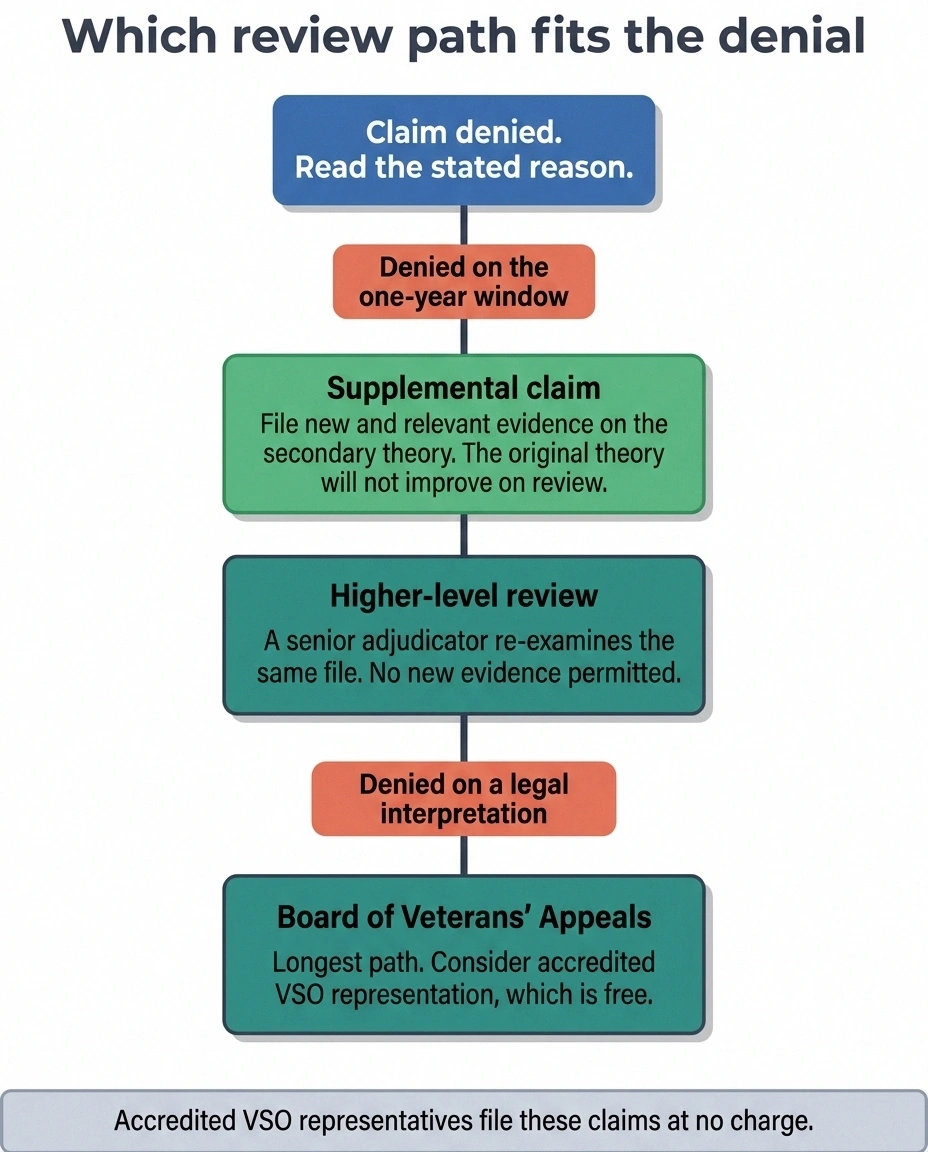
Veterans have three review paths: a supplemental claim with new and relevant evidence, a higher-level review by a more senior adjudicator with no new evidence permitted, and a Board of Veterans’ Appeals appeal. Which fits depends on why the denial happened. If it turned on the one-year window, the answer is usually a supplemental claim built on the secondary theory rather than an appeal of the original theory, because the original theory is not going to improve on review.
Accredited Veterans Service Organization representatives handle this work at no charge, and they file these particular claims constantly. Separately, if you are already carrying medical costs while a claim moves, our guide to neuropathy insurance coverage covers what Medicare and private plans typically pay for, and there is a related discussion of SSDI and SSI eligibility for veterans whose symptoms have reached the point of affecting work.
Frequently Asked Questions
Is peripheral neuropathy a presumptive condition for Agent Orange?
Yes, but in a restricted form. The list entry is “peripheral neuropathy (early onset)” and it requires the condition to have been at least 10% disabling within one year of the last herbicide exposure. Neuropathy that first appeared years or decades after service does not meet the presumption, though it may still be service-connected on a secondary basis.
What does “early onset” actually mean for VA purposes?
It refers to onset within twelve months of the last date of herbicide exposure, not to the veteran’s age at diagnosis. The clock runs from exposure, not from birth. Someone diagnosed in their forties has not met the criterion if the exposure was thirty years earlier.
My neuropathy started 30 years after Vietnam. Do I have any claim at all?
Very possibly, through secondary service connection. Type 2 diabetes is an Agent Orange presumptive condition with no timing requirement, and diabetic peripheral neuropathy is a well-established complication of diabetes. If you have both diagnoses, the neuropathy can be claimed as secondary to the service-connected diabetes rather than as a direct presumptive condition.
Which locations qualify for presumed Agent Orange exposure?
Vietnam, Thailand, Laos, specific sites in Cambodia, Guam, American Samoa, Johnston Atoll, and the Korean DMZ, each within a defined date range. The Thailand rules were broadened under the PACT Act to cover service on any U.S. or Royal Thai base rather than only perimeter duty, so some previously denied Thailand claims are worth refiling.
How does the VA rate neuropathy in both feet?
Each affected nerve in each limb is rated separately on a scale from mild to complete paralysis, ranging from 10% to 80% depending on the nerve group. Those ratings are combined using the VA’s combined ratings table rather than added together, and a bilateral factor is applied when both legs or both arms are involved.
Do I need a nexus letter?
For a straightforward presumptive claim where the condition and timing both fit, no. For a secondary claim, or any claim where the connection is not automatic, a nexus opinion is usually what decides it. It should state that the connection is “at least as likely as not,” which is the legal standard the VA applies.
Can I claim neuropathy if my diabetes is controlled now?
Yes. What matters for a secondary claim is that the service-connected condition caused or aggravated the neuropathy, not the primary condition’s current status. Nerve damage from years of elevated blood sugar does not reverse when the blood sugar normalizes, and the rating reflects your current neurological findings.
Does Agent Orange cause neuropathy directly, outside the one-year window?
The scientific question and the regulatory question have different answers. The VA’s presumption is a legal rule built around a specific evidence review, and it reflects what could be established about timing, not the full biological picture. A veteran can pursue direct service connection outside the presumption, but it requires individual medical evidence and a nexus opinion rather than an automatic presumption.
About the Author