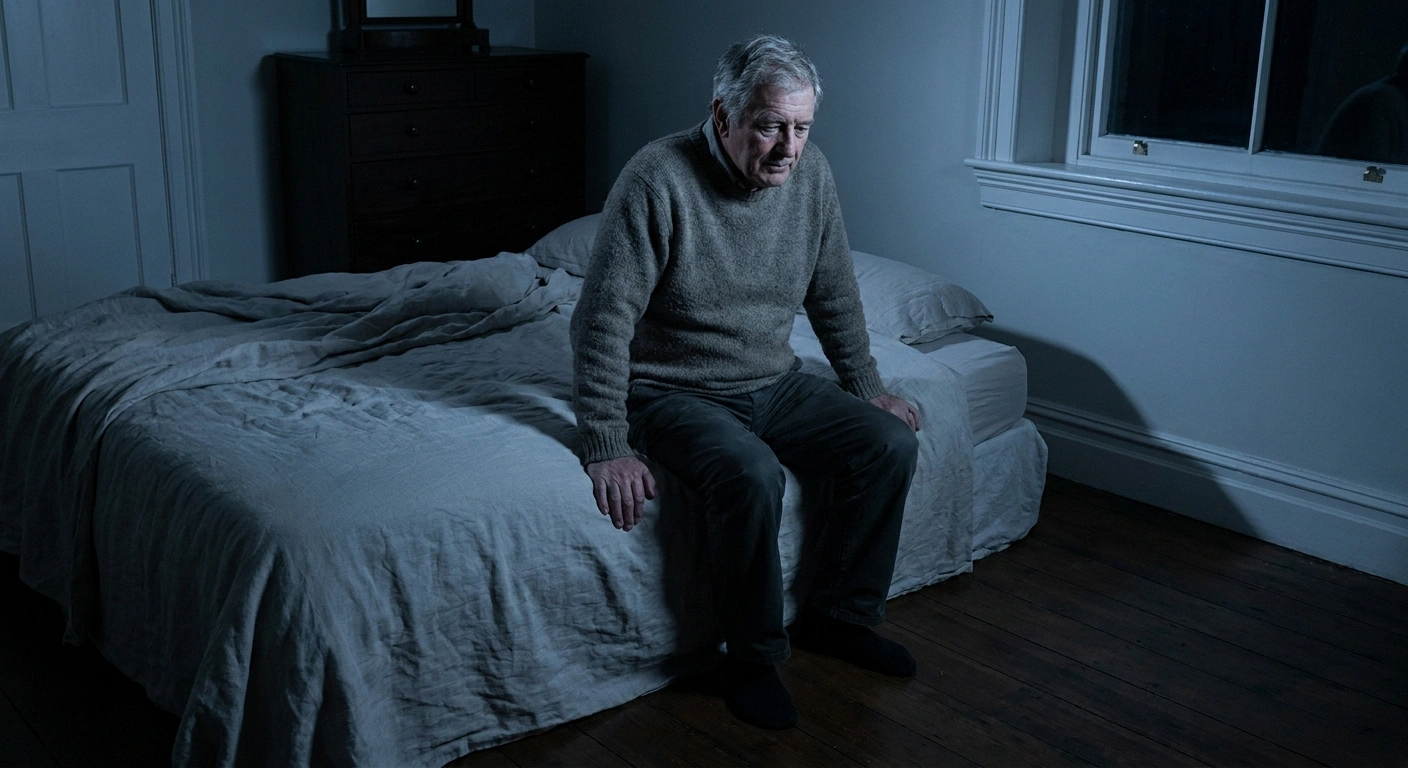
Two in the morning. You are awake because your bladder decided you were, and you are already halfway upright before you are properly conscious.
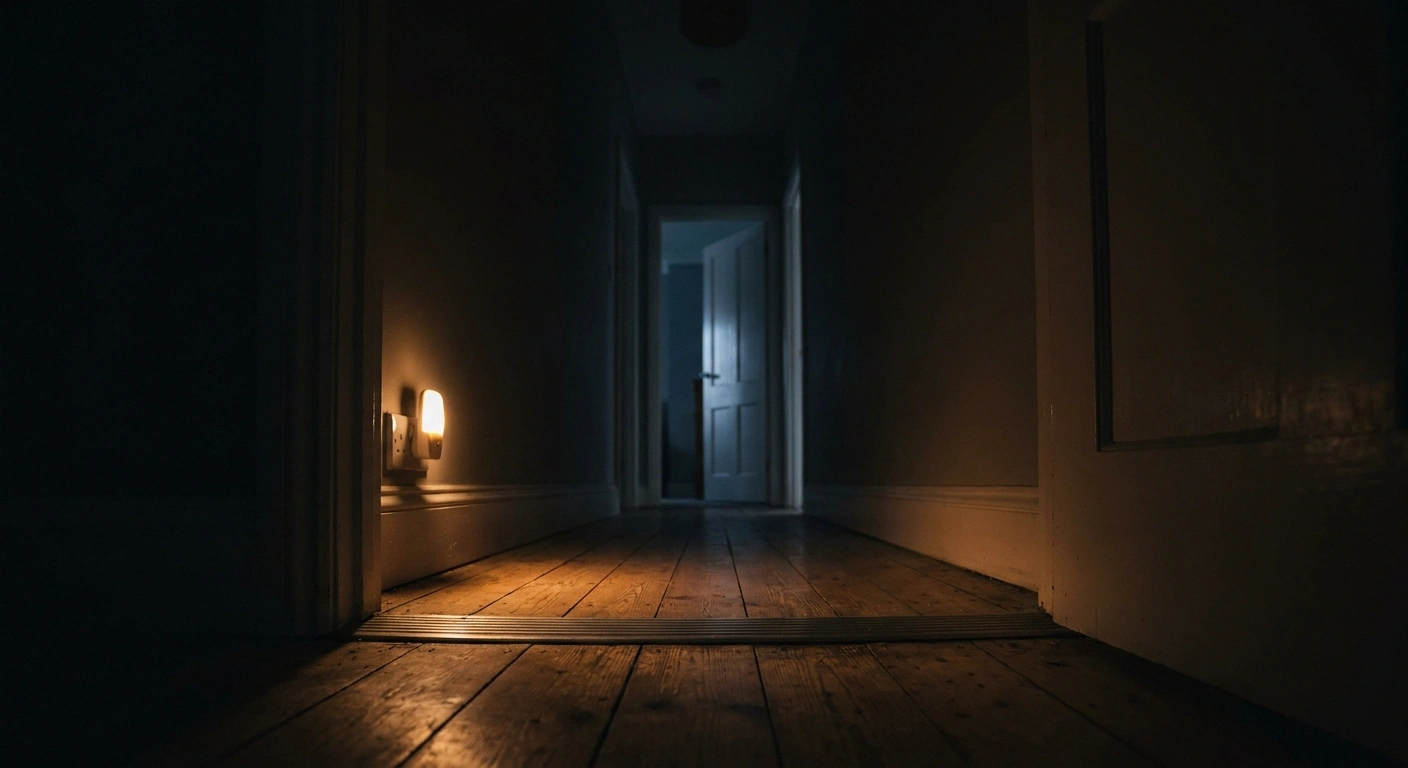
The room is dark. Your feet find the floor and report almost nothing back. You know where the door is, roughly, and you know there is a laundry basket somewhere on the left that was not there last week.
You make it. You almost always make it. Which is exactly why this walk never gets treated as a problem worth solving, right up until the night it is.
Why This Particular Walk Is the Riskiest One You Take
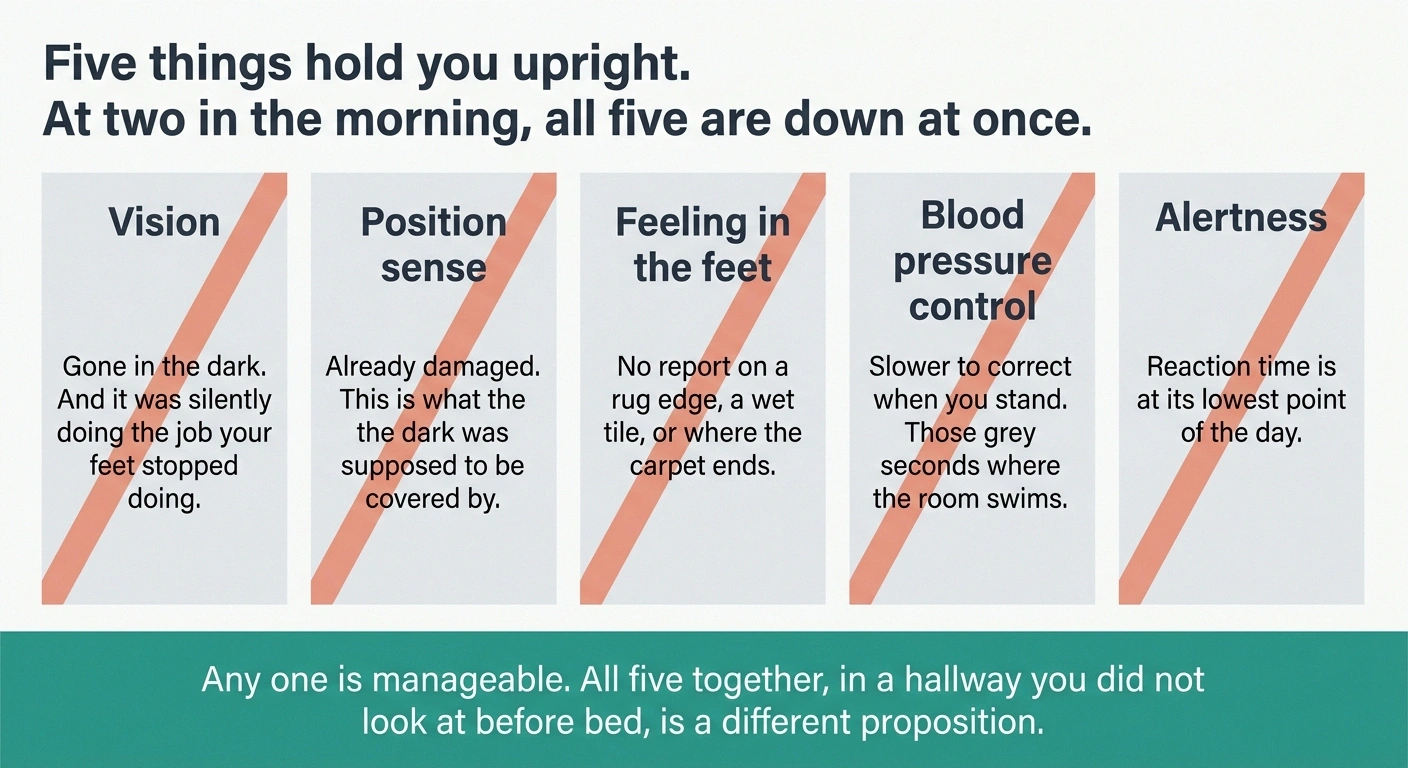
You cross that same stretch of floor twenty times a day without a thought. At two in the morning it is a different journey, because five things that normally hold you upright have all been removed at once.
Vision is gone. This is the big one, and not for the obvious reason. All day, without knowing it, you have been using your eyes to replace the position sense your feet no longer supply reliably. Darkness does not just make it harder to see obstacles. It takes away the substitute you have been quietly leaning on since your symptoms started.
Position sense is already damaged. Proprioception is how your brain knows where your foot is without looking. Neuropathy degrades it, and balance problems follow directly from that loss. The dark was supposed to be covered by the sense that is broken.
Your feet cannot read the floor. Numb soles do not report a rug edge, a wet tile, a dropped towel, or the exact moment the carpet becomes hardwood.
Blood pressure drops when you stand. Going from lying flat to upright causes a temporary drop in blood pressure in anybody. If you have autonomic involvement, the reflexes that normally correct that drop within a couple of heartbeats are slower, and the result is those grey seconds where the room swims.
There is a sixth factor for some people, which is that nerve pain tends to be worse at night in the first place. If your feet are already burning when you wake, you are walking on a surface you cannot read while your attention is being pulled somewhere else entirely.
You are not properly awake. Reaction time and judgement are at their worst in the first minute after waking. If you do stumble, you will catch yourself less well than you would at noon.
Any one of those is manageable. All five together, in a hallway you did not look at before you went to bed, is a different proposition.
The Numbers, Because They Are Worse Than People Expect
This is one of the few areas where the research is unusually clear, and it is not reassuring.
Find the row that matches your week
These figures come from general older-adult research, in people whose feet still report back normally. Nobody has published the version with numb soles added, and there is no reason to expect it reads lower.
| Trips per night | What the research found |
|---|---|
| One | About half of adults over 65. Ordinary, and still worth lighting the route. |
| Two | Odds of reporting a fall roughly 1.84 times higher. Fracture and injury risk more than doubled. |
| Three or more | Odds around 2.15. One study found a 28 percent higher chance of a fall within three years. |
Most people do not know their own number. Counting for one week costs nothing and is the single most useful thing to bring to your next appointment.
About half of adults over 65 get up at least once a night to use the bathroom, and roughly a quarter get up twice or more. So far, ordinary.
A quarter of all falls in older people happen overnight. Of those overnight falls, about a quarter are directly related to a bathroom trip.
Getting up two or more times a night more than doubles the risk of fractures and fall-related injuries. In one community study, people reporting nocturia twice a night had an odds ratio of 1.84 for falls, rising to 2.15 for more than three times a night. Another found that three or more trips a night was associated with a 28 percent increased risk of a fall within three years.
Those numbers come from general older-adult populations. They are not neuropathy-specific, which means they were measured in people whose feet still work. There is no published figure for what the risk looks like when you add numb soles and damaged position sense on top, and there is no reason to think it goes down.
One more finding worth knowing: more than half of people getting up twice or more a night have at least three contributing conditions, and the most common are diabetes, diuretic use, high blood pressure, and sleep apnea. If that list looks familiar, it is because it is the same list that shows up in the neuropathy conversation. The trips and the numbness frequently share a cause.
The Night-Time Fall Is Prevented in the Afternoon
Standard advice for this problem is to put in a nightlight. That is not wrong, and it is close to the least effective thing on the list for somebody with neuropathy, because the failure is not fundamentally a visual one.
The highest-yield intervention is reducing the number of trips. Every trip you do not take is a risk that never existed. And almost everything that reduces the number of trips is done in the afternoon, twelve hours before the risk window opens.
That is the reframe worth carrying away from this page. You do not prevent a two in the morning fall at two in the morning. You prevent it at four in the afternoon.
Fewer Trips: the Daytime Levers
Shift fluids earlier rather than cutting them. The instinct is to stop drinking after dinner, and taken too far that backfires. Dehydration worsens cramps, thickens the blood, and makes the blood pressure drop on standing considerably worse. Aim to get most of your fluid in before late afternoon rather than to drink less overall.
Which afternoon lever to pull first
Six levers, ordered by how much they typically move the number of trips, and how quickly you find out whether they worked.
- Diuretic timing. Biggest single change available and the fastest to test. One question for your prescriber, an answer within days. Never adjust this on your own.
- Legs up for half an hour in the late afternoon. Free, immediate, and works within a night or two if daytime swelling is part of your picture.
- Fluids shifted earlier, not reduced. Takes about a week to see. Cutting fluid instead of moving it makes cramps and dizziness worse.
- Blood sugar in range. Slower to show, and the only lever here that also acts on the nerve damage itself.
- Evening alcohol and caffeine. Obvious once removed, easy to test over a fortnight, and alcohol costs you balance as well as sleep.
- Sleep apnea assessment. Slowest to arrange and occasionally removes the problem entirely. Worth starting if anyone has ever mentioned your snoring.
Change one at a time and keep counting. Two changes at once tells you something worked and nothing about which.
Ask about the timing of your diuretic. If you take a water pill, when you take it substantially determines when your bladder fills. Many people take theirs later than necessary out of habit. This is a question for the prescriber and not a change to make on your own, but it is a question worth asking, because the fix costs nothing and can remove a trip a night.
Put your legs up in the late afternoon. If your ankles swell during the day, that fluid does not simply vanish overnight. It returns to circulation once you lie down, and your kidneys process it at three in the morning. Elevating your legs for half an hour in the late afternoon or early evening moves that fluid while you are awake and near a bathroom on purpose.
Watch alcohol and caffeine in the evening. Both increase urine production, and alcohol additionally worsens balance and deepens the early part of sleep so that you wake more confused.
Get sleep apnea checked if anyone has mentioned snoring. Untreated apnea genuinely increases night-time urination through a hormonal mechanism, and it sits on the list of conditions that travel with nocturia. Treating it sometimes removes the problem entirely.
Keep blood sugar in range. High glucose pulls water into the urine and fills the bladder faster. The same thing driving the trips is the thing driving the nerve damage, which makes this the one lever that pays twice.
Lighting That Helps, and Lighting That Costs You an Hour of Sleep
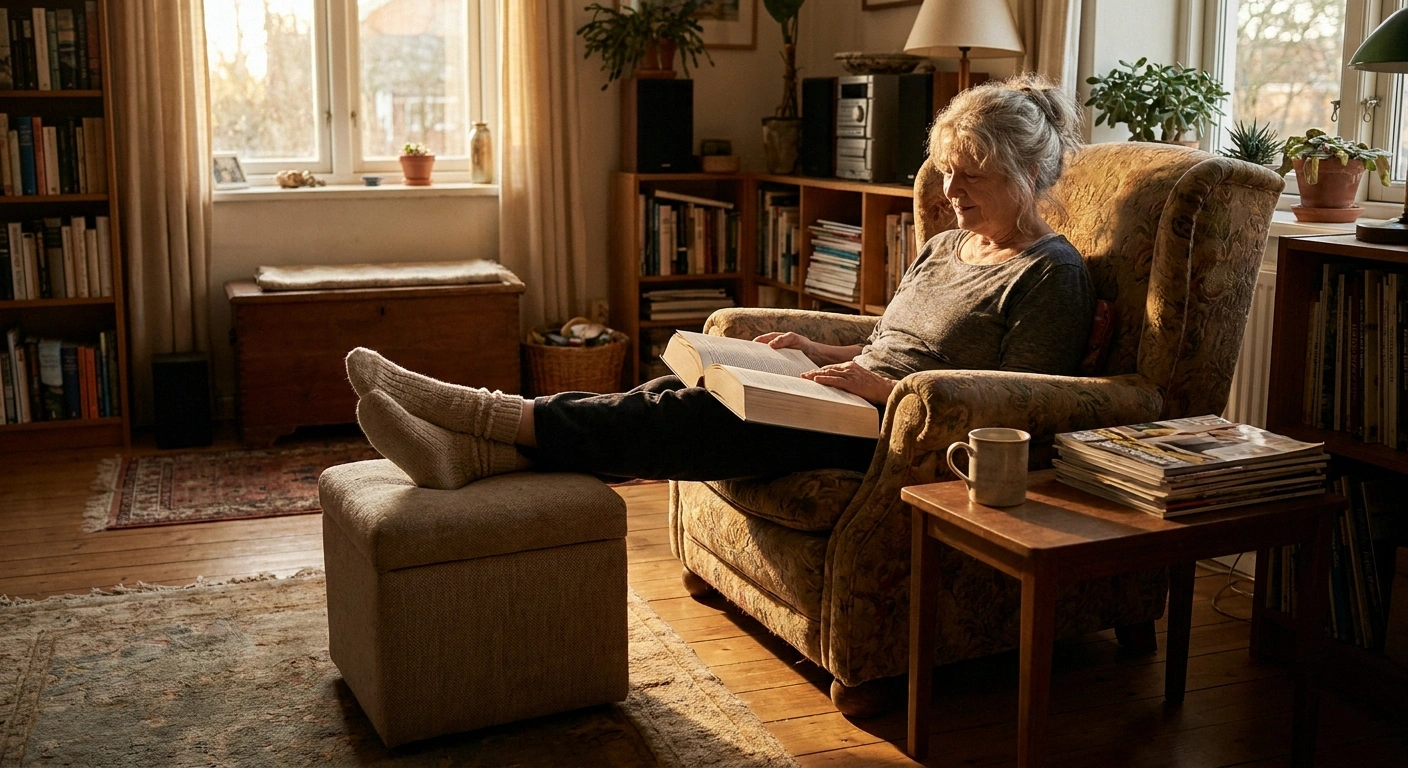
Lighting is not the most important lever, but it is the easiest one to get wrong in a way that creates a second problem.
Light the floor, not the room. Motion-activated strips or plug-in units placed low, at ankle height, along the entire route from bed to toilet. The floor is where the hazards are, and a low light rakes across the surface and shows up a raised threshold or a dropped object that overhead light would flatten out.
Use warm light, not blue-white. Cool white and blue-tinted LEDs suppress melatonin efficiently, which is exactly the wrong outcome for somebody trying to get back to sleep in four minutes. Warm amber bulbs disturb that far less. Look for the lowest colour temperature you can find, and if the packaging quotes Kelvin, aim for 2700 and below rather than anything labelled daylight.
Light the whole route, not just the bathroom. A brightly lit bathroom at the end of a dark hallway is worse than either extreme, because your eyes adapt to the bright room and then you walk back into a corridor you can no longer see.
And avoid the overhead switch entirely if you can. A sudden bright light at two in the morning wakes you fully, disrupts your sleep, and is the reason many people find themselves awake until four.
Feet, Footwear, and the Thirty-Second Rule
Never barefoot. Not on carpet, not for a short trip, not because it is only across the hall. Bare numb feet on a smooth floor is the exact combination that produces slips, and it also puts you one dropped drinking glass away from a cut you will not feel and will not find until morning, which is exactly the kind of injury daily foot checks exist to catch late rather than prevent.
The pair by the bed is usually the wrong pair
Most bedside slippers were chosen for how easy they are to slide into, which is precisely the property that makes them come off mid-step.
What you want
A closed back or a strap. Rubber sole with actual tread. Snug enough not to flap. Same fixed spot every night so you never search in the dark.
What to retire
Backless scuffs. Smooth or felt soles. Anything stretched loose. Socks alone on hard floors. And bare feet, on any surface, for any distance.
Check the sole of your current pair by pressing a thumb into it. If it is hard, shiny, or worn smooth in the ball of the foot, it is no longer gripping anything.
Keep one pair of shoes in one fixed spot beside the bed, always the same spot, and put them on every time. They need a back so they cannot be walked out of, a sole with real grip, and a fit snug enough that they do not flap. The slip-on scuffs most people keep by the bed are the worst possible choice, because they come off mid-step and then you are barefoot and off balance at once. Everything that makes a shoe right for neuropathy during the day applies more strongly at night.
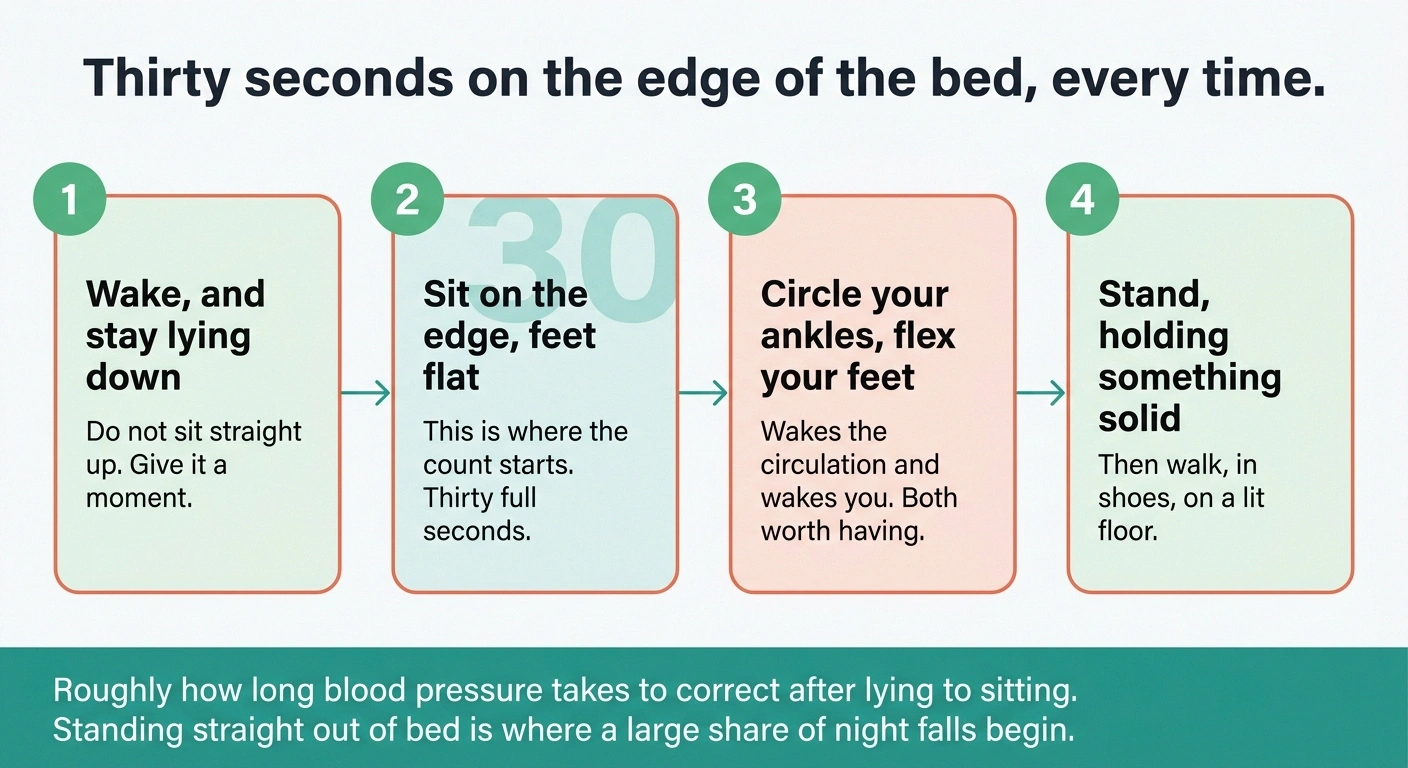
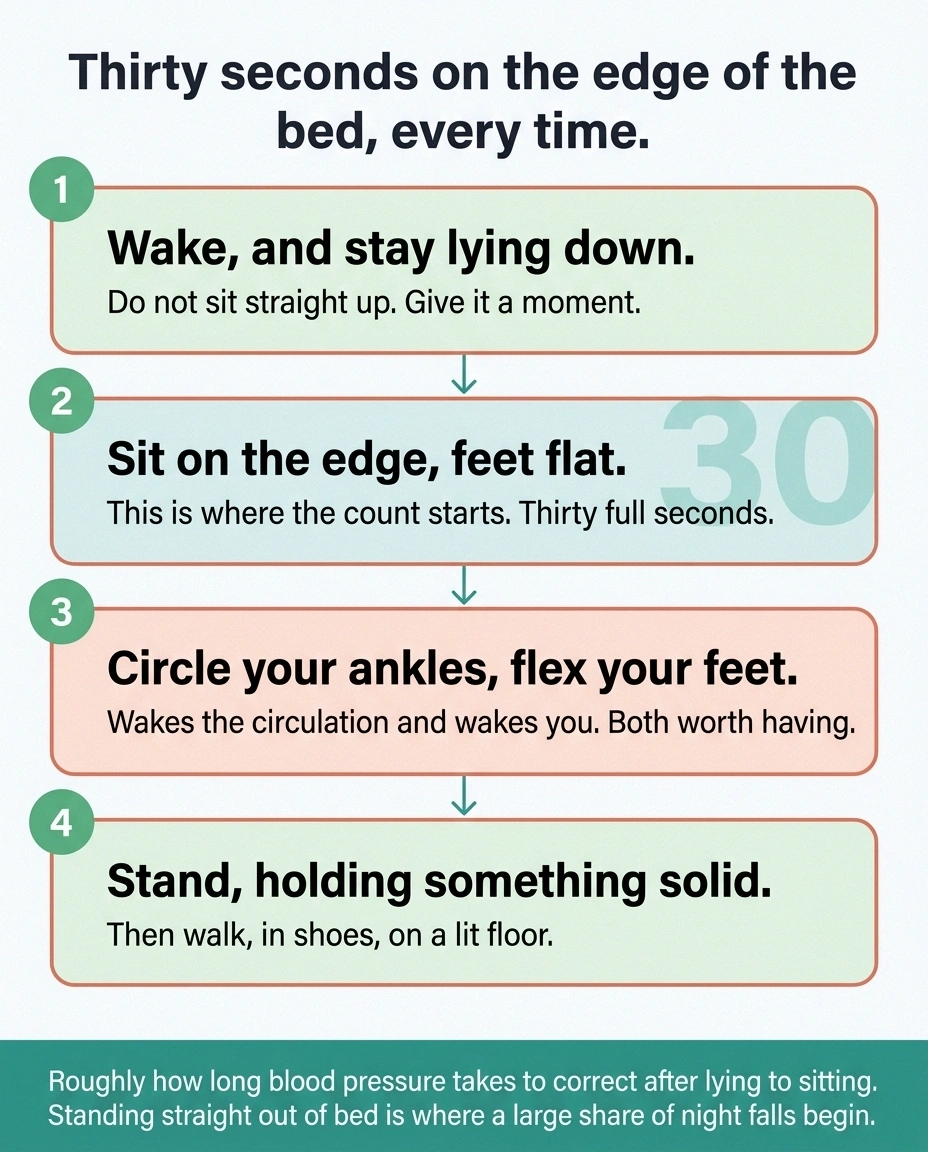
Then the thirty-second rule, which is the single highest-value habit on this page. Sit up on the edge of the bed and count to thirty before you stand. That is roughly how long it takes for blood pressure to correct after going from lying to sitting. Standing straight out of bed is where a large share of night falls actually begin, and thirty seconds costs you nothing.
While you sit, do something useful with the time. Circle your ankles a few times, flex your feet up and down, and give your legs a moment to report in. It wakes the circulation and it wakes you, which are both worth having before you commit your weight to a floor you cannot feel.
Clearing the Route
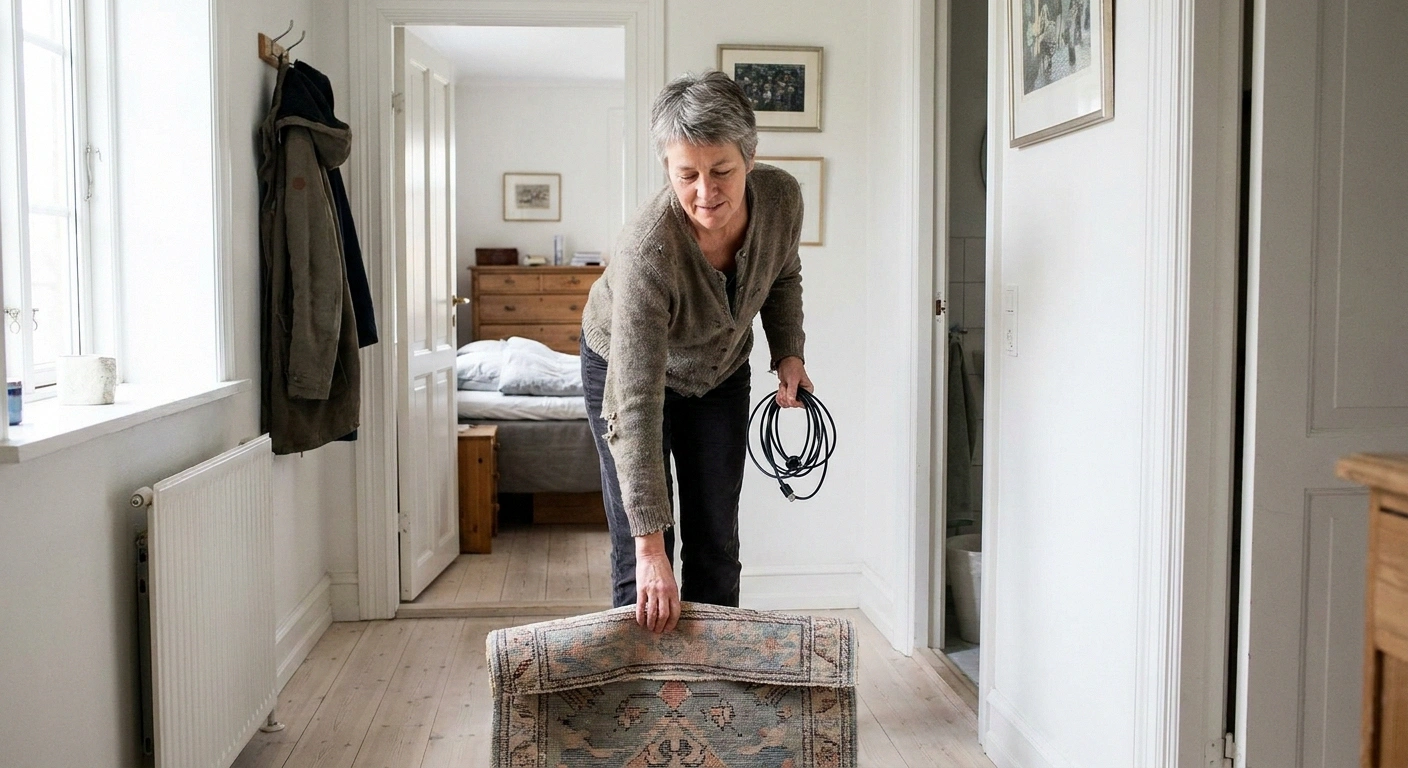
Walk the route once in daylight and look at it as though somebody else lived there.
Loose rugs and bath mats with curled edges come out. A rug you have stepped over ten thousand times is still a rug you cannot feel the edge of at two in the morning.
Cords come out of the walkway. Charging cables, lamp cords, the phone charger that lives on the floor beside the bed.
The floor stays clear. Laundry baskets, shoes, the bag you brought in and set down, the box that has been there a fortnight. Anything on that path has to have a fixed home somewhere else.
Doors stay open or ajar, in one consistent position. A door that is sometimes half closed is an obstacle that moves.
Grab bars go beside the toilet, not just in the shower. Sitting down and standing up are both moments of vulnerable balance, and a towel rail is not a grab bar. Towel rails come off walls under load, which is a fall with a metal bar attached.
And if you have a pet who sleeps in the bedroom, think about where they lie. A dog that sleeps beside the bed is directly in the path of somebody who cannot see or feel the floor.
The Bedside Option Nobody Wants to Discuss
If you are getting up three or four times a night and the daytime levers have not moved it, a bedside urinal or a commode beside the bed removes almost all of the risk in one step. No hallway. No corner. No dark bathroom threshold.
Three options, plainly described
People avoid this decision partly because nobody lays out what the choices actually are. Here they are, without euphemism.
- Handheld urinal
- Smallest and least conspicuous, stores in a bedside cabinet, versions made for both men and women. Removes the walk entirely. Costs about the price of a takeaway.
- Bedside commode
- A chair-height frame with a removable pan, two steps from the bed rather than twenty. Doubles as a sturdy handhold when standing, which is useful in itself. Many models look like ordinary furniture.
- Raised toilet seat with rails, in the bathroom
- Keeps the walk but makes the destination much safer, and reduces the sit-and-stand effort that is where balance is most vulnerable. Reasonable if the route is short and well lit.
Plenty of people use one of these for a few months during a bad stretch and then stop. It is a tool for a hazard, in the same category as a stair handrail, which nobody thinks twice about.
People resist this, and the resistance is about what it means rather than about whether it works. It feels like a line being crossed.
Consider it the way you would consider a handrail on a staircase, which nobody thinks twice about. It is a tool that removes a specific hazard on a specific night. Plenty of people use one for a few months during a bad stretch and stop again. And a hip fracture at seventy-five changes considerably more about a life than a discreet item beside the bed does.
If You Do Go Down
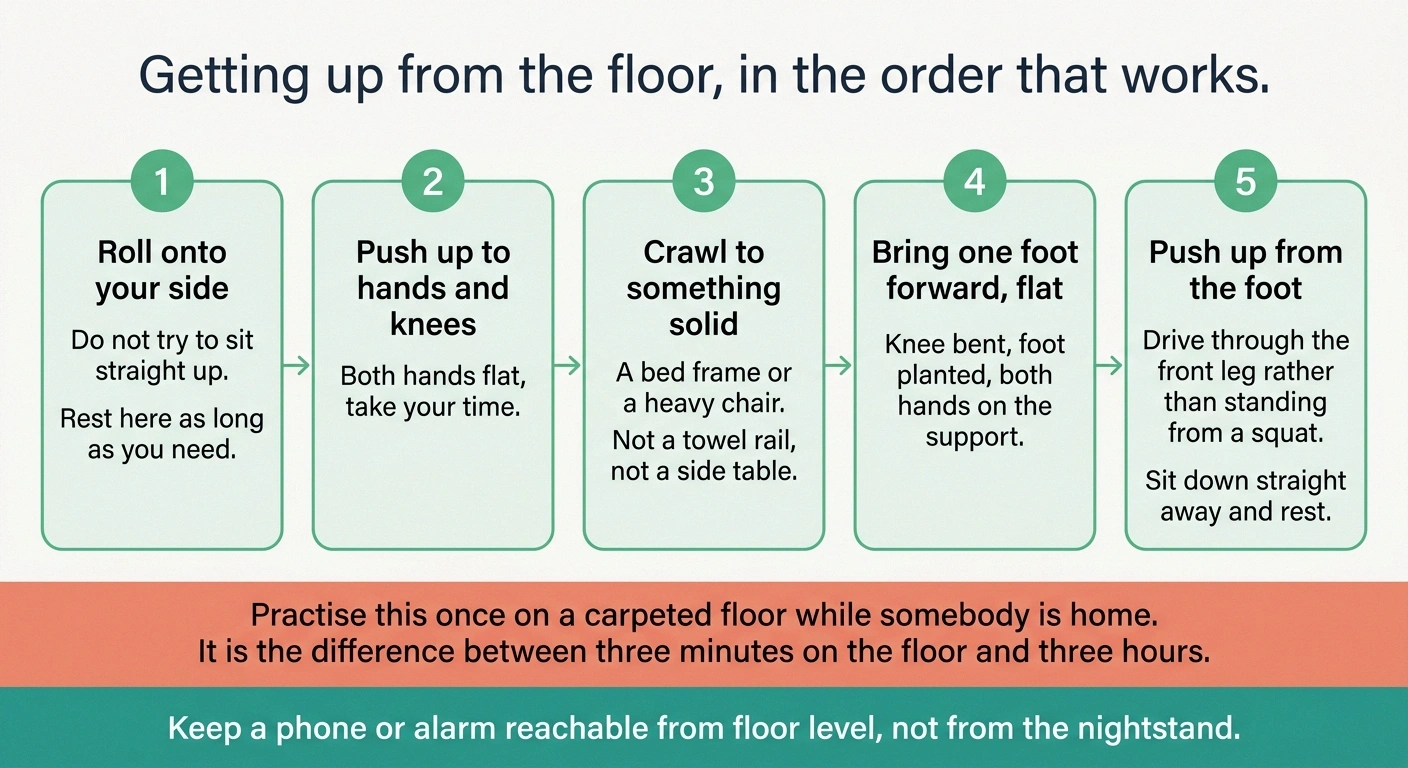
Some falls happen despite everything, so it is worth having two things sorted in advance.
Keep a phone or an alarm button reachable from the floor, not from the nightstand. A phone on a bedside table is useless to somebody lying beside the bed who cannot get up. A pendant alarm worn at night, or a phone kept in a low pocket of a bedside bag, solves it.
Know the sequence for getting up from the floor before you need it: roll onto your side, push up to hands and knees, crawl to something solid and stable such as a bed frame or a heavy chair, bring one foot forward, and push up from there rather than trying to stand from a squat. Reading it once now is worth a great deal at three in the morning, and it is worth practising on a carpeted floor while somebody is home.
And if a fall does happen, mention it at the next appointment even if nothing was broken. One fall predicts another, and it is one of the few things that reliably changes what a clinician goes looking for.
Frequently Asked Questions
Why do I have to get up so much at night?
Common causes stack rather than compete. High blood sugar pulls water into the urine. Diuretics fill the bladder on a schedule set by when you take them. Fluid that collects in the legs during the day returns to circulation once you lie down and gets processed overnight. Prostate problems, an overactive bladder, and untreated sleep apnea all contribute. Most people getting up twice or more have at least three of these at once, which is why one fix rarely solves it.
Should I stop drinking water in the evening?
Shift it earlier rather than cutting it. Dehydration makes cramps worse, makes the blood pressure drop on standing worse, and raises the risk of the dizziness that causes falls. Getting most of your fluid in before late afternoon usually reduces trips without the downside.
Is a nightlight enough?
It helps and it is not the main lever. For somebody with neuropathy the problem is not only that you cannot see, it is that you have lost the sense you were using to compensate for damaged position sense. Reducing the number of trips does more than lighting them well, and the thirty-second sit before standing does more than either.
Why do I get dizzy when I get up at night?
Blood pressure drops when you move from lying to standing. Autonomic nerve damage slows the reflexes that normally correct it, so the drop lasts longer. Sitting on the edge of the bed for a full thirty seconds before standing gives your body time to catch up, and it is the cheapest fall prevention available.
Should I use a bedside commode or urinal?
If you are up three or more times a night, or if you have already had a close call, it removes most of the risk in one step. It is a tool for a specific hazard, and many people use one temporarily during a difficult stretch rather than permanently.
What kind of slippers should I wear at night?
Ones with a back so they cannot be walked out of, a sole with real grip, and a snug fit. Backless scuffs are the worst option because they come off mid-step. Keep them in one fixed place beside the bed so you never have to search for them in the dark.
Where should grab bars go?
Beside the toilet as well as in the shower, because sitting down and standing up are both moments where balance is vulnerable. They must be anchored into studs or with proper fixings. A towel rail will not hold your weight and comes off the wall when tested.
How do I know if this is getting worse rather than staying the same?
Count for a week. Write down how many times you get up each night and any stumbles or near misses. A week of actual numbers is far more useful to a clinician than an impression, and it also tells you honestly whether the changes you made are working.
About the Author