Before you read any further, try this. Stand up somewhere you can reach a wall or a chair. Put your feet together, arms at your sides. Now close your eyes and count to ten.
Most people with neuropathy feel something start to happen around four or five. A drift. A correction. A quiet moment — not alarming, just clear — of not being certain where the floor is.
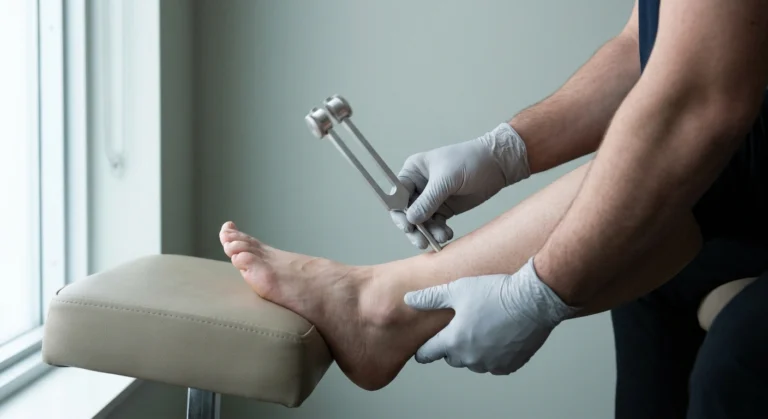
That’s a version of the Romberg test, and neurologists have used it for over a century. It works by taking vision away. Your balance runs on three inputs: the position sense coming up from your feet and joints, the balance organs in your inner ear, and your eyes. Neuropathy degrades the first one. Close your eyes and you’ve removed a second, and what’s left has to do all the work.
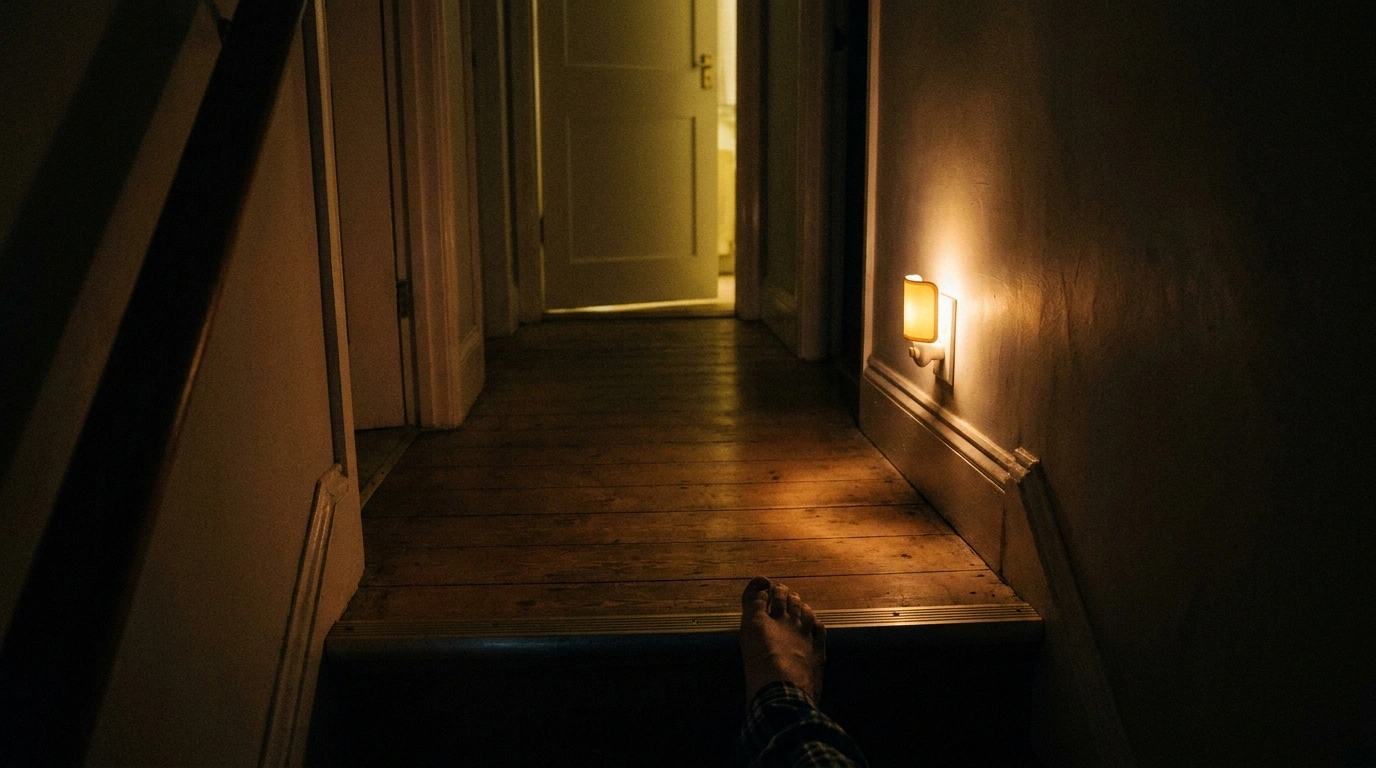
Which brings me to why I care so much about lighting. Every night, walking from your bed to the bathroom in the dark, you’re running that test on yourself — without meaning to, and without anyone timing it. Not for ten seconds. For the whole trip.
This Isn’t a Vision Problem
Every article I’ve read about night lights for older adults treats lighting as a seeing problem. Can you see the step? Can you see the doorframe? Fair enough, and true as far as it goes.
For us it’s different, and the difference is worth understanding, because it changes what you buy and where you put it.
When the nerves in your feet stop reporting reliably, your brain doesn’t just accept the loss. It reassigns the job. Vision takes over the work of telling you where your body is in space, and it does it so smoothly that most people never notice the handover happened. You feel steady in daylight for a reason — your eyes are quietly compensating for feet that have gone quiet.
Turn out the light and you haven’t dimmed one sensor among three. You’ve switched off the substitute that’s been covering for a sensor you already lost. That’s the whole reason losing position sense feels manageable during the day and frightening at 3 a.m.
Anyone who’s noticed they’re steadier in a bright kitchen than a dim hallway has already run the experiment. It isn’t nerves getting worse after dark. It isn’t imagination. It’s an input going missing — and you can put that one back.
Your Eyes Have Also Changed
The second half of the problem is that the eyes doing the compensating are not the eyes you had at thirty.
Three things happen with age, and they stack:
Less light gets in. The pupil doesn’t open as wide in the dark. Averaged out, a dark-adapted pupil measures about 5.6 mm in the sixties, against roughly 7.3 mm in the twenties. The lens has also yellowed and absorbs more light on the way through.
Adjusting takes longer. The chemistry that lets rod cells recover their sensitivity in darkness slows markedly with age. Walking into a dark room, a younger eye has largely adapted while an older eye is still working on it.
The requirement goes up. The minimum light needed for a visual task roughly doubles every decade of adult life. The hallway that was fine at fifty is genuinely not fine at seventy — and nothing about the hallway changed.
Put the two halves together and you get the real picture. You need vision more than most people do, and you have less of it to work with in low light. That’s not a reason for gloom. It’s a reason to treat lighting as safety equipment rather than décor.
Light the Route, Not the Room
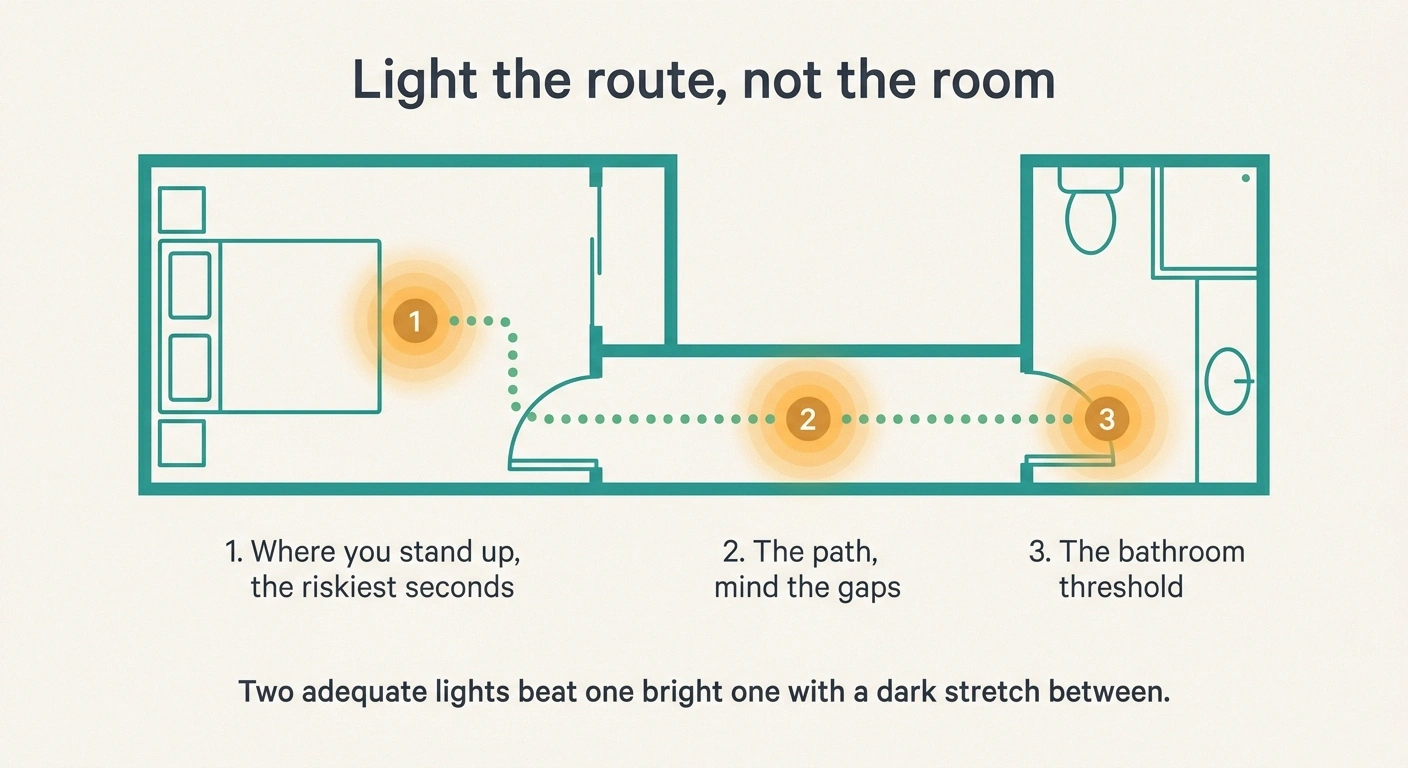
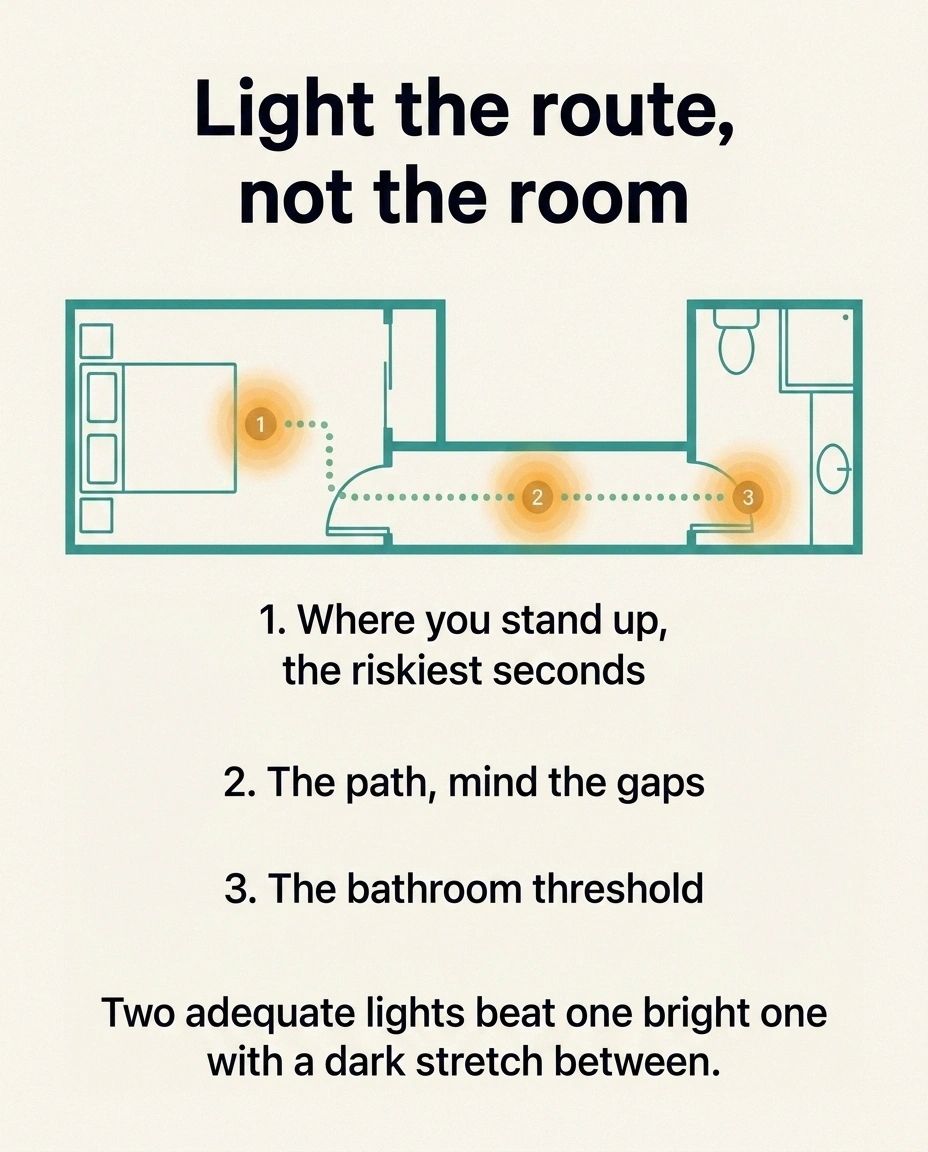
Most people buy one night light, put it in the bathroom, and consider the job done. But the bathroom is where you’re going — the danger is the trip.
Where you slow down. Not where it looks dark. Where your feet actually shorten their stride, which usually happens a step or two before the part that worries you.
Where your hand goes out. Reaching for a wall is your balance system asking for a third point of contact. Every one of those spots is a candidate for either a light or a rail.
Where you turn. Corners and doorways are where you change direction with no visual reference, and they need light more than a straight run does.
Do it at your real nighttime pace rather than a daytime walk-through, and if someone lives with you, ask them to watch. People consistently underestimate their own hesitations.
Think of it as three points on a path:
1. Where you stand up. This is the one people skip, and it’s the most important. The riskiest few seconds of the whole journey are the ones right after you swing your legs over the edge of the bed, when you’re not fully awake, your blood pressure hasn’t caught up, and you’re about to put weight on feet that can’t confirm what they’ve landed on. A light that comes on as you sit up means you never take a single step in the dark.
2. The path itself. Hallway, doorway, any corner you turn. Gaps matter more than brightness here. Two adequate lights covering the whole route beat one bright light leaving a dark stretch in the middle, because the dark stretch is where you’ll drift.
3. The bathroom entrance. The threshold, the door frame, and the floor immediately inside, which is the surface most likely to be wet. Add anything you need to grab for on the way. I’ve written separately about the nighttime bathroom trip, because it deserves its own plan, and about bathroom safety generally.
The test for whether you’ve got it right isn’t how it looks from the doorway with the overhead on. Walk the route at night, at your real pace, and notice where you slow down or reach for the wall. Your body will show you the gap before your eyes do.
Down Low, Not Up High
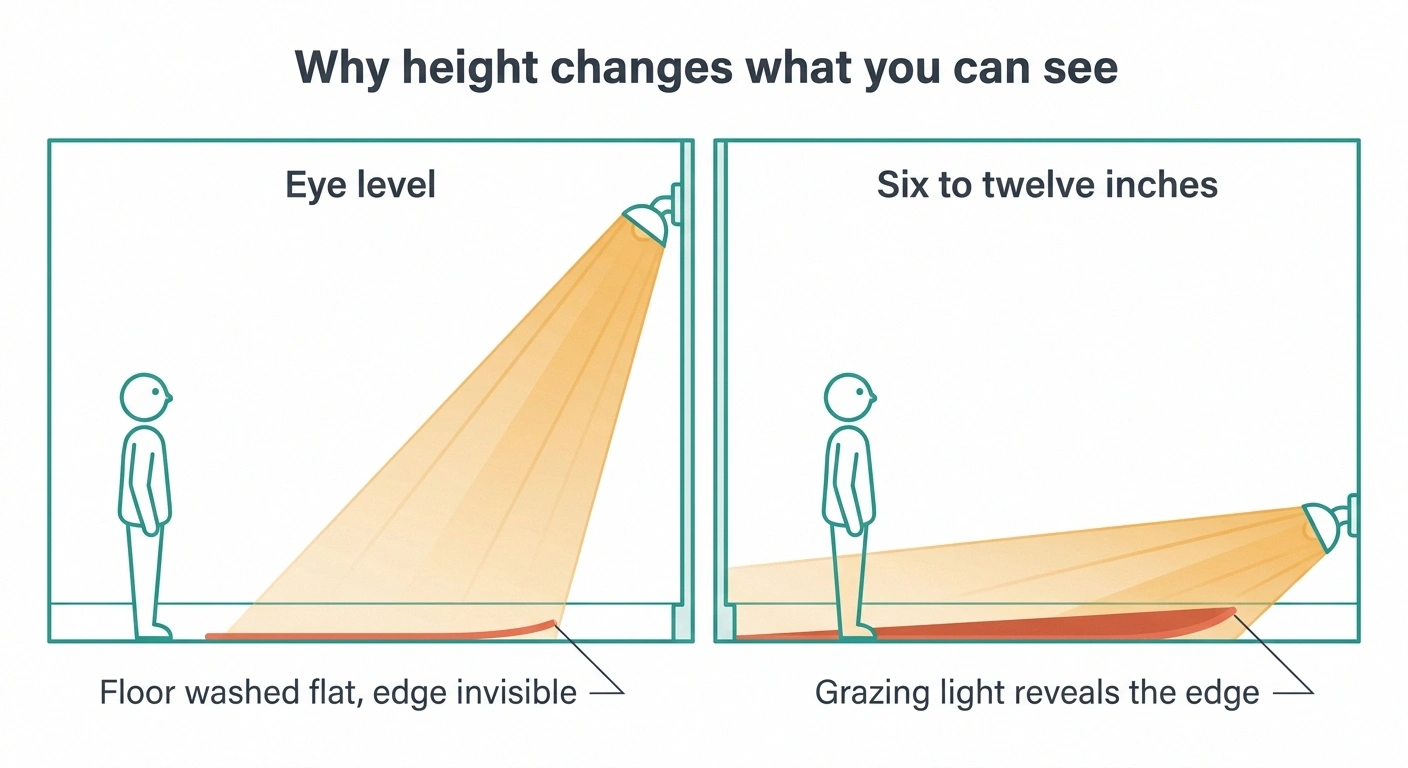
Height changes what a light does, and this is the part most people get wrong.
Six to twelve inches off the floor is the target. A light at that height sends its beam across the floor at a shallow angle, and that grazing light throws small shadows off anything raised — the lip of a rug, a threshold strip, a shoe that didn’t get put away. Shadows are what make edges visible. A light at eye level washes the floor flat and erases the very contrast you need.
Low placement also keeps the source out of your line of sight, which matters more than it sounds. Look directly at a bright point in a dark room and your pupils clamp down, taking several seconds to recover. In a hallway, those are the seconds you’re walking.
Aim the light along the path rather than across it. And step back to check for one thing: any light that puts a bright pool right next to a dark one has made a visual cliff, and to a brain that’s already short on floor information, a hard edge between light and dark can read as a step that isn’t there.
The Trade-off Nobody Tells You About
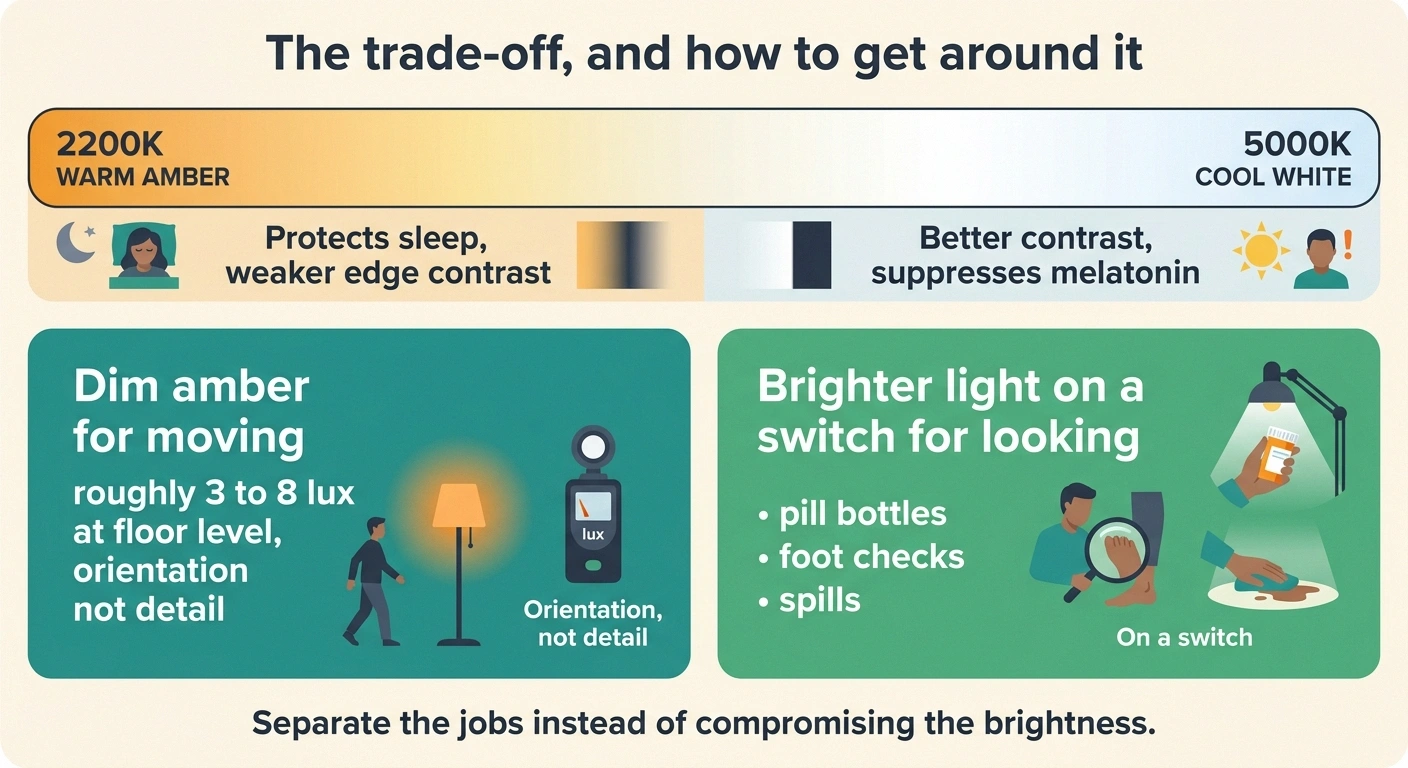
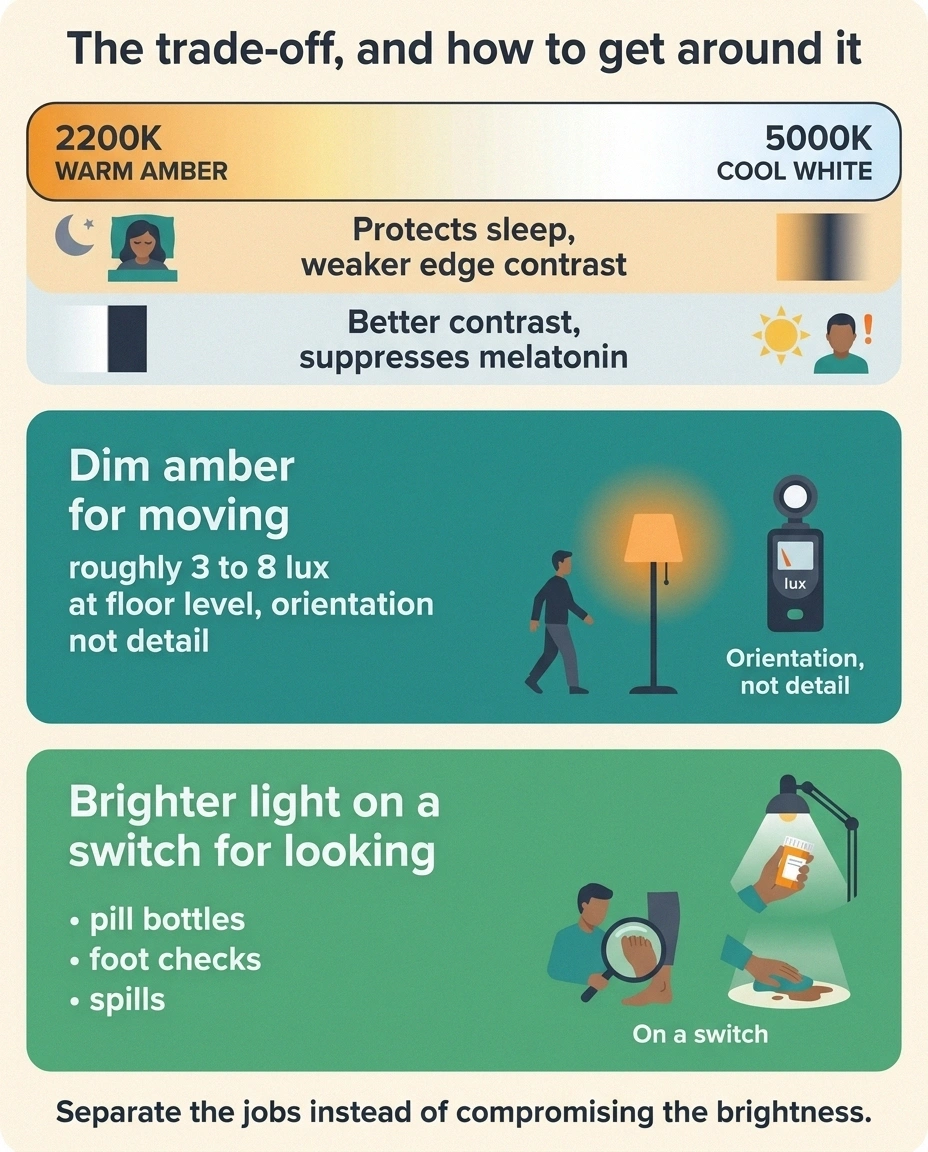
The standard advice is warm amber, very dim, and there’s a good reason for it. Blue-toned and cool white light above roughly 4000K suppresses melatonin, which is exactly what you don’t want at 3 a.m. Red and amber light around 620 to 650 nanometres barely touches that pathway at low levels. Most fall-prevention night lights sit around 3 to 8 lux at floor level.
| Colour temperature | How it looks | Use it for |
|---|---|---|
| Under 2200K, amber or red | Candle-like, deeply warm | The whole night route. Least disruption to sleep. |
| 2700K to 3000K | Standard warm bulb | Evening rooms before bed. Too much for 3 a.m. |
| 4000K and above | Cool white, bluish | Daytime tasks only. Suppresses melatonin. |
| Labelled “daylight” | 5000K to 6500K, harsh | Nothing on your night route, at any brightness. |
Lumens and Kelvin are separate specifications and packaging often shows only one. A light can be dim and still be the wrong colour, and that combination is the one that quietly costs you sleep without helping you see.
Here’s what that advice leaves out: the same dim amber light that protects your sleep is worse at showing you edges. Contrast and detail suffer under warm, low light. So the standard advice optimises for sleep, and you’re reading this for balance.
The resolution isn’t a compromise brightness. It’s separating the jobs.
Dim amber for moving. Walking a route you know by heart needs orientation, not detail. Where’s the wall, where’s the doorway, where does the floor end. Low warm light does that fine and lets you go back to sleep afterward.
Something brighter, on a switch, for looking. Reading a pill bottle, checking a foot, dealing with a spill. Put a separate light within reach at the destination and leave it off unless you need it. One brighter source used for thirty seconds costs you far less sleep than a compromise light that’s slightly too bright all night and never quite bright enough for the task.
If sleep is already a battle, the nighttime routine matters as much as the fixtures, and lighting is one piece of the larger bedroom setup.
The Trip Back
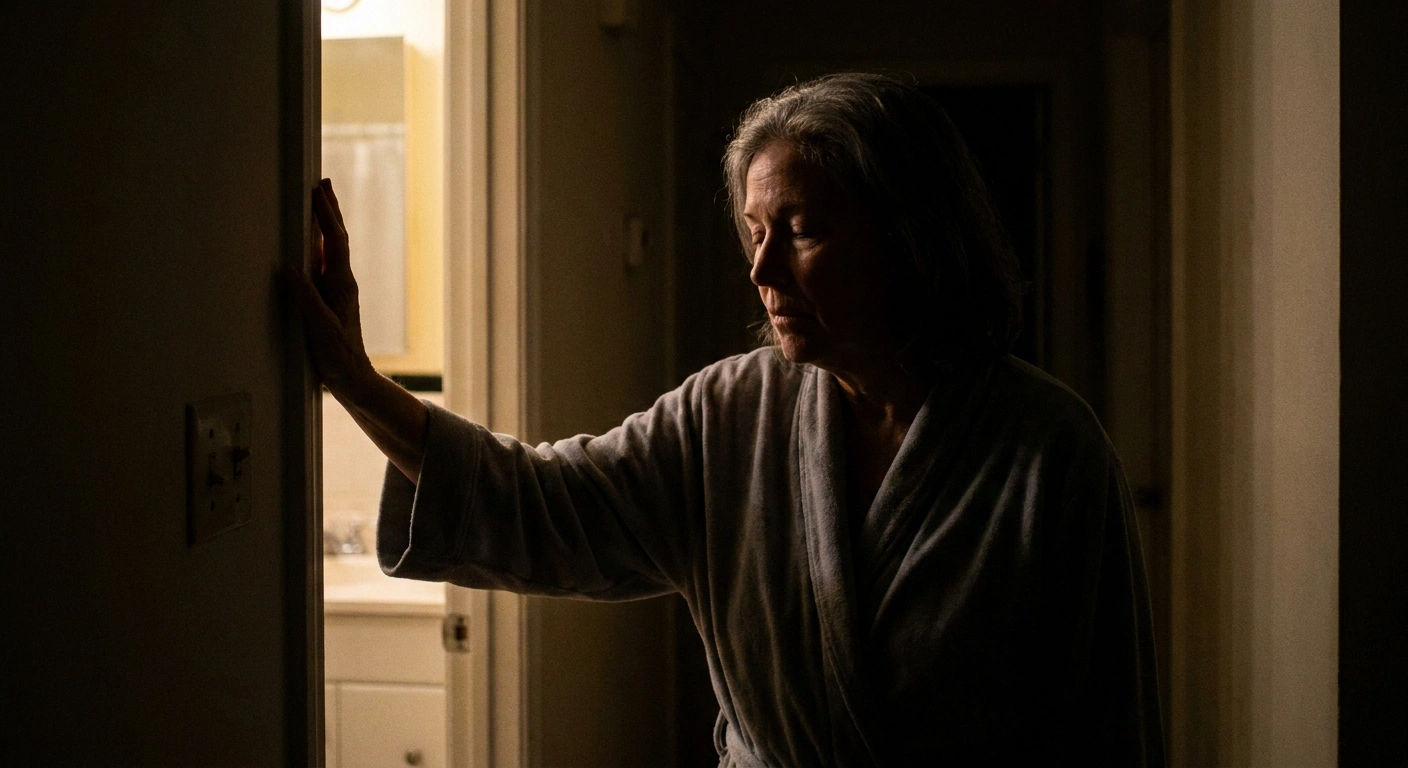
Almost nobody plans for the return, and it’s the more dangerous half.
Picture it. You’ve been in a bathroom with a bright overhead light for two or three minutes. Your eyes adapted to that. Now you switch it off and step into the hallway, and you have to walk it while your eyes are recovering — a recovery that takes noticeably longer than it used to.
Two fixes, and either one works:
Don’t use the bright bathroom light at night at all. Put a dim light in the bathroom on the same amber setting as the hallway, and your eyes never have to readjust in either direction.
Or, if you need the bright light, pause after you switch it off. Stand still, hand on the doorframe, and count to ten before you move. That’s not fussiness. It’s the length of time your eyes actually need, and it’s free.
The same logic applies at the top of a staircase, which is why stair safety and lighting are really the same subject.
What to Check on the Box
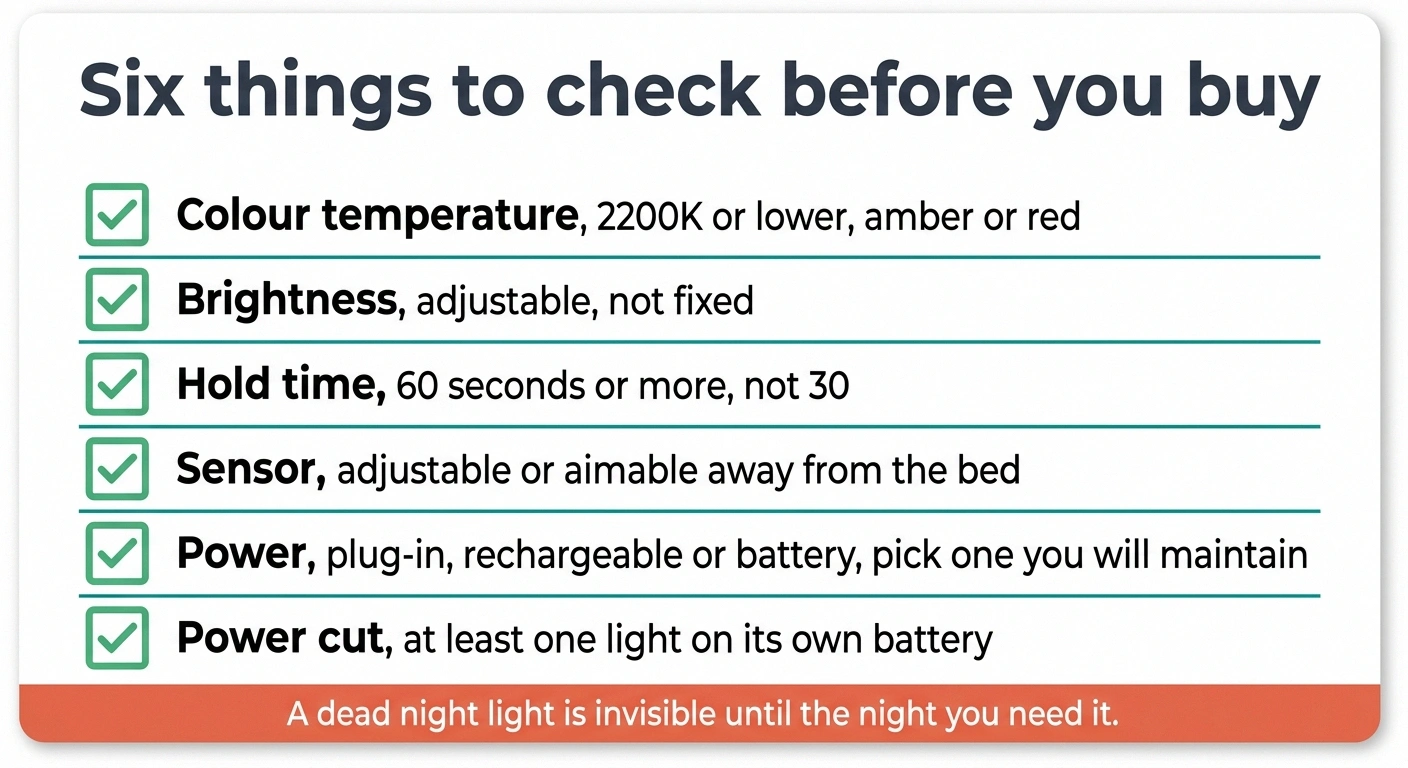
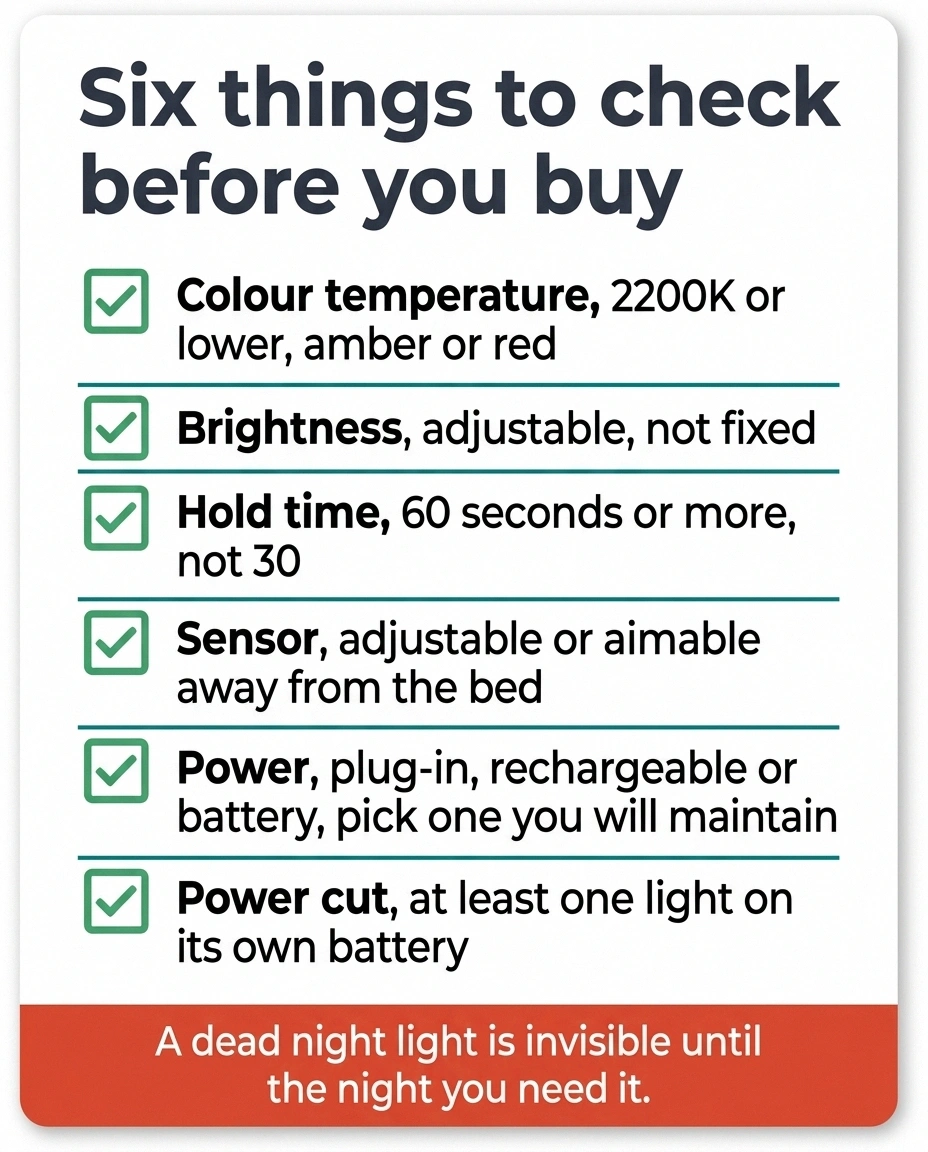
Specifications, not brands. Here’s what actually determines whether one of these things helps:
Inside the closet or wardrobe. Getting dressed in the early morning while the room is still dark means standing on one leg in poor light, which is a genuinely awkward combination when position sense is unreliable.
The kitchen floor, low down. Not the ceiling light. A dropped item, a spill, or a pet underfoot at 5 a.m. all sit below the level anything overhead reveals well.
The top and bottom stair. The two treads people misjudge most, and the two that reward a light at floor level rather than a fitting on the landing above.
The route from car to door. Uneven ground, a step, and often no light at all after dusk. A motion floodlight here does more for safety than another indoor fitting.
These four have something in common: each is a place where you change level or direction while carrying something, and both hands are already occupied.
Colour temperature. Look for 2200K or lower, or amber or red specifically. Anything described as “daylight,” “cool white,” or above 4000K belongs somewhere other than your night route.
Adjustable brightness. Rooms differ and so do nights. A fixed-output light will be wrong somewhere.
Sensor range and hold time. Hold time matters more than people expect. Thirty seconds is common, and thirty seconds is not enough for a slow walk down a hallway with a hand on the wall. Look for sixty seconds or more, or adjustable. A light that dies mid-route is worse than no light at all — because by then you were relying on it.
Sensor adjustability or aim. An oversensitive sensor pointed at the bed will fire every time you turn over. Being able to angle it away from the bed, or dial the sensitivity down, is the difference between a helpful device and one you unplug after a week.
Power source. Plug-in models never need charging but are stuck near outlets, which are rarely where you need light. Rechargeable magnetic strips go anywhere and need attention every few weeks. Battery models split the difference. Whichever you pick, put a recurring reminder on your phone, because a dead night light is invisible until the night you need it.
Behaviour in a power cut. Storms take out power, and a dark house you can’t navigate is exactly the scenario to plan for. At least one light on the route should run on its own battery.
What Lighting Can’t Fix
I’d be doing you a disservice if I let this read as a complete solution.
Lighting works only when you are looking at the hazard at the moment you pass it. Useful, and conditional on attention you may not have at 3 a.m.
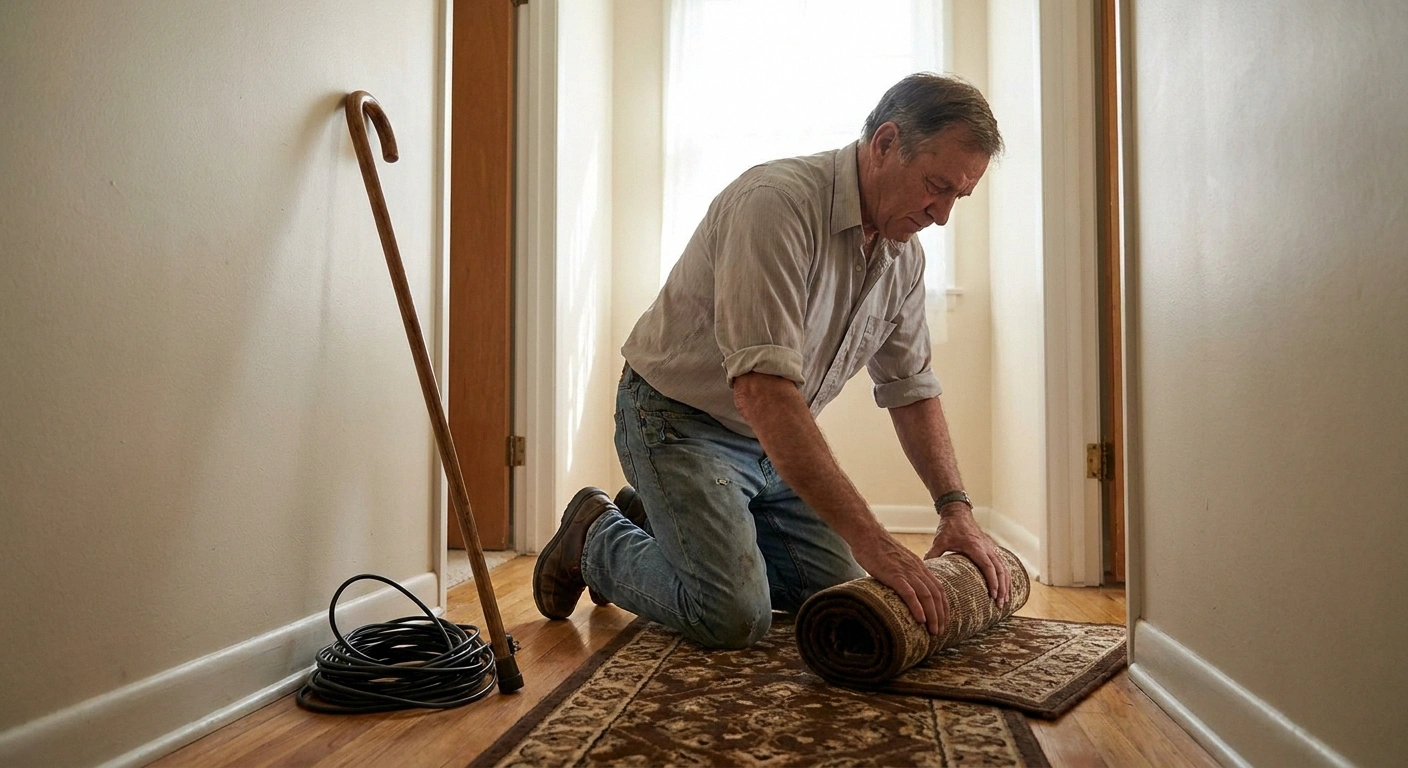
Removing the hazard works whether or not you are paying attention, every single time, permanently. This is why it outranks lighting rather than complementing it.
Something to hold gives your balance system a third input that does not depend on vision at all, which is exactly what is missing in the dark.
Ranked by how reliably each one works when you are half asleep: remove the hazard first, add something to hold second, light the route third. Most people do them in the reverse order because lighting is the easiest to buy.
Light makes hazards visible. It doesn’t remove them. A rug edge you can now see is still a rug edge, and if your feet can’t feel the moment they catch it, seeing it in advance only helps if you were looking down at that exact second. Removing it helps every time. The same goes for cords, low furniture, and the shoes nobody puts away, which is ground I covered in the room-by-room home safety guide.
Light also doesn’t replace something to hold. If you’re unsteady enough that a dark hallway frightens you, the honest answer might be a rail along that hallway, or keeping a cane beside the bed rather than by the front door where it’s no use at 3 a.m.
And it doesn’t substitute for the balance work itself. Lighting supports the system you have; training your balance improves it. People whose position sense has taken a real hit, the kind that shows up as sensory ataxia, get the most from doing both.
Start With One Light
If this feels like a project, shrink it.
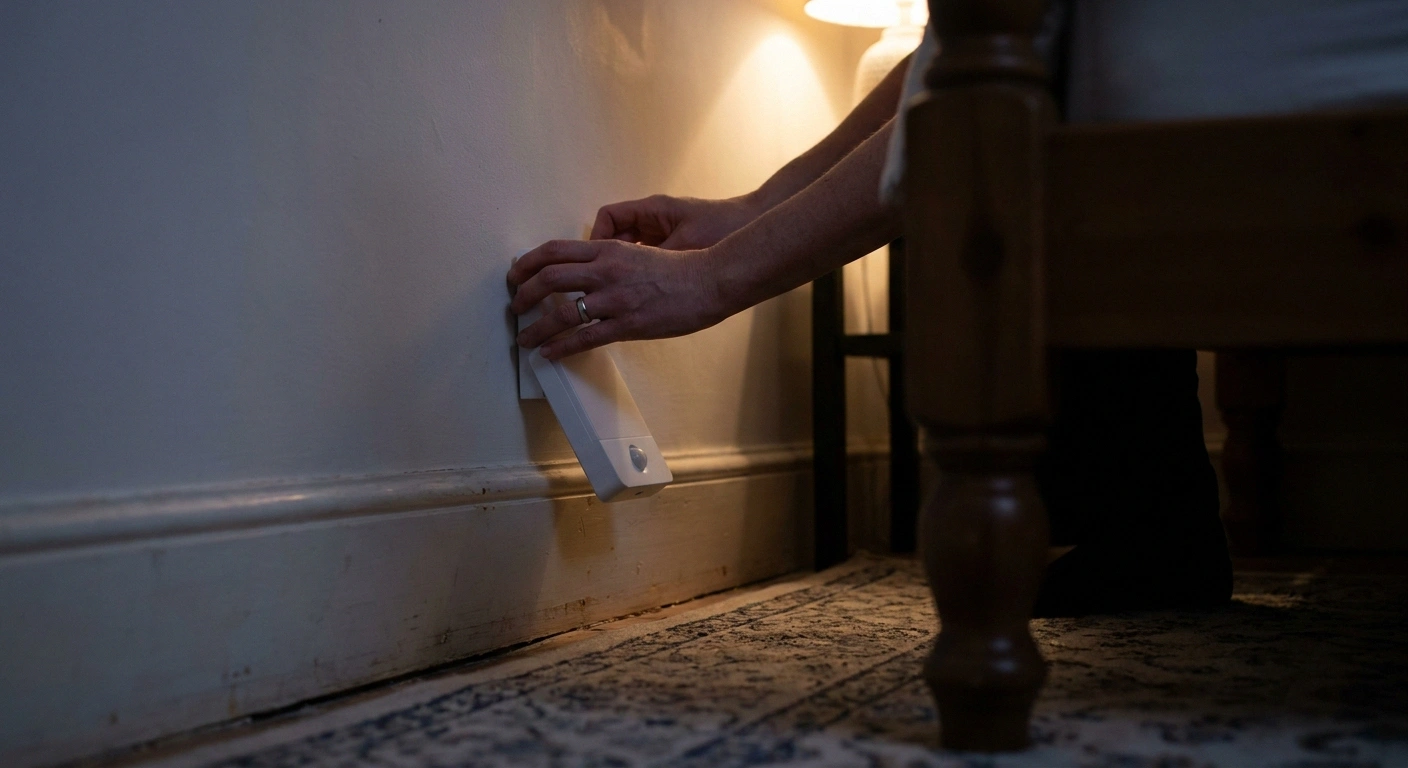
Buy one motion-activated amber light. Put it where you stand up — low down, aimed along the path rather than at the bed. Live with it for a week.
That single light covers the highest-risk seconds of the night, and it’ll teach you what you actually need next better than any list will. Some people find the bed-exit light is enough on its own. Others discover the real gap is a particular corner. You’ll know within a few nights.
The thing I’d want anyone to take from this: you aren’t being careful because you’re old, and you aren’t imagining that the dark is harder than it used to be. You’ve lost an input, your eyes have been covering for it, and turning on a light is how you give them what they need to keep doing the job. That’s not decline. That’s just working with the equipment you’ve got.
Frequently Asked Questions
Why is my balance so much worse in the dark?
Because vision has been compensating for the position sense your feet no longer provide. Balance draws on three inputs: proprioception from feet and joints, the inner ear, and the eyes. Neuropathy degrades the first, and the brain shifts the load onto vision without you noticing. Remove light and you remove the substitute, leaving only the inner ear. That is exactly what the Romberg test measures, and it is why standing with your eyes closed feels unstable while standing with them open does not.
What colour night light is best?
Amber or red, at 2200K or lower. Light above about 4000K, described as cool white or daylight, suppresses melatonin and makes returning to sleep harder. Red and amber wavelengths around 620 to 650 nanometres have far less effect on that pathway at low brightness. The trade-off is that warm dim light shows edges less sharply, which is why a separate brighter light on a switch is worth having for tasks that need detail.
How bright should a night light be?
Fall-prevention night lights typically produce around 3 to 8 lux at floor level, which is enough to orient by without waking you fully. Adjustable brightness is more useful than any single number, since a bedroom, a hallway and a bathroom each need something different.
Where should night lights go?
Three places, in order of importance: where you stand up beside the bed, along the path between bedroom and bathroom, and at the bathroom entrance. Mount them roughly six to twelve inches from the floor and aim the light along the route rather than across it. Low placement casts shadows that reveal raised edges, and keeps the bulb out of your direct line of sight.
Are motion sensor night lights worth it?
Generally yes, because they remove the need to find a switch in the dark. Two specifications decide whether one works for you. Hold time should be sixty seconds or more, since thirty seconds can expire mid-hallway. Sensitivity or aim should be adjustable, because an oversensitive sensor near the bed will trigger every time you turn over and wake you for nothing.
Why is the walk back from the bathroom harder?
Your eyes adapted to the bright bathroom light, and recovering from that adaptation takes longer with age. You end up walking a dark hallway during the worst few seconds of your visual recovery. Either avoid the bright light entirely by using a dim amber one in the bathroom too, or switch it off and stand still for a count of ten with a hand on the doorframe before you start walking.
Will night lights keep me awake?
Not if the colour and brightness are right. Dim amber or red light at floor level has minimal effect on melatonin. Motion-activated lights that stay off until you move help further, provided the sensor is not aimed at the bed. Cool white or blue-toned lights, and anything bright enough to read by, are the ones that cost you sleep.
Do I still need to remove rugs if I add lighting?
Yes. Lighting makes a hazard visible; it does not remove it. Seeing a rug edge only helps if you happen to be looking at the floor at that moment, whereas removing it helps every single time. Treat lighting and hazard removal as two separate jobs, and do both.
About the Author