
Nearly every treatment for hereditary transthyretin amyloidosis works the same way at a structural level. You take it, it holds the disease back, and if you stop taking it the disease resumes. An injection every three weeks, or every three months, or a capsule every morning, indefinitely.
Nexiguran ziclumeran proposes something different. One infusion, once, which changes the DNA inside your liver cells so they stop making the faulty protein at all. There is no maintenance schedule because there is nothing to maintain.
That is the promise, and it is a genuinely significant one. It also comes with a safety history that anyone reading about this drug deserves to have laid out plainly, including a patient death during a Phase 3 trial in late 2025 and the clinical holds that followed. Both halves of that story are below.
Nexiguran ziclumeran, usually shortened to nex-z and previously known as NTLA-2001, is investigational. It is not approved by the FDA or any other regulator for any use, and the only route to receiving it is enrolment in a clinical trial.
Why the Liver Is the Target for a Nerve Disease
Hereditary transthyretin amyloidosis begins with an inherited variant in the TTR gene. That gene produces transthyretin, a transport protein that carries thyroid hormone and vitamin A around the bloodstream.
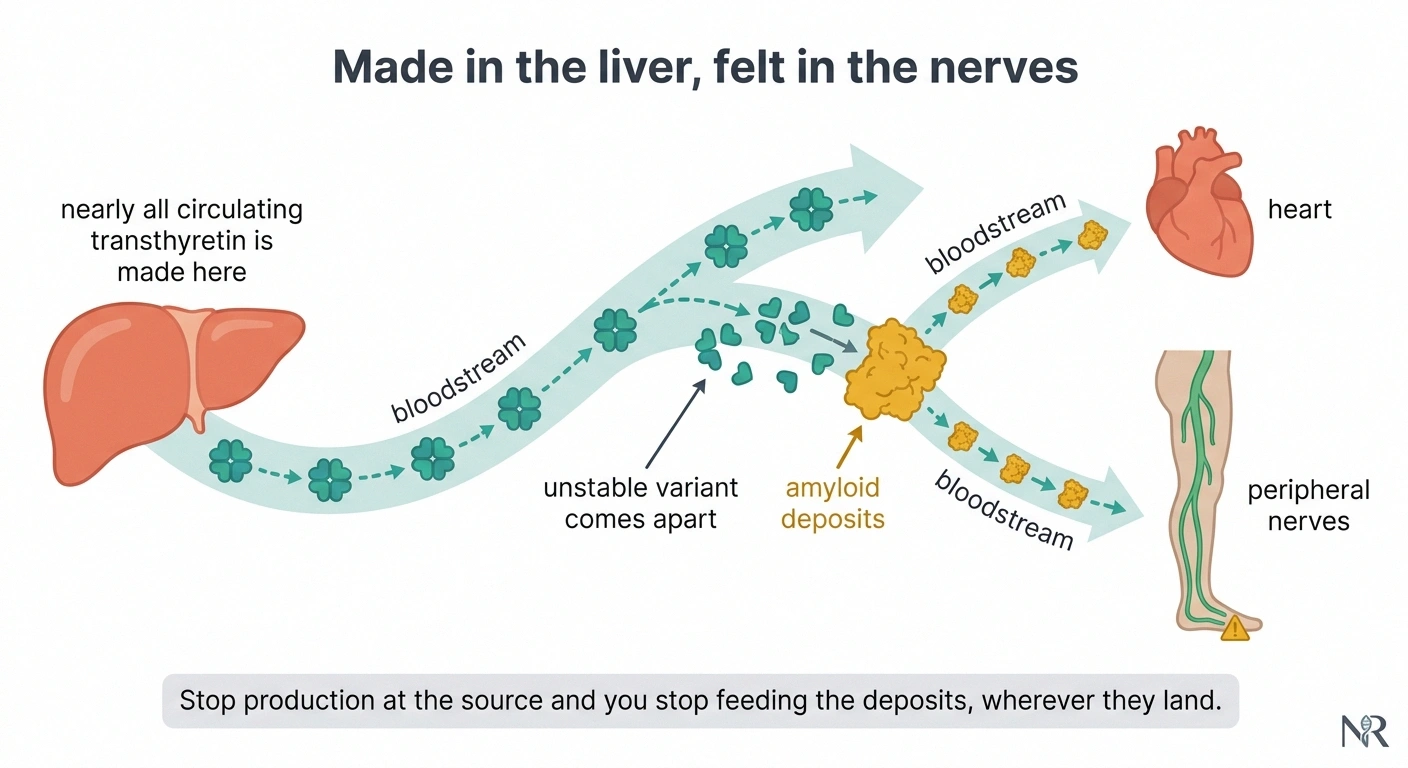
The variant makes the protein unstable. Instead of holding its normal four-part structure, it comes apart and the loose pieces misfold and clump together into amyloid deposits. Those deposits accumulate in tissue, and two tissues suffer most: the heart, and the peripheral nerves.
When nerves take the brunt of it, the condition is called ATTRv-PN, hereditary ATTR amyloidosis with polyneuropathy. It typically starts with numbness, burning and loss of temperature sensation in the feet, then progresses upward and eventually affects motor function and the autonomic nerves that control blood pressure, digestion and bladder function. Untreated, it is progressive and eventually disabling. Our overview of amyloid neuropathy covers the presentation and diagnosis in more depth.
Here is the part that makes a liver-directed treatment sensible for a nerve disease. Almost all of the transthyretin circulating in your blood is manufactured in the liver. The liver is producing the faulty protein; the nerves are simply where it ends up doing damage. Shut down production at the source and you stop feeding the process, wherever the deposits are landing.
This principle is not new to nex-z. It is why liver transplantation was the original treatment for this disease decades ago, and it is the logic behind every modern drug in the category.
What Happens Inside a Liver Cell
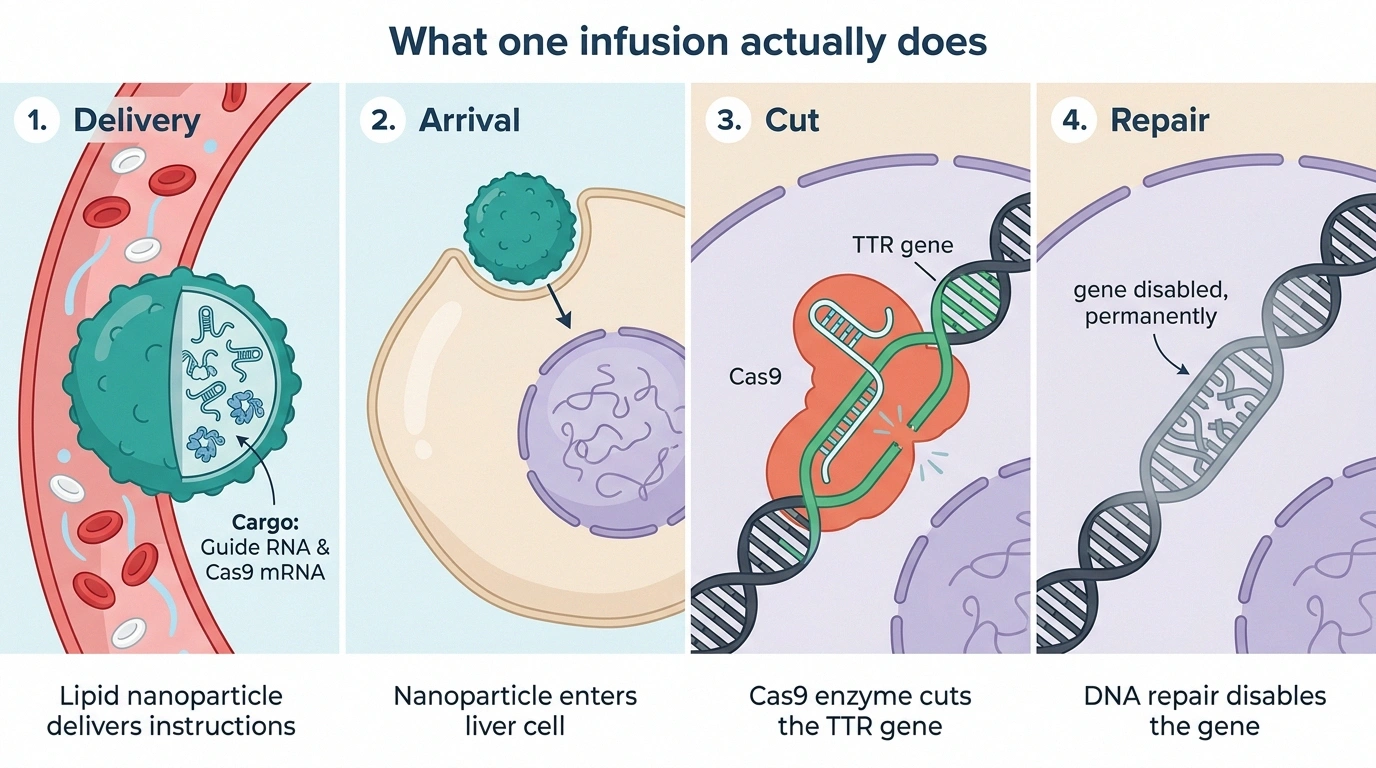
Nex-z is an in vivo CRISPR-Cas9 gene editing therapy. Two parts of that phrase are doing real work.
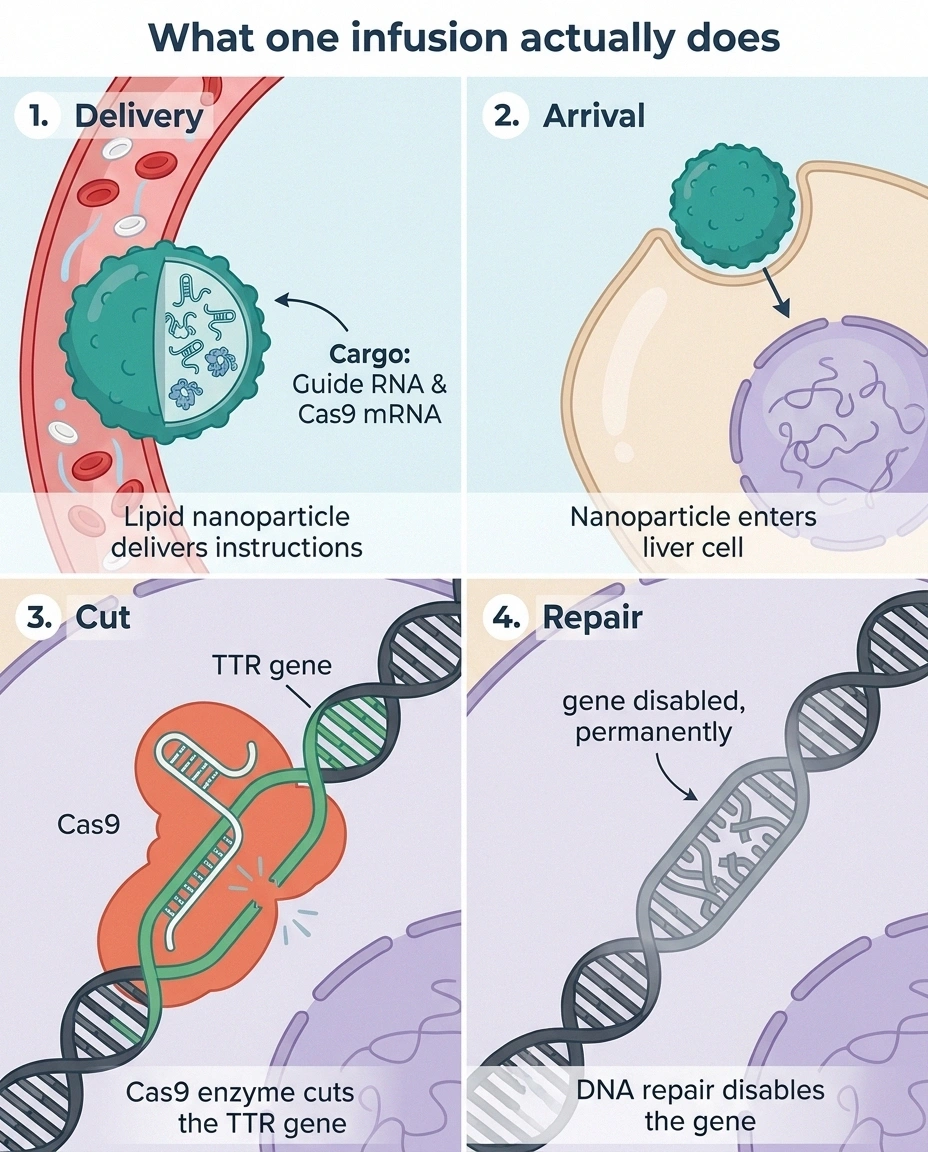
One infusion, four steps, no second dose
- Infusion. Lipid nanoparticles carrying CRISPR components enter the bloodstream.
- Arrival. Those particles accumulate in the liver, which is where they naturally end up and where the drug needs to be.
- Cut. A guide molecule steers the Cas9 enzyme to the TTR gene out of roughly three billion letters of DNA. Cas9 cuts.
- Repair. The cell patches the cut imprecisely, leaving the gene disabled. That cell can no longer make transthyretin, and neither can any cell it divides into.
Step 4 is the one that has no undo. Every other ATTR treatment can be discontinued; this cannot.
In vivo means the editing happens inside your body. Some gene therapies remove cells, edit them in a laboratory, and return them. Nex-z does not. It is given as an intravenous infusion, and the editing occurs in your own liver where those cells already sit.
CRISPR-Cas9 is the editing tool itself. Cas9 is an enzyme that cuts DNA. A guide molecule steers it to one specific sequence out of the roughly three billion letters in the genome. In this case, the target is the TTR gene.
Delivery is handled by a lipid nanoparticle, a microscopic fat bubble carrying the CRISPR components. Lipid nanoparticles naturally accumulate in the liver after intravenous infusion, which is convenient here because the liver is exactly where the drug needs to go.
Once inside a liver cell, Cas9 cuts the TTR gene. The cell repairs the cut, and that repair process is imprecise enough to leave the gene disabled. The cell can no longer produce functional transthyretin.
The consequence worth understanding is permanence. The edit is written into the DNA of that cell, and it stays there through every subsequent cell division. There is no washout period and no way to reverse it if you later decide you would rather not have had it done. That cuts in both directions, and it is the central thing that distinguishes this drug from everything else in the category.
Where It Sits Beside the Approved Drugs
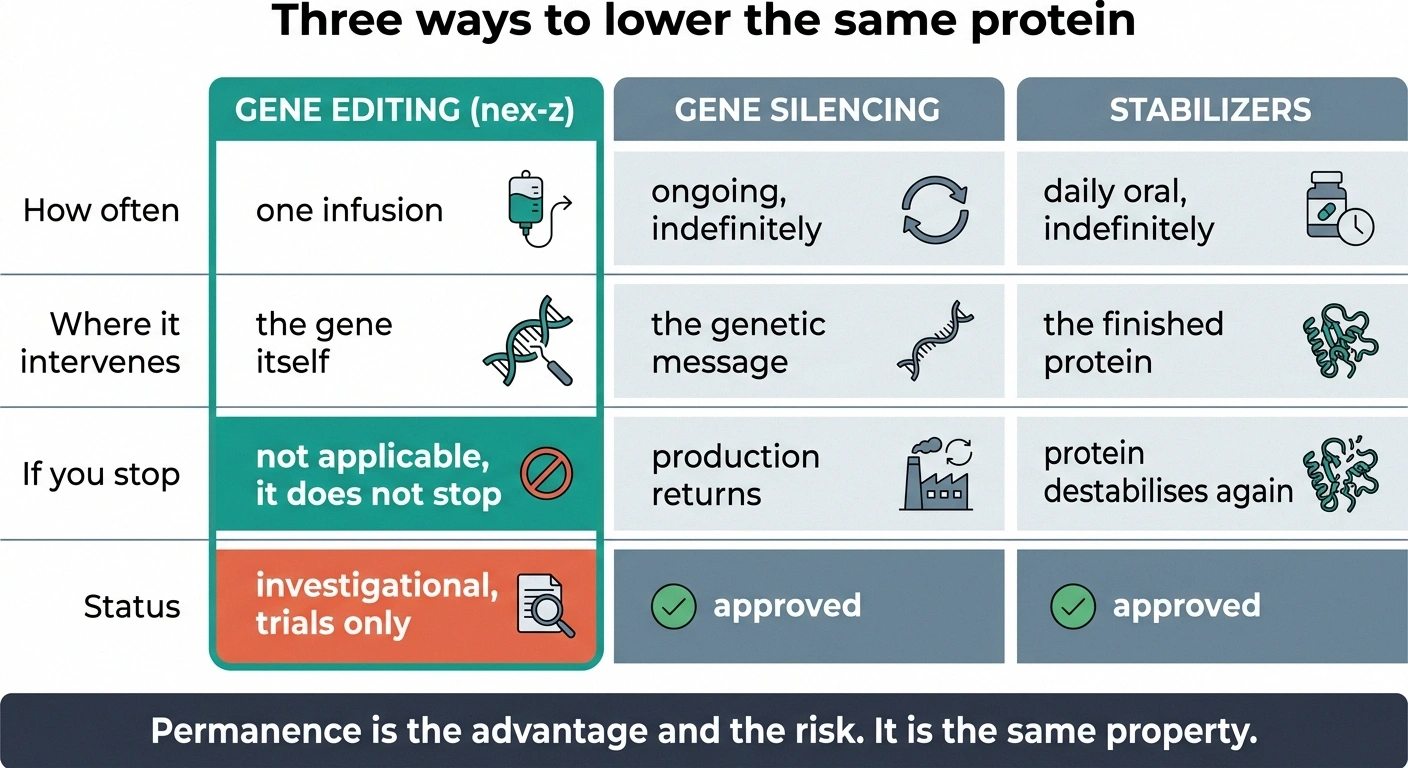
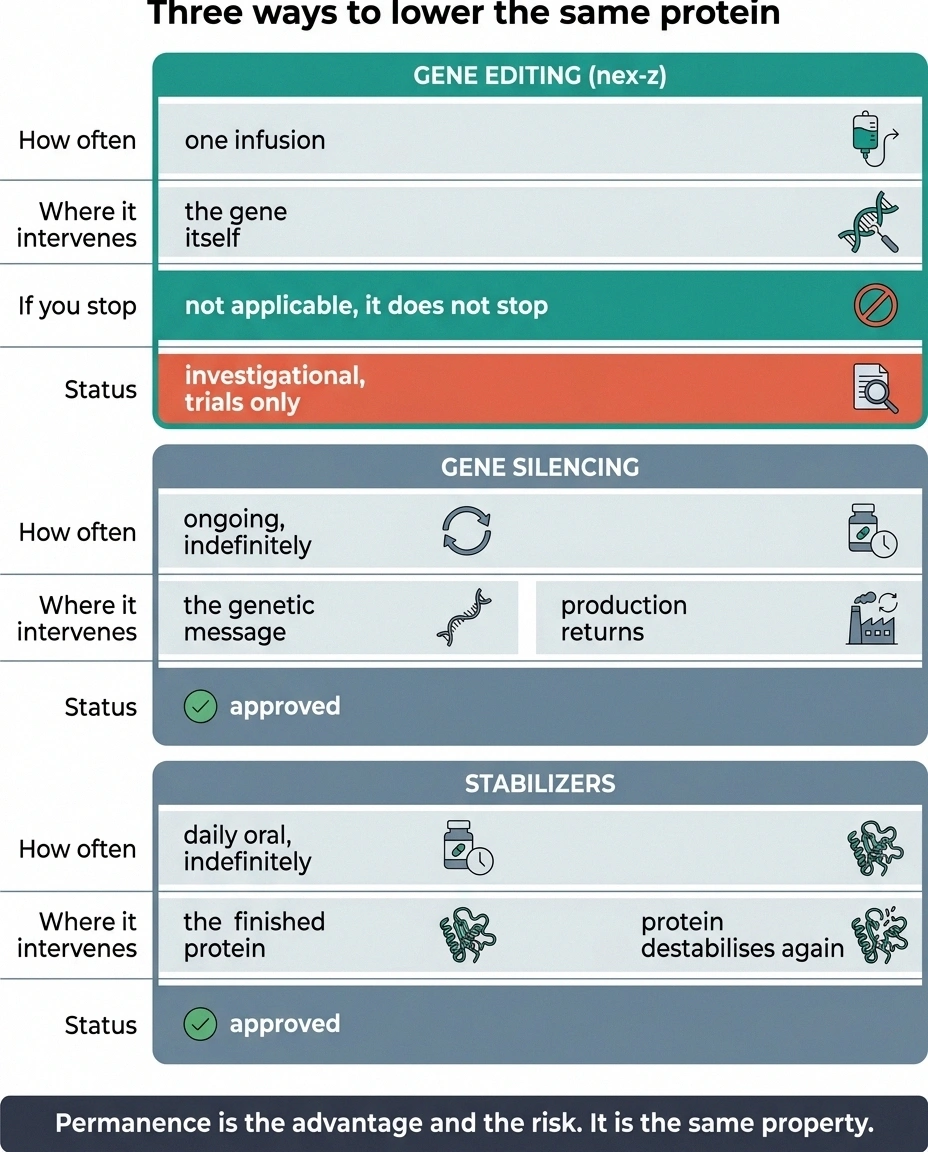
Several treatments for hereditary ATTR polyneuropathy already exist and are approved. They fall into two mechanisms, and nex-z is a third.
| Approach | How often | What it does | If you stop |
|---|---|---|---|
| Gene editing nex-z | One infusion | Disables the TTR gene in liver cells permanently | Not applicable. It does not stop. |
| Gene silencing siRNA and antisense drugs | Ongoing, indefinitely | Intercepts the genetic message before the protein is built | Protein production returns |
| Stabilizers | Daily oral, indefinitely | Binds the protein and holds it in shape so it misfolds less | Protein destabilises again |
The silencers are the closest comparison, because they aim at the same thing, reducing circulating transthyretin. The difference is where they intervene. A silencer degrades the messenger copy of the instruction, which means fresh messengers keep being made and the drug has to keep being given. An edit removes the instruction itself.
For a patient, that difference shows up as treatment burden. Regular infusions or injections, clinic visits, insurance authorisations, and the risk that a missed period of treatment lets the disease advance. A one-time therapy removes all of that.
What it removes in the other direction is the ability to stop. Every existing drug can be discontinued if it is not tolerated. This one cannot, and that is a real trade rather than a technicality.
What the Phase 1 Data Showed
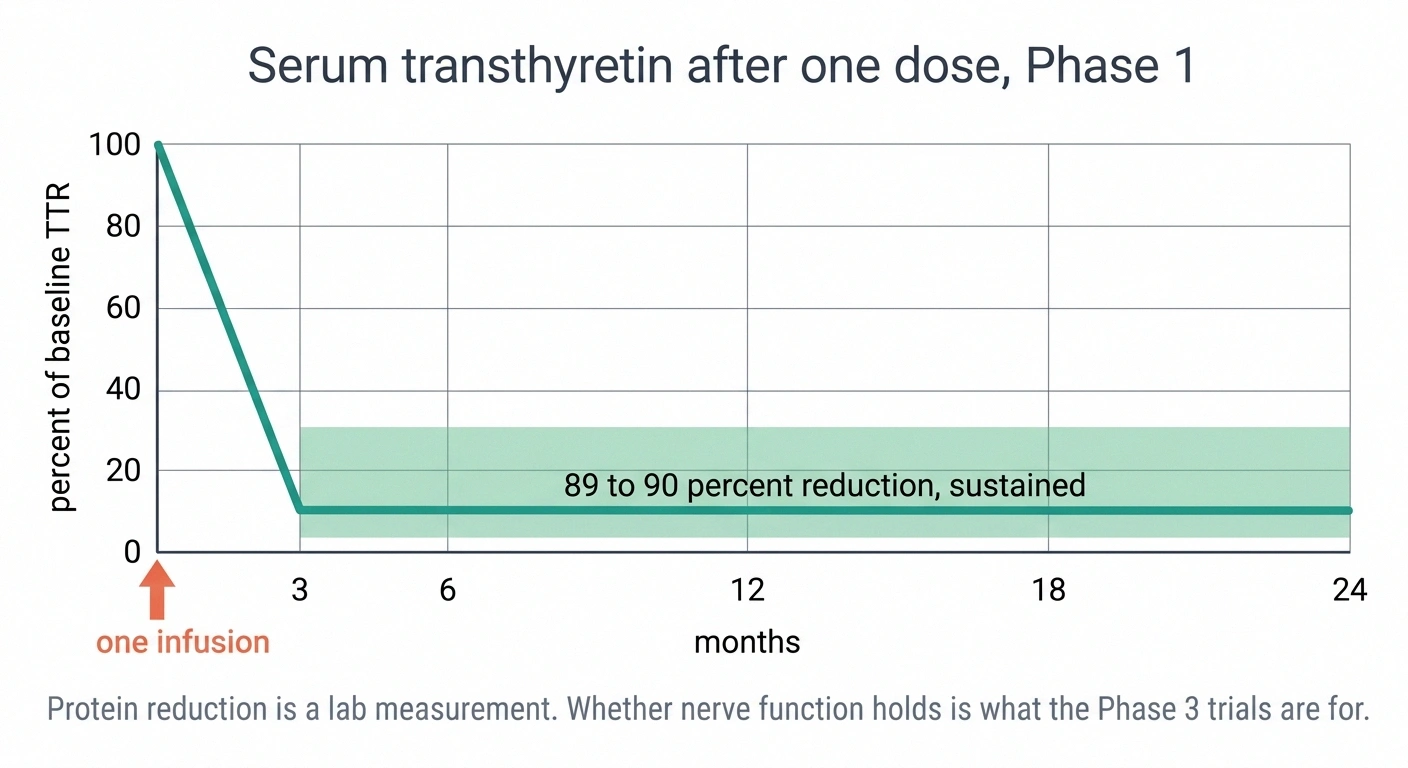
The early results were the reason this drug attracted so much attention.
In Phase 1, nex-z produced serum transthyretin reductions of roughly 89 to 90 percent, and those reductions were sustained at 24 months after a single dose. That durability is the whole proposition demonstrated in practice: one infusion, two years later, protein still suppressed by close to 90 percent.
Longer-term Phase 1 data in patients with the cardiac form showed stable or improved cardiac biomarkers alongside a safety profile the company described as manageable. Results in ATTR cardiomyopathy were published in the New England Journal of Medicine. Separate Phase 1 findings in patients with polyneuropathy were reported as showing promise, and Intellia has stated there is early clinical evidence that nex-z may favourably affect disease progression.
Two cautions belong with those numbers, and neither is a criticism of the drug.
Phase 1 trials are small and, in this case, not placebo-controlled. Reducing a protein is a laboratory measurement, not a clinical outcome, and the question that matters to a person with this disease is whether nerve function holds up over years. Only the Phase 3 trials can answer that.
The other caution is that a large share of the published long-term data concerns the cardiac form of the disease rather than the neuropathy form. The mechanism is the same and the reasoning carries across, but they are different trials with different endpoints, and the nerve data is at an earlier stage.
MAGNITUDE-2, the Trial That Matters for Nerves
MAGNITUDE-2 is the Phase 3 study in hereditary ATTR amyloidosis with polyneuropathy. It is randomized, double-blind and placebo-controlled, which is the design that produces answers rather than impressions.
Target enrolment was originally about 50 patients and has since been raised to approximately 60. Enrolment completion was expected during the first half of 2026.
Its larger sibling, MAGNITUDE, studies the cardiomyopathy form and enrolled several hundred patients. The two trials share a drug and a manufacturer, and they are frequently conflated in press coverage, so it is worth holding them apart. What happened next happened in the cardiac trial.
If you are considering trial participation generally, our guide to finding and joining neuropathy clinical trials covers screening, randomisation and the questions worth asking beforehand.
The Pause, the Death, and What Followed
This section is deliberately specific, because vague summaries of it are circulating and they mislead in both directions.
The safety sequence, dated
Coverage of this drug frequently omits the last two rows, which changes the meaning of the first three.
| 30 Sep 2025 | Patient dosed in MAGNITUDE, the cardiomyopathy trial |
| ~3 weeks later | Grade 4 liver transaminases and raised bilirubin. Hospitalised. |
| 29 Oct 2025 | Intellia pauses voluntarily. FDA places holds on both trials. |
| 5 Nov 2025 | The patient dies. Man in his early 80s, high BMI, comorbidities noted by his physician. |
| 27 Jan 2026 | FDA lifts the hold on MAGNITUDE-2, the neuropathy trial. Enhanced liver monitoring added; enrolment target raised from ~50 to ~60. |
| 2 Mar 2026 | FDA lifts the hold on MAGNITUDE. Both trials running. |
A patient in the MAGNITUDE trial, the cardiomyopathy study, was dosed with nex-z on 30 September 2025. Roughly three weeks after the infusion, that patient developed Grade 4 liver transaminase elevations along with raised total bilirubin. Grade 4 is the most severe category short of death in standard adverse event grading. The patient was hospitalised and monitored closely.
On 29 October 2025, Intellia voluntarily paused dosing and screening in both MAGNITUDE and MAGNITUDE-2, and the FDA placed clinical holds on both trials.
On 5 November 2025, the patient died. He was a man in his early eighties with a high body mass index, and according to the treating physician the case involved complicating comorbidities.
On 27 January 2026, the FDA lifted the clinical hold on MAGNITUDE-2, the polyneuropathy trial, after Intellia agreed a set of study modifications and mitigation measures including enhanced monitoring of liver laboratory tests. On 2 March 2026, the hold on MAGNITUDE was also lifted. Both trials resumed.
How to Read That Safety Story

Two facts sit alongside the death, and leaving out either one distorts the picture.
of all MAGNITUDE patients had Grade 4 liver transaminase elevations
Grade 4 elevations reported in MAGNITUDE-2, the polyneuropathy trial
Both figures matter. Drop the first and the risk looks routine; drop the second and it looks like it happened in the nerve trial. It did not.
The first: Grade 4 liver transaminase elevations were reported in fewer than 1 percent of all patients enrolled in MAGNITUDE. This was a rare event, not a pattern affecting a substantial fraction of patients.
The second: no Grade 4 liver transaminase elevations had been reported in MAGNITUDE-2, the polyneuropathy trial. The event that triggered both holds happened in the cardiac study, in a population that is generally older and carries more cardiac and metabolic comorbidity than the polyneuropathy population.
Neither fact makes the death less serious. A person went into a trial and did not come out of it, and that is the outcome every safety system exists to prevent.
What the sequence does show is a safety system doing what it is designed to do. A protocol-defined pausing threshold was crossed. The sponsor halted voluntarily. The regulator imposed a formal hold. The event was investigated, the protocol was modified with enhanced liver monitoring, and the trials only restarted once the FDA was satisfied. That is the process functioning, not failing.
The honest summary is this. Liver toxicity is a recognised and monitored risk with this therapy. It is uncommon. It has been severe in at least one case. Enhanced liver monitoring is now built into the protocol specifically because of it. Anyone considering enrolment should expect that risk to be discussed in detail during consent, and should ask about it directly if it is not raised.
The status of this drug, stated plainly
Nex-z is investigational. It has no FDA approval for any indication, it cannot be prescribed, and it is not available outside a clinical trial. Anyone currently taking an approved treatment for hereditary ATTR amyloidosis should not stop or alter it based on anything in this article. Trial eligibility also requires genetic confirmation of a TTR variant, which is a specific test rather than an assumption based on family history.
Who This Might Eventually Be For
MAGNITUDE-2 enrols people with genetically confirmed hereditary ATTR amyloidosis with polyneuropathy. Exact criteria for disease stage, prior treatment and organ function are set by the protocol and change over time, so the trial registry is the only reliable source for current requirements.
Some general observations hold regardless of the fine print.
Genetic confirmation is not optional. Hereditary ATTR is caused by a specific inherited variant in TTR, and the wild-type form of the disease, which is far more common and not inherited, is a different condition with different trial eligibility. This distinction is missed frequently, including in the assumption that a family history of similar symptoms is sufficient evidence.
This disease is also badly underdiagnosed. Its early neuropathy symptoms look exactly like other length-dependent neuropathies that start in the feet, and many people carry an idiopathic or diabetic label for years before anyone tests for amyloidosis. Red flags that should prompt the question include neuropathy alongside unexplained heart failure, carpal tunnel syndrome in both hands preceding the neuropathy, unexplained weight loss, or autonomic symptoms such as postural dizziness and early satiety appearing together with foot numbness.
Care for this condition is concentrated in specialist amyloidosis and neuromuscular centres, and those centres are also where the trials are run. A referral to one is the practical first step for anyone in this situation, independent of any interest in gene editing.
What Nobody Knows Yet

Honest uncertainty, in the order it matters.
Whether it preserves nerve function. Lowering transthyretin by 90 percent is established. Whether that translates into meaningfully slower neuropathy progression over years, and whether it beats the approved silencers on that measure, is what MAGNITUDE-2 exists to determine and is not yet known.
How long is genuinely forever. Durability is documented to 24 months. The biology suggests the edit should persist for the life of the edited cells and their descendants, but decades of human follow-up data do not yet exist for any in vivo CRISPR therapy, because none has been in people that long.
What the liver signal ultimately means. One severe case with confounding comorbidities is not enough to characterise a risk precisely. The enhanced monitoring now in the protocol is partly there to generate that understanding.
Whether reduced transthyretin causes problems of its own. Transthyretin does a job. It transports thyroid hormone and, with retinol binding protein, vitamin A. Suppressing it near-completely and permanently is a larger intervention than suppressing it reversibly, and long-term consequences remain under study.
Cost and access. Entirely unknown, since the drug is unapproved. One-time gene therapies for rare diseases have historically carried very high prices, and how that interacts with insurance for a treatment that replaces years of expensive maintenance therapy is unresolved.
For the wider set of therapies moving through development for nerve disease, our 2026 neuropathy drug pipeline guide tracks what else is in trials, and our overview of newly approved neuropathy treatments covers what has actually reached patients.
The Reasonable Position
Nex-z is one of the most consequential things happening in nerve disease research, and it is also unfinished.
The mechanism is sound, the protein reduction is dramatic and durable, and the trial design is rigorous enough to produce a real answer. Against that sits a permanent intervention with a documented severe liver risk and no clinical outcome data yet in polyneuropathy.
If you have hereditary ATTR with polyneuropathy, the actionable step is not waiting for this drug. It is being seen at a specialist amyloidosis or neuromuscular centre, starting or continuing an approved treatment, and discussing trials there with people who know the current protocols. Treatments that exist today and work reasonably well should not be deferred for one that might be approved in several years.
If you are watching this because a family member carries the variant, the useful move is genetic counselling and a conversation about surveillance. By the time this therapy is available, if it is, knowing your status will matter far more than knowing the trial results. Research on how close a genuine neuropathy cure might be puts this work in its broader context.
Frequently Asked Questions
What is nexiguran ziclumeran?
Nexiguran ziclumeran, shortened to nex-z and formerly called NTLA-2001, is an investigational in vivo CRISPR-Cas9 gene editing therapy developed by Intellia Therapeutics for transthyretin amyloidosis. It is delivered as a single intravenous infusion using a lipid nanoparticle that carries the editing components to the liver, where it inactivates the TTR gene so liver cells stop producing the transthyretin protein that forms amyloid deposits.
Is nex-z approved or available to patients?
No. Nex-z has not been approved by the FDA or any other regulator for any indication. It cannot be prescribed and is only available through enrolment in a clinical trial. The Phase 3 trial in hereditary ATTR amyloidosis with polyneuropathy is MAGNITUDE-2, and a separate Phase 3 trial called MAGNITUDE studies the cardiomyopathy form.
How is gene editing different from the ATTR drugs already approved?
Approved treatments fall into two groups. Gene silencing drugs intercept the genetic message before the protein is made, and stabilizers bind the protein and hold it in shape. Both require ongoing dosing indefinitely, and their effect reverses if treatment stops. Nex-z changes the DNA in liver cells permanently after a single infusion, so there is no maintenance schedule and no way to reverse it.
What happened with the patient death in the nex-z trial?
A patient in the MAGNITUDE cardiomyopathy trial was dosed on 30 September 2025 and developed Grade 4 liver transaminase elevations with raised bilirubin about three weeks later. Intellia paused both trials on 29 October 2025 and the FDA imposed clinical holds. The patient, a man in his early eighties with a high body mass index and comorbidities noted by the treating physician, died on 5 November 2025. Grade 4 liver enzyme elevations occurred in under 1 percent of MAGNITUDE patients, and none had been reported in the polyneuropathy trial.
Are the nex-z trials still on hold?
No. The FDA lifted the clinical hold on MAGNITUDE-2, the polyneuropathy trial, on 27 January 2026, after Intellia agreed study modifications including enhanced monitoring of liver laboratory tests and raised target enrolment from about 50 to about 60 patients. The hold on the MAGNITUDE cardiomyopathy trial was lifted on 2 March 2026. Both trials have resumed.
How much does nex-z reduce transthyretin?
Phase 1 data showed serum transthyretin reductions of roughly 89 to 90 percent, sustained at 24 months after a single dose. Longer-term Phase 1 results in the cardiomyopathy population also showed stable or improved cardiac biomarkers. Reducing the protein is a laboratory measurement rather than a clinical outcome, and whether this translates into slower nerve damage over years is what the Phase 3 trials are designed to establish.
Can the gene edit be reversed if there is a problem?
No. The edit is written into the DNA of the liver cells and persists through cell division, so it cannot be undone or discontinued. This permanence is the therapy's main advantage over treatments requiring indefinite dosing, and it is also its main risk, because every approved alternative can be stopped if it is not tolerated.
Do I need genetic testing to be considered for this trial?
Yes. MAGNITUDE-2 enrols people with genetically confirmed hereditary ATTR amyloidosis with polyneuropathy, which requires identifying a specific inherited variant in the TTR gene. Family history of similar symptoms is not sufficient. The wild-type form of ATTR amyloidosis, which is more common and not inherited, is a separate condition with different trial eligibility.
About the Author