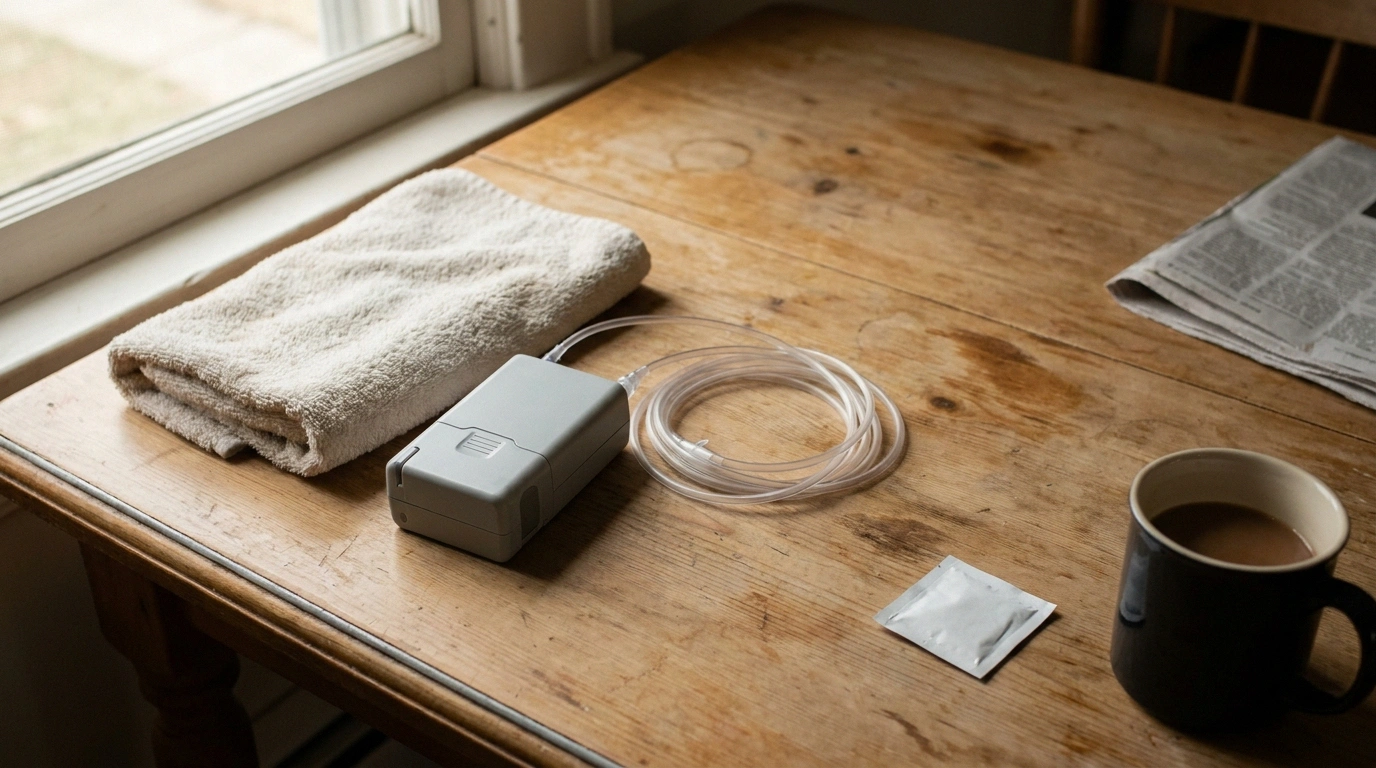
The first thing that changes is your calendar.
If you have been on IVIG for CIDP, you already know the shape of your month. There is the day. Maybe two days. You clear the morning, you arrange the ride, you sit in the chair for four or five or six hours, and then you spend the next day or two finding out what the infusion is going to charge you in headaches and fatigue. Everything else in your life gets arranged around that block.
Subcutaneous immunoglobulin takes that block and shreds it into confetti. Small doses. Under the skin, not into a vein. Usually at your own kitchen table, usually weekly, usually in under an hour. The drug is the same class of medicine. Almost nothing else about the experience is the same.
That trade is the actual decision in front of you, and it is a lot more interesting than the brochures make it sound. So let me lay out what the two available options really are, what the trials found, and the questions worth asking before you agree to anything.
What Subcutaneous Immunoglobulin Actually Is
Immunoglobulin therapy is pooled human antibodies, collected from thousands of plasma donors and purified. In CIDP, an autoimmune condition where your own immune system attacks the myelin insulation around your peripheral nerves, those donated antibodies interrupt the attack. Exactly how is still debated. That it works is not.
The traditional delivery route is intravenous. IVIG puts a large dose directly into your bloodstream over several hours, typically every three or four weeks.
Subcutaneous delivery does something different. The immunoglobulin goes into the fatty layer just under your skin, the same tissue plane where insulin goes. From there it seeps into your circulation over the following hours and days. Because that tissue can only absorb so much at once, the dose has to be smaller and the schedule has to be more frequent.
Which is the whole story, mechanically. Everything that follows, all the differences in side effects and scheduling and how you feel at week three, traces back to that one fact.
The Peak and Trough Problem
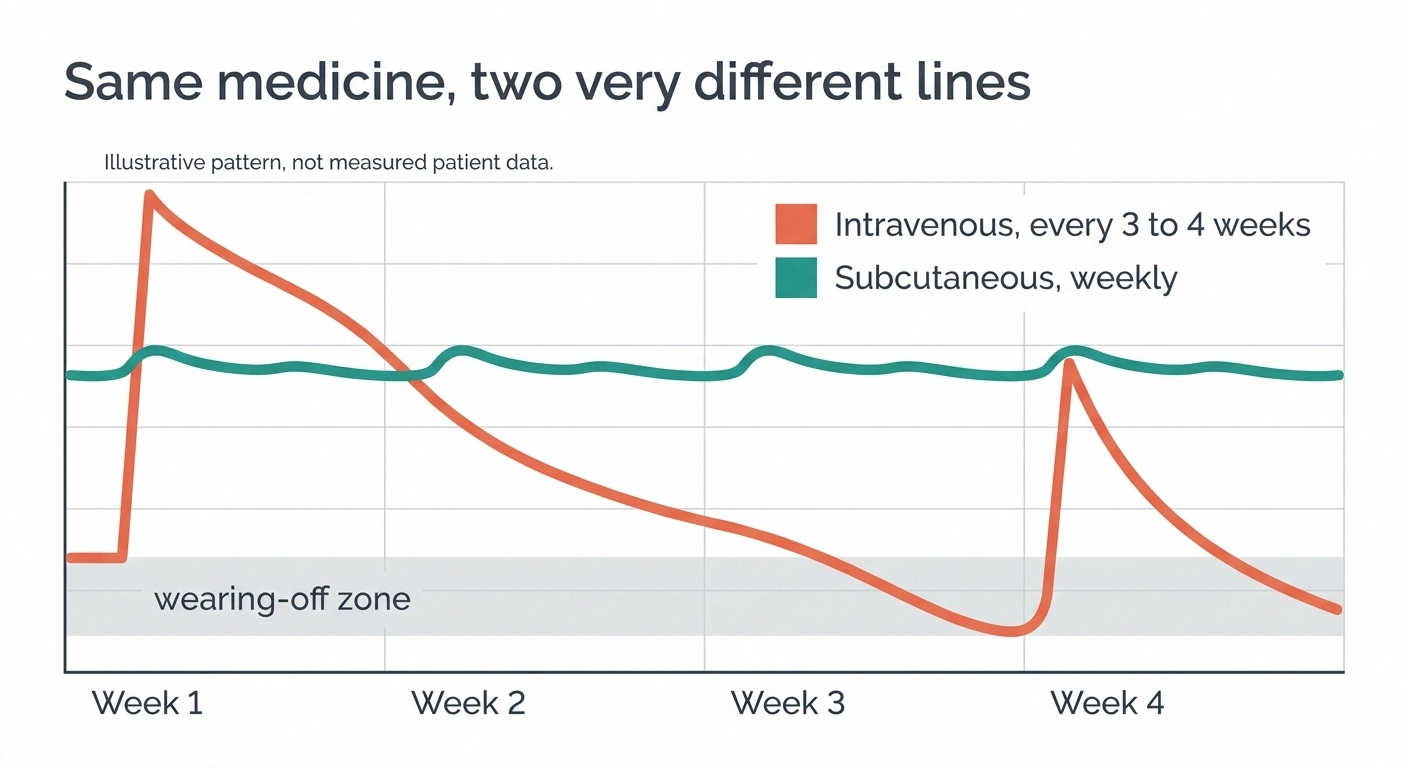
Picture your antibody level as a line on a graph.
Intravenous rhythm
Every 3 to 4 weeks
One large dose creates a peak far above your natural level, then a three-week decay. Roughly 12 to 17 infusion days a year, each one costing a chunk of the day around it. The last week before the next dose is where wearing-off symptoms cluster.
Subcutaneous rhythm
Weekly, or on a set interval
Small doses hold a nearly flat level with no peak and no trough. Around 52 sessions a year on a weekly product, but each one is short and happens at home. There is no reserve to coast on, so a skipped week is a real gap rather than a delay.
With IVIG, that line looks like a sawtooth. Infusion day sends it straight up to a peak far above where your body would ever naturally sit. Then it decays. By the end of week three, or into week four, it has fallen a long way down, and this is the stretch where a lot of people describe the wearing-off: the numbness creeping back, the stairs getting harder, the grip going. Then the next infusion resets it, and the sawtooth repeats.
With SCIG, that line is nearly flat. Smaller doses more often means the peaks never spike and the troughs never drop. Your level just sits there.
Two consequences fall out of this. The first is that a lot of the classic IVIG side effect load, the pounding headache, the flu-like day after, the rare but real aseptic meningitis, appears to be driven by the size and speed of the peak. Take away the peak and much of that goes with it. The second is subtler and matters more to daily life: people who had a predictable bad stretch before every infusion often stop having it. Not because the drug got stronger, but because the valley they were falling into stopped existing.
The cost of a flat line is that you cannot skip. A missed IVIG infusion is a delay. A missed SCIG week is a genuine dip in coverage, because there is no stored peak to coast on.
The Two Products, and Why They Are Not Interchangeable
Two subcutaneous immunoglobulin products carry a CIDP indication in the United States, and they solve the same problem in opposite directions.
The two CIDP-indicated subcutaneous products, side by side
Figures reflect product labeling and trial practice. Your prescriber sets your actual site count, volume, and interval.
| Hizentra | HyQvia | |
|---|---|---|
| Concentration | 20% immunoglobulin | 10% immunoglobulin plus recombinant human hyaluronidase |
| CIDP schedule | Weekly | Less frequent maintenance dosing |
| Infusion sites | Up to 8 simultaneously; about 4 was typical in CIDP trials | 1 or 2 |
| Volume ceiling | Limited per site; volume is spread across sites | Up to 600 mL in one site, 1200 mL across two |
| Suits you if | You would rather have a short weekly task and do not mind several small needles | Needle insertions are the hard part, or hand function makes multiple sites impractical |
Hizentra is a 20% immunoglobulin liquid, dosed weekly for CIDP. Twenty percent means it is concentrated, so the volume stays manageable, but subcutaneous tissue still has a hard limit on how much it will accept in one spot. The workaround is to spread the dose across multiple needle sites at once. The labeling allows infusion into as many as eight sites simultaneously. In the CIDP trials, most patients settled on about four.
HyQvia takes a different route. It pairs a 10% immunoglobulin with recombinant human hyaluronidase, an enzyme that temporarily loosens the connective tissue under your skin. That loosening lets the tissue accept a far larger volume than it otherwise would, which means fewer sites and less frequent infusions. The volume ceiling is dramatically higher: up to 600 mL into a single site, or 1200 mL split across two. HyQvia is indicated for CIDP as maintenance therapy, to prevent relapse of neuromuscular disability and impairment in adults.
So the choice inside the choice is this. Hizentra asks you to accept more needles, more often, for less time each session. HyQvia asks you to accept one or two needles and a longer sit, less often. Neither is the correct answer in the abstract. They are the correct answer for different people, and which one you are depends on things nobody will ask you unless you volunteer them: how you feel about needles, how steady your hands are, whether you live alone, how much of your body has usable subcutaneous tissue.
What the Trials Found, Including the Part That Should Worry You
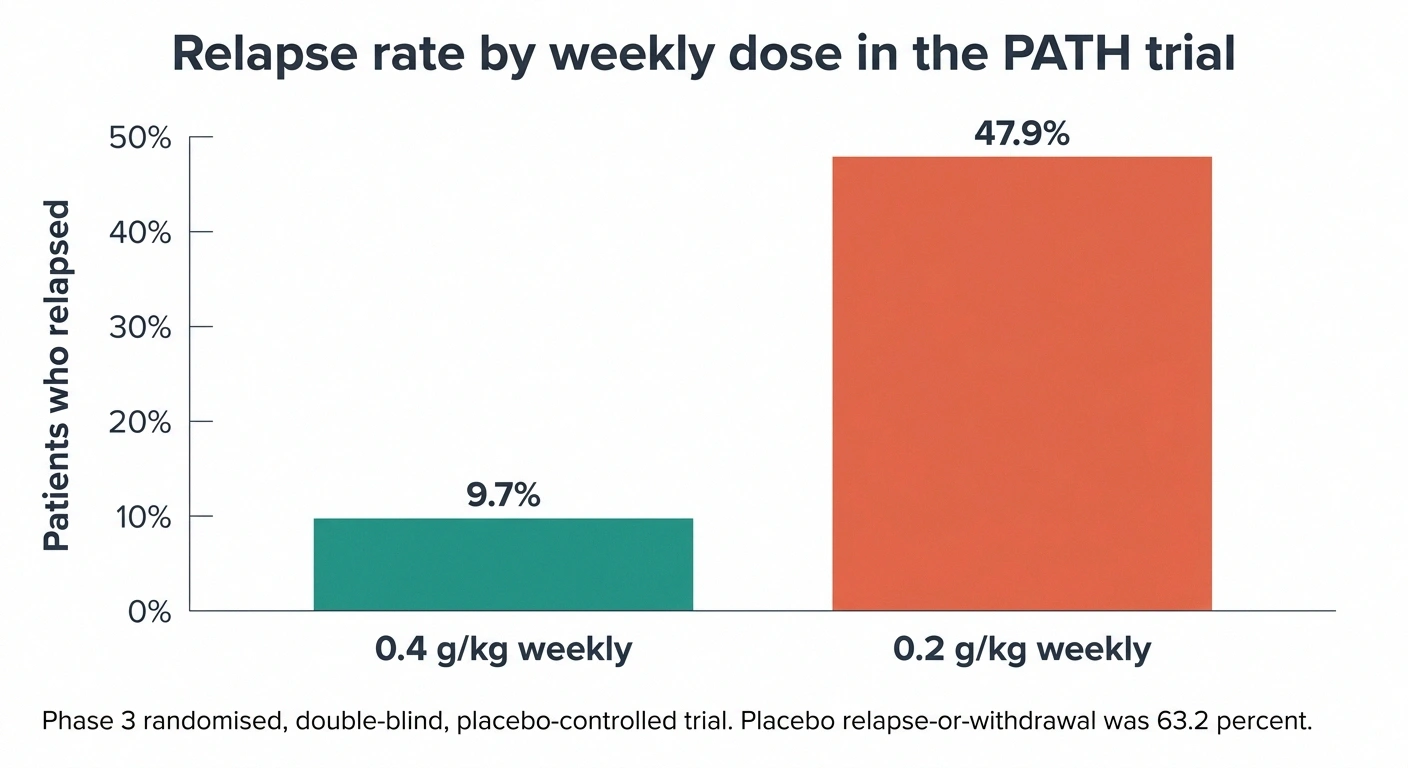
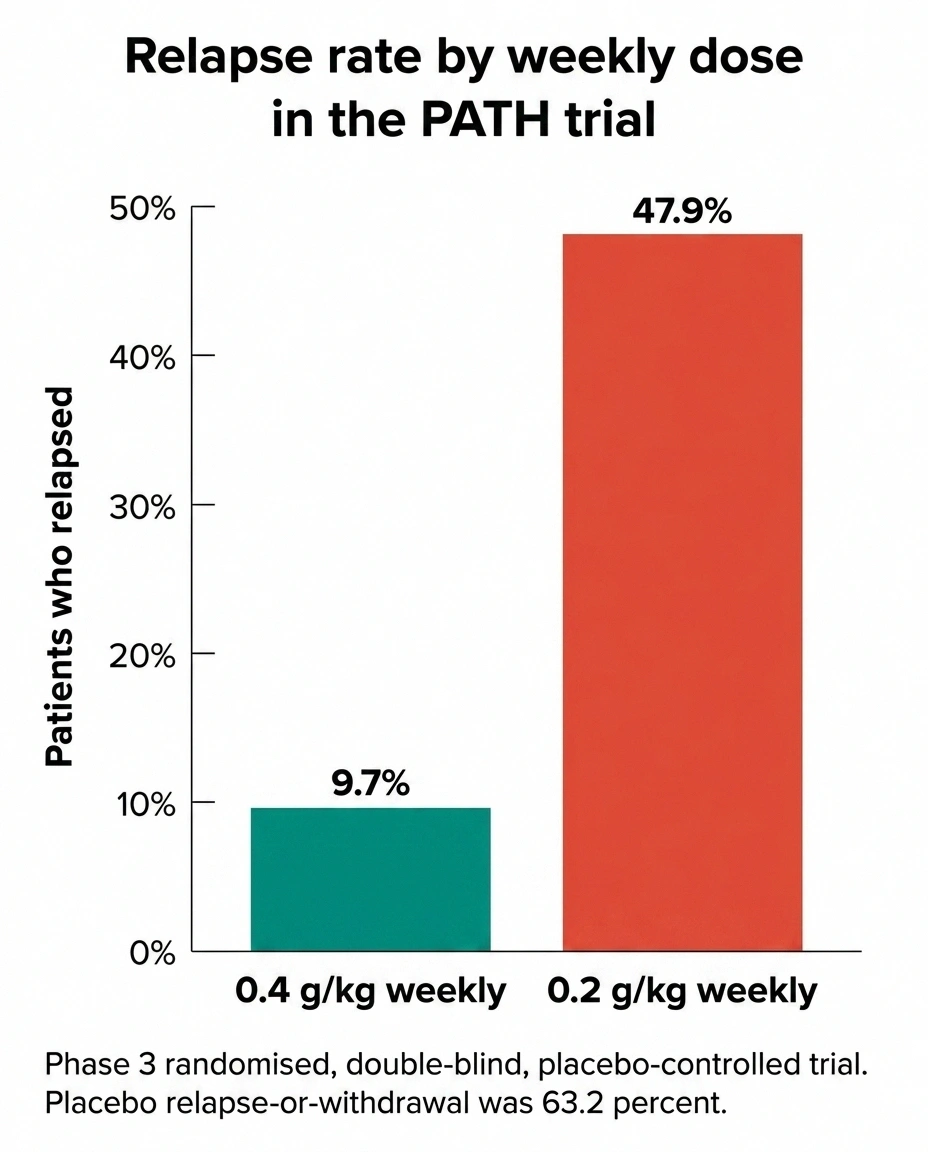
The pivotal study for Hizentra in CIDP was PATH, a phase 3 randomized, double-blind, placebo-controlled trial that tested two different weekly doses against placebo. Testing two doses instead of one turned out to be the most useful thing about it.
The number to bring to your next appointment
In the PATH trial, relapse rates on the two Hizentra doses were 9.7% at 0.4 g/kg weekly and 47.9% at 0.2 g/kg weekly. Same drug, same schedule, roughly a fivefold difference in relapse, driven only by amount.
Ask what dose you are being started on and what the plan is if symptoms creep back. Underdosing does not announce itself; it looks exactly like the disease progressing.
At the higher dose, 0.4 g/kg weekly, 9.7% of patients relapsed. At the lower dose, 0.2 g/kg weekly, 47.9% relapsed. Nearly half.
Read those two numbers next to each other again. Same drug, same route, same schedule, same disease. One number is comfortably good and one is close to a coin flip, and the only variable is how much you get.
Looking at the broader measure that counted both relapse and dropping out for any reason, the picture compresses somewhat: 32.8% for the higher dose, 38.6% for the lower dose, 63.2% for placebo. Both active doses beat placebo clearly. But the relapse-specific gap is the one to carry into your next appointment, because underdosing subcutaneous immunoglobulin does not fail loudly. It fails as a slow return of symptoms that is very easy to blame on the disease itself.
A 48-week open-label extension followed PATH, enrolling 82 patients, 62 of whom started at the higher weekly dose and 20 at the lower one.
For HyQvia, the long-term data comes from the ADVANCE-CIDP 3 extension study, which reported an annualized relapse rate of 4.5%. Across the entire observation period, 13% of patients with available data relapsed.
A word of caution on comparing those numbers directly. Different trials, different designs, different patient populations, different definitions of relapse and different lengths of follow-up. What you can fairly take away is that both products hold people in remission at rates that make home therapy a serious option. What you cannot take away is that one beats the other, because nobody has run that race head to head.
The Ramp-Up Nobody Explains Well
You will probably not start at your full dose.
Most people are stepped up gradually, a schedule that increases the amount over several sessions until you reach the target. This is a tolerability measure. Subcutaneous tissue that has never handled an infusion responds to a full-volume dose with more swelling, more redness, and more discomfort than tissue that has been eased into it over a few weeks. The ramp-up has been studied formally enough that HyQvia ran a dedicated trial comparing ramp-up against going straight to full dose.
Two practical things follow. First, judge the therapy on how it feels at month three, not week one. The first few sessions are the worst ones you will have, and people who quit early often quit during the part that was always going to be uncomfortable. Second, if you are still not tolerating full volume after the ramp-up is finished, that is a real conversation about site count and rate, not a sign that you have failed at the treatment.
Doing This At Home, Honestly

Both products can be infused in a doctor office, in an infusion center, or at home after training. With proper instruction, most patients self-infuse or have a caregiver assist. That is the marketing sentence, and it is true. Here is what it leaves out.
Five things to settle before your training visit ends
- Who you call at 8 p.m.
- Get a name and a number for problems that happen outside office hours, not the general clinic line.
- Your site rotation map
- Write down which areas you use in which order. Reusing the same spot is the fastest route to a hard, sore lump that will not settle.
- The rate you can actually tolerate
- Rate is adjustable. If sessions are uncomfortable, that is a setting to change, not something to endure quietly.
- What a supply gap looks like
- Know how many days of medication you hold and when your next shipment is confirmed, so a delivery delay never becomes a missed dose.
- One solo run while help is nearby
- Ask to do a full session yourself with the nurse present but hands off. It is a very different experience from being talked through it.
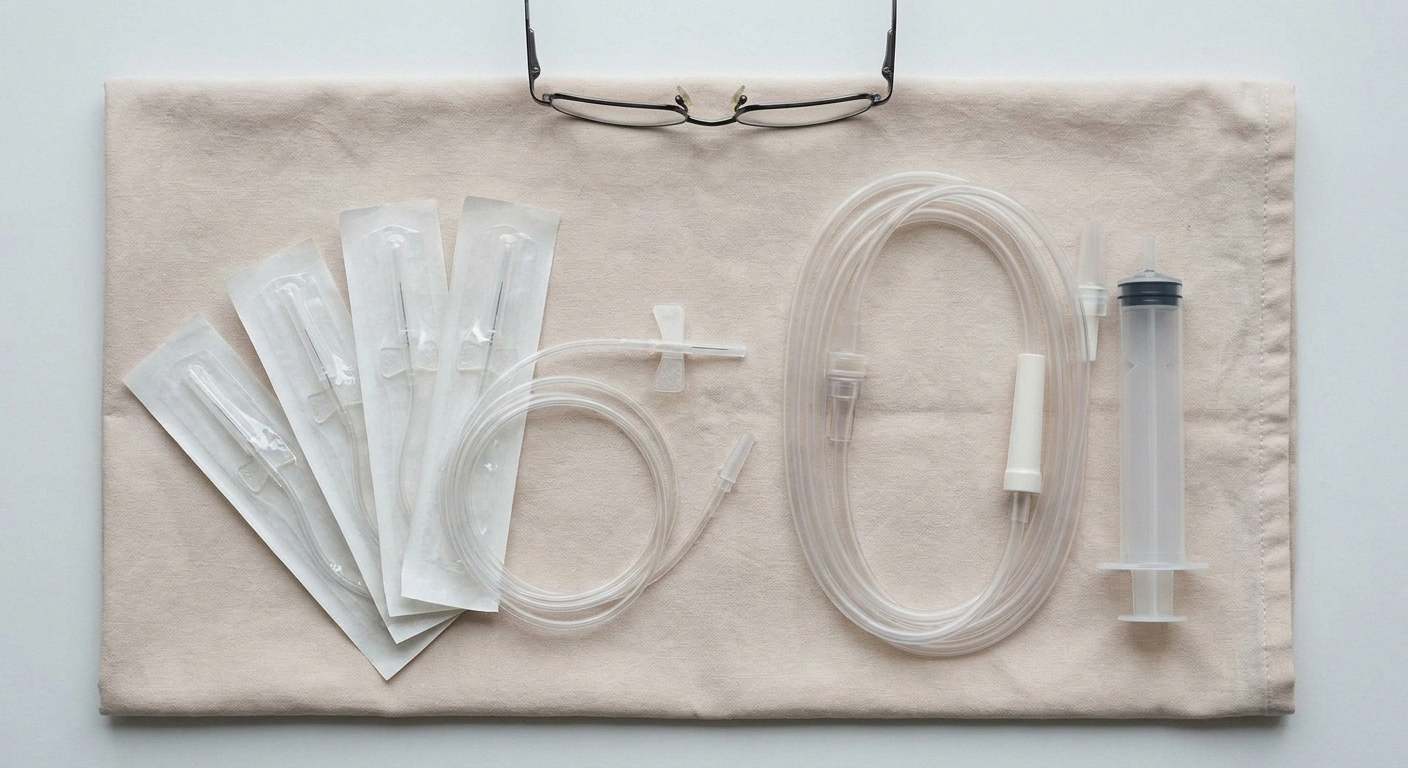
Training is usually a nurse coming to your house, often a few visits, teaching you to draw up the medication, prime the tubing, prep the sites, insert the needles, and run the pump. Most people find the mechanical steps easier than they feared and the first solo session much harder than they expected, because doing something correctly while a nurse watches is a completely different act from doing it alone in your own kitchen.
The part that catches people off guard is the fine motor requirement. You are handling small needles, tubing, and a pump. If your CIDP has affected your hands, and CIDP affects hands often, this is a real question and not a small one. It is also the strongest argument for HyQvia in some cases: one site is one insertion, and if each insertion is difficult for your fingers, going from four to one changes everything.
Site reactions are the trade you make for losing the systemic ones. Expect swelling, a firm lump, redness, and itching at the needle sites. For most people this settles over the first couple of months as the tissue adapts, and it tends to be worst where the tissue is thinnest. Rotating sites matters more than any product you can put on the skin afterward.
What you gain is not just convenience. Home infusion removes the ride, the waiting room, the shared air, and the entire lost day. For anyone who has arranged their life around infusion days, that is not a lifestyle upgrade. It is hours coming back.
The Insurance Fight, Which Is Its Own Condition

Immunoglobulin is expensive under any route, and coverage decisions turn on a detail most patients have never heard of: site of care.
Three questions for your specialty pharmacy coordinator
Not your neurologist. The intake coordinator processes these approvals daily and can usually predict where your plan will push back.
- Which specialty pharmacy supplies this, and are they in my network?
- Does my plan cover this as home infusion, or does it classify home therapy differently?
- How are the nursing training visits billed, and how many of them are covered?
Insurers classify where a drug is given, and hospital outpatient, physician office, and home infusion often sit in different benefit categories with different cost-sharing. Sometimes the same medication is a medical benefit in one setting and a pharmacy benefit in another. Which bucket you land in can change what you personally pay by an amount that has nothing to do with the drug.
Add to that a prior authorization that will usually want documentation of your CIDP diagnosis, your nerve conduction study findings, your response to previous therapy, and a functional measure. Our guides to insurance coverage for neuropathy treatment and what Medicare covers go through the general shape of these approvals.
Three questions worth asking before you commit to a plan:
- Which specialty pharmacy will supply this, and is it in network?
- Is home infusion covered as home infusion, or is my plan going to treat it as something else?
- What are the nursing visits billed as, and how many are covered?
Ask them of the person who actually knows, which is almost never your neurologist. It is the infusion coordinator or the specialty pharmacy intake nurse. They handle these approvals every day and they will usually tell you exactly where your plan is going to push back.
Where SCIG Fits Among the Newer Options
CIDP treatment has moved recently, and subcutaneous immunoglobulin is no longer the only conversation. Efgartigimod works by a completely different mechanism, clearing pathogenic antibodies rather than supplying donated ones. Testing has also improved: autoimmune nodopathies, once lumped in with CIDP, are now recognized as a distinct group that frequently responds poorly to immunoglobulin of any route and much better to other therapy.
That last point deserves emphasis. If you have been on immunoglobulin and it has never worked well for you, the useful question may not be which delivery route to try next. It may be whether the diagnosis is exactly right. Nodal antibody testing did not exist in routine practice a decade ago, and there are people carrying a CIDP label from before it did.
A Way to Decide

Strip the brochures away and the decision comes down to three questions in order.
First: is home therapy right for me at all? If your IVIG works well, you tolerate it, the schedule fits your life, and you would rather have someone else responsible for the needles, staying put is a legitimate answer that nobody should talk you out of. Switching therapy has a cost even when the new therapy is good.
Second: if home therapy appeals, which pain would I rather have? More needle sites more often, or fewer sites for longer, less often. Consider your hands honestly. Consider whether weekly maintenance appeals to you or wears you down. Some people like the rhythm of a small weekly task. Others find that the frequency is exactly what makes it feel like an illness that never lets up.
Third: what dose am I actually being prescribed, and why that one? Given what PATH found, this is not a detail to leave in the background. If the plan is a lower dose, ask what the reasoning is and what the plan is for monitoring, so that a slow return of symptoms gets recognized as underdosing rather than absorbed as the natural course of the disease.
None of that requires you to become an expert. It requires you to walk in with three questions instead of none, which is a much smaller ask and does most of the work.
What I Would Want Someone to Tell Me

Track something. Anything measurable and consistent, written down weekly: how many stairs before your legs complain, whether you can button a shirt, how far you walk before the balance goes. Subcutaneous immunoglobulin produces steady levels, which means changes are gradual, which means they are genuinely hard to notice from inside your own body. Six weeks of slow decline reads as a bad patch. Written down, it reads as a trend, and a trend is something your neurologist can act on.
Take the plateau seriously. Immunoglobulin does not usually rebuild what is already lost. It stops the attack that is causing further loss. A stable year on this therapy is not the treatment failing to help. It is the treatment doing exactly what it does, and it is the outcome you want.
Give it more than a month. The ramp-up period is the least representative stretch of the whole experience, and it is the stretch where people decide the therapy is not for them.
Frequently Asked Questions
Is subcutaneous immunoglobulin as effective as IVIG for CIDP?
The trials support subcutaneous immunoglobulin as effective maintenance therapy for CIDP, and both products with a CIDP indication showed clear benefit over placebo or low relapse rates in long-term follow-up. What has not been done is a large direct head-to-head comparison against IVIG at matched doses, so the honest answer is that SCIG is a proven option rather than a proven equal. Adequate dosing appears to matter more than route.
What is the difference between Hizentra and HyQvia?
Hizentra is a 20% immunoglobulin given weekly, spread across multiple infusion sites, with the labeling allowing up to eight simultaneous sites and most CIDP trial patients using about four. HyQvia is a 10% immunoglobulin combined with an enzyme called recombinant human hyaluronidase, which temporarily loosens the tissue under the skin so much larger volumes can be infused into one or two sites, up to 600 mL in a single site, less frequently. The trade is more needles more often versus fewer needles for longer.
How long does a subcutaneous infusion take?
It depends heavily on the product, your dose, and how fast your tissue tolerates the medication. Weekly small-volume infusions across several sites are typically the shorter sessions, often around an hour. Large-volume infusions into one or two sites take considerably longer per session but happen less often. Your infusion nurse sets the rate during training and it can be adjusted if you are not tolerating it.
Can I really do this myself at home?
Most people can, after training from an infusion nurse, and many have a spouse or caregiver assist rather than doing it entirely alone. The main practical barrier is hand function, since you are handling needles, tubing, and a pump. If CIDP has affected your hands, raise that specifically during training, because it can influence which product makes more sense for you.
What are the side effects?
The most common are local: swelling, redness, itching, and a firm lump at the infusion sites, which usually improve over the first couple of months as tissue adapts. Systemic effects such as headache and flu-like symptoms tend to be less prominent than with intravenous infusion, which is generally attributed to the absence of a large peak in blood levels. Serious reactions are uncommon but possible, and your infusion team should walk you through the warning signs before your first session.
What happens if I miss a dose?
Because subcutaneous dosing keeps antibody levels steady rather than building a large reserve, missing a scheduled infusion means a real dip in coverage rather than a simple delay. One missed week is not an emergency, but repeatedly missing them is one of the ways people slide back toward relapse without any single obvious event. Contact your infusion team for guidance rather than doubling up on your own.
Does insurance cover home infusion?
Frequently, but the approval usually hinges on site of care rather than on the drug itself, and plans differ substantially in how they classify and cover home infusion, specialty pharmacy supply, and nursing visits. Ask your specialty pharmacy intake coordinator to walk you through exactly how your plan handles each of those three pieces before you start, because they process these approvals routinely and can predict where yours will hit friction.
Will immunoglobulin reverse the nerve damage I already have?
Immunoglobulin is primarily aimed at stopping the ongoing immune attack rather than rebuilding nerve that has already been lost. Some people do recover function, particularly when treatment starts relatively early, because nerves can remyelinate when the attack stops. Long-standing damage is less likely to fully reverse, which is why stability is considered a good outcome in CIDP rather than a disappointing one.
About the Author