A woman in my support group brought in a printout last spring. Twelve sessions, $1,750, payable up front — ten percent off if she paid the whole thing that week. The clinic called it “oxidative medicine.” The brochure had a diagram of a mitochondrion on it.
She wanted to know one thing: does it work?
That turns out to be a better question than the internet is currently equipped to answer, and the reason why is worth understanding, because it will save you from a whole category of expensive decisions. The short version is that ozone therapy for nerve damage sits in an unusual spot. It isn’t quackery in the way some things are quackery. There’s a real biological rationale, real researchers pursuing it, and a serious clinical trial underway right now. There is also, as of today, no completed trial that tells us whether it helps. Every clinic selling it is selling ahead of the data.
Here’s the whole picture, including the parts the brochure leaves out.
What Ozone Therapy Actually Is
Ozone is oxygen with a third atom stuck on: O3 instead of O2. It’s the same molecule that makes the air smell sharp after a thunderstorm, and the same one that forms the layer protecting us from ultraviolet light. It is also, at the concentrations found in smog, a lung irritant that public health agencies issue warnings about. Holding all three of those facts at once is the beginning of thinking clearly about this.
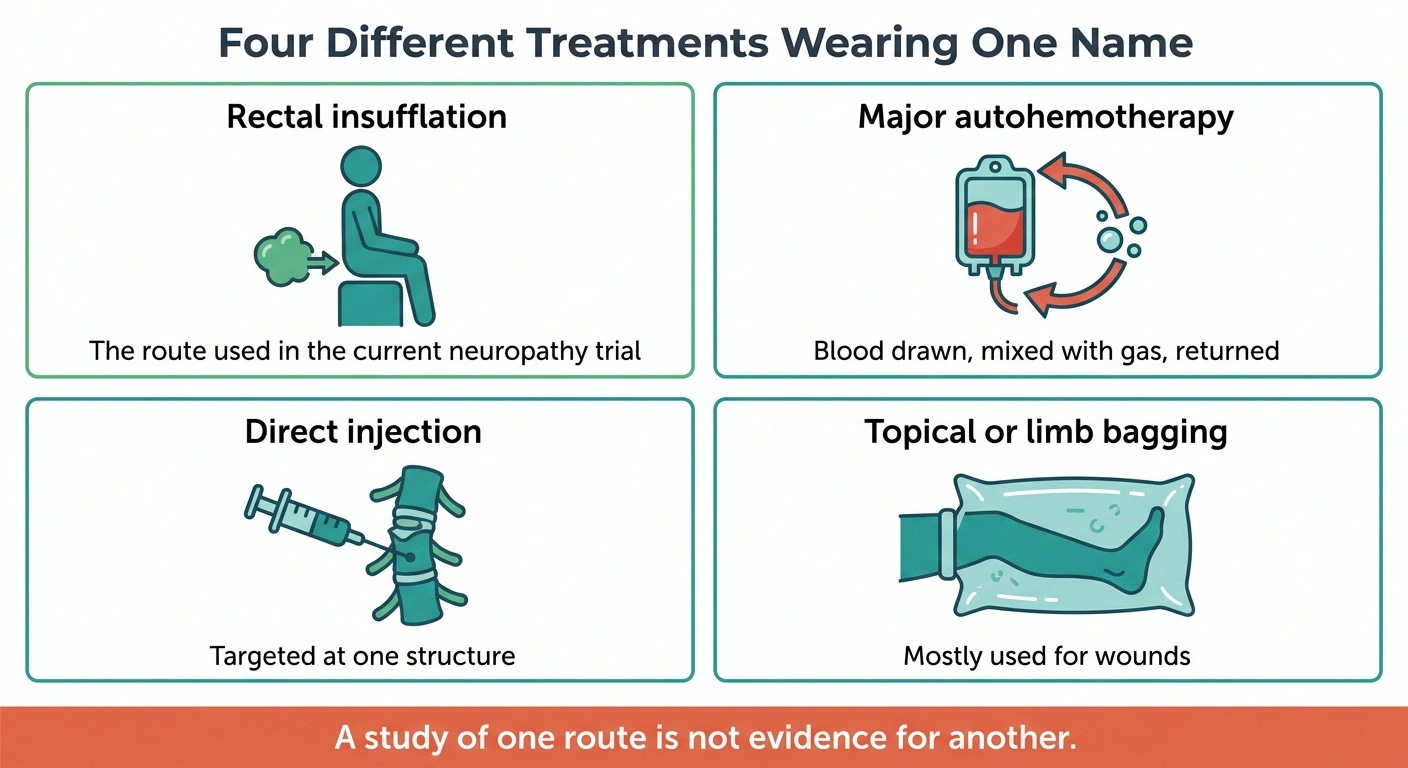
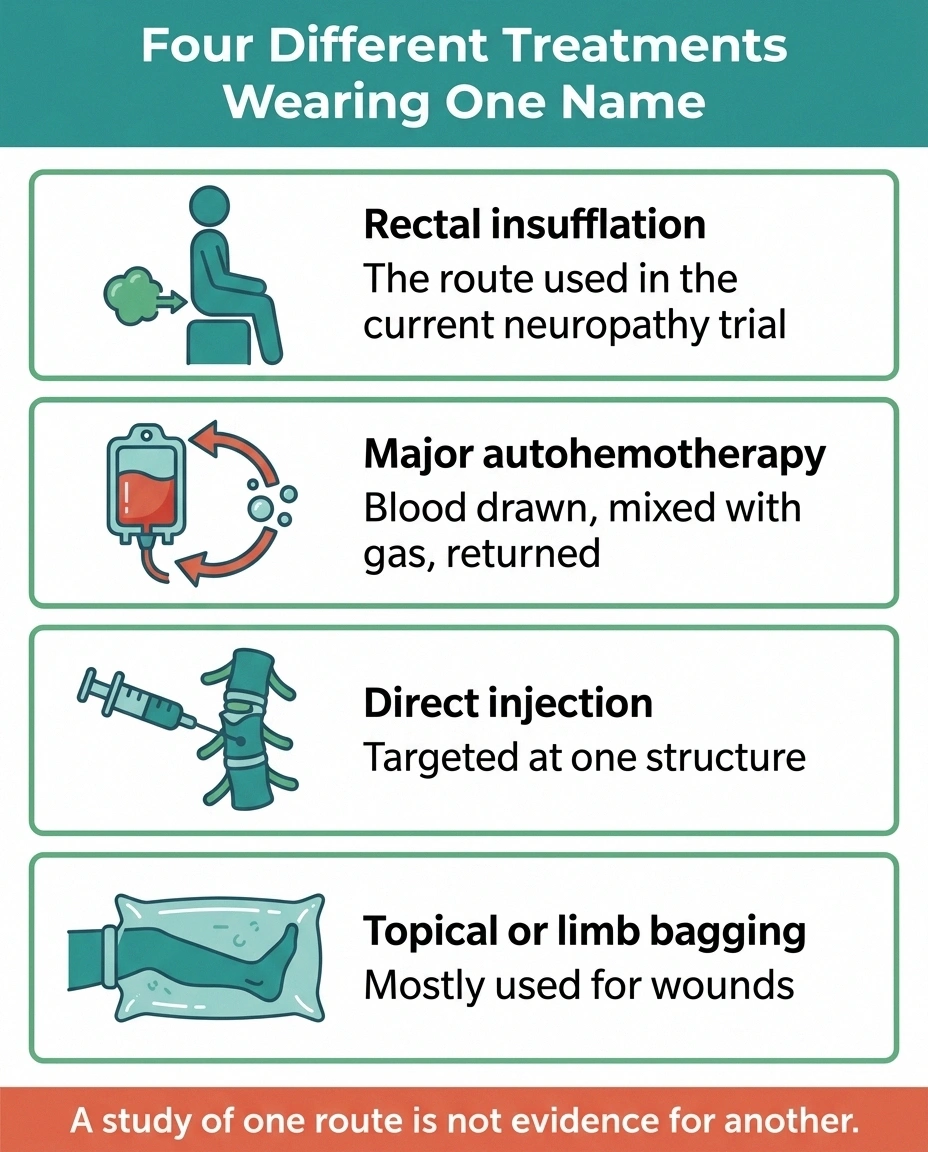
Medical ozone is generated on site from medical-grade oxygen, in a specific ratio, and delivered in one of several ways. The route matters far more than most people realize, so it’s worth separating them:
Rectal insufflation. A measured volume of ozone-oxygen gas introduced into the rectum, where it’s absorbed through the bowel wall. This sounds strange and it is the route the most serious neuropathy research is actually using. It’s low-cost, doesn’t require needles, and the dose is easy to control.
Major autohemotherapy. Blood is drawn, mixed with the ozone-oxygen gas in a bag, and returned by IV. This is the theatrical one, and the one clinics usually price highest.
Direct injection. Gas injected near a specific structure, such as around a spinal nerve root or into a joint. Targeted, invasive, and the version with the most interesting individual results.
Topical or limb bagging. The foot or leg sealed in a bag filled with the gas mixture, usually for wound care rather than nerve pain.
Keep those four separate in your head. Almost all of the confusion in this field — including most of what you’ll read online — comes from a study using one route being quoted to sell a different one.
The Reason Anyone Thinks This Might Work
The mechanism claim is more sophisticated than “more oxygen for your nerves,” which is the version you’ll hear at the front desk and which isn’t really right.
The actual proposal is a controlled stress response. A small, carefully-dosed exposure to an oxidizing agent nudges cells into switching on their own antioxidant machinery. Your body has a set of protective genes that stay relatively quiet until something provokes them, and the theory is that a mild ozone challenge provokes them without doing meaningful damage. The result, in theory, is a cell better equipped to handle the ongoing oxidative stress that contributes to nerve injury.
If that logic feels familiar, it should. It’s the same reasoning behind exercise: a controlled stress that leaves the system stronger. It’s not a fringe idea, and researchers studying chemotherapy-induced nerve damage have laid out the rationale carefully in the peer-reviewed literature.
Plausible mechanism and clinical benefit are different things, though. The graveyard of medicine is full of treatments with beautiful mechanisms that did nothing in people, and the only way to tell the difference is a trial where neither the patient nor the person measuring knows who got what.
Where the Evidence Actually Stands
Here is the honest inventory, and I want to be precise because precision is the useful thing here.
The published clinical and experimental reports on ozone and chemotherapy-induced peripheral neuropathy span roughly 1995 to 2025. A 2025 review of that whole body of work concluded that it offers preliminary evidence of a potential role, and that randomized clinical trials are needed to establish whether it works. That is not a hostile summary written by a skeptic. That’s the assessment from the researchers who are actively pursuing this.
Read that sentence again, because it’s the load-bearing fact of this entire article. Thirty years of reports, and the people most invested in the therapy describe the evidence as preliminary and call for the trials that would settle it.
What “preliminary” means in practice: small studies, often without a control group, frequently without blinding, sometimes without a comparison to anything at all. Studies like that can tell you a treatment is worth investigating. They cannot tell you it works, because pain and tingling are exactly the symptoms most responsive to expectation, attention, and the simple passage of time.
A 2026 appraisal in Frontiers in Medicine looked specifically at the methodological quality of ozone therapy research across its various uses. The fact that such a paper needed writing tells you where the field’s problem lies. It isn’t a shortage of studies. It’s a shortage of studies built to produce a trustworthy answer.
The Trial That Will Actually Settle This
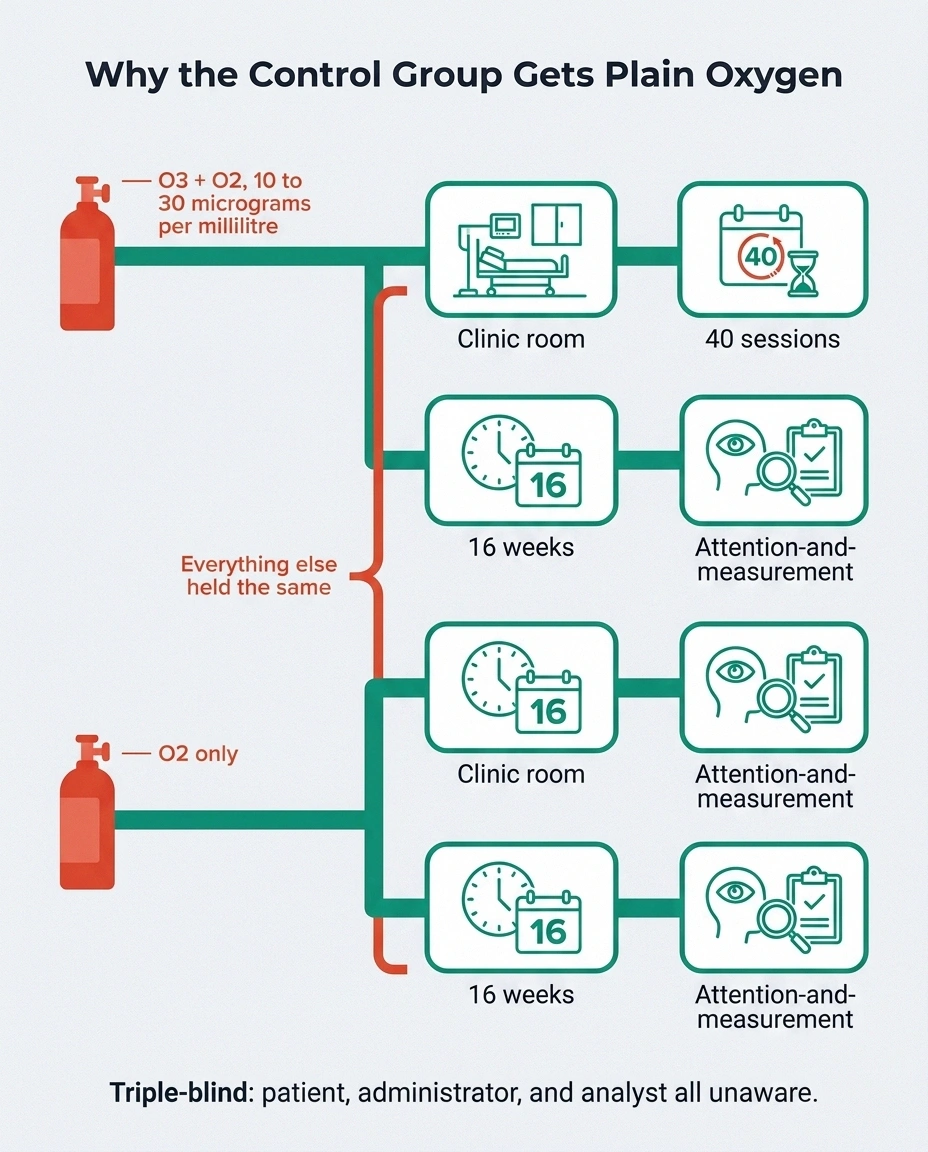
There is one, it’s running, and knowing about it changes how you should think about every clinic offer in front of you.
Registry entry NCT06706544, protocol published in BMC Cancer, 2025. Worth keeping the identifier: it is how you check for results yourself in a year rather than taking anyone’s word for where the evidence stands.
| Who | 42 adults, Grade 2 or worse chemotherapy-induced neuropathy lasting 3 months or more |
| Dose and route | Rectal insufflation, ozone-oxygen at 10 to 30 micrograms per millilitre |
| Schedule | 40 sessions across 16 weeks |
| Control arm | Plain oxygen, same procedure, same schedule |
| Blinding | Triple-blind: patient, administrator, analyst |
| Results | Not yet reported |
It’s called OzoParQT, registered as NCT06706544 and published as a protocol in BMC Cancer in 2025. The design is genuinely good, and the details are worth walking through because they teach you how to judge any trial you come across.
Who’s in it: 42 adults with cancer who have Grade 2 or worse chemotherapy-induced peripheral neuropathy that has stuck around for at least three months. These are people whose numbness and tingling didn’t resolve on its own, which matters, because a lot of chemo neuropathy improves with time and a study of newly-treated patients would confuse improvement with treatment effect.
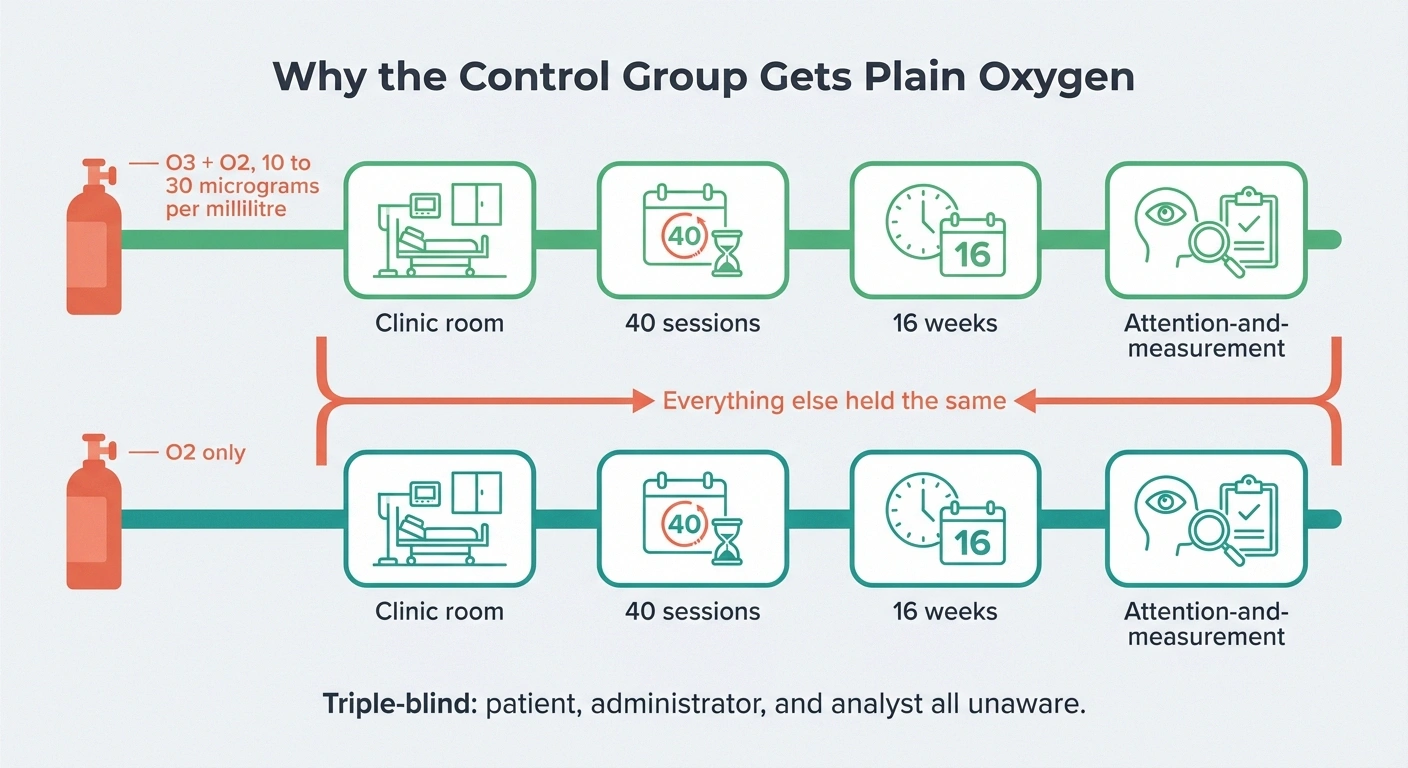
What they get: 40 sessions of rectal insufflation over 16 weeks. The active group receives ozone-oxygen at 10 to 30 micrograms per milliliter.
What the control group gets: plain oxygen, delivered identically. This is the detail I want you to notice. The comparison isn’t ozone versus nothing, and it isn’t ozone versus a pill. It’s ozone versus the same procedure, same room, same schedule, same everything, minus the ozone. That design isolates the molecule from the ritual, and the ritual in this case involves forty visits over four months of someone paying close attention to your symptoms. Any weaker comparison would credit ozone with the effect of being cared for.
Triple-blind: the patient doesn’t know, the person administering doesn’t know, and the person analyzing the results doesn’t know. That’s the standard that makes a result believable.
One caveat about that trial, in fairness to it: 42 people is small. A single trial of that size, however well built, is a first real answer rather than a final verdict, and a result either way would want confirming in a larger group. What it will do is replace thirty years of uncontrolled reports with one properly controlled measurement, which is a genuine step up from where we are.
There’s a second registered trial, NCT05000463, looking at ozone therapy in diabetic neuropathy specifically. Also registered. Also without published results in hand.
So the state of play is this: the study that could justify the $1,750 is currently in progress. If a clinic tells you today that ozone is proven for neuropathy, they are describing a result that does not yet exist. If you want to be part of finding the answer rather than paying for an assumption, that’s what enrolling in a clinical trial is for, and it usually costs nothing.
The Result That Keeps the Idea Alive
I don’t want to flatten this into “there’s nothing there,” because there is something, and pretending otherwise would be its own kind of dishonesty.
Ozone injected into the intervertebral foramen — the bony opening where a nerve root exits the spine — was studied in people with chronic, stubborn postherpetic neuralgia, the nerve pain that lingers after shingles. That study followed patients for a year and reported meaningful benefit.
Now hold that next to what’s being sold. That study involves a needle placed at a precise anatomical target under imaging, in a condition where one identifiable nerve root is the problem. The typical clinic offer for neuropathy is systemic: gas into the bloodstream or the bowel, aimed at nerve endings in both feet that are damaged along their entire length by a metabolic or toxic process.
Different route, different condition, different disease mechanism. The postherpetic result is a legitimate reason to keep studying ozone. It is not evidence for the package being sold to someone with diabetic or idiopathic neuropathy, and the slide from one to the other is where marketing does its quiet work.
What the FDA Says, and What It Costs You

The FDA has never approved ozone as a medical treatment for any condition, and in 2019 issued a warning specifically against its therapeutic use, citing insufficient evidence of safety and effectiveness. Cleveland Clinic’s patient-facing guidance goes further, stating that the risks to the heart and lungs outweigh the benefits, and noting the awkward fact that the ozone concentrations needed to kill microbes are concentrations incompatible with human safety.
The practical consequences reach your bank account directly.
Not FDA-approved means not covered — no insurance plan, no Medicare, no Medicare Advantage plan is paying for this. Every dollar is yours, it’s unlikely to count toward a deductible, and the package pricing structure exists because packages are how you get paid before the customer has evidence about whether it’s working.
It also means nobody is checking. An approved therapy comes with manufacturing standards, adverse event reporting, and a regulator who can act. Ozone generators sold for clinical use exist in a much looser space. The device, the concentration, the training of the person operating it, and what happens if something goes wrong all vary from one clinic to the next with no external floor under any of it.
Safety, Honestly
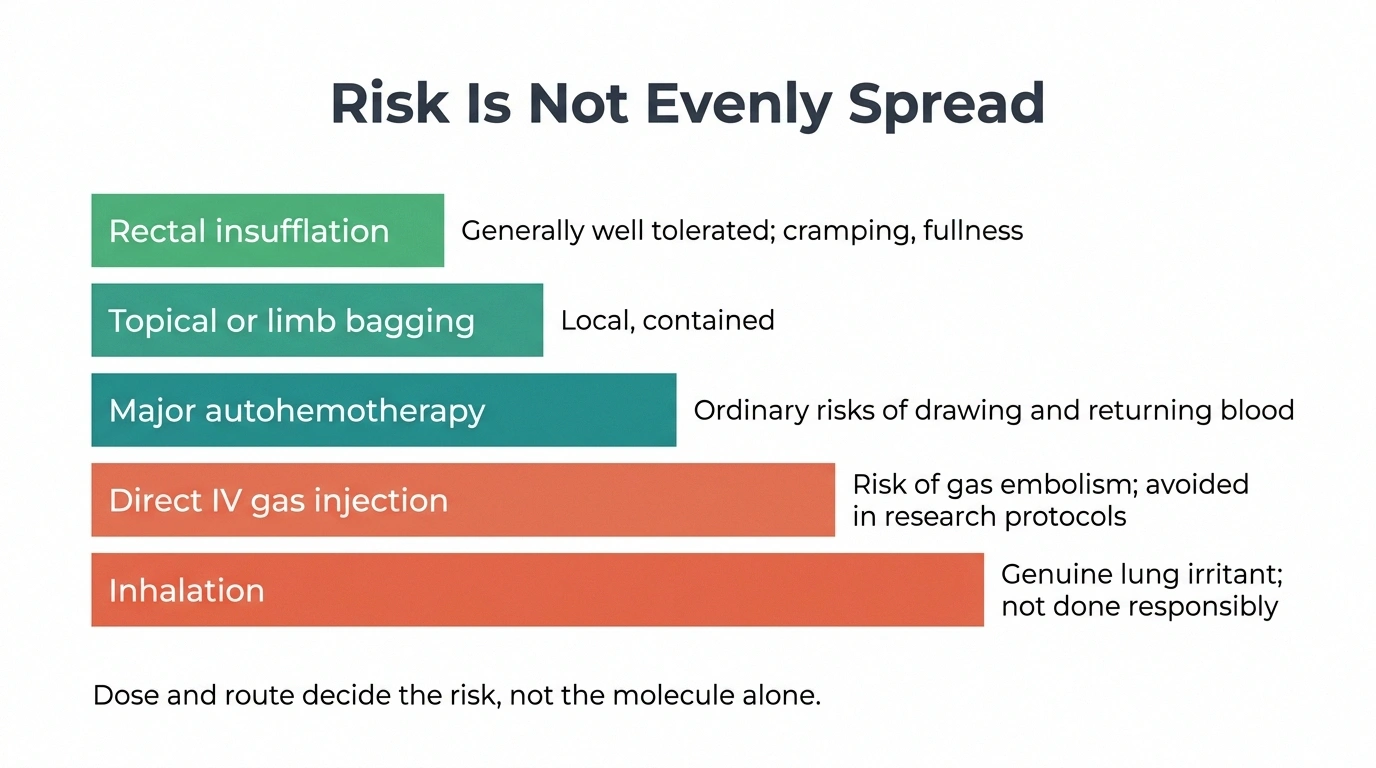
Ozone’s therapeutic profile depends almost entirely on dose and route, and the risk isn’t evenly distributed across the four delivery methods.
This applies to any treatment you are about to pay for, not only this one. Score each on a scale of zero to ten, in the evening, using the same wording every week. Three separate numbers rather than one, because a treatment can move one and not the others and a single overall score hides that.
- Pain at its worst in the past 24 hours.
- Numbness right now, where ten means no sensation at all.
- Steadiness on your feet today, where ten means you feel unsafe standing.
Symptoms swing across a single day, so score at roughly the same hour each time. Without a number recorded before session one, you are comparing today against a memory, and memory is generous toward things we have paid for.
The unambiguous danger is inhalation. Ozone is a genuine lung irritant, and nobody in this field disputes it. Breathing it can cause coughing, chest tightness, and airway inflammation, which is why direct pulmonary administration isn’t done by anyone practicing responsibly. If you have asthma or COPD, this is a real consideration and not a formality.
Direct intravenous gas injection is the other serious one, carrying a risk of gas embolism. This is why the research protocols use rectal insufflation and why blood-based administration mixes the gas with drawn blood outside the body rather than injecting gas into a vein.
Rectal insufflation, the best-studied route, is generally reported as well tolerated, with cramping and a feeling of fullness as the common complaints. Autohemotherapy carries the ordinary risks of any procedure involving drawing and returning blood, which are small but not zero and depend heavily on technique.
The risk that gets discussed least is the one I’ve watched do the most damage: months spent and money gone on something unproven, while a treatable underlying cause goes unaddressed. Neuropathy has causes, and some of them respond to treatment. If a vitamin deficiency or a medication side effect is driving your symptoms, that’s the thread to pull, and pulling it is free.
Questions to Ask Before You Pay

If you’re considering it anyway — and I understand why someone would, particularly if you’ve exhausted the standard options — these are the questions that separate a careful practitioner from a sales operation. Ask them out loud and listen to the shape of the answers.
- On a stopping rule
- Reassuring: “If your symptom score has not moved by session six, we stop and you are not charged for the rest.” Not reassuring: any version where there is no scenario in which the treatment is judged a failure.
- On measurement
- Reassuring: a numeric score taken before starting and at fixed intervals by the same method. Not reassuring: asking how you feel at the end of a 45-minute appointment during which someone has been kind to you.
- On evidence
- Reassuring: “There is no completed randomised trial in peripheral neuropathy, here is what we are extrapolating from.” Not reassuring: a stack of case reports handed over as though quantity substitutes for design.
- On the underlying cause
- Reassuring: questions about your blood sugar, your B12, your medication list, your alcohol intake. Not reassuring: no interest in why your nerves are damaged, only in how many sessions you will book.
“Which route are you proposing, and what’s the evidence for that specific route in my specific condition?” Watch for a study on a different route or a different disease being offered as the answer.
“What completed randomized trial supports this for peripheral neuropathy?” There isn’t one. A practitioner who says so plainly is being straight with you and is worth more of your trust than one who produces a stack of case reports.
“What’s the total cost, and can I pay per session?” Package-only pricing transfers all the risk to you before you have any information.
“What’s your stopping rule?” A good answer sounds like: if there’s no change in your symptom score by session six, we stop and you don’t pay for the rest. No stopping rule means no scenario in which the treatment is judged a failure.
“How will we measure whether it’s working?” “How do you feel?” after a forty-five minute appointment is not measurement. A numeric symptom score recorded before starting, at intervals, and by the same method each time, is.
“What are you doing about the underlying cause?” A practitioner uninterested in why your nerves are damaged is treating a symptom and charging by the visit.
Where Your Money Goes Further
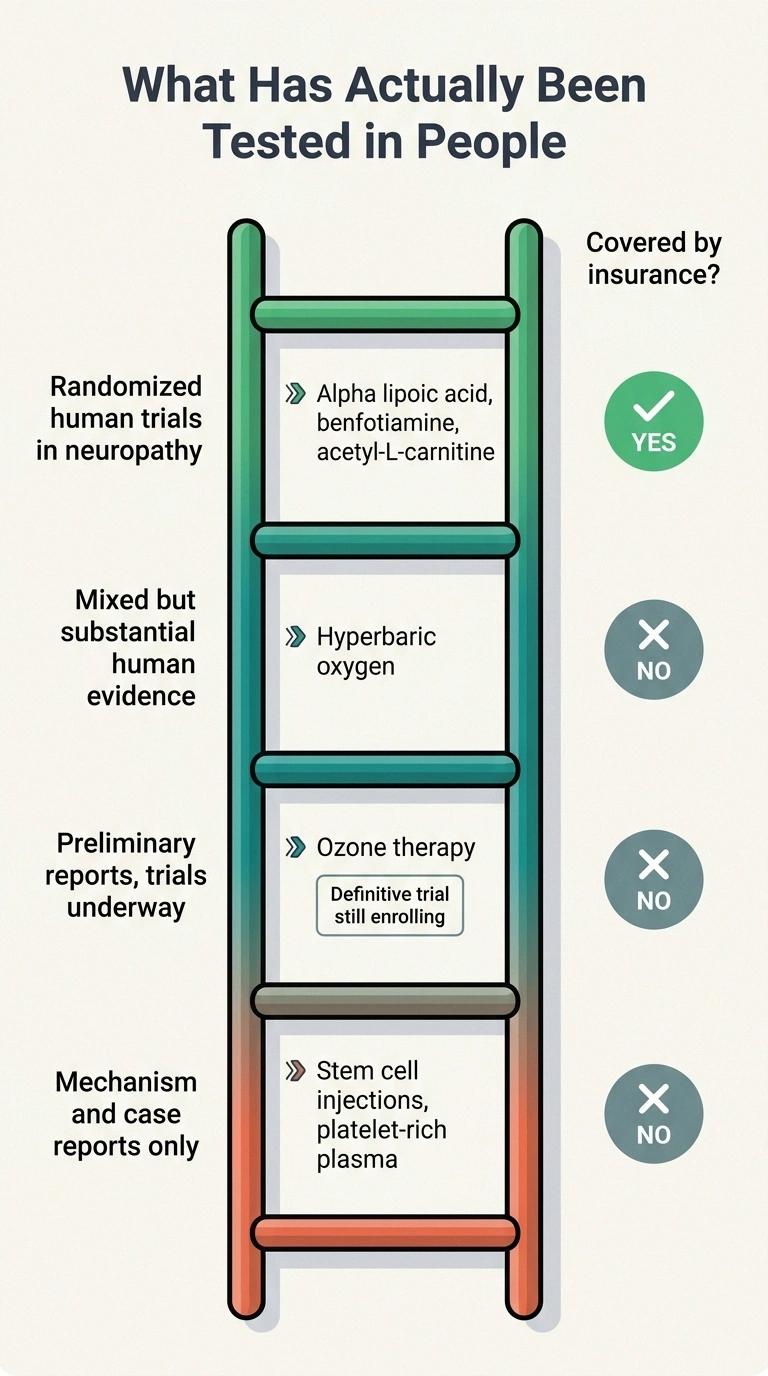
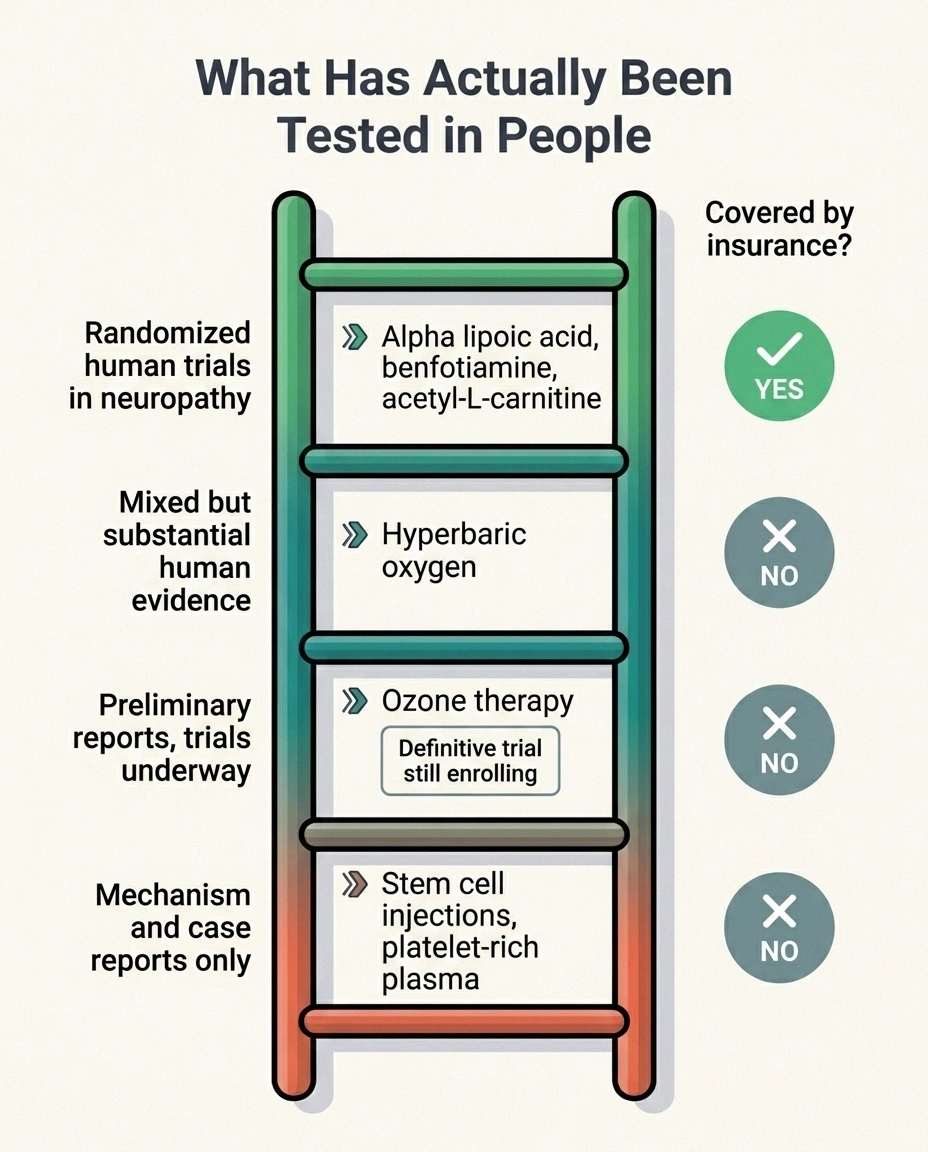
The frustrating thing about ozone is that its whole premise — reducing oxidative stress on damaged nerves — is a premise that other, better-studied options share. If that theory appeals to you, you can act on it right now with things that have actually been through human trials.
Hyperbaric oxygen: you breathe pure oxygen inside a pressurised chamber, which forces more oxygen into the plasma of your blood. It has FDA-approved uses for several conditions, and its neuropathy literature is mixed but substantially larger than ozone’s.
Ozone therapy: a different molecule, given in far smaller amounts, and not aimed at oxygen delivery at all. The proposal is that a small oxidative challenge switches on your own antioxidant response. No FDA-approved use for anything.
If a clinic offers both and cannot explain the difference in a sentence, that tells you something about the clinic rather than about the therapies.
Alpha lipoic acid is the closest match. It’s an antioxidant, it’s been studied in diabetic neuropathy in randomized human trials, and it costs a fraction of one ozone session per month. The evidence isn’t overwhelming, but it exists in the form ozone’s evidence doesn’t yet.
Hyperbaric oxygen is the therapy people most often confuse with this one. It’s a different mechanism entirely, delivered under pressure in a chamber, and it has its own mixed but more substantial literature. If a clinic offers both, ask them to explain the difference, and notice whether they can.
Then there are the sibling therapies sold on similar promises and similar evidence: stem cell injections and platelet-rich plasma. Reading those three pages side by side is a useful exercise, because the pattern repeats: strong mechanism, expensive package, thin trial evidence, no coverage.
And if the thing you want is to be part of the actual answer rather than a customer of an assumption, the research that’s genuinely moving is worth knowing about. Some of it is closer than you’d think.
What I Told Her
I didn’t tell my friend not to do it. It’s her money and her body, and after four years of symptoms nobody had helped with, “wait for better evidence” is an easy thing to say and a hard thing to live.
What I said was: ask for per-session pricing, agree on a stopping rule before you start, write down a number for your symptoms today so you have something to compare against, and know that the trial that would settle this is running right now and hasn’t reported.
She went to one session, asked the questions, and didn’t book the package. The answers were vague — vague in a way she couldn’t unhear once she was listening for it. That’s not the right outcome for everyone. But being the person who asks is the right position for everyone, and it costs nothing.
Frequently Asked Questions
Does ozone therapy work for neuropathy?
Nobody knows yet, and anyone who says otherwise is ahead of the evidence. The research to date is preliminary: small studies, often uncontrolled or unblinded, spanning about thirty years. A triple-blind randomized trial called OzoParQT is currently studying it in chemotherapy-induced neuropathy, comparing ozone against plain oxygen delivered identically, but it has not reported results. Until it does, the honest answer is that this is an open question.
Is ozone therapy FDA approved?
No. The FDA has never approved ozone as a medical treatment for any condition, and issued a warning against its therapeutic use in 2019 on the grounds that there is not enough evidence of safety or effectiveness. That means it is not covered by insurance or Medicare, and it means the devices and protocols are not subject to the oversight an approved therapy would carry.
How much does ozone therapy cost for neuropathy?
Pricing varies widely by clinic and by delivery route, and it is almost always sold in prepaid packages of eight to twelve or more sessions. Because it is not FDA approved, none of it is covered by insurance or Medicare and it generally will not count toward a deductible. If you are considering it, ask specifically whether you can pay per session rather than in advance for a package.
Is ozone therapy safe?
The answer depends heavily on how it is given. Inhaling ozone is genuinely harmful to the lungs and no responsible practitioner administers it that way. Direct injection of the gas into a vein carries a risk of gas embolism and is avoided in research protocols for that reason. Rectal insufflation, the route used in the current neuropathy trial, is generally reported as well tolerated, with cramping and fullness as typical complaints. Cleveland Clinic’s position is that the heart and lung risks outweigh the demonstrated benefits.
What is the difference between ozone therapy and hyperbaric oxygen therapy?
They are frequently confused and they are not related. Hyperbaric oxygen involves breathing pure oxygen inside a pressurized chamber, which dissolves more oxygen into your blood plasma. Ozone therapy uses a different molecule, delivered in much smaller amounts, and works on a completely different proposed mechanism involving the body’s antioxidant response rather than oxygen delivery. Hyperbaric oxygen has FDA-approved uses for certain conditions. Ozone has none.
Why do some ozone studies show good results?
Two reasons. First, many of them lack a proper control group, and symptoms like tingling and burning respond substantially to attention, expectation, and time. Second, some of the better results come from a very different application: ozone injected precisely at a spinal nerve root for postherpetic neuralgia, which is a targeted injection for a specific nerve problem, not systemic ozone for widespread nerve damage. Results from one route and condition do not transfer to another.
Should I stop my other neuropathy treatments to try ozone?
No, and this is the one place I would push back firmly. There is no evidence base supporting ozone as a replacement for anything, and stopping a treatment that is helping to make room for one that is unproven is a poor trade. This is also worth raising with whoever manages your care, particularly if you take blood thinners or have a heart or lung condition.
How would I know if it was actually working?
Write down a symptom score before your first session, using the same wording every time, ideally rating pain, numbness, and balance separately on a zero to ten scale. Record it weekly, at roughly the same time of day, since symptoms swing over the course of a day. Without a baseline number recorded before you started, you are comparing today against a memory, and memory is generous toward things we have paid for.
About the Author