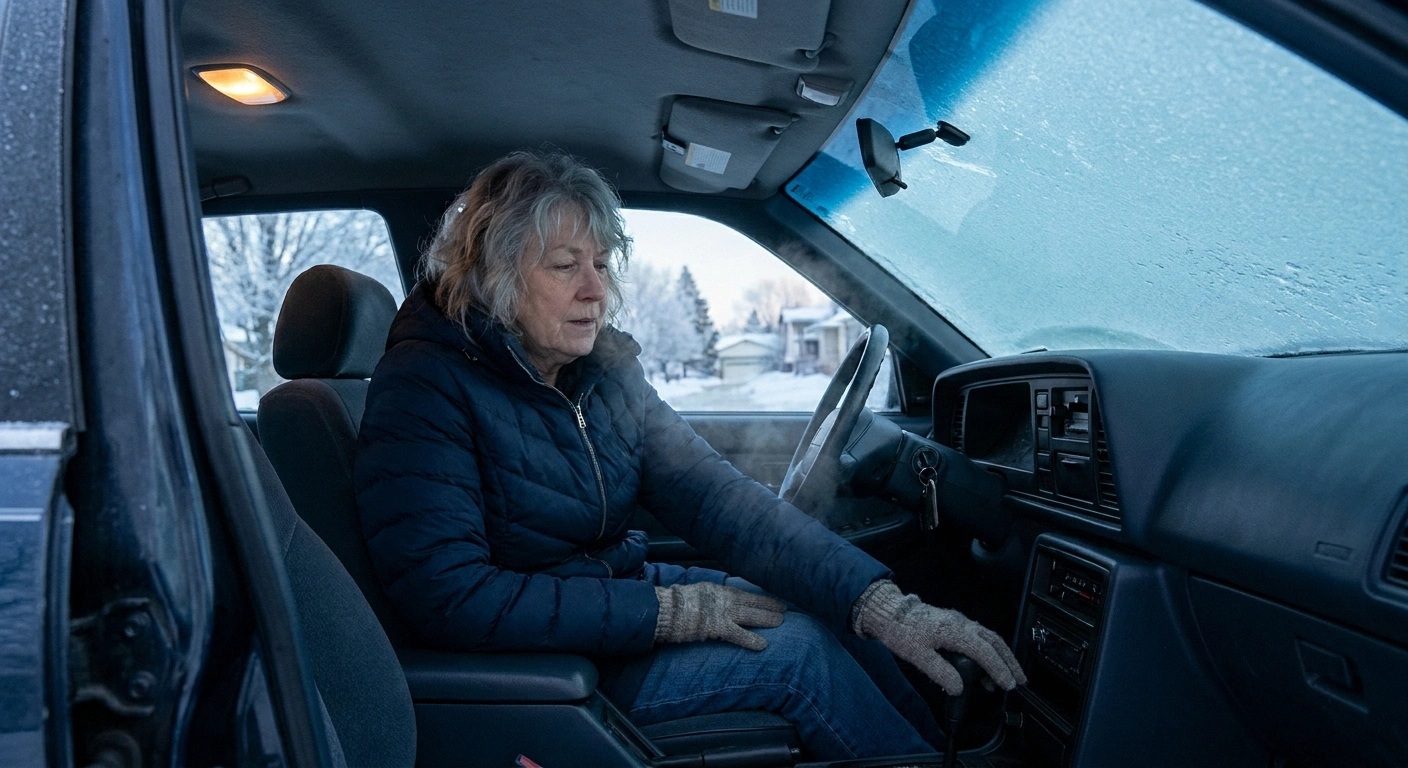
It’s twenty-eight degrees, the windshield is frosted over, and the little button with the wavy lines is right there by your knee. You press it twice for high, wait for the warmth to creep up through your coat, and pull out of the driveway. Ten minutes later you’ve forgotten it’s on. That’s the whole design—a heated seat is supposed to fade into the background.
For most drivers, that’s fine. Their skin speaks up long before anything gets too hot, and they shift, crack a window or switch it off without a second thought. With neuropathy, that quiet warning system may not be working the way it used to. The seat keeps doing its job. Your nerves just don’t report back.
I love a warm car as much as anyone, so this isn’t a lecture about giving up comfort. It’s a plain look at who is actually at risk from a heated seat, what the burn reports show, how the settings and timers really behave, and a simple routine that keeps the warmth without the surprise. I’m a patient advocate living with neuropathy, not a doctor, so I’ll point to the sources as I go.
Why a Warm Seat Can Burn Skin You Can’t Feel
Burns are a math problem of heat and time. Back in 1947, researchers Moritz and Henriques published the classic studies showing that skin damage depends on both how hot a surface is and how long the skin stays against it. Clinical reviews built on that work put it simply: below about 44°C (111°F), skin generally isn’t injured, but somewhere between 45 and 51°C (113 to 124°F), injury can start within minutes of steady contact.
Now put that next to a car seat. Testing described in burn case reports has measured seat heaters at roughly 95 to 120°F, and a safety advocacy group has reported individual seats reaching 140°F. The low end is harmless. The high end—the setting most of us reach for on a frosty morning—sits right in the range where a long drive becomes a long exposure.
Two more things work against you when you’re sitting. First, your body weight presses the skin against the heat source, which squeezes the small blood vessels that would normally carry warmth away. Second, you’re not moving much. A person with full feeling fidgets without noticing—that tiny shift lets the skin cool and recover. Take away the sensation and you take away the fidget.
That’s the core of it. Neuropathy doesn’t make a heated seat hotter. It removes the alarm that tells you to do something about it, which is the same problem behind most heating pad and hot water bottle burns. If you use other heat at home, my heating pad safety guide covers the same principle from the bedroom side.
Does Your Numbness Reach the Parts That Touch the Seat?
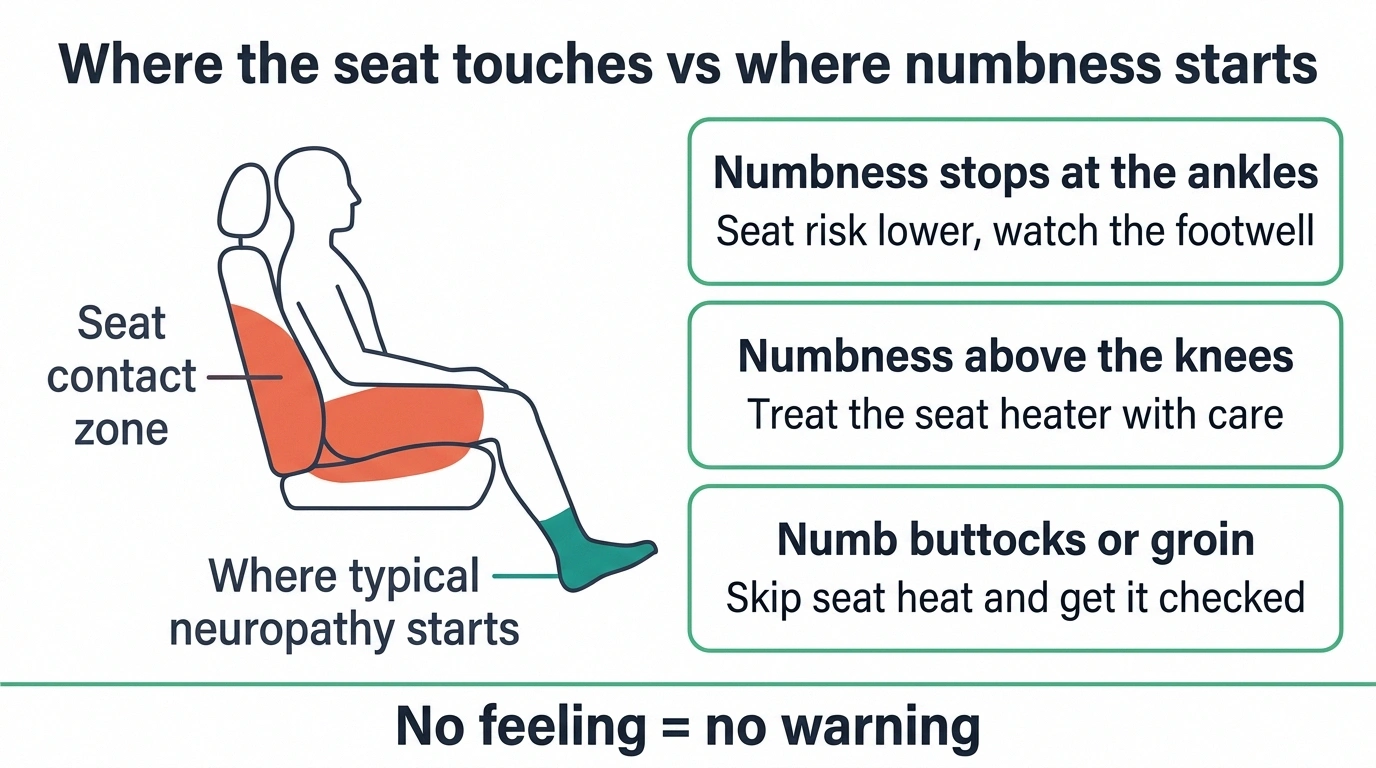
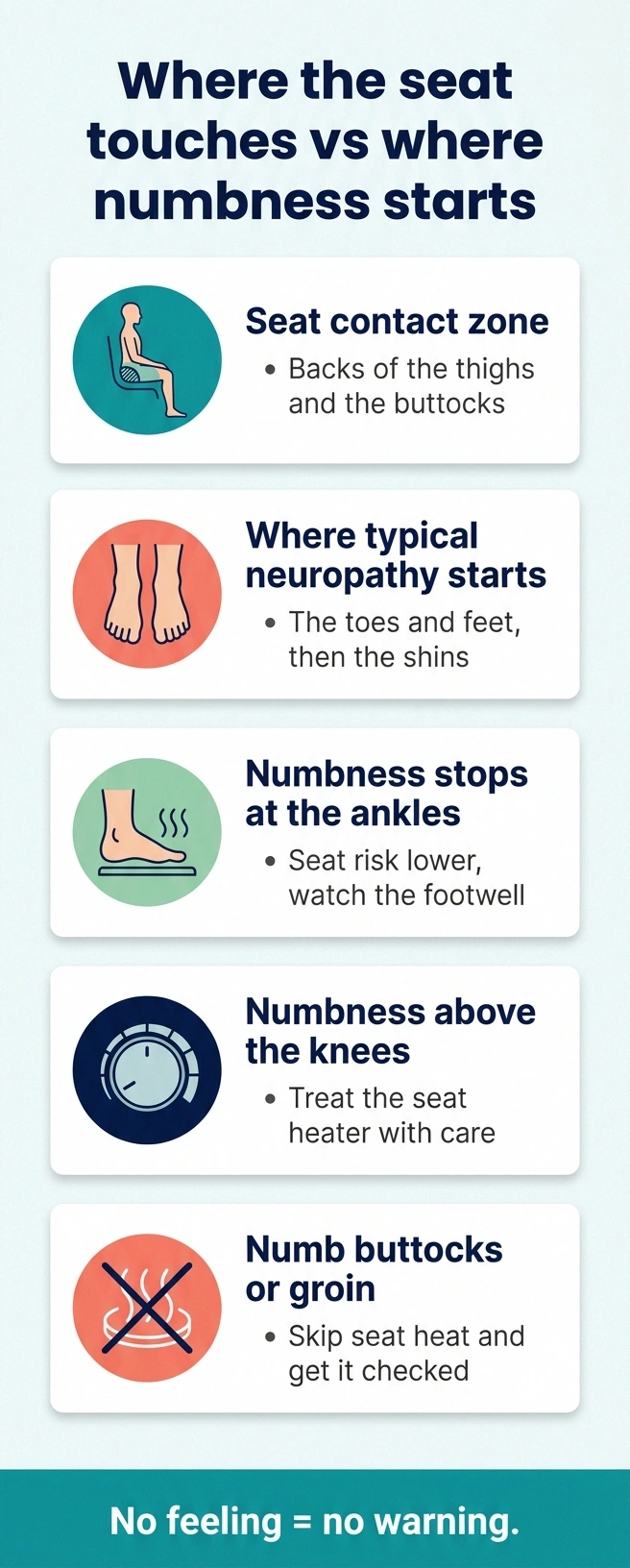
Here’s the honest twist that most heated-seat warnings skip. The most common type of peripheral neuropathy, the kind tied to diabetes, is length-dependent. It starts in the longest nerves, so the toes and feet go first, then the shins, then the fingertips. The backs of the thighs and the buttocks sit on much shorter nerve paths, and in typical diabetic neuropathy they’re often among the last areas to lose feeling.
The cold-spoon check (two minutes, at home)
- What you need
- A metal spoon that has sat in the fridge for ten minutes, and shorts or a loose skirt.
- Your reference spot
- Touch the back of the spoon to the inside of your forearm first. That’s what “normal cold” feels like for you today.
- The seat-contact spots
- Now touch the backs of both thighs, a few inches above the knee and again near the buttock crease. Compare each side with your forearm.
- How to read it
- If any spot feels duller, slower or not cold at all, treat that area as one that can’t warn you about heat. Repeat the check every winter, since neuropathy can change over a year.
So if your numbness stops at your ankles, your seat probably isn’t your biggest heat risk. Your feet are, and we’ll get to the footwell in a minute.
The picture changes for a few groups. If you’re one of them, take the seat heater seriously:
- Your numbness has climbed above your knees, or you’ve noticed reduced feeling on the backs of your thighs.
- You have numbness in the “saddle” area (the buttocks, inner thighs or groin), which can come from lower-back problems such as spinal stenosis or nerve root compression rather than peripheral neuropathy.
- You have a spinal cord injury, multiple sclerosis or another condition that affects feeling below a certain level of the body.
- Your neuropathy is a non-length-dependent type, which can cause patchy numbness in unexpected places.
- You take medicines that make you drowsy, or you tend to doze as a passenger.
A quick way to check yourself is to compare. Next time you’re in the car with the heater off, notice whether you can feel the texture of the seat fabric and the coolness of a leather seat through your trousers equally well on both sides, and as well as you feel it on your hands. If one area feels muffled, that’s the area to protect. Temperature sense can fade before touch does, so the muffled-or-not test is a starting point, not a guarantee. Our page on temperature sensitivity with neuropathy explains why heat and cold sensing can go before other kinds of feeling.
What the Burn Reports Actually Show

Car seat burns are not common, and I don’t want to overstate them. But the cases that have been written up are instructive because they follow the same pattern almost every time: reduced sensation, a long drive, a heater left on high.
A 2003 report in the burn literature described a 48-year-old man with paraplegia who got third-degree burns on his buttocks after about 20 minutes of driving with the seat heater on. Twenty minutes—that’s a trip to the pharmacy.
In 2021, the Journal of Burn Care & Research published the case of an 18-year-old with paraplegia who suffered full-thickness burns that needed surgery after prolonged exposure to a car seat heater. The authors then tested ten seat heaters made after 2014 and used the results to argue for better awareness and limits on how hot and how long these heaters can run.
A 2010 letter in the journal Spinal Cord, as summarized by the advocacy group Safety Research & Strategies, described a 50-year-old woman with diabetes burned by prolonged contact with heated seats. And in 2019, a report in the Journal of Emergency Medicine described something new: a man with no nerve problems at all who still developed significant burns on his buttocks after long heater use. If it can happen with full sensation, it can certainly happen without it.
The diabetic neuropathy picture outside the car is better documented. A 2022 study from Taiwan reviewed 16 patients with diabetic neuropathy who were burned by heat they applied themselves, mostly to the feet, and the authors called these burns preventable. The car is just one more place where that same pattern can play out.
Low, Medium, High: What the Settings Really Do
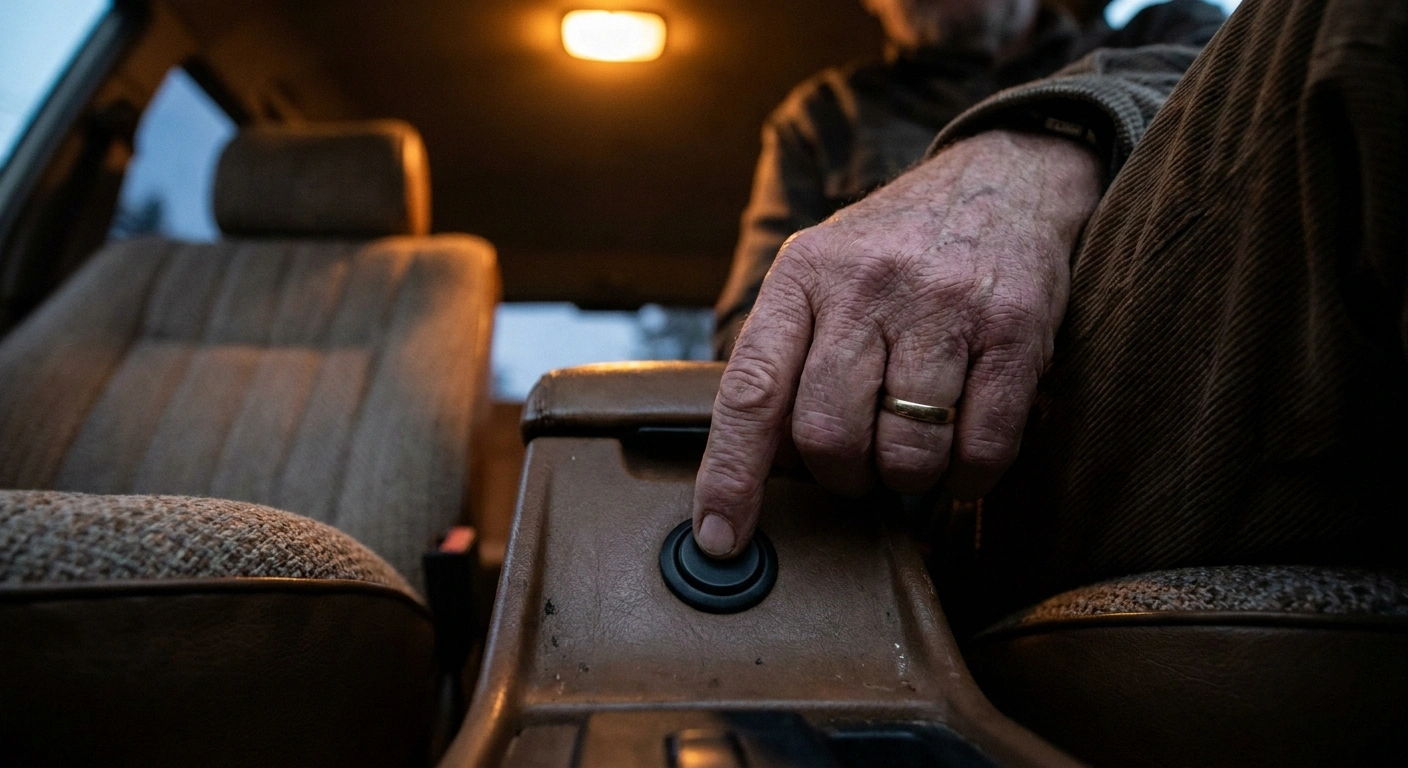
Most heated seats have two or three levels, and many newer cars step the heat down on their own after a while. That’s a useful backstop, but the timing varies a lot from car to car, and it’s usually buried in the owner’s manual.
| Look for | Why it matters |
|---|---|
| Step-down or shut-off time for each level | Tells you how long High really runs before the car lowers it, if it ever does. |
| “Auto” or climate-linked seat heat | Some cars warm the seat by themselves below a set outdoor temperature. |
| Remote start settings | Remote start can switch seat and wheel heat on before you reach the car. |
| Whether the setting is remembered | Some cars restart the heater at the last level used, so yesterday’s High comes back. |
| Indicator light location | Know exactly which light tells you the passenger seat is on, too. |
Some examples from manuals I read: one Chrysler manual says the system drops from High to Low after about 30 minutes of continuous use. A Kia manual describes High stepping down after 30 minutes and Medium after 60. Other models—plenty of them—simply stay where you set them until you turn the car off. Your manual will have the exact numbers for your car, usually under “seat warmers” or “heated seats.”
The manuals are also surprisingly blunt about who should be careful. Several list people who cannot detect temperature change or pain in the skin, older adults, and people taking medicines that cause drowsiness. They warn that even the low setting can burn with long use. Mazda’s manual tells drivers not to use the heater while napping in the car. One Hyundai manual notes that passengers must be able to feel the seat getting too warm so they can switch it off, which is exactly the ability neuropathy can take away.
Two takeaways. Low is safer than high, but it isn’t automatically safe on a three-hour drive. And a step-down timer protects you from forgetting for an hour. It doesn’t protect you from the first 30 minutes on high.
The Hidden Switches: Remote Start, Auto Mode and Plug-In Cushions
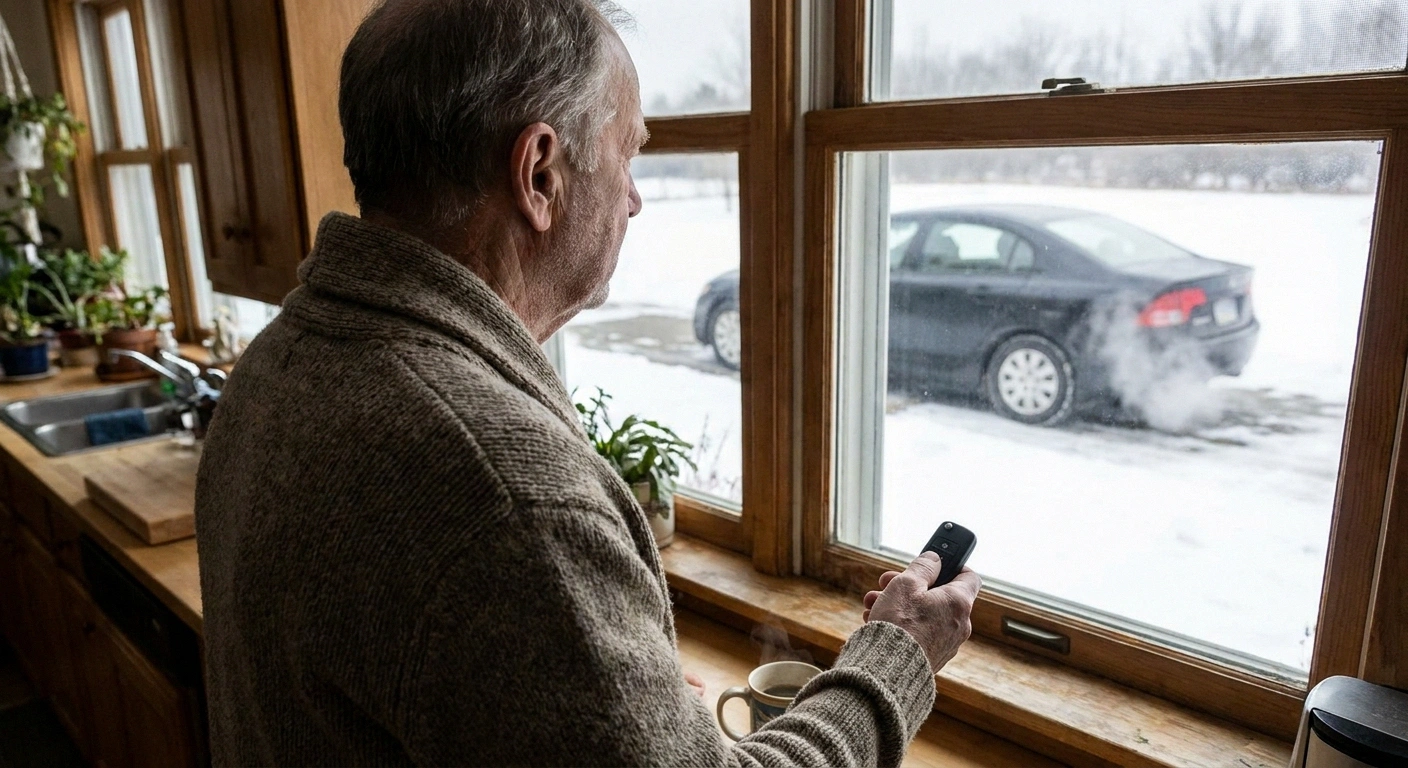
The seat heater you press is easy to manage. The one that switches itself on is the one that catches people.
Many newer vehicles can turn on the heated seats automatically. Some do it with remote start when it’s cold outside. Others have an “auto” setting that warms the seat whenever the cabin or outside temperature drops below a set point. If you didn’t set the car up yourself, or a dealer or family member did, you may not know it’s happening. Spend five minutes in the settings menu, or ask the dealer to show you, and decide on purpose whether you want this feature.
Then there are plug-in seat cushions, the kind that run off the 12-volt outlet. They’re cheap and popular, and they vary a lot. Some have timers and temperature limits; some have a simple on-off switch and nothing else. Because they sit on top of the seat, they also put the heat source closer to your skin. If you use one, look for an automatic shut-off on the box, and never stack it on top of a car seat that’s already heated. Owner’s manuals specifically warn against putting blankets, cushions or seat covers on a heated seat while it’s running, because the extra layer traps heat.
Heated Steering Wheels and Numb Fingers
If your neuropathy has reached your hands, the steering wheel deserves the same thought. Heated wheels generally run cooler than seats, and you’re gripping and releasing as you steer, so the exposure is less constant. Still, two habits help.
Check the wheel with a part of your body that feels well (the inside of your wrist or your cheek) rather than your fingertips. And if you notice redness, shiny patches or blisters on your palms or the pads of your fingers after a drive, the wheel is a suspect worth considering, especially if you drive with your hands in the same spot for long stretches.
Gloves are the easy fix. A thin pair of driving gloves keeps your hands warm with the wheel heater on low or off, and it gives your grip a little extra traction too.
Your Feet and the Footwell Heat
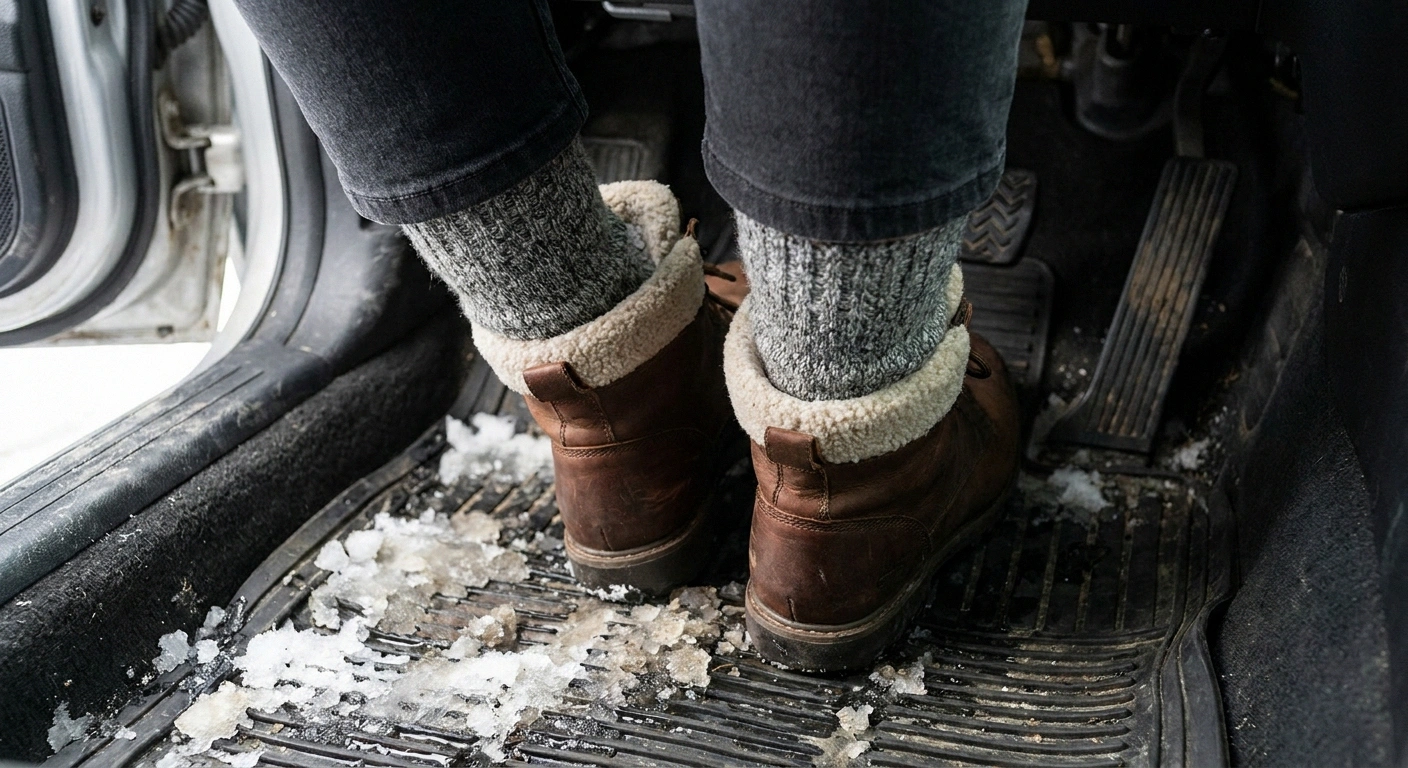
For many readers, this is the real risk—and it isn’t the seat at all. On a cold day it’s tempting to aim the floor vents straight at your feet and leave the fan on high for the whole drive. Hot, dry air blowing on feet that can’t tell you they’re overheated will dry out the skin and, on a long trip, can make shoes and socks very warm without you noticing.
Aim the vents at the cabin, not directly at your shoes, and let the whole car warm up instead. If your feet feel like ice, that cold feeling may be coming from the nerves rather than the temperature of your feet; warm socks and lined boots are a safer answer than a heater blasting at your ankles. Some cars also offer heated floor mats as accessories. Treat those exactly like a plug-in seat cushion: timer, low setting, and a foot check afterward.
Long drives bring their own foot issues (swelling, pressure, stiffness), and I’ve gathered those tips in a separate article on road trips and long drives with neuropathy.
A Simple Cold-Weather Routine for the Car
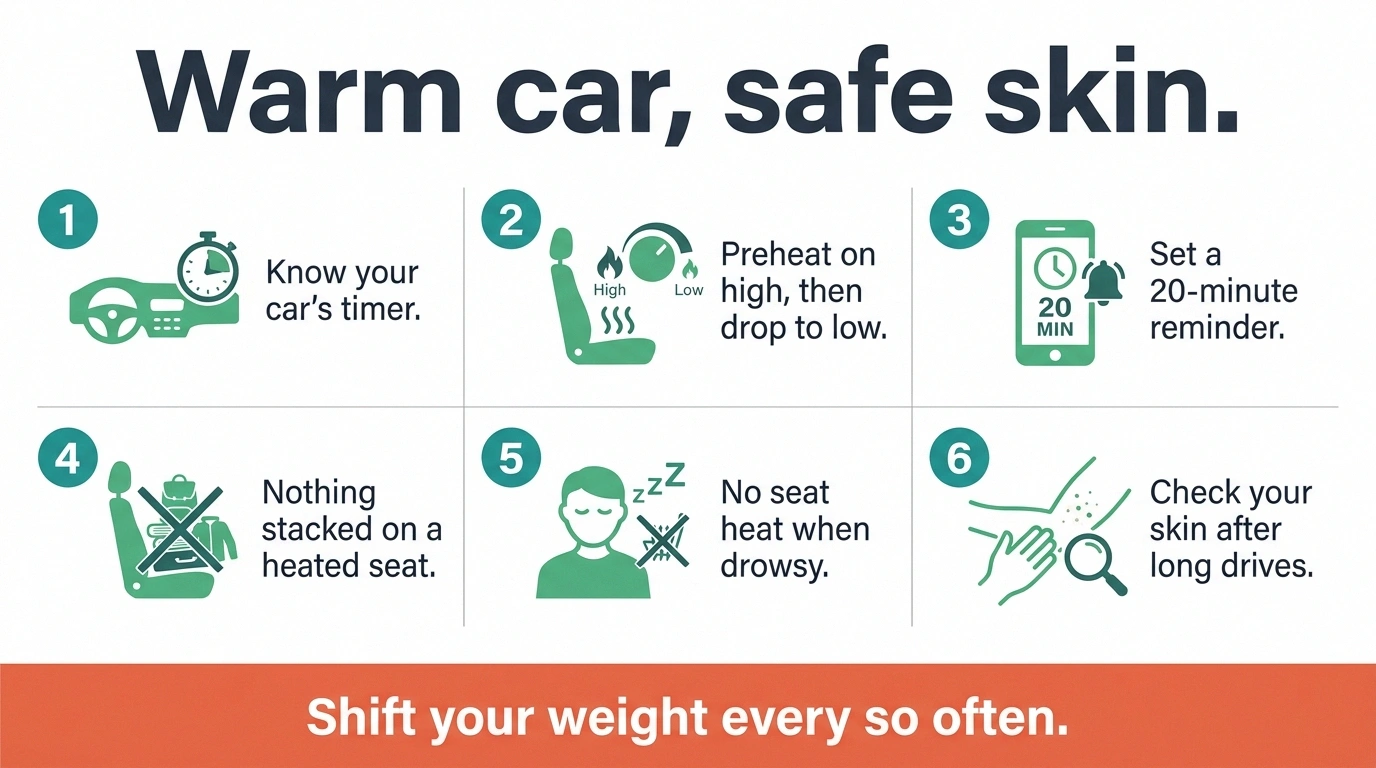
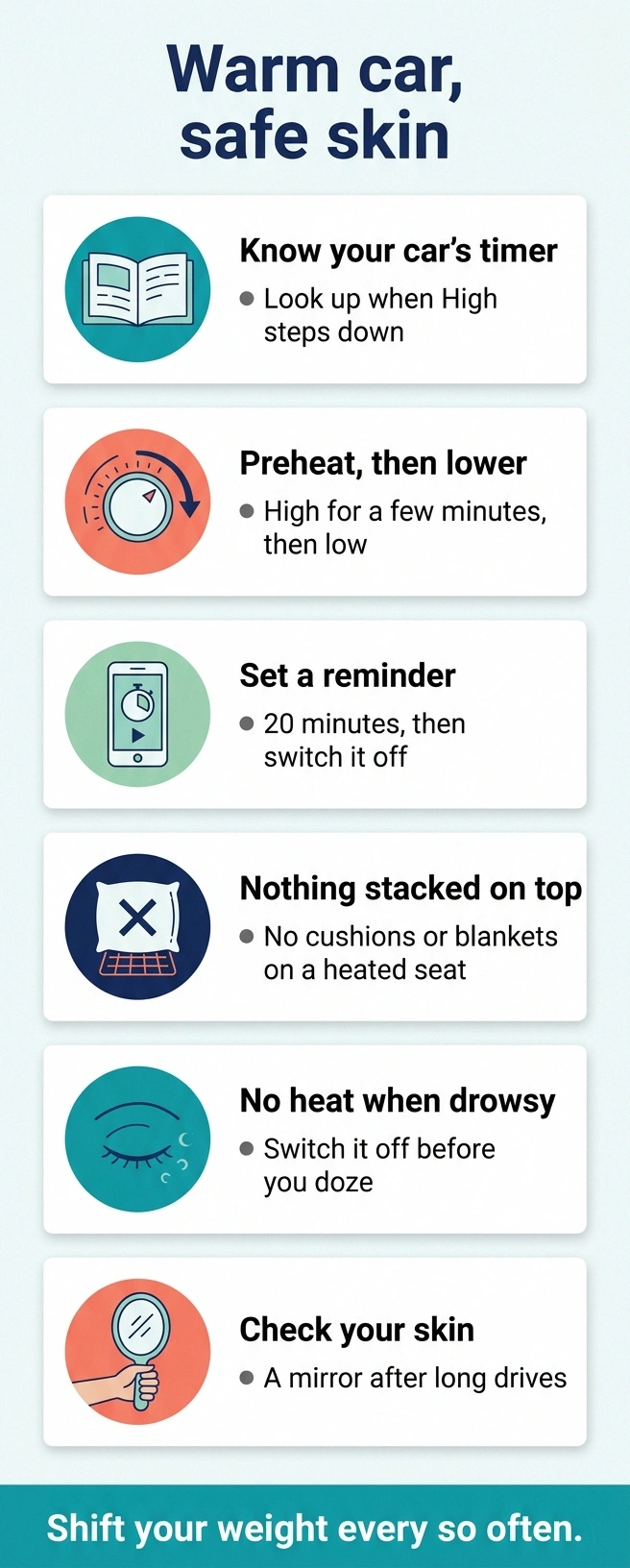
None of this means you have to shiver all winter. It means the warmth gets a little structure. Here’s the routine I’d suggest to a friend:
- Know your car. Look up how your seat heater steps down and whether anything turns it on automatically. Write the step-down times on a sticky note for the glove box.
- Preheat, then lower. Use high to warm the seat for the first few minutes, ideally before you sit down, then drop to low or off once you’re settled.
- Set a reminder. On drives longer than 20 or 30 minutes, set a phone timer or pick a landmark where you’ll switch the heater off.
- Keep layers between you and the heat. Trousers and a coat are fine. Nothing extra stacked on the seat, and no plug-in cushion on top of a heated seat.
- Never use it while sleepy. No seat heat while napping in the car, and as a passenger, switch it off before you get drowsy.
- Shift your weight. Every so often, lift one hip, then the other. It restores blood flow and gives the skin a break, heat or no heat.
- Check your skin after long drives. A quick look tells you more than any setting can.
If a family member or caregiver drives you regularly, share this list with them. A driver with full feeling can easily forget that the heat feels very different from the passenger seat. Our driving safety tips for neuropathy cover the rest of the car, from pedals to mirrors.
Checking Your Skin After a Drive
Since your nerves may not tell you, your eyes have to. After a long drive with the heater on, take a minute in the bathroom with a hand mirror and look at the backs of your thighs and your buttocks. Do the same for your feet if you had the floor heat running. If you already do a daily foot inspection, this just adds a second stop to the routine.
Get it seen the same day if
- The burned area is larger than about 3 inches across, or covers the buttocks or groin. First-aid guidance from major clinics treats burns in those areas as needing professional care.
- The skin looks white, waxy, gray, brown or leathery, even if it doesn’t hurt.
- You have diabetes and the skin has blistered or opened.
- Redness is spreading, or you notice warmth, swelling, pus or a fever over the next few days.
What you’re looking for:
- Redness that lingers. Pink skin that fades within 20 or 30 minutes is just warm skin. Redness still there an hour later deserves attention.
- Blisters or peeling. These are burns, even if they don’t hurt.
- Pale, waxy, gray or leathery patches. Deeper burns can look like this and can be painless because they damage the nerve endings in the skin. These need medical care promptly.
- A lacy, net-like brownish-red pattern. This is erythema ab igne, sometimes called toasted skin syndrome.
That last one surprises people. Dermatology journals have reported several cases tied to heated car seats, usually on the backs of the thighs. In one, a 49-year-old woman developed the rash after using her seat heater two to four hours a day. Another report described a 67-year-old woman who used the highest setting for around 130 trips of about 45 minutes each. It isn’t a burn in the usual sense—it’s a skin change from repeated, moderate heat, and it can take weeks to show up. In the reported cases, it usually faded once the heat stopped. Even so, it’s a clear sign your skin is getting more heat than it should, and a pattern that doesn’t fade is worth showing to your doctor.
For blisters, keep them clean and covered, and don’t pop them. My blister care guide walks through the dressing steps, which work the same on a thigh as on a foot. Any blister, open sore or dark patch that isn’t clearly getting better in a couple of days, or any sign of infection such as spreading redness, warmth, swelling or pus, needs a prompt visit. With diabetes, don’t wait on these.
Staying Warm Without Pressing Heat Into Your Skin

The goal is a warm body, not a hot seat. A few ways to get there with less risk:
Warm the cabin, not just the seat. If you have remote start, let the car run a few minutes before you get in (in an open driveway, never a closed garage). A warm cabin means you need much less seat heat.
Dress for the car. Thermal leggings under trousers, wool socks, lined boots you’ve already broken in, and a hat you can pull off once the car warms. Heat that comes from your own body—trapped by good layers—can’t overshoot.
Use the heater as a preheater. Many people find that two or three minutes on high before they sit down, then off, gives them a comfortable seat without any long exposure.
Keep a lap blanket for long trips, not a hotter setting. A blanket over your legs is fine when the seat heater is off. Just don’t tuck it underneath you on a heated seat.
Winter brings plenty of other challenges with neuropathy, from icy driveways to cracked skin, and I’ve put the broader season into my guide to neuropathy in cold weather. The car is just one small piece—handle it with a little planning and you get to keep the comfort and skip the surprise.
Frequently Asked Questions
Are heated car seats safe if I have neuropathy?
For many people they can be, with care. Typical diabetic neuropathy starts in the feet, so the thighs and buttocks often keep good feeling for a long time. The risk rises if numbness has reached above your knees, if you have numbness in the buttocks or groin, or if you get drowsy in the car. Use the lowest setting, keep drives with heat short, and check your skin afterward.
How hot do heated car seats get?
Testing described in burn case reports has measured seat heaters at roughly 95 to 120 degrees Fahrenheit, and a safety advocacy group has reported seats as hot as 140. Clinical reviews say skin injury can start within minutes at about 113 to 124 degrees, so the high setting on a long drive can matter if you can’t feel the heat.
Do heated seats turn off automatically?
Some do and some don’t. Many newer cars step the heat down after about 30 minutes on high, and some step down again later, but the timing varies by make and model and some seats stay on until the car is turned off. Check your owner’s manual under seat warmers or heated seats.
What is toasted skin syndrome?
Toasted skin syndrome, or erythema ab igne, is a lacy, net-like brownish-red rash caused by repeated exposure to moderate heat. Dermatology case reports have linked it to daily heated seat use, usually on the backs of the thighs. It can take weeks to appear and in reported cases usually faded after the heat was stopped.
Can I use a plug-in heated seat cushion with neuropathy?
Choose one with an automatic shut-off and a low setting, use it for short periods, and never place it on top of a car seat that is already heated. Owner’s manuals warn that cushions and covers on a heated seat can trap heat and raise the temperature against your skin.
Is a heated steering wheel safe for numb hands?
Heated steering wheels usually run cooler than seats, and your grip shifts as you drive, so the risk is lower. Check the warmth with your wrist or cheek instead of your fingertips, keep it on low, wear thin driving gloves, and look at your palms and fingertips after long drives.
What should I do if I find a burn after driving?
Cool the area with cool, not cold, running water, cover it with a clean dressing, and don’t pop any blisters. Seek medical care promptly for blisters, open skin, pale or leathery patches, or any burn if you have diabetes, since burns on numb skin can be deeper than they look.
About the Author