
Somewhere right now, a pharmacist is handing someone a box of nerve pain capsules that you cannot buy, cannot import, and cannot get your doctor to prescribe. Not because it’s experimental. Because of where you live.
The drug is crisugabalin. It went through a 729-patient trial, beat placebo convincingly, was measured head-to-head against Lyrica, and was approved in 2024 for diabetic nerve pain and shingles pain in adults. It’s on the market. People take it daily.
Only in China.
That’s the first thing to know, and I’m putting it up top because most of what’s written about this drug is a clinical abstract that never gets round to answering the question you actually came with. So: no, you can’t get it, and there’s no US filing to wait on. What follows is why it’s still worth understanding — because the trial that got it approved contains a comparison nobody else has run, and that comparison tells you something useful about the pills you probably are taking.
The Availability Question, Answered Properly
Crisugabalin (research name HSK16149) was developed by Haisco Pharmaceutical Group, a Chinese company, on its own intellectual property. China’s regulator approved it in 2024 for two indications: diabetic peripheral neuropathic pain and postherpetic neuralgia.
China is currently the only country where it’s approved. There’s no FDA approval, no European approval, and no publicly announced US filing. Every trial published so far enrolled Chinese patients only, which the researchers themselves flag as a limit on how far the results travel.
Importing a prescription drug for personal use is a legal grey area at best and a bad idea at worst, and with a drug that causes dizziness in more than a quarter of users and has no US prescribing information, I wouldn’t go near it. What’s genuinely useful here is the data, not the pill.
What Alpha-2-Delta Means When Somebody Says It At You
If you’ve taken gabapentin or pregabalin, you’ve already taken an alpha-2-delta drug, whether or not anyone used the phrase.
| Drug | Typical daily dose | Where you can get it |
|---|---|---|
| Gabapentin | 900 to 3,600 mg, split across three doses | Widely available, generic |
| Pregabalin | 150 to 600 mg, split across two or three doses | Widely available, generic, Schedule V in the US |
| Crisugabalin | 40 to 80 mg, split across two doses | China only |
The falling milligram numbers reflect potency, not effect. A drug that works at 40 mg is not stronger than one that works at 900 mg; it simply binds its target more tightly, so less of it is needed. Comparing doses across these three tells you nothing about which relieves more pain.
Here’s the mechanism in plain terms. When a nerve is damaged, its endings start hoarding calcium channels — far more than a healthy nerve carries. Calcium flooding in is what triggers the release of the chemical messengers that carry a pain signal onward. More channels, more calcium, more signal, and a nerve that shouts when it should be whispering.
The alpha-2-delta subunit is a component of those calcium channels, and it also acts as the shipping department that moves new channels out to the nerve ending. Gabapentin, pregabalin and crisugabalin all bind to it. They don’t plug the channel like a cork. They interfere with the traffic, so fewer channels reach the surface and less calcium gets in.
That’s also why these drugs take days to weeks to reach full effect. You’re not blocking something instantly, you’re changing what gets built and delivered.
Crisugabalin is described in the literature as a third-generation drug in this family — gabapentin first, pregabalin second, this one third. The selling point is tighter binding to the alpha-2-delta-1 subtype specifically, which is the one linked to pain, rather than alpha-2-delta-2, which is more associated with the side effects.
The Trial That Got It Approved
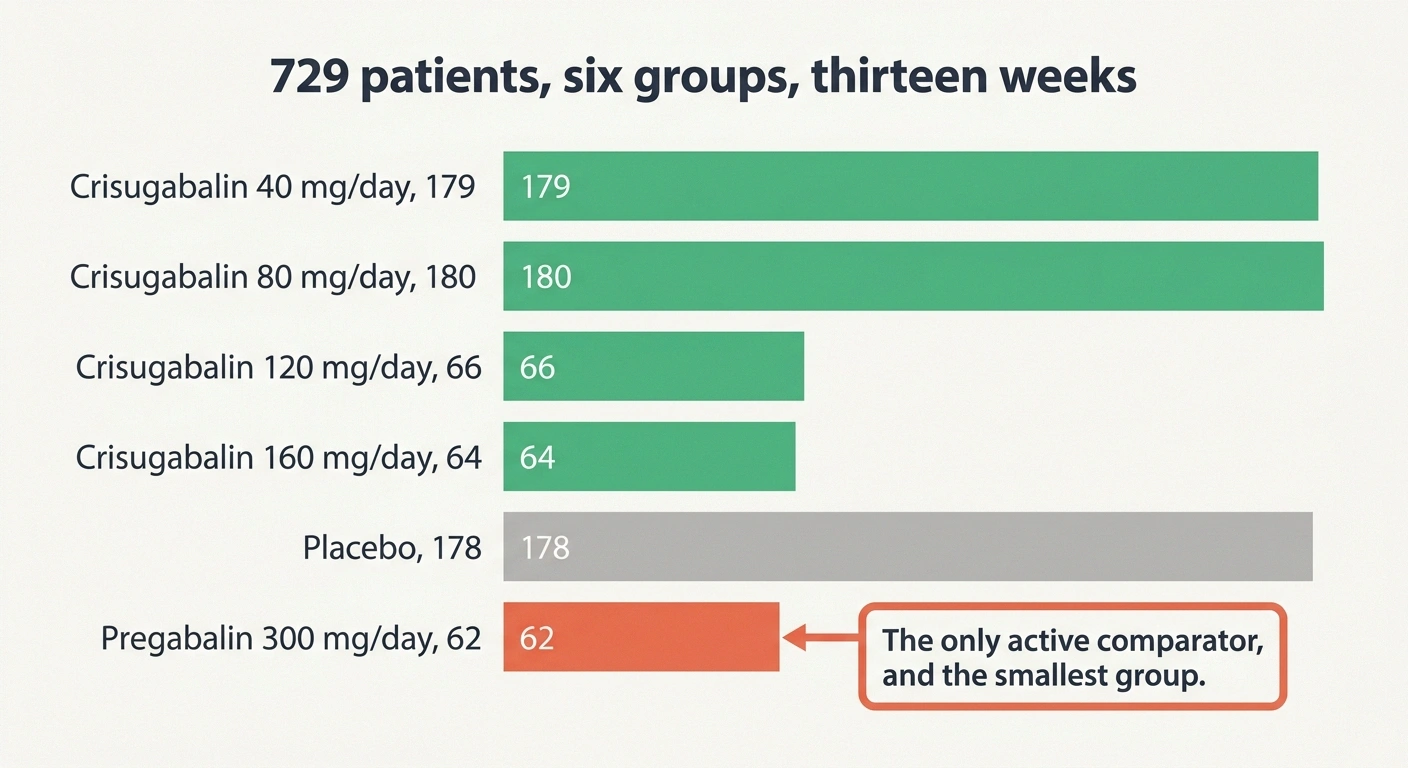
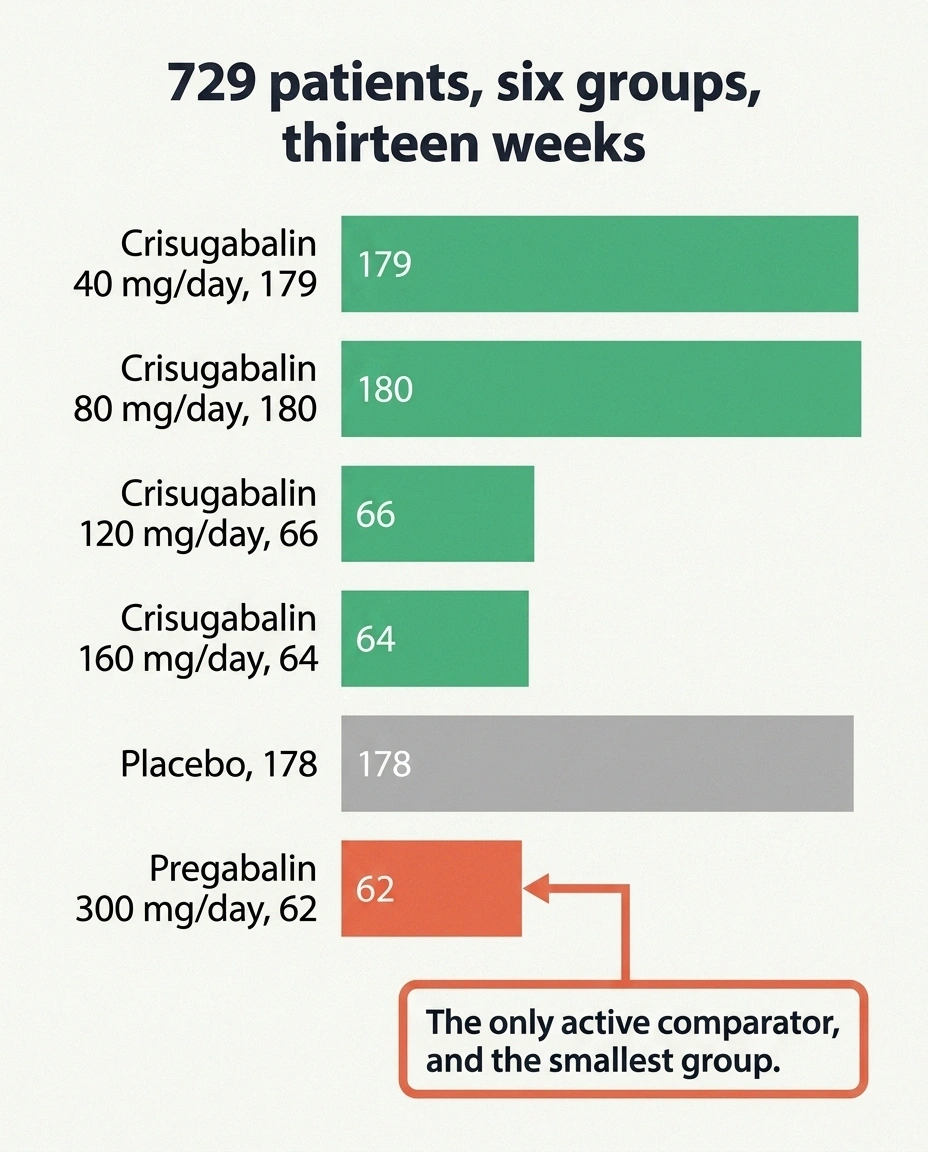
The pivotal study randomized 729 patients with painful diabetic neuropathy and treated them for 13 weeks. What makes it worth reading is the arm list, because it includes an active comparator, which most nerve pain trials skip:
- Crisugabalin 40 mg/day: 179 patients
- Crisugabalin 80 mg/day: 180 patients
- Crisugabalin 120 mg/day: 66 patients
- Crisugabalin 160 mg/day: 64 patients
- Placebo: 178 patients
- Pregabalin 300 mg/day: 62 patients
The main measure was the change in average daily pain score at week 13, on the familiar 0-to-10 scale. Results:
- Crisugabalin 40 mg/day: −2.24 points
- Crisugabalin 80 mg/day: −2.16 points
- Pregabalin 300 mg/day: −2.09 points
- Placebo: −1.23 points
Both crisugabalin doses beat placebo with a p-value below 0.001. And they landed within a fifth of a point of pregabalin.
Two things about that comparison deserve saying carefully. First, the pregabalin arm had only 62 people, and the trial was never designed or powered to prove crisugabalin superior to it. Anyone claiming this shows crisugabalin is better than Lyrica is over-reading a small arm. Second — and this is the honest read — the numbers sitting that close together is itself informative. The new drug did about what the old drug does, at a much smaller milligram dose, and that’s the actual claim.
The other oddity: 40 mg/day performed as well as 80 mg/day, and slightly better on the primary measure. Doubling the dose didn’t buy more pain relief. It’s an unusual finding, and it’s the reason the tolerability discussion later matters so much.
Responder Rates: The Number That Tells You More
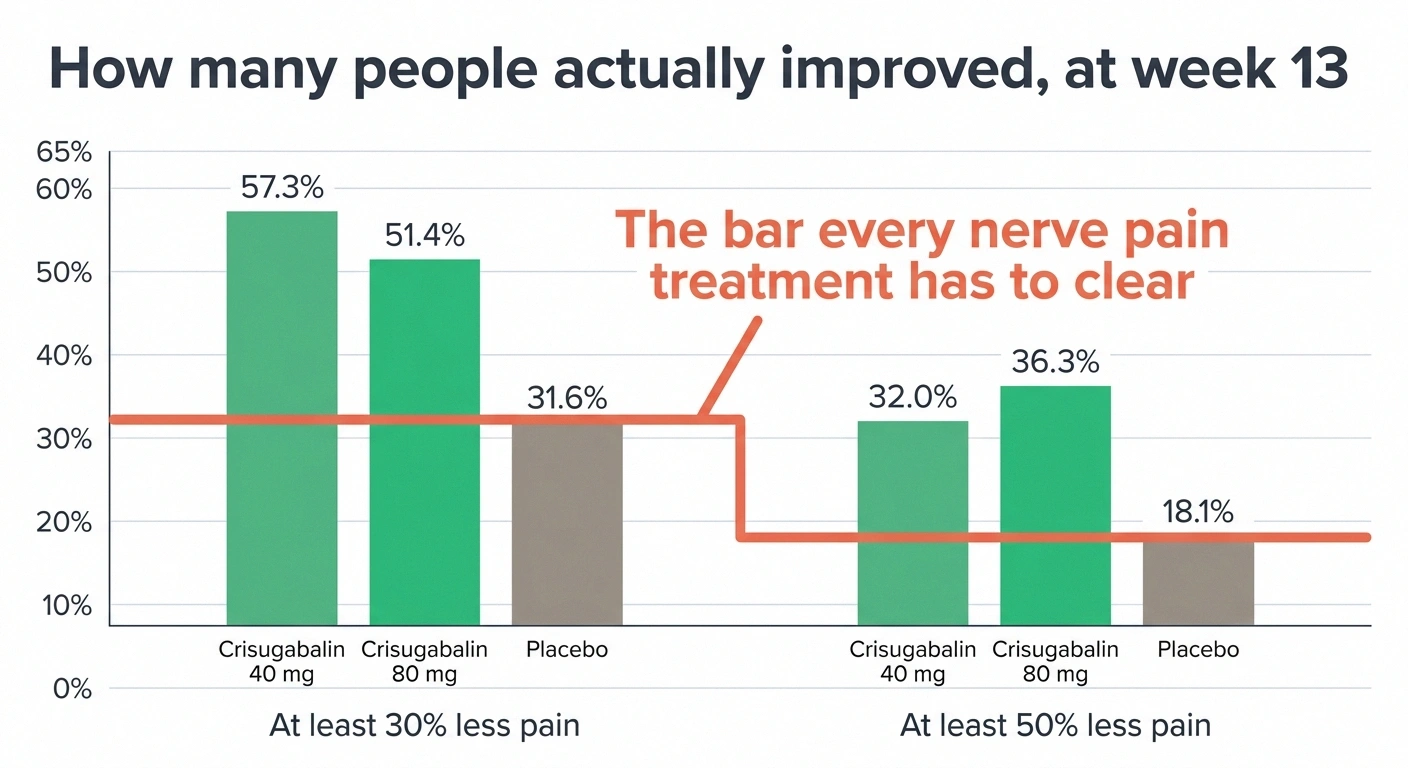
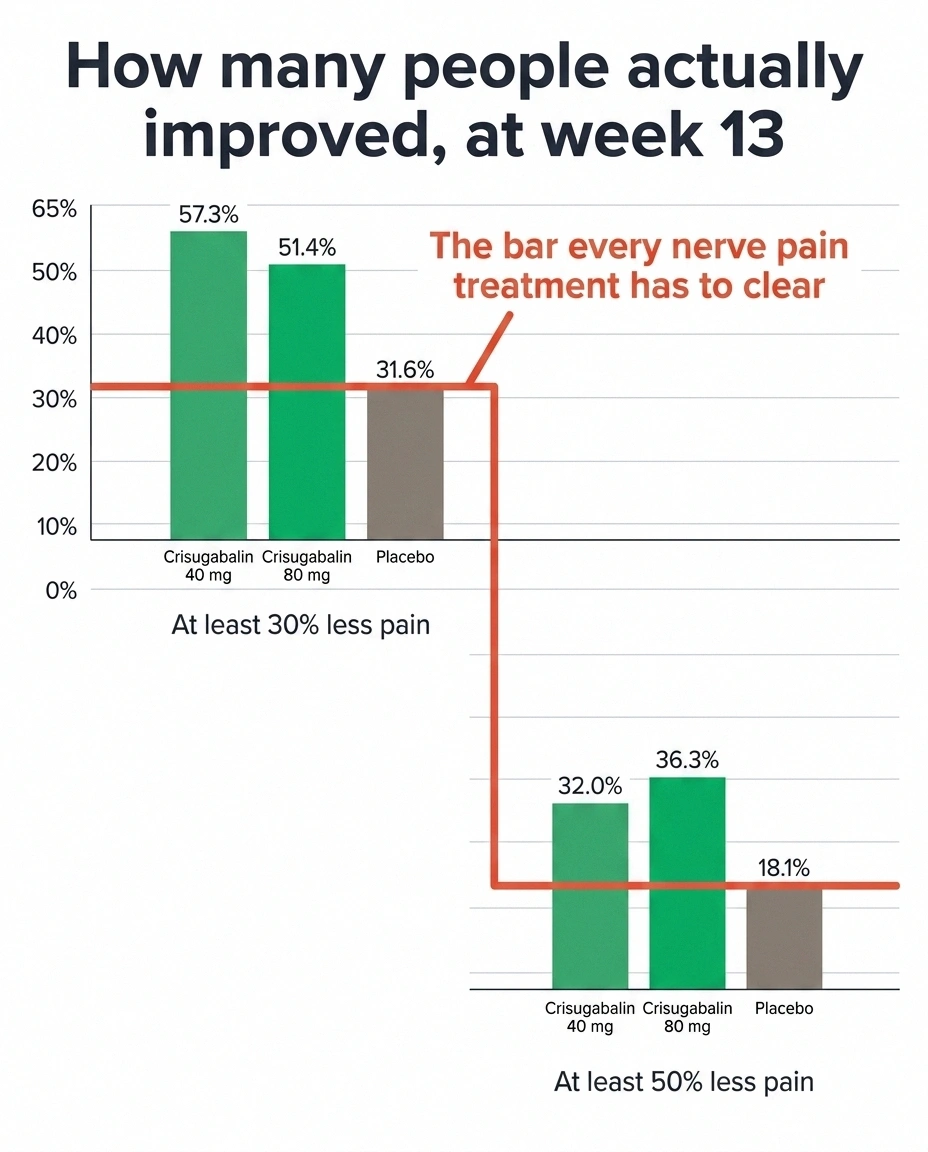
Average pain scores hide people. An average of −2.2 could be everyone improving a bit, or a third of people improving enormously while the rest get nothing at all. For nerve pain, it’s usually closer to the second. That’s why responder rates matter more.
Subtract before you react. A drug reporting that 57% of patients improved sounds transformative until you see that 32% improved on placebo. The honest figure is the gap, which here is about 26 percentage points, or roughly one extra person helped for every four treated.
High placebo response is not fraud or imagination. Pain fluctuates naturally, people enrol when they are at their worst and drift back toward their average, and structured weekly attention genuinely changes how pain is experienced and reported.
It is also why nerve pain drugs fail so often in late-stage trials. The bar is not zero. It is roughly a third of people getting meaningfully better on nothing at all.
At week 13, the share of patients whose pain dropped by at least 30%:
- Crisugabalin 40 mg/day: 57.3%
- Crisugabalin 80 mg/day: 51.4%
- Placebo: 31.6%
And the tougher bar, at least 50% pain reduction:
- Crisugabalin 40 mg/day: 32.0%
- Crisugabalin 80 mg/day: 36.3%
- Placebo: 18.1%
Look at the placebo column before anything else. Nearly a third of people on a sugar capsule got 30% better, and almost one in five halved their pain. That isn’t a flaw in the trial — it’s what nerve pain does. It fluctuates, attention changes it, and being enrolled in a study where somebody asks about your feet every week changes it too. Any pain treatment you read about has to clear that bar, and it’s a high one.
Separation from placebo started at week 1 and held all the way to week 13, which supports the “fast onset” claim the developers make.
A Full Year On the Drug
Thirteen weeks tells you about starting a drug. It says nothing about living on one, and diabetic nerve pain is a decades-long proposition.
So there’s a 52-week follow-on study: 301 patients, all taking 80 mg/day split into two doses, with permission to drop to 40 mg if needed. Ninety percent finished the year, which is a good sign in itself.
Pain kept improving. The pain rating index fell an average of 2.5 points and the visual analogue score fell 23.4 points, both highly significant. The share of patients reporting present pain intensity of 1 or less climbed from 68.4% at the start to 87.4% at the end.
But look at what that study didn’t measure, because the authors list it themselves: no comparison group over the year, no assessment of sleep, no quality-of-life measurement, and no data on withdrawal, tapering or abuse potential.
That last omission matters more than it sounds. Stopping a gabapentinoid abruptly can cause a genuinely rough withdrawal, and pregabalin is a controlled substance in the United States for exactly that reason. A 52-week study on a drug in this class that collects nothing about coming off it has left out the question a lot of long-term users would ask first.
Dizziness Doesn’t Go Away Just Because the Drug Is New
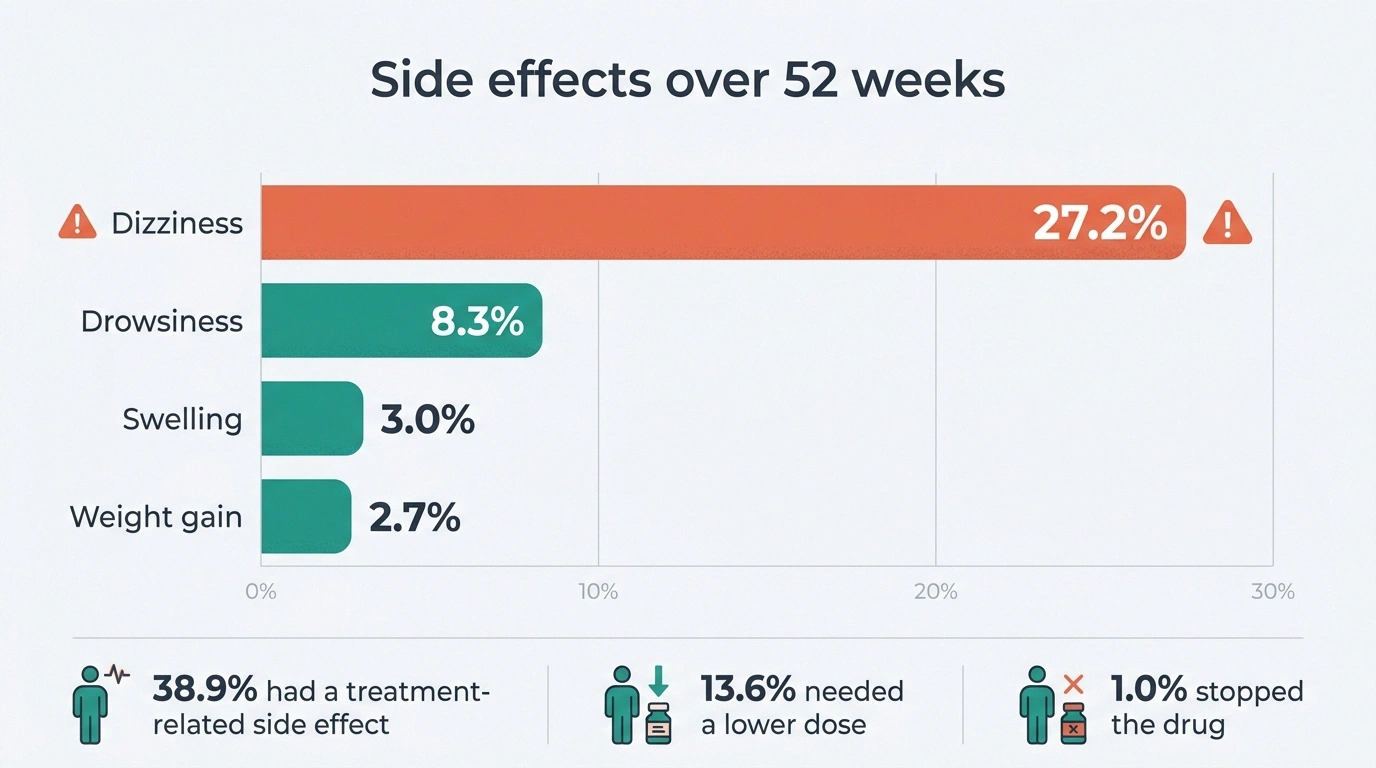
Across a year of treatment, 38.9% of patients had a treatment-related side effect. The breakdown:
- Dizziness: 27.2%
- Somnolence (drowsiness): 8.3%
- Peripheral edema (swelling): 3.0%
- Weight gain: 2.7%
Severe reactions were rare at 1.7%, and only 1.0% of patients — three people — stopped because of side effects. But 13.6% needed a dose reduction.
So the fair summary is this. The swelling and weight gain that drive so many people off pregabalin look genuinely less common here, at 3.0% and 2.7%. Dizziness does not. More than one in four people got dizzy, and they stayed on the drug anyway. For someone whose feet already can’t report reliably where the floor is, a drug that adds dizziness isn’t a minor inconvenience — it’s a fall risk stacked on top of an existing fall risk, which is why balance and fall prevention belongs in the same conversation as the prescription.
In the shorter pivotal trial, three-quarters of all participants recorded some adverse event, again led by dizziness and drowsiness. This is a class effect. A better-targeted molecule tempered it; nothing has abolished it.
What If Pregabalin Already Failed You?

That’s the question I’d want answered, and to their credit the developers ran a study on precisely it: a Phase 2 trial in people with diabetic nerve pain who had an inadequate response to pregabalin.
The design is interesting because the honest expectation would be pessimism. If a drug hits the same target as one that already failed you, why would it work? The counter-argument is that binding selectivity and dosing behaviour differ enough that individual responses might too — which is exactly the reasoning behind trying mirogabalin after pregabalin, and it’s the same logic clinicians use when they rotate people between gabapentin and pregabalin today.
The results were presented at a diabetes conference rather than published in full, so I’d treat them as preliminary. The important takeaway isn’t the numbers — it’s that “this class didn’t work for me” is a claim worth testing rather than assuming, and that a rotation within the class is a legitimate conversation to have about the drugs you can actually get.
Kidneys, and Why This Matters for Diabetes
Alpha-2-delta drugs leave the body through the kidneys, essentially unchanged. If kidney function drops, the drug accumulates, and accumulation is what turns manageable dizziness into a fall.
“When was my eGFR last checked, and has my gabapentin or pregabalin dose been adjusted since?”
Both drugs leave the body almost entirely through the kidneys, unchanged. When kidney function declines the drug accumulates, and the first sign is usually not pain relief. It is unsteadiness, drowsiness, or a swimming feeling that arrives weeks after nothing changed about the prescription.
Kidney function drifts slowly, so this is easy for everyone to miss. If a medication you have taken comfortably for years starts making you feel unsteady, an outdated dose is one of the more common and more fixable explanations.
This isn’t an obscure scenario. Diabetic kidney disease and diabetic neuropathy travel together, driven by the same years of elevated blood sugar. A great many people who need one of these drugs have reduced kidney function whether or not anyone has mentioned it to them.
A dedicated study of crisugabalin in patients with varying degrees of renal impairment was published in 2026, which is the right thing to have done. If you’re on gabapentin or pregabalin today, the practical takeaway is simple and worth acting on: your dose should be matched to your current kidney function, not the number from three years ago. An eGFR that’s drifted downward without a matching dose adjustment is one of the more common reasons a medication that used to feel fine starts making somebody unsteady.
What Would Have To Happen For This To Reach US Pharmacies
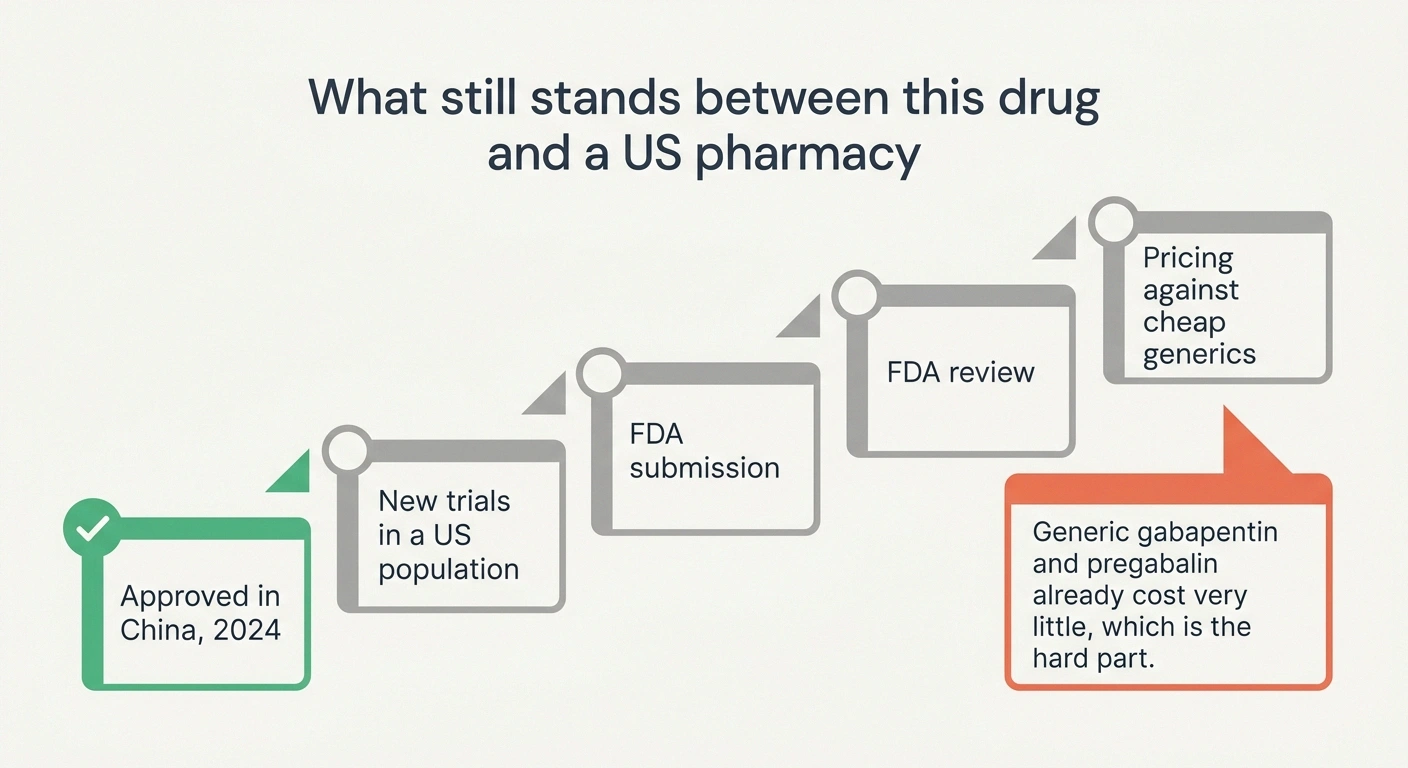
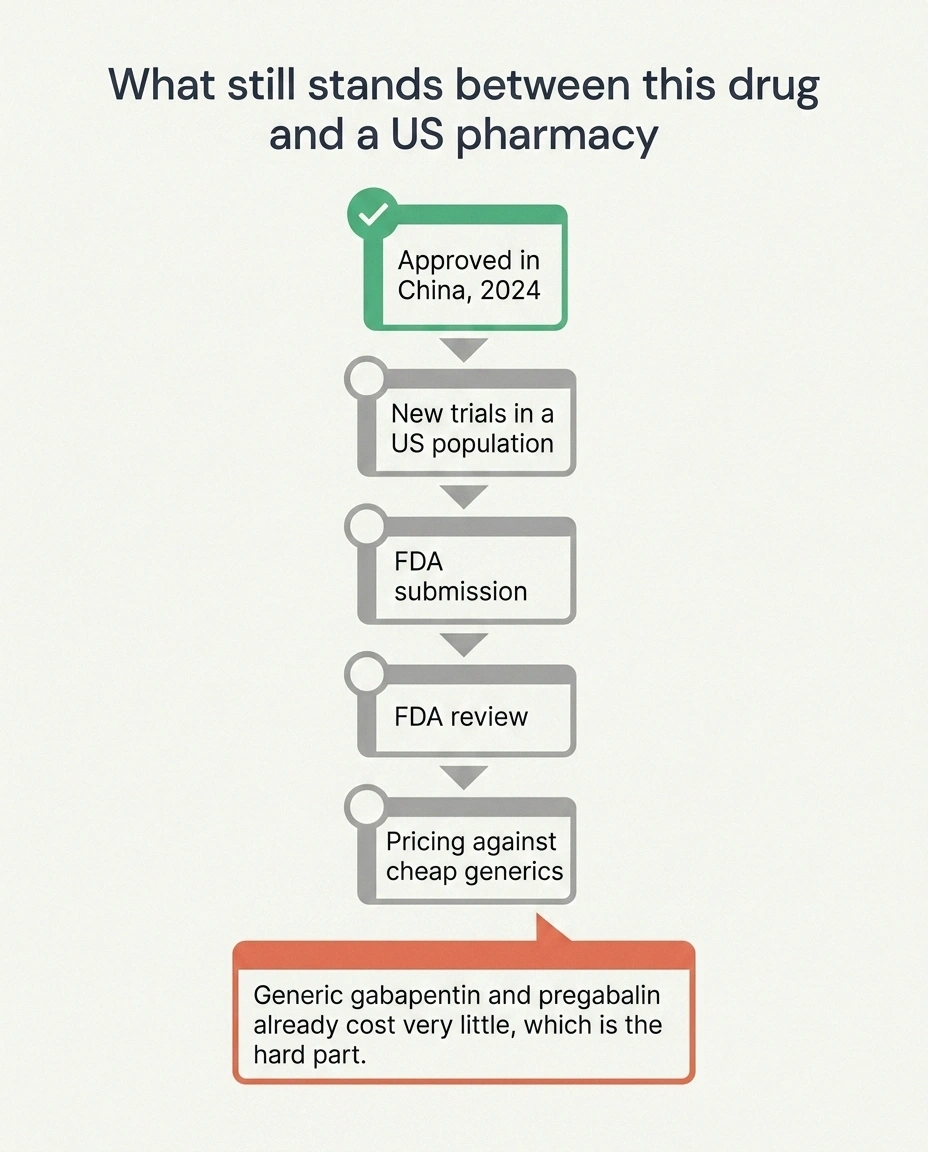
Realistically, a lot — and there’s no sign it’s underway.
No comparison group. Everyone received the drug. Improvement over a year in a single-arm study cannot be separated from time, attention and natural fluctuation.
No sleep or quality-of-life measures. For a condition whose worst hours are at night, that is a sizeable gap in what was recorded.
No withdrawal or tapering data. Notable for a class where stopping abruptly is a known problem and where the closest relative is a controlled substance in the US.
Chinese patients only. The authors flag this themselves as a limit on how far the findings generalise.
None of this makes the results wrong. It marks the edges of what they can tell you, and researchers listing their own limitations plainly is a sign of a study worth taking seriously rather than a reason to dismiss it.
The FDA generally wants trial data that reflects the population that’ll use the drug. Every published crisugabalin study enrolled Chinese patients, and the researchers name that as a limitation. A US approval would most likely require new trials run here, which means years and a great deal of money, and a company would only spend it if the commercial case held up against generic gabapentin and pregabalin that already cost very little.
That’s the uncomfortable economics of nerve pain drugs. A modestly better molecule in a crowded class with cheap generics is a hard business case, no matter how good the science is. It’s the same wall that several other promising compounds in the current pipeline have to get over.
None of that makes the science less real. It does mean that if you’re waiting on this specific pill, you’re waiting on something that may never arrive, and there’s better use for your attention.
The Part You Can Use Tonight
Crisugabalin itself isn’t actionable. What the trial data around it says about your own treatment is.
First: the 40 mg arm matching the 80 mg arm is a reminder that with this class of drug, more isn’t automatically better. If you’re on a high dose of gabapentin or pregabalin and feeling foggy without proportionate pain relief, that’s a real conversation to have, not a personal failing.
Second: the ceiling on all of these drugs is lower than most people are told. Roughly half of patients get 30% relief, a third get 50%, and a substantial fraction get that on placebo. If your medication took the edge off but didn’t fix it, you’re having the normal experience, not a bad one. That’s also why combining approaches tends to outperform chasing the perfect pill.
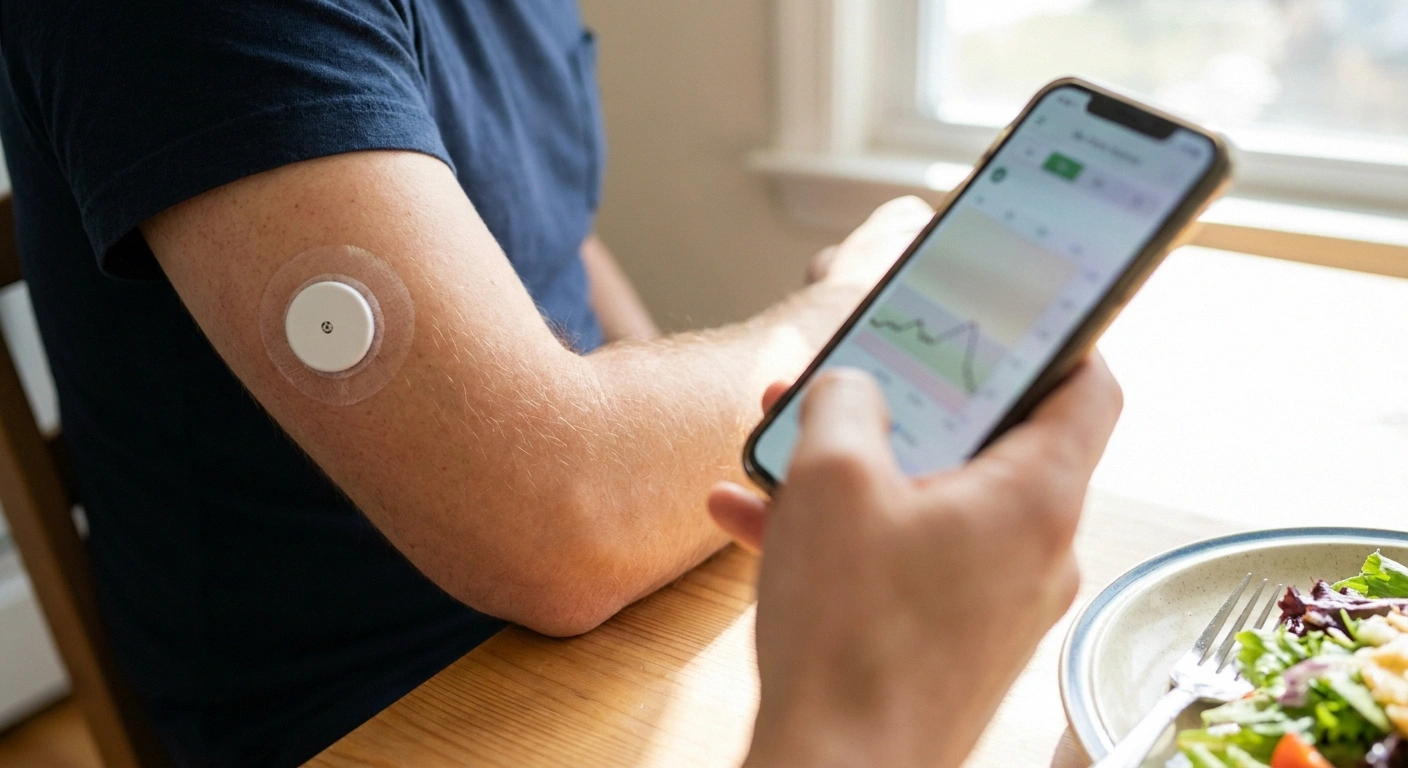
Third: the thing that changes the trajectory of diabetic neuropathy isn’t in this article at all. Pain drugs treat the symptom. Glucose stability treats the cause, and time in range is the measure that reflects what your nerves actually experience day to day — far better than a single quarterly number does.
Frequently Asked Questions
Is crisugabalin available in the United States?
No. It is approved only in China, where it was authorised in 2024 for diabetic peripheral neuropathic pain and postherpetic neuralgia. There is no FDA approval and no publicly announced US application. It cannot be prescribed or legally imported for personal use in the US.
Is crisugabalin better than pregabalin?
The evidence does not support that claim, though the two performed similarly. In the pivotal trial, crisugabalin 40 mg/day reduced average daily pain by 2.24 points and pregabalin 300 mg/day by 2.09 points, but the pregabalin arm included only 62 patients and the study was not designed to test superiority. What can be said is that crisugabalin matched pregabalin’s effect at a far smaller milligram dose, and showed lower rates of swelling and weight gain over a year.
What is an alpha-2-delta ligand?
It is a drug that binds the alpha-2-delta subunit of voltage-gated calcium channels on nerve endings. Damaged nerves accumulate extra calcium channels, and calcium entry triggers release of the messengers that carry pain signals. These drugs reduce how many channels reach the nerve surface, which lowers the signal. Gabapentin, pregabalin, mirogabalin and crisugabalin all work this way.
How fast does crisugabalin work?
In the pivotal trial, patients on crisugabalin separated from placebo by week 1 and stayed separated through week 13. A separate analysis was published specifically on the speed of onset. As with all drugs in this class, the full effect builds over days to weeks rather than arriving with the first dose.
What are the side effects?
Over 52 weeks, 38.9% of patients had a treatment-related side effect. Dizziness was by far the most common at 27.2%, followed by drowsiness at 8.3%, swelling at 3.0% and weight gain at 2.7%. Severe reactions occurred in 1.7%. Only 1.0% stopped treatment because of side effects, but 13.6% needed a dose reduction.
Does it cause weight gain and swelling like pregabalin?
Less often, based on the year-long data. Weight gain occurred in 2.7% of patients and swelling in 3.0%, both notably lower than typically reported for pregabalin. Dizziness, however, remained common at 27.2%, so the improvement in tolerability appears real but partial.
Is crisugabalin a controlled substance?
Its scheduling status in the US is not applicable, because it is not approved there. Pregabalin is a Schedule V controlled substance in the US due to withdrawal and misuse potential, and gabapentin is scheduled in some states. The published 52-week crisugabalin study explicitly did not assess withdrawal, tapering or abuse potential, so that question is unanswered for this drug.
Could it help if pregabalin did not work for me?
A Phase 2 trial was run specifically in patients with an inadequate response to pregabalin, which suggests the developers consider it plausible. The results were presented at a conference rather than published in full, so they should be treated as preliminary. The broader principle does hold in practice: not responding to one drug in this class does not reliably predict failing another, which is why rotation within the class is a standard approach.
About the Author