
Browse all our living with neuropathy guides for more articles like this one.
When neuropathy first started affecting my daily life, the last thing I expected was that it would eventually threaten my ability to work. But for many people living with peripheral neuropathy, the burning, numbness, and weakness in their hands and feet progresses to the point where holding a job becomes genuinely difficult — or even impossible. If you're in that situation, you deserve to know that help is available.
The Social Security Administration (SSA) recognizes peripheral neuropathy as a potentially disabling condition. Depending on the severity of your symptoms and how they affect your ability to work, you may qualify for Social Security Disability Insurance (SSDI) or Supplemental Security Income (SSI). In fact, according to the SSA, 9.9% of disabled workers in 2021 received benefits for neurological conditions including peripheral neuropathy.
This guide walks you through everything you need to know: how the SSA evaluates neuropathy claims, what evidence you'll need, and practical steps to strengthen your application. As someone who's navigated the healthcare system with neuropathy for over a decade, I know how overwhelming this process can feel — but understanding the rules gives you a real advantage.
By the Numbers
9.9% of disabled workers receiving Social Security benefits in 2021 had neurological conditions including peripheral neuropathy. The SSA formally lists peripheral neuropathy under Blue Book Section 11.14 as a qualifying disability.
Is Neuropathy Considered a Disability?
Yes — peripheral neuropathy is listed in the SSA's Blue Book (their official listing of impairments) under Section 11.14: Peripheral Neuropathy, within the neurological disorders chapter. This means the SSA formally recognizes it as a condition that can qualify for disability benefits.
However, having a neuropathy diagnosis alone isn't enough to qualify. The SSA evaluates claims on a case-by-case basis, focusing on how severely your symptoms limit your ability to work — not just whether you have the condition. Many people with mild neuropathy continue working without major issues, while others with severe forms find even basic tasks like gripping objects, standing, or walking extremely difficult.
Beyond SSDI and SSI, neuropathy may also qualify you for protections under the Americans with Disabilities Act (ADA) if your symptoms substantially limit one or more major life activities. This means your employer may be required to provide reasonable accommodations — such as a seated workstation, modified duties, or flexible scheduling — before you reach the point of needing disability benefits.
SSDI vs. SSI: Understanding the Two Programs
The SSA offers two separate disability programs, and understanding which one applies to you is an important first step.
Social Security Disability Insurance (SSDI) is for people who have worked and paid Social Security taxes for a sufficient period. You earn “work credits” based on your earnings — generally, you need about 20 credits in the 10 years before your disability began (roughly 5 years of work). The benefit amount depends on your lifetime earnings history. For 2026, the average SSDI payment for someone with a neurological condition is approximately $1,420 per month, though it can be as high as $3,627 per month depending on your work history.
Supplemental Security Income (SSI) is a needs-based program for people with limited income and resources, regardless of work history. You don't need work credits to qualify for SSI, but your financial assets must fall below certain thresholds. SSI payments are generally lower than SSDI — the federal maximum is around $943 per month in 2026, though some states add a supplement.
Some people qualify for both programs simultaneously. If you've worked but your SSDI amount would be very low, you might receive SSI as a supplement. The key difference: SSDI is based on work history, SSI is based on financial need.
💼 SSDI
Based on: Work history & tax contributions
Requires: ~20 work credits (5 years of work in last 10 years)
Average payment: ~$1,420/month
Maximum: Up to $3,627/month
🤝 SSI
Based on: Financial need (limited income & assets)
Requires: No work credits needed
Federal maximum: ~$943/month
Note: Some states add supplements
How the SSA Evaluates Neuropathy Disability Claims
The SSA uses a five-step sequential evaluation to determine whether you qualify for disability. Understanding this process helps you build the strongest possible case.
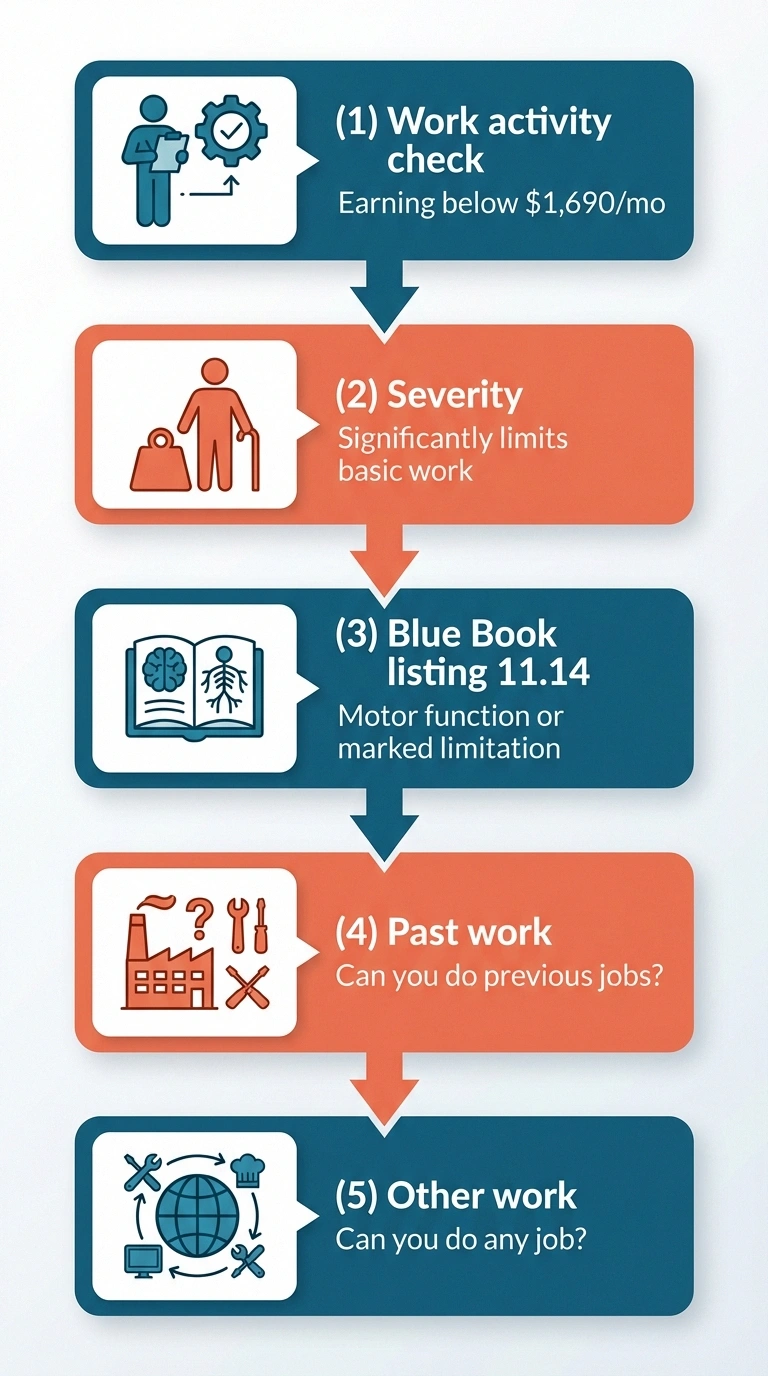
Step 1: Are you currently working? If you're earning above the “substantial gainful activity” (SGA) threshold — $1,690 per month in 2026 for non-blind individuals — you generally won't qualify, regardless of your medical condition.
Step 2: Is your condition “severe”? Your neuropathy must significantly limit your ability to perform basic work activities. This is a relatively low bar — most people with diagnosed peripheral neuropathy that causes ongoing symptoms will meet this step.
Step 3: Does your condition meet or equal a Blue Book listing? This is the critical step. The SSA's Blue Book listing 11.14 for peripheral neuropathy requires you to demonstrate one of two things:
Option A: Disorganization of motor function in two extremities (arms, legs, or one of each), resulting in an extreme limitation in your ability to stand up from a seated position, balance while standing or walking, or use your upper extremities.
Option B: A marked limitation in physical functioning, PLUS a marked limitation in at least one of these mental/cognitive areas: understanding and remembering information, interacting with others, concentrating and maintaining pace, or adapting and managing yourself.
Step 4: Can you do your previous work? If you don't meet the Blue Book listing exactly, the SSA asks whether your neuropathy symptoms prevent you from performing any of your past jobs.
Step 5: Can you do any other work? The SSA considers your age, education, work experience, and remaining functional abilities to determine if there's ANY type of work you could reasonably do. This is where age actually works in your favor — the SSA recognizes that people over 50, and especially over 55, have fewer realistic options for switching careers.
Key Takeaway
You don't have to meet the Blue Book listing exactly to qualify. If your neuropathy prevents you from doing your past work AND any other work you're qualified for, you can still be approved through the RFC (Residual Functional Capacity) evaluation at Steps 4 and 5.
What Medical Evidence Do You Need?
Medical documentation is the foundation of any successful disability claim. The SSA wants to see objective evidence that your neuropathy is severe enough to prevent work — not just your description of symptoms. Here's what strengthens your case:

Nerve conduction studies (NCS) and electromyography (EMG): These are the gold standard tests for documenting neuropathy severity. NCS measures how quickly electrical signals travel through your nerves, while EMG records electrical activity in your muscles. Abnormal results on these tests provide concrete, objective evidence of nerve damage that the SSA takes very seriously.
Skin biopsy (IENFD): For small fiber neuropathy, intraepidermal nerve fiber density testing measures the actual number of nerve fibers in a skin sample. This is particularly important because small fiber neuropathy often doesn't show up on standard nerve conduction studies, yet can be equally disabling.
Imaging studies: CT or MRI scans can help identify compressed nerves, herniated discs, tumors, or other structural issues contributing to your neuropathy.
Blood work: Tests for vitamin deficiencies, diabetes, thyroid function, and autoimmune markers help document the underlying cause and show you're following up with medical care.
Treatment history: Documentation showing you've tried multiple treatments — gabapentin, duloxetine, physical therapy, etc. — and still have significant limitations is powerful evidence. It shows you're not just skipping treatment and claiming disability.
Treating physician records: Regular records from your neurologist or primary care doctor documenting your symptoms over time carry significant weight. The SSA gives particular deference to your treating physician's opinion because they have firsthand knowledge of your condition.
The Residual Functional Capacity (RFC) Assessment
If you don't meet the Blue Book listing exactly — which is the reality for many neuropathy patients — the SSA will assess your Residual Functional Capacity (RFC). This is essentially a detailed evaluation of what you can still do despite your limitations.

The RFC considers things like:
- How long you can stand or walk without needing to rest
- How much weight you can lift and carry
- Whether you can use your hands for fine manipulation (typing, handling small objects)
- How well you can reach, bend, and climb
- Whether you need to elevate your feet throughout the day
- How often you need breaks due to pain or numbness
- Whether your medications cause drowsiness or cognitive fog
Here's a critical tip: ask your own doctor to complete an RFC form. You can download the RFC form (SSA-4734) from the SSA website. When your treating physician fills out this form with specific, detailed limitations — “patient can stand no more than 10 minutes at a time” or “patient drops objects due to hand numbness 3-4 times per hour” — it's far more persuasive than a generic SSA consultative exam done by a doctor who has never treated you.
The impact of hand neuropathy on work capacity is often underestimated. Even if you could theoretically sit at a desk all day, if neuropathy in your hands prevents you from typing, handling papers, or working with small objects, the number of available jobs drops dramatically. Make sure your RFC addresses upper extremity limitations specifically.
5 Steps to Strengthen Your Disability Application
Getting approved for neuropathy disability benefits isn't just about having the condition — it's about presenting your case effectively. These steps can significantly improve your chances:
1. Get up-to-date diagnostic testing. The SSA wants recent medical evidence — ideally no more than 6 months old. If your last nerve conduction study was two years ago, get a new one. New test results may also reveal progression that strengthens your case. Even if you've had these tests before, repeat testing can demonstrate worsening over time.
2. Document your daily limitations in detail. Keep a symptom journal that records specific instances when neuropathy prevented you from doing something. “I dropped three glasses this week because I couldn't feel them in my hand.” “I fell on my way to the bathroom because my feet were completely numb.” These concrete details matter more than general statements like “my neuropathy is bad.”
3. Get your treating physician's RFC. As mentioned above, a detailed RFC from your own doctor is one of the most powerful pieces of evidence you can provide. An Administrative Law Judge (ALJ) will often give this more weight than a consultative exam by an SSA-appointed doctor who spent 15 minutes with you.
4. Build supporting evidence from your work history. Letters from former employers or coworkers describing how your neuropathy affected your job performance can be compelling. Educational records showing your skill set is limited to jobs you can no longer perform also help demonstrate that there's no “other work” you could realistically transition to.
5. Consider working with a disability attorney. Disability attorneys work on contingency — they only get paid if you win your case, typically receiving 25% of your back pay up to a maximum of $7,200. Statistics consistently show that applicants represented by attorneys have significantly higher approval rates, particularly at the appeals level. An attorney knows exactly how to frame your medical evidence in terms the SSA responds to.
📋 Your Application Checklist
Up-to-date nerve conduction study / EMG (within 6 months)
Detailed symptom journal with specific functional limitations
RFC form completed by your treating physician
Supporting letters from former employers or coworkers
Complete treatment history documentation
Consultation with a disability attorney (free case evaluation)
What Happens After You Apply
The disability application process is notoriously slow, and having realistic expectations helps manage the stress.

Initial application: Most initial applications are decided within 3-6 months. Unfortunately, approximately 65% of initial neuropathy disability claims are denied. Don't be discouraged — this is common across all disability types, and many cases are ultimately won on appeal.
Reconsideration: If denied, you have 60 days to request reconsideration. This is essentially a second review by a different examiner. Approval rates at this stage are still low (around 10-15%), but filing reconsideration preserves your right to the next level of appeal.
Administrative Law Judge (ALJ) hearing: This is where many neuropathy cases are won. You'll appear before a judge who can ask you questions directly about your symptoms and limitations. This is also where having a disability attorney is most valuable — they can present your medical evidence strategically, question vocational experts about job availability, and ensure the judge understands the full impact of your neuropathy.
Appeals Council and Federal Court: Further appeals are available if the ALJ denies your case, though these are less common.
One important note: apply as soon as you believe your neuropathy prevents you from working. The application date affects when your benefits begin. Even if you expect a denial at first, filing early protects your claim date while you build a stronger case for appeal.
Specific Neuropathy Types and Disability

The type of neuropathy you have can affect your claim strategy:
Diabetic neuropathy: This is the most common type seen in disability claims. Because diabetes itself can be disabling, you may have a stronger case when combining neuropathy limitations with other diabetic complications like retinopathy, nephropathy, or cardiovascular issues.
Chemotherapy-induced neuropathy (CIPN): CIPN that persists after cancer treatment often qualifies, particularly when it affects fine motor skills in the hands. The SSA considers both your cancer history and the lasting nerve damage from treatment.
Small fiber neuropathy: SFN can be harder to get approved because standard nerve conduction studies may come back normal. A skin biopsy showing reduced nerve fiber density is essential documentation for SFN disability claims.
Autonomic neuropathy: autonomic nerve damage affecting blood pressure, heart rate, digestion, or bladder function can qualify under both the neurological listing and potentially under cardiovascular or digestive system listings, giving you multiple pathways to approval.
Idiopathic neuropathy: Having neuropathy without an identified cause doesn't disqualify you. The SSA evaluates your functional limitations, not the cause of your neuropathy. However, showing you've undergone thorough testing to identify the cause demonstrates that you're taking your condition seriously and following up with medical care.
Workplace Accommodations Before Disability
If you're not yet at the point of needing full disability benefits, the Americans with Disabilities Act may provide options to help you keep working. Under the ADA, employers with 15 or more employees must provide “reasonable accommodations” for disabilities — including peripheral neuropathy.
Common accommodations for neuropathy include:
- Ergonomic equipment (adaptive keyboards, grip aids, specialized tools)
- Seated workstations if standing is painful
- Flexible scheduling for medical appointments and bad symptom days
- Modified duties that reduce physical demands
- Temperature-controlled work areas (cold can worsen neuropathy symptoms)
- Frequent break periods for stretching and movement
Documenting that you've tried accommodations and they weren't sufficient can actually strengthen a later disability claim. It shows the SSA that you made genuine efforts to continue working before applying for benefits.
Common Mistakes That Sink Neuropathy Disability Claims

In my years of connecting with others in the neuropathy community, I've seen the same mistakes come up repeatedly:
Inconsistent medical records: If you tell the SSA you can't walk more than 50 feet, but your doctor's notes say you “ambulate normally,” that inconsistency will hurt your case. Make sure your doctor's records accurately reflect what you've told them about your limitations.
Gaps in treatment: Long periods without medical visits suggest to the SSA that your condition may not be as severe as claimed. Even if you feel nothing is helping, maintain regular appointments to create a continuous paper trail.
Vague symptom descriptions: “I have neuropathy pain” is far less persuasive than “I have constant burning pain in both feet rated 7-8 out of 10 that prevents me from standing for more than 5 minutes at a time.” Be specific, be detailed, and quantify whenever possible.
Ignoring mental health impacts: Many people with chronic neuropathy also experience depression, anxiety, or cognitive difficulties from pain medications. These mental health conditions can be documented alongside neuropathy to meet the “Option B” criteria in the Blue Book listing. Don't leave this out — neuropathy's impact on mental health is real and the SSA recognizes it.
Missing the appeal deadline: You have exactly 60 days from a denial to file an appeal. Missing this deadline means starting over from scratch, losing months or years of waiting. Set a calendar reminder the day you receive any decision.
Critical Deadline
You have exactly 60 days from a denial to file your appeal. Missing this deadline means starting the entire process over from scratch. Set a calendar reminder the day you receive any decision from the SSA.
Frequently Asked Questions

Can you get disability for neuropathy in your feet?
Yes, neuropathy affecting your feet can qualify for disability if it's severe enough to prevent you from working. The SSA specifically evaluates limitations in standing, walking, and balance. If your foot neuropathy causes falls, prevents you from standing for extended periods, or makes walking unreliable, these are exactly the kinds of limitations the Blue Book listing addresses. Documenting these limitations with nerve conduction studies and a detailed RFC from your doctor is essential.
How much does SSDI pay for neuropathy?
SSDI payments for neuropathy are the same as for any other qualifying disability — they're based on your lifetime earnings, not your specific condition. The average monthly payment for someone with a neurological condition is approximately $1,420, but it can range up to $3,627 per month in 2026. SSI, which is needs-based, pays up to $943 per month at the federal level, with some states adding supplements.
What percentage of neuropathy disability claims get approved?
Approximately 35% of initial neuropathy disability applications are approved. However, many denied claims succeed on appeal — particularly at the Administrative Law Judge hearing level, where approval rates are significantly higher. Having a disability attorney and thorough medical documentation dramatically increases your chances at every stage.
Can I work part-time and still receive disability benefits?
You may be able to work part-time as long as your earnings stay below the substantial gainful activity limit, which is $1,690 per month in 2026. The SSA also has a Trial Work Period that allows you to test your ability to work for up to 9 months while still receiving full benefits. This can be valuable if you're unsure whether you can sustain employment.
Do I need a lawyer to apply for neuropathy disability?
You don't legally need a lawyer, but statistics consistently show that represented applicants have higher approval rates, especially at the hearing level. Disability attorneys work on contingency, meaning you pay nothing unless you win, and their fee is capped at 25% of your back pay up to $7,200. For a condition like neuropathy where the evidence can be complex, having someone who understands how to frame your limitations in SSA terms can make a significant difference.
How long does the neuropathy disability application process take?
The initial application typically takes 3-6 months for a decision. If denied and you appeal, reconsideration takes another 3-6 months, and scheduling an ALJ hearing can take 12-18 months depending on your location. The total process from initial application to hearing decision can take 1-2 years. Applying promptly is important because benefits can be back-dated to your application date.
Taking the First Step
Applying for disability benefits is rarely an easy decision. Many people feel a sense of loss or even guilt about acknowledging that they can no longer work. I want you to know that seeking benefits you've earned through years of paying into the system — or that exist specifically to help people in your situation — is not something to feel ashamed about.
If neuropathy is making it impossible for you to work safely and reliably, start by talking to your neurologist about documenting your functional limitations. Gather your medical records, consider consulting with a disability attorney for a free case evaluation, and file your application sooner rather than later. The process is slow, and waiting only delays the help you may need.
Remember: the SSA evaluates what you can't do because of neuropathy, not just what diagnosis you have. The more specifically and thoroughly you document your limitations, the stronger your case will be.
This article is for informational and educational purposes only. It is not legal or medical advice. Consult with a qualified disability attorney and your healthcare provider for guidance specific to your situation.
About the Author