For about three years after my neuropathy got serious, Saturday was my worst day of the week. That was cleaning day. By Saturday afternoon I'd be sitting on the edge of the bathtub trying to scrub it, my feet on fire, my hands aching from squeezing the spray bottle, knowing I still had to get the bedroom done. By dinner time I'd have a tray on my lap because I couldn't stand long enough to make a real meal. Sunday was my recovery day. Sometimes Monday was too.
It took me longer than it should have to figure out that the problem wasn't my house. The problem was the entire concept of “Saturday is cleaning day.” That's a healthy person's schedule. With neuropathy, that schedule will eat you alive every single week.
What works instead is something most people in our community land on eventually: pacing. Spreading the same cleaning across small daily slots, sitting whenever possible, using the right tools, and making peace with “good enough” instead of “spotless.” This guide is what I figured out after years of trial and error, and the small handful of changes that made the biggest difference.
The Spoon Theory in Three Sentences
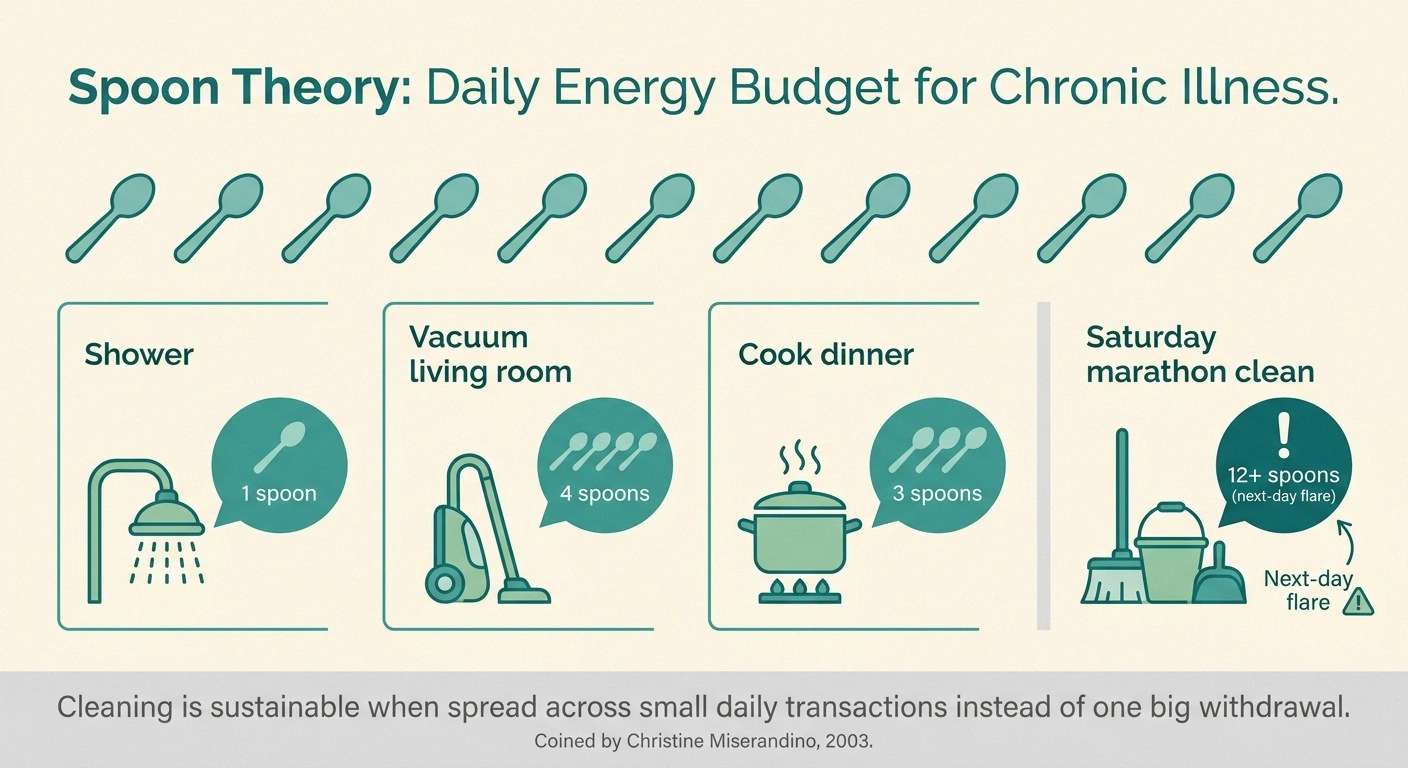
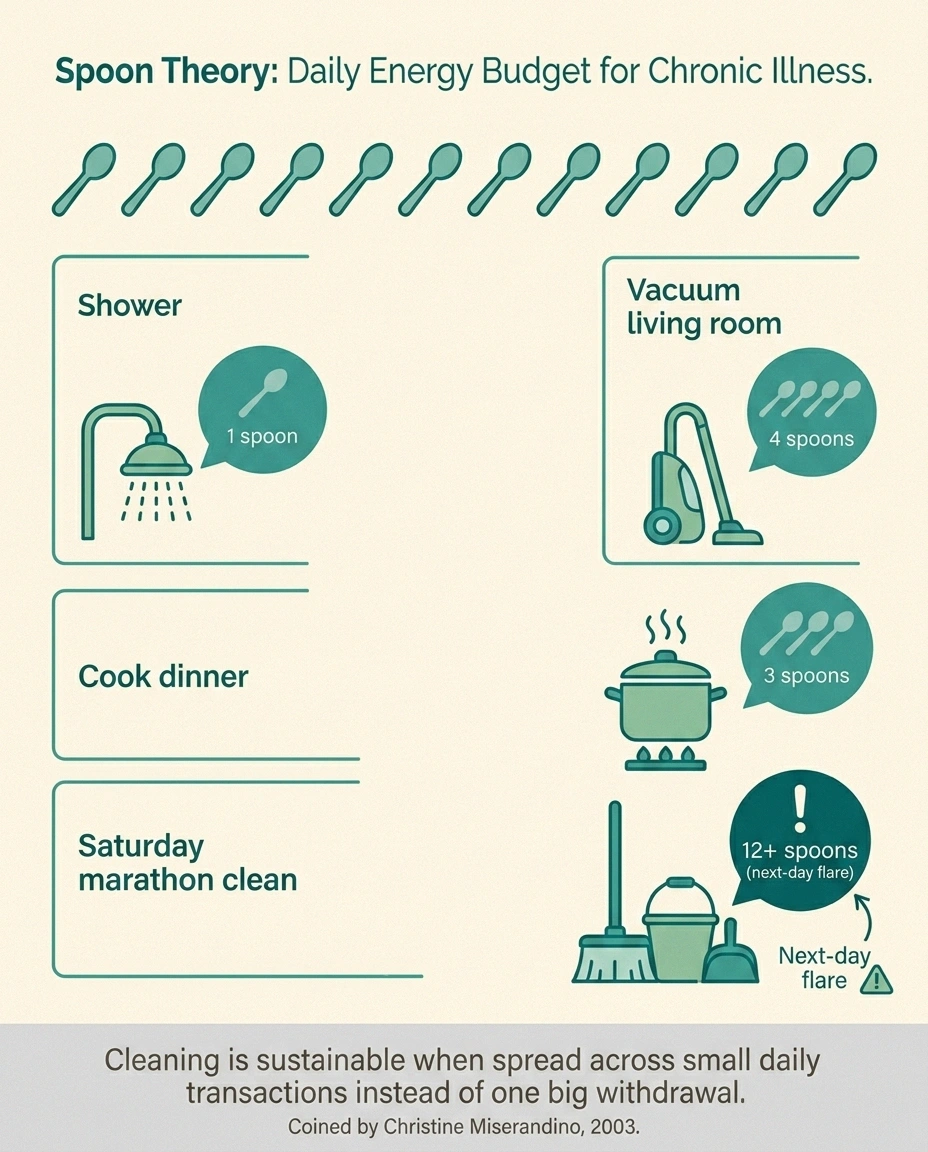
You've probably heard of spoon theory — the metaphor invented by Christine Miserandino in 2003 to describe how people with chronic illness experience energy. The short version: imagine you start each day with a finite number of “spoons,” and every task costs spoons. A shower might cost one spoon. Vacuuming the living room might cost four. Cooking dinner might cost three.
Key Takeaway
Stop the marathon Saturday clean. Break the house into 5-7 small zones, do one zone per day in 15-20 minutes, sit between tasks, and use adaptive tools. The same total cleaning happens, but no single day eats your spoons. The point isn't a spotless house — it's a livable house that doesn't cost you Sunday and Monday in flare recovery.
Healthy people have so many spoons they never have to count. People with neuropathy do count, whether they realize it or not. The reason marathon Saturday cleaning sessions wreck the rest of the week is simple: you've spent every spoon you had, plus borrowed against next week, and the body has to repay that debt with a flare.
The fix isn't to clean less. It's to spread the same cleaning over more, smaller transactions.
The Two-Sit Rule
Before any cleaning task, sit down for two minutes. Plan what you're going to do. Gather what you need. Drink some water. Then do the task — and at the end, sit down again before transitioning to anything else.
The Two-Sit Rule
1. Sit before you start. Two minutes. Plan, gather what you need, drink water. This prevents “I'll just quickly…” from turning a 5-minute task into 40.
2. Sit before you finish. Don't transition straight into the next thing. The second sit is what prevents stacking task-on-task into a flare.
Remember nothing else from this article? Remember this. It changes more than any tool you can buy.
The first sit prevents the “I'll just quickly…” trap that turns a five-minute task into a forty-minute one because you got distracted by everything else that needs doing. The second sit prevents stacking task on task on task without recovery, which is what tips you over the edge into a flare.
If you remember nothing else from this article, remember this one. It changes more than any single tool you can buy.
Map Your House Into Small Zones
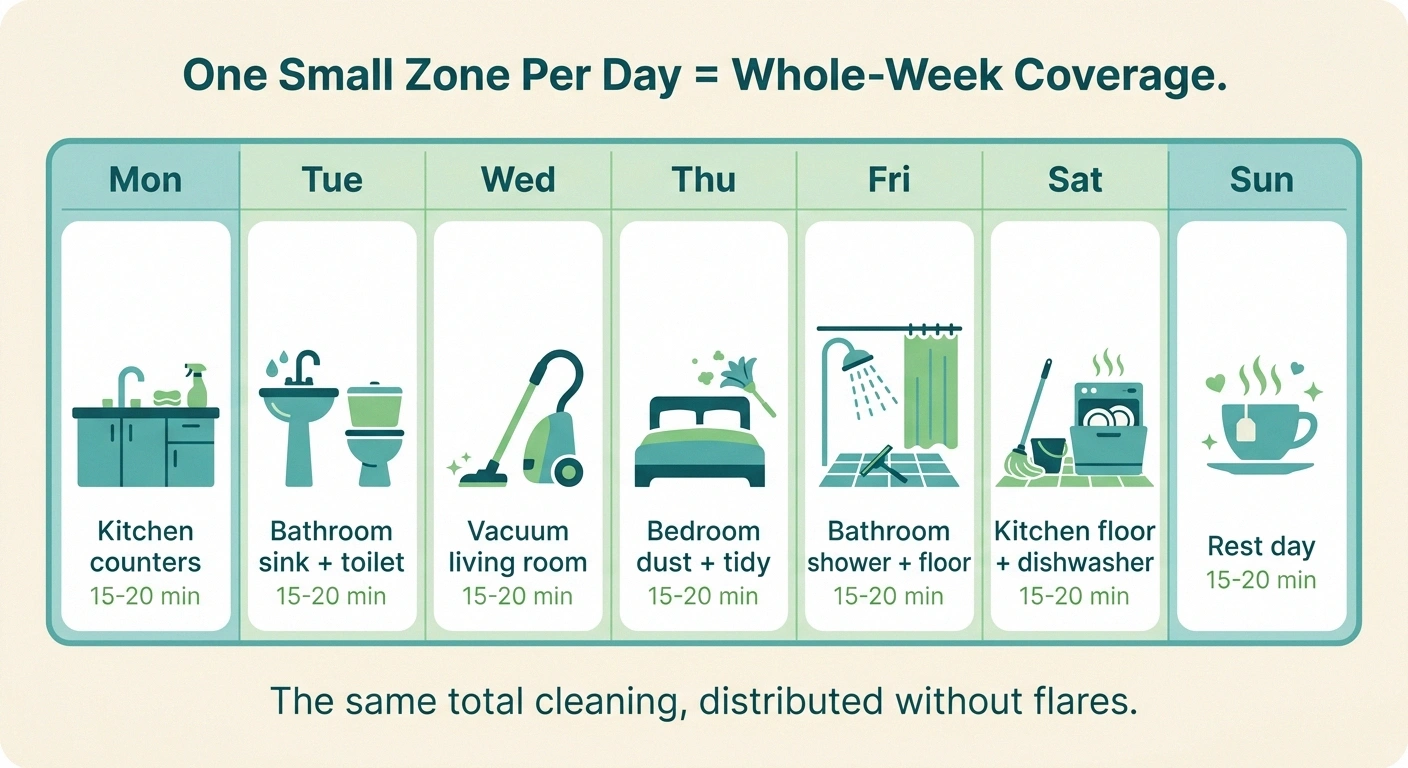
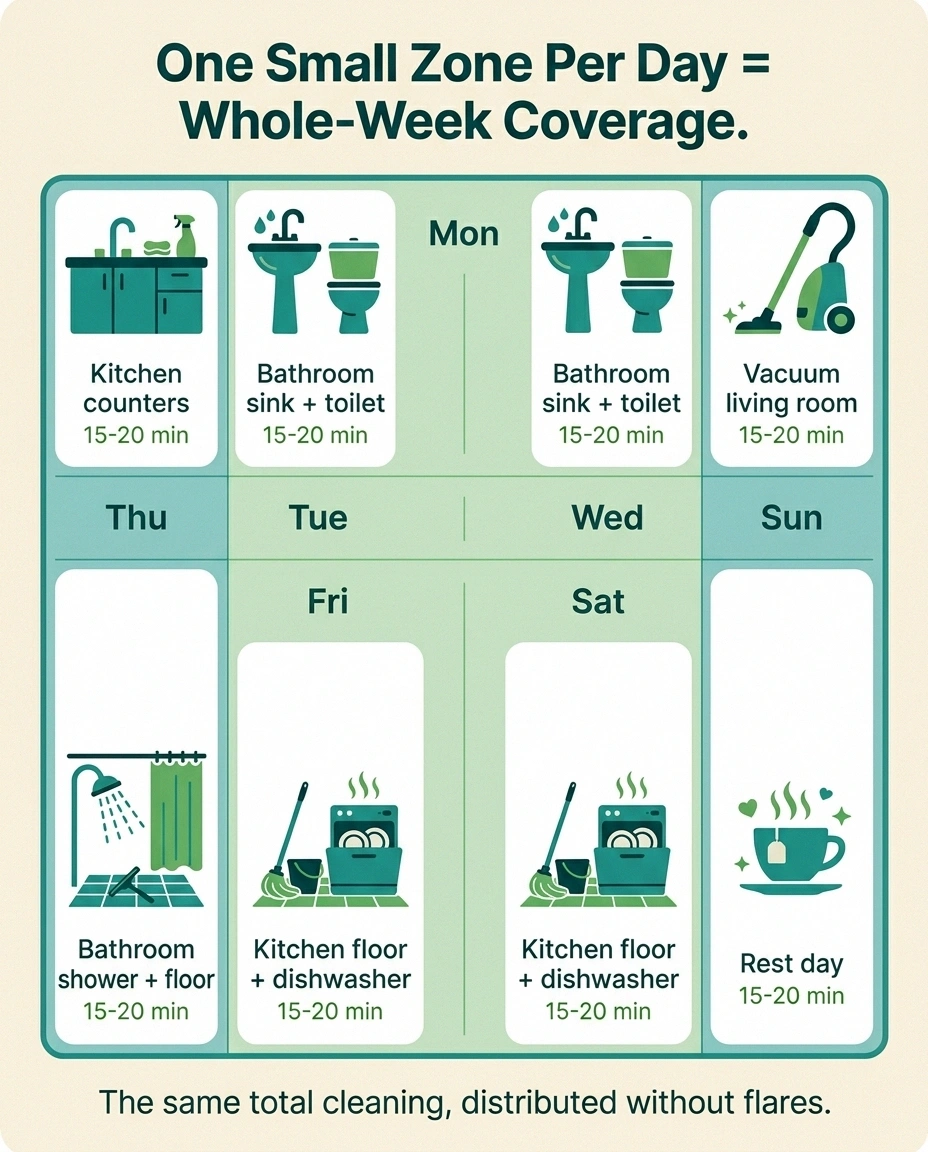
The mental shift that helps most is breaking your house into smaller zones than feels natural. Not three rooms. Five to seven zones, each small enough to clean in 15 to 20 minutes:
A Sample Week of Paced Cleaning
Kitchen counters & stovetop — 15 min
Bathroom sink, mirror, toilet — 15 min
Vacuum living room (3 sections, 1 today) — 15 min
Bedroom dust & tidy + make bed sitting — 15 min
Bathroom shower + floor (chemistry does the work) — 20 min
Kitchen floor + dishwasher — 15 min
Rest day — no cleaning. Energy deposit.
Same total cleaning. Distributed without flares.
- Kitchen counters and stovetop (one zone)
- Kitchen floor and dishwasher (separate zone)
- Bathroom — sink, mirror, toilet (one zone)
- Bathroom — shower or tub and floor (separate zone)
- Bedroom — make bed, dust, tidy surfaces
- Bedroom — vacuum and closet floor
- Living room — surfaces and dust
- Living room — vacuum and tidy
- Entryway and hallway
One zone per day. Done in 15 to 20 minutes. By the end of the week, every part of the house has been touched, and no single day cost you more than a small portion of your spoons. The transformation isn't in how clean each day looks — it's in how clean the week looks compared to before, and how much energy you have left to actually live.
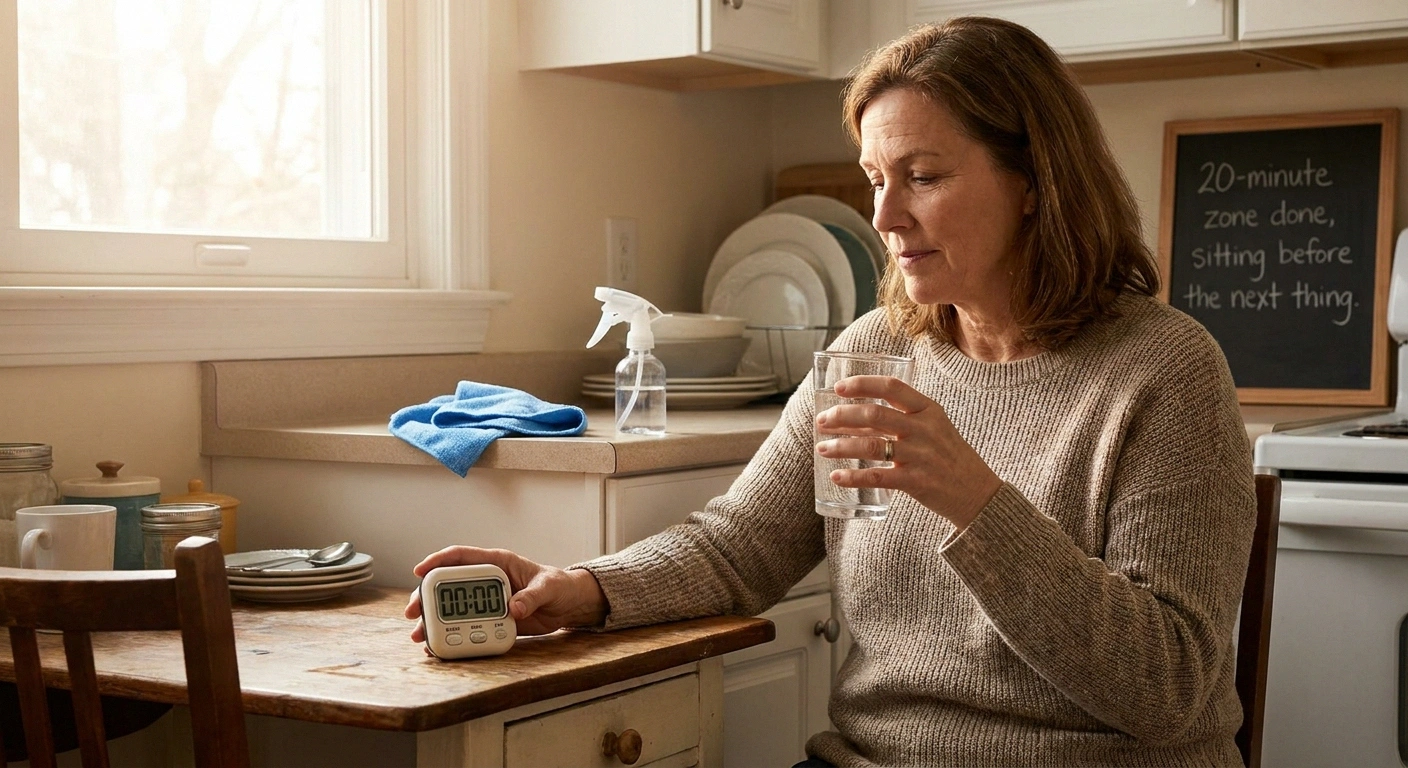
Set a Twenty-Minute Timer
This sounds simple but it's the most important behavioral change in this whole approach. When you start a zone, set a kitchen timer or your phone for 20 minutes. When it dings, stop. Even if you're not done. Even if you're “right in the middle.” Especially if you're “right in the middle.”
Sit for ten minutes. Drink water. Listen to the silence. Then either pick up where you stopped, declare the zone done for today, or move to a different non-cleaning activity.
The reason this works is that nerve pain doesn't tell you how tired you are until you've already gone too far. By the time your feet are screaming, you've already spent the spoons you needed for tomorrow. The timer interrupts the spiral before your body has to.
Sit Whenever You Can
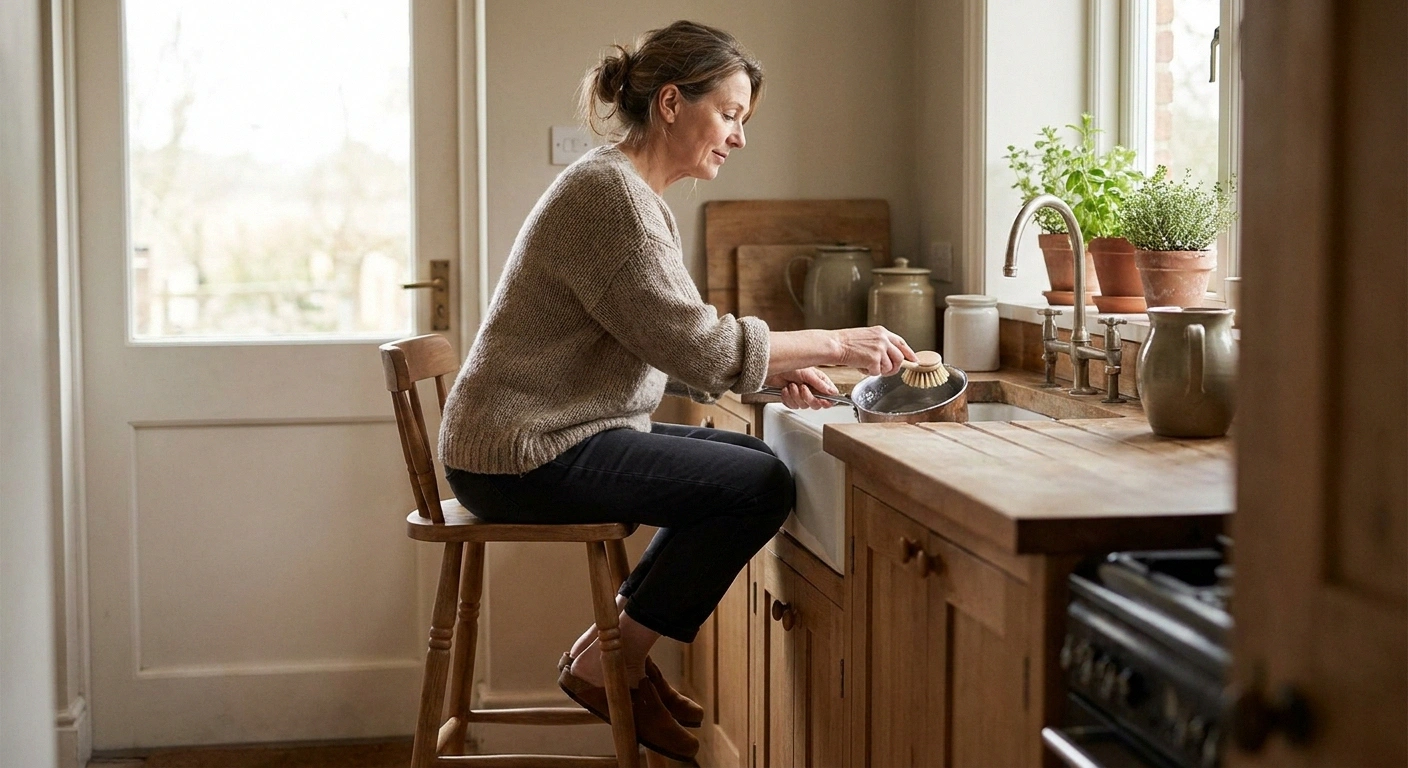
Most cleaning we think of as “stand up” tasks can be done sitting if you adjust:
Tasks You Can Do Sitting Down
- Folding laundry on the couch or at a table
- Loading and unloading the dishwasher from a stool
- Washing dishes (sturdy stool at the sink)
- Wiping counters (rolling chair, scoot along)
- Dusting low shelves (rolling office chair)
- Cleaning the tub (sit on closed toilet, long-handle brush)
- Wiping baseboards (sit on the floor with a microfiber cloth)
- Sorting mail or paperwork (always at a table)
A sturdy kitchen stool with a back is one of the best $40 investments you can make. Roll it room to room as needed.
- Folding laundry: sitting on the couch or at a table
- Loading and unloading the dishwasher: on a kitchen stool that lets you reach the bottom rack without bending
- Washing dishes: a sturdy stool at the sink, or a small chair if your kitchen layout allows
- Wiping counters: on a stool, scoot along
- Dusting low shelves: sitting in a rolling office chair, push along
- Cleaning a tub: sitting on the closed toilet, using a long-handled scrub brush
- Wiping baseboards: sitting on the floor with a microfiber cloth, scooting on a small carpet square
- Sorting mail or paperwork: always at a table, never standing at a counter
A sturdy kitchen stool with a back is one of the best $40 investments you can make. Roll it from room to room as needed. There's no medal for standing through tasks you can do sitting down.
The Right Tools Save Real Spoons
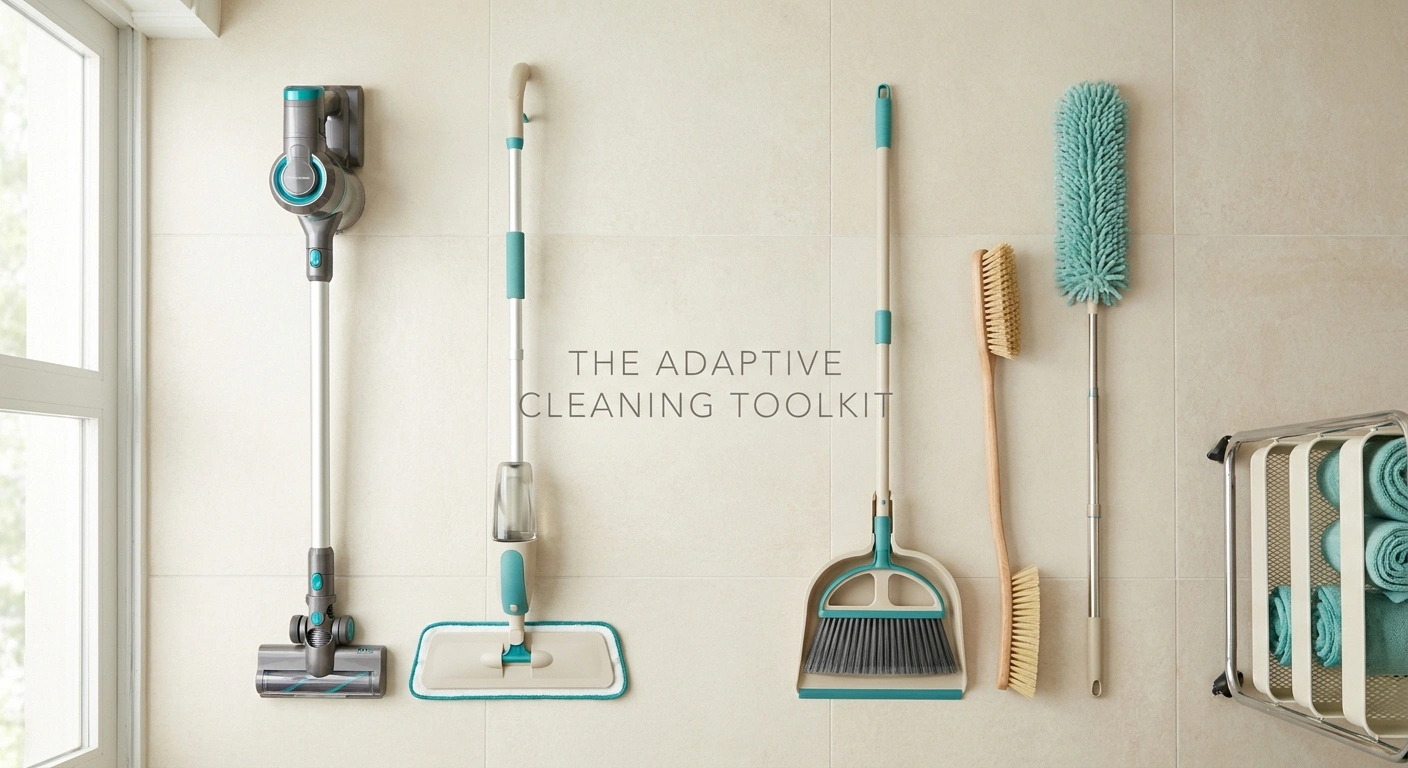
Cleaning tools designed for healthy people aren't designed for you. The right adaptive tools cost some money up front but save energy every time you use them, for years.
The Adaptive Cleaning Kit — What to Own
A cordless lightweight stick vacuum. The single biggest tool upgrade for chronic illness. Look for one under 6 pounds with a quick-release wand so you can clean stairs and upholstery without lugging anything heavy. The “lightweight” matters more than the brand. Heavy upright vacuums are spoon-eaters. Plug-in canister vacuums with hoses you have to wrestle around furniture are spoon-eaters. A grab-and-go cordless stick is a spoon-saver.
A flat microfiber spray mop. The kind with a refillable spray bottle attached to the handle. No bucket lifting. No wringing. No pouring. Spray as you go, swap the microfiber pad when it's dirty, throw the pad in the wash. About $25.
A long-handle dustpan and broom set. No bending. No squatting. Stand-up sweeping for kitchen and bathroom floors between mop sessions.
A long-handle scrub brush for the tub and shower. Around $15. Saves you from having to crouch in the tub or scrub on hands and knees. Some have angled heads designed specifically for tubs.
Microfiber dusters with telescoping extension poles. Reach ceiling fans, the tops of door frames, light fixtures, and high shelves without a step stool. Falls happen on step stools.
A small rolling cart. Carry your cleaning supplies from room to room without making 12 trips back to the supply closet. A three-tier rolling cart from any home store works.
An anti-fatigue rubber mat in front of the sink. If you have to stand to do dishes, this matters more than you'd think. Cushions the feet, distributes weight, reduces the burning that builds during longer dish sessions.
A shower bench or seat. Not just for showering — also useful for sitting while you scrub the shower walls. Doubles as bathroom safety equipment.
None of this is luxury. It's medical equipment that happens to be sold at Target.
Top-Down, Always
When you're cleaning a single zone, work from highest to lowest. Dust falls down. If you vacuum first and then dust the shelves, you have to vacuum again. If you dust first and then vacuum, you've done it once.
The order in any room:
- Highest items first (ceiling fans, light fixtures, top of door frames) — only on weeks you tackle these, not every cleaning
- Mid-level surfaces (shelves, window sills, picture frames)
- Furniture (tables, dresser tops, couch arms)
- Floor (vacuum or sweep, then mop if needed)
For most weekly cleaning, you skip the highest level entirely. That's monthly territory. Don't try to do everything every week. The whole point of pacing is acknowledging finite energy.
Room-by-Room Adaptations
Kitchen
The kitchen is high-traffic and tends to need attention every day or two. The rule that helps most: clean as you go, not after. Wipe a counter while waiting for the kettle to boil. Rinse a pan while a microwave runs. Tiny five-second tasks distributed across the day prevent the 30-minute “clean the whole kitchen” session that wipes you out.
For sink work, use that anti-fatigue mat or pull up a stool. Most sinks can be approached from a sitting position with a stool tucked at the right height. Use a long-handle dustpan for crumbs around the floor. Flat spray mop for the floor itself. Skip mopping if it doesn't need it — running a damp microfiber pad over visible spots takes 90 seconds and looks just as good.
Bathroom
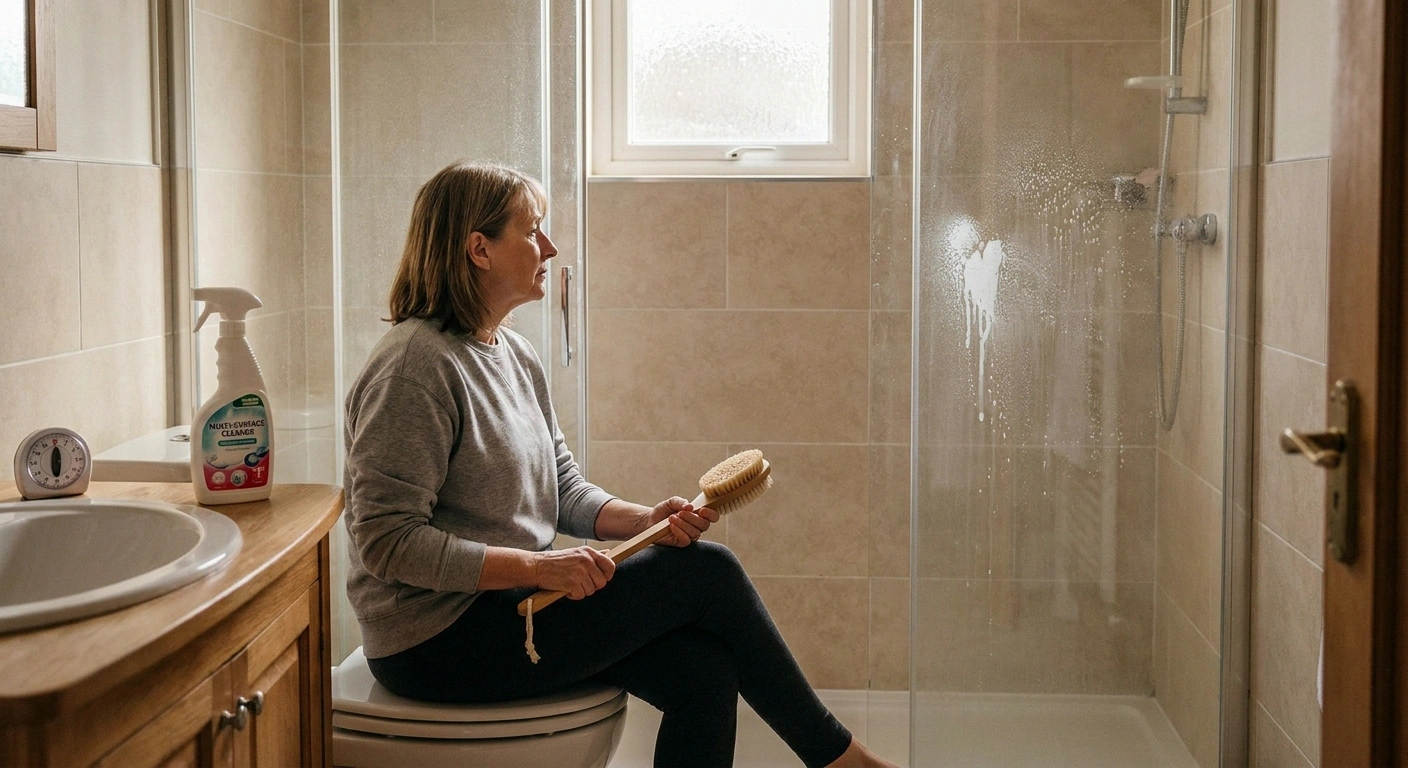
The bathroom is the highest fall-risk room in the house — see our bathroom safety guide for the full picture. For cleaning, the secret is letting chemistry do the work:
- Spray cleaner on shower walls, tub, sink, and toilet
- Sit on the closed toilet for 10 minutes
- Wipe down with a microfiber cloth — much less scrubbing needed
Use a long-handle scrub brush for the tub. A toilet brush with a long handle stored upright in the bathroom (not under the sink, where you have to bend to reach it). Floor cleaning with a small flat mop, 5 minutes maximum.
Bedroom
Make the bed sitting on the edge of the bed. Pull sheets up and tuck on one side, scoot to the other side, do the same. No racing around the bed twice.
For changing sheets — strip from one corner first, walk slowly around (or sit on a stool and roll). Sheet changing is a high-spoon task; consider doing it every two weeks instead of weekly if a flare is brewing.
Vacuum with a cordless stick, taking the bedroom in two passes (under the bed area first; main floor second) with a five-minute sit between if needed.
Living Room
Sit on the couch and dust nearby surfaces from there. A microfiber duster reaches further than your arm without you having to stand and reach.
For larger rooms, divide into three sections: in front of the couch, around the furniture, and the rest. One section per cleaning session. Three days, three sections, all done — and your nerves never had to do the whole room in one go.
Laundry
Already covered in detail in our neuropathy and laundry guide. The same principles: small loads more often, sit while folding, rolling hampers instead of carrying baskets.
Tasks to Drop Without Guilt
Some “supposed to” cleaning tasks are spoon-expensive and low-payoff. With finite energy, dropping them is sound strategy:
Permission Slip — Drop These Without Guilt
- Wiping baseboards weekly → once or twice a year
- Polishing wood furniture → just dust, monthly
- Daily perfect bed-making → pull comforter up evenly, done
- Cleaning inside windows weekly → twice a year by season
- Dusting picture frames individually → one duster wand across the wall
- Scrubbing grout monthly → annually at most
With finite spoons, the cleaning that doesn't affect daily comfort can wait.
- Wiping baseboards weekly. Once or twice a year is plenty for most homes.
- Polishing wood furniture. Microfiber dust cloth, monthly. Skip the polish.
- Daily bed-making to perfection. Pull the comforter up evenly. Done.
- Cleaning the inside of windows weekly. Twice a year, by season change.
- Dusting picture frames individually. A duster wand across a wall of frames in 30 seconds is fine.
- Scrubbing grout. Annually at most. Cleaning grout monthly will end you.
The list of “things you don't have to do” is liberating once you write it down. Permission slip from someone who's been at this longer than you have.
Energy Banking: The Day Before Counts
If you have an event you care about — a grandkid's recital, a family dinner, a doctor's appointment that requires being sharp — the day before is a “deposit day.” No cleaning. Real rest. Light activity. Save those spoons.
Same goes for the day after a flare. Skip cleaning. The body is repairing. Adding cleaning task on top of repair is how flares stretch from one day into three.
This is where a symptom diary earns its keep — over a few weeks, you start to see your own patterns. The day after a long car ride, no cleaning. The morning after a poor night's sleep, no cleaning. Cleaning is a discretionary task; it can move.
When to Outsource
Hiring help is not failure. For many people in our community, a once-a-month or twice-a-month deep-clean from a professional cleaner has been life-changing. Costs vary by region but typically run $80 to $150 per visit for a standard home.
The Outsourcing Math
A monthly $120 deep clean from a pro that saves you 2 days of post-cleaning flare per month = $60 per saved day. That's a bargain.
If hiring isn't possible, ask family or friends for specific help: “Can you vacuum the living room on Saturday?” is something someone can say yes to. “I need help cleaning” is too vague.
The math: if a $120 cleaning saves you two days of post-cleaning flare per month, the cost per “saved day” is $60. That's a bargain. Many people find that paying for the deep clean lets them maintain easily between visits, instead of constantly playing catch-up.
If hiring isn't in the budget, ask about help. Adult children, a spouse, a neighbor — many people are willing if asked specifically. “Can you vacuum the living room on Saturday?” is a request someone can say yes to. “I need help cleaning” is too vague.
The Mindset That Actually Helps

The hardest shift for most of us isn't tools or schedules — it's the mental adjustment to “good enough” cleaning. We were raised on standards that assumed unlimited energy. Letting go of those standards feels at first like failure. With practice, it feels like wisdom.
A spot-cleaned bathroom is better than no clean bathroom because you couldn't face a deep one. A vacuumed living room with the corners skipped is better than no vacuumed living room. Done is better than perfect when “perfect” costs you Sunday and Monday in flare recovery.
Your house being livable is the goal. Your house being magazine-cover spotless is not the goal. Holding both of those at the same time, for years, is what makes living with neuropathy sustainable instead of crushing.
Three years into this approach, my Saturdays look completely different. I still clean — but it's a 15-minute zone, not a four-hour marathon. By Saturday afternoon I have energy left for actual life. The house isn't spotless. It's clean enough. And clean enough is enough.
Frequently Asked Questions
How often should I clean my house with neuropathy?
Distribute cleaning across the whole week instead of doing one big session. A workable approach is 15 to 20 minutes per day, focused on one small “zone” — kitchen counters one day, bathroom sink and toilet the next, vacuum the living room another. By the end of the week every area gets attention without any single day costing too many spoons. Marathon weekend cleaning sessions are spoon-eaters and reliably trigger flares; small daily slots are sustainable for the long term.
What's the spoon theory and how does it apply to cleaning?
Spoon theory, coined by writer Christine Miserandino in 2003, is a metaphor for the limited energy people with chronic illness have each day. You start the day with a finite number of “spoons,” and every task — showering, cooking, vacuuming — costs spoons. Healthy people have so many they never count. With neuropathy you do count, even if you don't realize it. The reason marathon cleaning sessions cause flares is simple math: you spent more spoons than you had, and the body charges you with a flare to repay the debt. Pacing solves it by spreading the same total cleaning across many smaller transactions.
What cleaning tools help most for neuropathy?
The biggest game-changers are a cordless lightweight stick vacuum (under 6 pounds), a flat microfiber spray mop with a refillable bottle (no bucket lifting), a long-handle dustpan and broom for stand-up sweeping, a long-handle scrub brush for tubs and showers, microfiber dusters with telescoping extension poles for high spots, a small three-tier rolling cart for moving supplies room-to-room, an anti-fatigue rubber mat in front of the sink, and a shower bench. A sturdy kitchen stool with a back lets you sit for tasks normally done standing. None of this is luxury — it's adaptive equipment that pays for itself in saved spoons over years.
Should I sit while cleaning?
Yes, whenever possible. Most “stand up” cleaning tasks can be done sitting if you adapt: fold laundry on the couch, load and unload the dishwasher from a stool, wipe counters scooting along on a rolling chair, scrub the tub from the closed toilet seat with a long-handled brush, dust low surfaces from a rolling office chair. There is no award for standing through tasks you can do sitting. A small kitchen stool you can move between rooms is one of the most useful pieces of cleaning equipment in the house.
How do I clean the bathroom safely with neuropathy?
Bathrooms are the highest fall-risk room in the house, so go slow. The most useful trick is letting cleaning chemistry do the work: spray the shower walls, tub, sink, and toilet, then sit on the closed toilet for 10 minutes while the cleaner activates. Wipe down with a microfiber cloth — much less scrubbing required. Use a long-handle scrub brush for the tub so you don't have to crouch or kneel. Use a long-handle toilet brush stored upright in the bathroom. Keep mop time to 5 minutes max with a small flat microfiber spray mop. Wear non-slip footwear. Move slowly between tasks.
Is it OK to skip some cleaning tasks?
Absolutely yes. Several “supposed to” tasks are spoon-expensive and low-payoff: wiping baseboards weekly (once or twice a year is plenty), polishing wood furniture (just dust monthly), making the bed perfectly daily, cleaning the inside of windows weekly (do them seasonally), dusting picture frames individually, scrubbing grout monthly. Dropping these tasks isn't laziness — it's strategic energy management. With finite spoons, prioritize the cleaning that affects daily comfort and skip the cleaning that doesn't.
Should I hire a cleaner if I have neuropathy?
If it fits your budget, almost certainly yes. A monthly or twice-monthly professional deep clean (typically $80 to $150 per visit) lets you handle easy maintenance between visits instead of constantly playing catch-up. Do the math on what flare days cost you in lost function — if a $120 cleaning saves you two days of post-cleaning flare per month, that's $60 per saved day, which is a bargain. If hiring isn't possible, ask family or friends for specific help: “Can you vacuum the living room on Saturday?” is a request people can say yes to. “I need help cleaning” is too vague to act on.
How do I stop a flare-up triggered by cleaning?
If a flare is starting, stop cleaning immediately and switch to recovery mode. Sit or lie down, elevate the feet, hydrate, take any prescribed medication on schedule, and skip cleaning for the next day or two. Don't try to push through — the flare lasts longer when you do. Going forward, smaller daily zones, the 20-minute timer rule, and the two-sit rule (sit before and after each task) prevent most cleaning-triggered flares before they start. A symptom diary helps you spot the patterns that predict a flare for you specifically. Our guide to neuropathy flare-ups covers managing them in detail.
About the Author