This is one of the harder things I've written for this site, and I want to start by saying why. For years I've sat in support group circles and listened to people describe their neuropathy, and every so often someone's voice would drop a little, and they'd say some version of the same sentence: “I think I might be relying on this too much.” Sometimes it was the wine. Sometimes it was the pills. Almost always it came wrapped in shame, and almost always the person looked around the room afraid of what we'd think of them.
I want to take that fear out of the room. If you've found your way to this page, there's a decent chance you've had that quiet thought yourself — about a medication, about alcohol, about something you reach for when the burning in your feet won't let up. You are not a bad person for having that thought. You are a person in pain who has been doing whatever you could to get through the day, and at some point you started to wonder whether the thing that was helping had become its own problem.
Let's talk about it honestly, without judgment, with the actual facts, and with a clear path toward help that doesn't require you to choose between your dignity and your pain relief.
Three Words That Get Tangled Together
Before anything else, we have to untangle three words that get used as if they mean the same thing. They don't, and the difference matters enormously — both for understanding yourself and for talking to your doctor without panic.
Three Words, Three Different Meanings
The same dose works less well over time. Normal and physical. Not addiction.
Stopping suddenly causes withdrawal, so it must be tapered. Happens with many prescribed medications. Not the same as addiction.
Compulsive use that continues despite harm. Involves the brain's reward system, not just the body's adaptation.
Tolerance means your body has adjusted to a medication so that the same dose produces less effect than it used to. If your nerve pain medication worked beautifully at first and now seems weaker at the same dose, that may be tolerance. It is a normal, physical, expected process with many medications. It is not addiction. It does not mean you did anything wrong.
Physical dependence means your body has adapted to a medication being present, so that stopping it suddenly causes withdrawal symptoms. This is also normal and physical, not moral. People are physically dependent on all kinds of medications they take exactly as prescribed — blood pressure drugs, antidepressants, and yes, many nerve pain medications. Dependence means you need to stop carefully and gradually, with your doctor's help. It does not, by itself, mean you are addicted.
Addiction — what doctors now call a substance use disorder — is different. It's a pattern of compulsive use that continues despite harm: using more than intended, being unable to cut back even when you want to, spending a lot of mental energy on getting or using the substance, and continuing even though it's damaging your health, relationships, or life. Addiction involves the brain's reward system, not just the body's adaptation.
Here is why this matters so much. Most people with neuropathy who take their medications as prescribed develop some tolerance and some physical dependence. That is expected and is not the same as being an addict. The fear that the two are identical keeps people from being honest with their doctors — and that silence is far more dangerous than the medications themselves.
Why Chronic Pain Sets This Trap in the First Place
Nobody chooses this situation. It's worth understanding how the trap is built, because seeing the mechanism removes some of the self-blame.
Neuropathic pain is relentless. Unlike a sprained ankle that heals, nerve pain often has no end date. It's worse at night, it interferes with sleep, and the exhaustion makes the next day's pain feel worse, which wrecks the next night's sleep. That spiral wears people down in a way acute pain rarely does.
On top of that, neuropathy frequently travels with depression and anxiety. The link between nerve pain and mood is real and physiological, not a sign of weakness — I've written more about that in our piece on neuropathy and mental health. When you're in constant pain, low, anxious, and not sleeping, anything that offers even temporary relief becomes very compelling. That's not a character flaw. That's how human brains respond to unrelenting distress.
So the setup is: a pain that doesn't stop, a mood that's suffering, sleep that's broken, and substances — prescribed or not — that genuinely do take the edge off, at least for a while. You can see how a sensible person, doing their best, ends up somewhere they never intended to be.
The Medications: Where the Real Risks Actually Are
Let me be precise here, because vague warnings help no one and scare everyone.
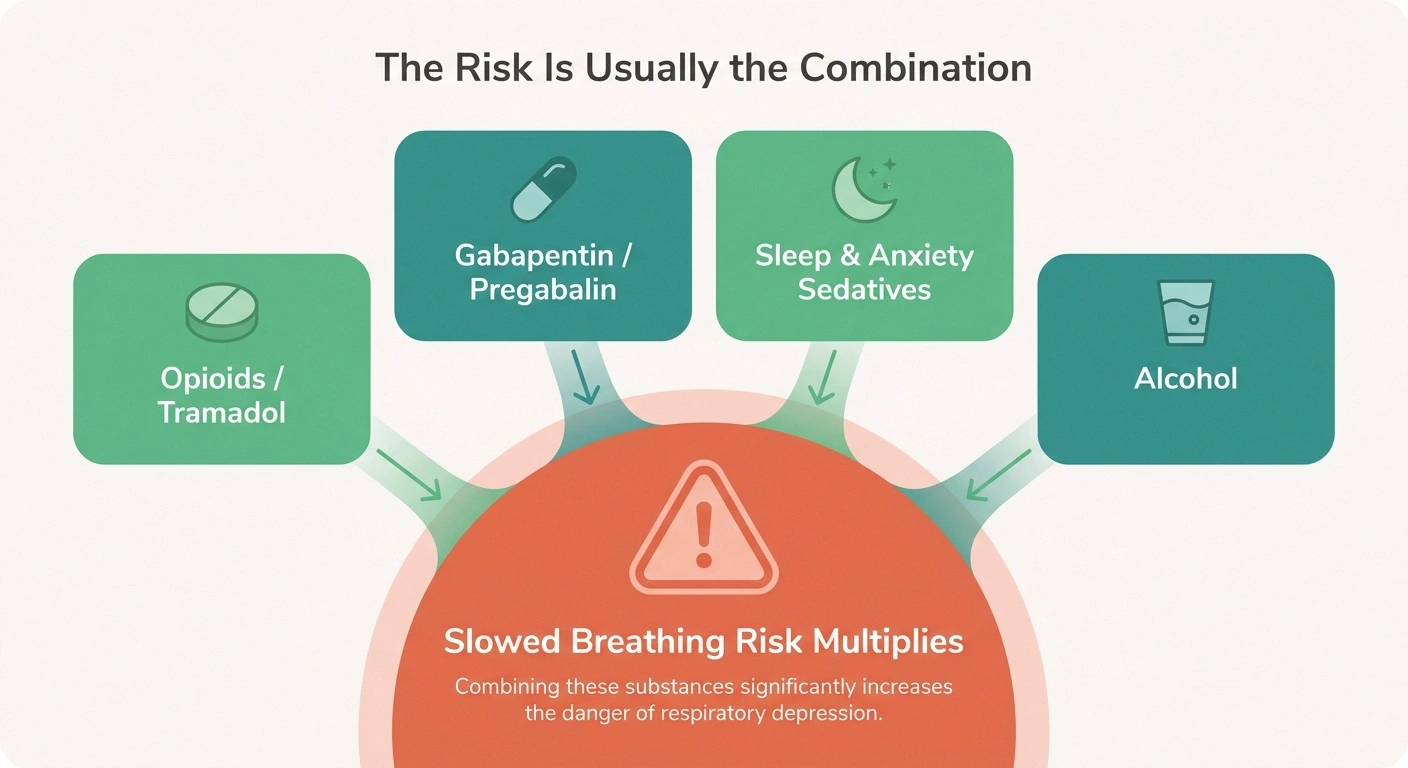
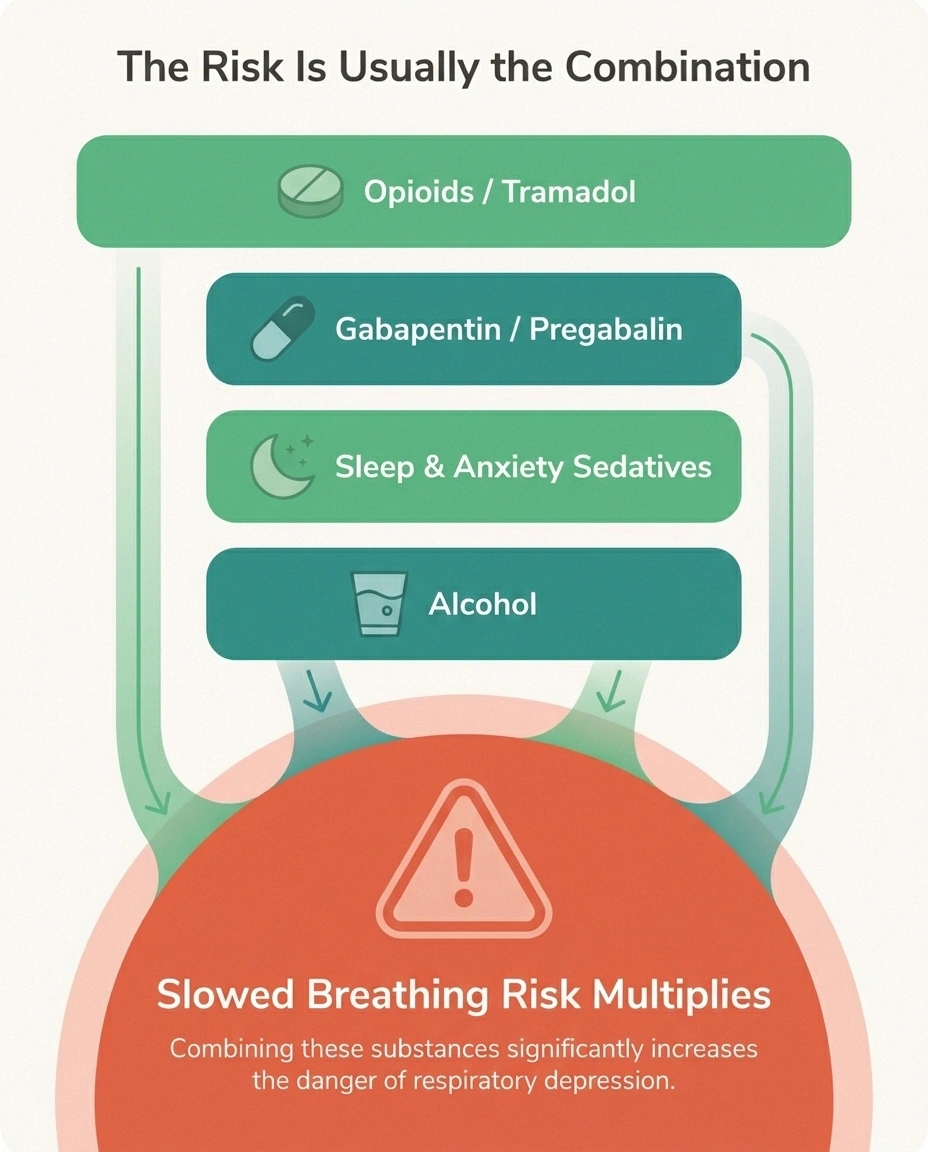
The danger is usually the combination, not one drug
Opioids + gabapentinoids, or either of those + benzodiazepines, or any of them + alcohol multiplies the risk of dangerously slowed breathing. Tell your doctor and pharmacist everything you take — including the nightly drink and over-the-counter sleep aids.
Gabapentin and Pregabalin (the Gabapentinoids)
These are among the most commonly prescribed nerve pain medications. You can read the fuller picture in our guides to gabapentin for neuropathy and pregabalin (Lyrica). Here is the honest summary on the dependency question.
For the large majority of people who take gabapentin or pregabalin as prescribed for nerve pain, misuse is uncommon. The published research consistently shows that the meaningful abuse risk is concentrated in people who already have a substance use disorder — particularly an opioid use disorder — where these drugs can be misused to amplify a high or to blunt opioid withdrawal. If that's not your situation, the risk profile is very different from what alarming headlines suggest.
That said, two things are true and worth knowing. First, both drugs cause physical dependence, so they must be tapered, never stopped abruptly. Second, pregabalin is a federally controlled substance (Schedule V) in the United States, and gabapentin is now a controlled substance in a number of individual states with prescription monitoring. That isn't a reason to fear them — it's a reason to take the “don't stop suddenly, don't share, don't double up” guidance seriously.
Opioids and Tramadol
Opioids are generally a later-line option for neuropathic pain, and tramadol sits in a complicated middle space — it's opioid-like and also affects other neurotransmitters. With chronic opioid use, physical dependence is essentially universal; that's pharmacology, not personal failing. The harder questions are whether the relief still justifies the downsides over time, and whether use has drifted from “as prescribed” toward “as needed to feel okay at all.”
The Combination That Causes the Most Harm
If you remember one safety fact from this entire article, make it this one. The most dangerous scenario is not any single medication — it's combining central nervous system depressants. Opioids plus gabapentinoids, or either of those plus benzodiazepines (for anxiety or sleep), or any of them plus alcohol, multiplies the risk of slowed breathing. The U.S. Food and Drug Administration has specifically warned that serious and even fatal breathing problems can occur when gabapentin or pregabalin are combined with opioids or other depressants, especially in older adults and people with lung conditions.
This is the conversation worth having with your doctor and pharmacist by name: “Here is everything I take, including the wine at night and the sleep aid. Is any of this combination dangerous together?” That single question has prevented real tragedies.
Alcohol: The Most Common Self-Medication, and a Cruel Irony
In every support group I've been part of, alcohol comes up more than any prescription. It's legal, it's everywhere, it's socially normal, and a drink genuinely does dull pain and ease the anxious, racing-mind quality that nerve pain brings at night. It's the most accessible coping tool there is, which is exactly why it deserves a clear-eyed look.
Alcohol is itself a nerve toxin. Using it to quiet nerve pain can, over time, feed the very nerve damage causing the pain. Regular heavier drinking can directly cause or worsen peripheral neuropathy — which is exactly why the nightly-drink pattern is so important, and so hard, to notice early.
Here's the cruel part, and I say it gently because it surprises many people: alcohol is itself a nerve toxin. Regular heavier drinking can directly damage peripheral nerves and cause or worsen neuropathy on its own. We have a full piece on alcohol-related neuropathy if you want the detail. The short version is that using alcohol to quiet nerve pain can, over time, feed the very nerve damage causing the pain. It is one of the most painful loops I've watched people get caught in, and the cruelty of it is exactly why it's so hard to talk about and so important to.
None of this is said to shame anyone who has a glass of wine. It's said so that if you've noticed the nightly drink becoming two, or becoming the thing you organize the evening around, you can recognize that pattern early — when it's far easier to change.
“Is This Me?” — Honest Questions, Asked Kindly
I'm not going to give you a clinical checklist that makes you feel like you're being graded. Instead, here are the questions I've heard people ask themselves quietly, the ones that tend to be the real signal. Read them the way you'd let a trusted friend ask them — with curiosity, not a verdict.
Have you started taking more than prescribed, or drinking more than you meant to, not to feel good but just to feel normal? Do you find yourself watching the clock until the next dose or the next drink? Have you been vague with your doctor about how much you're really using because you're afraid they'll take it away? Have you tried to cut back and found you couldn't, or that cutting back made you anxious in a way that wasn't only about the pain? Has someone who loves you said something — even once, even gently — and have you found yourself defending or hiding it? Is the relief getting shorter and the dose getting bigger?
If several of those landed, that doesn't make you an addict and it doesn't mean anyone is going to abandon you to your pain. It means it's time for an honest conversation — and the rest of this article is about how to have it safely.
If You're Worried: What Actually Helps

The single most important thing I can tell you is this: the goal is never to leave you in unmanaged pain. Good care does not mean ripping away the only thing that's been helping and walking off. It means building a safer plan. That distinction is everything, and it's the reason it's safe to be honest.
A Safer Conversation, Step by Step
Name both truths: you want to be safer and pain control still matters.
Any reduction is doctor-led and gradual — never a cold-turkey stop you attempt alone.
Treat what's underneath — depression, anxiety, broken sleep — so the substance carries less weight.
Widen the toolbox so no single thing has to do all the work.
Talk to Your Doctor Without Losing Your Pain Control
Many people stay silent because they imagine the conversation goes: confess, and your medication is gone tomorrow. That is not how careful prescribers handle this. A good conversation sounds more like: “I'm worried I'm leaning on this more than I should, and I'm scared of what happens to my pain if it changes. Can we look at this together?” That framing tells your doctor two true things — that you want to be safer and that pain control still matters. Our guide on how to talk to your doctor about neuropathy pain has more on having these conversations as a partner rather than a supplicant.
Any Reduction Is Doctor-Led and Gradual
If part of the plan involves coming down on a medication, that is a slow, supervised process — never a cold-turkey stop you attempt alone. Abruptly stopping gabapentinoids, opioids, certain antidepressants, or heavy alcohol can be genuinely dangerous on its own. The whole point of involving a professional is that the taper is paced to you, withdrawal is managed, and an alternative for the pain is put in place at the same time. You do not have to design this yourself, and you should not try to.
Quiet Questions, Asked Without a Verdict
- Using more just to feel normal, not good?
- Watching the clock until the next dose or drink?
- Being vague with your doctor out of fear it'll be taken away?
- Tried to cut back and couldn't?
- Someone you love said something — and you hid or defended it?
- Relief getting shorter, dose getting bigger?
Several landing doesn't make you an addict. It means it's time for an honest conversation — not a punishment.
Treat What's Underneath
Substance reliance in chronic pain is very often a logical response to untreated depression, anxiety, and insomnia. Addressing those directly takes pressure off the substance. Cognitive behavioral therapy for pain has real evidence behind it, and treating the anxiety that rides along with nerve pain often reduces the felt need to reach for relief at all. This isn't a consolation prize for people who can't have “real” pain relief — addressing the mood and sleep layer frequently makes the pain itself more bearable.
Widen the Toolbox
The more genuine tools you have, the less weight any single one has to carry. Topical treatments, physical approaches, paced movement, sleep work, stimulation devices, and the broader management strategies we cover across this site don't replace medication, but they spread the load — and a load that's spread is one that's far less likely to tip into dependence.
A Word for Families

If you're reading this because of someone you love, the most useful thing I've learned from watching this play out many times is that confrontation framed as accusation almost always backfires, and concern framed as fear-for-them almost always opens a door. “You have a problem” closes people down. “I've been scared watching you hurt this much, and I want to help you find something safer — can we look together?” is a sentence people can actually walk through. Shame drives this underground. Steady, non-judgmental presence brings it back into the light where it can be helped.
About Shame, and About Hope
I'll close where I started, because it's the part that matters most. Nothing about needing relief from relentless nerve pain makes you weak or bad. The medications that can become a problem are the same ones that have given countless people their lives back. Alcohol is woven into ordinary life. Tolerance and dependence are physical processes that happen to careful, responsible people who did everything they were told. If reliance has crept past where you wanted it, that is a circumstance to address, not a sentence on your character.
The choices are not “silent suffering” or “losing control”
There is a middle road: honesty without shame, help without abandonment, and care that never leaves you in unmanaged pain. It starts with one true sentence said out loud to someone who can help.
I have watched people in my groups have this exact conversation with a doctor they were terrified of, and walk out with their pain still treated and a plan that let them sleep without dread. It is one of the most consistent quiet victories I've witnessed. The path forward is honesty without shame, help without abandonment, and the firm refusal to accept that the only choices are silent suffering or losing control. There is a middle road. It starts with one true sentence said out loud to someone who can help.
Frequently Asked Questions
Is gabapentin addictive?
For most people taking gabapentin as prescribed for nerve pain, problematic addiction is uncommon. Gabapentin does cause physical dependence, meaning it must be tapered rather than stopped suddenly, but that is different from addiction. The meaningful misuse risk is concentrated in people who already have a substance use disorder, particularly involving opioids. If you take it as prescribed and have no history of substance use disorder, the risk profile is much lower than alarming headlines suggest.
What is the difference between dependence and addiction?
Physical dependence means your body has adapted to a medication so that stopping suddenly causes withdrawal. It is normal, physical, and happens with many prescribed medications taken correctly. Addiction, or substance use disorder, is a pattern of compulsive use that continues despite harm, involving the brain's reward system. You can be physically dependent without being addicted. Confusing the two keeps many people from being honest with their doctors, which is the more dangerous outcome.
Why is mixing nerve pain medication with alcohol or sleeping pills dangerous?
Opioids, gabapentinoids, benzodiazepines, and alcohol are all central nervous system depressants. Combining them multiplies the effect on breathing and can cause dangerously slowed or stopped breathing. Regulators have specifically warned about combining gabapentin or pregabalin with opioids or other depressants, especially in older adults or people with lung conditions. Always tell your doctor and pharmacist about every substance you take, including alcohol and over-the-counter sleep aids.
Can drinking alcohol to cope with nerve pain make neuropathy worse?
Yes. Alcohol is itself a nerve toxin, and regular heavier drinking can directly damage peripheral nerves and cause or worsen neuropathy. Using alcohol to quiet nerve pain can, over time, feed the very nerve damage causing the pain. Occasional moderate drinking is a different situation from a pattern of using alcohol as a primary pain or sleep tool, but the underlying risk is why this loop is worth catching early.
If I tell my doctor I'm worried about dependency, will they take away my pain medication?
Careful prescribers do not respond to honesty by abruptly removing pain control. The goal of a good plan is never to leave you in unmanaged pain. A productive conversation makes clear that you want to be safer and that pain control still matters. Any reduction in a medication is gradual, supervised, and paired with an alternative for the pain. Honesty is far safer than silence, and it does not mean losing relief.
Is it normal to need a higher dose over time?
Needing more of a medication for the same effect is called tolerance, and it is a normal physical process with many drugs. It is not the same as addiction and does not mean you did anything wrong. It is, however, worth discussing with your doctor, because it may mean it is time to reassess the plan, consider a different approach, or look at whether something else is driving the increased pain.
How do I help a family member who I think is becoming dependent?
Approach it as concern, not accusation. Statements that begin with “you have a problem” tend to make people defensive and drive the behavior underground. Statements that express fear for them and an offer to help find something safer tend to open the conversation. Steady, non-judgmental support and an offer to help them talk to a doctor are more effective than confrontation. Shame is the main thing keeping this hidden.
What can I use for nerve pain that has lower dependency risk?
Several approaches carry little or no dependency risk and can spread the load so any single tool matters less: topical treatments, physical and movement-based strategies, sleep-focused work, stimulation devices, and psychological approaches like cognitive behavioral therapy for pain. These generally do not replace medication entirely, but widening the toolbox reduces how much weight any one substance has to carry. Discuss the right mix with your healthcare provider.
About the Author