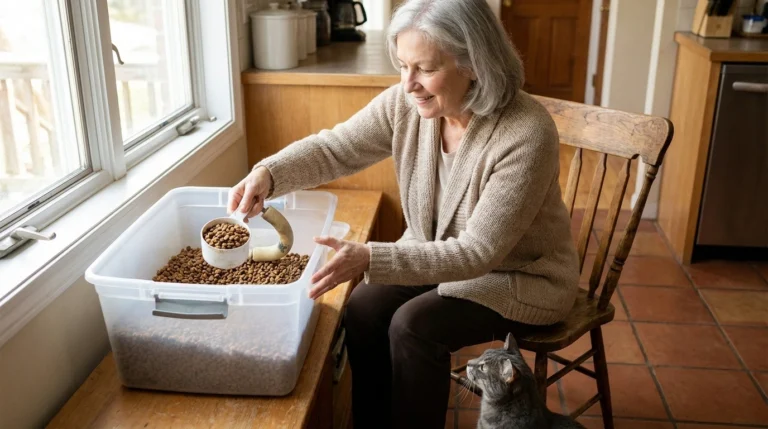
A friend of mine called me a few weeks ago, voice flat with the kind of tiredness that doesn't get fixed by a nap. She'd done one load of laundry, walked to the mailbox, made a simple dinner, and then sat on the edge of her bed and cried because she couldn't make herself shower. “I didn't do anything today,” she said. “Why am I this wiped out?”
I knew exactly what she meant, because most of us in this community have had that day. The not-doing-anything day that somehow exhausted us anyway. The day that, from the outside, looks like nothing got done — and from the inside, feels like a marathon.
What she was experiencing has a name, and a useful way of thinking about it that has helped a lot of people I know. It's called the Spoon Theory, and the practice that goes with it is called pacing. They're not medical treatments. They don't fix nerve damage or reduce pain directly. But they change how you spend the energy you have, which changes how much you have left at the end of the day, which changes everything else. This is the gentlest, most practical, most freeing framework I've come across for living with chronic neuropathy and the fatigue that comes with it.
This guide walks through what the Spoon Theory actually is, why neuropathy is so exhausting in ways that aren't always obvious, how to figure out your own daily spoon budget, the three pacing habits that protect it, and a practical script for the conversations with family and friends that make this easier instead of harder.
What the Spoon Theory Actually Is
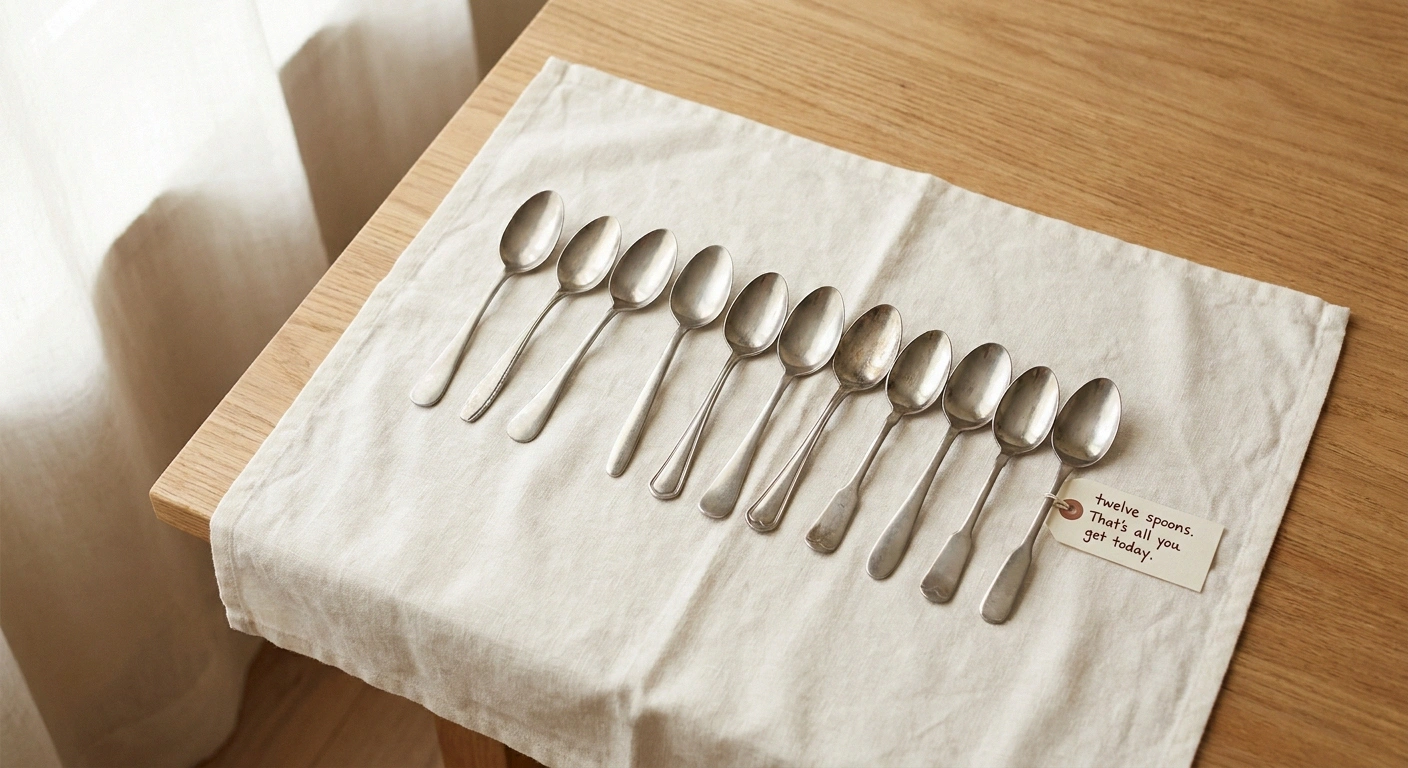
The Spoon Theory was created by Christine Miserandino, a writer with lupus, in 2003. She was sitting in a diner with a friend who'd asked her what it was actually like to live with chronic illness. Miserandino looked around, grabbed every spoon she could see — a dozen of them — and handed them to her friend.
Key Takeaway
You start each day with a finite number of “spoons” of energy. Every activity costs a spoon. Pacing means spending them on purpose — not by accident. The framework doesn't fix nerve damage, but it changes how much energy you have left at the end of the day, which changes everything else.
“You start your day with twelve spoons,” she said. “Every single thing you do costs you a spoon. Getting out of bed. Taking a shower. Making breakfast. Driving to work. Each one takes a spoon away. When you're out of spoons, you're out. You can't go borrow more. You either rest, or you go into the next day already short.”
That image — finite spoons, every activity costs one, you can't print more — landed for a generation of people with chronic illness in a way that no medical explanation ever had. It gave us a way to talk to our families about why we can't do everything they take for granted. It gave us a way to talk to ourselves about why we're so tired without feeling broken.
The Spoon Theory doesn't claim to be science. It's a metaphor, a budgeting tool, and a language. The language is what makes it powerful. Once your family knows what “I'm out of spoons” means, conversations get a lot shorter and a lot kinder.
Why Neuropathy Is So Exhausting
Neuropathy looks like a foot or hand problem from the outside. From the inside, it's a whole-system energy drain. Four things are usually happening at once, and they stack.
Four Background Energy Drains
1. Constant pain processing
Your brain works in the background to suppress pain even when you're not thinking about it.
2. Sensory vigilance
Compensating for numb feet means consciously monitoring every step.
3. Fragmented sleep
8 hours in bed can deliver only 5 hours of restorative sleep when pain interrupts cycles.
4. Autonomic compensation
The body works harder to maintain blood pressure, heart rate, and GI function.
1. Chronic pain processing burns energy. Pain isn't just a signal — it's a signal that your brain has to process, suppress, and re-suppress all day long. Even when you're not consciously thinking about your feet, part of your brain is doing constant background work to keep the pain in the basement so you can function. That work is not free. It uses real metabolic energy and real attention.
2. Sensory vigilance burns energy. When you can't feel your feet properly, your brain compensates by working harder visually and consciously to monitor where they are, where you're stepping, whether you're going to trip. Each step on uneven ground becomes a small decision instead of an automatic motion. By the time you've walked from the parking lot to the grocery store, you've spent attention that someone without neuropathy didn't have to spend.
3. Sleep is often disrupted. Neuropathic pain tends to worsen at night, and even when it doesn't wake you up fully, it can fragment your sleep architecture — fewer deep-sleep cycles, more shallow waking. You can spend eight hours in bed and only get five hours of restorative sleep. Our piece on why neuropathy gets worse at night covers that picture in more depth.
4. The autonomic load is real. If your autonomic neuropathy involves any of the automatic-function nerves — blood pressure regulation, heart rate, GI motility, sweat control — the body is also spending energy compensating for those systems running poorly. Standing up takes more work than it should. Eating takes more work than it should.
Add those four together and you have an explanation for why doing “nothing” exhausts you. You weren't doing nothing. You were doing the full-time work of being a body with damaged nerves, plus the everyday tasks that everyone else does without thinking about them.
Your Own Daily Spoon Budget
The first practical step is figuring out roughly how many spoons you actually have on a typical day. This isn't a precise measurement — it's a working estimate that you'll refine over a few weeks. Here's the framework I use with people in our support group.
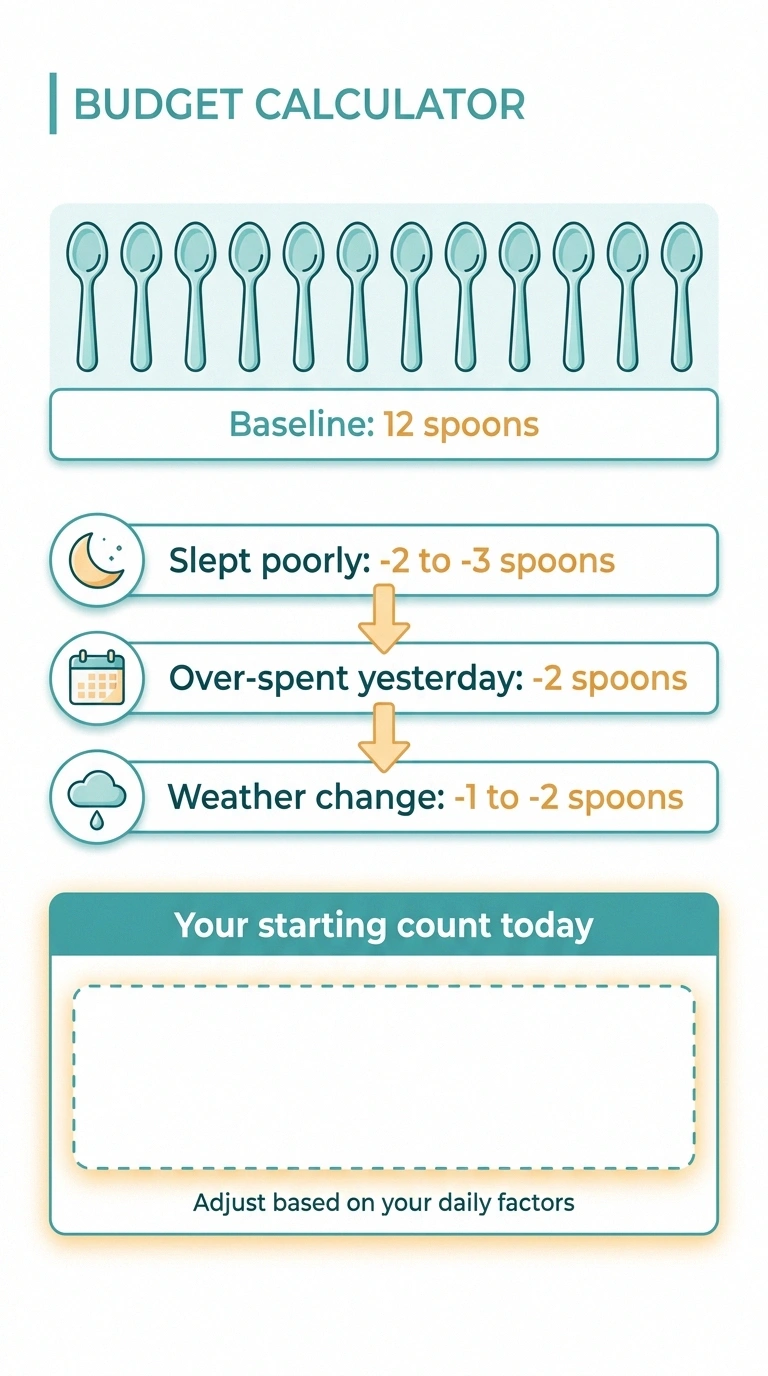
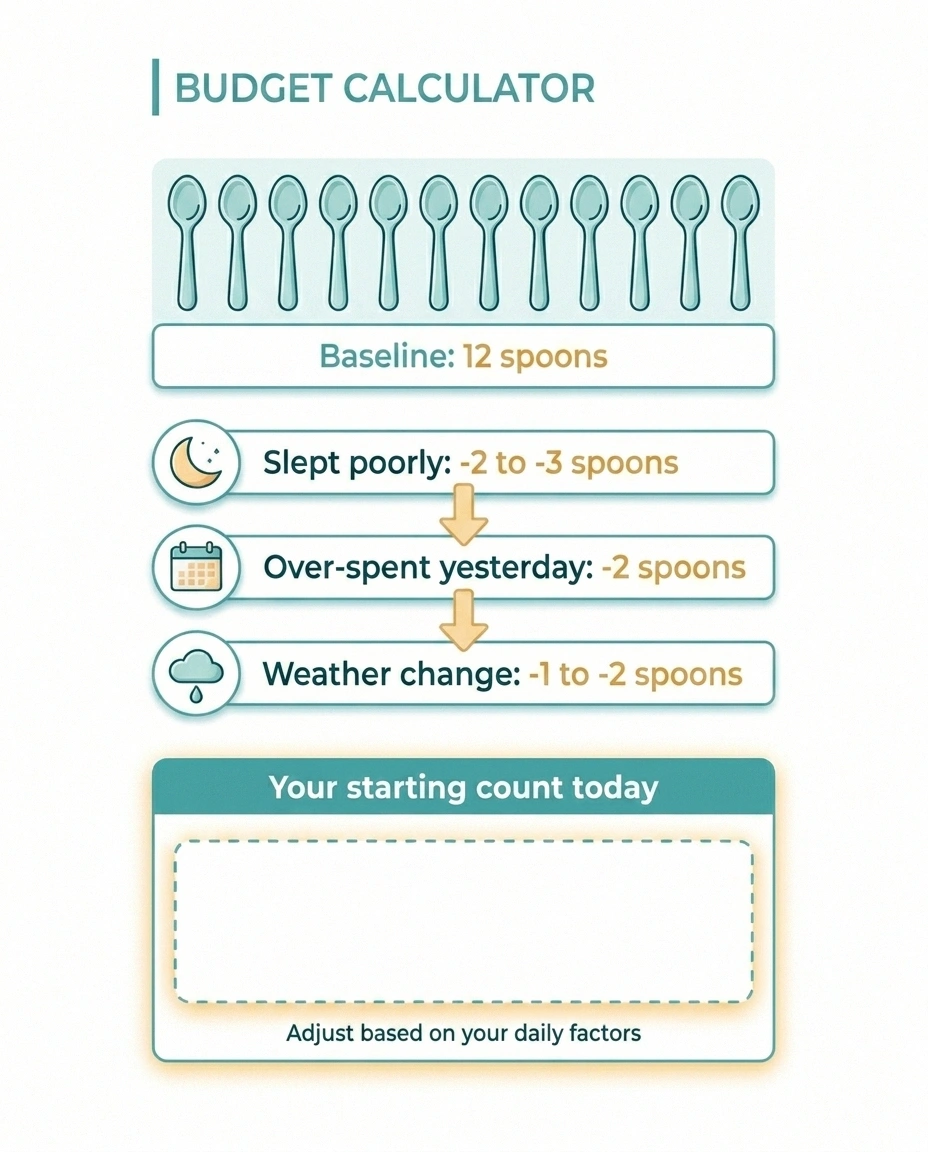
Start with twelve as a baseline. Twelve is the number Miserandino used, and it's a useful starting point for most adults with chronic illness. Some days you'll have more; some days you'll have fewer.
Adjust for your reality. Take a look at last week. Did most days feel like you had reasonable energy? You might start with 14 or 15. Did most days feel like you ran out by 2 p.m.? You might start with 8 or 10. The number is yours — what matters is that it's roughly honest.
Account for the “rough sleep penalty.” If you slept poorly, knock 2 or 3 spoons off the baseline before you've even started the day. If you slept genuinely well, you might be at the high end of your range. This isn't shameful — it's information.
Account for the “yesterday penalty.” If you spent more than your budget yesterday — what some people call “borrowing from tomorrow” — you'll have fewer spoons today. The day after a big family event, a long doctor's appointment, or a major chore is almost always a low-spoon day. Plan for it; don't get blindsided.
Account for weather and barometric pressure. Many people in our community swear that big weather changes — storms moving in, sudden temperature swings — drop their spoon count. Whether the science is clear or not, the felt experience is real for a lot of us. Track it for yourself for a few weeks and see if a pattern emerges.
By the end of a few weeks of paying attention, most people can give a pretty accurate estimate of what they have on any given day. That estimate becomes the budget.
What Things Actually Cost
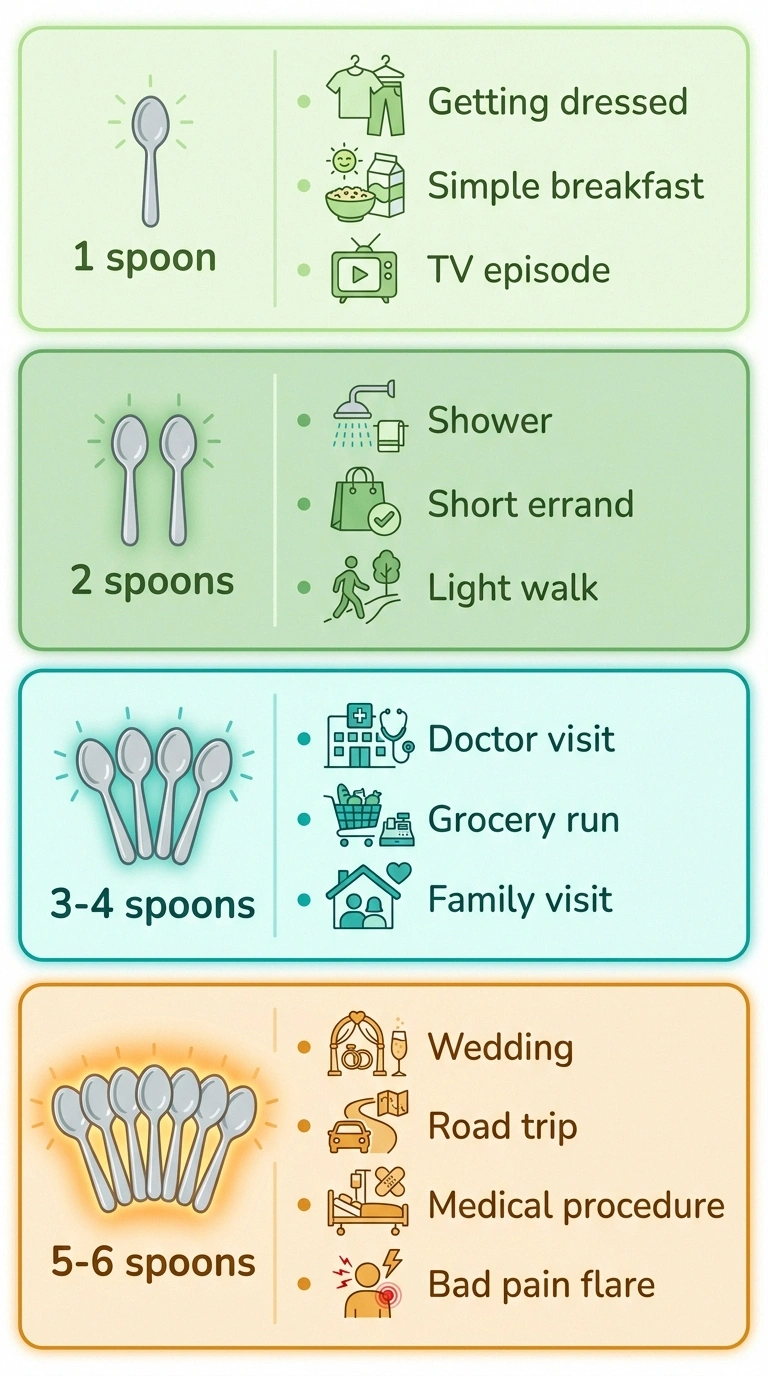
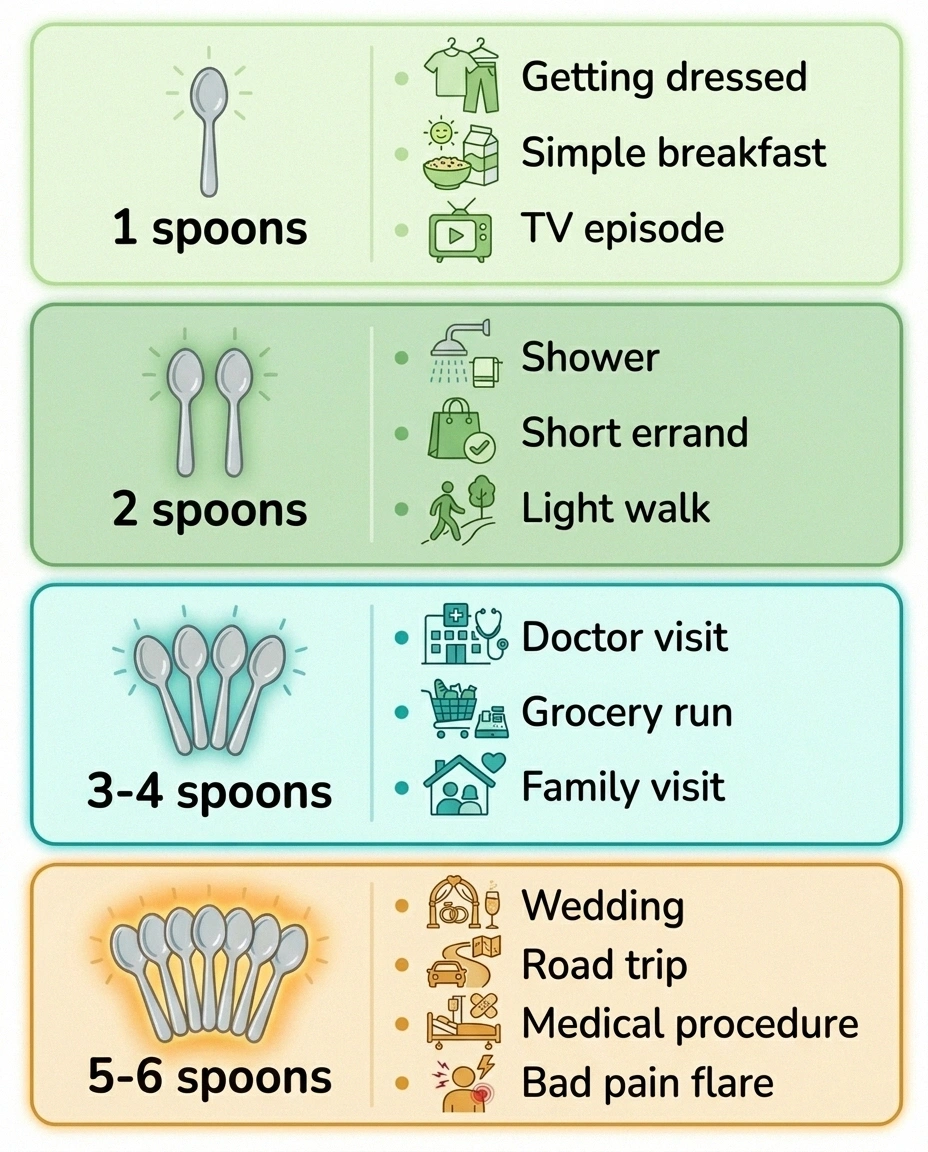
The next piece is figuring out the cost of common activities. These vary by person — what costs you two spoons might cost me four — but a rough taxonomy helps. Here's the version I share with people just getting started.
Typical Spoon Costs by Activity
| Cost | Example Activities |
|---|---|
| 1 spoon | Getting dressed; making a simple breakfast; a 10-minute phone call; watching a TV episode |
| 2 spoons | Showering; driving a short errand; making a real meal; one load of laundry; a short flat walk |
| 3–4 spoons | A doctor's appointment; grocery shopping; an hour of family visiting; a complicated meal |
| 5–6 spoons | A long family gathering; a wedding or funeral; a road trip; a medical procedure; a bad pain flare |
Costs vary by person and day — these are starting points. Calibrate yours over 2–3 weeks of paying attention.
1-spoon activities (the small things that add up):
- Getting dressed
- Making a simple breakfast
- Loading or unloading the dishwasher
- A 10-minute phone call
- Light reading
- Watching a TV episode
2-spoon activities (the regular daily costs):
- Showering and grooming
- Driving a short familiar errand
- Making a real meal
- One load of laundry start-to-finish
- A 30-minute conversation with a friend
- A short walk on flat familiar ground
3-to-4-spoon activities (the ones that take a real bite):
- A doctor's appointment
- Grocery shopping
- A trip to a busy store, mall, or airport
- An hour-long family visit
- Cooking a complicated meal
- Cleaning a bathroom thoroughly
5-to-6-spoon activities (the ones to schedule with care):
- A long family gathering
- A wedding or funeral
- A road trip of more than an hour
- A medical procedure
- A holiday with grandchildren visiting
- A bad pain flare day, even if you “did nothing”
The numbers are illustrative. You'll calibrate them to your own life. What's important is that you start seeing activities as costing something, not as free.
The Three Pacing Habits
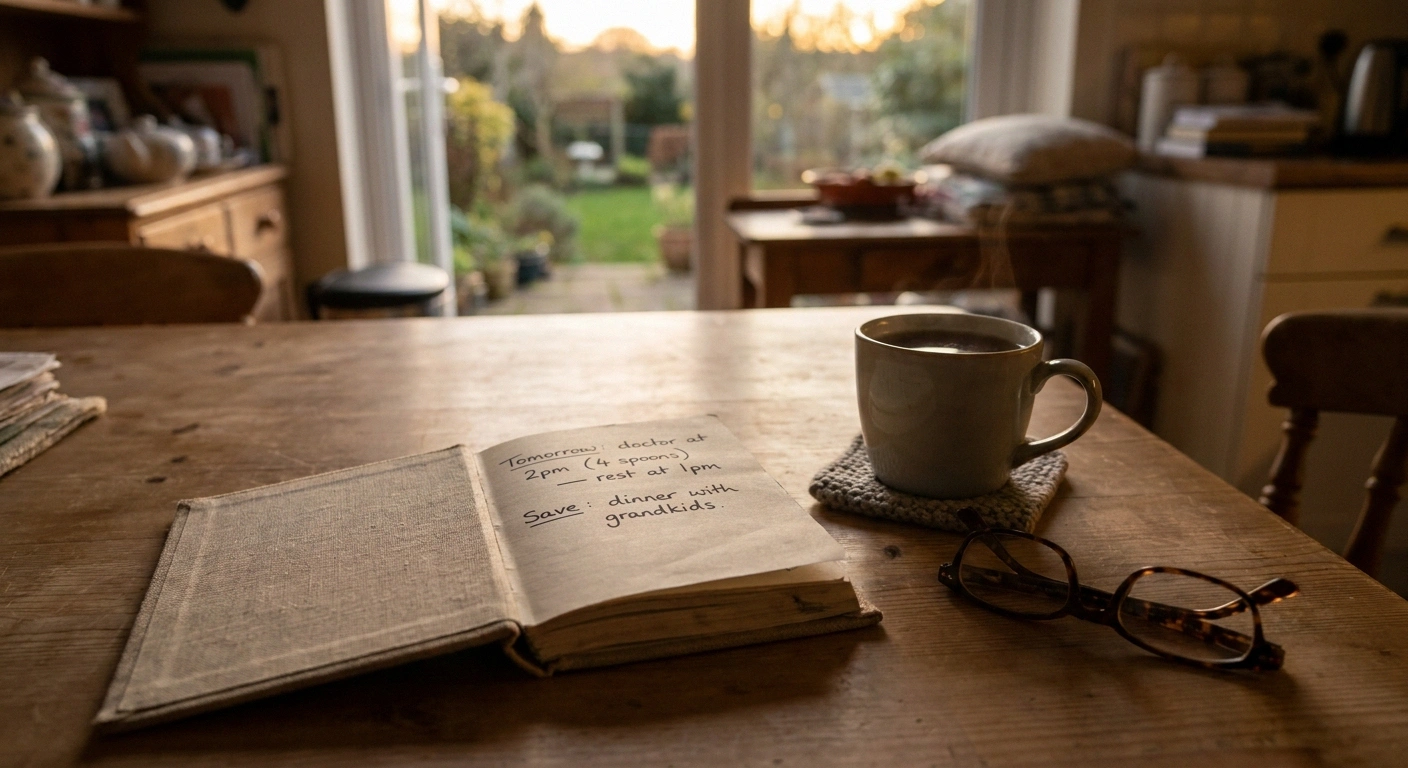
Pacing is the practice of spending your spoons on purpose instead of by accident. It rests on three habits that, once they become natural, transform a chronic-fatigue day from a series of crashes into a manageable rhythm.
The Three Pacing Habits
1. Plan the day before, not the morning of
Deciding as you go costs spoons too. Five minutes the night before saves the constant re-evaluation.
2. Bank rest before you need it, not after
A 15-minute lie-down between activities saves more energy than a 90-minute crash-recovery.
3. Refuel intentionally
Real meals, sunlight, brief lie-downs refill. Phone scrolling, sugar, upsetting news drain even when they feel like rest.
Habit 1: Plan the day before, not the morning of. The night before, take five minutes and look at tomorrow. What are the must-dos? What's the estimated spoon cost? Where are the rest gaps? People who plan the night before consistently report having more usable energy than people who decide as they go — the deciding itself costs a spoon, and so does the constant re-evaluating.
Habit 2: Bank rest before you need it, not after. The temptation is to push through and rest when you crash. The better pattern is to take a small rest before you crash. A 15-minute lie-down between activities preserves more energy than a 90-minute crash recovery. Counterintuitively, scheduling rests when you feel fine is what keeps you from running out hours later.
Habit 3: Refuel intentionally. Some things refill spoons. Some things drain them. Sit and notice which is which. Things that often refill spoons: a real meal (not a snack), 20 minutes lying flat with the eyes closed, sunlight in the morning, gentle movement like a short walk (yes, sometimes movement gives back what it costs), a phone call with someone who genuinely lifts your mood. Things that often drain even when they feel like “rest”: scrolling on a phone for an hour, watching upsetting news, a difficult conversation, a meal of mostly sugar that spikes and crashes blood sugar.
The combination of those three habits — plan ahead, rest early, refuel intentionally — is what makes pacing actually work as a practice.
The Family and Friends Conversation

One of the hardest parts of living with chronic fatigue is that the people who love you sometimes don't get it. You look fine. You're not in a wheelchair. You're not bandaged. Why can't you come to dinner? Why did you cancel? Why are you so tired again?
The Conversation Script — Save This One
“I want to explain something about how my energy works. Imagine I start every day with twelve spoons. That's all I get. Every single thing I do costs a spoon — getting dressed, making a meal, driving, talking. When I run out, I'm done for the day. I can't borrow more.
That's why I sometimes have to say no to things I'd love to do. It's not that I don't want to. It's that I've already spent the spoons. When you hear me say ‘I'm out of spoons,' it means I need to stop. Not later. Now.”
The Spoon Theory gives you language for this conversation that, in my experience, almost nothing else does. Here's the script I use with people who are about to have this conversation for the first time with a spouse, an adult child, or a close friend.
“I want to explain something about how my energy works, because I know it sometimes looks like I'm flaky or avoiding things, and I'm not. Imagine I start every day with twelve spoons. That's all I get. Every single thing I do costs a spoon — getting dressed, making a meal, driving, talking. When I run out, I'm done for the day. I can't borrow more. The next day, if I overspent today, I start with fewer.
“That's why I sometimes have to say no to things I'd love to do. It's not that I don't want to. It's that I've already spent the spoons, or I'm saving them for something else I committed to. When you hear me say ‘I'm out of spoons,' it means I need to stop. Not later. Now.”
Most people, when they hear this once, get it. Some take a few rounds. Some never quite get it, and that's a separate problem worth recognizing. But for most relationships, the Spoon Theory turns “I'm too tired” from an excuse into a shared language. That changes everything.
Practical Pacing Scripts

Here are a few specific moves that I see work consistently for people in our community.
The “two-spoon morning” rule. Don't spend more than two spoons before 10 a.m. unless you absolutely have to. The morning is when sleep is fresh and you can think clearly. Save your decisions, your hard conversations, your driving for after you're warm and moving, but don't blow your whole budget before lunch.
The “rest before, not after” appointment rule. A doctor's appointment usually costs 3 to 4 spoons. Schedule a 20-minute rest before you leave the house, not just after you get home. You'll get through the appointment with more clarity and less crash.
The “one big thing per day” rule. On most days, plan one large activity (a doctor's appointment, a grocery trip, a family visit) and treat everything else as bonus. Two large activities in one day is a 60 percent over-budget day for most people. Three is a guarantee you'll be paying for it tomorrow.
The “buffer day” rule. If you have a big day coming up — a wedding, a holiday, a long doctor visit — plan the day before and the day after as light. Going into a big day already drained, or trying to do anything the next day, is how the worst crashes happen.
The “sit-down rule” for cooking. Set a stool or chair in the kitchen and use it. Most cooking can be done seated. Chopping vegetables, mixing batter, watching a pot simmer — all sit-down activities. Standing in the kitchen for an hour when you could have been sitting costs spoons you didn't need to spend.
The “delegate the hardest spoon” rule. Identify the single most expensive task in your week and ask whether someone else can do it or whether it can be paid out. For some people that's grocery shopping (delivery service for $10 a week saves 3 spoons). For some it's bathing (a grab bar plus a shower chair turns a 3-spoon activity into a 1-spoon activity). For some it's stairs (one rearranged bedroom location can save 2 spoons a day).
Pacing isn't laziness. It's strategy.
The Red Flags You've Over-Spent
Some signs that you've gone past your budget for the day, even if you don't realize it consciously:
Signs You've Over-Spent — Stop Now
• Pain noticeably worse than this morning
• Sudden irritability or weepiness without trigger
• Brain fog — losing words, forgetting what you were doing
• Sudden chill, low-grade nausea
• Increased tripping or stumbling (real fall risk)
• Eyes wanting to close mid-sentence
Two or three of these together — sit, lie down if you can, rest 20–30 real minutes. Pushing through is what produces tomorrow's crash.
- Pain that's noticeably worse than this morning
- Sudden irritability or weepiness without a specific trigger
- Brain fog: forgetting what you were just doing, losing words, fumbling with familiar things
- Sudden chill or low-grade nausea
- Increased tripping or stumbling (a real fall risk — our piece on balance and falls covers what's at stake)
- The feeling that even sitting down doesn't help
- Eyes that feel like they want to close while you're still mid-sentence
When you notice two or three of these together, that's your body telling you the budget is gone. The right answer is to stop, sit, lie down if you can, and rest for a real 20 to 30 minutes — not five. Pushing through after these signals shows up is what produces the next-day crash.
The Connection to Mental Health and Sleep
Fatigue from neuropathy and mood can spiral together. Bad sleep makes the fatigue worse. Worse fatigue makes the pain feel worse. Worse pain makes sleep harder. And the whole picture wears on mood until even small things feel impossible. If you've been at the bottom of that spiral, you're not weak — you're caught in a feedback loop that's hard to climb out of by sheer willpower.
Two things help most. First, an honest conversation with your doctor about sleep and mood, separately from the conversation about pain. Both have specific treatments. Both are worth treating in their own right, not just as side effects of the neuropathy. Our piece on neuropathy and mental health covers the picture in more depth.
Second, keeping a simple log — even just a few words a day — about your energy, sleep, and pain. Patterns are easier to see in writing than in memory. Our symptom diary guide walks through a low-effort version that works for most people.
The Bigger Picture
For people with diabetic neuropathy, chemo-induced neuropathy, idiopathic neuropathy, or any other chronic nerve picture, the fatigue is real, it's not in your head, and the way you spend your energy matters more than how much energy you have. Pacing is the practice. The Spoon Theory is the language. Together they give you back some of the agency that chronic illness so quietly takes away.
Some people in our community add gentle movement to the picture — short walks, chair exercises, light stretching — and find that, paradoxically, the movement gives back spoons it costs. Our piece on gentle neuropathy exercises covers the ones most likely to be on the “refuels rather than drains” side of the ledger.
It takes a few weeks for any of this to feel natural. You'll over-spend some days. You'll under-spend others. The goal isn't perfection — it's awareness. The first time someone in your life says “looks like you're running low on spoons, can I take that off your plate” without you having to ask, you'll understand why this whole framework matters.
Frequently Asked Questions
Is twelve spoons the right number for me?
Twelve is the original Spoon Theory number, but it's just a starting point. Some people work with eight on bad days and fifteen on good days. Some people use a different number altogether — pennies, coins, M&Ms, whatever metaphor works. The number isn't the point. The point is treating your energy as a finite daily resource that you spend on purpose. Whatever framing helps you do that is the right one.
Does pacing mean I shouldn't be active?
No. Pacing means being intentional about what kind of active and how much. Gentle movement — short walks, chair stretches, light gardening — often refuels spoons rather than draining them, especially when it's done in the morning and at moderate intensity. What pacing pushes back on is the boom-bust pattern: high-energy bursts when you feel good, followed by days in bed. Steady, gentle, planned movement protects more energy than either pushing too hard or doing nothing.
How do I explain pacing to a family member who thinks I just need to “push through”?
The Spoon Theory conversation script above is the simplest opener. If that doesn't land, sometimes a specific example helps: “Yesterday I went to the doctor and made dinner. That was about six of my twelve spoons. Today I had two left after waking up. That's why I can't come to lunch — I'm not flaking, I'm out.” Concrete, calm, no guilt — works better than abstract explanations. Some people will still struggle to understand. With those people, you may need to accept that “I can't” is a complete sentence and stop justifying.
What about caffeine and energy drinks?
Caffeine in moderation (a cup or two of coffee in the morning) is fine for most people and can be part of the toolkit. Energy drinks and high-caffeine pre-workout products are usually a borrowing-from-tomorrow trade — they give you a few hours of usable energy and take away from sleep quality that night, which leaves you with fewer spoons tomorrow. The net is usually negative. Use them rarely if at all, and never after early afternoon.
Why am I so tired even on days I do nothing?
Because doing “nothing” with chronic neuropathy isn't actually nothing. Pain processing, sensory vigilance, autonomic compensation, and disrupted sleep all run in the background even when you're sitting still. A day in your chair watching TV is a real-cost day, not a free one. Recognizing this is part of why pacing works — you stop expecting to recover everything in a single rest day. Recovery from a high-spoon day often takes 24 to 48 hours of careful spending, not one nap.
Does this work for people with neuropathy from chemo or autoimmune disease, not just diabetes?
Yes. The Spoon Theory was originally written by someone with lupus, and the framework has been adopted by people with multiple sclerosis, fibromyalgia, chronic fatigue syndrome, long COVID, lupus, rheumatoid arthritis, and many forms of neuropathy. The underlying logic — finite daily energy that you spend on purpose — applies to any chronic condition that involves real fatigue.
What if my spouse or partner is also tired and doesn't see why I need special accommodations?
This is hard, and worth naming. The Spoon Theory works best when both people recognize that chronic-illness fatigue is genuinely different from regular tiredness — not more important, just different in kind. A regularly-tired person can usually recover with one good night's sleep. A spoon-tired person often can't. If your partner is open to learning, Christine Miserandino's original “Spoon Theory” essay (easy to find online) is a five-minute read that has helped many couples reach a shared understanding. If they're not open to learning, that's a relationship conversation, not just a fatigue conversation.
About the Author