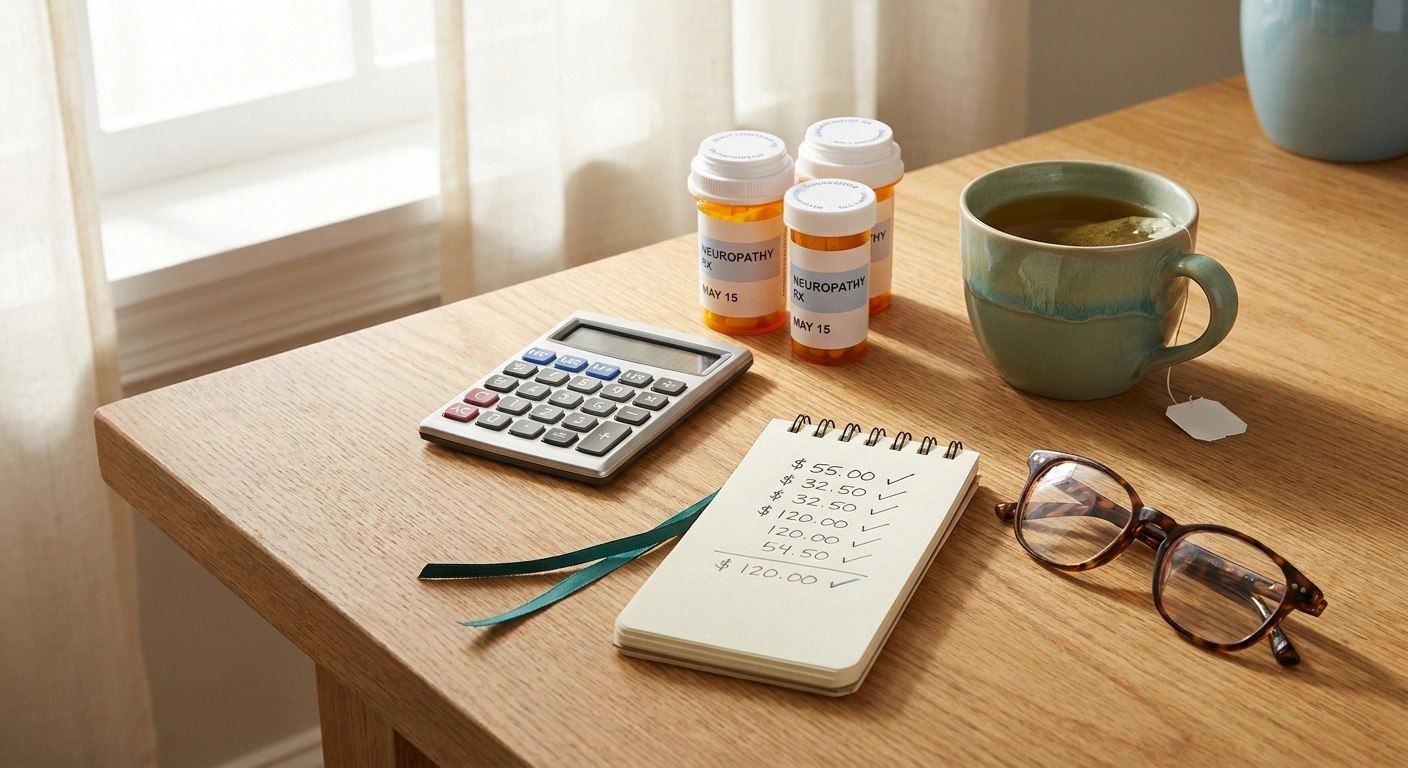
The first time I picked up a Lyrica prescription, the pharmacist slid the bag across the counter and said, almost apologetically, “That’ll be four hundred and twelve dollars.” I stood there for a long moment, holding my credit card in mid-air, doing math in my head about which bill I could push to next month. I remember thinking, I am not the first person in this line to have this exact reaction.
I’m Janet. I’m a patient advocate with neuropathy, not a financial advisor or a pharmacist. But I’ve spent years figuring out which doors are worth knocking on, which “discounts” are actually discounts, and which generic swaps are perfectly fine versus the ones where the price difference reflects a real difference. This is the cheat-sheet I wish someone had pressed into my hand at that pharmacy counter.
None of this replaces a conversation with your prescriber or pharmacist. But you’ll walk into both of those conversations a lot better armed if you read this first.
Why Neuropathy Meds Cost What They Cost
Before we talk about saving, it helps to know what you’re up against. Nerve-pain prescriptions fall into a few cost buckets, and the bucket your drug lives in tells you almost everything about which strategies will work.
Key Takeaway
Most neuropathy medications now have inexpensive generic equivalents — gabapentin, pregabalin, duloxetine, and the older tricyclics all cost $4 to $50 a month with a discount card. Brand-only drugs have manufacturer assistance programs. The biggest savings come from layering generic-switching, pharmacy-shopping, and assistance-program enrollment in that order.
- Cheap, plain-generic, decades old. The tricyclic antidepressants — amitriptyline, nortriptyline — were patented in the 1960s. They’ve been generic forever and now sit on the $4 lists at large pharmacies. So does plain gabapentin, the older anti-seizure drug. These are the bargain basement, and many neurologists still reach for them first specifically because cost rarely becomes a barrier.
- Recently-generic, still mid-priced. Pregabalin (the generic of Lyrica) went off-patent in 2019. Duloxetine (generic Cymbalta) went off-patent in 2013. The cash price has dropped enormously since then, but you can still get sticker-shocked if you don’t shop around. Without using any discount tool at all, retail prices vary by 5x across pharmacies on the same exact pill in the same town.
- Brand-only, expensive. A handful of nerve-related medications are still patent-protected and brand-only. The capsaicin 8% patch (Qutenza), droxidopa (Northera), and some compounded topical formulations have no generic equivalent yet. These are where manufacturer patient-assistance programs and specialty-pharmacy negotiation matter most.
The cost game looks different in each bucket, so we’ll tackle them differently.
Start Here: Ask If a Generic Exists
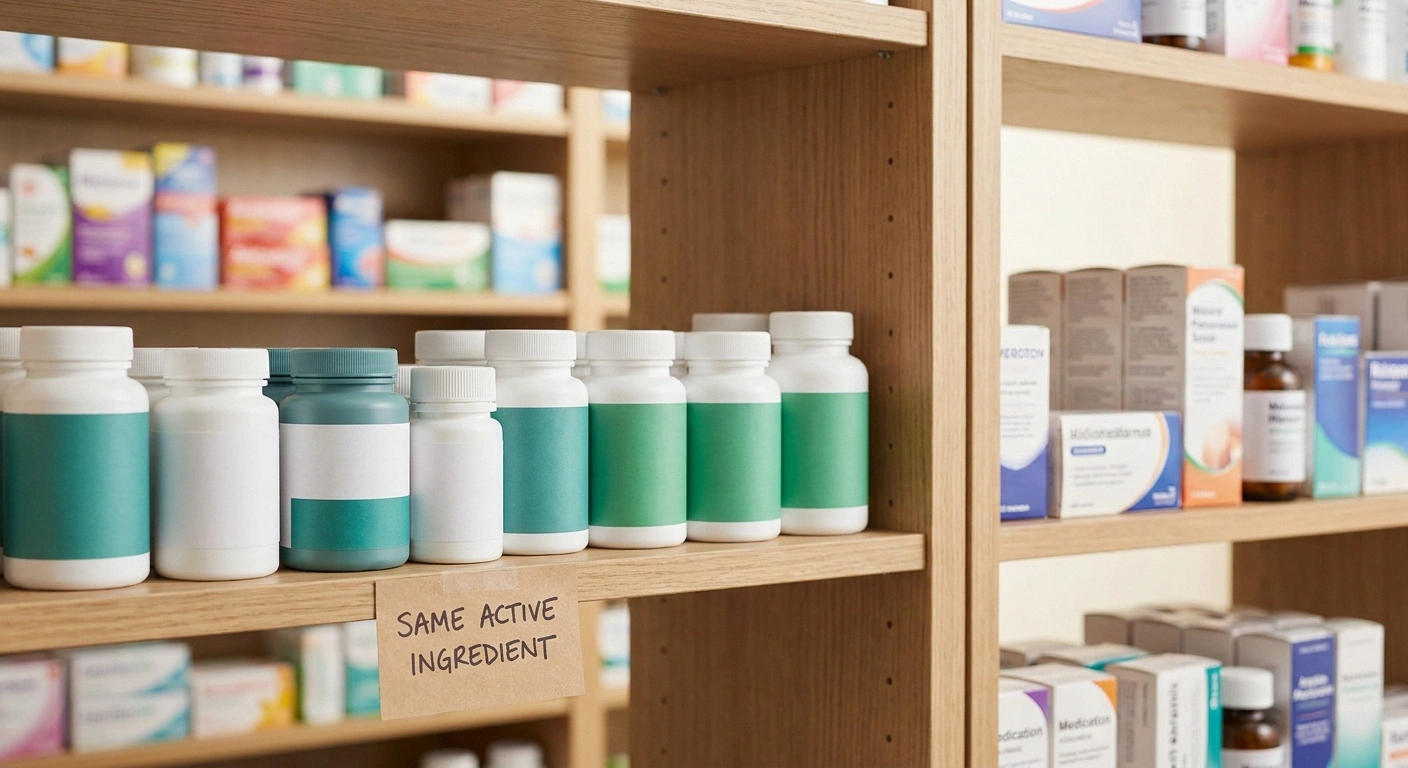
If you’re paying brand-name money for Lyrica or Cymbalta in 2026, stop reading and call your prescriber. There’s almost certainly a generic equivalent on the shelf that will work the same way for one-tenth the price. Insurance companies will sometimes default-fill the brand if the prescription was written that way years ago and nobody updated it.
Neuropathy Med Cost Tiers (2026, Cash Price with Discount Card)
Here’s a quick map of generic availability for the most common nerve-pain medications:
- Gabapentin — generic since the early 2000s. Often $4 to $15 for a 30-day supply at large pharmacies; even cheaper at a 90-day fill.
- Pregabalin (the generic of Lyrica) — available since 2019. Cash price has fallen from $400+ to roughly $15 to $50 a month with a discount card.
- Duloxetine (the generic of Cymbalta) — available since 2013. Cash price runs $10 to $40 monthly with a card.
- Amitriptyline and nortriptyline — generic for decades. $4 to $10 a month at most chains, often less with a discount card.
- Venlafaxine (generic of Effexor) — generic for years. $10 to $25 a month.
- Topiramate (generic of Topamax) — generic. Mid-priced unless on a chain’s discount list.
- Lidocaine 5% patches — generic patches have been available, though prices vary widely; sometimes a compounded lidocaine cream from a compounding pharmacy is cheaper.
- Capsaicin 8% patch (Qutenza) — brand-only, expensive, administered in-office. Patient-assistance program available.
- Droxidopa (Northera) — brand-only, very expensive, with a manufacturer assistance program.
When you ask your doctor “is there a generic?”, be specific. Ask whether the active ingredient is the same and whether they’d be comfortable writing for the generic version. Most will say yes immediately — for a few people the brand-name version genuinely works better, but that’s the exception, not the rule.
The Pharmacy Discount Card Layer
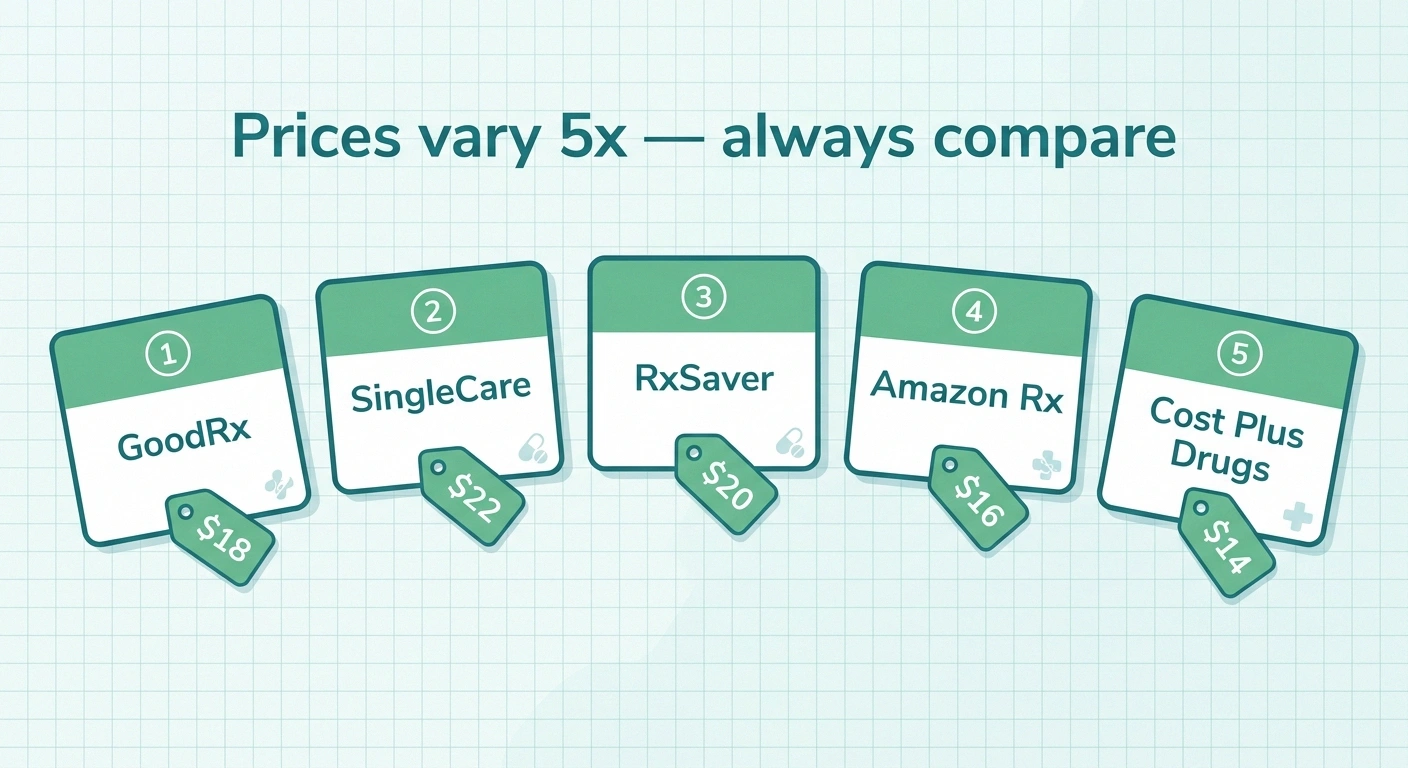
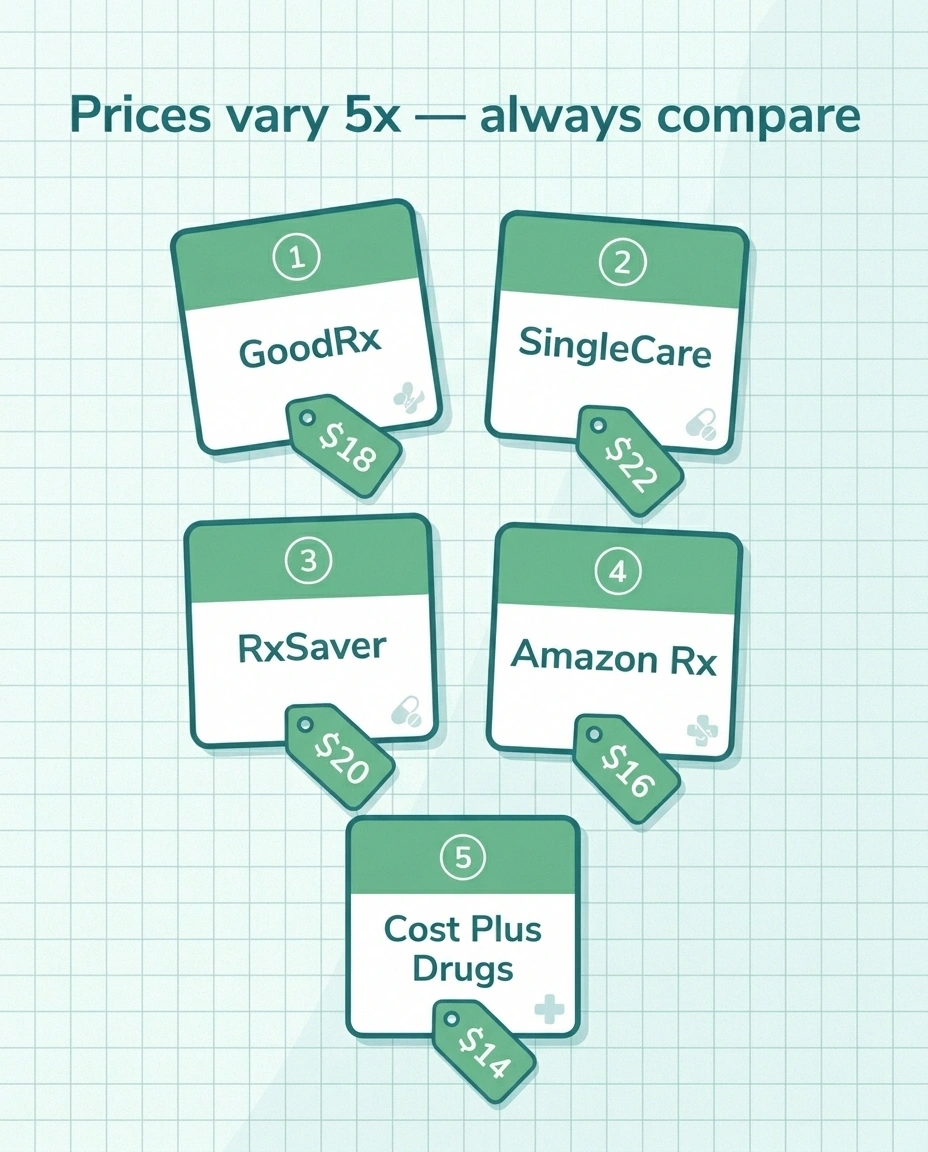
This is the single biggest source of savings most people leave on the table. Even if you have insurance, sometimes the cash price with a discount card beats your copay. Don’t assume your insurance is the best deal — at the register, ask the pharmacist to run both and quote you the lower one.
Your 5-Minute Pharmacy Price Check
- Search the drug name + your ZIP on GoodRx and SingleCare.
- Check Cost Plus Drugs (costplusdrugs.com) for the same generic.
- Check Amazon Pharmacy with your Prime account.
- At the counter, ask the pharmacist to run both your insurance AND the cheapest card and quote you the lower price.
- Buy the lowest. Re-check every 6 months — prices drift.
The major discount card services for 2026:
- GoodRx — the best-known. Free app or printable coupon. Pulls negotiated rates from pharmacy benefit managers across most major chains. Their database is broad and their prices for generic gabapentin, pregabalin, and duloxetine are consistently competitive.
- SingleCare — frequently beats GoodRx on certain drugs at certain chains. Always worth a side-by-side check.
- RxSaver — similar concept, sometimes cheapest at smaller pharmacies.
- WellRx — yet another comparison engine; their app and printable coupons work the same way.
- Amazon Pharmacy — has its own Prime Rx discount program; for some drugs, the Prime member price is the cheapest in town.
- Mark Cuban Cost Plus Drug Company (costplusdrugs.com) — an interesting newer player. They sell generic drugs at manufacturer cost plus a flat 15% markup plus pharmacy and shipping fees. For many nerve medications including gabapentin and amitriptyline, this is now one of the very lowest prices available. Worth a five-minute search on their site before any refill.
Two practical tips. First, you cannot stack a discount card with insurance — it’s one or the other on a given fill. Pick the one that’s cheaper. Second, prices vary by chain and by ZIP code. The exact same pregabalin from the exact same manufacturer can cost $18 at one pharmacy across town and $73 at another, on the same day, with the same card. Shop around. The five minutes you spend on the GoodRx and SingleCare apps before your refill is the highest-paid five minutes of your week.
Patient Assistance Programs for the Brand-Only Drugs
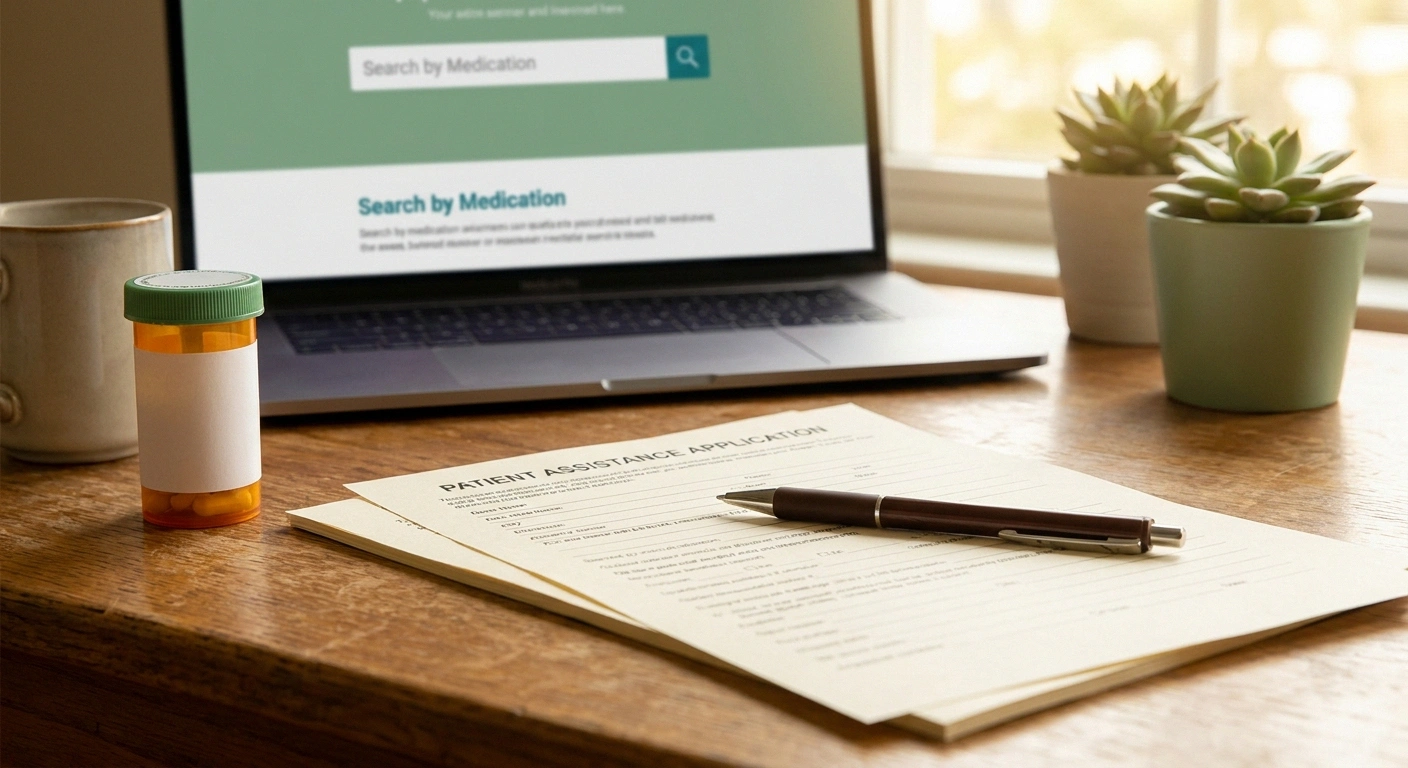
If your medication is still brand-only — Qutenza, Northera, or certain compounded formulations — there is a separate path. Most pharmaceutical manufacturers run patient-assistance programs (PAPs) that provide their drug free or at a deep discount to people who can show financial need.
Here are the main programs that touch neuropathy treatment:
- Pfizer Patient Assistance Program covers some of their nerve-relevant medications. Apply at pfizerpatientassistance.com.
- Lilly Cares Foundation covers Lilly drugs (including the brand-name Cymbalta, if you’re still on it for some reason). Apply at lillycares.com.
- Averitas Pharma Access for the Qutenza capsaicin patch.
- Northera Patient Support Program for droxidopa.
- Bristol Myers Squibb, AbbVie, Novartis, AstraZeneca, Janssen — all run their own programs for the drugs they manufacture.
You don’t have to find each one yourself. Two clearinghouses make this much easier:
- NeedyMeds.org — a nonprofit database of patient-assistance programs, organized by drug name. Free to use, no login required, no advertising. Type in your medication and it gives you the program details, the income limits, and the application forms.
- RxAssist.org — similar concept, also free and nonprofit.
- Medicine Assistance Tool (MAT) at medicineassistancetool.org — run by the pharmaceutical industry trade group PhRMA, but a legitimate search engine across most manufacturer programs.
The typical income limits for these programs run around 200% to 400% of the federal poverty line, which is more generous than most people assume. A single person earning under roughly $60,000 a year, or a household of four earning under roughly $125,000, will qualify for many of them. Each program has its own forms, and your doctor’s office often has to sign part of the application, but the math frequently works out to free or near-free medication for months at a time.
If You Have Insurance: Read the Formulary, Then Negotiate
Insurance is a moving target. Two strategies inside the world of insured patients matter most for neuropathy meds.
Strategy one: copay cards from the manufacturer. If you’re on a brand-name drug AND you have commercial insurance (not Medicare and not Medicaid — those programs forbid copay cards by federal law), the manufacturer often offers a copay card that drops your share of the cost to a flat rate like $5 or $25. Ask your prescriber’s office or check the manufacturer’s website. These can save thousands of dollars a year while you’re between job-related insurance and Medicare age.
Strategy two: tier exceptions. Your insurance formulary places every drug on a tier. Tier 1 is cheapest (generics), tier 3 or 4 is most expensive (brands or specialty). If your prescriber documents that a tier 1 generic didn’t work for you and you need a tier 3 brand, many plans will grant a “tier exception” that drops the brand drug to a generic copay. Your doctor’s office has to file this paperwork. It often gets approved on the first try.
If a drug is flat-out denied by your insurance, you have appeal rights — typically a first-level appeal handled internally, then an external review by an independent third party. Your pharmacy and your doctor’s office can both help you navigate this. Don’t accept a denial without asking why and what the appeal process is.
Medicare, Medicaid, and the New Out-of-Pocket Cap
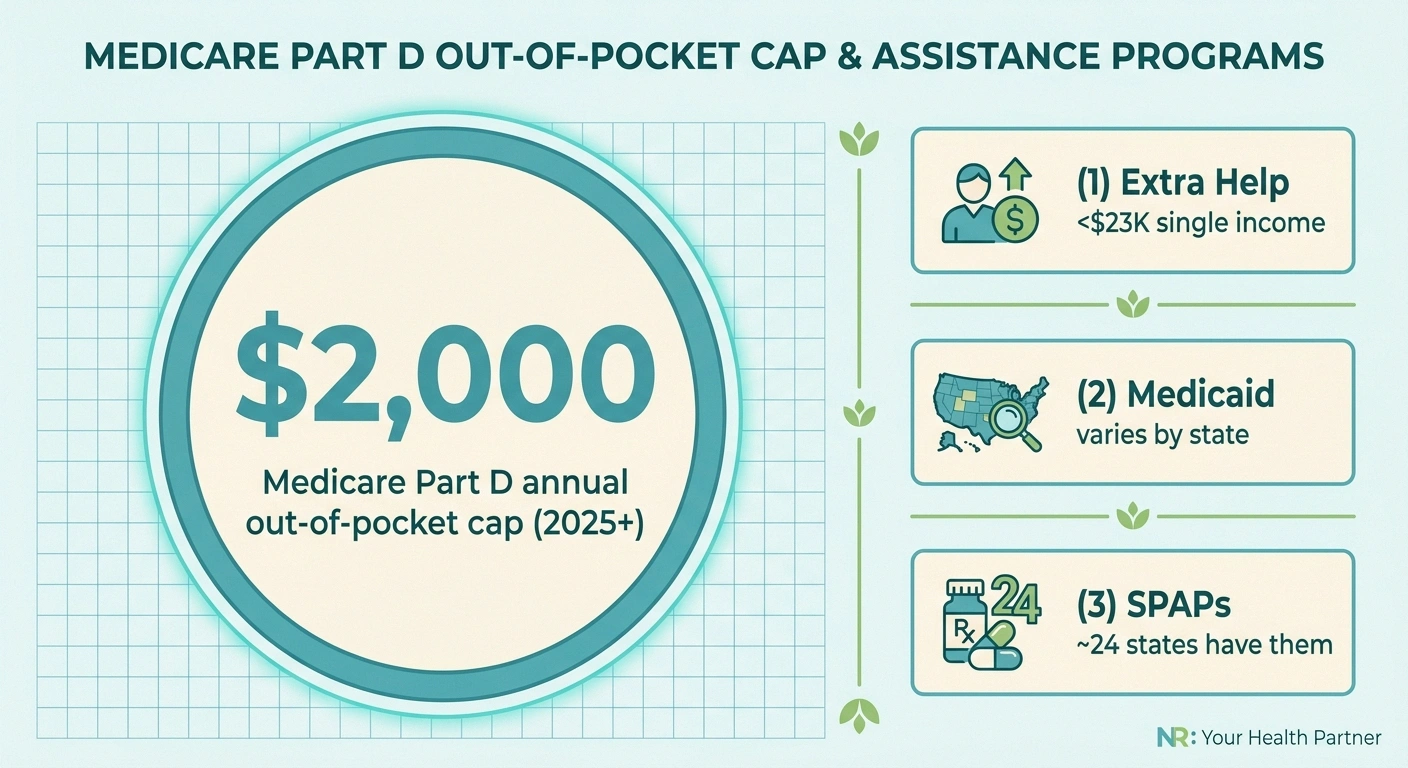
Medicare Part D has been getting cheaper, and quietly. For 2025 and forward, Part D includes a hard $2,000 annual out-of-pocket cap on covered prescriptions. Once you’ve spent $2,000 out of pocket on Part D drugs in a calendar year, the rest are free for the year. That’s a huge change from the old donut-hole math.
If your income is modest, you may also qualify for Medicare Extra Help (also called the Low-Income Subsidy or LIS). Extra Help eliminates Part D premiums and deductibles entirely and caps copays at a few dollars per prescription. As of 2025, a single person earning less than roughly $23,000 and with limited assets, or a married couple earning less than roughly $31,000, qualifies. You apply through the Social Security Administration — the form is short. If your circumstances change (a spouse passes away, you stop working), reapply.
Medicaid covers prescription medications at very low copays in every state. If you’re not currently enrolled but think you might qualify, the rules vary by state but tend to favor the disabled, elderly, low-income parents, and pregnant women. Some states cover all adults under a certain income. Apply through your state’s Medicaid agency — there’s no shame in qualifying, and many neuropathy patients qualify and don’t know it.
State pharmaceutical assistance programs (SPAPs) are another layer. Roughly two dozen states run their own programs that supplement what Medicare or Medicaid doesn’t cover, often targeting the chronically ill. Search “[your state] pharmaceutical assistance program” or call your state’s department of aging.
The Federally Qualified Health Center Card
Federally Qualified Health Centers (FQHCs) are community clinics that get federal funding to serve low-income patients. They use a federal program called 340B to buy prescription drugs at deep discounts, then pass those savings to patients on a sliding-scale fee based on income.
The Help-Finding Stack — Free Resources
If you’re getting your neuropathy care through an FQHC — or if you could switch — gabapentin, pregabalin, duloxetine, and most TCAs become very inexpensive. You don’t need to be uninsured to use an FQHC; many take Medicare and private insurance too. To find one, search findahealthcenter.hrsa.gov.
Some hospital systems also run charity-care programs that include prescription assistance for established patients. Ask your prescriber’s office whether your hospital network has one and how to apply.
Smart Pharmacy Tricks That Add Up
Beyond the big strategies above, a handful of small choices compound into real money over a year.
- Ask for a 90-day fill. Most insurance plans price 90 days noticeably cheaper than three 30-day fills. Mail-order pharmacies almost always price 90 days as the default. You also save trips and forgotten refills.
- Switch to mail-order if your plan offers it. Major insurance plans often have a preferred mail-order pharmacy that’s quite a bit cheaper. The downside is the slower turnaround for new prescriptions; the upside is that it shows up automatically.
- Pill-split where it’s safe. Some nerve medications can be split (gabapentin tablets, some nortriptyline forms). Others absolutely cannot — pregabalin capsules, duloxetine delayed-release capsules, and extended-release versions of almost anything must be taken whole. Ask your pharmacist before splitting anything; cutting a capsule or a controlled-release pill can change how the drug absorbs and either reduce its effectiveness or cause side effects.
- Take advantage of $4 generic lists. Walmart, Target, Kroger, Walgreens, and many regional chains keep lists of common generics priced at $4 for 30 days or $10 for 90 days. Amitriptyline, nortriptyline, and gabapentin are usually on these lists; ask the pharmacist for the current paper list.
- Compare topical alternatives. If you’re spending heavily on a brand-name topical, ask your doctor whether a compounded cream or a generic patch from a smaller compounding pharmacy might do the same job for less.
What I Wouldn’t Cut to Save Money
Saving money on prescriptions is empowering. But some “savings” are actually false economy, and I want to name them so nobody confuses being thrifty with being self-defeating.
Never Cut Costs These Ways
- Don’t skip doses to stretch a prescription — most nerve meds need steady blood levels
- Don’t stop abruptly — pregabalin, duloxetine, and TCAs need a taper
- Don’t split a capsule or extended-release pill without asking your pharmacist
- Don’t quietly substitute a supplement for a prescription without telling your doctor
- Don’t hide cost concerns from your prescriber — they can almost always help if they know
- Don’t skip doses to stretch a prescription. Most nerve medications need a steady blood level to work; intermittent dosing can both feel worse and lead to withdrawal symptoms.
- Don’t stop a medication abruptly to avoid a refill. Pregabalin, gabapentin, duloxetine, and the TCAs all need a taper. Stopping cold can trigger sleep disturbance, anxiety, dizziness, and a sharp pain rebound. If you genuinely can’t afford a refill, call your prescriber’s office that day and ask what to do — they often have samples or can call in a short bridge prescription.
- Don’t substitute herbs for a prescription you’ve been told you need without telling your doctor. Some supplements interact with nerve medications. The best supplement strategies work alongside the right prescription, not as a budget replacement.
- Don’t skip the foundations because they don’t come in a bottle. Tight blood-sugar control if you’re diabetic, abstaining from alcohol if that’s your trigger, treating B12 deficiency, and the lifestyle work outlined in our piece on medications that can damage nerves — none of those cost much, and all of them affect whether your prescription has to do all the heavy lifting alone.
How I’d Approach This If I Were Starting Over
If I were sitting at the kitchen table tomorrow with a fresh diagnosis and an empty wallet, here’s the order I’d run through:
The Order I’d Run These In
- Confirm with my prescriber whether the cheapest generic for my drug class would work before trying the more expensive options. For most neuropathy patients, this means gabapentin or one of the TCAs as the first try — both are very inexpensive.
- Check the price at three or four pharmacies near me using GoodRx, SingleCare, and Cost Plus Drugs. Pick the lowest.
- If the lowest cash price is still uncomfortable, search NeedyMeds.org and the manufacturer’s website to see whether I qualify for a patient-assistance program.
- If I have Medicare and modest income, file for Extra Help that week. If I might qualify for Medicaid, apply too.
- If I have commercial insurance and a brand-name drug, check whether the manufacturer offers a copay card.
- If a brand-name drug is denied by my insurance, ask my doctor’s office to file a tier exception or a prior-authorization appeal.
- If I’m getting care through a hospital system, ask their financial counselor whether their charity-care program covers outpatient prescriptions.
- Set up 90-day fills wherever possible, and put a reminder on my phone to recheck pharmacy prices every six months. Prices drift.
This whole sequence can be worked through in a couple of focused hours. It’s tedious, it’s not glamorous, and it has saved me — and friends I’ve helped — several thousand dollars over the years.
Talking to Your Doctor About Cost
One last thing, and it matters more than people realize. Tell your doctor when cost is a barrier. Most prescribers genuinely don’t know what their patients pay at the counter — the pricing world is opaque even to them. If you say “this medication costs me $300 a month and I can’t keep affording it,” many will switch you to a cheaper alternative on the spot, write for the generic version, hand you a manufacturer copay card from the drug rep’s drawer, or refer you to their clinic’s financial-assistance contact.
What doctors can’t do is read your mind. Don’t quietly stop a medication because of cost without telling them. Don’t dilute or stretch doses. Bring it up at the appointment with the same matter-of-fact tone you’d use to talk about a side effect. There is no shame in it. Cost is a side effect, just one the prescription bottle doesn’t list.
Frequently Asked Questions
What’s the cheapest neuropathy medication?
For most people, generic gabapentin and the generic tricyclic antidepressants (amitriptyline, nortriptyline) are the least expensive prescription options, often $4 to $15 for a 30-day supply. Whether they’re the right medication for you depends on your specific symptoms and other health conditions — cheapest is not always best.
Can I get free Lyrica or generic pregabalin?
Generic pregabalin is no longer expensive — most people can get a 30-day supply for $15 to $50 with a discount card. If even that is unaffordable, the Pfizer Patient Assistance Program may cover brand-name Lyrica for people who qualify on income, and FQHCs sell generic pregabalin at sliding-scale prices. Apply through NeedyMeds.org or pfizerpatientassistance.com.
How do I qualify for Medicare Extra Help?
You qualify if you have Medicare Part D and your income and assets are below set limits — roughly $23,000 in annual income for a single person and $31,000 for a couple as of 2025, with asset limits around $17,000 single and $34,000 couple. Apply through the Social Security Administration at ssa.gov or by calling 1-800-772-1213. The form is short and most people get a decision within a few weeks.
Does GoodRx work with my insurance?
Not at the same time. Each prescription fill uses either your insurance or a discount card, not both. The smart move is to ask the pharmacist to run both and tell you which is cheaper, then use that one. For many generic nerve medications, the discount card price beats the insurance copay.
Is Mark Cuban Cost Plus Drugs legitimate?
Yes. Cost Plus Drug Company is a real licensed pharmacy that sells generics at manufacturer cost plus a flat 15% markup plus a small pharmacy fee. For many common neuropathy medications, their price is among the lowest available in 2026. You order through their website, send your prescription to them, and they ship it to your door.
Can I split my pregabalin or gabapentin pills to save money?
It depends on the form. Gabapentin tablets can usually be split if your pharmacist confirms the specific tablet is scored or splittable. Pregabalin capsules cannot be split — opening the capsule changes how the drug absorbs. Extended-release versions of either drug must be taken whole. Always ask your pharmacist before splitting anything; the wrong split can either lower the effective dose or cause a sudden absorption spike with side effects.
What if my insurance denies my neuropathy medication?
You have appeal rights. Ask your prescriber’s office to file a prior-authorization request explaining why this specific medication is needed for you. If that’s denied, you can appeal — first internally, then through an independent external review. Many denials get reversed on appeal, especially when your doctor documents that you’ve tried other options.
Are 90-day prescriptions really cheaper?
Almost always, yes. Most insurance plans price a 90-day fill at roughly two times a 30-day copay rather than three. Mail-order pharmacies and the major retail chains all offer 90-day pricing on common generics. You also save on pharmacy trips and reduce the chance of missing a refill.
Can I use a manufacturer copay card if I’m on Medicare?
No. Federal law prohibits the use of manufacturer copay cards by patients enrolled in Medicare, Medicaid, or other federal health programs. The copay-card programs are designed for people with commercial insurance. If you’re on Medicare and need help affording a brand-name drug, look instead at the manufacturer’s patient-assistance program, Extra Help, or a state pharmaceutical assistance program.
About the Author