There is a word that separates two very different appointments, and almost nobody explains it to patients.
A neurologist finished residency in neurology. A neuromuscular specialist is a neurologist who then spent another year in fellowship training on nerves and muscles specifically, and who can sit a separate board examination in neuromuscular medicine. That extra year is the whole difference. It is also the reason one office orders a nerve conduction study and calls it idiopathic, while another office looks at the same result and orders four antibody panels and a skin biopsy.
You do not always need the second kind of office. Plenty of neuropathy is straightforward, and a good general neurologist manages it well for years. But when a case is not straightforward, the gap between those two appointments is measured in years of wrong answers.
Here is how to tell which one you need, where the specialists actually are, and how to check a physician’s credentials yourself in about ninety seconds.
What the Extra Year of Training Buys
Neuromuscular medicine became a formal subspecialty in the United States on 2 December 2005, when the American Board of Psychiatry and Neurology and the American Board of Physical Medicine and Rehabilitation set up a joint certification committee. The first examination was given in 2008. So this is a relatively young credential, which is part of why so few patients have heard of it.
The training concentrates on the peripheral nervous system: the nerves themselves, the junction where nerve meets muscle, and muscle. In practice, that concentration shows up in four places.
Pattern recognition on the exam. A neuromuscular specialist is looking for whether your weakness and numbness follow a length-dependent pattern, a patchy multifocal one, or a proximal one, because each points somewhere different. That distinction is often made in the first ten minutes of the physical examination, before any test is ordered.
Reading the electrical study rather than receiving it. Most neuromuscular specialists perform their own nerve conduction studies and needle examinations. That matters more than it sounds. Someone reading a nerve conduction report secondhand sees numbers. Someone who ran the study saw which nerves were hard to find, where the responses dropped off, and what they chose to test next when something looked unusual.
Knowing what a normal test does not rule out. Standard nerve conduction testing measures large myelinated fibers. It is close to blind to the small fibers that carry burning, temperature and pinprick. A specialist who sees small fiber neuropathy weekly does not stop at a normal study; they move to skin biopsy or autonomic testing.
Familiarity with the treatable rare things. The conditions where getting the diagnosis right changes the outcome dramatically are exactly the uncommon ones: CIDP, multifocal motor neuropathy, vasculitic neuropathy, amyloid neuropathy, a paraprotein-associated neuropathy. A general neurologist may see a handful of these in a career. A neuromuscular clinic sees them in a month.
When a General Neurologist Is Genuinely Enough
This section exists because the honest answer saves a lot of people a nine-month wait for an appointment they did not need.
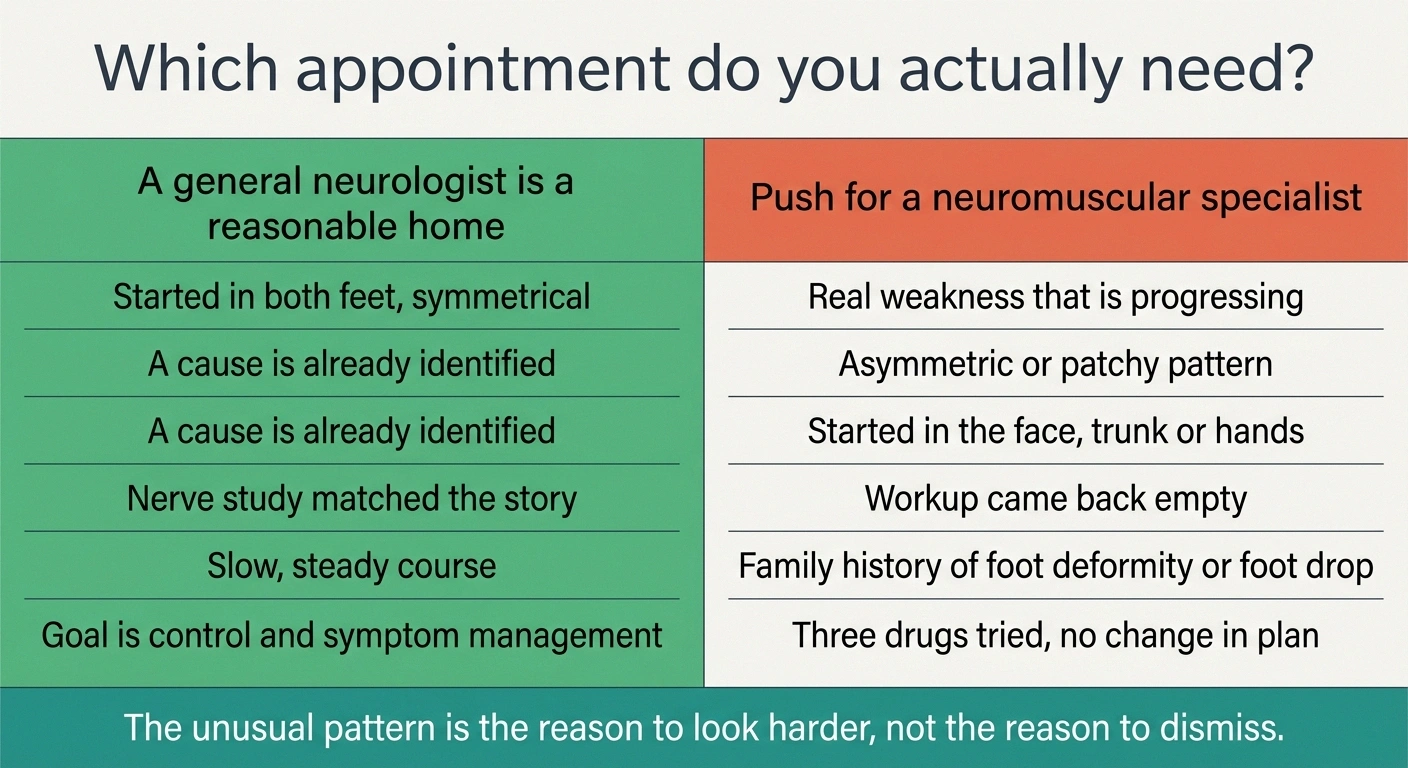
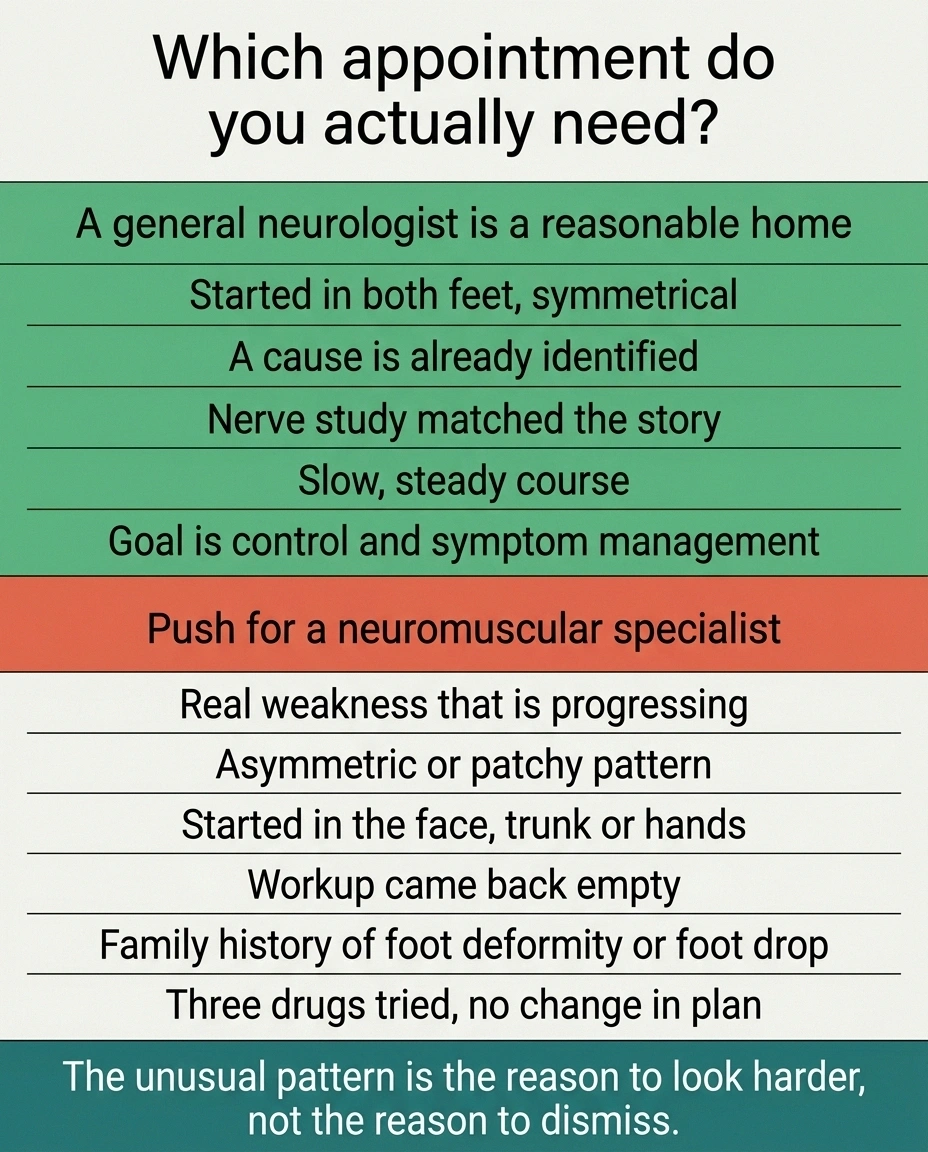
A general neurologist is a reasonable long-term home for your care when the picture is typical and stable. That looks like: symptoms that started in both feet and crept upward symmetrically, a plausible cause already identified such as diabetes or a B12 deficiency or chemotherapy, a nerve conduction study that matched the story, and a course that is slow rather than sudden. If that describes you, the useful work is controlling the metabolic drivers behind the damage and finding a tolerable symptom regimen. Neither of those requires fellowship training.
Push for the subspecialist when any of the following is true.
The weakness is real and it is moving. Numbness that spreads slowly is one thing. Losing strength over weeks is a different animal, and it moves the differential toward inflammatory and autoimmune causes where treatment exists and timing matters.
It is asymmetric or patchy. One wrist, then a foot, then the opposite thigh. That pattern does not fit the common length-dependent picture and deserves a specialist’s read.
It started somewhere other than the feet. Face, trunk, hands first. Non-length-dependent presentations point in a different direction entirely.
The workup came back empty. If a full blood panel and a nerve conduction study found nothing, that is not automatically an endpoint. Somewhere between a fifth and a third of neuropathy stays idiopathic even after a thorough evaluation, but a great deal of what gets labelled idiopathic simply had a shallow evaluation.
There is a family history. A parent with high arches, hammertoes, foot drop or lifelong clumsiness raises the question of an inherited neuropathy, and genetic testing choices are not intuitive.
Treatment is not working and nobody is changing course. Three medications tried, none helped, and the plan is to keep going. That is a signal the diagnosis deserves rechecking rather than the prescription.
The Four Places Specialists Are Actually Listed
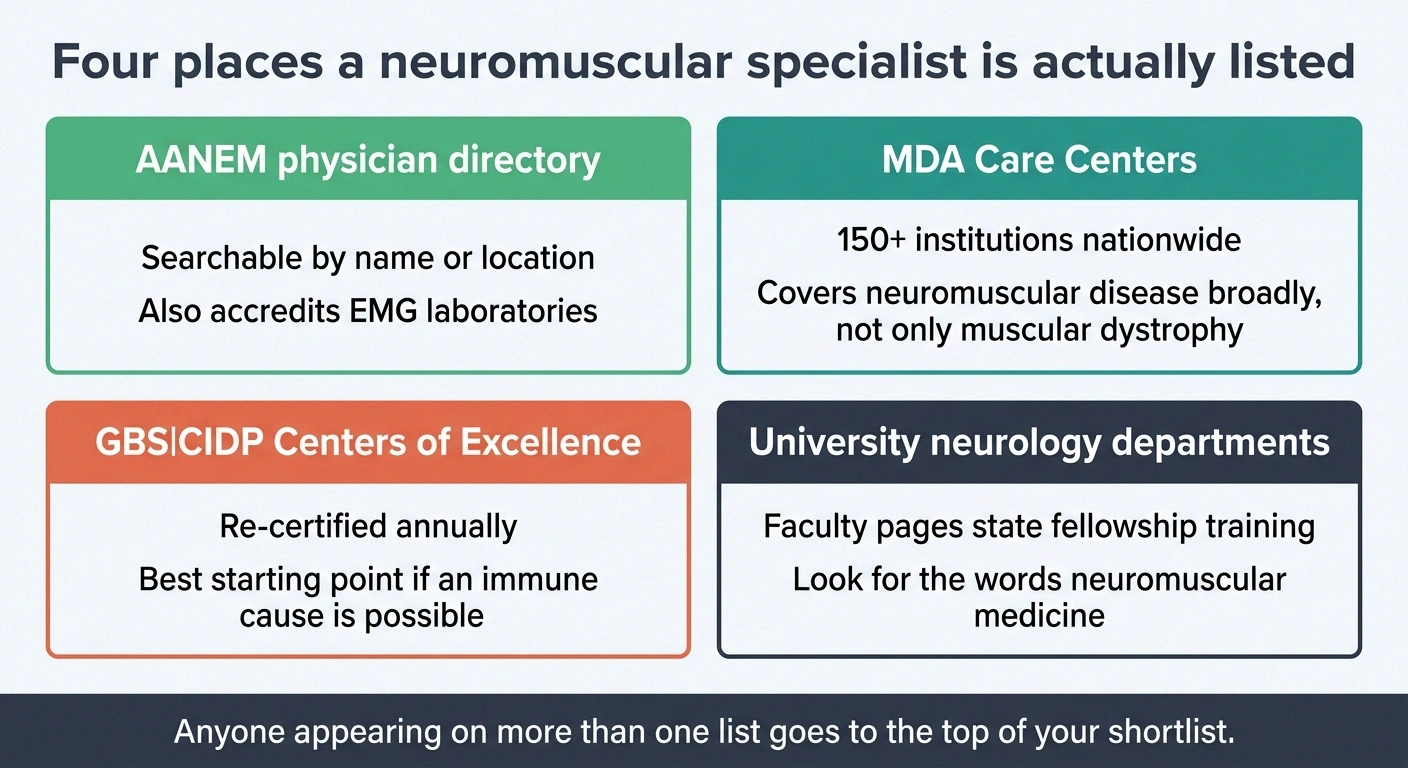
Searching your insurance directory for “neurologist” will return dozens of names with no way to tell them apart. These four sources let you filter for the specific training before you ever call an office.
Four titles you may be referred to, and the training behind each
Years shown are after medical school. The gap between the first two rows is the one that changes what gets ordered on your behalf.
- Neurologist · 4 years
- One preliminary year plus three years of neurology residency. Covers the entire nervous system, brain to toes. Manages typical neuropathy competently for years.
- Neuromuscular specialist · 5 years
- Everything above, plus roughly one fellowship year on nerve, neuromuscular junction and muscle. Usually performs their own nerve conduction and needle studies rather than reading someone else’s report.
- Physiatrist, PM&R · 4 years
- Rehabilitation medicine. Can also subspecialise in neuromuscular medicine through the same examination. Strongest on function, bracing, gait and getting you moving again.
- Pain medicine physician · 4 to 5 years
- Anaesthesia, neurology or PM&R base plus a pain fellowship. The right referral once the diagnosis is settled and the problem is control. The wrong one while the diagnosis is still open.
1. The AANEM physician directory. The American Association of Neuromuscular and Electrodiagnostic Medicine maintains a searchable list of physicians certified through its board, and it searches by name or by location. This is the most direct route from a map to a shortlist. AANEM also accredits electrodiagnostic laboratories, which is a separate and useful signal about the quality of the testing itself.
2. MDA Care Centers. The Muscular Dystrophy Association funds care centers at more than 150 institutions across the country. The name misleads people, because these centers cover neuromuscular disease broadly rather than muscular dystrophy alone, and they are staffed by exactly the physicians you are looking for. They are also multidisciplinary, meaning physical therapy, occupational therapy and orthotics sit in the same building.
3. GBS|CIDP Foundation International Centers of Excellence. The Foundation re-issues this designation annually to facilities that meet its standards for expertise, treatment availability and research in inflammatory neuropathies. If there is any chance your neuropathy is immune-mediated, this list is the highest-yield place to start. The centers carrying the seal are almost always strong on the entire neuromuscular range, not only inflammatory disease.
4. University neurology departments. Academic medical centers nearly always have a neuromuscular division, and their departmental websites list faculty by subspecialty with their fellowship training stated. Reading a faculty page tells you more in two minutes than an insurance directory tells you in an hour. Look for the phrase “neuromuscular medicine” in the fellowship line.
Checking the Credential Yourself

Board certification is public information, and this is the step that almost nobody takes.
Three phrases that look like credentials and are not
Board eligible. Means the training was completed and the examination has not been passed, or not yet taken. It is a legitimate stage early in a career and a warning sign fifteen years in. There is no expiry police, so the phrase can sit on a profile indefinitely.
Board certified in neuropathy. No such board exists. Any certificate using this wording came from a private organisation that sells it, not from a recognised certifying board.
Fellowship trained. True and unspecific. Ask which fellowship. A stroke fellowship and a neuromuscular fellowship both produce the phrase and only one of them is relevant to your feet.
Certification status is free to check by name and takes under two minutes. The point is not to disqualify anyone. It is to turn a list of interchangeable names into a ranked one.
The American Board of Psychiatry and Neurology runs a verification tool that shows whether a given physician holds ABPN certification and the current status of that certificate. Search the name. You are looking for two entries: certification in Neurology, and a separate subspecialty certification in Neuromuscular Medicine. If a physician trained through physical medicine and rehabilitation instead, the subspecialty certificate is issued by the American Board of Physical Medicine and Rehabilitation, using the same examination.
Three things worth understanding before you draw conclusions from what you find.
An excellent neuromuscular physician may have completed the fellowship without sitting the subspecialty examination, particularly if they trained before 2008 or built their expertise through years of practice. Absence of the certificate is a question to ask, not a verdict.
The reverse also holds. The certificate confirms training. It does not tell you whether the person listens, returns calls, or explains anything.
And a physician who is board certified in neurology with no neuromuscular subspecialty may still run a heavily neuromuscular practice. The faculty page or the practice description will say so.
What you are really doing with this check is converting a list of interchangeable names into a ranked one. That is enough.
Getting a Referral Your Insurance Will Accept
Most specialist appointments in the US require a referral, and most neuromuscular clinics require records before they will even schedule. Both are easier when you ask for the right thing.
What to say when the scheduler answers
Schedulers triage by what they can write in a box. Three specifics move you up the list, and all three fit in one sentence.
“I have a referral to neuromuscular neurology. My symptoms are asymmetric and my workup was unrevealing. My records are ready to send today. Can you also add me to the cancellation list?”
Why each part earns its place. Naming the subspecialty stops the referral being routed by availability. A clinical reason gets triaged; a preference does not. Records ready today removes the most common reason a booking stalls. And the cancellation list is the only lever that reliably moves an appointment forward by months.
Ask for the scheduler’s name and write it down. If the referral goes missing, and referrals do go missing, you will want it.
Ask your primary care doctor or current neurologist for a referral to neuromuscular neurology, naming the practice or the physician if you have one. A referral written to “neurology” gets routed to whoever has the nearest opening, which is exactly the outcome you are trying to avoid. Naming the subspecialty on the order is a small act with a large effect.
Give a reason the scheduler can put in a box. “My symptoms are asymmetric and my workup was unrevealing” is a reason. “I want a second opinion” is a preference, and it triages lower. If you have been through the second opinion process before, you already know how much the framing changes the response.
If your plan requires a referral and your primary care doctor is reluctant, ask for the reasoning in writing. That request alone frequently resolves the matter, and if it does not, it gives you a clean document for an appeal. Coverage rules for neuropathy care vary enormously by plan, and a denial for an out-of-network specialist is often reversible when no in-network subspecialist exists within a reasonable distance.
Ask to be put on the cancellation list at the time you book. Neuromuscular clinics have high cancellation rates because many of their patients are unwell and travelling far. People routinely move appointments forward by months this way, and it costs one sentence.
The Wait Is the Real Obstacle
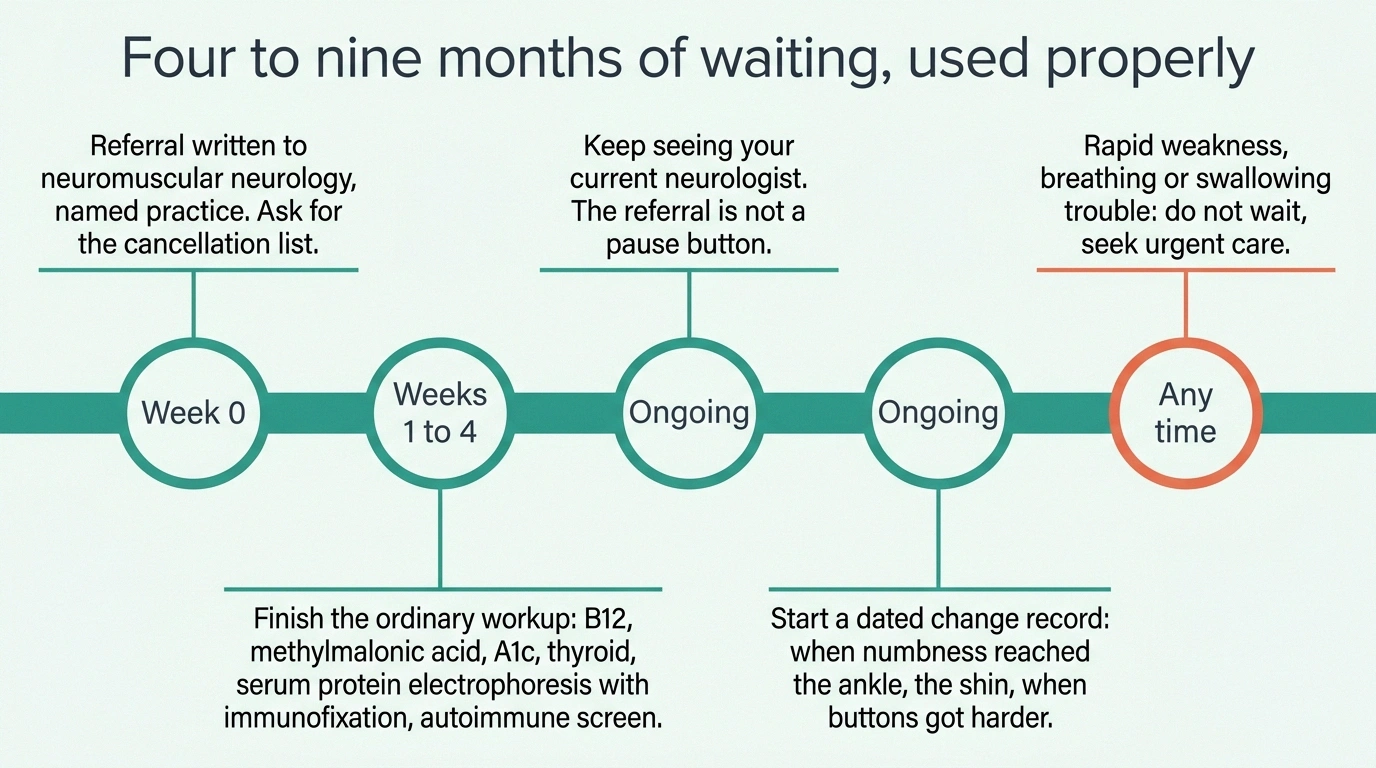
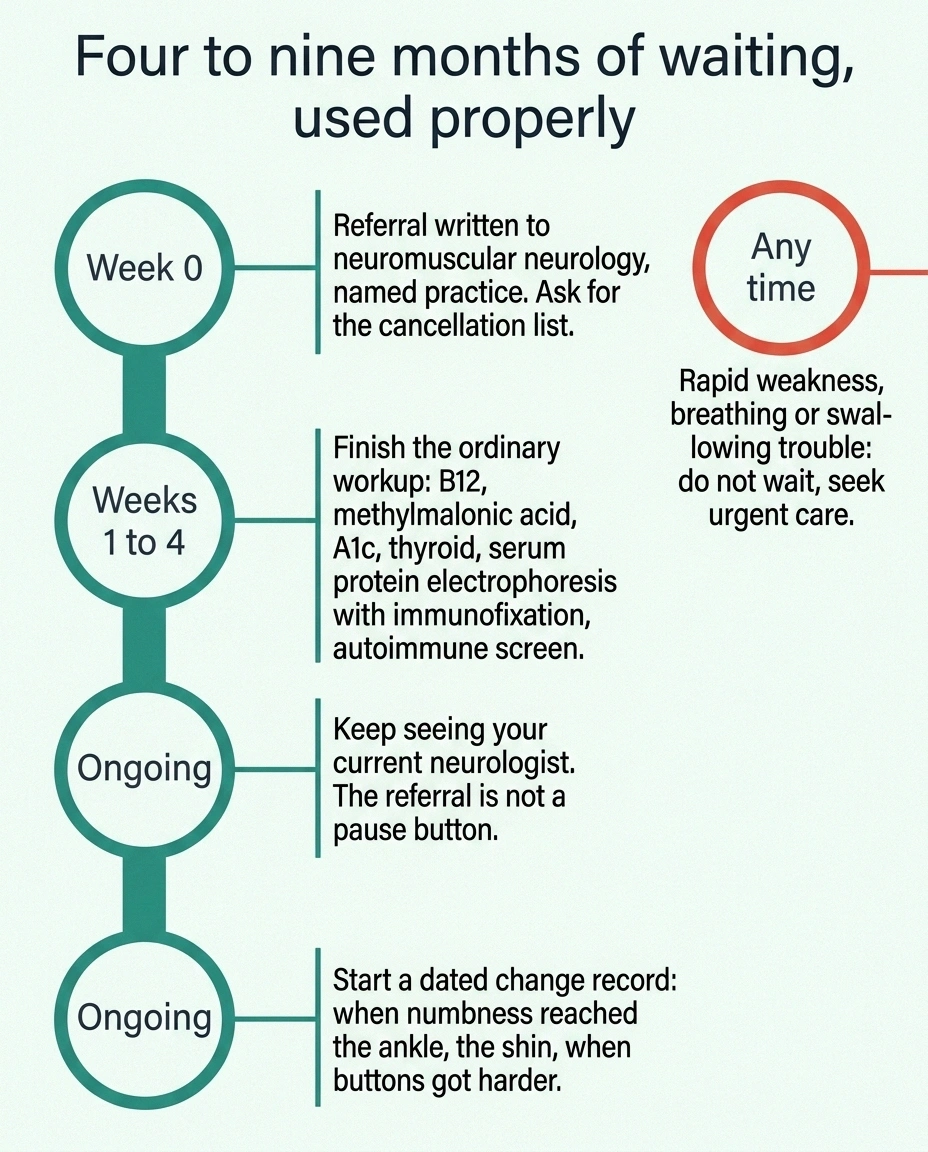
A first appointment at a busy neuromuscular clinic can be four to nine months out. That wait is the single biggest practical barrier in this entire process, and it is worth planning around rather than simply enduring.
Keep seeing your current neurologist during the wait. Do not let the referral become a reason nothing happens for half a year.
Use the interval to finish the ordinary workup. If B12, methylmalonic acid, A1c, thyroid function, serum protein electrophoresis with immunofixation and a basic autoimmune screen have not all been done, get them done now. Arriving with those complete moves the first visit from information-gathering to decision-making.
Start a dated symptom record. Not a pain diary; a change record. When did numbness reach the ankle, when did the shin, whether you have started catching a toe on stairs, whether buttons or keys have become harder. A structured record of symptom change over time is genuinely diagnostic information, and it is the one piece of evidence only you can produce.
If anything changes sharply while you wait, do not wait. Rapidly progressive weakness, difficulty breathing or swallowing, or loss of function over days rather than months belongs in urgent evaluation, not on a waiting list.
What to Send Ahead So the First Visit Counts

A specialist appointment is typically an hour, and it is easy to lose forty minutes of it reconstructing history that already exists on paper somewhere. Send the file ahead, and send the actual documents rather than summaries.
Send these five, and avoid the mistake attached to each
Every row in the last column is something that routinely costs half of a first appointment.
| Send | Why they want it | Common mistake |
|---|---|---|
| Nerve conduction and needle study | They re-interpret the values rather than accept the conclusion | Sending the summary line instead of the tables |
| Blood results | Borderline values matter and get read differently here | Reporting “normal” instead of the number and reference range |
| Medication history | Stops the visit ending with something you already failed | Listing names without doses reached or why each stopped |
| Dated symptom record | Rate of change is diagnostic and only you can supply it | Recording pain scores instead of where and when things changed |
| Family history notes | High arches, hammertoes or foot drop in a parent redirects testing | Assuming it does not count because nobody was ever diagnosed |
The nerve conduction and needle examination report, in full. Not the one-line conclusion. The tables of values are the part a neuromuscular physician wants, because they will re-interpret them rather than accept the previous reading.
Laboratory results with the numbers and the reference ranges visible. A note saying B12 was normal is much less useful than a result of 240 pg/mL, which many clinicians would consider borderline and worth pursuing with methylmalonic acid.
Any imaging reports, any biopsy results, and a complete medication list including everything you have already tried, the doses reached, and why each was stopped. That last column prevents the appointment from ending with a prescription you failed on two years ago. Preparing properly for a neurology appointment pays back more here than anywhere else in neuropathy care, because these visits are scarce.
Write your three questions down and hand the list over at the start rather than the end. Specialists generally respond well to it, and it stops the visit from closing before the thing you came for gets discussed.
Signs You Are in the Wrong Office
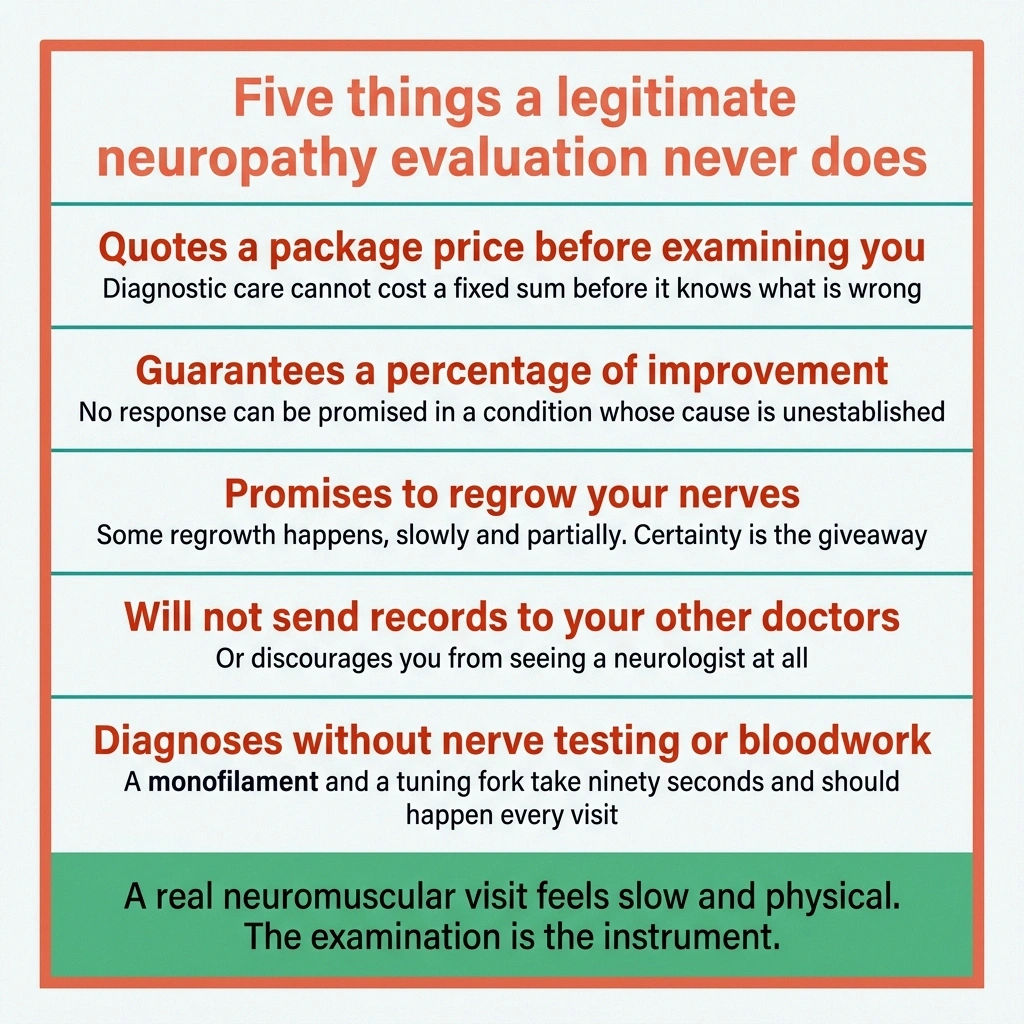
Some practices market heavily to people with neuropathy and are not what they appear to be. A few reliable warning signs, none of which require medical knowledge to spot.
A package price quoted before an examination. Legitimate diagnostic care does not know what it will cost until it knows what is wrong.
A guaranteed percentage of improvement. No one can guarantee a response in a condition whose cause has not been established.
A promise to regrow nerves. Some nerve recovery is possible in some circumstances, and it is slow, partial and unpredictable. Certainty is the giveaway.
Refusal to send records to your other physicians, or discouraging you from seeing a neurologist at all.
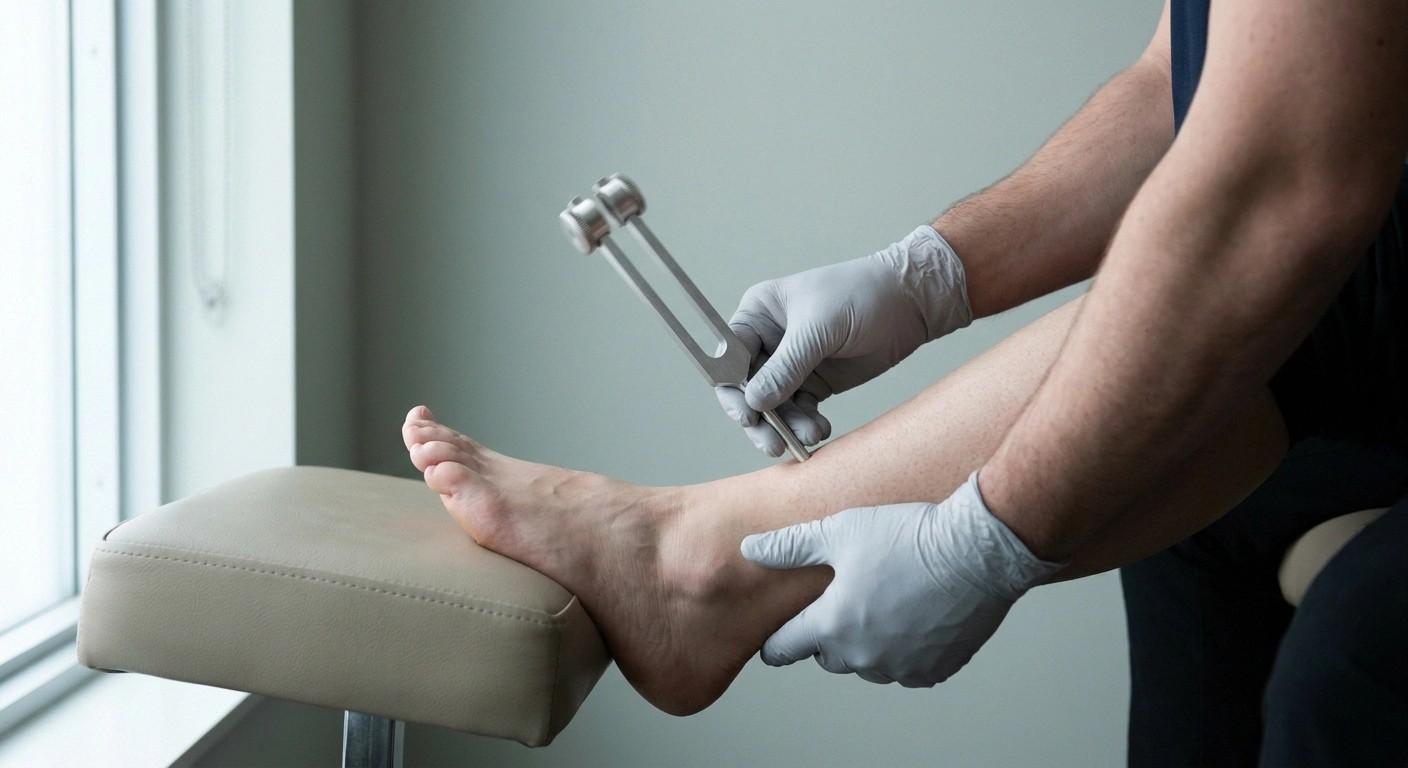
A diagnosis of neuropathy made with no nerve testing, no bloodwork and no examination of sensation. A monofilament and a tuning fork take ninety seconds and should happen at every visit.
The contrast with a real neuromuscular evaluation is stark once you have seen one. The specialist visit tends to feel slow, physical and slightly repetitive, because the examination is the instrument.
A Realistic Sequence
If you are starting from nothing, this order works.
Search the AANEM directory by your city and note the names. Cross-check each name against the MDA care center list and the GBS|CIDP Centers of Excellence list, and mark anyone appearing on more than one. Look up the survivors on the ABPN verification tool and confirm the subspecialty certificate. Read their department faculty page for a clinical interest in peripheral neuropathy specifically rather than ALS or myasthenia. Take the top two names to your primary care doctor and ask for a referral naming them. Book the earlier of the two, ask for the cancellation list, and send records the same week.
That whole sequence takes an evening. The alternative, which is accepting whichever neurologist your insurance directory lists first and hoping, is how people spend three years being told nothing more can be done by someone who was never trained to look further. Knowing that the right kind of doctor exists is most of the battle. Finding the specific person is an evening’s work.
Frequently Asked Questions
Is a neuromuscular specialist the same as a neurologist?
Not quite. Every neuromuscular specialist is a neurologist or a physical medicine and rehabilitation physician first, and then completed roughly one additional year of fellowship training focused on nerve and muscle disease. The subspecialty certification in neuromuscular medicine has been offered since 2008 through the American Board of Psychiatry and Neurology and the American Board of Physical Medicine and Rehabilitation.
How do I check whether a doctor is board certified in neuromuscular medicine?
Use the American Board of Psychiatry and Neurology verification tool, which lets you search by physician name and shows the certificates held and their status. The American Association of Neuromuscular and Electrodiagnostic Medicine also publishes a searchable directory of physicians certified through its board, searchable by name or location. Both are free and public.
Do I need a referral to see one?
Usually yes, both because most insurance plans require it and because most neuromuscular clinics ask for records before scheduling. Ask for the referral to be written specifically to neuromuscular neurology rather than to general neurology, and name the practice if you have one in mind, since referrals written broadly get routed by availability.
What if there is no neuromuscular specialist near me?
Consider a one-time consultation at the nearest academic center, with follow-up care handled locally afterward. Many neuromuscular divisions are willing to do an evaluation and send a management plan back to your local neurologist. Some record-based second opinions can also be arranged remotely, though the physical examination genuinely cannot be, since the sensory testing requires hands.
How long does the first appointment take?
Plan for a long visit. A first neuromuscular evaluation commonly runs forty-five to ninety minutes, and if electrodiagnostic testing is done the same day it can take considerably longer. Bring water, medication you take on a schedule, and something to sit on if standing in a waiting area is difficult.
Will a specialist find a cause when my other doctors could not?
Sometimes, and it is worth being realistic about how often. A meaningful share of neuropathy remains without an identified cause even after a thorough specialist evaluation. What changes more reliably is the confidence of the answer. There is a real difference between idiopathic after a full evaluation and idiopathic after a blood test and a shrug, including for treatment decisions and for disability documentation.
Is a pain specialist an alternative?
They serve a different purpose. Pain medicine physicians manage symptoms, sometimes very effectively, and are the right referral when the diagnosis is settled and the problem is pain control. They are not the right referral when the diagnosis itself is uncertain or when weakness is progressing. Many people end up seeing both.
About the Author