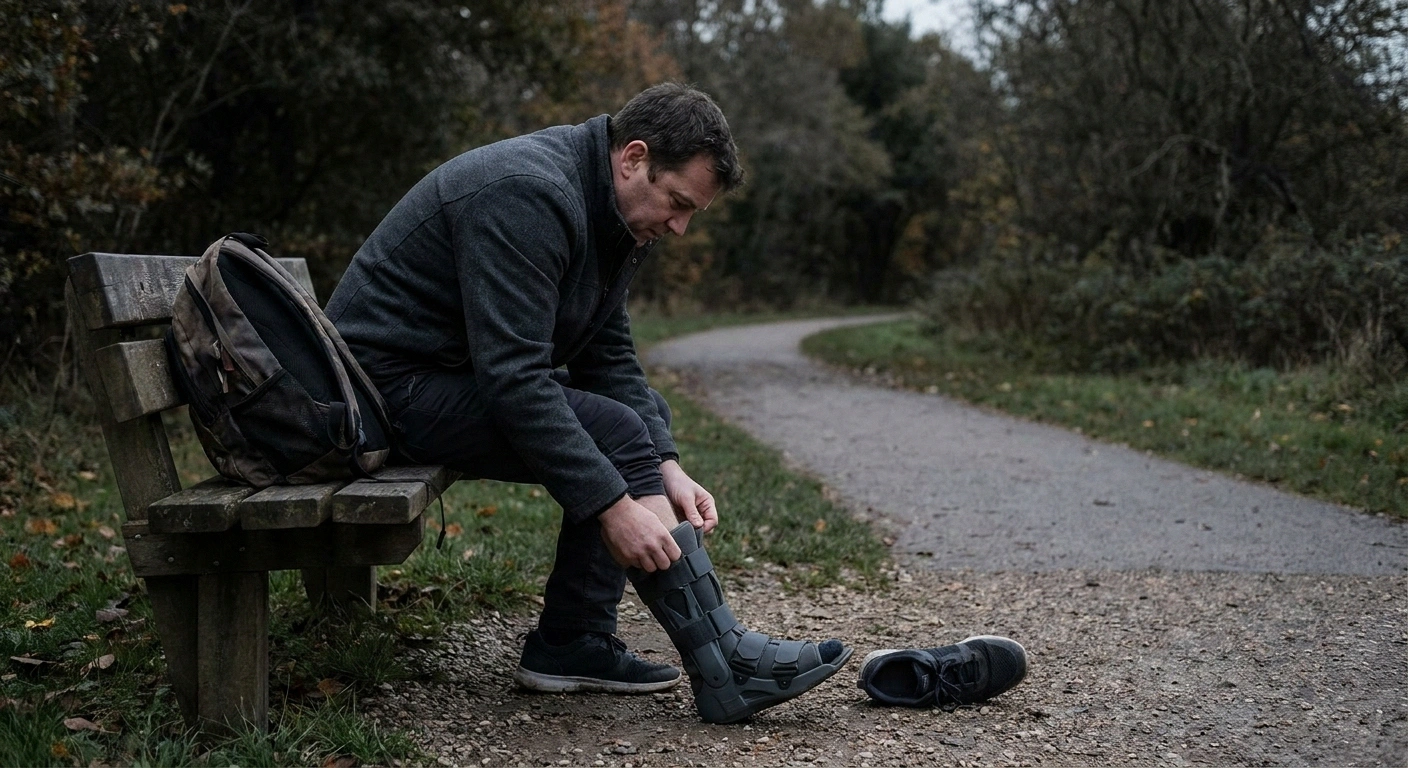
Here is a fact I still find hard to sit with. Charcot-Marie-Tooth disease was described in 1886. It affects roughly one in 2,500 people, which makes it the most common inherited nerve disorder there is. And in the 140 years since, the number of treatments approved to slow it down, stop it, or reverse it has been zero.
Not “few options.” Not “limited options.” None. Braces, physical therapy, surgery on the deformities it causes, painkillers for what hurts — everything on the list manages consequences. Nothing touches the disease.
That’s the empty space a drug called govorestat is trying to fill, for one specific subtype. It won’t help most people with CMT and it certainly won’t help most people reading this site. But it’s the closest anyone has come, and how it works turns out to matter well beyond the small group it was built for.
A Sugar Your Nerves Cannot Take Out
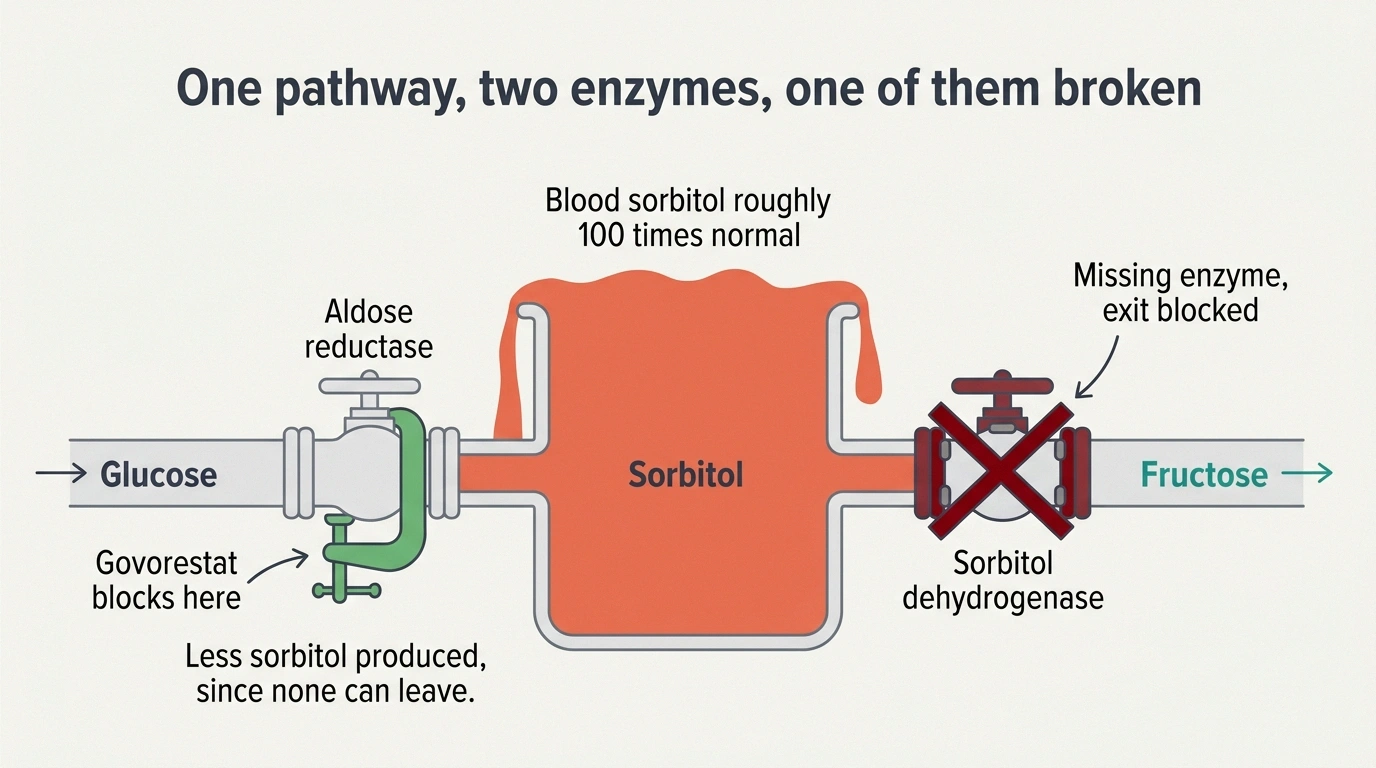
Your cells have a side door for glucose. When blood sugar runs high and the main processing route is saturated, an enzyme called aldose reductase converts the excess glucose into sorbitol.
Glucose enters the side route and aldose reductase converts it to sorbitol. Sorbitol dehydrogenase then converts sorbitol to fructose so it can leave. In SORD deficiency the second enzyme does not work, and sorbitol cannot easily cross cell membranes on its own, so it stays where it was made.
The scale of the backlog is the part that surprises people. Blood sorbitol in SORD deficiency runs roughly 100 times the normal level. This is not a marginal metabolic drift; it is a pathway with the exit welded shut.
Because both copies of the gene must be affected, parents are usually unaffected carriers, which is why so many people with this condition have no family history to report.
Sorbitol is a problem molecule. It doesn’t cross cell membranes easily, so once it’s made inside a nerve cell it tends to stay there. The normal fix is a second enzyme, sorbitol dehydrogenase, which converts sorbitol into fructose so it can be used or cleared. Two enzymes, one in, one out, and the pathway stays balanced.
SORD deficiency breaks the second step. The SORD gene that makes sorbitol dehydrogenase carries mutations on both copies, the exit enzyme doesn’t work, and sorbitol accumulates inside peripheral nerves at levels many times normal. People with this condition run blood sorbitol roughly a hundred times higher than everyone else.
The nerves degenerate. Symptoms usually begin in the teens or twenties with weakness and wasting in the feet and lower legs, high arches or hammertoes, foot drop, difficulty running, and progressive loss of function upward over decades. It presents as a classic Charcot-Marie-Tooth picture, which is exactly how it’s classified: CMT-SORD.
Because it’s recessive, both parents carry a broken copy without symptoms, which means it frequently appears in families with no known history of nerve disease. A great many people with CMT-SORD have therefore been told at some point that their neuropathy is idiopathic.
The Gene With a Nearly Identical Twin
SORD deficiency wasn’t identified as a cause of CMT until 2020, which is startlingly recent for something now believed to be among the more common recessive forms. The reason it hid so long is a technical one worth understanding, because it explains why an old negative genetic test doesn’t settle anything.
SORD sits beside a pseudogene, SORD2P, that matches it at roughly 96%. Short-read sequencing reassembles DNA by matching overlapping fragments, and at that level of similarity fragments from the two regions are routinely confused. Many panels therefore skipped SORD or reported it unreliably.
SORD was not identified as a cause of Charcot-Marie-Tooth until 2020, which is why this is not a criticism of anyone’s earlier testing. It is a reason to ask what the test actually looked at.
The specific question worth asking: did my panel assess SORD using a method that can distinguish it from the SORD2P pseudogene? A negative result from a panel that never read the gene is not a negative result.
Sitting next to the SORD gene in the genome is SORD2P, a pseudogene — a near-copy of SORD that doesn’t produce a working enzyme. The two sequences are about 96% identical.
Standard genetic testing reads DNA in short fragments and then reassembles them by matching overlaps. When two stretches of the genome are 96% identical, short fragments from one are constantly mistaken for fragments from the other. The practical result was that many gene panels either skipped SORD entirely or reported it unreliably.
So the situation for years was this: a reasonably common cause of hereditary neuropathy sat inside a region that routine sequencing couldn’t read straight. Newer testing handles it with methods designed specifically for the SORD/SORD2P confusion, but plenty of people were tested before those existed.
If you had a CMT panel more than about five years ago and it came back negative, that result did not rule out SORD deficiency. It may never have looked.
Blocking the Entrance Instead of Fixing the Exit
You can’t easily repair a broken exit enzyme. But you can turn down the tap feeding the room.
That’s govorestat’s entire logic. Also known as AT-007, it’s an oral once-daily aldose reductase inhibitor — it blocks the first enzyme, the one converting glucose into sorbitol. Less sorbitol goes in, and since the exit is broken either way, less accumulates.
The design detail that separates it from its ancestors is that govorestat crosses into the central nervous system. Earlier aldose reductase inhibitors largely didn’t, which limited where they could act.
And there is a longer history here that anyone considering this drug should know. Aldose reductase inhibitors were tried extensively in diabetic neuropathy starting in the 1980s, on the same reasoning: high glucose drives sorbitol, sorbitol damages nerves, block the enzyme. Most of those trials disappointed. Several drugs were abandoned for toxicity, and only one, epalrestat, is approved anywhere, in Japan.
Why should this attempt go differently? Because the target is different in kind. In diabetes, the sorbitol pathway is one contributor among many to a disease that also involves damaged blood vessels, oxidative stress, and inflammation. In SORD deficiency it is the single defect — one broken enzyme, one accumulating molecule, one obvious thing to block. A mechanism that’s a modest lever in a complicated disease can be the whole lever in a simple one.
Fifty-Six People

The trial is called INSPIRE. It’s a Phase 2/3 double-blind, placebo-controlled registrational study of once-daily oral govorestat in 56 patients aged 16 to 55, across the United States and Europe.
Fifty-six. Hold onto that number while reading anything else about this drug, because it governs what the results can carry. In a disease affecting a few thousand people worldwide, 56 is a real achievement of recruitment. It is also a group small enough that a handful of participants doing unusually well or badly moves the whole result.
What was reported: the 12-month interim analysis was positive, with sorbitol reduced and improvement across clinical and patient-reported outcomes. At 18 and 24 months the company reported slowed disease progression on MRI along with continued improvement on key clinical measures. Those longer results were presented at the Peripheral Nerve Society’s 2025 meeting.
What an MRI Can and Cannot Tell You
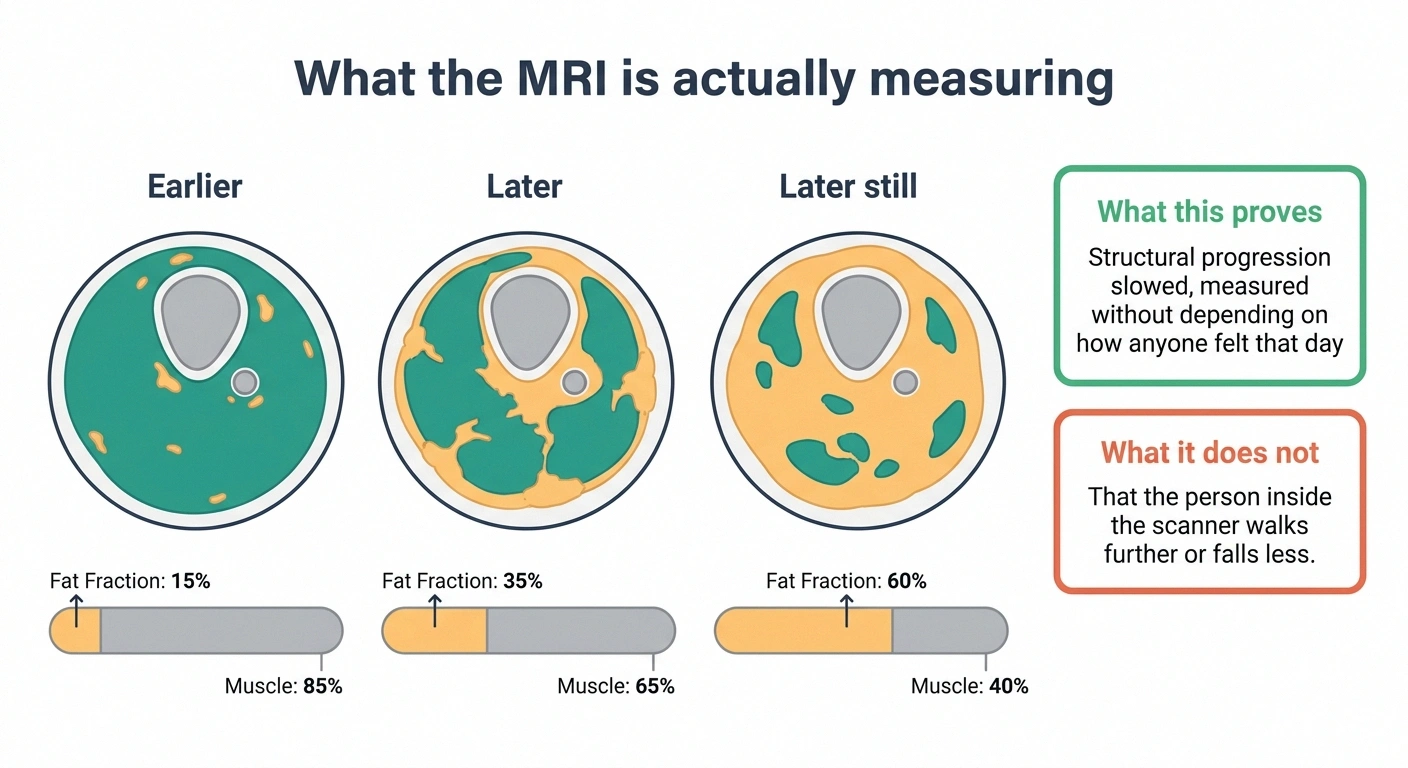
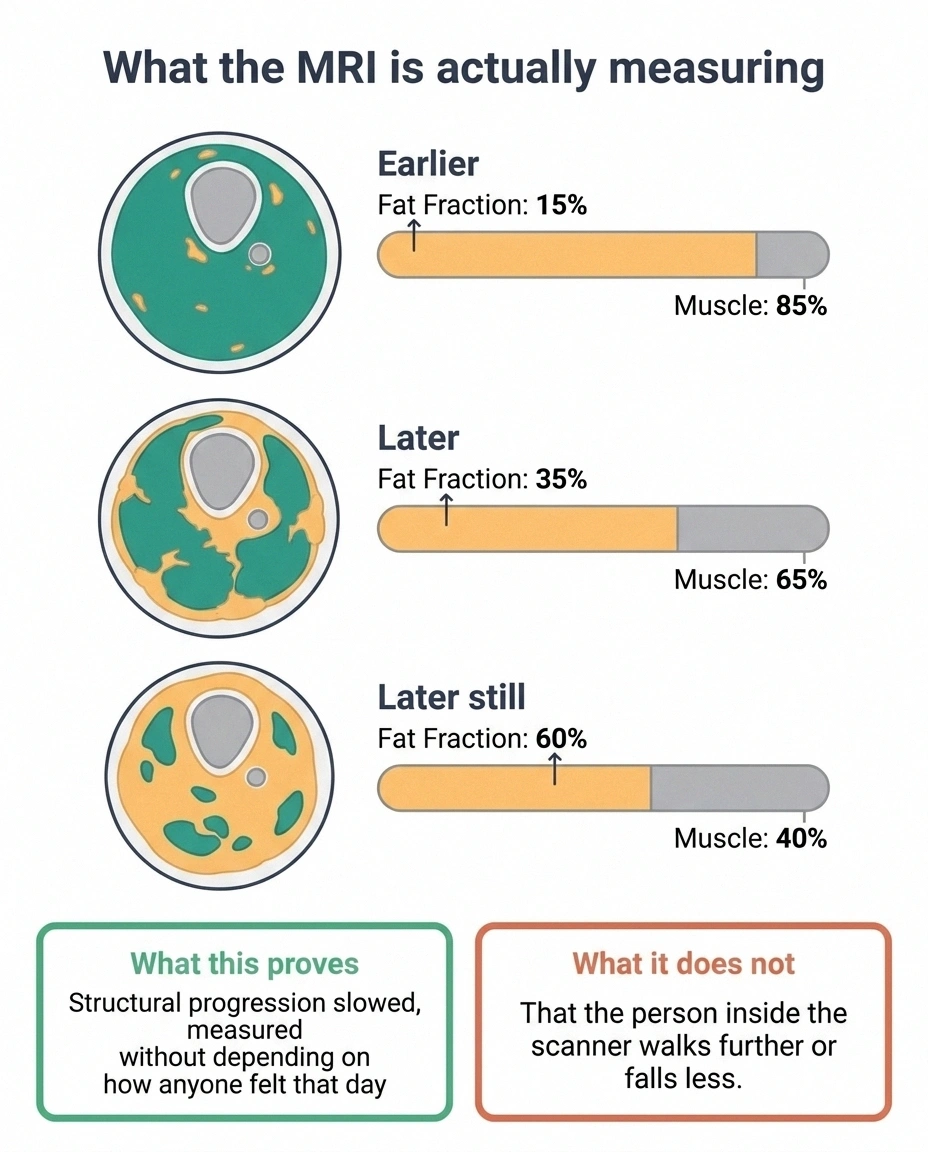
The MRI finding deserves a closer look, because it’s both the most sophisticated result in the program and the easiest to over-read.
| Measurement | What it establishes | What it does not |
|---|---|---|
| Sorbitol level | The drug reaches its target and does what it was designed to do | That lowering it changes the disease |
| MRI muscle fat | Objective, observer-independent evidence that structural progression slowed | That daily function improved for the person inside the scanner |
| Clinical and reported outcomes | The measure closest to what patients actually care about | Immunity to expectation effects, especially unblinded and with 56 participants |
The chain runs mechanism to biomarker to imaging to function, and it holds together. The final link carries the least weight, which is the ordinary situation for a registrational trial in a disease this rare.
When a motor nerve dies, the muscle it served wastes and is gradually replaced by fat. MRI measures that fat replacement well, and it does so on a timescale where you can see change over a year or two. That makes it a far better progression marker than asking someone whether they feel worse, which is noisy, or timed walking tests, which bounce around with sleep, mood, and the weather.
So “slowed progression on MRI” means something concrete: less muscle was lost to fat than expected. In a relentlessly progressive disease with no treatment at all, slowing is the realistic goal, and demonstrating it objectively is genuinely good work.
What it isn’t is proof that people function better. Sorbitol dropping shows the drug hits its target. MRI slowing shows the target matters. Neither one is the same as walking further, falling less, or keeping a job. The clinical and patient-reported measures point the right way, but in an unblinded extension with 56 participants, those are the measures most vulnerable to expectation.
The honest summary is a coherent chain of evidence from mechanism to biomarker to imaging, with the final link — how much daily life changes, and for how long — still the thinnest.
The Regulatory Picture Is Genuinely Unresolved
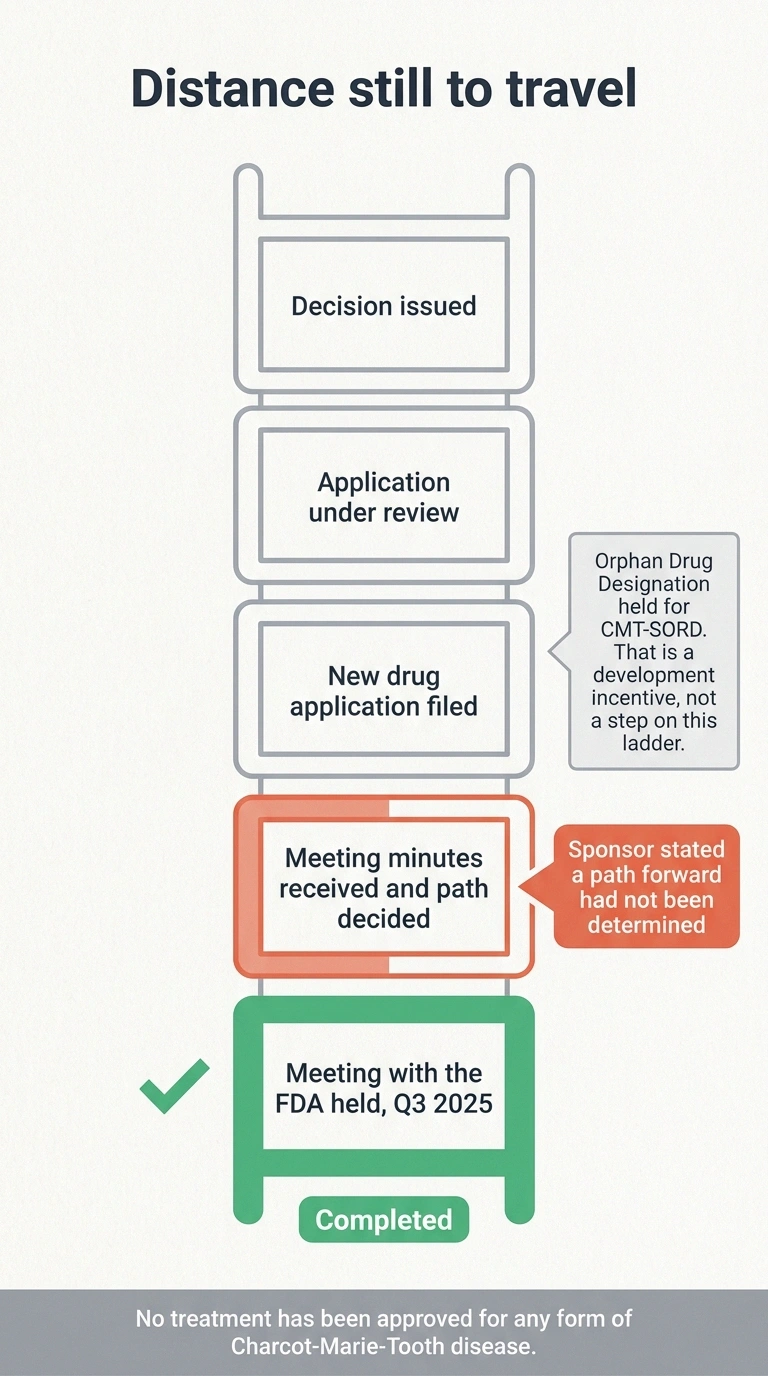
This is where reporting on govorestat gets loose, so here is the sequence exactly.
Applied Therapeutics completed a meeting with the FDA in the third quarter of 2025 to discuss a potential new drug application for govorestat in CMT-SORD. Afterward, the company said it was awaiting the official meeting minutes and that a path forward had not been determined, including whether an accelerated approval route applies.
Read that plainly. It isn’t “approval expected.” It isn’t even “application filed.” It’s a company that had a conversation with the regulator and hasn’t yet said publicly what the regulator told it.
Govorestat does hold Orphan Drug Designation for CMT-SORD, which brings development incentives and market exclusivity if approved. Worth having, and not a statement about the likelihood of approval.
The Letter That Belongs in This Story
There’s one more piece of history, and leaving it out would be the kind of omission that makes a reader feel misled later.
In November 2024 the FDA issued a Complete Response Letter for govorestat in classic galactosemia — a different rare disease the same molecule was being developed for. A Complete Response Letter means the application cannot be approved in its present form.
That doesn’t transfer to CMT-SORD. Different disease, different trial, different endpoints, and each application is judged on its own evidence. What it does establish is that this drug has already been through an FDA review that ended in rejection, and that the agency has previously found the sponsor’s evidence package insufficient in a rare disease with unmet need.
People desperate for something to work tend to read regulatory silence as good news. It usually isn’t news at all. Given the 2024 letter, patience is the right posture here.
Should You Ask About SORD Testing?

Most people reading this have adult-onset neuropathy from diabetes, chemotherapy, or no identified cause, and CMT-SORD is not a plausible explanation for that picture. But some readers do fit, and the testing question is the one part of this article that could change someone’s life this year.
- Onset before about age 30
- Acquired neuropathies overwhelmingly arrive later. Early onset is the strongest single pointer toward an inherited cause.
- Weakness leading, not numbness
- Tripping, foot drop, ankles that give way. Length-dependent neuropathies usually lead with sensory loss instead.
- Structural foot shape
- High arches, hammertoes, curled toes. These develop over years of imbalanced muscle pull and point to a long-standing motor problem.
- An affected sibling with unaffected parents
- The signature pattern of a recessive condition, and the one most often dismissed as coincidence.
- A negative gene panel from before roughly 2021
- The quiet trap. Blood sorbitol can also be measured, and in SORD deficiency it is dramatically elevated rather than borderline, which makes it a useful confirmatory check.
Worth raising with a neurologist if several of these apply:
Symptoms began before roughly age 30. Weakness is as prominent as numbness, or more so — trouble lifting the foot, tripping, ankles that give way. Your feet have a structural shape to them, high arches or hammertoes or curled toes. A sibling has something similar, even if your parents don’t. Your neuropathy has been called idiopathic despite a thorough workup. Or you had genetic testing before about 2021 and it was negative.
That last one is the quiet trap. A negative CMT panel from 2018 tested for what could be tested in 2018, and SORD was largely invisible to those methods. Asking whether your panel specifically covered SORD, with a method able to distinguish it from SORD2P, is a reasonable question and costs nothing to ask.
The diagnostic tools here are the standard ones — nerve conduction studies to establish the pattern, then targeted genetic testing. Blood sorbitol can also be measured, and in SORD deficiency it is dramatically elevated rather than borderline.
Two reasons this matters even without an approved drug. A confirmed genetic diagnosis ends the search, which for people who’ve spent years cycling through diagnostic testing is worth a great deal on its own. And a confirmed diagnosis is the entry ticket to trials, which is currently the only way anyone gets this medication.
What the Rest of Us Take From It

If you don’t have SORD deficiency, this drug will not help you. I’d rather say that than let anyone build a hope on it.
What it does demonstrate is transferable. For most of the last century, nerve degeneration was treated as one-directional and untouchable: you managed symptoms and hoped for a slow decline. Govorestat’s results suggest that when you understand precisely which molecular step is broken, you can sometimes intervene upstream and change the trajectory — not repair the damage already done, but slow what’s coming.
That principle is showing up elsewhere. Gene therapy approaches are being tested for pain in other neuropathies, and the broader 2026 drug pipeline is noticeably more mechanism-specific than anything before it. The era of “here’s a painkiller, good luck” is ending, slowly, one subtype at a time.
CMT-SORD is going first partly because it’s simple. One gene, one enzyme, one molecule to block. The complicated diseases will take longer, and there’s no promise attached to that. But the direction is right, and after 140 years of nothing, direction counts.
Frequently Asked Questions
Is govorestat approved for CMT-SORD?
No. As of September 2026 govorestat is not approved for CMT-SORD anywhere. Applied Therapeutics completed an FDA meeting in the third quarter of 2025 to discuss a potential new drug application and afterward stated it was awaiting official meeting minutes, with the path forward not determined. It holds Orphan Drug Designation for CMT-SORD, which is a development incentive rather than an indication of approval.
What is SORD deficiency?
An inherited condition caused by mutations in both copies of the SORD gene, which makes the enzyme sorbitol dehydrogenase. Without it, sorbitol cannot be converted to fructose and builds up inside peripheral nerves, where it is toxic. Blood sorbitol runs roughly a hundred times normal. The result is a progressive motor-sensory neuropathy classified as a form of Charcot-Marie-Tooth disease, usually starting in the teens or twenties.
Why do older genetic tests miss SORD?
The SORD gene has a nearly identical pseudogene called SORD2P sitting beside it, about 96% the same sequence. Standard short-read sequencing assembles DNA by matching overlapping fragments, and fragments from these two regions are easily confused, so many panels either omitted SORD or reported it unreliably. SORD was only identified as a CMT cause in 2020. A negative panel from before roughly 2021 may never have assessed it.
How does govorestat work?
It blocks aldose reductase, the enzyme that converts glucose into sorbitol. Since the exit enzyme is broken in SORD deficiency, reducing how much sorbitol is produced is the way to limit accumulation. Govorestat is taken orally once daily and is designed to penetrate the central nervous system, which earlier aldose reductase inhibitors largely did not.
What did the INSPIRE trial show?
INSPIRE is a Phase 2/3 placebo-controlled study in 56 patients aged 16 to 55. The 12-month interim analysis was positive, showing sorbitol reduction with improvement in clinical and patient-reported outcomes. At 18 and 24 months the sponsor reported slowed disease progression on MRI, which measures fat replacement of muscle, along with continued clinical improvement. With 56 participants, these results establish direction rather than precise magnitude.
Could govorestat help diabetic neuropathy?
There is no trial supporting that use. Aldose reductase inhibitors were tested extensively in diabetic neuropathy from the 1980s onward with mostly disappointing results, and only epalrestat is approved anywhere, in Japan. The sorbitol pathway is one contributor among several in diabetes, alongside vascular damage, oxidative stress, and inflammation. In SORD deficiency it is the entire defect, which is why the same mechanism may perform very differently.
What was the 2024 Complete Response Letter about?
In November 2024 the FDA issued a Complete Response Letter for govorestat in classic galactosemia, a separate rare disease the same molecule was developed for. It means that application could not be approved as submitted. It does not directly determine the CMT-SORD outcome, since applications are judged separately, but it is relevant history when weighing how likely and how quick approval might be.
How would someone get govorestat today?
Only through a clinical trial, and enrollment requires a confirmed genetic diagnosis of SORD deficiency. The practical first step for anyone who suspects they fit the picture is genetic testing that specifically covers SORD using a method able to distinguish it from the SORD2P pseudogene. Advocacy organizations for Charcot-Marie-Tooth disease maintain current information on which studies are recruiting.
About the Author