
Most of what I write about here moves in years. Diabetic nerve damage takes a decade to declare itself. Chemotherapy neuropathy fades or doesn’t over eighteen months. You measure progress in seasons.
Guillain-Barré syndrome is not like that. It moves in days. Someone notices weakness in their feet on a Monday, can’t climb the stairs by Wednesday, and is in an intensive care unit by Saturday. The nerve damage that will determine how well that person walks two years from now is happening inside that first week, while everyone is still trying to figure out what’s wrong.
That timeline is the reason a drug called tanruprubart is worth understanding. It isn’t a better version of what we already have. It’s an attempt to do something the current treatments can’t do — interrupt the damage while it’s still being done, rather than help the body clean up afterward.
It is not approved. Not in the United States, not in Europe, not anywhere. I want that on the table in the first thirty seconds, because a lot of what’s written about this drug reads like an announcement and it isn’t one yet. What follows is where it actually stands, what the trials showed, and what they didn’t ask.
The Damage Happens on a Clock
Guillain-Barré syndrome starts when the immune system misidentifies part of a peripheral nerve as a threat. Usually this follows an infection: a stomach bug, a respiratory virus, sometimes a vaccine — though that last one is far rarer than internet arguments suggest. The immune system builds antibodies against the invader, those antibodies happen to fit a molecule on the surface of your nerves, and they attack.
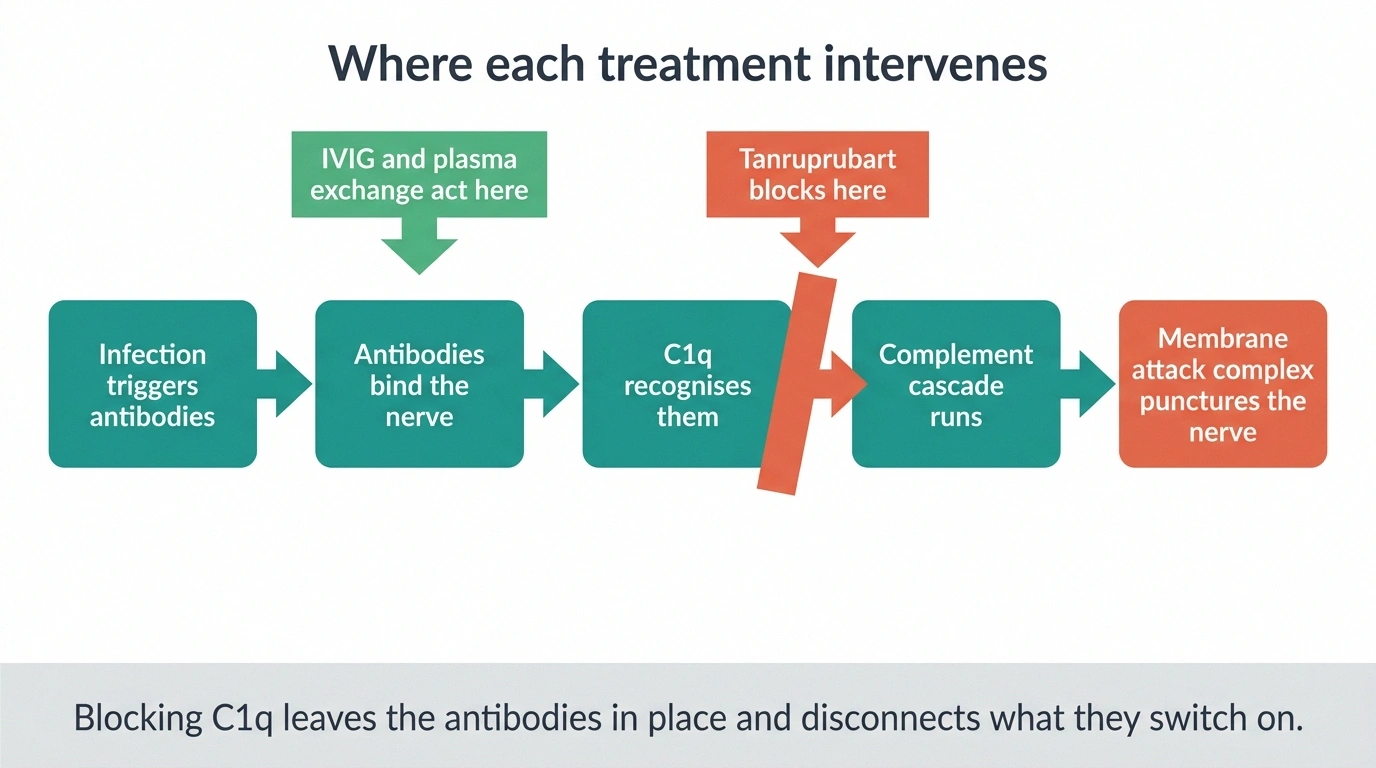
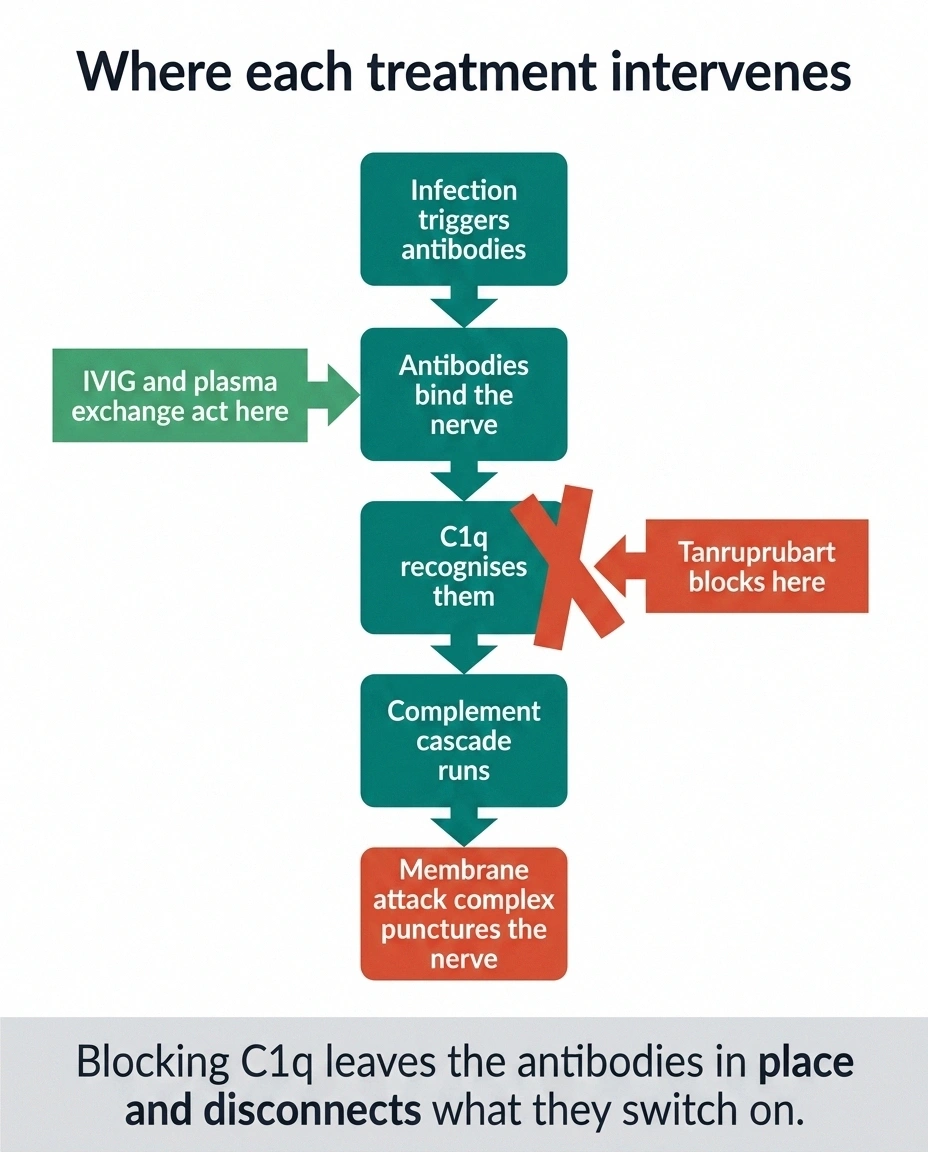
Antibodies alone don’t do much. They’re flags. What actually destroys the nerve is what the flags summon, and in Guillain-Barré that summons is the complement system.
Complement is a chain of about thirty blood proteins that sit in an inactive state until something triggers the first one. Once that first domino falls, the rest fall in sequence, and the end of the sequence is a structure called the membrane attack complex that punches physical holes in whatever the chain was pointed at. It’s a demolition tool. In Guillain-Barré, it’s pointed at either the myelin insulation around your nerve fibers or, in more severe forms, the nerve fiber itself.
That distinction matters more than almost anything else in the disease. Damage to myelin can be repaired reasonably quickly, because the cells that make myelin survive and rebuild. Damage to the axon — the actual living cable — regrows at roughly a millimeter a day from wherever the injury was. If the injury was at your hip and the target is your toes, the arithmetic is brutal — a meter of cable at a millimeter a day. This is the same demyelinating versus axonal distinction that shapes recovery in every nerve disease, and in Guillain-Barré it gets decided inside about two weeks.
So the clock isn’t a metaphor. Every day the complement cascade keeps running is a day the injury creeps closer to the axon, and every millimeter of axon lost is a day of regrowth added to a recovery that already takes a year or more.
Why IVIG and Plasma Exchange Are Blunt Instruments

The two standard treatments have both been in use since the 1980s, and both work by going after the antibodies rather than the demolition crew they summon.
| Plasma exchange | IVIG | Tanruprubart | |
|---|---|---|---|
| What it acts on | Removes antibodies, plus most else dissolved in plasma | Adds donor antibodies to outcompete yours | Blocks C1q, the first step of the complement cascade |
| Delivery | Repeated sessions, large-bore vascular access | Infusion over roughly five days | One infusion, 30 mg/kg |
| In use since | 1980s | 1980s | Not approved anywhere |
The first two aim at the accusation. The third aims at the weapon. That is the only real distinction between them, and it is the reason speed differs.
Plasma exchange is mechanical. Your blood is routed through a machine, the plasma is separated off and discarded along with everything dissolved in it, and replacement fluid goes back in. It removes the harmful antibodies. It also removes the useful ones — plus clotting factors and a good deal else — which is why it requires large-bore vascular access and careful monitoring.
IVIG takes the opposite approach: instead of removing your antibodies, it floods you with pooled antibodies from thousands of donors. Exactly why that helps is still debated. The leading explanations involve the donated antibodies outcompeting yours for the receptors that keep antibodies alive, and interfering with complement activation along the way. It works, but it works indirectly and it takes five days to infuse.
Both treatments have the same structural weakness. They aim at the trigger, not the weapon. By the time someone is sick enough to be diagnosed, the antibodies have already recruited complement, and removing or diluting those antibodies doesn’t call off an attack that’s already underway. Both also take days to work, which is exactly the window in which the axonal damage gets done.
And there’s a plainer problem. Neither is dramatically better than the other, neither shortens the disease as much as anyone would like, and roughly a third to a half of people treated with them still can’t walk unaided six months later. This is a field that has not had a genuinely new option in forty years.
What Tanruprubart Blocks
Tanruprubart, developed by Annexon Biosciences and known through most of its trial history as ANX005, is a monoclonal antibody aimed at a single protein: C1q.
C1q is the first domino. It’s the sensor that recognizes an antibody stuck to a target and starts the classical complement cascade. Block C1q and the cascade never begins, which means the membrane attack complex never assembles and the nerve never gets punctured, even though the misdirected antibodies are still sitting there.
That’s a meaningfully different design philosophy from IVIG. IVIG says: let’s get rid of the accusers. Tanruprubart says: let the accusers stand there, but disconnect the machine they were going to switch on.
Two practical consequences follow. The first is speed. It’s given as a single intravenous infusion at 30 mg/kg, and because it works by physically binding C1q that’s already in your bloodstream, the block is essentially immediate rather than accumulating over days. The second is precision. Only the classical complement pathway runs through C1q — the other arms of complement immunity remain available.
Precision is not the same as safety, and I’ll come back to that. But the mechanism is clean, and it is the first treatment for this disease designed around what actually destroys the nerve rather than what points at it.
The Phase 3 Result, and What 31 Days Actually Buys
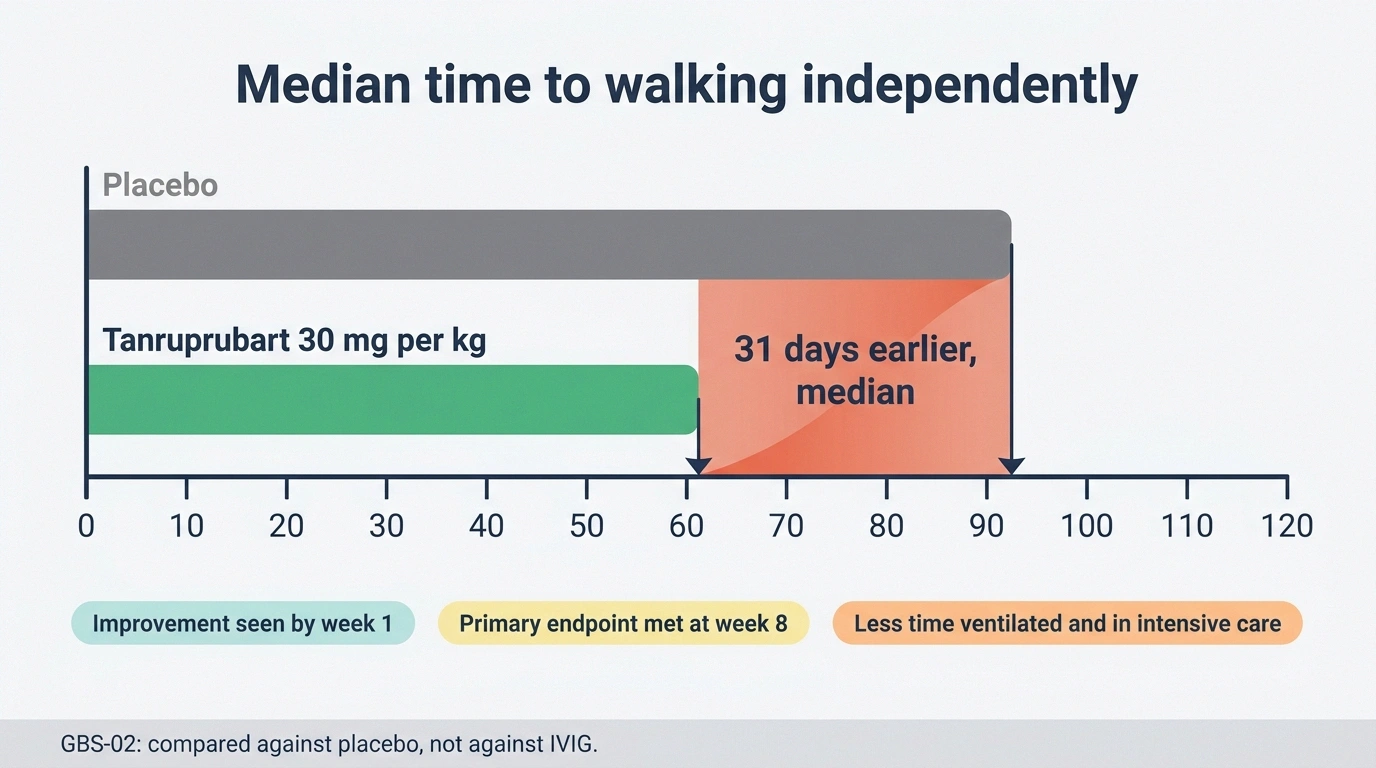
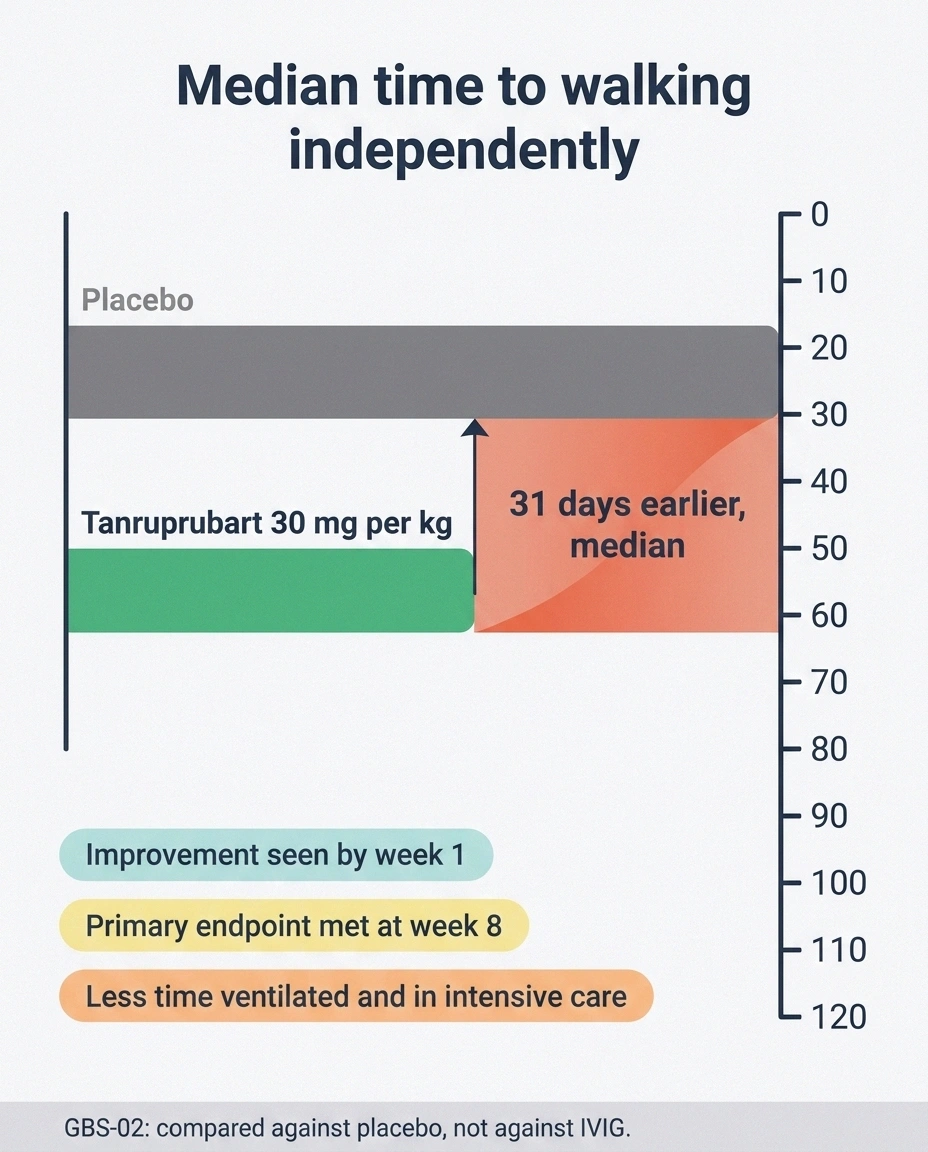
The pivotal trial was called GBS-02. Patients received either a single infusion of tanruprubart or placebo, and the primary measurement was disability at week eight on the Guillain-Barré disability scale, a seven-point scale where the difference between a 2 and a 3 is the difference between walking across a room by yourself and needing someone’s arm.
The primary endpoint was disability at week eight on a seven-point scale, where the gap between a 2 and a 3 is the gap between crossing a room alone and needing someone’s arm. The 31-day figure is a median, meaning half the treated group reached independent walking even sooner.
What sits inside those 31 days: continued muscle wasting that must later be rebuilt, ongoing pressure-sore and clot risk, inpatient or rehab billing, and someone else’s unpaid leave. Ventilator and ICU days also fell, and those are where both the cost and the mortality of this disease concentrate.
Roughly 30% of treated patients had an infusion-related reaction, mostly transient rashes. Unremarkable for an intravenous antibody, and the reason these infusions are given under observation.
The 30 mg/kg dose met that endpoint. Improvement showed up by week one, which in a disease where most people are still getting worse at week one is the part that made neurologists sit up. About nine in ten treated patients had clinically meaningful improvement by day eight.
The number that gets quoted most, though, is this one: treated patients walked independently a median of 31 days earlier than the placebo group.
A month is easy to skim past. It is not a small thing when you unpack what a month of not walking contains. It’s a month of hospital or rehab billing. It’s a month of muscle wasting that then has to be rebuilt, a month of pressure-sore and blood-clot risk, a month of someone taking unpaid leave to help you to the bathroom. Treated patients also spent less time on mechanical ventilation and less time in intensive care — and ventilator days are where both the cost and the danger of this disease concentrate.
On safety, the trial reported no new signals. Most adverse events were mild to moderate. About 30% of patients had an infusion-related reaction, mostly transient rashes, which is unremarkable for an intravenous antibody but is not nothing, and it’s the reason these infusions happen with monitoring.
What GBS-02 Did Not Test
Here is the caveat that most coverage of this drug leaves in a footnote, and it deserves better placement than that.
Answered: does tanruprubart beat no active treatment? Yes, in a trial run largely where supportive care is the standard, which is what made a placebo arm ethical there.
Not answered: does it beat what a US or European hospital would give you today? No trial has compared it head to head against IVIG or plasma exchange.
A second wrinkle: axonal variants of Guillain-Barre are more common in parts of Asia than in North America and Europe, so the variant mix in the pivotal trial differs from the one most readers of this page would fall into.
The pivotal trial compared tanruprubart to placebo. It did not compare tanruprubart to IVIG or to plasma exchange. That was possible because the trial was conducted largely in Bangladesh, where IVIG and plasma exchange are not routinely available and supportive care is the standard, so a placebo group was ethical in a way it would not have been in Boston or Berlin.
That design gives you a clean read on whether the drug does anything. It gives you no read at all on whether it does more than what a patient in the United States would already be receiving. Those are different questions, and only one of them has been answered.
There’s a second limitation worth naming. Guillain-Barré isn’t one disease. It has variants, and the mix of variants differs by region, with axonal forms considerably more common in parts of Asia than in North America and Europe. A result generated in one population doesn’t automatically transfer to another with a different variant distribution.
Neither of these makes the result less real. They make it narrower than the headlines, and knowing the shape of what was proven is how you avoid being disappointed later.
The FORWARD Study Was Built for That Gap

FORWARD is the follow-on study running in the United States and Europe, and it exists precisely because of the questions above. It enrolls patients in health systems where IVIG and plasma exchange are standard, across a Western variant mix.
The first cohort reported in August 2026 was ten patients, ranging in age from 12 to 78, spanning moderate to severe disease. All of them showed clinically meaningful improvement in strength within about four days of a single infusion. One patient who required a ventilator was weaned off it within four days of treatment.
Ten patients is ten patients. There’s no control group in that number and no statistics worth the name — early cohorts in open-label studies are the single most over-interpreted category of result in all of medicine. What it does establish is that the effect seen in Bangladesh shows up in a completely different population and health system on a similar timeline, which is the specific thing a skeptical reader should want to see next.
Where It Stands With Regulators
As of September 2026, tanruprubart is not approved for use anywhere in the world.
- Europe
- Marketing Authorization Application submitted to the EMA in January 2026. Under review. A submission starts a review; it does not end one.
- United States
- No application filed yet. The company has stated an intention to submit a Biologics License Application in the fourth quarter of 2026, including FORWARD data.
- Anywhere else
- Not approved. The only route to the drug today is a clinical trial, and eligibility windows in acute Guillain-Barre are measured in days from symptom onset.
In January 2026, Annexon submitted a Marketing Authorization Application to the European Medicines Agency. That application is under review. In the United States, the company has said it intends to submit a Biologics License Application to the FDA in the fourth quarter of 2026, including data from the FORWARD study.
Read that carefully, because the two sentences describe different stages. Europe has an application in hand. The United States does not yet have one filed. A submission is the beginning of a review, not the end of one, and reviews take months and sometimes end in a request for more data. Anyone giving you a date when this will be available at your hospital is guessing.
The realistic path, if everything goes well, involves a US filing at the end of 2026 and a decision sometime after that. If you want to follow the wider set of drugs at this stage, the 2026 neuropathy drug pipeline tracks the others alongside it.
Who This Is Actually For
I need to be direct here, because I get email about drugs like this from people it was never designed for.
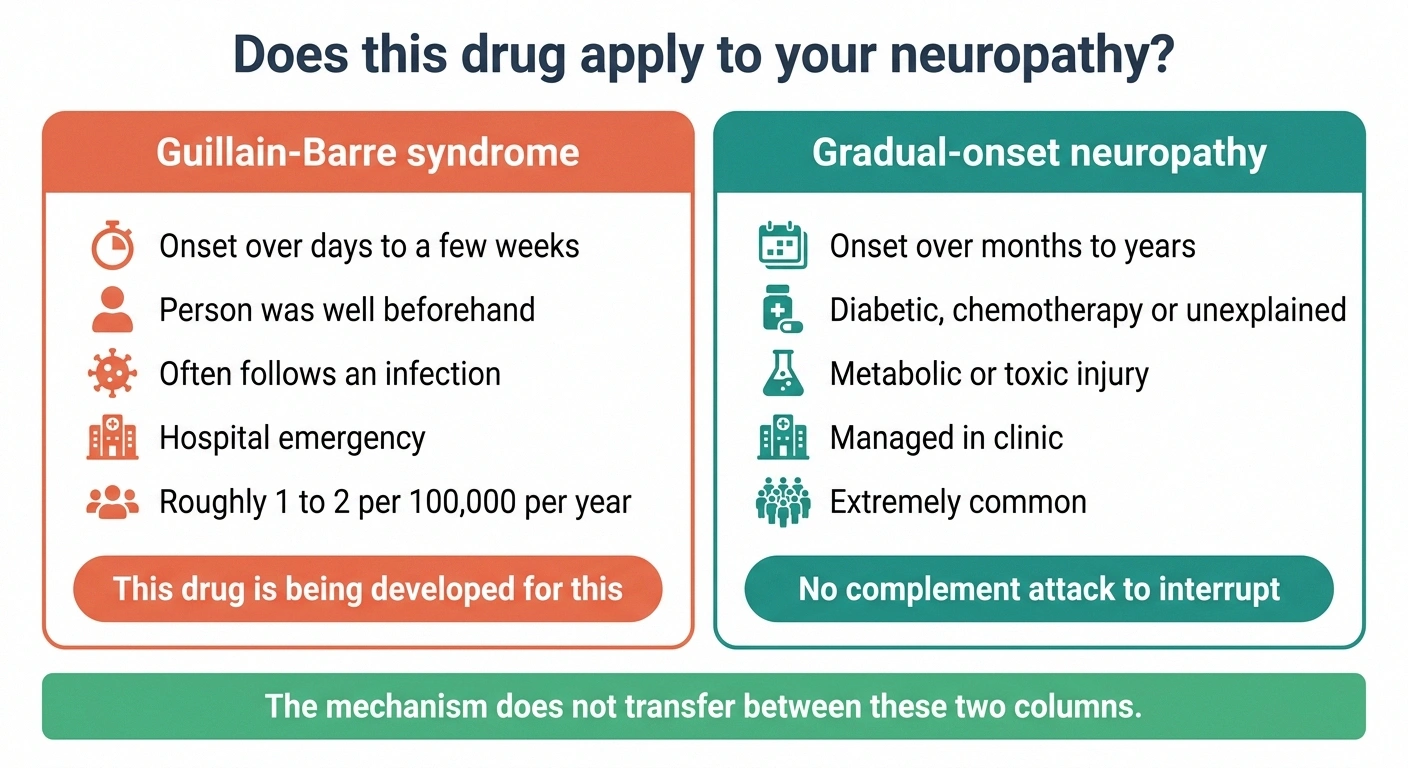
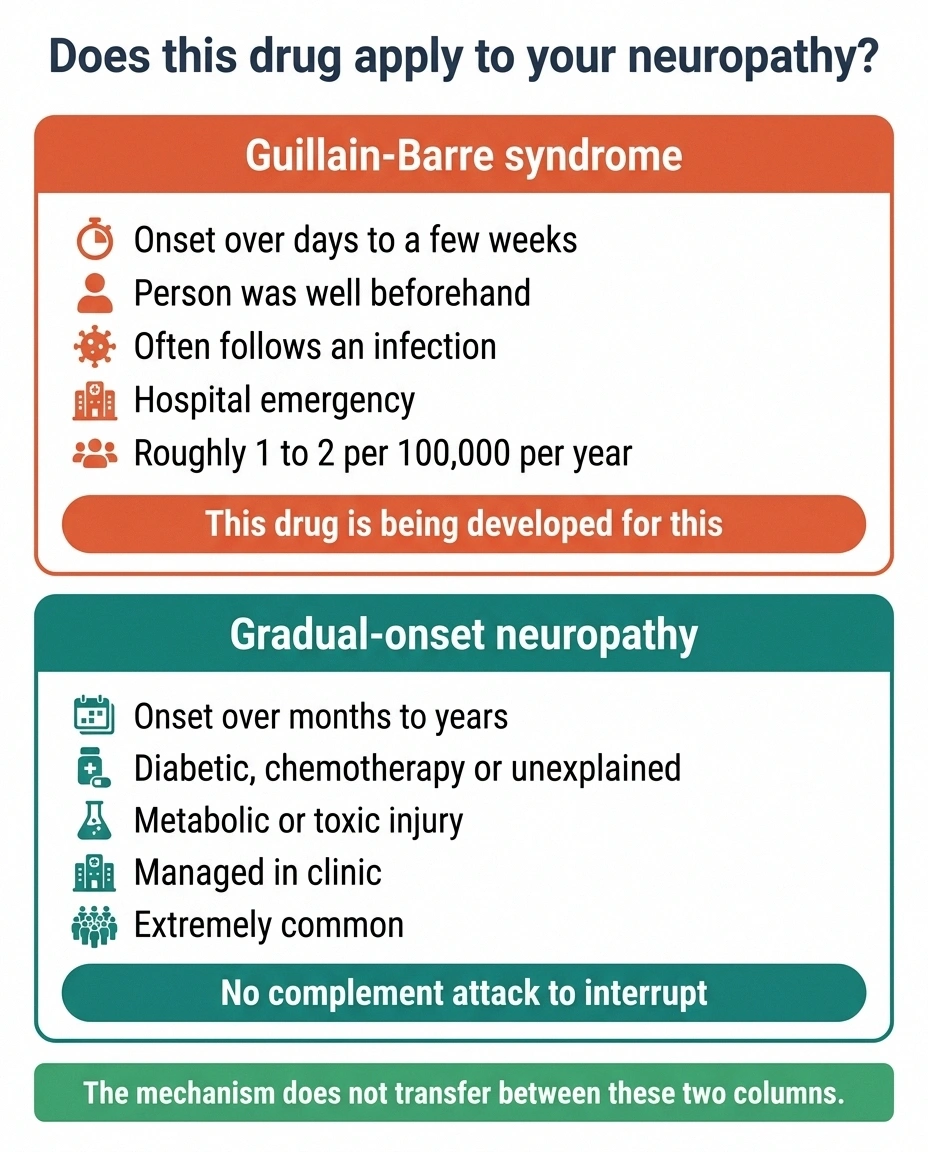
Tanruprubart is being developed for acute Guillain-Barré syndrome. Guillain-Barré is rare — roughly one or two people per 100,000 per year — and it is an emergency that unfolds over days to a few weeks in someone who was well beforehand.
If your neuropathy came on gradually over months or years, this drug is not for you. That covers diabetic neuropathy, chemotherapy-induced neuropathy, idiopathic neuropathy, and every slow-onset form. The mechanism doesn’t fit: there is no runaway complement attack to switch off in a nerve that’s been declining since 2019, and blocking a fire alarm does nothing about a slow leak.
The chronic cousin of Guillain-Barré is CIDP, which is a genuinely different situation with its own drug development happening in parallel, including the FcRn blockers. Tanruprubart is not currently in a registrational CIDP program, and CIDP treatment decisions run on a different set of options.
What this drug does offer people with chronic neuropathy is indirect, and it’s still worth something: a proof of concept that going after complement, rather than after antibodies, changes outcomes in a nerve disease. That mechanism has cousins under study in other conditions.
If Someone You Love Is in the Hospital This Week

Given the timelines involved, some readers will find this page in the worst possible circumstances. A few practical notes for that situation.
Treatment decisions in acute Guillain-Barré are made by a hospital neurology team, usually within hours. There is no version of this where you obtain an investigational drug on your own. The route into an unapproved medicine is a clinical trial, and enrollment happens at participating centers with narrow time windows measured in days from symptom onset.
The reasonable question to ask the team is whether the hospital is a FORWARD site or has access to any active Guillain-Barré trial, and to ask it early, because the eligibility clock is short. How trial enrollment actually works covers the mechanics, though in an acute case the neurology team is your fastest path.
Meanwhile, standard care is genuinely effective care. IVIG and plasma exchange are not placeholders. They’re the treatments that have carried this disease for four decades, and beginning one of them promptly matters more today than any drug still under review.
What I Take From This
I’ve read a lot of press releases about nerve drugs. Most of them describe something that lowers a number in a laboratory and leaves the person feeling exactly the same.
This one is different in a specific way that I think is worth naming. The measurement wasn’t a biomarker. It was the date someone walked across a room without help, and that date moved by a month. Whatever else is uncertain about tanruprubart, and plenty is, they measured the right thing.
What’s still unproven is whether it beats the treatment your hospital would give you today. That study is running now. Until it reports, the honest description of tanruprubart is a promising drug with one strong trial behind it, an application under review in Europe, nothing filed yet in the United States, and a real question still open about how it compares to the standard of care.
That’s less exciting than a headline. It’s also the version that won’t leave you disappointed in six months.
Frequently Asked Questions
Is tanruprubart approved by the FDA?
No. As of September 2026 it is not approved in the United States or anywhere else. The manufacturer submitted a Marketing Authorization Application to the European Medicines Agency in January 2026, which is under review, and has stated it intends to submit a Biologics License Application to the FDA in the fourth quarter of 2026. Neither submission means approval, and review periods typically run months.
What is the difference between tanruprubart and ANX005?
They are the same drug. ANX005 was the development code used throughout the early trials, and tanruprubart is the nonproprietary name assigned later. Older trial publications and conference abstracts use ANX005, which is why searching one term can miss half the available information.
How does tanruprubart differ from IVIG?
IVIG floods the system with pooled donor antibodies, which appears to work partly by outcompeting the harmful antibodies and partly by interfering with complement, and it is infused over roughly five days. Tanruprubart binds a single protein called C1q, which blocks the classical complement cascade at its first step, and it is given as one infusion. IVIG targets the antibodies; tanruprubart targets what those antibodies switch on.
Could tanruprubart help diabetic or chemotherapy neuropathy?
There is no reason from the mechanism to expect it would, and no trials in those conditions. Tanruprubart blocks an acute complement-driven immune attack on nerves. Diabetic and chemotherapy neuropathies are driven by metabolic and toxic injury over long periods, which is a different process entirely. This drug is being developed for acute Guillain-Barré syndrome only.
What does blocking C1q do to your immune system?
C1q starts the classical complement pathway, one of three routes into the complement system. Blocking it leaves the alternative and lectin pathways working. Complement does contribute to defense against certain encapsulated bacteria, which is why any complement-targeting drug requires attention to infection risk, and the trials monitored for it. Reported adverse events were mostly mild to moderate, with infusion-related reactions in about 30% of patients, generally transient rashes.
Why did the main trial use a placebo group instead of comparing against IVIG?
The pivotal trial was conducted largely in Bangladesh, where IVIG and plasma exchange are not routinely available and supportive care is the standard of care. That made a placebo comparison ethically acceptable there. It also means the trial cannot tell you whether tanruprubart outperforms IVIG. The FORWARD study, running in the United States and Europe, is designed to address that gap.
How would someone get access to tanruprubart now?
Through a clinical trial at a participating center, and only within a narrow window from symptom onset. Since acute Guillain-Barré is managed in hospital, the practical step is asking the treating neurology team immediately whether the hospital participates in a Guillain-Barré trial. Eligibility windows in this disease are measured in days.
Does earlier walking mean a better long-term recovery?
Not automatically, and the trials have not run long enough to settle it. The reasoning behind hoping so is that ongoing complement activity is what converts myelin damage into axonal damage, and axonal damage is what leaves lasting deficits. Stopping the attack sooner should mean less axon lost. That is a plausible chain of reasoning supported by the disease mechanism, not a proven long-term outcome.
About the Author