
Seventy-two point seven percent.
That figure came out of a routine trial-enrollment update for a drug called nipocalimab, and it is easily the most useful number I’ve read all year. It means this: of the first 110 people screened for a large CIDP trial — all of them carrying a CIDP diagnosis from a real neurologist — an independent expert committee found that only 72.7% actually met the diagnostic criteria for the disease.
Round it off. More than one in four of those screened candidates, all of them carrying a CIDP label and receiving CIDP treatment, did not have confirmed CIDP when specialists looked hard at the file.
The trial that produced that number is called ARISE, and it’s testing whether nipocalimab can keep CIDP in remission. It’s a genuinely interesting drug and I’ll get to it. But I want to start where the trial started, because for most readers the diagnostic finding is worth more than the drug news.
Why a Drug Trial Ended Up Auditing Diagnoses
Trials of CIDP drugs have a recurring embarrassment. Historically, a meaningful share of enrolled patients turned out not to have CIDP, which quietly wrecks the results: people without the disease can’t respond to a treatment for it, so a drug that works can look like it doesn’t.
What it is: of the first 110 people screened for ARISE, an independent committee applying the 2021 EAN/PNS criteria confirmed CIDP in 72.7%. Just over 1 in 4 did not meet criteria.
What it is not: a misdiagnosis rate for everyone with a CIDP label. Trial candidates skew toward people doing badly on treatment, and poor response is itself a clue to a wrong diagnosis, so this population is enriched for exactly the error being measured.
The useful inference is narrower and still worth acting on: among people struggling enough to be considered for a trial, the diagnosis is wrong often enough that trial designers now screen for it as standard practice.
The response was to build in an independent adjudication committee. Every candidate’s records go to CIDP specialists who assess them against the 2021 EAN/PNS criteria, the current international standard, before that person can enroll.
The committee confirmed 72.7% of the first 110 screened. The rest had something else — or a picture too ambiguous to call.
Now, that number needs an honest caveat before anyone takes it to their neurologist. People who get referred into a drug trial are disproportionately people who aren’t doing well on standard treatment, and someone who isn’t responding to CIDP treatment is more likely than average to have been misdiagnosed. So this isn’t a clean estimate of the misdiagnosis rate across everyone with a CIDP label.
What it does tell you is that among people struggling enough to be considered for a trial, the diagnosis itself is unreliable often enough that the professionals designing these studies now screen for it as a matter of routine.
What CIDP Is, and What It Gets Confused With
Chronic inflammatory demyelinating polyneuropathy is an autoimmune attack on the myelin insulation wrapping your peripheral nerves. It usually builds over at least eight weeks, it typically causes weakness closer to the body as well as further out, and — unlike most neuropathies — it can be treated with real effect.
- Diabetic polyneuropathy
- Long-standing diabetes can slow nerve conduction enough to read as demyelinating on a quick look, particularly when the criteria thresholds are not applied strictly.
- Hereditary neuropathies
- Some inherited forms produce uniformly slow conduction that looks inflammatory. The tell is usually a slow lifelong course and a family pattern, not an eight-week decline.
- Paraprotein-associated neuropathy
- An abnormal blood protein drives the damage. The presentation overlaps heavily with CIDP, but the treatment path is not the same.
- Autoimmune nodopathies
- Split out of CIDP as a separate category precisely because they behave differently. Notably, they often fail to respond to standard CIDP treatment, so a non-responder is worth re-examining for one.
That last point is why the label sticks so easily. If a patient has an unexplained progressive neuropathy and CIDP is treatable, there’s a strong pull toward trying treatment. Nobody wants to withhold something that might help.
The trouble is what gets swept in. Ordinary length-dependent neuropathy from diabetes can produce nerve conduction results that look demyelinating on a quick read. Some hereditary neuropathies produce slow conduction that looks inflammatory but isn’t. Paraprotein-associated neuropathies, which involve an abnormal protein in the blood, look similar but respond differently. So do several autoimmune nodopathies, which were split out of CIDP as a separate category precisely because they behave differently and don’t respond to the standard treatments.
The 2021 criteria exist to sort these apart. They lean heavily on nerve conduction studies read against specific thresholds, and they’re demanding enough that applying them properly takes real effort.
Here’s the practical consequence, and it’s the reason this article opens where it does. If you carry a CIDP diagnosis and treatment hasn’t done much, there are two possible explanations. One is that you have CIDP and it isn’t responding. The other is that you don’t have CIDP. Those lead to completely different next steps — and only one of them is usually considered.
What Nipocalimab Is
Nipocalimab, sold as Imaavy, is a monoclonal antibody from Johnson & Johnson. The FDA approved it in April 2025 for antibody-positive generalized myasthenia gravis in people 12 and older.
Myasthenia gravis, not CIDP. That distinction matters for anyone who reads that a drug is approved and assumes it’s available for their condition. For CIDP it is investigational: no regulator has approved it for that use, and the evidence is still being gathered.
Its class is where the interest lies. Nipocalimab is an FcRn blocker, and FcRn blockers are the newest real idea in antibody-driven autoimmune disease.
How Blocking a Recycling Receptor Lowers Antibodies
Your body treats IgG antibodies as expensive equipment worth maintaining.
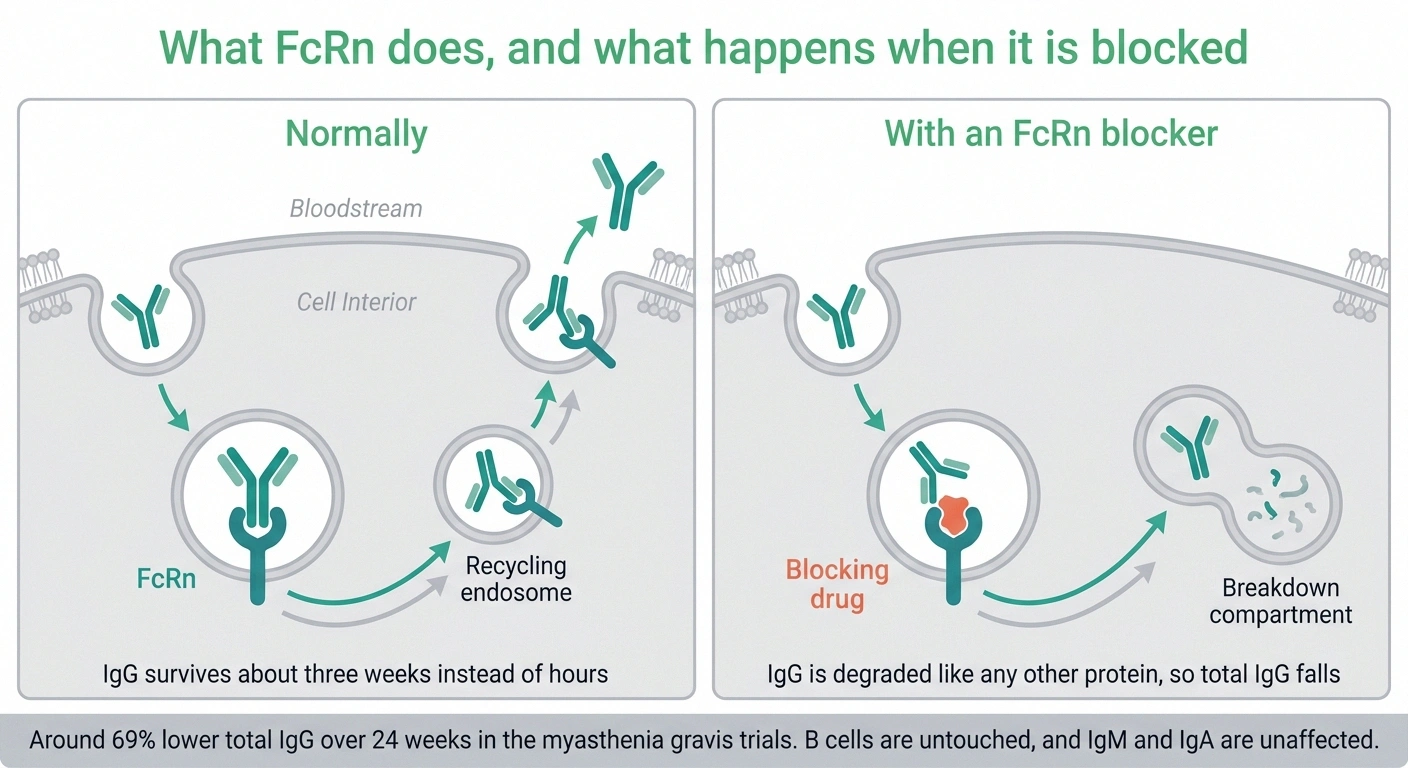
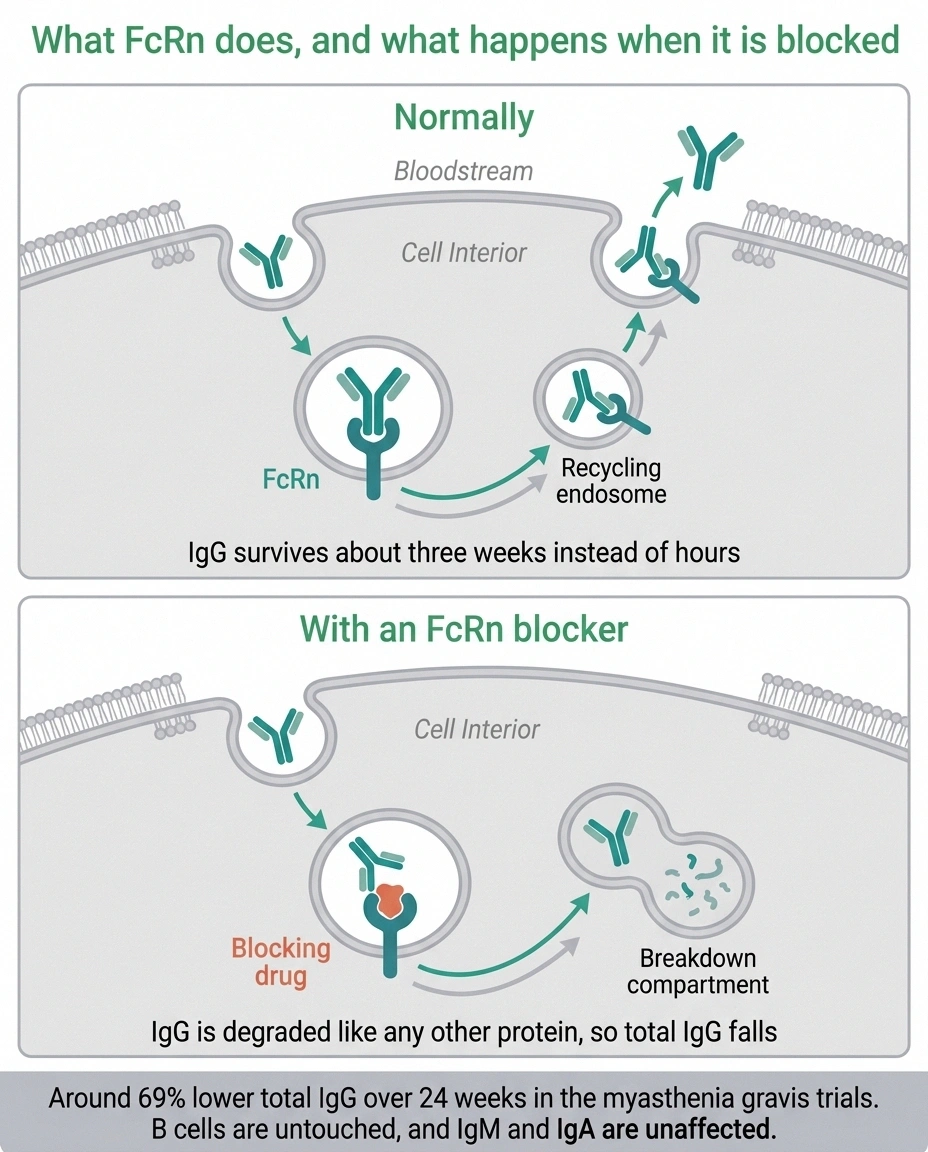
Most proteins that get taken into a cell are broken down and their parts reused. IgG gets an exemption. Inside the cell, a receptor called FcRn (the neonatal Fc receptor) grabs passing IgG and escorts it back out to the bloodstream instead of letting it be destroyed. That salvage operation runs constantly, and it’s the reason IgG antibodies survive for around three weeks in circulation while most proteins last hours or days.
Wonderful arrangement — right up until the antibody being lovingly preserved is the one attacking your nerves.
Nipocalimab occupies FcRn so IgG can’t bind to it. The escort service stops. IgG that gets taken into cells is broken down like any other protein, and total IgG in the blood falls. In the myasthenia gravis trials that produced roughly a 69% reduction in total serum IgG over 24 weeks.
Two things make that appealing compared with what CIDP patients receive today. It doesn’t kill B cells, so your antibody factories stay intact and start producing again as soon as the drug stops. And it leaves IgM and IgA alone, since only IgG uses this recycling pathway. Compared with corticosteroids — which suppress essentially everything — that’s a narrow instrument.
It’s also worth noticing the family resemblance to plasma exchange. Both work by lowering circulating antibodies. One does it by filtering your blood through a machine every few weeks; the other does it pharmacologically, and there’s no vascular access involved.
What ARISE Is Actually Asking

ARISE is a Phase 2/3 study running at centers across multiple countries, targeting roughly 300 patients. Its design is called randomized withdrawal, and the structure is worth walking through because it determines what the results can and cannot say.
| Stage A | Stage B | |
|---|---|---|
| Who takes part | Everyone enrolled | Only those who improved in Stage A |
| What they receive | Nipocalimab, open label | Nipocalimab or placebo, blinded |
| Question asked | Who responds at all? | Does staying on it delay relapse? |
Target enrolment is roughly 300, with primary completion anticipated in 2026. Because Stage B enrols only responders, the result will describe performance in a pre-selected group and will not tell you the odds that a randomly chosen person with CIDP responds.
Stage A: everyone gets nipocalimab, openly, nobody blinded. People who improve move forward. People who don’t improve are done.
Stage B: the responders from Stage A are randomly assigned to either keep receiving nipocalimab or switch to placebo, and neither they nor their doctors know which. Then everyone is watched to see who relapses.
The primary question is whether staying on the drug delays relapse compared with stopping it.
This design has an obvious appeal for patients: nobody with active CIDP sits on placebo for months while getting worse, because only people already improving reach the randomized stage. It also concentrates the study on people the drug is helping, which makes a real effect easier to detect.
What it costs you is generalizability. The result will describe how nipocalimab performs in people already selected for responding to it. It won’t tell you the odds that a randomly chosen person with CIDP responds at all, and it won’t tell you how nipocalimab compares to IVIG, because IVIG isn’t the comparator. Placebo is.
None of this is a criticism. Randomized withdrawal is a legitimate and widely accepted design in rare disease, where recruiting enough patients for a head-to-head trial can be close to impossible. It just answers a narrower question than the one most patients are actually asking, which is “should I switch?”
Where the Trial Stands in September 2026
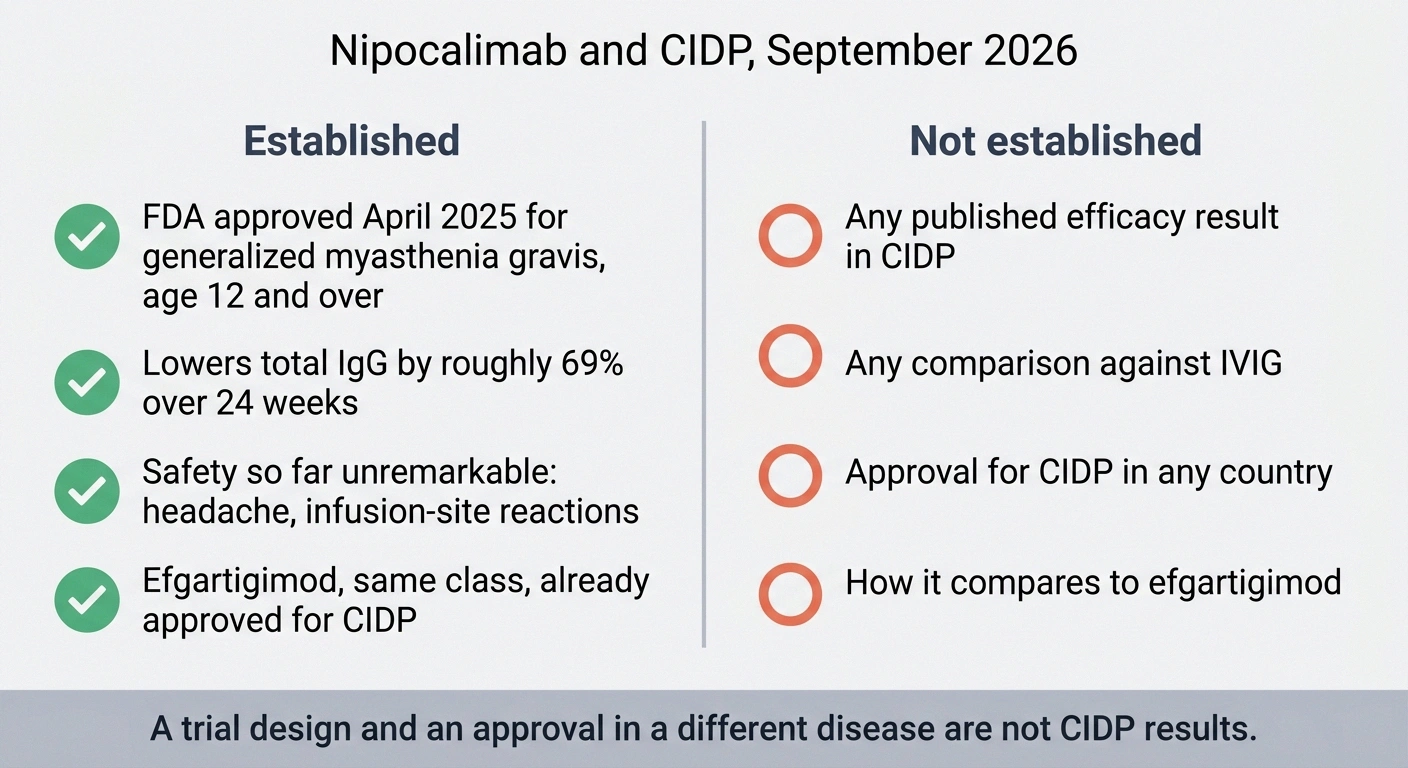
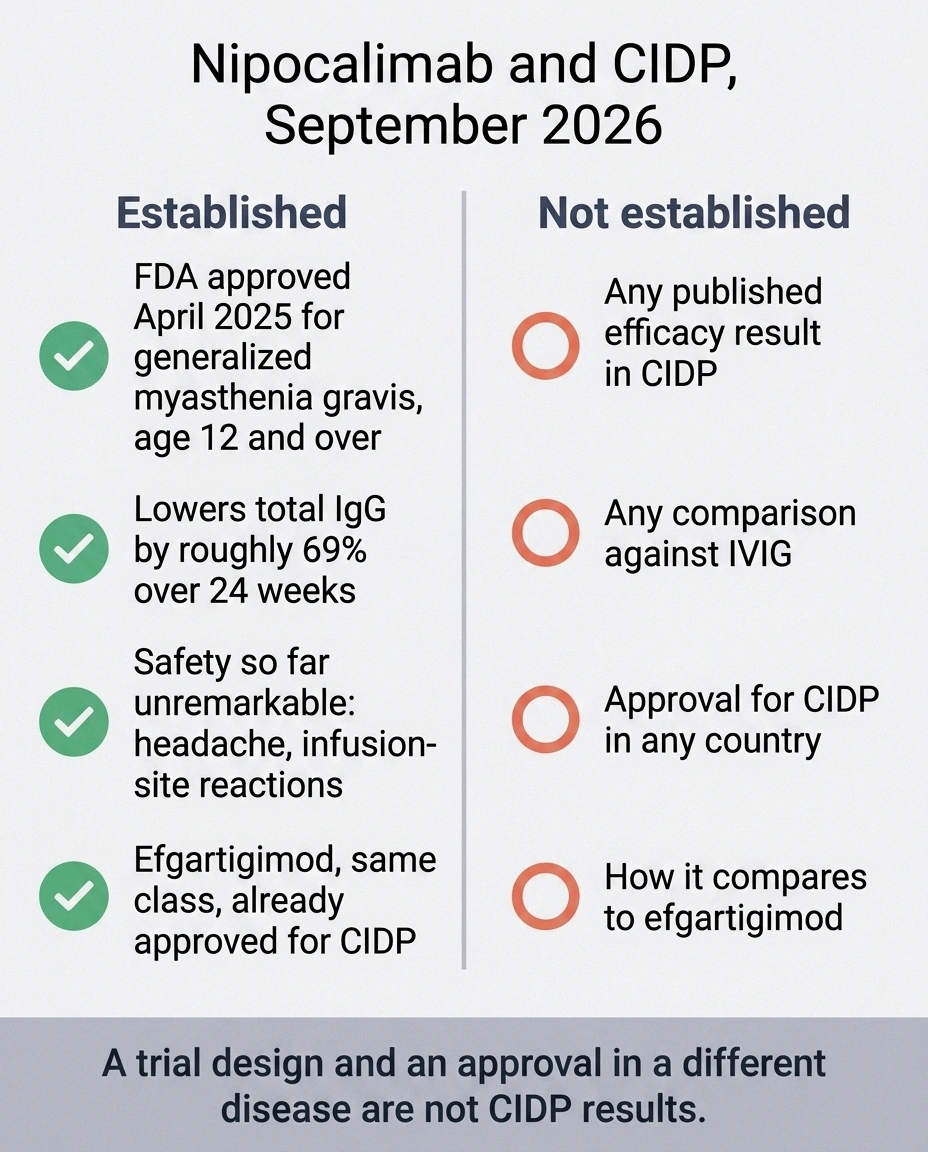
ARISE has been enrolling since 2022, with primary completion anticipated in 2026. There are no published efficacy results for CIDP. None.
I want to be blunt about that, because searching this drug’s name turns up a great deal of confident-sounding coverage, most of which is describing the myasthenia gravis data and the CIDP trial’s design rather than CIDP outcomes. Reported safety so far has been unremarkable, with headache and infusion-site reactions the common complaints, mostly mild.
Anyone who tells you today whether nipocalimab works for CIDP is telling you what they hope, not what’s known.
It Is Not the First FcRn Blocker Here
Nipocalimab is arriving second, and the difference matters for what happens if it succeeds.
Efgartigimod, sold as Vyvgart Hytrulo, is already FDA-approved for CIDP. Same broad mechanism, same class, already prescribable.
So nipocalimab isn’t competing for the title of first FcRn blocker in CIDP. It’s competing on the details that separate two drugs in a class: how often it’s dosed, how it’s administered, how deeply and how durably it lowers IgG, how it’s tolerated, what it costs, and what insurers will approve.
Those sound like minor considerations until you’re the one receiving infusions on a fixed schedule for years. Between two drugs with similar efficacy, dosing frequency and route are frequently what decides which one a person can actually live with.
The Trade-Off That Belongs in the Headline

Lowering IgG by two-thirds is the mechanism working correctly. It is also — unavoidably — a reduction in your immune defenses.
Corticosteroids: suppress immune function broadly. Weight gain, bone loss, and raised blood sugar accumulate with duration rather than dose alone.
IVIG: infusion reactions, headache, and a small thrombosis risk. Also dependent on a pooled human plasma supply, which is why shortages affect availability.
FcRn blockers: total IgG falls, around 69% over 24 weeks in the myasthenia gravis trials. That is the mechanism working, and it is simultaneously a reduction in acquired immunity, which is why vaccine response during treatment may be blunted.
There is no entry here without a cost. A conversation that presents one as risk-free is incomplete, not reassuring.
IgG is the workhorse antibody class — the accumulated record of every infection you’ve fought and every vaccine you’ve received. Drop it and you’re more vulnerable to infection, and vaccines given during treatment may produce a weaker response.
Trials so far have not reported a large excess of serious infections, and this is genuinely more targeted than the alternatives. But every CIDP treatment involves interfering with immune function somewhere, and no version of that is free. Corticosteroids suppress broadly and bring weight gain, bone loss, and blood sugar problems. IVIG carries infusion reactions and a small thrombosis risk. FcRn blockers lower IgG. There is no option on this list that leaves the immune system untouched, and any conversation that presents one as risk-free is incomplete.
What to Do With This If You Have a CIDP Diagnosis
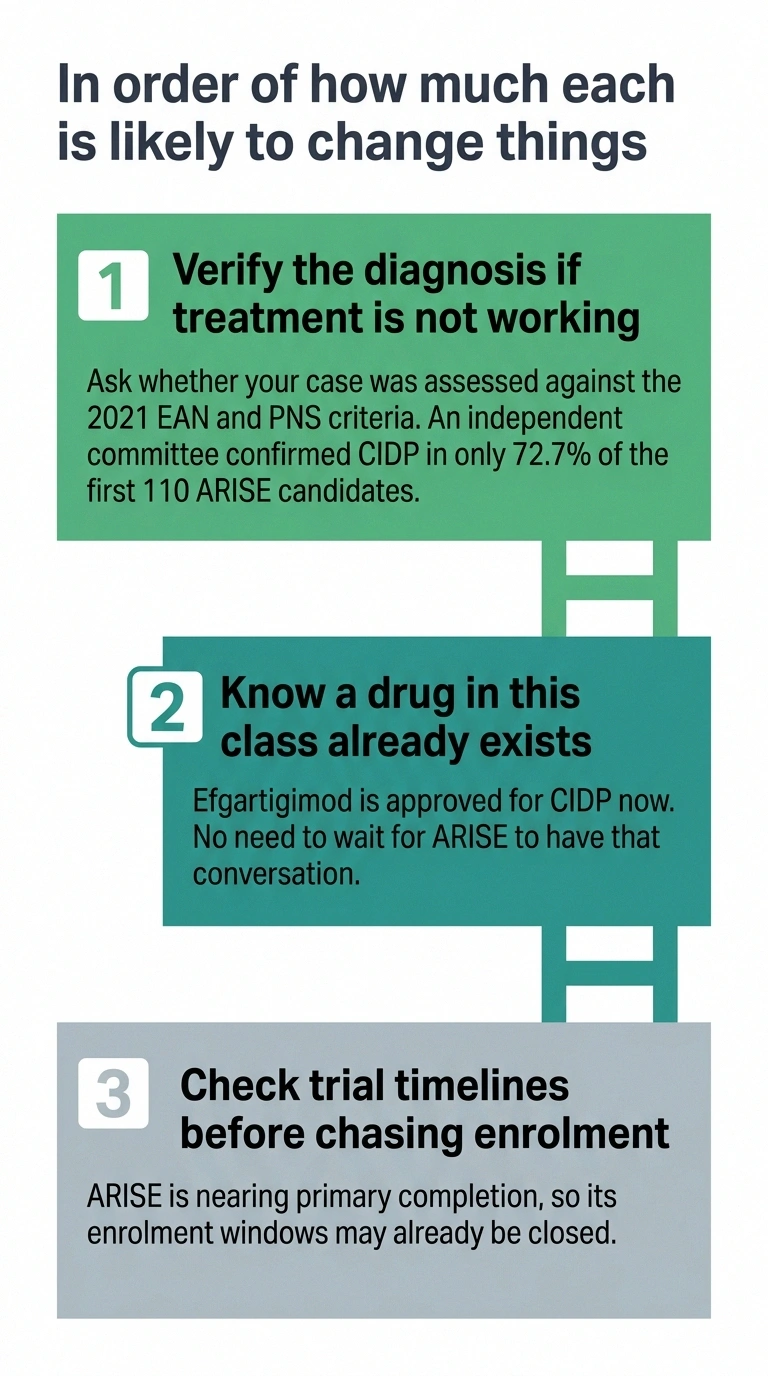
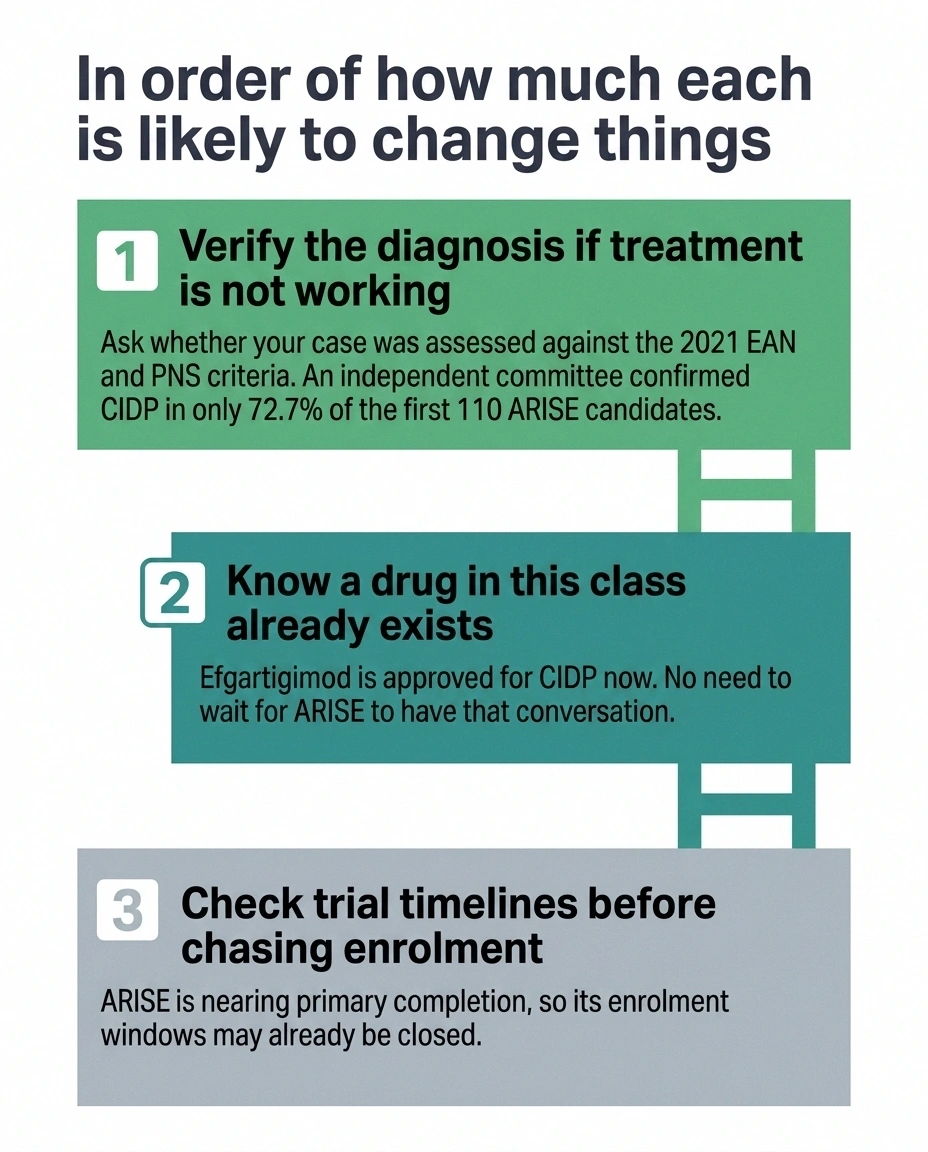
Three things, in order of how much they’re likely to change your situation.
First, verify the diagnosis if treatment isn’t working. This is the highest-value action on the page. If you’ve been treated for CIDP for many months without meaningful improvement, ask whether your case has been assessed against the 2021 EAN/PNS criteria specifically, and consider a second opinion at a center that handles a lot of neuromuscular disease. The trial screening data says that question comes back “no” more often than anyone expected. Raise it alongside your current treatment rather than changing anything on your own.
Second, know that a drug in this class already exists. If your neurologist hasn’t discussed FcRn blockers with you and you’re not doing well on IVIG or steroids, efgartigimod is approved and available now. You don’t have to wait for ARISE to read out to have that conversation.
Third, if you want to be in the trial, act on the timeline it’s actually on. ARISE is nearing primary completion, so enrollment windows for it are closing or closed. Finding and joining a trial takes longer than most people expect, and a study approaching completion is usually the wrong one to be chasing.
The Honest Summary

Nipocalimab is a well-designed drug, in a class that has already proven itself in this disease, being tested in a trial with unusually careful diagnostic screening. That’s a good set of facts. It is also unapproved for CIDP, unreported for CIDP, and second into a market where a similar drug is already on pharmacy shelves.
If it works, it becomes a second option in a class that until recently didn’t exist, and having two is better than having one. That is a real but modest thing, and it’s what I’d want a friend to expect.
The trial’s most useful output so far isn’t about the drug at all. It’s the reminder that a diagnosis written in your chart is a conclusion someone reached with the information they had, and that conclusions are worth re-examining when the treatment built on them isn’t working.
Frequently Asked Questions
Is nipocalimab approved for CIDP?
No. Nipocalimab, sold as Imaavy, was approved by the FDA in April 2025 for antibody-positive generalized myasthenia gravis in patients 12 and older. For CIDP it is investigational and available only through clinical trials. The ARISE study is the trial testing it in CIDP, and no efficacy results for CIDP have been published.
What does the ARISE trial measure?
ARISE uses a randomized-withdrawal design. In Stage A all participants receive nipocalimab openly. Those who improve are randomly assigned in Stage B to continue the drug or switch to placebo, with neither participants nor investigators knowing which. The primary measure is whether continuing treatment delays relapse. It is a placebo comparison, not a comparison against IVIG or steroids.
How is an FcRn blocker different from IVIG?
IVIG adds pooled donor antibodies to your bloodstream, and part of how it helps is thought to involve competing for the same recycling receptor. An FcRn blocker goes at that receptor directly, preventing IgG from being salvaged so it gets broken down instead. IVIG adds antibodies to change the balance; an FcRn blocker removes them. FcRn blockers also lower IgG more predictably and do not require pooled human plasma.
Does nipocalimab weaken your immune system?
It lowers total IgG, which is the antibody class that carries most of your acquired immunity, so yes, it reduces one arm of immune defense. In myasthenia gravis trials the reduction was around 69% over 24 weeks. It does not deplete B cells and does not lower IgM or IgA. Trials have not reported a large excess of serious infections, though they were not long enough or large enough to settle rarer risks, and infection risk and vaccine response are monitored throughout treatment.
What does the 72.7% figure mean for me?
Among the first 110 people screened for ARISE, an independent committee confirmed CIDP in 72.7% using the 2021 EAN/PNS criteria. Trial candidates skew toward people not responding well to treatment, so this is not the misdiagnosis rate for everyone with a CIDP label. It does mean the diagnosis is unreliable often enough to be worth re-checking, particularly if treatment has not helped.
Is nipocalimab better than efgartigimod for CIDP?
There is no evidence for that comparison, and no head-to-head trial. Efgartigimod is already FDA-approved for CIDP. Nipocalimab is still in trials for it. If both end up available, the practical differences will be dosing schedule, route of administration, how deeply and durably each lowers IgG, tolerability, and coverage.
Can I get nipocalimab for CIDP now?
In practice, through a clinical trial. Nipocalimab is an approved drug for generalized myasthenia gravis, so a physician could in principle prescribe it off-label, but there is no published CIDP evidence to justify doing so and an insurer is very unlikely to cover it for an unapproved indication. ARISE is approaching primary completion, so enrollment may be closed. If you want an FcRn blocker for CIDP now, the approved option to discuss with your neurologist is efgartigimod.
How long does IgG stay low after stopping the drug?
The effect is reversible. Because FcRn blockade interferes with recycling rather than destroying the cells that produce antibodies, IgG levels recover once the drug clears. That reversibility is one of the arguments for this class over treatments that deplete B cells, though the exact recovery timeline depends on the specific drug and dose schedule.
About the Author