The first time I heard about honokiol was at my book club, of all places. One of the women, Marilyn, had just gotten back from a trip to her daughter’s house in Boulder, where she had picked up a bottle of magnolia bark capsules from a little health-food shop because the clerk had told her it was “what they use in China for nerve trouble.” Marilyn was three weeks in by the time she told me about it, asking if I had ever heard of it. I had not. So I did what I always do. I came home, made a pot of tea, and started reading.
What I found was interesting enough that I want to walk through it with you, because honokiol is one of those supplements with real science behind some of its claims, almost no human studies for the specific claim that brought it onto our radar, and a story that is more nuanced than either the supplement bottle or the skeptical news article will tell you.
What Honokiol Actually Is
Honokiol is a compound found in the bark, leaves, and seed cones of the magnolia tree, particularly Magnolia officinalis, which grows in China and Japan. Magnolia bark, called hou po in traditional Chinese medicine, has been used for somewhere between fifteen hundred and two thousand years for what the old texts describe as “stagnant chi”—loosely translated, complaints involving anxiety, digestive upset, and certain kinds of body pain.
The bark contains two main bioactive compounds: honokiol and a closely related cousin called magnolol. Most modern supplements are standardized to one or both. When you read a label that says “90% honokiol” or “magnolia bark extract, 250 mg standardized to 50% honokiol/magnolol,” that is what it is talking about. The raw bark itself contains only small amounts of these compounds, so the extracts concentrate them many times over.
For most of the modern research history, honokiol was studied in two very different lanes. One was anxiety and sleep, because the compound interacts with GABA-A receptors in the brain in a way similar to how some medications do, just much more gently. The other was cancer research, where honokiol’s ability to cross the blood-brain barrier and trigger apoptosis in certain tumor cell lines made it an object of laboratory curiosity for thirty years. The neuropathic pain story is much newer.
The Neuropathic Pain Research, Honestly
This is the part where I have to slow down and be very honest with you, because the honest answer is more useful than the marketing answer.
There is genuine, peer-reviewed research suggesting honokiol may reduce neuropathic pain. The strongest of these is a 2023 study published in the journal Antioxidants, in which a standardized honokiol-rich extract of Magnolia officinalis bark was given to mice with a spared nerve injury—a standard laboratory model of trauma-induced neuropathic pain. The extract at 30 milligrams per kilogram reduced the mice’s pain response to touch (a measure called allodynia) without making them sleepy or wobbly, which is unusual for a compound that interacts with GABA. The researchers also measured a drop in inflammatory markers in the spinal cord and a calming of microglia, the immune cells of the nervous system that get over-activated in chronic nerve pain.
A 2025 mechanistic review in Molecular Pain pulled the existing animal and cell-culture studies together. The mechanism, as best as researchers can describe it, looks like this: honokiol calms the inflammation that damaged nerves trigger in the surrounding tissue, it dampens the overactive immune-cell signaling in the spinal cord that turns short-term pain into chronic pain, it has antioxidant effects that protect nerve cells from further oxidative damage, and it appears to nudge the body’s own cannabinoid system in a pain-relieving direction.
That is all genuinely interesting. Here is the part I want you to hold onto: almost all of this is in animals and cells, not in people with neuropathy. When I went looking for randomized human trials of honokiol or magnolia bark extract for any kind of nerve pain, I found none. The human trials we have are for anxiety, for menopausal symptoms, for sleep quality, and for some early cancer work. The bridge from “this reduces pain in mice” to “this will help you” has not been built yet, at least not with the rigor that other supplements like alpha-lipoic acid or acetyl-L-carnitine have been studied. If you would like a sense of what that rigor looks like, our breakdown of alpha-lipoic acid for neuropathy shows what a strong human evidence base actually looks like.
Why the Animal Evidence Is Not Nothing, Though
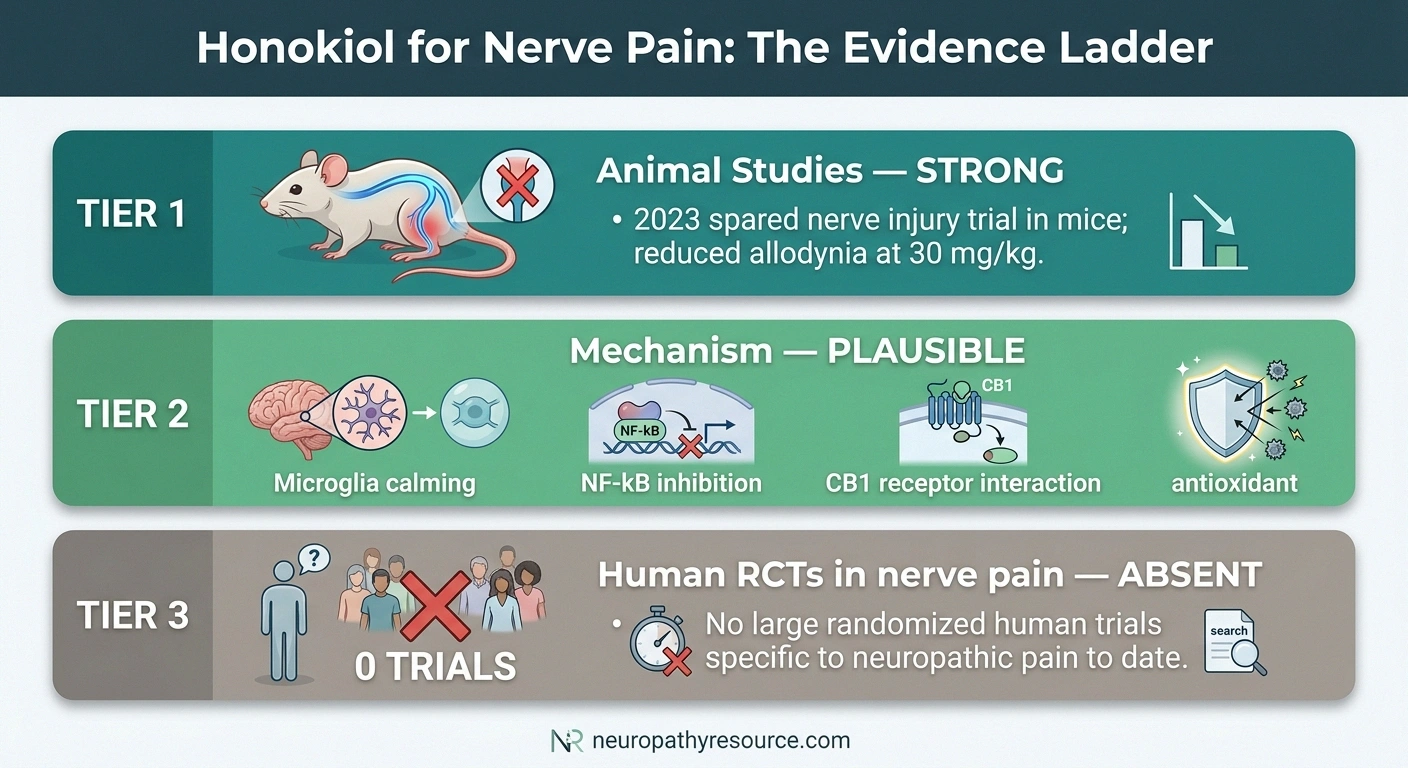
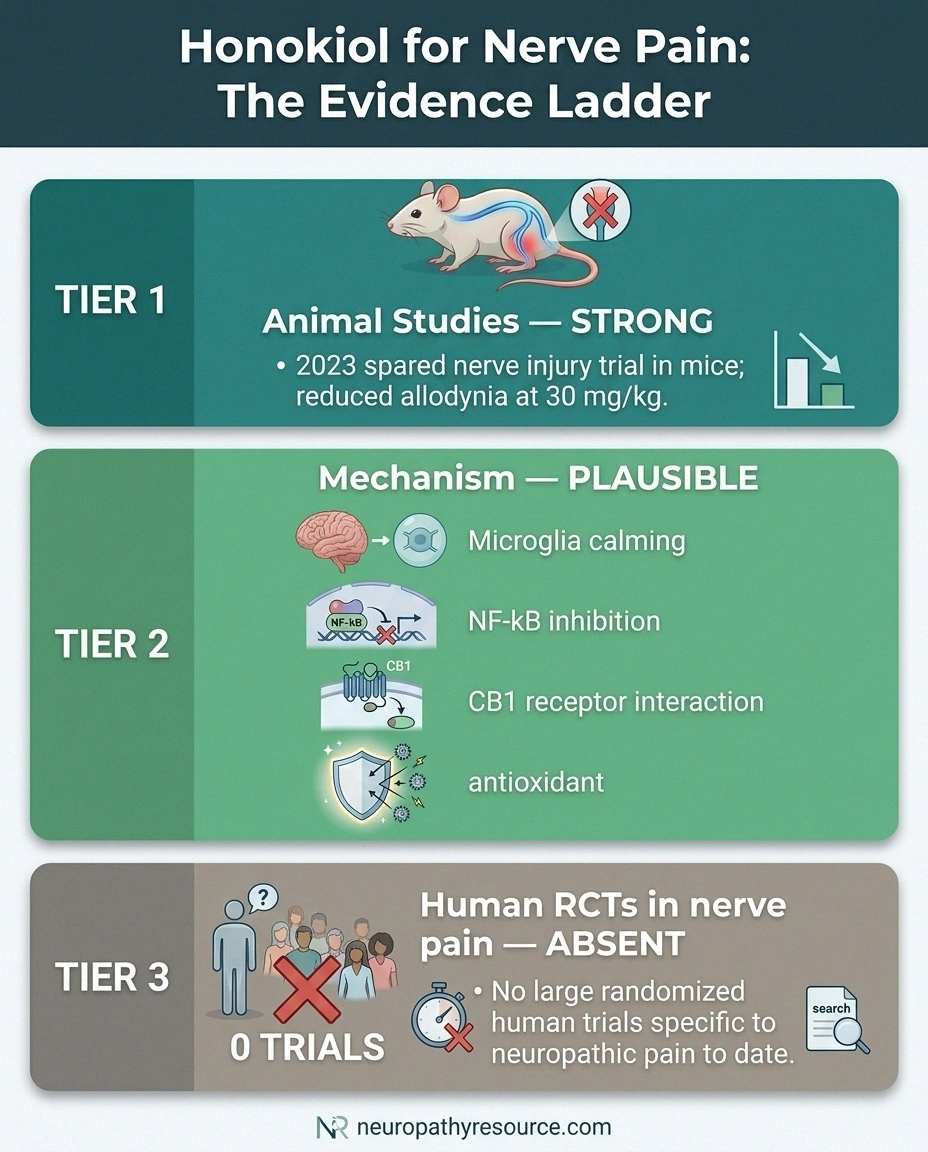
I do not want to swing the pendulum too hard the other way. Animal models of neuropathic pain are not perfect predictors of what works in people, but they are the same models that gave us the first signals for gabapentin, for duloxetine, for capsaicin, and for many of the medications now sitting in our cabinets. A strong animal signal is the start of the road, not the end of it.
What makes honokiol a bit more interesting than the average supplement-of-the-week is that the mechanism it appears to work through is plausible and overlaps with how we already know neuropathic pain gets generated and maintained. Microglial activation, neuroinflammation, oxidative stress, sodium-channel dysfunction—these are all real parts of the picture, and honokiol seems to touch several of them. It would be more surprising if a compound that calms microglia and reduces inflammation in mice did nothing for people. Whether the effect translates strongly enough to matter is the question we do not yet have a clean answer to.
What People Are Actually Taking
Among the patients I have talked to in my support group who have tried honokiol or magnolia bark, the typical dose lands somewhere in the range of 200 to 500 milligrams of standardized extract per day, often split into two doses, often taken in the evening because of the calming effect on anxiety and sleep. Some take a pure honokiol extract; some take a combined honokiol/magnolol extract. The combined version is generally cheaper, and there is no strong evidence that the pure-honokiol versions are clinically superior, despite the higher price.
The patients who told me they noticed a benefit usually described it not as the pain going away, but as the pain becoming easier to live with. “The volume came down a notch” was how Marilyn from book club put it. They also commonly mentioned better sleep, less anxiety, and feeling generally calmer—any of which could be the GABA-modulating effect doing what magnolia bark has always been used for, more than something specific to nerve pain. Some patients noticed nothing.
The Bioavailability Problem
One thing worth knowing if you are going to spend money on honokiol: it is poorly absorbed when taken by mouth. The compound is rapidly broken down by the liver, has a short half-life of about an hour in the bloodstream, and only a fraction of what you swallow actually makes it into circulation. This is the same bioavailability problem that plagues curcumin from turmeric, and the supplement industry has responded the same way: with liposomal formulations, phospholipid complexes, and combinations with absorption enhancers.
Do these enhanced forms work better? Maybe. The animal studies that show benefit usually use direct oral dosing of the extract powder, suggesting some bioactive compound is getting through even in plain form. The bioavailability research on enhanced forms is mostly funded by the supplement companies that sell those forms, which means it should be read with appropriate skepticism. My honest take: if you are going to try honokiol, the regular standardized extract is a reasonable starting point. If you have given that an honest six to eight weeks at a clinically reasonable dose and noticed nothing, the enhanced version is unlikely to suddenly unlock a response.
Safety and What to Watch For
Honokiol has a generally favorable safety profile in the trials that have been done. Side effects are uncommon at typical supplement doses and, when they happen, tend to be mild: some drowsiness, occasional digestive upset, sometimes a flat or “flattened” feeling if the dose is too high for that individual. That said, there are a few specific things I want you to know before you put a bottle in your cart.
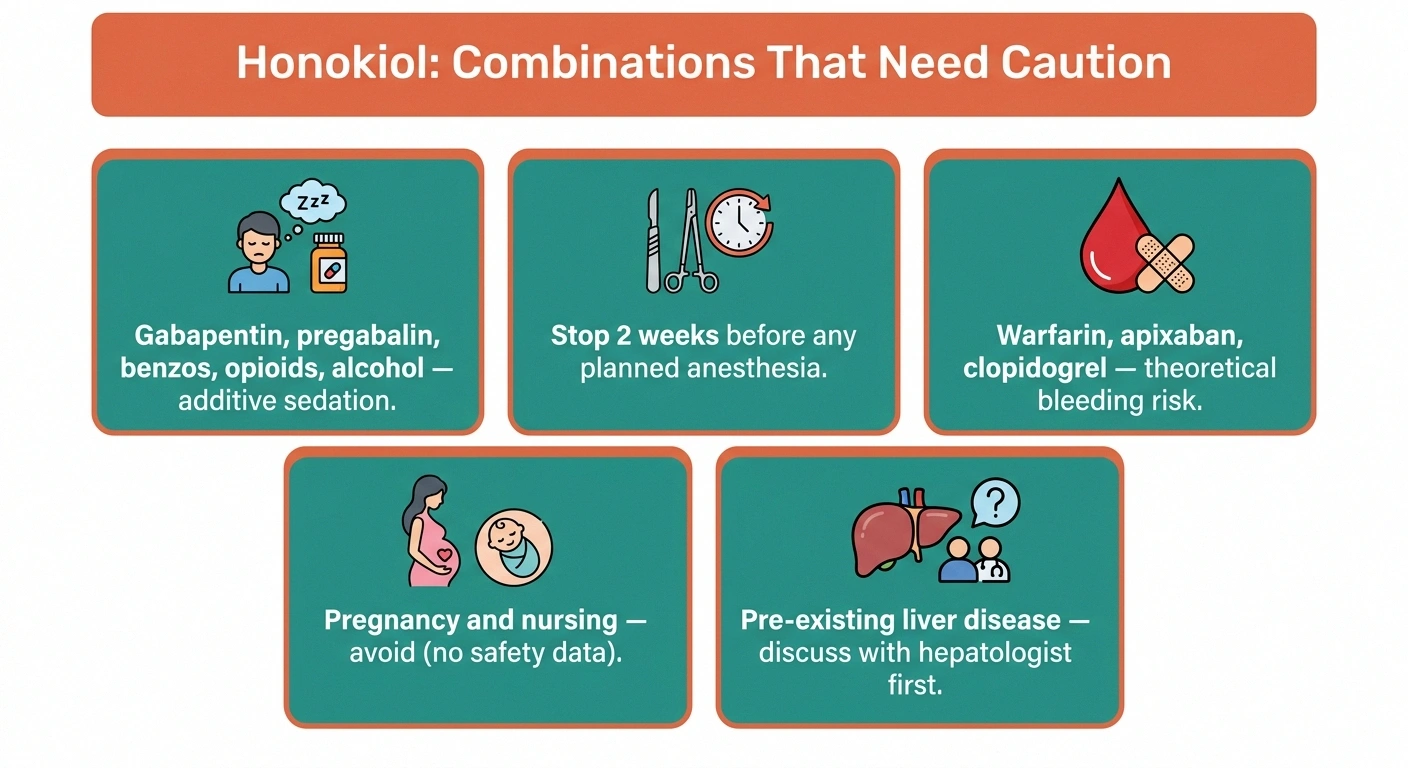
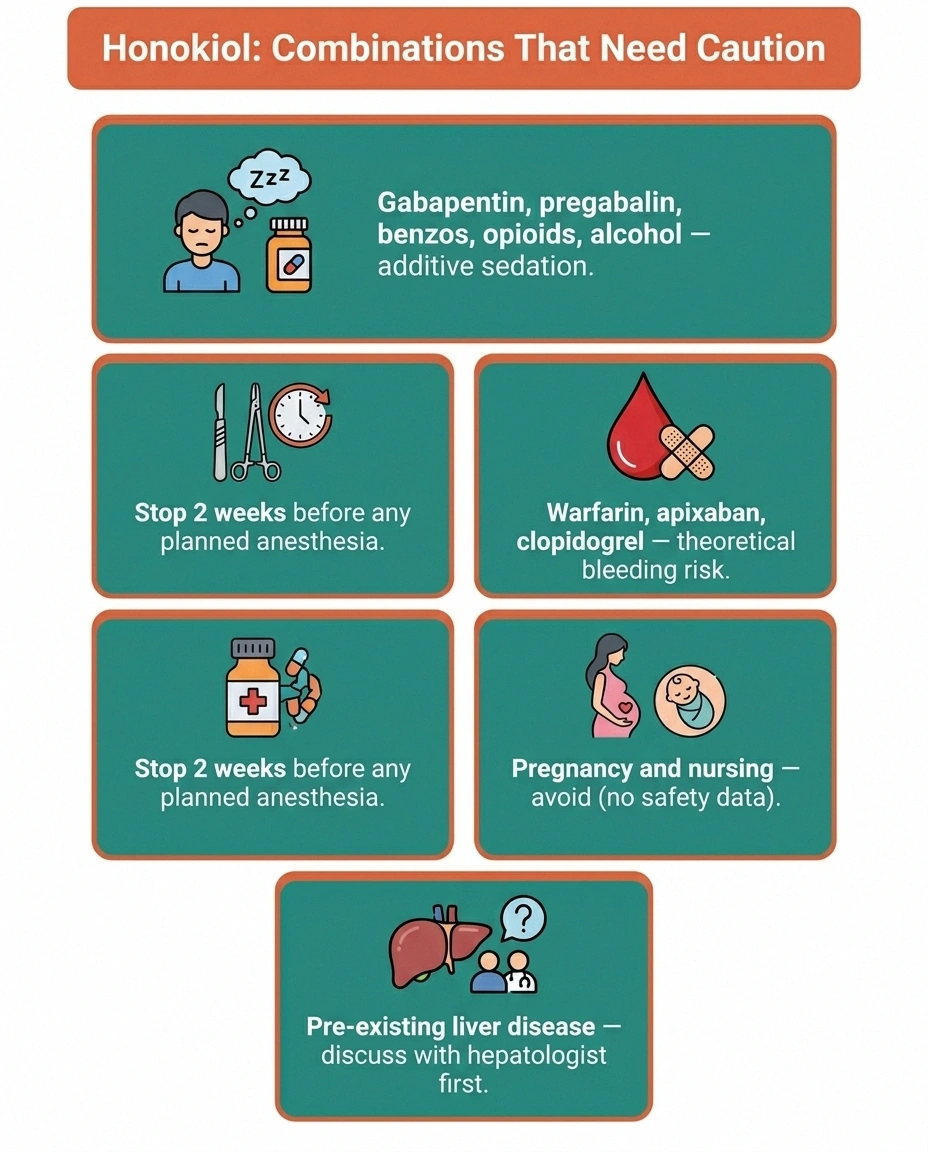
- Sedative interactions. Honokiol’s GABA-modulating activity means it can add to the sedative effect of other things that hit that same system. If you take gabapentin, pregabalin, a benzodiazepine like Ativan or Xanax, a sleep medication like Ambien, an opioid, or alcohol, the combination can be more sedating than either alone. Start at the lower end of the dosing range and pay attention.
- Anesthesia. Honokiol may potentiate general anesthetic agents. The conservative recommendation is to stop honokiol at least two weeks before any planned surgery and to tell your anesthesiologist what you have been taking. Add it to the same list as fish oil, vitamin E, and any other supplement you are pausing.
- Blood thinning, theoretically. There is in-vitro evidence that honokiol may have mild antiplatelet activity. If you are on warfarin, apixaban, rivaroxaban, clopidogrel, or even daily aspirin, talk to your doctor before adding honokiol.
- Pregnancy and nursing. Insufficient data. Avoid.
- Liver function. No clear hepatotoxicity signal at supplement doses, but if you have existing liver disease, run any new supplement past your hepatologist.
None of these are reasons not to consider honokiol. They are reasons to make it part of an organized conversation with whoever manages your medications, rather than a quiet addition to your morning routine.
Where Honokiol Fits in a Sensible Neuropathy Plan
I want to be careful here because the way supplements get marketed encourages people to think of them as alternatives to medications, when in real life they are almost always best thought of as complements. Honokiol is not going to replace the medication a neurologist has put you on for nerve pain. The animal evidence we have is not strong enough to bet a treatment plan on. What it might do is contribute a small, additional layer of benefit on top of what you are already doing—a layer that, if it works for you, can help with the sleep and anxiety pieces of the chronic-pain picture that are often as exhausting as the pain itself.
If you are building out a thoughtful supplement strategy, honokiol probably sits in a second tier, after the supplements that have strong human evidence in neuropathy—the B vitamins where you are deficient, alpha-lipoic acid for diabetic neuropathy, acetyl-L-carnitine in certain situations. Our roundup of the best neuropathy supplements for nerve health walks through the evidence-graded hierarchy.
The honest framing is this: honokiol is an interesting candidate with promising mechanism and limited human data. If you have tried the supplements with stronger evidence and want to add something else with a reasonable safety profile and a plausible story, it is not unreasonable. If you are looking for the first thing to try, there are better-supported options.
A Sensible Trial Protocol

If after all of this you and your doctor decide honokiol is worth a try, here is the protocol I would suggest borrowing from what I have seen work for people in my support group.
- Start with a standardized extract labeled with the percentage of honokiol and magnolol. Avoid raw magnolia bark powders that do not specify concentration—dose-response gets impossible to track.
- Begin at the lower end of the range (200 to 250 mg of standardized extract once daily, preferably in the evening) for a week to assess tolerance.
- If well-tolerated, increase to a typical study-relevant dose (around 400 to 500 mg per day, divided morning and evening, or all evening if sedation is a benefit).
- Keep a simple symptom diary. Pain on a 0-to-10 scale, sleep quality, anxiety, any side effects. A neuropathy symptom journal is the cheapest, most underrated tool we have for figuring out what is actually helping.
- Give it eight weeks before deciding. Supplements that work on inflammation typically need that long to show their effect, the way alpha-lipoic acid does.
- If nothing has changed at eight weeks, stop. Not every supplement works for every body chemistry. Knowing it does not help you is information worth having.
- If you have a meaningful response, talk to your doctor about whether to continue. Some doctors will want to check liver enzymes after a few months of continuous use, particularly if you are on other liver-metabolized medications.
What This Whole Thing Is Really About

I think the most useful frame for honokiol—and for a lot of the natural compounds we encounter in this world—is to treat them like what they actually are: candidates with partial evidence, not solutions, not snake oil. The story we are told is usually either “ancient wisdom heals modern disease” or “no good evidence, don’t bother,” and the truth almost always lives between those two narratives.
For honokiol, the truth is that we have a compound from a plant that has been used for fifteen hundred years for things that look adjacent to nerve pain, with promising animal research, a plausible mechanism that overlaps with what we know causes neuropathic pain, no large human trials in nerve pain specifically, a generally favorable safety profile with a few specific interactions worth respecting, and a real-world pattern of “some people get clear benefit, some people get nothing, and most of the benefit may be on the sleep-and-anxiety side.” That is a longer answer than the bottle would give you. It is also a more accurate one.
If you decide to try it, do it deliberately. If you decide it is not where you want to spend your supplement budget, that is also a perfectly reasonable decision. Either way, you are now equipped to talk about honokiol with your doctor without either of you having to look it up on the spot.
Frequently Asked Questions
Is honokiol the same as magnolia bark extract?
Not quite. Magnolia bark extract refers to any preparation made from the bark of Magnolia officinalis. Honokiol is one of the two main bioactive compounds found in that bark, along with magnolol. Most quality supplements are standardized to a specific percentage of honokiol, magnolol, or both—so a “magnolia bark extract” bottle and a “honokiol” bottle may contain the same active ingredients, just expressed differently on the label. Read the percentage line, not just the headline.
How long does honokiol take to work for nerve pain, if it works at all?
Based on the animal studies and the pattern I have heard from people who have tried it, expect to wait at least four to six weeks for any pain-related effect, and ideally give it a full eight weeks before deciding. The sleep and anxiety effects, by contrast, often show up within the first week or two—which can be confusing because people assume the rapid effect means the slower nerve-pain effect is also happening. Keep a symptom diary to separate the two.
Can I take honokiol with gabapentin or pregabalin?
You can, but with caution and a conversation with your prescriber. Both medications and honokiol can cause sedation, and the combination may be additive. Many people take both without trouble; some find the combination too sedating. Start at the low end of the honokiol dose range, take it in the evening, and pay attention to how you feel the next morning.
Is honokiol safe for diabetics?
No specific diabetes-related safety concerns have been identified in the research literature. Honokiol does not appear to significantly affect blood sugar in either direction. If you have diabetic neuropathy, the bigger consideration is whether honokiol displaces or competes with the supplements that have stronger diabetes-neuropathy evidence—alpha-lipoic acid being the leading example. Layer, do not substitute.
What’s the difference between honokiol and magnolol?
They are structural cousins, both classified as neolignans, both found in magnolia bark. The mechanisms overlap but are not identical. Magnolol tends to be slightly stronger at the GABA-A receptor and is the historically dominant compound in traditional preparations. Honokiol has more of the antioxidant and neuroprotective research behind it. Most commercial extracts contain both. Whether one is better than the other for nerve pain specifically has not been worked out in any rigorous way.
Should I take honokiol in the morning or at night?
Most people who use it tolerate it better in the evening because of the calming effect. If you have nerve pain that is worse at night, evening dosing also lines up with when you want the effect. Some people split the dose, morning and evening. If the evening dose makes you feel groggy the next morning, move it earlier in the evening or reduce it.
Are there any neuropathy types where honokiol should be avoided?
No condition-specific contraindications have been established, but the general supplement cautions apply more strongly in certain situations. If you have severe autonomic neuropathy with low blood pressure, the sedative and possible mild blood-pressure-lowering effects of honokiol could amplify that. If you have liver disease, run it past your hepatologist. If you are immunosuppressed or in active cancer treatment, talk to your oncologist before adding any supplement.
What should I look for on the label?
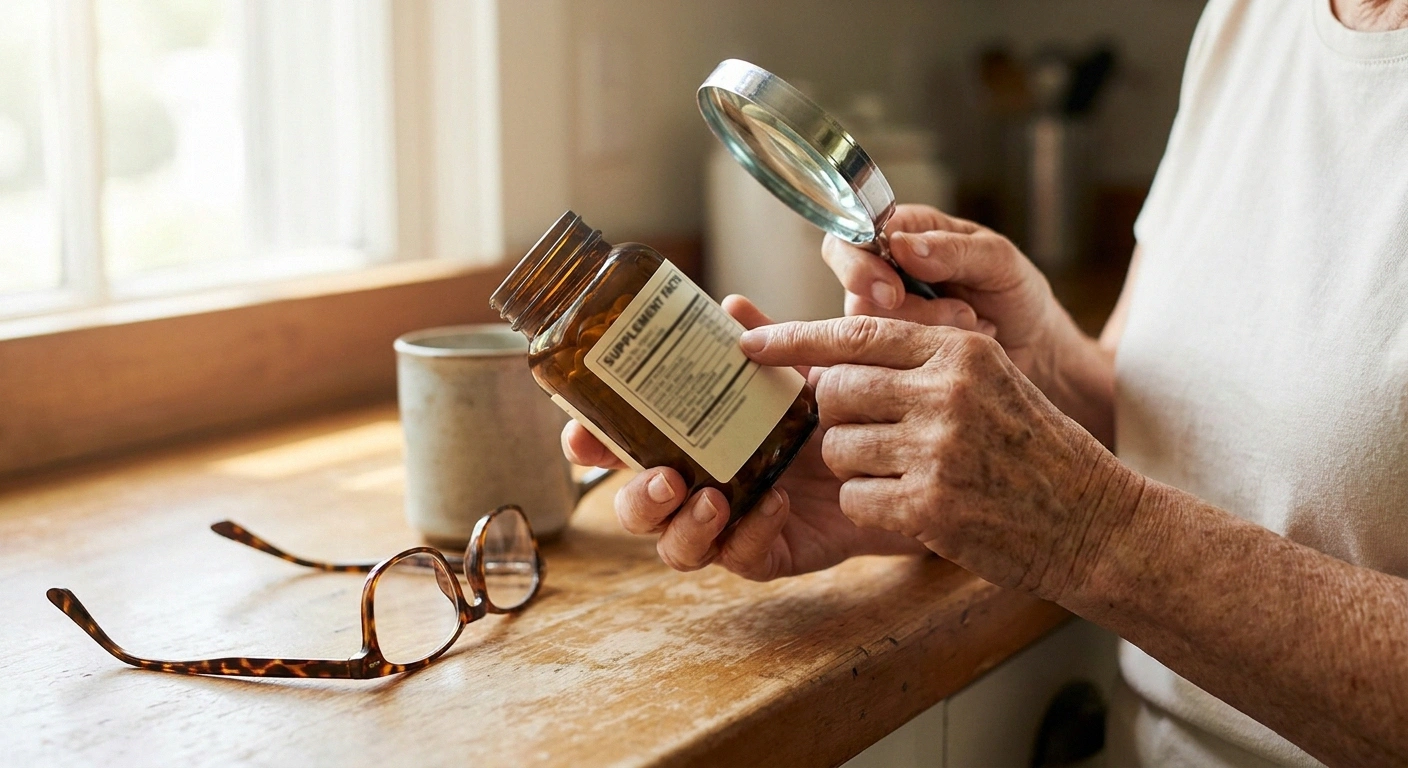
Three things. First, the species: Magnolia officinalis is the most-studied. Second, standardization: a specific percentage of honokiol, magnolol, or both, expressed as a percentage of the extract. Third, third-party testing: a USP, NSF, or ConsumerLab seal means the bottle contains what it claims and does not contain heavy metals or contaminants. Supplements are weakly regulated, and the trustworthy products are the ones that pay for outside verification.
About the Author